Health Care Fiscal Problem in a Nutshell

Via John Stoessel:

Medicare already faces a $30 Trillion deficit. The bigger issue is that Democrats are poised to make cuts in Medicare -- something that is incredibly difficult to do -- but instead of applying those cuts towards Medicare, they are applying it towards a lavish new entitlement program.

Of course, that assumed that the spending estimates for the new health care plan are meaningful, which is highly unlikely, since every single entitlement of this kind has always vastly outspent its initial estimates.   Greece, here we come.

Environmental Theater

Via Maggies Farm, much of your recycling ends up in a landfill, so that much of our recycling effort is just an empty ritual, a ceremony of dedication to the Earth mother god without any actual consequences.  I have written for years that only aluminum and certain other metals really makes economic sense to recycle, so effort on all those other materials is just a fiscal loss to municipalities to save landfill space that is not really even running short.  Given this, it is not surprising that, behind our backs, cash-strapped local governments are just dumping it.

This is a theme of my comments next week at a forum on alternative energy -- no business model (save perhaps farming, which the public seems willing to subsidize forever) is sustainable if it requires constant subsidies - at some point, the public wearies of the fiscal drain, or the growth of the business makes the subsidies too large to sustain.

By the way, don't even get me started on the government-enforced labor involved.  10 minutes a week per person is 2.6 billion man-hours a year of forced labor.  I remember old Loony Tunes cartoons where some guy is sorting mail into slots and on the other side of the wall you see all the mail from the various slots being sent back into a single bag.  Given that the government forces us to expend this labor, forgetting the individual liberty aspects of it, is this really the best use of 2.6 billion man hours?

Postscript: Every time I write about recycling, I get this:  Well, we agree that mostly it does not save energy and we agree it does not save money (even though we told everyone it did) but you are forgetting about landfill space.   OK, here is a take on landfill space -- it turns out that it is not running out, as technology and innovation  (and the profit motive) have expanded the capacity of existing landfills.

Slowing Progress at the FDA

Econlog tells the story of how the FDA is blocking a drug for Restless Leg Syndrome because massive doses caused cancer in a few rats.  Millions of humans have taken the drug with no ill effect, but let a few rats dies, and the FDA refuses to approve it for a new use.

This reminded me of a story I meant to point out from the winter Olympics.  I think many people saw the US Bobsled team win the gold, piloted by Steve Holcomb.  Perhaps you heard the story of how Holcomb would have had to give up the sport several years ago due to a vision disorder until a new operation restored his sight.  But note the clause I have bolded:

Traditional corneal surgery would have left his eyes susceptible to damage from a jarring bobsled run. So last March he underwent a radical procedure, yet to be approved by the FDA, in which doctors implanted a lens behind each iris. When he woke from the surgery, Holcomb immediately noticed the detail of the palm trees in one of the posters on his doctor's wall. "An hour before, I didn't even know there were posters," he says. "It was a new world."

I wonder how many hoops he had to jump through to get the operation, and whether average people who are not on the Olympic team would have been able to get the same benefits.

Capitalism and Developing Countries

Long ago on this site, I wrote this:

More recently, progressives have turned their economic attention to lesser developed nations.  Progressives go nuts on the topic of Globalization.  Without tight security, G7 and IMF conferences have and would devolve into riots and destruction at the hands of progressives, as happened famously in Seattle.  Analyzing the Globalization movement is a bit hard, as rational discourse is not always a huge part of the "scene", and what is said is not always logical or internally consistent.  The one thing I can make of this is that progressives intensely dislike the change that is occurring rapidly in third world economies, particularly since these changes are often driven by commerce and capitalists.

Progressives do not like American factories appearing in third world countries, paying locals wages progressives feel are too low, and disrupting agrarian economies with which progressives were more comfortable.  But these changes are all the sum of actions by individuals, so it is illustrative to think about what is going on in these countries at the individual level.

One morning, a rice farmer in southeast Asia might faces a choice.  He can continue a life of brutal, back-breaking labor from dawn to dusk for what is essentially subsistence earnings.  He can continue to see a large number of his children die young from malnutrition and disease.  He can continue a lifestyle so static, so devoid of opportunity for advancement, that it is nearly identical to the life led by his ancestors in the same spot a thousand years ago.

Or, he can go to the local Nike factory, work long hours (but certainly no longer than he worked in the field) for low pay (but certainly more than he was making subsistence farming) and take a shot at changing his life.  And you know what, many men (and women) in his position choose the Nike factory.  And progressives hate this.  They distrust this choice.  They distrust the change.  And, at its heart, that is what the opposition to globalization is all about "“ a deep seated conservatism that distrusts the decision-making of individuals and fears change, change that ironically might finally pull people out of untold generations of utter poverty.

Which is why I really enjoyed this article linked by Mark Perry:

"Years after activists accused Nike and other Western brands of running Third World sweatshops, the issue has taken a surprising turn. The path of discovery winds from coastal factory floors far into China's interior, past women knee-deep in streams pounding laundry. It continues down a dusty village lane to a startling sight: arrays of gleaming three-story houses with balconies, balustrades and even Greek columns rising from rice paddies.

It turns out that factory workers -- not the activists labeled "preachy" by one expert, and not the Nike executives so wounded by criticism -- get the last laugh. Villagers who "went out," as Chinese say, for what critics described as dead-end manufacturing jobs are sending money back and returning with savings, building houses and starting businesses.

Workers who stitched shoes for Nike and apparel for Columbia Sportswear, both based near Beaverton, Oregon, are fueling a wave of prosperity in rural China.

Update: I would have thought it unnecessary to add these provisos, but apparently per the comments it is necessary for some.  Of course people need to be treated as human beings.  Companies in some poor countries that are using the power of local government to actually enslave workers or to employ them in non-consensual ways are not organizations a good libertarian would ever defend, as our bedrock principle is to deal with other human beings without force or fraud.

My point is that we cannot apply our wealthy middle class values to the pay/benefits/workweek package being offered in poor countries.  To my mind it is immoral to try to deny poor people in poor companies jobs just because we rich people in the US would not consider taking such a job.  This arrogant and frankly clueless attitude forgets a critical question - what is their alternative?  We may think the Nike factory job sucks, and against the choices we have it probably does, but I would bet the subsistence rice farming job, with one's family always one bad harvest away from starvation, would suck worse.  Of course we should aspire that everyone in the world can work in an air conditioned building for $40,000 a year while spending most of the day surfing the Internet and texting friends complaining that they are underpaid.  But you can't tell these countries that the only ladder they can use to escape poverty doesn't have any rungs in the first 20 feet.

A Rare Links Post

I am really swamped at work, but I have a number of good things saved that I want to share.

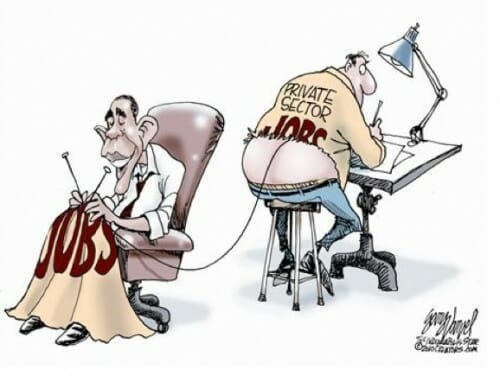
1.  This picture is the best single explanation of what is wrong with the stimulus jobs creation numbers -- the stimulus money comes from somewhere, and starves efficient businesses of capital in favor of politically connected endeavors.  HT Russ Roberts
CrowdingOut

2.  More on what I call the only good idea for reducing health care spending -- making individuals responsible for making price-value purchasing tradeoffs like we do, oh say, with absolutely everything else we buy.  This article on on HSA's in Indiana:

State employees enrolled in the consumer-driven plan will save more than $8 million in 2010 compared to their coworkers in the old-fashioned preferred provider organization (PPO) alternative. In the second straight year in which we've been forced to skip salary increases, workers switching to the HSA are adding thousands of dollars to their take-home pay.

Most important, we are seeing significant changes in behavior, and consequently lower total costs. In 2009, for example, state workers with the HSA visited emergency rooms and physicians 67% less frequently than co-workers with traditional health care. They were much more likely to use generic drugs than those enrolled in the conventional plan, resulting in an average lower cost per prescription of $18. They were admitted to hospitals less than half as frequently as their colleagues. Differences in health status between the groups account for part of this disparity, but consumer decision-making is, we've found, also a major factor.

Mark Perry reports in a later post that Congress is declaring war on HSA's

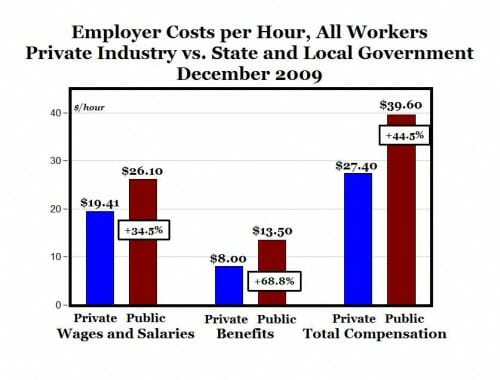
3.  There has been a lot of good stuff lately on the growing rift between the two America's -- those in government or with access to government patronage and those who actually make a living by being productive.  I am increasingly convinced that Obama and Congress are working to create a European-style corporate state, where government insiders, a few large corporations, and a few large unions protect themselves against everyone else.  Katherine Mangu-Ward looks at a study of government vs. private pay for the same jobs.  It used to be government paid less in return for having to work less hard and being impossible to fire.  Now government workers have it all.

There are two million civilian federal workers. 1.1 million of them have direct private sector equivalents. And they are laughing their asses off at those private sector suckers, who are doing similar jobs for less pay"”often a lot less.

"Accountants, nurses, chemists, surveyors, cooks, clerks and janitors are among the wide range of jobs that get paid more on average in the federal government than in the private sector," according to a USA Today report. In jobs where there are private equivalents, the feds are earning $7,645 more on average than their private counterparts.

Her post has more data. And an update and response to criticisms is hereMark Perry looks at wage growth, and the difference is amazing.  Government employees are the new robber barons, and this time, the title is appropriate.
employercost

And speaking of the corporate state, this was an interesting essay at the Claremont Institute, via Maggies Farm.

Joseph Schumpeter ominously speculated that as capitalism succeeded, democracies in time would come to expect its end (wealth) but reject its means (free-market competition). He worried that because of the inequality and creative destruction it brings, capitalism would provoke a kind of adverse reaction. A popular call would arise for government to plan market outcomes according to some utopian view of society's good, and this democratically guided central planning would inevitably slow economic growth. Schumpeter predicted, in turn, that if economic expansion faltered, individual liberty would be directly imperiled or quietly ceded by citizens resigned to having their diminished economic position protected by the state.

The one mistake writers often make is to call capitalism a "system."  Capitalism is the un-system.  It is the lack of a system.  It is the natural self-organization of individuals when they freely follow their own self-interest.

4.  The individual responsibility story of the day, via Overlawyered

In 2004, truck driver Simon Loza Mejia violated company regulations, and took his eight-year-old Diana Yuleidy Loza-Jimenez along on a long-haul trip from Oregon to Bakersfield. That November 27, he was pulling away in the truck, but apparently didn't bother to check where his daughter was, and ran over her. This was, argued her attorneys, the fault of her father's employer"”and a Sacramento County judge agreed with the argument that it was legally irrelevant that her father was the one who ran her over. Unsurprisingly, a jury ignorant of the facts awarded Diana, whose lower body was crushed, a jackpot verdict of $24.3 million.

5.  Charter schools in Harlem.  Never have so many kids been held hostage to so few, in this case a few union officials and their captive legislators.

The United Federation of Teachers and its political acolytes in the New York state legislature are hell-bent on blocking school choice for underprivileged families. Worried that high-performing charters are "saturating" Harlem, State Sen. Bill Perkins and State Assemblyman Keith Wright have backed legislation that would gut state per-pupil funding at charter schools and allow a single charter operator to educate no more than 5% of a district's students. Unions dislike charter schools because many aren't organized. But how does limiting the replication of successful public education models benefit ghetto kids?

These obstructionists, Mr. Clark says, aren't doing the community any favors. "The teachers unions ought to be ashamed of themselves because they know better than I do how bad these schools are," he says. "Everybody on my block and in my building and around the corner . . . they all want charter schools. They don't want a political debate."

Separately, John Stoessel digs into Diane Ravitch's shilling for the teachers unions.

6.  I could have sworn the politicians swore up and down they would never ever interfere with business decisions at GM.

General Motors Co. will reinstate 661 dealerships it sought to drop from its sales network.GM executives said Friday that the dealerships -- more than half of those seeking to stay with the automaker -- will receive letters giving them the option to remain open. GM said it would not have enough time to negotiate with all 1,100 dealerships that appealed the automaker's decision to close them within a four-month window imposed by the federal government....

"It's not exactly what they wanted to do, and it's always I think a little embarrassing when you have to make changes based on an arbitration process, but they've had to adjust and move forward," he said.

Well, at least the Congress and the DOT is hammering GM's competitor Toyota, so I guess they can call it even.  Welcome to Europe, guys.  I have said it before, but this is exactly the kind of BS European nations do all the time - hammering foreign competitors of their domestic politically connected manufacturers in exchange for substantial ability to regulate and modify these companies decisions.  Soon to follow - Europe's lower growth rates and higher structural unemployment.

7.  Dog bites man:  Paul Krugman still a political hack who is willing to eschew everything he knows or has written about economics to support his team.

Somebody Should Write About This...

Years ago, I wrote a novel (still available at Amazon!) wherein a key plot point was a conspiracy between a Senator, a law firm, and a media company to create a high-profile tort case out of thin air.

Today, we may be seeing something similar with the Toyota sudden acceleration case.  In this case, we have the Senate calling stooges of the plaintiff's bar as "expert witnesses" with the whole thing getting a third of the air time on nightly news programs.   In my book, the whole thing was kicked off by a media company afraid of a new competitor - in this case it was kicked off by the US government, which controls GM, trying to sit on a competitor.

It is hard to spot the lowest behavior in the affair so far, but that honor can arguably go to ABC and the lengths to which it went to pretend it had recreated the problem.  In fact, they had to strip three wires, splice in a resistor of a very specific value and then short two other wires.  They made it sound like this is something that could easily happen naturally  (lol) but this is an easy thing to prove - and inspection of actual throttle assemblies from cars that have supposedly exhibited the sudden acceleration problem have shown no evidence of such shorting.  So the ABC story was completely fraudulent, similar to the old Dateline NBC story that secretly used model rocket engines to ignite gas tanks.   Its amazing to me that Toyota, acting in good faith will get sued for billions over a complex problem which may or may not exist in a few cars, while ABC will suffer no repercussions from outright fraud.

Basically ABC proved that if you bypass a potentiometer with a resistor, you can spoof the potentiometer setting.  Duh.  The same hack on a radio would cause sudden acceleration of your volume.

Henry Payne has more.

Commercial Jetpack!

It would be nice if it were more compact, but they are claiming a 30-minute flight time, which is huge compared to earlier efforts.

10mar10jetpack25

It does help to illustrate a different point I make about alternatives to internal combustion.  Note the device uses gasoline.  Nothing else that is so cheap and plentiful has gasoline's energy content to weight ratio.  Which is why it is so freaking hard to replace in cars.

The Oft-Missed Component When Evaluating European Socialized Health Care

Yes, the Europeans pay less per person for health care.  Is the care as good?

Well, when life-expectancies are adjusted for things that are not amenable to the health care system (like murder rates), Americans have the highest life expectancy in the world, and by far the highest cancer survival rates.

The prices we pay for drugs and medical devices, while high, effectively subsidize the entire world's medical R&D.

Oh yes, and we don't have to wait 6 months to get treated.  The wait time issue is often poo-poo'd by elites in the political debate, but it seems to be an important issue for real people:

In a survey, people were asked how they felt about various forms of medical care for a urinary tract infection or for influenza. While people preferred traditional, office-based care, they would opt to see a nurse-practitioner at a retail clinic if they could save at least $31.42. They would wait one day or more for an appointment if they would save at least $82.12.

The researchers concluded that the appointment wait period is the most important determining factors in an individual's choice on where to seek care for minor health problems such as influenza. Primary-care doctors who fear their business will be undercut by the growing popularity of retail health clinics may want to offer more same-day appointments and walk-in hours."
...


"This study is the first in the United States to quantify the relative importance of and the utility associated with the main attributes of retail clinics. The utility (willingness to pay) associated with receiving same-day care is more than twice the utility associated with receiving care from a physician. Primary care physician practices, especially in competitive markets, are therefore likely to derive greater competitive advantage by addressing patient convenience features (such as same-day scheduling, walk-in hours, and extended hours) than by reducing fees."

Follow the link for more and a link to the original study.  Patient convenience is the LAST thing government health care systems design for, but apparently, what actual people most want.

I say over and over, yes, we could reduce the cost of medical care (but by increasing the accountability of individuals for paying for their own care, exactly the opposite direction taken by the Obama plan).  But a big reason that we pay more is not because we are stupid and incompetent, but because we can because we are wealthier.  It is incontrovertible that we are wealthier per capital than the Europeans -- is it surprising that we would choose to spend a large portion of this extra wealth on our health?

Andy Thomas Apparently Toast

Our absolutely awful, self-serving, abusive County prosecutor seems to finally be getting the scrutiny he so richly deserves:

PHOENIX -- The Arizona Supreme Court has appointed a special investigator to look into accusations of misconduct against Maricopa County Attorney Andrew Thomas.

That's bad, but it's not the end of Thomas's troubles.  The next shoe is the tort case.

Malicious prosecution is a tort and if a civil litigant obtains a ruling that Thomas abused his office, it could cost the County tens of millions of dollars.  Multiply that by the number of people whom Thomas has targeted, intimidated, abused or prosecuted and we are dealing with a very large number indeed.

My Only Oscar Comment

Yeah, I watched the Oscars, though I seldom find them entertaining any more.  My wife and I were able to attend about 20 years ago (the year Clint Eastwood won for Unforgiven) and go to the Governor's Ball afterward so we have a certain nostalgia for the event.    Only one image really sticks with me, and it was before the show.  It was an image of George Clooney high-fiving his fans, but doing it separated by a chain link fence.  Even the President still greets the public in person from time to time.  To me, it was a brutal caricature of a Hollywood actor trying to pretend he is engaging with the common man but utterly failing to do so.

Nearly Every Human Who Has Ever Lived Denied Fundamental Human Right

From a BBC poll:

Almost four in five people around the world believe that access to the internet is a fundamental right, a poll for the BBC World Service suggests.

The survey - of more than 27,000 adults across 26 countries - found strong support for net access on both sides of the digital divide.

Countries such as Finland and Estonia have already ruled that access is a human right for their citizens.

International bodies such as the UN are also pushing for universal net access.

So everyone who ever lived before about 1990 were denied a fundamental human right.  I would rewrite this study either as "80% of people have a silly definition of human rights" or probably more correctly "100% of BBC poll authors do not know how to write a good poll question."

Chart of the Day

Via Radley Balko and Pat's Papers, comes this chart on Canadian water consumption during the Olympic Hockey finals.  As he asks, what happens when everyone in the country goes to the bathroom at the same time?

flush_game

Dispatches from the Corporate State

The NY Times has a fairly ugly story, though hardly unique, of a project to restore water flow to the Everglades turning into a corporate welfare project for United States Sugar.   The short story is that in a time when United States Sugar was in desperate financial straights and when real estate prices in Florida were tumbling, the Florida government treated USS like it had all the power, rolling over to paying above-market prices and letting USS pick and choose the land parcels to be purchased.  The story did not mention much about it, but there is a second large sugar producer in the area who it strikes me could have been played off against USS to get the best deal.

Remember that the US Sugar operation likely exists only because of sugar tariffs and import quotas that raise the price of sugar in the US well above the world norm.  So consumers are paying extra, and drinking soft drinks with crappy HFCS, so that US Sugar can screw up the Everglades and get bailed out by taxpayers.   Readers will understand it is the purest coincidence that US Sugar's attorney is chief of staff to the state's governor.

From running my recreation privatization blog, I know that there are many folks who will ascribe this to a failure of private enterprise and an excess of corporate speech and money in politics.   But to my mind this is a great example of why election and speech limits don't have any utility.  This is all back room lobbying, cronyism, and quid pro quo politics that doesn't show up in any monetary ledger, and thus are not and have never been subject to any limits.  As I wrote here:

when the stakes of government are so high, money and influence never goes away.  Just as in any economy, when you ban money, a barter economy arises.  So if we ban large campaign spending, then the quid pro quo becomes grass roots efforts and voter mobilization.  Groups like the UAW become more powerful (we are seeing that already).  They are trading their member's votes for influence.  Connected companies like GE are doing the same thing, trading their support for legislation that is generally hostile to commerce for specific clauses in said legislation that exempts GE and/or makes the laws even more punishing on their competition.  The problem with all this activity is it is hard to see and totally unaccountable "” at least with advertisements we see people out in the open with their agendas.

The other obvious point is that no private entity would ever allow themselves to get rolled so badly by US Sugar.  They would have sense USS's weakness and broken its knees in the negotiation.  One US Sugar manager even says as much:

For its board members, Mr. Crist's overture was appealing in part because they figured a government purchase would be far more lucrative than a private deal.

"It wasn't another company coming in and bottom-fishing you," Mr. Wade said. "They knew it would be for fair-market appraisals."

Over at my privatization blog, I wrote about a deal in Chicago where the government made four or five huge mistakes in issuing a private contract that a private company (or at least one that is not going to go bankrupt) would never make.  So of course the problems are blamed on privatization.

More on Wind

I was having a back and forth with a reader about wind power and how much fossil fuel capacity must be kept on standby to support grid reliability with wind.  Here are some excerpts of what I wrote:

Forget all of the studies for a moment.  I used to operate power plants.  Any traditional capacity (fossil fuel, nuclear) except perhaps gas turbines takes on the order of a day or more to start up - if you don't take that long, the thermal stresses alone will blow the whole place up.  During the whole startup and shutdown, and through any "standby" time, the plant is burning fuel.   Since we don't have a good wind energy storage system, some percentage of wind capacity must be backed up with hot standby, because it can disappear in an instant. We are learning now, contrary to earlier assumptions, that wind speeds can be correlated pretty highly over wide geographies, meaning that spreading the wind turbines out does not necessarily do a lot to reduce the standby needs.  And since plant startups take time, even gas turbines take some time to get running, the percentage of wind power that required hot backup is pretty high -- I would love to find this percentage.

I found at least one source for such a percentage, which posits that for England, the percentage of hot backup needed is as high as 80%:  http://www.ref.org.uk/Files/ref.for.decc.28.10.09.i.pdf

I quote from page 6-7:

On any view, including the square root rule of thumb referred to above, the result, imposed for purposes of maintaining adequate response and reserve requirements, implies that a high degree of conventional (dispatchable) plant capacity is retained in the system to support wind generation. Thus, for 25 GW of installed wind capacity only 5 GW of conventional plant can be replaced leaving 20 GW in the role of standby capacity (also known as "Spare" or "Shadow Capacity").3

So 80% of the expected production from wind has to be backed up with hot spares burning fossil fuels.  They go on to say that the percentage of required spare capacity may be lower if the grid area is substantially larger, but not a lot lower.  I had not considered hydro power, but apparently that can be used to provide some quick response to wind production changes.  The report also talks about diesel generators for standby since they can be started up quickly, but these are seriously inefficient devices.  Despite the report's conclusion that the situation might be a bit better on the continent with a larger and more diverse grid, a report of the largest German utility seems to argue that German experience may actually be worse:

As wind power capacity rises, the lower availability of the wind farms determines the reliability of the system as a whole to an ever increasing extent. Consequently the greater reliability of traditional power stations becomes increasingly eclipsed.

As a result, the relative contribution of wind power to the guaranteed capacity of our supply system up to the year 2020 will fall continuously to around 4% (FIGURE 7). In concrete terms, this means that in 2020, with a forecast wind power capacity of over 48,000MW (Source: dena grid study), 2,000MW of traditional power production can be replaced by these wind farms.

It is hard to tell, because 48,000 MW is the nameplate capacity which is virtually meaningless, but my guess is that they are not doing better than 80%.

I've Been Given a Reason to Vote Republican

I wrote a while back that I had a real hard time getting excited about either McCain or Hayworth in this year' s AZ senate race.  But despite my disaffection from both candidates, I may have to suck it up and vote for one or the other.  Via Valley Fever:

Michael Moore Says He's Not Coming Back to Arizona Until State "Elects a Democrat as Senator"

Moore is nothing if not able to suppress his beliefs when money is on the line, so I have a guess we will continue to see him at Sundance despite the lack of a Utah Democrat in the Senate.

It's Time to Admit that CO2 Abatement is Going to be Freaking Expensive

I have to tell one of my favorite stories of chutzpah.  In the 1940's and 1950's, railroads were making the transition from steam engines to diesel engines.  One of the changes was that a diesel engine only needed a driver, it did not need a fireman as steam engines did to shovel coal and keep the boiler running well.   The unions of course saw this coming.  So what did they do?  They preemptively made the demand that diesel engines should have to have TWO fireman.  Railroads spent so much time fighting this insane proposal that it took them years to get the firemen per locomotive to the correct number (ie zero).

I am reminded of this story when I think of how the Obama administration has handled the issue of CO2 abatement.  Reasonable people understand that CO2 abatement will be horrifically expensive - it just will not be cheap in terms of cost or lost economic output and lost personal liberties to take the country back to a CO2 per capita it last had in the 19th century.     But rather than taking this on, the Obama administration preemtively attacked, saying that in fact Co2 abatement would lead to economic growth and job creation.  This was the broken windows fallacy on steroids, but the usual progressive illiterates and consumers of party talking points have run with it.

We are finally getting folks to start to address the true costs of CO2 abatement, and they are enormous.  People who push the precautionary principle try to say that even a small risk of climate catastrophe outweighs some minor abatement costs.  But does a small change of manmade warming outweigh a near certainty of enormous economic costs?

I have said for years that to really get to an 80% reduction target, gas prices would have to rise over $20 a gallon  (they are at $10 already in Europe and they are no where near the targets).  Some researchers looked at the gas price implications of more modest CO2 targets:

To meet the Obama administration's targets for cutting greenhouse gas emissions, some researchers say, Americans may have to experience a sobering reality: gas at $7 a gallon.

To reduce carbon dioxide emissions in the transportation sector 14 percent from 2005 levels by 2020, the cost of driving must simply increase, according to a forthcoming report by researchers at Harvard's Belfer Center for Science and International Affairs.

And this is with a straight tax, probably the most efficient way to hit the targets.  The study agreed that other intervenist approaches didn't seem to work as well as a straight tax:

In the modeling, it turned out that issuing tax credits could backfire, while taxes on fuel proved beneficial.

Hot Money

Apparently our state government has been in another subsidy bidding war over a plant relocation, and fortunately it lost.  Why the state government pulls together Defcon 5 activity levels to bring 80 jobs to a town of 4 million is just beyond me.  But beyond my usual problems with subsidizing business relocation, which haven't changed from this post way back when I talked about relocation subsidies in the context of the prisoner's dilemma, I have three issues specific to our state's efforts to attract solar manufacturers:

  1. I am constantly amazed at the strategic planning that says Arizona residents should pay more taxes to promote a solar manufacturing industry because, uh, we have a lot of sun.  That's roughly as logical as saying an FM radio maker should manufacture in NY City because they have a lot of radio stations.  I suppose you could argue it would reduce shipping costs to solar using areas, but I can't believe that shipping costs dominate since most of the panels we buy in this country originated in Japan or Germany.
  2. Companies and industries that seek subsidies are like hot money in the investment world.  Even if you attract it today, they will jump next week to another location that offers them more.  We see it in this case, as AZ bought Kyocera's presence at one facility but can't afford the price to get them to build this new facility.
  3. The state's approach defies all business strategy, and is making a typical novice investment approach.  Specifically, they are chasing the hot industry.  Everyone is bidding for solar plants, so the price goes way up.  This is why we have bubbles in housing and Internet, because people all pile into the same investment like lemmings.  If I were to run a government business relocation strategy (which I most certainly would never do) I would be focusing on boring stuff no one subsidizes.  We offered nearly 100% property tax abatement plus investment tax credits and can't get a solar plant.  Instead we should be up in business hostile states like CA and NY getting rubber stamp makers and garage door manufacturers.  Surely we could get 70 jobs a lot cheaper.

One Step Forward, One Step Back

The other day I was happy to see lefty Kevin Drum pointing out the obvious problems with subsidizing Edit Post "¹ Coyote Blog "” WordPressethanol.  This is a step forward, when smart people on both sides of the aisle can agree that a certain approach is dumb.  Of course, given the incentives in government, that doesn't mean that ethanol subsidies will actually stop.

So we make some progress on ethanol, but just replace it without another absurdly dumb subsidized energy technology, in this case wind.  Wind is not even close to being ready for grid service, and given the hot backup power one needs to cover its unpredictability, it does about zero to reduce CO2 emissions.  A series of studies have shown that it has done nothing to reduce fossil fuel consumption in either Germany or Denmark.  And the whole green jobs thing is even more absurd -- it makes no sense theoretically, as shifting private investment to less economically viable uses has never, ever created jobs -- and has been debunked in practice in both Denmark and Spain.

Unfortunately, the Obama administration has bent over backwards to ignore the science and push wind, for no other reason I can figure out except to avoid admitting he was wrong when he campaigned on wind.  This makes for a pretty depressing story, and, given there are more documents the Administration is resisting releasing under FOIA, probably more ugly news to follow.

Postscript: One way you could use wind is with some kind of storage system, of which I can think of two.  The first is to use wind to pmp water up hill into a reservoir where the potential energy could later be harvested as hydroelectric power.  The other is to use the wind power to make hydrogen from water.  You need some sort of process that can be stopped and started on short notice.

It's Been A While Since I Dissed on Ethanol...

... so it's probably about time.  Kevin Drum has a very cogent analysis of all the issues, and is, if anything, givin ethanol the benefit of the doubt with some of the numbers he uses.  He ends by echoing something I have said any number of times:

Bottom line: corn ethanol is no greener than gasoline. In fact, it's almost certainly less green, and at the very least, there's no urgent need for the U.S. government to pay billions of dollars to subsidize its production. Too bad Iowa is the first state on the primary calendar every four years, isn't it?

What I find amazing is that when he wants to, Drum can be quite insightful about this kind of political failing,  What I don't understand is why he continues to advocate programs like government health care that are almost assured of being dominated by the same horrible incentives and decision-making.  Under either the House or Senate health care bills, for example, just imagine the line of lobbyists who will be working to get their pet procedures covered under insurance  must-cover rules.  How can he possibly imagine that the same Congress that votes for ever-expanding ethanol subsidies is going to make good cost-benefit tradeoffs based on science for health care procedures?   Doing the same thing over and over and expecting different results is the definiation of, what?

It's Not Over When it's Over

So the head of the IOC declares the Olympics over, the flame is out, but there still seem to be people on the stage.  It seems that Canadians, so long without an overt sense of nationalism, have decided to use the stage to hold a pep rally for their country.   Can you imagine how unbelievably creepy, and probably scary, it would have been had the Chinese closed the Olympics in a similar China-uber-alles manner.  But since the Canadians are thought to be (mostly) harmless, I suppose its OK.

Postscript: Not 30 seconds before this started, I was lamenting the fact that Rush was not a musical act, with the silver lining that we had not seen William Shatner either, when lo and behold he rises onto the stage.

PPS: I thought the way they opened the show, with the clown fixing the broken torch, was much more consistent with the Canadian style, and more flattering in a sense than the goofy show at the end.  It is particularly funny, to me at least, to see that all the people who they have chosen so far to extol the virtues of Canada actually left the country for the US to make their fortune.  What are they selling, that Canada is a great place to be from?  They couldn't have found someone like Jim Balsillie who actually mad his fortune and reputation, you know, in Canada.

PPPS:  OK, it was only the talking quasi-celebrities I thought was odd.  Who couldn't love the giant inflatable beavers that followed?

Speech and Spending

I had a dinner conversation last night with my Massachusetts mother-in-law.  She is pretty interesting to talk to because she is a pretty good bellwether for Democratic talking points on most issues.  She was opposed to the recent Supreme Court speech decision removing limits on third party advertising near an election  (I think she misunderstood the scope of that decision but that is not surprising given the shoddy reporting on it, up to and including Obama getting it wrong in his State of the Union).   She advocated strict campaign spending restrictions (both in terms of amount of money and length of the campaign season) combined with term limits.

We could have gone a lot of places with the discussion, but we ended up (before we terminated the conversation in the name of civility) discussing whether restrictions on money were equivalent to restrictions on speech.  She of course said they were not, and said under strict monetary controls I still had freedom of speech - weren't we still talking in the car?

It is hard to reach common ground when one person is arguing from a strict rights-based point of view while the other is arguing from a utilitarian point-of-view.   Essentially she knows in her heart that she is restricting speech, but wishes to do so to reach a better outcome.  I made a couple of utilitarian arguments, including:

  • I pointed out that when the stakes of government are so high, money and influence never goes away.  Just as in any economy, when you ban money, a barter economy arises.  So if we ban large campaign spending, then the quid pro quo becomes grass roots efforts and voter mobilization.  Groups like the UAW become more powerful (we are seeing that already).  They are trading their member's votes for influence.  Connected companies like GE are doing the same thing, trading their support for legislation that is generally hostile to commerce for specific clauses in said legislation that exempts GE and/or makes the laws even more punishing on their competition.  The problem with all this activity is it is hard to see and totally unaccountable -- at least with advertisements we see people out in the open with their agendas.
  • I observed that it was smart to add term limits to her plan, as otherwise her recommendations would be the great incumbent protection act.  But by limiting money, immediate advantage is given to people who already have name recognition and celebrity.  Think we have too many actors and athletes running for office?   Well be prepared for a flood with stricter campaign finance restrictions

However, I tend to shy away form utilitarian arguments.  The best arguments I have against the notion that money can be restricted without restricting speech are:

  • Her comment that I still had freedom of speech (ie I am talking freely in the car) with strict campaign cash restrictions ignores the actual wording of the First Amendment, which reads "Congress shall make no law ... abridging the freedom of speech."  Her test, which is "Am I still able to speak in some forum even if I can't in others" is not a valid test for conformance to the First Amendment.  Otherwise, speech could be restricted at will as long as there was some narrow safe harbor where one could express his opinion.    The better test is whether the proposed law, ie a restriction on how much and when a person can spend money advertising his or her opinions, abridges or reduces freedom of speech.  And I think it is hard to deny that everyone has less freedom, in the form of fewer options and reduced scope, after such legislation.
  • One interesting test is to broaden the question -- Does restricting spending on something (in this case speech) constitute a restriction on one's underlying right to the activity (e.g. speaking freely).  I was tempted to ask her (she is a strong and vocal abortion rights supporter) whether she would therefore consider the right to abortion to be untouched by Congress if a law were passed to limit each person's spending on abortion to $5 a year.   Abortion would still be entirely legal  -- all government would be doing is putting on some spending restrictions.   Obviously one's scope and options to get an abortion would be limited -- only those who happened to have a doctor in the family could perhaps get an abortion -- just as under her speech plan only those who had a large newspaper in the family could speak fully and freely before an election.

Making Fiscal Sense

Kudos to Kevin Drum for his obvious skepticism about California high speed rail.  Too often the left accepts high speed rail projects credulously, despite their backbreaking costs and little proven impacts on energy use or greenhouse gas production.

I have had back and fort over rail projects with supporters for years, and I am always particularly amazed at how supporters treat me like some kind of neanderthal  (e.g. "the debate is over!" and "rail is settled policy.")  I finally figured out the other day how to characterize rail supporters arguments.

They are like kids who might say, "why wouldn't you want Santa Clause to bring you an Xbox for Christmas?"  They treat rail like it is a birthday present, and that I am some sort of schlub for turning down such a shiny new present.  But of course it is not a present, and costs matter.  The problem with rail is not that I don't like riding on trains, the problem is that I don't like draining resources by force from millions of people so that a few thousand middle class commuters can ride on trains to work.

A Great Example Why Peak Oil Theory Has Never Been That Compelling to Me

As I have written a number of times, reserves numbers for oil are not based on the total oil though to be under the ground, but the total oil thought to be under the ground that is economically recoverable at expected prices.  Changes in technology and/or oil price expectations change the amount of reserves, even without the discovery of a single new field.

Oil companies have known about the formation, and the oil trapped in it, since at least the 1950s. But they couldn't get more than a trickle of oil from the dense, nonporous rock.

That began to change in the early 2000s, when companies in Texas began using new drilling techniques in a similar formation near Fort Worth known as the Barnett Shale. They would drill down thousands of feet and then turn and go horizontally through the gas-bearing rock"”allowing a single well to reach more gas. Then they would blast huge volumes of water down the well to crack open the rocks and free the gas trapped inside.

The real shift has come in the past two years as companies honed drilling techniques, leading to bigger wells, faster drilling and lower costs. Marathon, for example, last year took an average of 24 days to drill a well, down from 56 days in 2006."

So apparently, oil production in North Dakota may soon pass that of Alaska, though this is more due to the fact that production can be ramped up in North Dakota without an act of Congress, which is not the case in Alaska.

The largest threat to oil prices and production remains not peak oil, but the fact that most of the world's best reserves rest in the hands of state-run oil companies whose competence and willingness to invest for the long-term is sometimes in question.

Tariff Article Rewrite

I love it when Mark Perry rewrites trade stories

"U.S. Steel Unions Score American Consumers Dealt Yet Another Huge Victory Loss As China They Are Slammed With New Steel Tariffs Taxes"

One has to envy pity the insignificant amount of pull U.S. steel workers consumers and steel-using companies have. The majority of U.S.-China trade agitation is caused by imposes signifcant costs on this one relatively tiny huge part of the U.S. economy.

Green Screen

This is a pretty cool video showing green screen use in TV and movies.

I will say I don't really draw any philosophical conclusions about the meaning of life and reality from it, other than to say, "how cool is it that we can do this?"

Via Maggies Farm