Posts tagged ‘prices’

A Great Example Why Peak Oil Theory Has Never Been That Compelling to Me

As I have written a number of times, reserves numbers for oil are not based on the total oil though to be under the ground, but the total oil thought to be under the ground that is economically recoverable at expected prices.  Changes in technology and/or oil price expectations change the amount of reserves, even without the discovery of a single new field.

Oil companies have known about the formation, and the oil trapped in it, since at least the 1950s. But they couldn't get more than a trickle of oil from the dense, nonporous rock.

That began to change in the early 2000s, when companies in Texas began using new drilling techniques in a similar formation near Fort Worth known as the Barnett Shale. They would drill down thousands of feet and then turn and go horizontally through the gas-bearing rock"”allowing a single well to reach more gas. Then they would blast huge volumes of water down the well to crack open the rocks and free the gas trapped inside.

The real shift has come in the past two years as companies honed drilling techniques, leading to bigger wells, faster drilling and lower costs. Marathon, for example, last year took an average of 24 days to drill a well, down from 56 days in 2006."

So apparently, oil production in North Dakota may soon pass that of Alaska, though this is more due to the fact that production can be ramped up in North Dakota without an act of Congress, which is not the case in Alaska.

The largest threat to oil prices and production remains not peak oil, but the fact that most of the world's best reserves rest in the hands of state-run oil companies whose competence and willingness to invest for the long-term is sometimes in question.

Bigger Oil

Roger Pielke, Jr. (hat tip to a reader) points to an interesting FT Lex column that should offer some interesting insights to America's progressives:

9c437598-11bb-11df-9d45-00144feab49a

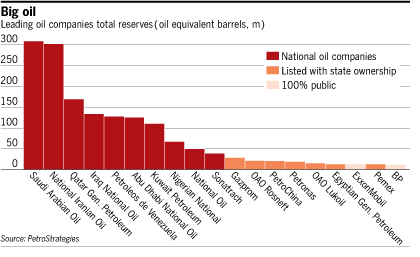
"Big" and "oil" are mentioned so often in the same breath that it is easy to lose perspective. Motorists and environmentalists never tire of berating the dominant supermajors whose petrol stations and share listings make them the public face of the industry, their favourite target being America's ExxonMobil. If market value were the sole magnet for opprobrium then Exxon's executives could breathe a bit easier because PetroChina recently overtook it as the world's most valuable listed energy company.

But there is "Big Oil" "“ last year, Royal Dutch Shell earned more than $1bn a month "“ and then there is bigger oil. No oil major is able to affect energy prices on its own and even Exxon is far smaller than the world's largest energy company. It is not even close. Saudi Aramco's estimated hydrocarbon reserves of 300,000 million barrels of oil equivalent make it 15 times Exxon's size. Exxon comes in about 17th place, with the top 10 being entirely state-owned.

US oil company executives routinely get pulled in front of Congress to defend themselves against charges they are manipulating world oil prices.   Huh? It would be as rational to accuse Grinnell College of manipulating national tuition rates.  Americans can take comfort in the fact that by limiting their ability to seek new oil in the US, we have made sure that oil markets are not controlled by evil publicly traded companies like Exxon and Shell but instead are controlled by entirely more trustworthy entities like the governments of Iran, Saudi Ariabia, Venezuela, Russia, Nigeria, and China.

This chart also supports the one good argument I think there is for peak oil -- that most of the world's oil reserves are controlled by patently incompetent institutions (e.g. governments) that have very bad incentives that make them highly unlikely to invest well.  The only reason these countries are able to produce at all is because western companies are stupid enough to keep walking into this cycle:

1.  US companies invest huge amounts of capital and know-how to build oil industry
2.  Once things are producing, local government steals it all (they call it "nationalization")
3.  Oil fields go into extended decline due to short-term focused and incompetent government management
4.  US companies invited back int to invest huge amounts of know-how and capital
5. repeat

Amazon and Macmillan

I have been kind of amazed at the backlash at Amazon over its showdown with Macmillan Publishing.  As I understand it, Apple, with its new iPad, had adopted a strategy of wooing publishers by offering promises of higher retail prices, an offer Amazon basically refused to match.   This dynamic (with retail discounters pleasing customers but ticking off manufacturers and product suppliers) is not at all new to retail.  I am sure a lot of manufacturers wish Wal-Mart was never invented, but they have to try to play ball with them because Wal-Mart wields so much power with customers, in large part because of their pricing.

In this sense, I have always thought of Wal-Mart and Amazon as my agents, using the power of my and other consumer's volume to pound manufacturers on price.  They serve the same role as, and in fact are more effective than, a buying cooperative or consumers union.

So my agent, Amazon, had to go to the mattresses with a publisher on its pricing.  This happens in all negotiations -- if you are not willing to walk out the door, then at some point there is a limit to your bargaining power.  I was ready to applaud them for it.  Sure, they had selfish interests of their own, but who cares?  That is how capitalism works -- through the alignment of incentives, people who really don't even know me or really care if I live or die work hard to create value for me  (this is the opposite of big government, where people who claim to care about me deeply work really hard to destroy value).

Anyway, the clients that Amazon represents apparently lost faith quickly, and decided they were more freaked out by a couple day blackout than increased retail prices.  Wimps.

Postscript: I understand the debate is a bit more subtle, with Macmillan arguing that they want price flexibility over a range from $6-$16 (or whatever) for e-books rather than a hard cap at $9.99.  Trust me, though, any inference that this approach roughly averages Amazon's approach is so much chin music.  Most sales would be for new books at the high price, with low-volume books at the lower price  (something, by the way, Amazon already does).  The average sales price is higher in the Macmillan approach, and I don't blame them for trying.  And Apples is just trying to differentiate itself, and attempting to lock up publishers into exclusives or sweetheart arrangements fits their proprietary business model.   So I am not crying foul, I simply was rooting for Amazon because I felt my interests as a consumer lay with them in this dispute.   And I am wondering why so many people see it differently.

Awesome Takedown of Homeopathy

I have written about it before, but here is Matt Parker:

I have just purchased a packet of Boots-brand 84 arnica homeopathic 30C Pills for £5.09, which Boots proudly claim is only 6.1p per pill. Their in-store advice tells me that arnica is good for treating "bruising and injuries", which gives the impression that this is a very cost-effective health-care option.

Unlike most medication, it didn't list the actual dose of the active ingredient that each pill contains, so I checked the British Homeopathic Association website. On their website it nonchalantly states that to make a homeopathic remedy, they start with the active ingredient and then proceed to dilute it to 1 per cent concentration. Then they dilute that new solution again, so there is now only 0.01 per cent of the original ingredients. For my 30C pills this diluting is repeated thirty times, which means that the arnica is one part in a million billion billion billion billion billion billion.

The arnica is diluted so much that there is only one molecule of it per 7 million billion billion billion billion pills.

It's hard to comprehend numbers that large. If you were to buy that many pills from Boots, it would cost more than the gross domestic product of the UK. It's more than the gross domestic product of the entire world. Since the dawn of civilisation. If every human being since the beginning of time had saved every last penny, denarius and sea-shell, we would still have not saved-up enough to purchase a single arnica molecule from Boots.

The amazing thing to me is that the folks lining up to be fleeced by this industry, and who will vociferously defend that they are not being fleeced, are the types of folks who are typically the first to throw up the barricades in the street when gas prices rise by 5 cents.

By the way, Arizona has a state board of homeopathic examiners to check ... what, exactly?  To guarantee no active ingredient made its way into the product?

Here is a funny related video:

Unfortunately, I Have Lately Had Cause to Lament the Same Thing

Via Mises Blog:

The hidden hand behind this unsanitary calamity is the US government. The true origin of the mess was not in the hour before I arrived but back in 1994, when Congress passed the Energy Policy and Conservation Act.This act, passed during an environmentalist hysteria, mandated that all toilets sold in the United States use no more than 1.6 gallons of water per flush. This was a devastating setback in the progress of civilization. The conventional toilet in the US ranges from 3.5 gallons to 5 gallons. The new law was enforced with fines and imprisonment.

For years, there was a vibrant black market for Canadian toilet tanks and a profitable smuggling operation in effect. This seems either to have subsided or to have gone so far underground that it doesn't make the news. I've searched the web in vain for evidence of any 3.5 or 5.0 gallon toilet tanks for sale through normal channels. I wonder what one of these fetches in the black market. This possible source has no prices and an uncertain locale.

The toilet manufacturers, meanwhile, are all touting their latest patented innovations as a reason for the reduced hysteria surrounding the toilet disaster. I suspect something different. We have all gotten used to a reduced standard of living "” just as the people living in the Soviet Union became accustomed to cold apartments, long bread lines, and poor dental care. There is nothing about our standard of living that is intrinsic to our sense of how things ought to be. Let enough time pass and people forget things. So let us remember way back when:

  • Toilets did not need plungers next to them, and thank goodness. Used plungers are nasty, disease carrying, and filthy. It doesn't matter how cute the manufacturer tries to make them or in how many colors you can buy them. In the old days, you would never have one exposed for guests. It was kept out in the garage for the rare occasion when someone threw a ham or something stranger down the toilet.
  • Toilet paper was super thick and getting thicker. None of this one-ply nonsense.
  • You never had any doubt about the capacity of the toilet to flush completely, with only one pull of the handle. The toilet stayed clean thanks to five gallons of rushing water pouring through it after each flush.

It concludes:

"Capitalism achieved something spectacular in waste disposal. Government came along and took it away from us."

Only A Company Living Off of Government Pork Would Make This Decision

Aptera apparently wants to build electric cars using our tax dollars.  They are looking for a manufacturing plant location.   They seem to be homing on an one of the last locations on the planet I would build a new manufacturing facility:

At least we learn that the company is might soon be closing in on a new production facility as a result of a new application to the DOE's AVTMP [advance vehicle technology manufacturing program]. The loan application asks for a 10-year facility plan, which meant Aptera needed to actually come up with such a plan. Aptera's production schedule "calls for more than 10,000 units in the first 3 years and more than 300 employees," so it is looking for a new place to build the cars somewhere in Southern California, specifically somewhere in San Diego County.

High land prices?  Hugely expensive land use and environmental regulations?  High taxes?  Really high local wages?  Perfect, lets build an auto assembly plant!

A Health Care Parable

This was simply amazing to me.  For years, I and others have said that putting more health care spending under insurance plans was going exactly the wrong direction, both from an individual choice as well as a system cost perspective.  By eliminating the need or incentive to shop by the consumer of services, prices almost inevitably rise.

Here is a fabulous smoking gun example from my windshield repair today.  I happen to have free windshield replacement in my insurance policy.   I called the insurance company and said I had an auto glass claim.  I was transferred to Safelite Auto Glass, who apparently (very intelligently) have a contract to process claims for my insurance company.  They said I could use any provider, but would I like them to call out someone for me -- if I used their choice, the insurance company would guarantee the work.

Well, what did I care -- I wasn't paying for it -- so I had them make an appointment for me.  Unsurprisingly, it was with Safelite Auto Glass.

I must add here that Safelite did an exceptional job, the guy who showed up at my workplace was friendly and competent.  No complaints at all about the service or workmanship.

Anyway, I got a bill for which I owed zero dollars, which I suppose is heading right this minute for the insurance company.  Before I show it to you, I was curious what I would have paid for this service if it hadn't been insured and I shopped around.  I got just one quote - from the Safelite Auto Glass web site.   This is a bit unrealistic because for a purchase this large, I would have gotten several quotes.  But this was the only quote I needed.  The charge to me if I bought the new glass service with my own money without insurance was$321.05  (click to enlarge).

safelite web quote

And this was the bill I signed for the insurance company:

safe-lite-3

For a total of $710.40.  Same service.  Same car.  Same customer.  Same part.  Probably the same repair guy.  2.2x higher price.

Now, I suppose I might be willing to believe there is some invoice pricing game here and the insurance company may get a discount over invoice, similar to car sales, though I am not sure what their incentive would be for this game -- it should be the opposite.  In fact, we can be nearly positive they are marking up the price to insurance companies given a) the web quote says right up front it is not good for insurance work and b) I have already shown how glass companies give enormous consumer kickbacks for insurance work.

kickback2

If I had cared, I would have eschewed the offer on the call to have them set up the appointment and shopped around for the best kickback.  All a cross subsidy from those who don't use the insurance to those who do use the insurance.  Talk about a terrible incentive.

I think the conclusion is pretty strong.  Anything we shift to insurance from having individuals pay out of pocket gets substantially more expensive.  And this doesn't even address my changing willingness to live with a small windshield crack and avoid this purchase altogether when I am paying the bills vs. when I am not.

Private Policies Cheaper Under Obamacare?

Kevin Drum responding to a study by Jonathan Gruber:

There are three important things to note about this.  First, the Senate bill lowers average premiums across the board.  Second, in addition to this reduction, the Senate bill provides subsidies to low- and middle-income familes that makes health insurance even less expensive.  Third, it does this for a plan that covers about 70% of all medical expenses, compare to a non-reform plan that covers only about 60% of all expenses.  On an apples-to-apples basis, the Senate bill lowers premiums by about 20% and then subsidizes that lower price to reduce the cost of coverage even more.

I won' bother to dispute the study's finding until I have read it, though it flies in the face of experience in all the individual states who have actually tried this. However, here is a few things even without disputing the study methodology are nearly assured:

1. It is not a cost decrease for those who currently choose not to buy insurance. It is an enormous cost increase. Further, the cost decreases projected in this study are based mainly on the implicit subsidy of young healthy people being forced to purchase a policy whose price is much, much higher than its expected benefit to them, thereby subsidizing the rest of us. Further, this subsidy is enhanced by provisions in the bill that put cost caps on policies for the sick and elderly, thereby increasing the amount the young and healthy pay and therefore increasing the cross-subsidization.

2. It is not a cost decrease if you are like me and have real insurance, by that I mean insurance that covers catastrophes rather than regular maintenance. Those of us with high deductible health plans, which are the smartest plans from a system perspective because it forces us to price-shop and make tradeoffs for routine procedures, will see our costs go up as our plans are banned.

3. Likewise, those of us who have policies that cover a narrower range of things (e.g. no mental care, no aromatherapy, no massage, etc) and happily live in a state that allows such narrower policies will see our prices increase as the Senate bill forces us to pay for coverage we do not want.

In other words, the Senate bill might, sort of, possibly represent somewhat of a price decrease if you currently are insured and you are not young and not healthy and desire exactly the one-size fits all policy that Congress is mandating.

Of course, this assumes that Congress will resist a parade of special interests trying to get their particular procedure or device included in the mandated coverage guidelines. So far, state governments like New York have not been able to resist the blandishments of these folks, causing premium prices to skyrocket, and I see not hope Congress will resist either.

And all this assumes that price caps and various rules Congress puts in place won't drive out the providers in the system. What good is a $100 price cut if I have to spend 20 extra hours a year of my valuable time standing in lines, filling out forms, or trying to find a doctor who will take me on.

Update: More on the numbers here.

Wow! An Article on Water That Actually Focuses on Price

For years it has aggravated me that politicians claim the need to make command and control decisions on water conservation, and they run advertisements trying to shame me for my water use, all while the state government has subsidized some of the cheapest water in the country.

This is crazy!   If we are really drawing down reservoirs like Lake Mead and Lake Powell as well as underground aquafers, then raise the price until demand matches a sustainable supply level.  Duh.

But water is one of those commodities like gasoline that politicians love to meddle with prices for populist ends.  So we continue to have cheap water, and as a result we have 1) no incentive to find new sources and 2) no incentive to conserve.  As I pointed out in the earlier post linked above, we here in the desert have water less than half the price of Seattle!.  All while the government pays farmers over $100 million a year to grow water-hungry crops in the Arizona desert, using price-subsidized water.

Well, miracle of miracles, and for the first time in my experience, the AZ Republic actually published an article focusing on the absurdity of water subsidies. The article focuses narrowly on the cross-subsidy of our municipal power and water authority, charging higher electric rates to keep water rates lower.

Unfortunately, this is only a small part of the effective subsidy, for like most of the economically ignorant the Republic focuses only on the difference between the current price and cost (which is about $33 million).  The real subsidy is the difference between the current price and the true market clearing price at a sustainable supply rate (sustainability defined here as the rate that maintains reservoir, both above and below the ground, levels constant or rising over the long term.)  This is a MUCH larger number than $33 million.

What's Next -- Dreaming of Mussolini?

Violet at Reclusive Leftist writes in an article entitled, "Dreaming of Diocletian":

When the Roman Empire was broken, Diocletian fixed it. He completely revamped the imperial government, discarding centuries of tradition in favor of a new organizational structure designed to meet the challenges of the day. You can do stuff like that when you're an emperor. It was sort of a one-man Constitutional Convention.

I think of Diocletian whenever I contemplate the political mess in this country.

Let's make sure we understand what Diocletian did.  What she calls "fixing the Roman Empire" was in fact the imposition of a new level of autocracy.  The best modern equivalent would be if Putin were reunify the old Soviet Union through military force and repression.  Would we celebrate this? No?  Then why do we celebrate when it happened 18 centuries ago?

Certainly since Augustus, the Empire had been ruled autocratically, but there were checks on the Emperor's power, not the least of which was the fact that the Empire simply didn't have the bureaucracy or communications for real command and control governance.  Further, the Emperors had at least maintained a facade, and sometimes a reality, of being a servant of the people - calling themselves Princeps , or something like the "first man."

Diocletian changed all of that.  He demanded people call him Dominus and Deus, meaning Lord and God.  But Lord is a poor translation of Dominus - literally dominus meant master to a slave.  The Empire became a nation of slaves with one master, Diocletian.  Any who approached Diocletian for audience had to approach on hands and knees with face averted.  If Diocletian ruled in ones favor, he was allowed to crawl on hands and knees and kiss the hem of the Emporer's tunic.

Diocletian was faced with an enormous economic problem - the debasement of a currency by generations of emperors who spent more than they had (sounds familiar).  Instead of forcing the hard changes to re-establish a sound currency, Diocletian dealt with the rampant inflation from the debased currency by setting maximum prices for every good and service in the Empire, with violations punishable by death.

When the inevitable shortages occurred (as happen whenever the government enforces a price ceiling), Diocletian dealt with the shortages by forcing key businessmen (bakers, sausage makers, etc.) to remain in business (can you say directive 10-289?)  Further, he mandated that all children of these men must remain in the same profession perpetually.  If your father was a baker, by law you were to be one as well.  He also did this for a number of underpaid government jobs that no one wanted - making them hereditary so people of the future would be forced to fill them.

Diocletian also had a tax problem.  Much of his taxes came from property taxes on farm land.  The tax was attached as a fixed amount to certain pieces of land.  When those values got too high, the occupants abandoned the land and moved to the city, and no one was there to pay the tax.  Diocletian took a census and forced peasants to return to the land of their birthplace, and forced them to remain in perpetuity on certain plots of land and then pay the taxes on that land to the government  (eventually these taxes morphed into rents to the local government noble in charge).

If you see the origins of much of the worst of the middle ages in all of this -- serfs tied to the land, paying rents to the master, with hereditary professional guilds in the towns -- you are not far off.

When I dream of Diocletian, all I get is a nightmare.

PS- Which is really what the quoted author wants, some sort of fascism by females.

All Our Shower Heads In My House Have Been Hacked

The first thing I do when I buy a shower head is make sure that the design has a flow restrictor ring (put in to comply with US law) that can be removed.  First thing I do after I buy a shower head is remove the ring.

If they want me to use less water, then raise the price beyond the ridiculously low prices we have now, prices that clearly do not match supply with demand.  It is not we consumers in Arizona that are draining Lake Powell, it is politicians who price water below any kind of reasonable supply/demand clearing price to gain some incremental love at the ballot box  (also, politicians prefer command and control legislation of the shower head variety to allowing the price mechanism to work automatically).  More here.

Yes, It's a Tax

Obama continues to deny that the health insurance mandate which is backed with a penalty to be collected by the IRS is a "tax."  He says "For us to say that you've got to take a responsibility to get health insurance is absolutely not a tax increase."  Three responses:

  1. Asking people to take individual responsibility for their health care expenses is not a tax.  Asking them to do so via a particular method, in this case the purchase of an insurance policy rather than, say, just paying expenses as they go, is a tax.
  2. Obama might argue that since people are getting value for the policy they have to buy, there is not net tax but just a (forced) exchange of value.  But this is the classic technocratic fault, to assume that the central planner's definition of value is the same as every individuals.  But its not.  Many folks don't get value from a policy, which is why they don't buy one today
  3. Even if Obama were right in #2, he would still be wrong given the rules embedded in this bill.  Young, healthy people will be forced to subsidize the old and those with pre-existing conditions by the rules imposed on insurance companies.  These rules effectively make it impossible to charge full cost to the old and sick, so that the young and the healthy will have to pay more.  Because the young and the healthy will not see values in policies at the prices they will be paying (given these transfers), they won't value the policy with is EXACTLY why the law has to force them to buy it.  Which is why it is a tax.

John Stoessel via Carpe Diem

Competition is a "discovery procedure," Nobel-prize-winning economist F. A. Hayek taught. Through the competitive market process, we producers and consumers constantly learn things that force us to adjust our behavior if we are to succeed. Central planners fail for two reasons:

First, knowledge about supply, demand, individual preferences and resource availability is scattered -- much of it never articulated -- throughout society. It is not concentrated in a database where a group of planners can access it.

Second, this "data" is dynamic: It changes without notice. No matter how honorable the central planners' intentions, they will fail because they cannot know the needs and wishes of 300 million different people. And if they somehow did know their needs, they wouldn't know them tomorrow.

The Unintended Consequence They Pretended Not To Expect But Everyone Predicted

Cash for clunkers has raised used car prices, particularly for the poor looking for cars under $5000

In her search for a cheap, used minivan for her and her husband, Krissy Dieroff has visited seven dealerships across Berks and Schuylkill counties in the last week, but to no avail.

"There's not much to pick from, and the ones we do find are overpriced," said Dieroff of Auburn, Schuylkill County, while browsing the lot of a city dealership on Monday.

Dieroff blames the shortage of inexpensive used cars on the federal cash-for-clunkers program, in which almost 700,000 used vehicles were traded in for newer, more fuel-efficient vehicles, and then scrapped.

Some local used car dealers specializing in vehicles priced $5,000 and under agreed that there are fewer inexpensive vehicles available.

The trend is occurring nationally as well.

The Manheim Used Vehicle Value Index reported that prices reached record highs in September. The consulting firm that publishes the index blamed low inventories.

That's bad news in Berks, where many shoppers seek inexpensive, used vehicles, especially during difficult economic times, said George Tabakelis, general manager of Perry Auto Service & Sales on Route 61 in Perry Township.

"Customers used to be able to find a good car for their son or daughter to take to college for $2,000 or $3,000, but now that same car may cost $5,000," Tabakelis said. "It's sad."

Via Maggies Farm

This Won't End Well

Steve Chapman via Ilya Somin:

Watching Washington policymakers in action, I sometimes think they make mistakes because of unrealistic goals, flawed thinking, blind obedience to party, or dubious information. And sometimes I think they make mistakes because they are"”how to put this?"”clinically insane.

There is no other way to explain what is going on at the Federal Housing Administration, which provides federal guarantees for home mortgages. Given the collapse in real estate prices, the weak economy, and the epidemic of foreclosures, banks are acting with more caution than before. They now commonly require home buyers to make down payments of 20 percent to qualify for a loan. But the FHA often requires only 3.5 percent.

That's the equivalent of playing pool with a guy named Snake, and it's had two predictable effects. The first is that the agency is insuring about four times as many home loans as it did just three years ago. The other is that the number of FHA-approved borrowers who are not repaying their loans is climbing. Since last year, the default rate has jumped by 76 percent.

Another likely consequence looms: you and I eating the losses. A former executive of mortgage giant Fannie Mae told a congressional subcommittee that the FHA "appears destined for a taxpayer bailout in the next 24 to 36 months." Commissioner David Stevens had to assure the subcommittee that it would not need help"”well, unless there is a "catastrophic home price decline." But who says there won't be? It's not as though anyone at the FHA foresaw the housing bubble or the housing bust. Yet now it feels confident betting its $30 billion cash reserve that prices won't fall.

Somin comments:

Unlike Chapman, I don't think the policymakers are "insane." They are responding rationally to perverse incentives. If another mortgage crisis occurs, they hope to shift the blame to a supposedly insufficiently regulated private sector "“ which is more or less how many of them managed to escape blame the last time around. The public did punish the Republican Party in the 2008 presidential election. But most of the members of Congress and federal bureaucrats who supported the GSEs got off scott-free. Moreover, the full negative effects of risky government-backed lending may not become evident for years to come "“ perhaps at a time when some other administration and Congress will be in office. In the meantime, the administration, the FHA, and key members of Congress can reap the political benefits of getting support from grateful borrowers, real estate developers, and other interest groups that benefit from easy credit.

Our Government is Anti-Consumer

Forget all the BS political posturing about the consumer -- the fact is that in the vast majority of its actions, the government is anti-consumer.  How else can one explain Administration officials criticizing China for selling goods to the US below cost.  "We're sorry, consumers, that you have been burdened with product choices that have had their prices subsidized by the Chinese.   We're working hard to fix this and make sure prices go back up where they should be."

Licensing, trade law, anti-trust, even consumer products laws -- its all become protection of politically connected corporations against smaller and upstart rivals.  Just look at how Mattel, whose sloppy due diligence forced a number of toy recalls last year, became the big winner of the new "consumer" law these recalls spawned.

Google voice is one of the more exciting communication products I have seen in years.  I have a phone number for free, I can have that number ring multiple different numbers while retaining a single voice mail -- with a free transcription service.  Awesome.

So, of course, the FCC is probably going to kill it.  They will find some way to justify it on nominally consumer grounds, but they are really just doing AT&T a favor.  The argument is that Google voice blocks calls to certain high-access rural areas.  So what?  Heck, I use it mostly to receive calls but if I made calls, do I really want my phone bill to go up by four or five times just so I can call some phone numbers I am never going to call.

I Hate to Repeat Myself, But...

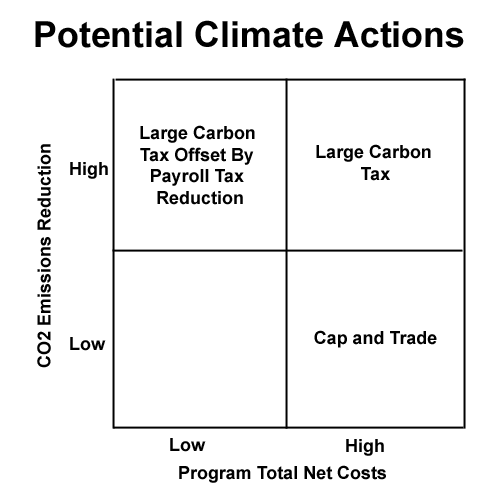
Remember this -- a climate bill will have impact on CO2 emissions in direct proportion to how much it raises fossil-fuel-related energy prices.  When supporters of the bill say things like "it won't raise prices very much" they are in effect declaring "this bill will not solve the intended problem."

Below is a map of some of the climate actions being proposed.  As portrayed here, the current cap-and-trade bill is perhaps the worst of all choices, realizing limited gains (as demonstrated by programs in Europe and their supporters own estimates) combined with high costs.  The program is expensive to administer and much of the higher costs to consumers end up as subsidies to large corporations and green pork.

climate-actions

The combination plan of a large carbon tax offset by payroll tax reductions was discussed here.

Weird -- Someone Should Develop A Theory on This

Strangely enough, it turns out that increased prices seem to induce market participants to seek out and invest in new sources of supply.   Someone should develop a theory around this.

From a good article in today's New York Times: 2009 is turning out to be a bumper year for new oil discoveries; new oil discoveries always occur, but this year has been unusually fruitful. This quote from the article illustrates the important dynamic intertemporal incentives that price signals provide:

These discoveries, spanning five continents, are the result of hefty investments that began earlier in the decade when oil prices rose, and of new technologies that allow explorers to drill at greater depths and break tougher rocks.

"That's the wonderful thing about price signals in a free market "” it puts people in a better position to take more exploration risk," said James T. Hackett, chairman and chief executive of Anadarko Petroleum.

More than 200 discoveries have been reported so far this year in dozens of countries, including northern Iraq's Kurdish region, Australia, Israel, Iran, Brazil, Norway, Ghana and Russia. They have been made by international giants, like Exxon Mobil, but also by industry minnows, like Tullow Oil.

Why My Business Has Ceased Investing

This post at Dr. Helen's site is dead on.  She posts a number of comments from Don Surber's site, starting with this one:

Commenter Sean says:

Businesses aren't hiring because no one knows what in the hell our economic system is going to look like 5 years, or even 5 months, from now.

Will "Cap and Trade" get implemented as the Democrats hope?

How much of an upheaval will "Healthcare Reform" end up being?

Is the administration and Congress done overhauling regulation of the Financial Industry?

No prudent investor is going to bet their money (i.e., invest in growth) when it is conceivable that the government is going to radically alter how 50% of this nation's economy functions.

This is exactly where I am right now.   The business I own has been growing at about 10% a year for the last five years.  In each of the last 3 years, we have invested an average of a half million dollars in new facilities.  In the past five years I have added over a hundred new positions in the company.

This year we will add ZERO.

It is not for lack of opportunity.  Because we are on the low-cost end of recreation, we have had a record year.  And because I am in the business of privatizing public recreation, my phone has been ringing off the hook.  All over the country, desperate public recreation authorities are calling me to say that they are out of money, their parks are about to shut down, and can I do something to keep them open.

To the extent we find opportunities to grow with limited investment, we are pursuing those.  But I just cannot put up any more capital in this environment.  If I make an investment, how much will the government let me keep?  How much are taxes going up (because they certainly are going up)?   Inflation simply must be around the corner given the monetary policy this country is pursuing -- so will my business be able to raise prices fast enough to keep up with inflation in my inputs?

The legislative risks we face are tremendous.   My two highest costs are labor (50% of revenues) and fuel and electricity (about 10% of revenues).  Thus, nearly 2/3 of my costs are going to be increased by the current health care bill and cap-and-trade bill.  The only question is how much.   If forced to guess, I would estimate that my labor costs are going up 8% and my fuel costs by 20%,which when you compute these by their percentage shares, says that my costs will likely increase by at least 6% of revenues.  My current profit margin before tax is between 6 and 8 percent of revenues.  I may be able to raise prices fast enough to cover this, or I may not.  In a business with thin profit margins, there just isn't much, uh, margin for uncertainty.

And none of this takes into account the proposed new paperwork load that will likely make my business less enjoyable to run (example of current mess).  From having to track and report our company's greenhouse gas emissions to keep track of the health insurance choices made by every employee, it is sure to be ridiculously burdensome.

So I am going to wait it out for a while.

Here Is A Great Issue for "Progressives." Somehow I Doubt They Will Run With It

From Daniel Griswold in the Washington Times:

President Obama and the other Group of 20 leaders delivered their obligatory warning against protectionism at last week's summit in Pittsburgh. But at home the U.S. president continues to conduct his own trade war, not only against imports from China and other developing countries, but against the most vulnerable of American consumers.

America's highest remaining trade barriers are aimed at products mostly grown and made by poor people abroad and disproportionately consumed by poor people at home. While industrial goods and luxury products typically enter under low or zero tariffs, the U.S. government imposes duties of 30 percent or more on food and lower-end clothing and shoes - staple goods that loom large in the budgets of poor families....

The tariff the president imposed on Chinese tires earlier this month was heavily biased against low-income American families. The affected tires typically cost $50 to $60 each, as compared with the unaffected tires that sell for $200 each. The result of the tariff will be an increase in lower-end tire prices of 20 percent to 30 percent. Low-income families struggling to keep their cars on the road will be forced to postpone replacing old and worn tires, putting their families at greater risk....

A few liberal Democrats still care, too. Edward Gresser of the Democratic Leadership Council has done more than anyone to expose the unfair, anti-poor bias of the U.S. tariff code.

In his 2007 book "Freedom From Want: American Liberalism and the Global Economy," he calculated that a single mother earning $15,000 a year as a maid in a hotel will forfeit about a week's worth of her annual pay to the U.S. tariff system, while the hotel's $100,000-a-year manager will give up only two or three hours of pay.

ADM's Mistake (Mostly Corrected)

Alex Tabarrok discusses the new movie about Mark Whitacre and price fixing at Archer Daniels Midland.  ADM apparently was caught holding meetings with competitors to fix prices of certain chemical commodities, specifically Lysine.

Here was ADM's mistake, and it is one they have clearly learned from:  in the modern American corporate state, there is no reason to engage in illegal private price fixing or cartel arrangements when corporations can achieve similar ends legally and openly through the government.  If ADM was concerned about difficult competition depressing pricing, they could have emulated any of these examples:

  • Run to Congress to beg for strong tariff's on foreign sources of their commodity product (as do the sugar and ethanol industries)
  • Run to Congress and have them institute minimum pricing or buy up excess supply (as do many agricultural producers)
  • Run to Congress to seek supply restrictions (as does the taxi business)
  • Run to Congress and have them restrict new competition and sources of supply through licensure (as do a variety of industries, from real estate to funeral homes to medicine)
  • Run to Congress to have them pass onerous legislation that makes it difficult for new capacity to be added in the business (as does the waste disposal industry)
  • Run to Congress to seek subsidies for their product in the name of some public good - it doesn't even have to be true (as does, well, ADM with ethanol)
  • Run to Congress to seek regulations that favor your particular production and product technologies while hamstringing your competition (as does GE with light bulbs)
  • Run to Congress and have them enforce an industry price-fixing arrangement -- its legal when Congress does it (as do the Milk producers)
  • Run to the FTC to bring anti-trust actions against your competition (as did Netscape and Sun against Microsoft)  This is an interesting article on this, which says in part, "Most [antitrust] cases are not brought by public representatives, whether elected or self-appointed, but by private companies, often rivals of the defendant who are being driven out of business. Businessmen believe that competition is good if they win but bad if the other guy wins."

Of course, all of this takes a little care.  The competitive relief must be couched in something like "consumer protection" or "saving jobs" or "going green" or "fairness," but there are plenty of good examples of consumers getting the shaft in the name of consumer protection that it shouldn't be too hard to come up with something.  Developing a high profile in an early Presidential primary state like Iowa doesn't hurt either.

As I said in the title, ADM has certainly figured this out, if their approach to the ethanol business is any guide.  In ethanol, they have resorted to any number of these tactics simultaneously.

Does Anything Exceed the Commerce Clause Nowadays?

A question has been going around on legal blogs -- "Does a Federal Mandate Requiring the Purchase of Health Insurance Exceed Congress' Powers Under the Commerce Clause?"

My answer is:  Nowadays (not in the original intent) is there anything the Feds can do that exceeds current interpretations of the commerce clause?  In Raich, the Supreme Court decided that a product (marijuana) that was grown in state for personal consumption, like tomatoes in your own garden, and was used legally under state law, can still be regulated under the commerce clause.    As Clarence Thomas wrote in dissent:

Diane Monson and Angel Raich use marijuana that has never been bought or sold, that has never crossed state lines, and that has had no demonstrable effect on the national market for marijuana. If Congress can regulate this under the Commerce Clause, then it can regulate virtually anything and the Federal Government is no longer one of limited and enumerated powers

No kidding.

Unfortunately the theory that this personal use in California could somehow affect marijuana pricing in other states (by growing their own, they reduced demand for out of state weed which might affect prices in Arizona -- again similar to an argument that growing your own tomatoes might affect prices in another state) won the day in the Court.   With the Supreme Court accempting this "butterfly effect" argument  (because truly the demand of one person in a national market is like a butterfly flapping its wings in China and affecting a hurricane in the Gulf of Mexico), anything falls under the commerce clause.

At Least Four New Taxes in Baucus Bill

The Baucus Health Care bill follows in the tradition of many other pieces of recent legislation in raising taxes in ways such that Congress can claim that it didn't actually raise taxes.  Here are four such taxes in the Baucus Bill  (note that no one that I know of has read any actual legislative language, so this is based on the press releases by the bill's authors.  Actual bill language can only be worse).

Employer Penalty is a Tax: In a step right out of Goldilocks, the Baucus bill will impose "penalties" on employers with no employee health care plan as well as on employers who have plans that are "too rich."  Never mind the insanity of the government micromanaging how an employer chooses to structure his compensation package to employees.  These "penalties" are structured as percentages of wages -- the one for having no health care plan was 8% of wages in the last bill.  This is a direct tax on employment, making hiring people more expensive (effectively the same magnitude as doubling the Social Security tax).  So how does this effect the average person?  Think of it this way, for the same wage, you job will be more expensive to a company that it was before the bill, making it less likely you will get hired at that wage.

Insurance Mandate as a Tax: The mandate that everyone must have insurance is a tax on the young and the healthy, as I explained previously:

People focus too much on the penalty itself being a new tax.  But the new tax is actually the requirement that individuals buy a product (in this case a health insurance policy) that they feel has no value (or else they would purchase it of their own free will today).  The government stopped pretending long ago that these younger middle class families will get much value from such a policy.  In fact, if they did get value commensurate with the premiums they will be paying, the mandate would not be achieving its purpose.  The whole point is that healthy people pay more into the insurnace system than they get back to support sick people.  If that payment is mandatory, then it is a tax, even if it is called an "insurance mandate" instead.

In fact, this is made all the more clear when politicians also suggest that cheaper high deductible health insurance plans be banned, as they were in Massachusetts.  Again, the whole point is to get young healthy people to overpay for insurance, and allowing them to buy sensible, cheaper, high deductible insurance defeats the whole purpose.

In fact, the bill's supporters have explicitly discussed requirements that insurance companies raise the price of insurance to the young and healthy to help reduce premiums for the old and, er, politically more active.  This is a redistributive tax, hidden within an insurance rate structure that will be heavily regulated by Congress.  Though don't expect Congress to admit this when young folks start to complain, they will say "blame the insurance companies."  Which is the whole beauty of such a hidden tax.

Corporate Taxes as Consumer Taxes: The plan would place new excise taxes on insurance companies, drug companies, and medical device providers.  But these taxes, particularly in the low margin insurance businesses (Yeah, I know if you only listened to Obama, you would never realize they were low margin but they are) just get passed onto consumers in the form of higher prices.  Congress knows this, but pretends it doesn't happen, so it can tell the economically ignorant that it hasn't raised taxes on consumers, and that rising prices are all the fault of the evil insurance companies blah blah, you know the drill.

Price Controls as a Tax: A large part of the Baucus Medicare savings is instituting price controls on doctors and other medical suppliers --  basically cutting their reimbursement rates.  This, by the way, just confirms what we all have known, that Obama and the Democrats don't have some mysterious win-win way to cut medical costs.  The only levers they have are 1. Price Controls and 2. Denying care.

There is absolutely no difference to a doctor between price controls and a tax.  A cut in the reimbursement rate from $50 to $40 is the same as having a 20% tax put on his $50 reimbursement.  Again, price controls in this context are just a way of hiding a tax.

And this might be the most dangerous tax of all, as such price controls always, by the immutable laws of economics accepted by monetarists and Keynsians alike, reduce available supply.  Doctors, for example, are going to be less willing to stay in the medical profession.  The result is inevitably shortages and long waits, something that should surprise absolutely no one as shortages and queuing are endemic in every government health care system in the world, starting with liberal darling Canada, whose citizens get medical treatment quickly only by crossing the border into the US.

Good News, for Once, on Water

Kevin Drum links this:

The city of Palmdale is running out of water, and as a result prices are going up.  Way up:

"My bill went from $12.80 to $185," [Tracey] Summerford, a Neighborhood Watch captain, told the water board.

"My water bill went from $139 to $468," Sanchez said at that meeting. Since then Sanchez received another monthly bill, one for $324. Together that meant she owed the water district $792, plus a prior balance that brought her total to $924. "That's my two car payments," said Sanchez, who moved into her home in November....I feel discouraged. I feel like we should have stayed in Santa Clarita and lived in our apartment."

I wrote in the comments:

This is really good news. For years California has claimed to have water shortages, but municipal water prices never reflected that shortage. Politicians would prefer to use command and control allocation and rationing powers than just let price do its work.

It is really good to see some California communities price water in line with its scarcity. Under-pricing water has always provided an implicit subsidy for building and farming in certain areas. I wish all California water would be priced on the basis of supply/demand clearing rather than political patronage.

By the way, the author later calls Santa Clarita "the city."  That is pretty hilarious to anyone who has been there.  Santa Clarita sure looks like the burbs every time I have been there.

So Much For The Tax Pledge

"I can make a firm pledge"¦.no family making less than $250,000 will see any form of tax increase"¦..not any of your taxes"-Barack Obama, September 12, 2008

Oops, well, so much for that, as Obama imposes a 35% tax on Chinese tires, requiring higher prices be paid by the majority of Americans.  This is a broad-based tax aimed at supporting one narrow American industry, as a payoff to the United Steel Workers who have been sad that the UAW has been getting all the political gravy of late.

Suppose the Chinese government is massively subsidizing tire exports -- that they are taking Chinese taxpayer money and directly applying it to tire exports to reduce prices in the US.  What should our response be?  Mine would be:  Thanks, suckers.  If the Chinese really want to tax their people to subsidize lower US consumer prices, why in the world would we want to stop them?

Oh, and remember that Obama pledge to be all lovey-dovey with the rest of the world instead of that nasty confrontational Bush administration?  Well, forget that too:

HONG KONG -- Just two days after the United States slapped Chinese tire imports with hefty tariffs, Beijing has hit back by saying it would launch an anti-dumping investigation into automobile and chicken products from the U.S.

[...]

The "protectionist" policy that seems to have triggered the Chinese tit-for-tat investigation was an order signed on Friday by President Barack Obama that imposes a 35% tariff on tires imported from China on top of the existing import duty of 4%.

Can anyone say, "Smoot-Hawley."  I am sure happy we all learned from the one unequivocal lesson that every economist, left-right-Keynsian-monetarist, took away from the Great Depression -- that starting an international trade war is the best way to exacerbate a recession.  Obama has  done just about the only thing everyone agrees shouldn't be done in response to a major economic downturn.

Update: More good analysis here

Postscript: I wrote this hypothetical post from the Chinese perspective a couple of years ago:  From "Panda Blog:"

Our Chinese government continues to pursue a policy of export promotion, patting itself on the back for its trade surplus in manufactured goods with the United States.  The Chinese government does so through a number of avenues, including:

  • Limiting yuan convertibility, and keeping the yuan's value artificially low
  • Imposing strict capital controls that limit dollar reinvestment to low-yield securities like US government T-bills
  • Selling exports below cost and well below domestic prices (what the Americans call "dumping") and subsidizing products for export

It is important to note that each and every one of these government interventions subsidizes US citizens and consumers at the expense of Chinese citizens and consumers.  A low yuan makes Chinese products cheap for Americans but makes imports relatively dear for Chinese.  So-called "dumping" represents an even clearer direct subsidy of American consumers over their Chinese counterparts.  And limiting foreign exchange re-investments to low-yield government bonds has acted as a direct subsidy of American taxpayers and the American government, saddling China with extraordinarily low yields on our nearly $1 trillion in foreign exchange.   Every single step China takes to promote exports is in effect a subsidy of American consumers by Chinese citizens.

This policy of raping the domestic market in pursuit of exports and trade surpluses was one that Japan followed in the seventies and eighties.  It sacrificed its own consumers, protecting local producers in the domestic market while subsidizing exports.  Japanese consumers had to live with some of the highest prices in the world, so that Americans could get some of the lowest prices on those same goods.  Japanese customers endured limited product choices and a horrendously outdated retail sector that were all protected by government regulation, all in the name of creating trade surpluses.  And surpluses they did create.  Japan achieved massive trade surpluses with the US, and built the largest accumulation of foreign exchange (mostly dollars) in the world.  And what did this get them?  Fifteen years of recession, from which the country is only now emerging, while the US economy happily continued to grow and create wealth in astonishing proportions, seemingly unaware that is was supposed to have been "defeated" by Japan.

We at Panda Blog believe it is insane for our Chinese government to continue to chase the chimera of ever-growing foreign exchange and trade surpluses.  These achieved nothing lasting for Japan and they will achieve nothing for China.  In fact, the only thing that amazes us more than China's subsidize-Americans strategy is that the Americans seem to complain about it so much.  They complain about their trade deficits, which are nothing more than a reflection of their incredible wealth.  They complain about the yuan exchange rate, which is set today to give discounts to Americans and price premiums to Chinese.  They complain about China buying their government bonds, which does nothing more than reduce the costs of their Congress's insane deficit spending.  They even complain about dumping, which is nothing more than a direct subsidy by China of lower prices for American consumers.

And, incredibly, the Americans complain that it is they that run a security risk with their current trade deficit with China!  This claim is so crazy, we at Panda Blog have come to the conclusion that it must be the result of a misdirection campaign by CIA-controlled American media.  After all, the fact that China exports more to the US than the US does to China means that by definition, more of China's economic production is dependent on the well-being of the American economy than vice-versa.  And, with nearly a trillion dollars in foreign exchange invested heavily in US government bonds, it is China that has the most riding on the continued stability of the American government, rather than the reverse.  American commentators invent scenarios where the Chinese could hurt the American economy, which we could, but only at the cost of hurting ourselves worse.  Mutual Assured Destruction is alive and well, but today it is not just a feature of nuclear strategy but a fact of the global economy.

Licensing Is About Protecting Incumbent Businesses

Most licensing efforts are nominally sold based on some public or consumer good but almost always end up being mostly about protecting politically connected incumbent businesses against new competitors.   Nowhere is this more obvious than in liquor licensing.

If you want to start a new liquor-based business (restaurant or bar) in Phoenix, it is going to cost you a hundred grand just for the license.

In fact, the sales price for existing licenses has dropped in recent years, with prices for a bar license in the Phoenix area slipping from $100,000 to $85,000 or $90,000, he said.

And these are the numbers with record-low demand.  Why does Arizona (or most other states) limit the number of licenses at all?  Why not just issue them to all comers, and let the market sort out who is successful and who is not?  Certainly we would likely see a lot more interesting restaurant startups if there was not an effective $100,000 tax on starting a restaurant imposed by the state.

State officials used to pretend the reason was to protect the community from being overrun by, er, dining choices or bars or whatever, but nowadays they don't even bother with such justifications and just give the true reason - they are protecting incumbents from competition.

Arizona hadn't awarded licenses since the late 1980s before the 2005 law passed. That was largely because holders of existing licenses didn't want to diminish their resale value.

Well, I am a holder of several existing Arizona licenses and I say -- open the floodgates!