Posts tagged ‘Phoenix’

Rates are Too High -- So Lets Limit Competition

Apparently, some of our local politicians in the Phoenix area are upset about payday loan companies.  According the an AP report in the AZ Republic:

The stores cater to customers who live paycheck to paycheck who need
quick access to a few hundred dollars for rent, car repairs or just to
make ends meet. Banks traditionally don't make those type of small,
short-term loans.

So these stores provide loans to people no one else will touch.  And customers use their services of their own free will.  So what is the problem?  Well, not surprisingly, the rates on these loans are high, and the default terms tend to be drastic.  "Activists" think that people are making the wrong decision using these services, and, to be fair, I would certainly advise anyone who asked to try to find another alternative.  But what do my preferences matter?  Its easy for me to say in my middle-upper class hubris that such services don't make sense, but I have a steady job and ready access to bank loans.  In a free society, both I and those activists are free to convince people to not use these services, but its wrong to artificially limit people's choices out of some elitist sense that we can make decisions for other people better than they can for themselves.

Besides, lets think about the alternative.  These folks are not going to get bank loans -- in fact many customers may be illegal aliens who are, post 9/11, effectively barred from the banking system.  The only other alternative before these payday loan companies were loan sharks, whose interest is even higher and whose penalty for non-payment even more dire. This reminds me of the people who decry Nike "sweatshop" jobs in poor countries.  "Activists" similarly decry these jobs as if the alternative is $25 an hour office work, when in fact the alternative is actually grinding subsistence agricultural work for half the pay.  You may not like the payday loan companies, but they are replacing a much worse system.

But the really funny thing about this article is their proposed solution to the problem of rates for these payday loan services being too high.  Their solution?  Limit competition!  (emphasis added)

Arizona now has more than 600 payday loan stores - with 165 in the [Phoenix suburb] Mesa area alone - and some residents are upset about it.

"People are sick of it in west Mesa," said Dave Richins, a neighborhood
activist and executive director of the West Mesa Community Development
Corporation.

Richins and other critics claim the stores exploit customers with high interest rates.

[Phoenix suburb] Peoria blocks the shops from opening within 1,000 feet of a competing
store. Phoenix and Tucson are looking to that city's restrictions as a
model for new rules in their communities, with action possible by early
next year.

Gee, I bet that will help keep rates down -- make sure there are no competitors nearby!  Lets make sure it is as hard as possible to compare rates, particularly since the customer base is one that can't afford the gas, or doesn't even have a car, to drive all over town shopping.  I wonder why no one is suggesting the same thing for gas stations to keep gas prices down, lol.

My Wife's Handbags up For Rising Star Fashion Award

I tried to warn you to buy one of my wife's designer handbags before she got famous.  It may be too late.  Next week she will be a finalist in the Phoenix Rising Star Fashion Awards:

Phoenix may not be an international center of fashion, but it is a hotbed of design.

The Valley brims with independent designers who make everything from
purses to baby clothes to yoga wear, all available at local boutiques
and/or online.

Three promising Valley designers will receive Rising Star awards on Thursday, given by the Phoenix chapter of Fashion Group International,
a networking organization for fashion professionals. Awards are given
in three categories: clothing, accessory and interior design.

Kategrovespurses2
(click image to enlarge)

Sorry, newspaper photos really don't scan very well.  They just had to use the chick with the guitar for the online article, so my wife's photo didn't make the online edition.  Many of her funky handbag designs are online, and I posted here about the last exposure of her designer purses in Yes Magazine.

Technorati Tags:  ,

Water: The Only Market the Government Screws Up Worse than Oil

Arizona Watch makes a great observation about water use here in the desert.  All-too-often, the anti-growth folks use the water issue to try to make us feel like Phoenix is heading toward some parched apocalypse.  Arizona Watch makes the following point:

Scott Patterson's "Swimming in the desert," is dangerously miss-informed. To
advance his anti-growth agenda, he predicts future water shortages in Arizona
due to urban population growth. Urban growth is not to blame.

Nearly 70% of Arizona's water is used for agricultural purposes. What's more,
the cost of water for agricultural use is significantly lower than for
industrial or household use. The problem is not that people live in this desert,
it's that people inefficiently grow crops in this desert, and the inefficiency
is encouraged by price controls on water. If water costs for agriculture were
not subsidized, then market pricing would ensure a plentiful supply of water for
generations to come.

Read the whole thing for the cites to the actual statistics.  I cannot understand why water can't be sold at a market rate.  If you subsidize water prices, and more people then come to the desert than the water supplies can support, is it the fault of the individuals who show up, or is it the fault of the government that can't seem to allow markets to operate when it comes to water?  This is yet another example of the government creating a problem with regulation, blaming the adverse results on the free market, and using the ensuing mess to justify more regulation.

Farmers in particular are getting paid by you and me, in the form of subsidized water, to try to grow wet-country crops out here in the desert.  This water subsidy is on top of the huge farm subsidies Arizona farmers get, including over $100 million a year in cotton subsidies alone.  The government is paying farmers to dump tons of water on cotton plants in the desert that grow perfectly well without irrigation in many other states. 

Postscript:  Farmers really have done an amazing job lobbying for themselves in this country.  They are particularly succesful here in Arizona, where the largest farms are owned by Indian tribes, that have the added lobbying strength of protected-group status.  The other night I was serving out my painful 7 hours or so in drivers ed. class when it was mentioned that us urban dwellers will get a huge fine for not having our 4 year old strapped down in a car seat, but rural pickup truck drivers in Arizona can legally have a 6-month-old rolling around in the back of a bouncing pickup truck without any restraint and be perfectly legal.  Why the difference?  Because the farmers wanted it that way.

And I Thought OUR Governor Was an Idiot

Cafe Hayek has a fabulous fisking of Missouri governor Matt Blunt's letter to the editor explaining why his call for price controls on gasoline is consistent with his free market principals.  Its all good, I can't pick out any one quote.  Read it all.

But wait!  This just in!  Maybe our governor IS this dumb.

Our great benevolent leader, Janet Napolitano, has stated in press conference
the she is going to investigate these fuel prices of ours. Mostly she was
ruffling her feathers right after Hurricane Katrina shutdown a good 30% of the
domestic supply source. So of course prices increased slightly to account for
the lack of supply. This trend that followed exactly what even very simple
supply and demand theory would predict was not enough to convince miss Gov. J.No
not to call for yet another investigation. No way! She was not going to be
swayed by facts, reality or "assurances from the oil industry" that these were
fair market prices. Nope. An investigation was needed.

A little over a year ago, a pipeline broke and the only source of gasoline into Phoenix was stopped.  Due to EPA regulations, Phoenix requires a special gas blend made in only one refinery coming to us through one pipeline, so it is not surprising that if that source is interrupted, gas might be short here for a while and prices might spike up.  Which they did.  Governor Napolitano at that time blamed the whole situation on the oil industry and called for investigations.  Tellingly, she took only three policy actions:

  • Temporarily waived regulations for a special blend of gas in Phoenix
  • Temporarily waived regulations on truckers that were preventing them from filling in for the broken pipeline
  • Considered circumventing regulations that were preventing a local refinery to serve the Phoenix market from being built.

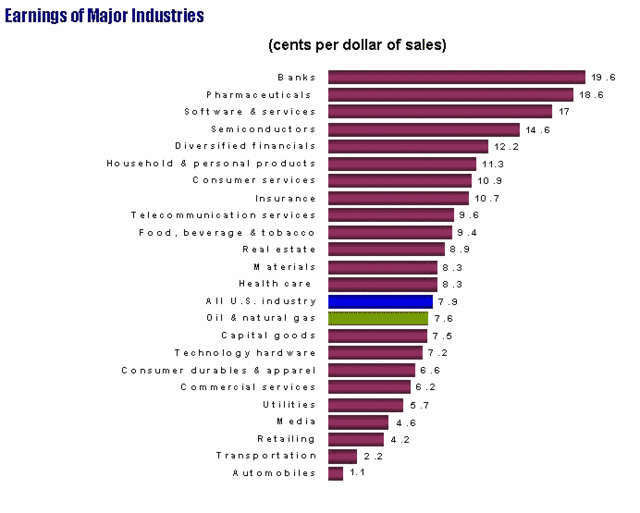
So the rhetoric at the time was "its all the oil companies faults" but the solution was "repeal government regulations".  Hmmmmm.  By the way, the Commons Blog created a nice chart showing how those filthy rich oil companies are making, uh, ahem, lower profits than average for US industry (click to enlarge).  I wish they were more profitable- we would probably have a lot more oil.

Margins1a

Gas Scarce in Phoenix?

This morning, as I drove to work and stopped to get gas, I noticed that they were sold out of two of their three grades (only premium was left).  The manager told me that several folks had come in today saying that this was the fourth or fifth place they looked for gas, though I will say the next two stations down the street seemed to have gas and I did not see lines anywhere.

Phoenix is one of those funny gas markets, where due to government regulations, we have a unique gas blend that can only be made in one place by left handed Eskimos, or whatever.  Several companies have tried for years to get a refinery permitted to serve this market, but the Arizona state government has consistently blocked it.  As a result, we get some strange ups and downs here, including gas lines last year when the only pipeline into town from the only refinery that makes gas that can be sold here broke.

Its a bit too early for Katrina to be actually affecting wholesale gasoline supplies (update:  or maybe not), but it is not too early for Katrina-led expectations to be draining gasoline inventories.  I explained previously about how an expectation among consumers that gas will be short can become a self-fulfilling prophecy:

Take
the example of 1972, and we will use typical numbers of that era.  Lets
say there were 100 million cars each with an average 20 gallon tank.
Lets say normally, people refill their tank when it is ¼ full, so on
average their tank is 5/8 full.  Doing the math, there are 5/8 times 20
times 100 million gallons actually in cars or about 1,250 million
gallons.  That's right - one of the largest single inventories of gas
in this country is in people's tanks.

Now,
lets say due to supply panic, everyone suddenly refills at ¾ full. No
one wants to be caught short (I remember in the 1970's, people would
wait in line to put a gallon or two in their tanks -- it was nuts).  In
this case, on average they are 7/8 full or there are a total of 1750
Million gallons in cars' tanks.  So, in the space of what might be two
or three days, people suddenly demand 500 million gallons above and
beyond their normal usage to increase their tank's inventory.  Boom,
stations are out of gas, which causes people to feel even less secure
without a full tank, so they inventory more (many in spare gas cans)
and the problem gets worse.

Here is my previous post on why I am hoping for gas price gouging.

I Don't Know the Economics Term for This

While I sometimes get grouped into economics blogs, I actually don't have a degree in the subject.  I have an MBA, some practical experience, some hobbyist reading, a few undergraduate courses, and, as my wife can attest, a willingness to pretend I know what I am talking about.  Unfortunately, that is not enough in this case.

Over the last 6 months, I have observed an interesting phenomena in the Phoenix area, one which I am sure I am not the first to discover, but I don't have enough background to put a name on it.  Here is what is going on:

Over the last year or two, the Phoenix real estate market has been red hot.  This has caused a lot of individual investors to make local real estate investments (I discussed more about this here).  The preferred type of investment seems to be to buy an old house on valuable land, tear it down, and sell the new house for a profit.

All fine and normal so far.  The interesting part comes when the investor chooses the style and appearance of the new home.  Remember that these are typically highly leveraged investments.  Investors take out a large mortgage, and that mortgage has to be paid every month that the investor cannot sell the home.  It is critical, then, that the investor build a home that is designed in a way to be most likely to sell.

Let's imagine that the pool of possible house buyers have the following preferences (I am making these numbers up):

  1. Tuscan / Mediterranean style, 40%
  2. Santa Fe style, 25%
  3. Santa Barbara style, 20%
  4. New England style, 10%
  5. Ultra modern style, 5%

With only limited information on what is going on in the market around them (ie what others are planning to build) all of these investor-builders pick the most popular style on the list, thereby apparently maximizing their ability to sell the home.  As a result, every tear down / rebuild / remodel I see in our area is a new Tuscan home.  So, while 40% of buyers (or whatever the number is) want Tuscan, 100% of the supply is Tuscan.  By the way, the same thing apparently happened in the last big Phoenix real estate boom back in the 1980's, since nearly every house in our neighborhood that was built in the early eighties was built in what we call the "santa barbara" style.

This is obviously some type of market failure, but I don't know what it is called.  I might call it the "variety failure".  To a large extent, this dynamic is made possible by the fact that many of the investors in the real estate market are only entering the housing market for a single transaction, and are not well informed of the actions of other sellers in the market.  In most other industries, investors need to make money over multiple transactions over many years, which mutes this effect.  For example, there are always farmers who try to plant this year what was earning good money last year, but these players in the market are usually weeded out over time as last year's shortage leads to this year's glut and financial losses.  Also muting this failure nowadays are changes in manufacturing techniques, which allows low cost production of greater variety, as well as expansion of specialty retail space (e.g. category killers like Petsmart or Borders), which allows display of more product variations.

Away at Camp

Posting will be kind of light this week because I am away at camp.  My wife signed us up for a family camp that they have run for years at UC-Santa Barbara.  One good sign already:  most of the guests have been coming for years.  One lady I had dinner with is here for the 28th year.

Basically all the family stay in the dorms here, and there are activities arranged by age group all day for the kids and optional activities for the adults.  Meals are in the cafeteria, where the food has been pretty decent.  The whole family has had a good time so far, though it had a bit of a rough start for me.  We drove here from Phoenix, and I am usually fine with long-distance drives.  However, the last 4 solid hours were spent basically inside LA fighting traffic.  I was ready to blow my brains out when I got here.  Unfortunately, our car was met at the gate by a group of camp counselors who were channeling "Up with People" or maybe the Mousketeers, but they were way to jolly for my mood at the time.

By the way, how does anyone study at a University that sits on a beach?  Well, at least the high speed LAN in the rooms works really well.

Gerry Thomas, RIP

Gerry Thomas, inventor of the TV dinner, died here in Phoenix at the age of 83.  Though decried by the intelligentsia of this country, the TV dinner opened the door for a huge influx of products aimed at letting people who don't want to or can't cook create a decent meal.  As a kid, it never ceased to be a treat to get one of these for our evening meal, and looking back, Mr. Thomas and his successors probably cooked for me more than my mom.  Mr. Thomas is a member of the Frozen Food Hall of Fame (I kid you not) in Orlando.  This strikes me as a story that James Lileks should be all over.

Tvdinner


Update:
  According to CNN, James Doohan, recently diagnosed with Alzheimer's, has died as well.  How many times have you asked this guy to get you out of a tough spot?  Beam me up, Scotty.

Scotty

Why Aren't We Seeing Long Gas Lines

An email from a friend recently got me thinking about why, despite rising prices and tight worldwide demand, we aren't seeing gas station lines this year, like we did during oil shocks of the early and late 70's.  I remember both well, but the later shocks resonate with me more because as a newly minted 16-year-old driver, I was given the family job of driving around town hunting for gas for the family cars.

My first thought was that it was related to the speed and sharpness of the supply discontinuity.  Certainly the 1972 embargo represented a sharp supply change which took the world market a while to absorb, and what we have seen of late has been more gradual.  This is certainly part of the explanation, but incomplete, as the gas lines of the late 1970's were not accompanied by a similar discontinuity.  I might add that many economists at the time might have said that the speed should not matter that much, since it was accepted at the time that energy demand was inelastic, that it did not change much with price.  Therefore, the speed would not matter, since the market's corrective mechanism of price would not work well anyway.  Since then, we have learned that energy demand is very elastic, and that usage will adjust itself based on price.

My second thought was that regulation has a role in the explanantion.  Usually, when you see people queing up for a product or service, it means that prices or supply or both have been artificially limited.  Certainly last year's gas lines we got in Phoenix were almost entirely due to regulation.  Here in Phoenix, the government requires a blend of gas used no where else in the country.  The gas comes in from another state via a single pipeline.  Mobil tried for years to build a small refinery here to produce this blend closer to the market, but were never allowed by state regulators.  So, last year when the pipeline broke, we had shortages.  Our intrepid governor, as most politicians love to do in an oil shortage, blamed greedy gas station operators and oil companies for the problem.  However, when it came time to issuing her plan for dealing with the crisis, here were the first three steps:

  • Temporarily repeal regulations setting the unique gas blend for Phoenix
  • Temporarily repeal regulations on truckers to allow them to better take up the transportation slack
  • Reevaluate regulations that have restricted the construction of a refinery in Arizona

LOL, so it is all the oil companies' faults but the solution was to repeal three sets of government regulations.  Much the same situation occured in the early 70's.  Richard Nixon was probably one of the worst presidents from an economics standpoint that we have had in the last half century.  Few people remember just how close we got to a government program of gas rationing and how loud the calls were for nationalisatoin of oil companies.  Fortunately this never happened, but other bad stuff did.  For example, the markets ability to close the supply-demand gap were limited by a number of pricing controls on oil and other energy subsitutes, regulations that were not repealed until nearly a decade later.  Even weirder, the US government put in place distribution rules that said that oil companies had to send each market (I think it was done county by county) the same proportion of supply as in the year before the embargo.  I am not sure what fear drove this rule, but the result was chaotic.  For example, the previous summer lots of people drove cross-country for vacation, filling up out on the interstate in the countryside.  With shortages, no one wanted to drive long distance.  As a result, rural areas typically had plenty of gas, and cities were running out.  Demand patterns shifted (duh) but the government would not allow supply distribution to shift to match.

The final, and perhaps most important reason, though, that we have not had long gas lines is because people are not expecting them.  Fear of gas lines is a self-fulfilling prophacy, for the following reason:

Take the example of 1972, and we will use typical numbers of that era.  Lets say there were 100 million cars each with an average 20 gallon tank.  Lets
say normally, people refill their tank when it is ¼ full, so on
average their tank is 5/8 full.  Doing the math, there are 5/8 times 20 times 100
million gallons actually in cars or about 1,250 million gallons.  That's right - one of the largest single inventories of gas in this country is in people's tanks.

Now, lets say
due to supply panic, everyone suddenly refills at ¾ full. No one wants to be caught short (I remember in the 1970's, people would wait in line to put a gallon or two in their tanks -- it was nuts).  In this case, on average they
are 7/8 full or there are a total of 1750 Million gallons in cars' tanks.  So, in the space of
what might be two or three days, people suddenly demand 500 million gallons above and
beyond their normal usage to increase their tank's inventory.  Boom, stations are
out of gas, which causes people to feel even less secure without a full tank, so
they inventory more (many in spare gas cans) and the problem gets
worse.

One of the conspiracy theories of the 1970's was that we had gas lines because oil companies were holding tankers offshore waiting for prices to rise (the early 1970's were the point in time where the leadership banner for conspiracy theory nuts was handed off from the right wing to the left).  The irony is that the answer to the "mystery" of where all the gasoline inventory went was right under people's noses.  If an average tanker of the time carried 500,000 barrels of oil, and each barrel of crude oil produces about 20 gallons of gasoline (in addition to all of the other fuels) then then the act of gassing up cars faster caused 50 tanker loads of oil to disapear into people's gas tanks.  The "missing oil" was right in their garage!

Alice Cooper

Arthur Cherenkoff and Glenn Reynolds seemed surprised that aging shock-rocker Alice Cooper had some sensible opinions on foreign policy issues.  Those of us who live in the Phoenix area, however, are not.  Oddly enough, Alice Cooper has become something of an elder statesman in Phoenix, keeping a fairly high profile leading various community and charity events.  Its a little odd living in a town where your most visible community leaders include Alice Cooper and Charles Barkley, especially given the area's attraction to many of the rich and famous as a retirement location, but it seems to work.

One story that comes to mind:  Alice Cooper is a regular at Suns games.  A couple of years ago, my company had some nice season tickets just a few rows up from Mr. Cooper, who had seats in the first row on an aisle.  Just about every game I attended, at least one pair of guys would come down the steps, kneel on the floor next to Alice's seat, and bow down saying "We're not worthy" ala Wayne's World and then head back up the aisle without another word.  Always made me laugh.

Mens Underwear Recomendation

OK, this may be a bit bizarre, but believe me, when you live in a climate that routinely remains between 100-114 degrees for five months, comfortable underwear is a must.  I have tried nearly every type and brand, from briefs to boxers, and have recently discovered some new ones that are great.  They are made by Under Armour, which is an entirely familiar clothing line to everyone here in Phoenix because they handle heat and sweat so well.  My kids live in the Heatgear, though I opt for the Loosegear since I no longer have the body for form fitting clothing. 

The underwear is made of that silky under-armour fabric, but is very comfortable and seems to wick sweat away from your body.  The downside is that they are nearly $20 a pair, but they don't shrink and so far have held up well. 

PS- I know my friend Scott in San Francisco tried a pair as well - he may be able to give us a review in the comments of whether he liked them or not.

Final Note: To those of you who suggest "none", you haven't lived in a really hot climate.  "Freefalling" may be OK on a breezy day on the California coast, but in a Phoenix summer or in my birthplace of Houston, you are going to regret it.

Really Random Tangent: Someone sitting with me in my office this morning commented that "the only reason we think it is hot when it is 98 out is because of our clothes.  If we were naked, 98.6 would be the perfect temperature because that is our body heat."  This is actually a misconception and ignores several principals of thermodynamics.

The key fact is that the body generally is a net producer of heat.  To be comfortable and maintain body heat, the body must shed this heat, which humans do in two ways.  First, we transfer heat to the surrounding air from our skin - to do this well, the surrounding temperature needs to be less than our body heat.  The more differential, the more heat transfer.  Air motion (via wind) provides convective heat transfer, which accelerates this process.  Second, we sweat.  When sweat evaporates, it pulls heat from the surrounding air and adjacent body.  Sweating cools us therefore based on evaporation rates, which is one reason why drier climates are more comfortable -- sweat evaporates faster. 

In addition to shedding the body heat we produce, we also have to shed any heat we pick up by radiative transfer.  Radiative heating is the heat we feel on our skin when we are in direct sunlight, and is why one can be cooler in light than dark clothing (dark colors absorb more radiative heat). 

All this means that if we are naked, in the shade, in a dry climate like Phoenix on a breezy day, we are likely to be comfortable at a temperature closer to 98.6.  In the direct sun in a calm, humid climate, even naked, we are going to want a temperature much much less than 98 to be comfortable.

OK, There May Be A Housing Bubble

I don't have access to the right kind of data to decide whether there is a housing bubble in the US, though a lot of people are writing about it

In the Phoenix / Scottsdale area, housing values have really starting going up, up, up in the last 18 months, though whether this is just a catch-up to other desirable metropolitan areas (Phoenix real estate has been pretty sluggish for years, and way cheaper than other resort-type destinations) or a true bubble, I can't tell.  Certainly speculation activity is way up, with a lot of homes being bought and renovated by investors, but again, I could argue that Scottsdale was behind other suburban markets in the whole tear-down thing. 

So, to date, I have been unconvinced about the housing bubble, at least as it applied to our community.  After all, demographics over the next 20-30 years are only going to support Scottsdale area real estate. 

However, over the weekend I had a disturbing experience:   At a social function, I heard a dentist enthusiastically telling a doctor that he needs to be buying condos and raw land.  The dentist claimed to be flipping raw land parcels for 100% in less than 6 months. 

For those who don't know, this is a big flashing red light.  When doctors and dentists start trying to sell you on a particular type of investment, run away like they have the plague.  At Harvard Business School, I had a great investment management class with a professor who has schooled many of the best in the business.  If an investment we were analyzing turned out to be a real dog, he would ask us "who do you sell this to?" and the class would shout "doctors!"  And, if the investment was really, really bad, to the point of being insane, the class would instead shout "dentists!"  Marginal Revolution has another potential bubble indicator.  Angry Bear has a lengthy analysis.

Postscript: By the way, just so you doctors and dentists won't feel like I am picking on you, we small business owners are considered to be almost as bad, which is I why I get so many boiler room calls.

Update:  OK, in one of those great moments in timing, my wife just called me to say that one of the moms at school was trying to get other moms to invest with her in some condos, and should we join in?  Eeeek!

Best of Coyote III

Well, it worked for Johnny Carson, why not for me?  Instead of
leaving you with dead air (photons?) while I am knocking the rust off
my beer pong skills back at Princeton, I will share with you a few of
my favorite posts from my early days of blogging.  Since most of these
posts were viewed by about 5 people, there is a certain temptation to
just recycle them without attribution, given the unlikelihood of
getting caught.  Instead, though, I will share them as my best of
Coyote...


This post was from early December, and commemorated the 60th anniversary of a facinating event in Arizona history.  Many people are familiar with the movie the Great Escape or the TV series Hogans Heroes.  Few know, though, that there was really a great escape ... by German POW's in Arizona!  Here is my post "WWII Great POW Escape -- In Phoenix?"

Many people have seen the Steve McQueen movie "the Great Escape",
about a group of 60 or so prisoners who cleverly dug a tunnel out of a
German POW camp and escaped in various directions across Europe, many
of whom where eventually recaptured.

I don't know if such an event occurred in Europe, but an almost
identical real-life POW escape (tunnel and all) occurred right here in
Phoenix, Arizona almost exactly 60 years ago.

Like many isolated western towns in WWII, Phoenix played host to a
number of German POW's, in our case about 1700 in Papago Park.
Phoenix, and in particular Papago Park, with its arid climate and red rocks, must have been quite a culture shock to the Germans.

Anyway, I won't tell the whole story, but it is fascinating and you can read it all here.  A short excerpt:

The
German prisoners asked their guards for permission to create a
volleyball courtyard. Innocently obliging, the guards provided them
with digging tools. From that point on, two men were digging at all
times during night hours. A cart was rigged up to travel along tracks
to take the dirt out. The men stuffed the dirt in their pants pockets
which had holes in the bottoms, and they shuffled the dirt out along
the ground as they walked around. In addition, they flushed a huge
amount of dirt down the toilets. They labeled their escape route Der Faustball Tunnel (The Volleyball Tunnel).

They
dug a 178 foot tunnel with a diameter of 3 feet. The tunnel went 8 to
14 feet beneath the surface, under the two prison camp fences, a
drainage ditch and a road. The exit was near a power pole in a clump of
brush about 15 feet from the Cross Cut Canal. To disguise their plans,
the men built a square box, filled it with dirt and planted native
weeds in it for the lid to cover the exit. When the lid was on the
tunnel exit, the area looked like undisturbed desert.

There
is some dispute about how many people actually escaped -- official
records say 25.  Others argue that as many as 60 escaped, but since
only 25 were recaptured, 25 was used as the official number to cover up
the fact that German POW's might be roaming about Arizona.

The prisoners who led this escape were clearly daring and inventive,
but unfortunately in Arizona lore they are better known for their one
mistake.  Coming from wet Northern European climes, the prisoners
assumed that the "rivers" marked on their map would actually have
flowing water in them.  Their map showed what looked like the very
substantial Salt River flowing down to the Colorado River and eventual
escape in Mexico.  Unfortunately, the Salt River most of the year (at
least in the Phoenix area) is pretty much a really wide flat body of dirt.  The German expressions as they carried their stolen canoes up to its banks must have been priceless.

It
never occurred to the Germans that in dry Arizona a blue line marked
"river" on a map might be filled with water only occasionally. The
three men with the canoe were disappointed to find the Salt River bed
merely a mud bog from recent rains. Not to be discouraged, they carried
their canoe pieces twenty miles to the confluence with the Gila river,
only to find a series of large puddles. They sat on the river bank, put
their heads in their hands and cried out their frustration.

I
know how they feel every summer when we go to Lake Powell and find the
water lower than the previous year.  Anyway, we shouldn't just make
light of the escapees.  Apparently the prison guards made Sargent Schultz look like Sherlock Holmes:

Although
the men left in the wee hours of Christmas Eve, the camp officials were
blissfully unaware of anything amiss until the escapees began to show
up that evening. The first to return was an enlisted man, Herbert
Fuchs, who decided he had been cold, wet and hungry long enough by
Christmas Eve evening. Thinking about his dry, warm bed and hot meal
that the men in the prison camp were enjoying, he decided his attempt
at freedom had come to an end. The 22-year old U-boat crewman hitched a
ride on East Van Buren Street and asked the driver to take him to the
sheriff's office where he surrendered. Much to the surprise of the
officers at the camp, the sheriff called and told them he had a
prisoner who wanted to return to camp.

One
of the last to be re-captured was U-boat Commander Jürgen Wattenberg,
the leader of the breakout.  Interestingly, Captain Wattenberg hid out
in the hills just a few hundred yards from my current home.

Regulate Thyself

Arizona Watch has a great post today about our state government's foray into amusement park regulation after several folks were stuck on a local ride for a couple of hours. 

There are no major amusement parks in Arizona, although two large
ventures are apparently planned. Currently, inspections are handled by
insurance companies, who have a serious financial stake in maintaining
the safety of the rides. Insurers can't afford to have unsafe rides at
their client's amusement park. Compare that to the state, that has
exactly what at stake?

As an aside, Phoenix is an awful place for a roller-coaster and amusement park fan like myself to live.  Basically, we have no real amusement parks  (though there are some great ones about a 6-hour drive away in LA).  I have sat and pondered this a lot - why does a city this large with such a strong tourist economy not have a Six Flags type attraction?

The answer I guess is  that our season is wrong.  Our season is November-April, when the weather is nice.  Unfortunately, the kiddies are in school then.  During summer vacation months, Phoenix is a bit, uh, toasty (but its dry heat, as we tell our Thanksgiving turkey each year).  This answer is not totally satisfying, as uncomfortable summer cities like San Antonio and Houston have major theme parks.  Also, Phoenix has no real world class water parks (just a couple of places with 2 slides and a pool).  Maybe its because all the developpers here have golf courses on the brain.

Where do Phoenix people go for fun in the summer?  Well, if you are ever in San Diego or LA during the summer, check the license plates.  Then you will know where we are.

Economics of Tipping

I've written a couple of times about how I find the whole process of tipping in this country to be irritating.  There is absolutely no logical framework you can come up with to say why we are expected to tip restaurant workers but not, say, retail workers.  Tipping has long, long ago passed the point where it was a practice to reward good service and has instead become a way for employers to shift the burden of paying wages to their employees onto their customers.  For example, I wrote (or more accurately, ranted) here:

Unfortunately, restaurants and other service establishments have
twisted this act of reward and generosity into having customers pay the
wages of their staff.  Restaurants are simultaneously increasing
tipping expectations (from 15% to 20%+) while requiring tips on more
and more occasions by building them automatically into the bill.

The event that brought my irritation to a boil the other day
actually happened valet parking my car at a restaurant.  As background,
the establishment charged $4 to valet park your car.  Now, I am not a
socialist, so I accept that value is not driven by cost but rather by
what I am willing to pay for it, and I was willing to pay $4 to avoid
having to walk a few blocks from the free lot  (those of you from
Boston or NY are wondering what the fuss is about -- a valet parking
charge of any amount is virtually unprecedented in Phoenix, at least
until recently).

So I paid my $4, and then I saw the sign:

"Our employees work for tips"

What?
You mean I just paid your company $4 for what amounts to about 5
minutes of labor, and now you are telling me that in addition, I need
to pay your employees' wages for you too?  This is pretty nervy - I
mean, other than a percentage concession payment they are probably
making to be the parking company at that location, what other costs do
they have?  I didn't want to hurt the young guy actually doing the
parking, but for the first time in years I didn't tip the valet.  That
little sign turned, for me, an act of goodwill into a grim obligation,
extorted from me by guilt.

I bring all this up because I saw an interesting piece the other day on Marginal Revolution:

1. Two studies show little relationship between quality of waiter service and
size of tip.

2. Hotel bellboys can double the size of their tips, on average, by showing
guests how the TV and air conditioning work.

3. Tipping is less prevalent in countries where unease about inequality is
especially strong.

4. The more a culture values status and prestige, the more likely that
culture will use tipping to reward service.

5. Tips are higher in sunny weather.

6. Servers can increase their tips by giving their names to customers,
squatting next to tables, touching their customers, and giving their customers
after-dinner mints. (query: how do lap dances fit into this
equation?)

7. Drawing a smiley face on the check increases a waitress's tips by 18
percent but decreases a waiter's tips by 9 percent.

8. In one study, waitresses increased their tips by 17 percent by wearing
flowers in their hair.  In general it pays to look distinctive albeit not freaky


Kudos to my Congressman

Its never surprising to see Arizona Congressman Jeff Flake or Texas Congressman Ron Paul voting against pork, they are pretty consistent libertarians in their vote.  However, I have only just begun to follow my own Phoenix-area Congressman John Shadegg.  I was pleased to see that he stood up to considerable pressure and opposed the recent pork-filled Highway bill.

Of late, I have felt used by the Republican party, who put on small-government clothes to entice libertarians like me but who have generally abandoned all spending restraint now that they are in the majority.

Financing Small Business Growth

A while back I wrote a series of posts here, here, and here on buying a small business.  One of the things I said in that post was:

Then, there are the banks. From my experience, it is very, very
difficult to get a bank to make an collateralized loan - i.e. a loan
that is secured only by the cash flow of a company rather than by
assets. In fact, I have never been successful at that. About the only
way that I have found that banks will make a loan is if it is an SBA
loan, where the SBA basically guarantees the loan for the bank. The SBA
goes through cycles of being very open to lending to being very tight.
I have not dealt with them for over two years, so I don't know what
their stance is today. Remember, though, that the SBA is not going to
approve any loan where the buyer has no experience in the industry or
where the buyer is not putting down his own money as well. The SBA has
a lot of information here.

This statement is still mostly true but I have learned a lot over the last couple of months.  The following is an update.

One of the things they tell you all the time in business school, but frankly I always found impossible to really internalize, was how much cash growth takes.  I guess I always thought of businesses with cash flow problems as being unsuccessful, slowly sliding down the drain and trying to make ends meet.  Wrong.  Growth is tremendously expensive.  And stressful.

My business is based on concession contracts.  Each winter, we are usually presented with the opportunity to bid on many contracts.  We narrow the field down to 4-6 we bid on, hoping to win about 2.  One of the things I did last year was greatly improve our standard bid materials, hoping that would help us win good projects.  Did it ever.  We bid on 6 last year and we won 6 (including Burney Falls, Pyramid Lake, and Lake Havasu).  Yea!  But then I began adding up all the investments in new inventory, new equipment, salary (you always have to hire people before the first revenues come in), licenses, building improvements, etc.  Eeek!

After a lot of work with bankers, I stand by most of my statement above.  Most bankers will not lend to businesses on cash flow, and always want some type of collateral (like my home equity).  Over time, though, I have found a few bankers who are willing to lend on cash flow and really understand business growth and why maybe I don't want to have my business's growth rate limited by how much equity I have in my personal home.  There are bankers who will put together packages of long-term loans backed by the SBA plus short term working capital loans that will now let me grow faster.  The folks at Copper Star Bank, for example, have been great. 

One of the reasons I felt the need to post this update is that I have been told that my difficulty finding a good business banker was due in part to my location here in Phoenix.  The Phoenix banking market is very real estate driven, so bankers usually come from that background rather than a business background.  I am told that those of you on the east coast or in the Midwest may have an easier time finding good business bankers.

Postscript: By the way, you might ask how I feel as a small government libertarian about accepting the government subsidy implicit in an SBA loan.  The answer is "conflicted".  Some libertarians are fine accepting government services, on the theory that they certainly have paid for them with all their taxes.  Some try to avoid government services, but that is almost impossible in today's world (such as using government roads).  I generally try to be pragmatic, operating somewhere in the middle.

As far as SBA loans go - I don't know what the commercial banking world would look like without SBA loans.  I think that the banking world would have found an alternative way to mitigate the risk (e.g. via securitization) without the government gaurantee, but we can't know.  The fact is that SBA gaurantees exist and banks would be crazy not to use the gaurantees in making business loans.  So, the reality is, if I want a cash flow based loan for a company my size, it will likely carry the SBA gaurantee.  My appologies to all those whose taxes support my loan gaurantee.

Happy Florist and Restaurant Profitability Day!

I am not a Scrooge on most holidays - heck, we even decorate our house for July 4, not to mention Halloween and Christmas.  However, I feel about the same guilt in not celebrating Valentines Day as I do not having kitchen floors as minty-fresh as the ones in the Pine-Sol commercial.

When I was single, I used to love Valentines Day.  Often it was a great excuse to get my girlfriend all romantic and full of wine, and, well, you know.   One year when I was in business school and was sans g/f, I secretly left  a red rose on the desk of every female in my section.

Since I have been married, though, Valentines has been one of those sort of grim opportunities to screw-up, like anniversaries.  For the married person, Valentines is all down-side.  Yes, I know a few couples who have developed some Valentines rituals with which they seem to have a lot of fun (power to them), but my wife and I never have particularly bonded with the day.  This year, my wife and I swore off the flowers (its much more money to apply the money to roses some day she is not expecting them) and had a nice lunch al fresco on a beautiful Phoenix day.  So I guess it wasn't so bad after all.

Watching Golf

Today I am going to the the Phoenix Mardi Gras, which happens to take place at a golf tournament.  The Phoenix Open is unique among PGA Tour events, with about twice the attendance as the next-most-attended tournament, and with a huge party atmosphere.

Below is the famous 16th hole, ringed all the way around with grandstands and tents.  Absolutely the loudest and rowdiest hole on the PGA tour:

Hole_16_5

By the way, here is the weather forecast today (he he):

Its a Chicken-Little World

Over the last two days, Phoenix put out an order to boil tap water before drinking and not to bathe or shower.  Many restaurants closed for the two day period, and many many people went out and loaded up on expensive bottled water.

What I found interesting was that through the whole "crisis", and now after the fact, Phoenix officials continued to say that they thought the water was safe, that they had not gotten any bad test results, but that people still shouldn't use the water "as a precaution".

Given the current state of liability and torts, I probably would have done the same in their shoes, but is this really the world we want?  There are costs to shutting off water in a city of 2 million plus people.  Shouldn't those costs be justified by some real risk? 

When I was an engineer, my job was often to rule on whether some condition was "safe".  Every day I had to make decisions like "should we shut this part of the plant down, or can we keep running it safely".  Certainly we wanted to err on the side of safety, but ruling every little concern as cause for shutdown would have caused the plant to be shut down almost all the time.  In that job, I had to take responsibility and make a decision, balancing risks and costs.  People want to say that shutting the plant (or the water system) at every hint of a problem is the "responsible" thing to do -- but in fact it is just the opposite.  It is an avoidance, both of decision-making and responsibility.

Unfortunately, no one wants to make such decisions anymore.  My wife's mammogram had something on it the doctor said he was 100% sure was just an artifact of the photography, but to cover his butt he said he had to get her to go have a biopsy (painful, expensive, and time-consuming) which was of course negative.  We are loading the economy down with risk-defense costs, an invisible tax that is already hammering the medical field.

But beyond just the costs, at what point does this hair-trigger defensive posture lead to a chicken-little syndrome where no one pays attention to warnings any more?  I know that the next time we get a warning about Phoenix water, I will be much less likely to be careful, because I remember that the last time nothing was really wrong with the water.  How many people pay attention to homeland security alerts any more?  Do you even bother to read warning labels any more, on the off chance it is a useful warning and not a "this toaster should not be used as a water ski" type warning?

No Water

My disdain for the local news media got me in a little trouble today.  Apparently, something happened to the local Phoenix water system such that they had to declare the water contaminated in some way.  Everyone was told not to drink or take showers, and many restaurants closed.  I totally missed this for most of the day (what does it say about me that I notice Internet outages within 5 minutes but it takes all day to figure out we have no water). 

The media is not giving many details, but apparently drinking water supplies were contaminated by storm runoff.  Two of my doctor friends were more specific- they said that the rumor around the hospitals was that "human remains" had been found in the water systems.  Yum.

Fortunately, we have plenty of bottled water around the house.  I usually laugh at people's perceptions of bottled water -- I bet if you asked most people, they would say the water came from some spring or glacier runoff or whatever.  The fact is that most bottled water comes right from the tap.  I almost bought a water company here in Phoenix that sells most of the private label water to local supermarkets, and I know for a fact they just filter and bottle good old Phoenix tap water.  Anyway, I am happy to have the bottled water today.

Don't Get Hung Up on the Degrees

Last Thursday I spoke at the the Phoenix Enterprise Network about buying your own business, a topic I discuss in more depth here.  The audience was pretty full, not for me, but in expectation of Sharon Lechter of Rich Dad, Poor Dad fame.  Since Ms. Lechter and her partner Robert Kiyosaki have become the chief evangelists of starting your own business, a lot of people were there who were interested in that topic.

I found that for at least one reason, I was probably the wrong person to speak at this function.  Many people in the audience seemed fixated on my Harvard MBA and felt intimidated that somehow they were under-qualified or undereducated to be entrepreneurs. 

I tried as hard as I could to convince folks that everything I learned at Harvard was virtually useless for running a small business.  I told them (truthfully) that my Harvard diploma hangs in my laundry room, since that was the only thing I really learned to do well at school.  I emphasized that knowledge and passion about the business you want to start is much more important, and that everything else could be learned.  Night courses in certain areas could help, and I would focus on two areas:

  • accounting:  it is always good to know accounting.  It is never good to entirely trust someone else with the books.
  • marketing and competitive advantage:  the one "framework" that still serves me well from my MBA is that I never look at an idea or business without asking what I am going to do with it that is different than competitors. 

In reality, the Harvard sheepskin on my wall actually hurts me running a small business as often as it helps me.  For example, many of my employees when they first work for me seem intimidated by the degree, and assume I must know everything and therefore they are afraid to raise concerns or share ideas.  Any of my managers who read this will probably laugh, because most have gotten some version of my speech on this topic:

DO NOT assume Warren has a secret plan or brilliant idea on any subject that he has not told you yet.  Assume that if you have not heard from Warren on a topic, he either has no clue there is an issue at all or else he has no idea what to do.  Therefore, do what you think needs to be done, and call Warren if you need help.

By the way, if you are in the Phoenix area, the Enterprise Network not only has one of those exceedingly rare and valuable two-letter URL's, but it is a great group if you are an entrepreneur or you business sells to entrepreneurs.

Outsourcing to Your Customers

So what does valet parking, soft drinks, and firewood have in common?  More in a second.  First, some background.

We have had a problem over the last few years in our California campgrounds.  We sell a lot of firewood to campers, usually in bags of 6-8 sticks.  We are having difficulties getting a good, inexpensive firewood source in the Owens Valley.  We can find a bunch of people who will deliver stacks of firewood by the cord for a very good price, but only one person in the valley bags the wood.  As a result, the bagging step alone is effectively costing us between $1 and $2 a bundle, which is a lot for something we sell for $5-$6. 

In kicking the problem around, we considered what is becoming an increasingly common approach - if bagging is labor intensive and costly, lets see if we can outsource that step to our customers.  Outsourcing to your customers has been around for a while, but has gotten more popular of late.  Many furniture and equipment makers have been doing this for years, by outsourcing final assembly to customers.  While some of this is to reduce shipping costs, part of the benefit to manufacturers is that they save on assembly labor.

Service industries have started to get into the act of late.  Banks have been outsourcing teller functions for years via ATM's.  Most fast food restaurants have outsourced soft drink cup filling to the customers.  Grocery stores (and now Home Depot) have hopped on the bandwagon, providing self-service checkout for those who don't want to wait in line.

What all these examples have in common is that they seem to meet with customer acceptance if they provide some sort of value to the customer(short-circuiting lines, easier drink refills, the right amount of ice in the cup) , and not just cost-savings to the company.

Which brings me to the examples that really irritate me - of companies outsourcing their payroll to me.  [Note, I am a libertarian -- please do not interpret the following as a call for government action!]  Tipping, in its purest form, is a way to reward exceptional (meaning - beyond the standard or expected) service.  Unfortunately, restaurants and other service establishments have twisted this act of reward and generosity into having customers pay the wages of their staff.  Restaurants are simultaneously increasing tipping expectations (from 15% to 20%+) while requiring tips on more and more occasions by building them automatically into the bill.

The event that brought my irritation to a boil the other day actually happened valet parking my car at a restaurant.  As background, the establishment charged $4 to valet park your car.  Now, I am not a socialist, so I accept that value is not driven by cost but rather by what I am willing to pay for it, and I was willing to pay $4 to avoid having to walk a few blocks from the free lot  (those of you from Boston or NY are wondering what the fuss is about -- a valet parking charge of any amount is virtually unprecedented in Phoenix, at least until recently).

So I paid my $4, and then I saw the sign:

"Our employees work for tips"

What?  You mean I just paid your company $4 for what amounts to about 5 minutes of labor, and now you are telling me that in addition, I need to pay your employees' wages for you too?  This is pretty nervy - I mean, other than a percentage concession payment they are probably making to be the parking company at that location, what other costs do they have?  I didn't want to hurt the young guy actually doing the parking, but for the first time in years I didn't tip the valet.  That little sign turned, for me, an act of goodwill into a grim obligation, extorted from me by guilt. 

Which brings me back to firewood.  In outsourcing bagging to the customer, I did not want to tick off our customers like I had been angered by similar steps, so I set two criteria for my managers and any plan they came up with:

  • It had to save a substantial amount of money, some of which we could pass back to customers as a price savings
  • It had to offer the customer more value - a better product somehow.

The plan my managers hit on was to purchase a number of small milk crates that customers could fill with wood for the same price as the old bag.  These crates would hold a bit more than the old bag, so customers can get more wood for their money.  In addition, customers can pick out their own pieces of wood from the stack.  This is actually something that has been requested in the past - some customers complained the bags had too many small sticks, some complained they had too many large sticks.  Now people can get what they want.  We will try this out in a few sites to see what customer reaction is, and, perhaps more importantly, to see if we can hold on to our milk crates without them walking away.

New Floor for the Atrium

As promised (threatened?) here is a report on my home improvement project from this weekend.

We have a small (about 10x15) atrium area in the center of the house.  We have never really been happy with this area, and wanted to develop it as a sitting area when the weather is nice out.  We put in a ceiling fan and ordered some relatively inexpensive furniture, which of course won't get delivered for decades.  However, we were dissatisfied with the floor.  The original owners had a dirt floor, but the plants all apparently died.  They then laid in brick paving stones in the atrium.  Today, many of these paving stones are cracked and water stained, but I did not really have the energy or the money to dig them up and start over.

Last Friday we were at the Phoenix home show and saw a 12"x12" outdoor wooden interlocking floor tile advertised (they are called "interlocking keruing floor tiles").  The tiles have strips of finished wood that looks like teak (but are keruing, whatver that is) attached to a flexible rubber mat.  See the pictures below for the top and bottom respectively (click on any picture to get a larger version):

Pr_top  Pr_bottom

They can be laid with all the strips running the same way, or, as we did it, alternating for a parquet look.  The tiles were $3.25 each, not cheap but less expensive than alternatives, so we purchased enough to cover the area.  They look pretty good, but not perfect - you can see the plastic milk-crate pattern through the wood strips if you look at the right angle.

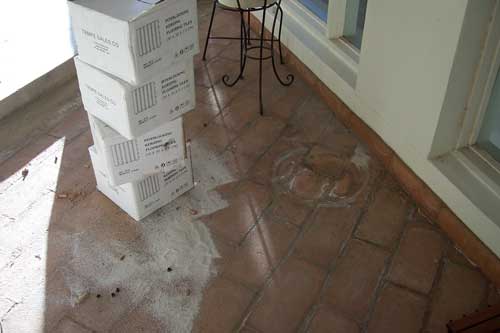
Here is the area before - note the water stains and the sand which is filling in big cracks and dips in the pavers:

Pr_before

Here is the floor after about 15 minutes -- they do go down fast.  They just lay on the ground with no adhesive.  The design of the bottoms keeps them from sliding around. 

Pr_middle

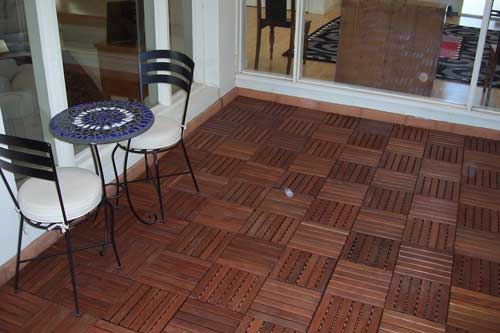
And finally, here we are mostly done.  The company offers edge pieces that are designed like little ramps so a mat of these tiles can stand alone, but we did not need them since I was filling a depressed space wall-to-wall.  Here is the final effect:

Pr_after2

We love the result.  I am just finishing a few diagonal cuts to finish off the last side - these were really the only hard part of the job.  I made them with some careful measuring and a circular saw (got a new one with a laser guide - awesome!)

Pr_almost_done

Anyway, this is not really the kind of thing I normally blog, but this product was something I had never seen before and came out so well and was so easy to put down, I had to share.  Besides, if VodkaPundit can share this (which made me really jealous by the way), I thought I could show my weekend project too.

Home Improvements

Blogging is light this weekend due to home improvements.  However, we found a cool new product for our house at the Phoenix home show, and, when I finish getting it installed, I will share some pictures.