Author Archive

Adding Solar to Our House -- Here Is Why

UPDATE:  This article has been heavily edited.  It turns out that solar installations without extensive battery systems do NOT act as a backup to grid outages.  By utility rules, the solar system has to shut itself down when the grid shuts down.  I should have done better research, but frankly I could not believe that the system shuts down EXACTLY when you most need it.  For me this revelation (which came from several readers, thanks!!) was a bit like finding out that your flashlight has software to shut down when it is dark outside. 

Our house has always been a good candidate for solar.  It has a large flat roof, good sightlines to the south, and we live in just about the best solar location in the country (Phoenix).  The problem has been two-fold:

  • Even with large tax rebates and other subsidies (e.g. ability to sell power into the grid at retail rather than wholesale rates), the payback periods are long.
  • Given that we are working in 10+ year paybacks, it has never been clear to me that most panels have the life needed.  All solar panels degrade with time and sometimes fail and I am not sure most economics include those factors.

What finally changed our minds was a question my wife asked me a few months back.  She would really be distressed at losing the A/C during a Phoenix summer, and asked if we should get a backup generator.  I told her such generators were large and expensive, but that if we really wanted some grid backup in Phoenix, solar seems to make sense.  Sure, it only backs up in the day, but that is when we really need it here.  The backup aspect was the cherry on top of the economics that put us over the top.

We knew we did not want some sort of leasing or pay-for-power arrangement that would encumber our home if we ever had to sell it so that meant we could shop for about any sort of panel we wanted.  In shopping for things nowadays, there is seldom consensus on the best, but right now there seems to be a near consensus in solar panels.  The SunPower panels have the best efficiency, the lowest efficiency reduction from high temperatures, the least efficiency drop off with time, and the longest warranty.  You pay for all that of course and they are pricey, but I decided to go with the pricier panels where I could be more sure of the economics in the out years.  We have made other investments in our home that have essentially represented a decision to stay for the long-term, so we invested for the long-term here.  I will say that it is possible we could have gotten better economics with another panel that was cheaper, even considering a shorter life, but I did not do the math for every panel.***  The panels we are buying are a huge step ahead of the old ones, as they have built -in inverters in each panel and so they produce AC directly.  This greatly reduces the wiring and installation costs.

Interestingly, the efficiency did not buy us much (at least today) because our total installation was limited by our service panel limits, which total to 400 amps.  This means that the efficiency really only saved us roof space which we had more than enough of.  However, while I chose not to do a battery system this time around (too expensive and too many safety questions), I may do one in the future so I wanted space for more panels to charge a future battery system.

The total payback comes to just about 10 years for our system.  At historic cost of capital numbers this probably does not pencil out but today with ZIRP it makes sense, especially with the extra benefit of some immunity from outages.  Even to get to these numbers you folks had to chip in to help my economics, in the form of the 30% tax rebate you are giving me and the above-wholesale price you are paying me for power I put into the grid.  This payback is mainly from getting rid of a LOT of our on-peak power usage, which costs us way more per KwH than off-peak.  A second project to add more solar charging batteries for evening use will have more challenging economics and will likely have to be justified purely on grid independence.  On the other hand, your economics in another location may be better, since our off-peak power costs of around 10-12 cents is pretty cheap.  On the gripping hand, you may not have as good of a solar insolation factor where you live.  My summary is that if you live in certain parts of SoCal with high electricity rates, this is a no brainer; if you live where I do it is marginal but works if you value some grid independence; and most everywhere else it is a real stretch and maybe closer to a rich man's toy than a sensible investment**.  However, those of you who have had good economics doing this elsewhere are welcome to comment below.

I will give more reports in the future as we go through this.

**  I would argue that experience from some place like SolarCity does not necessarily count as they never have and (as part of Tesla) likely never will make money, so there is an added subsidy in the equation there from well-meaning but naive stockholders.

*** It is hard also to do the full installation math on every panel as most installers have a limited range they work with and we only had the energy and time to engage a few installers for quotes.


I Agree With the NY Post: It’s shameful what US Open did to Naomi Osaka

Via the New York Post".  This is just disgusting:

Naomi Osaka, 20 years old, just became the first player from Japan to win a Grand Slam.

Yet rather than cheer Osaka, the crowd, the commentators and US Open officials all expressed shock and grief that Serena Williams lost.

Osaka spent what should have been her victory lap in tears. It had been her childhood dream to make it to the US Open and possibly play against Williams, her idol, in the final.

It’s hard to recall a more unsportsmanlike event.

Here was a young girl who pulled off one of the greatest upsets ever, who fought for every point she earned, ashamed.

At the awards ceremony, Osaka covered her face with her black visor and cried. The crowd booed her. Katrina Adams, chairman and president of the USTA, opened the awards ceremony by denigrating the winner and lionizing Williams — whose ego, if anything, needs piercing.

“Perhaps it’s not the finish we were looking for today,” Adams said, “but Serena, you are a champion of all champions.” Addressing the crowd, Adams added, “This mama is a role model and respected by all.”

Incredibly, much of the media and powerful celebrities have rallied around Ms. Williams to claim that she is actually the victim. She claims she was a victim of sexism in the match, but she was playing (and getting beat) by another woman.  She claims she was a victim of racism in the match because she is a woman of color, but she was not playing a white woman.  She claims to be a victim of the tennis establishment when in fact she is the most powerful person in women's tennis (maybe ever) and wields far more wealth and power than anyone on that court that day -- a power and privilege demonstrated by the fact that all the other powerful and privileged rallied to her side immediately after the match.

How Do You Know When That Psychology Study Won't Replicate?

This is a very good, very readable article about why many psychology studies don't replicate, though most of it is applicable to most any other field of research.   The author has four rules to keep in mind, and they are all good.  He looks at a number of studies that do not replicate to demonstrate how the rules work.  A sample:

This study is basically a p-hacking manual. They’re not even trying to hide it, instead describing in detail how, when a hypothesis failed to yield a p-value below 0.05, they tried more and more things until something publishable popped out by chance.

Libertarians Are Terrible At Persuasion in the Social Justice Language of Power and Privilege, and We Should Be Better At It. There is Definitely Common Ground to Be Explored

Why use the language of Power and Privilege at all?

One of my favorite political books is Arnold Kling's Three Languages of Politics (free download here).  It is a great reference for understanding why so much of politics devolves into talking past one another, and is a great guide for those who want to be persuasive outside of one's own tribe.

As background, I am a life-in-the-real-world (LIRW) libertarian who is most comfortable arguing on the freedom-coercion axis and based on economic efficiency.  LIRW libertarian means that I don't answer every policy question with a knee-jerk anarcho-capitalist get-the-government-out-of-the-way policy prescription.  I accept that government coercion is not going away and I can accept some state coercion in support of certain policy goals.   However, in doing so I assign something I call the Cost of Coercion to policy proposals in balancing out the costs and benefits and the coercion cost I assign will be high.  As such, then, I tend to discuss policy in terms of meeting goals with maximum economic efficiency and minimum levels of coercion.

In this article I want to talk about my (and other libertarians') attempts to engage (or failures to engage) Progressives on their preferred Oppressor-Oppressed axis.  While I think everyone benefits from learning to engage with folks who speak different political languages, doing so is particularly important for libertarians in the United States because we are the odd man out in the current two-party system.  Half our issues (e.g. free markets, limited government) require common cause with Conservatives while the other half (e.g., open immigration, drug legalization, gay marriage) require making common cause with Progressives.  In this article I want to talk about my (and other libertarians') attempts to engage Progressives on the Oppressor-Oppressed axis.

To start, I feel like I am pretty good at understanding the Progressive point of view on many issues (e.g. my intellectual Turing test here on Progressive arguments for the minimum wage).

However, on the airplane yesterday I was looking back at my proposed trans-partisan plan on climate action and found I did little in it to excite Progressives.  I still think that this is a very fair plan that could appeal to both Progressives and Conservatives, but I realize in retrospect that it does almost nothing to sell the plan to Progressives.  The article is mostly economic efficiency arguments that can sway Conservatives (at times) but seldom have a lot of power with Progressives.  Sure, the plan gives Progressives what they are asking for (a carbon tax) but I acknowledge in the article that there is evidence from the Washington State carbon tax vote that Progressives don't actually understand the benefits of a carbon tax very well.  Here, for example, is how I discussed the shift from a myriad of scattershot government interventions to the carbon tax:

Point 1: Impose a Federal carbon tax on fuel....So what is the best way to reduce CO2 -- by substituting gas for coal?   By more conservation?  By solar, or wind?  With biofuels?  With a carbon tax, we don't have to figure it out or have politicians picking winners.  This is why a Pigovian tax on carbon in fuels is going to be the most efficient possible way to reduce CO2 production.   Different approaches will be tested in the marketplace....

Point 3:  Eliminate all the stupid stuff...[in turn] I propose that we eliminate all the current Federal subsidies, mandates, and prohibitions that have been justified by climate change. Ethanol rules and mandates, solar subsidies, wind subsidies, EV subsidies, targeted technology investments, coal plant bans, pipeline bans, drilling bans -- it all should go.  The carbon tax does the work.

Picture the social justice warriors at some college today -- are they going to be excited by this?  I doubt it.  But what if I said this instead:

We should shift climate efforts from all the disparate, scattershot efforts today to a neutral carbon tax that is impossible for the powerful and privileged to game to their advantage. Current climate programs are all more likely to benefit Wall Street bankers and crony political interests than they are to help the climate.  For example, the Koch brothers have publicly admitted that their company is one of the largest beneficiaries of the current ethanol program, which was meant to benefit the climate but instead just pumps profits into a few well-connected multi-billion dollar corporations, while taking food from the poor and feeding it into people's gas tanks.

This second version, while it needs some polish, is clearly more compelling to a Progressive, and all of it is something I believe -- It's just not the first way I naturally defend the plan.  I need to get better on this.

Power and Privilege are a Useful Framework (among others) for Analyzing History and Public Policy

I have studied a lot of history in my life, mostly as a hobby.  When I first started studying history in secondary school in the 1980's, it was almost all presented as "great man" history -- i.e. history can be described as driven primarily by the actions of prominent individuals.  Julius Caesar did this and Henry the VIII did this other thing, etc.   Really, this approach to history was being overtaken even 100 years earlier than this, but I didn't really get exposed to other approaches until college.  There, I began to learn that Marxist historians in the 20th century brought a different view, that most of history was driven by big social and economic and demographic changes rather than individuals -- think Hari Seldon if you know that reference.

But the Marxists had a familiar problem (other than the obvious one where they explain every event in history as a class struggle and proto-Marxist revolution): They brought a great new tool to the analysis of history but then declared that it was the ONLY correct tool.  But there are plenty of historical turns where individuals mattered.  The revolution in Rome from the Republic to the Empire was probably inevitable from the large forces at work, but was the end of the civil wars in favor of decades of peace inevitable without the acumen of Augustus?

Other groups have contributed yet more lenses for looking at history.  I remember when it became de rigueur that history courses include lectures on life of the common person, the experience of women, and on other groups that don't have a big presence in the traditional historic record.  I initially rolled my eyes thinking that this all was a politically correct placeholder, but I eventually found it fascinating -- to the extent that I have since taken whole courses solely on the experience of common people in the Middle Ages and the Roman Empire.

To this same end, power and privilege is yet another useful framework for analyzing history.  The problem in my mind comes in the fact that so many students go through college, even graduate from college in history, looking at the world ONLY through this one lens.  To me this is madness.  It is like trying to play golf with just a 2-iron or to do math with just cosines.

Libertarians and the Power & Privilege Language

As demonstrated in my climate example earlier, there is no reason libertarians cannot engage progressives on the power and privilege or oppressor/oppressed axis.  Libertarians care a lot about the ability of the individual to be able to make decisions and live their life without coercion.  Many of the same things that upset progressives -- racism, sexism, various sorts of sexual prohibition, narcotics prohibition, fraud, migration restrictions, military interventionism -- also upset libertarians.  Libertarians and progressives both talk a lot about power and abuse of power, though granted they fear different sorts of power: libertarians tend to have more fear of government power, while progressives tend to fear any sort of economic power.  But even getting that far is at least a basis for meaningful discussion.  If you want to have an interesting discussion with a progressive, do what I did with one of my progressive in-laws and watch Michael Moore's Capitalism: A Love Story together.  The progressive will gladly watch it with you because they will think you are about to get schooled.  But watch as the movie unfolds -- failure after failure that Moore wants to describe to capitalism are in fact mostly due to crony government interventions to which libertarians are strongly opposed.  There is a surprising amount of common libertarian-progressive ground in the movie if you look past Moore's interpretation of these failures and pay attention to their actual causes.

This is what I had in mind when I wrote my recent article in Regulation Magazine, "How Labor Regulation Harms Unskilled Workers", to try to write something about labor regulation that was pitched more to progressives than to libertarians and conservatives.  Too often articles on the minimum wage focus solely on economic efficiency, or worse, on how labor market interventions negatively impact businesses.  When progressives see that something negatively impacts businesses, their first reaction is "awesome, let's do more of it!"  Not a great sales approach.   In my article, I was never going to convince progressives to give up on regulation of the terms and conditions of labor altogether -- it is simply too deeply ingrained in their philosophy that workers are powerless in the face of employers and need external protection.  But it might be possible to show progressives why something like the minimum wage can be a bad anti-poverty program that it actually tends to hurt the poorest and most vulnerable and least skilled.

The absolute best example I can think of how libertarian attempts to engage progressives have been terrible is the book by Nancy MacLean called Democracy in Chains.   The book makes the weird and not very well substantiated claim that James Buchanan, who won a Nobel Prize for his work in public choice theory, was heavily influenced by southern slavery supporters like John Calhoun, and thus, uh, public choice is racist or evil or something.  The book tends to get lauded by people who mostly like its thesis but did not read it and torn apart by academics who are hugely skeptical about its logic and factual basis.  The most amazing thing about the book is just how incurious Ms. MacLean is about public choice theory itself -- the head of the national organization of public choice economists is a professor on her own campus, with an office just a short walk away, yet she never consulted anyone in the field.

Here is why I highlight it, and not to beat up on a progressive who in turn beat up on a libertarian icon.  Public choice theory -- as I and most people who have studied it understand it -- should be tremendously interesting to progressives, so much so I think it could be a core text they study.  Not because I want to make them not-progressives (I will send them to Hayek for that) but because public choice theory says so much about how power and privilege are created and sustained.  Want to understand why Wall Street makes so much money and is so seemingly immune to accountability, check out public choice theory.  Want to know why you and I spend billions to subsidize profitable corporations like Boeing or Koch Industries, check out public choice theory.  Want to understand why public interventions often fail so you can make better interventions in the future, check out public choice theory.

The reason progressives don't look at public choice theory this way is in large part because libertarians have adopted public choice theory as their own and use it most often to push back on nearly every government intervention.  In particular, the Koch Brothers and Cato love public choice theory and use it to argue for small government, so in the tribal politics of the day, this means that progressives have to hate it.  I would argue that the best description of Nancy MacLean's approach to James Buchanan and public choice theory in her book (and her  more-than-apparent lack of desire to learn anything about it) is the fact that public choice theory is associated with the Koch Brothers and thus she wanted to bring it down to help bring down the Koch siblings who have become a progressive bete noire (despite their actually supporting a lot of progressive causes like gay marriage).  Ironically, from my limited reading, James Buchanan appears to have treated public choice more as a guide to good government than a trump card to be played against any government intervention.

This is why the book I would most like to write, if I had the academic chops and time to write it, would be "Public Choice for Progressives:  What James Buchanan can teach good government and equalizing power and privilege."  There are a lot of things libertarians and progressives are never going to agree on, but there are enough that we can agree on to make it worthwhile to learn their language.

Today's Lesson in Public Choice Theory and Unintended Consequences

"F.D.A. Cracks Down on Juul and E-Cigarette Retailers" today, via the NYT.

As of this moment, cigarette-maker Phillip Morris stock is up nearly 4.5% on the news.  This happens so many times in sloppy policy making that I can't even count them.  Do-gooders assume that when they ban things, like e-cigarettes, that individuals will turn to the regulators' preferred alternative, in this case abstinence from any type of vaping or smoking.  But in fact, many are much more likely to switch to tobacco smoking, which is orders of magnitude more dangerous than vaping.  Adults who think these things through, like investors on Wall Street, understand this so that is why Phillip Morris has gained over $5 billion in value today.  The FDA is working to create a whole new generation of tobacco smokers.

When I hear that "that teenage use of electronic cigarettes has reached 'an epidemic proportion,'" unlike the regulators I do not immediately assume this is unalloyed bad news.  Another way of putting this is an "epidemic of teenagers who are turning to safer alternatives to really damaging tobacco products."

And when it turns out the regulators just make things worse so they can win this news cycle of virtue signalling, there is no way they will take responsibility for it,

And if you want to be really, really cynical about this, you might remember that with the huge government tobacco settlement, the government essentially made itself business partners with the large tobacco companies.  Any competitors threatening the top companies in the settlement seriously threaten tax income to many state governments.

Trans-partisan Plan #1: Addressing Man-Made Global Warming With A Plan That Could Be Supported By Both Democrats and Republicans

While I am not deeply worried about man-made climate change, I am appalled at all the absolutely stupid, counter-productive things the government has implemented in the name of climate change, all of which have costly distorting effects on the economy while doing extremely little to affect man-made greenhouse gas production.  For example:

Even when government programs do likely have an impact of CO2, they are seldom managed intelligently.  For example, the government subsidizes solar panel installations, presumably to reduce their cost to consumers, but then imposes duties on imported panels to raise their price (indicating that the program has become more of a crony subsidy for US solar panel makers, which is typical of these types of government interventions).  Obama's coal power plan, also known as his war on coal, will certainly reduce some CO2 from electricity generation but at a very high cost to consumers and industries.  Steps like this are taken without any idea of whether this is the lowest cost approach to reducing CO2 production -- likely it is not given the arbitrary aspects of the program.

These policy mess is also an opportunity -- it affords us the ability to substantially reduce CO2 production at almost no cost.

The Plan

Point 1: Impose a Federal carbon tax on fuel.

I am open to a range of actual tax amounts, as long as point #2 below is also part of the plan.  Something that prices CO2 between $25 and $45 a ton seems to match the mainstream estimates of the social costs of CO2.  I think methane's greenhouse effects are exaggerated, but one could make an adjustment to the natural gas tax numbers to take into account methane leakage in the production chain.   I am even open to making the tax=0 on biofuels given these fuels are recycling carbon from the atmosphere.

So what is the best way to reduce CO2 -- by substituting gas for coal?   By more conservation?  By solar, or wind?  With biofuels?  With a carbon tax, we don't have to figure it out or have politicians picking winners.  This is why a Pigovian tax on carbon in fuels is going to be the most efficient possible way to reduce CO2 production.   Different approaches will be tested in the marketplace.  Cap and trade could theoretically do the same thing, but while this worked well in some niche markets (like SO2 emissions), it has not worked at all in European markets for CO2.   There has just been too many opportunities for cronyism, too much weird accounting for things like offsets that is hard to do well, and too much temptation to pick winners and losers.

When I first crafted early drafts of this plan several years ago, I had assumed that Progressives championed a carbon tax for the reasons I listed above, ie that it is the most efficient means to allow markets to reduce emissions.  However, the referendum a couple of years ago in Washington State demonstrated that many Progressives may not understand this at all.  You can read a lot more about this debate here.  I fail the ideological Turing test on this one, because I don't know if the Progressives who were strongly for CO2 reduction but opposed the Washington State carbon tax did so because they did not understand economics or because they cared less about global warming than funding other Progressive causes.

Point 2:  Offset 100% of carbon tax proceeds against the payroll tax

Yes, there are likely many politicians, given their incentives, that would love a big new pool of money they could use to send largess, from more health care spending to more aircraft carriers, to their favored constituent groups.  But we simply are not going to get Conservatives (and libertarians) on board for a net tax increase, particularly one to address an issue folks on the Right may not agree is an issue at all.  So our plan will use carbon tax revenues to reduce other Federal taxes.

I think the best choice would be to reduce the payroll tax.  Why?  Because, the carbon tax will necessarily be regressive (as are most consumption taxes) and the most regressive other major Federal tax we have are payroll taxes.  Offsetting income taxes would likely be a non-starter on the Left, as no matter how one structures the tax reduction the rich would get most of it since they pay most of the income taxes.

There is another benefit of reducing the payroll tax -- it would mean that we are replacing a consumption tax on labor with a consumption tax on fuel. It is always dangerous to make gut-feel assessments of complex systems like the economy, but my sense is that this swap might even have net benefits for the economy -- so much so that we might want to do it even if there was no such thing as greenhouse gas warming.  In theory, labor and fuel are economically equivalent in that they are both production raw materials. But in practice, they are treated entirely differently by the public.   Few people care about the full productive employment of our underground fuel reserves, but nearly everybody cares about the full productive employment of our labor force.   After all, for most people, the primary single metric of economic health is the unemployment rate.  So replacing a disincentive to hire with a disincentive to use fuel could well be popular.

Point 3:  Eliminate all the stupid stuff

Oddly enough, this might be the hardest part politically because every subsidy, no matter how idiotic, has a hard core of beneficiaries who will defend it to the death -- this the the concentrated benefits, dispersed cost phenomena that makes it hard to change many government programs.  But never-the-less I propose that we eliminate all the current Federal subsidies, mandates, and prohibitions that have been justified by climate change. Ethanol rules and mandates, solar subsidies, wind subsidies, EV subsidies, targeted technology investments, coal plant bans, pipeline bans, drilling bans -- it all should go.  The carbon tax does the work.

States can continue to do whatever they want -- we don't need the Feds to step on states any more than they do already, and I continue to like the 50 state laboratory concept.  If California wants to continue to subsidize wind generators, let them do it.  That is between the state and its taxpayers (and for those who think the California legislature is crazy or that the Texas legislature is in thrall to oil companies, that is what U-Haul is for).

Point 4:  Revamp our nuclear regulatory regime

As much as alternative energy enthusiasts would like to deny it, the world needs reliable, 24-hour baseload power -- and wind and solar are not going to do it (without a change in storage technology of at least 2 orders of magnitude in cost).  The only carbon-free baseload power technology that is currently viable is nuclear.

I will observe that nuclear power suffers under some of the same problems as commercial space flight -- the government helped force the technology faster than it might have grown organically on its own, which paradoxically has slowed its long-term development.  Early nuclear power probably was not ready for prime time, and the hangover from problems and perceptions of this era have made it hard to proceed even when better technologies now exist.   We are at least 2 generations of technology past what is in most US nuclear plants.  Small air-cooled thorium reactors and other technologies exist that could provide reliable safe power for over 100 years.  I am not an expert on nuclear regulation, but it strikes me that a regime similar to aircraft safety, where a few designs are approved and used over and over makes sense.  France, which has the strongest nuclear base in the world, followed this strategy.  Using thorium could also have the advantage of making the technology more exportable, since its utility in weapons production would be limited.

Point 5: Help clean up Chinese, and Asian, coal production

One of the hard parts about fighting CO2 emissions, vs. all the other emissions we have tackled in the past (NOx, SOx, soot/particulates, unburned hydrocarbons, etc), is that we simply don't know how to combust fossil fuels without creating CO2 -- CO2 is inherent to the base chemical reaction of the combustion.  But we do know how to burn coal without tons of particulates and smog and acid rain -- and we know how to do it economically enough to support a growing, prosperous modern economy.

In my mind it is utterly pointless to ask China to limit their CO2 growth.  China has seen the miracle over the last 30 years of having almost a billion people exit poverty.  This is an event unprecedented in human history, and they have achieved it in part by burning every molecule of fossil fuels they can get their hands on, and they are unlikely to accept limitations on fossil fuel consumption that will derail this economic progress.  But I think it is reasonable to help China stop making their air unbreathable, a goal that is entirely compatible with continued economic growth.  In 20 years, when we have figured out and started to build some modern nuclear designs, I am sure the Chinese will be happy to copy these and start working on their CO2 output, but for now their Maslov hierarchy of needs should point more towards breathable air.

As a bonus, this would pay one immediate climate change benefit that likely would dwarf the near-term effect of CO2 reduction.  Right now, much of this soot from Asian coal plants lands on the ice in the Arctic and Greenland.  This black carbon changes the albedo of the ice, causing it to reflect less sunlight and absorb more heat.  The net effect is more melting ice and higher Arctic temperatures.  A lot of folks, including myself, think that the recent melting of Arctic sea ice and rising Arctic temperatures is more attributable to Asian black carbon pollution than to CO2 and greenhouse gas warming (particularly since similar warming and sea ice melting is not seen in the Antarctic, where there is not a problem with soot pollution).

Final Thoughts

At its core, this is a very low cost, even negative cost, climate insurance policy.  I am convinced this policy, taken as a whole, would still make sense even if CO2 turns out to be as harmless as nitrogen.  The carbon tax combined with a market economy does the work of identifying the most efficient ways to reduce CO2 production.   The economy benefits from the removal of a myriad of distortions and crony give-aways, while also potentially benefiting from the replacement of a consumption tax on labor with a consumption tax on fuel.  The near-term effect on CO2 is small (since the US is only a small part of the global emissions picture), but actually larger than the near-term effect of all the haphazard current programs, and almost certainly cheaper to obtain.  As an added benefit, if you can help China with its soot problem, we could see immediate improvements in probably the most visible front of man-made climate change:  in the Arctic.

Postscript

Perhaps the hardest thing to overcome in reaching a compromise here is the tribalism of modern politics.  I believe this is  a perfectly sensible plan that even those folks who believe man-made global warming is  a total myth ( a group to which I do not belong) could sign up for.  The barrier, though, is tribal.  I consider myself to be pretty free of team politics but my first reaction when thinking about this kind of plan was, "What? We can't let those guys win.  They are totally full of sh*t.  In the past they have even threatened to throw me in jail for my opinions."  Since I first published this plan I have had very prominent skeptics contact me to criticize me for "giving in to the warmists."

A New Series: Trans-partisan Policy Plans

For a while I have been thinking about a jumble of interrelated issues:  problems with civil discourse, particularly the tribalization of politics and social media;  a personal aspiration to be better at Caplan's ideological Turing test on a number of issues; and a skepticism that pleas for civility are really going to achieve more than just becoming another form of virtue signalling.

So what I have decided to start a new series with a number of policy proposals that are as broad in their appeal as I can make them.  And in saying this I am not just going to present libertarian plans and call them non-partisan --  I bring libertarian-ish leanings to these proposals, but I will also diverge from the hard core libertarian position on each.  I use trans-pipartisan" as a shortcut term to say they are meant to simultaneously play on all of Arnold Kling's three axes of politics.

As a warning, I am not a policy expert and a large reason I present these is to develop and clarify my own thinking.  Some will be well-developed -- the  climate plan is in its 3rd or 4th iteration -- and some like the education plan is just a jumble of thoughts in my brain right now.

Media Extrapolating a Trend From A Single Data Point: 2018 Heat Wave Edition

This article in something called Inside Climate News seems to be typical of many I have seen this year:  Because we have had much attention in the media on heat waves this year, there must be an upward trend in heat waves and that is a warning signal that man-made global warming is destroying the planet.  Typical of these articles are a couple of features

  1. Declaration of a trend without any actual trend data, but just a single data point of events this year
  2. Unstated implication that there must be a trend because the author can't remember another year when heat wave stories were so prevalent in the media
  3. Unproven link to man-made global warming, because I guess both involve warmth.

I have no idea if well-publicized heat waves this year are a harbinger of an accelerating global warming trend.  But since we are discussing "trends" it struck me as useful to actually liven up the discussion with some actual trend data, ie data for more than one summer.  There is a real danger to extrapolating trends from volume of media coverage, as I discussed here.  If you don't want to click through, I have a funny story in the postscript.

First, our most reliable temperature trend data does not really show a spike in temperatures this summer.  Remember, a heat wave that covered the entire US would only affect 6% of the world's landmass and <2% of the world's total area (source).  You can easily see the trend upwards several tenths of a degree over the last 40 years, but it is impossible to see much unique about the last 3 months of summer.

Second, there really is no substantial upward trend in US heat wave index (from right off the EPA's web site, as are all of the following charts.  Look at the source for yourself to make sure I am not playing games).  Note that all of the following charts are through 2016 and do NOT include the recent summer but are pretty meaningful none-the-less.

Third, in most of the country, there is actually a downward trend rather than upward trend in extreme heat days.

Pretty much everyone agrees, skeptics included, that the world and the US has warmed.  So why are extreme heat days down in many locations, and certain down from the 1930's?  This defies our intuition.  The explanation is in part due to a feature of global warming that is seldom explained well by the media, that much of the warming we see and as predicted in climate models is in the night.  We are seeing some increase in hot daytime highs, but really not at an unprecedented level over the last century.  BUT, we see MUCH more of a trend in hot daily lows, which basically means warming evenings.

I spoke at Amherst College a while back and here was their temperature trends, broken up between daily highs and nighttime lows.  All of Amherst's temperature trend since 1950 has not been in increased daytime highs but higher nighttime lows.  This is a pattern you see repeated over and over at nearly every temperature station.

This is why I consider media reports of heat waves, at least of the scope we have seen to date, absolutely irrelevant to "proving" the world is warming.

Postscript:  Here is the story everyone should keep in mind when extrapolating from media coverage volume to underlying trends:

let's take a step back to 2001 and the "Summer of the Shark." The media hysteria began in early July, when a young boy was bitten by a shark on a beach in Florida. Subsequent attacks received breathless media coverage, up to and including near-nightly footage from TV helicopters of swimming sharks. Until the 9/11 attacks, sharks were the third biggest story of the year as measured by the time dedicated to it on the three major broadcast networks' news shows.

Through this coverage, Americans were left with a strong impression that something unusual was happening -- that an unprecedented number of shark attacks were occurring in that year, and the media dedicated endless coverage to speculation by various "experts" as to the cause of this sharp increase in attacks.

Except there was one problem -- there was no sharp increase in attacks. In the year 2001, five people died in 76 shark attacks. However, just a year earlier, 12 people had died in 85 attacks. The data showed that 2001 actually was a down year for shark attacks.

Update:  I am not really an active participant in the climate scene any more, particularly when positions hardened and it was impossible to really have an interesting discussion any more.  The implicit plea in this post goes beyond climate -- if you are claiming a trend, show me the trend data.  I can be convinced.  There is clear trend data that temperatures are increasing so I believe there is an upward trend in temperatures.  Show me the same for droughts or heat waves or hurricanes and I will believe the trend about those as well, but so often the actual data never matches the arm-waving in these media sources.

YouTube Does Not Actually Understand The Skeptic Position: It Put A Warning On My Climate Video Saying Exactly What I Said

I have made this point in the past, but very few folks on the warming-panic side of the climate debate actually are familiar with even the most basic outlines of what skeptics argue.  The climate debate is one of the worst examples I can think of where partisans gain their only knowledge of what the other side is saying from slanted and ill-informed descriptions of the opponents by their own side.  This is roughly like my informing myself of Hillary Clinton's political positions solely from listening to Rush Limbaugh.

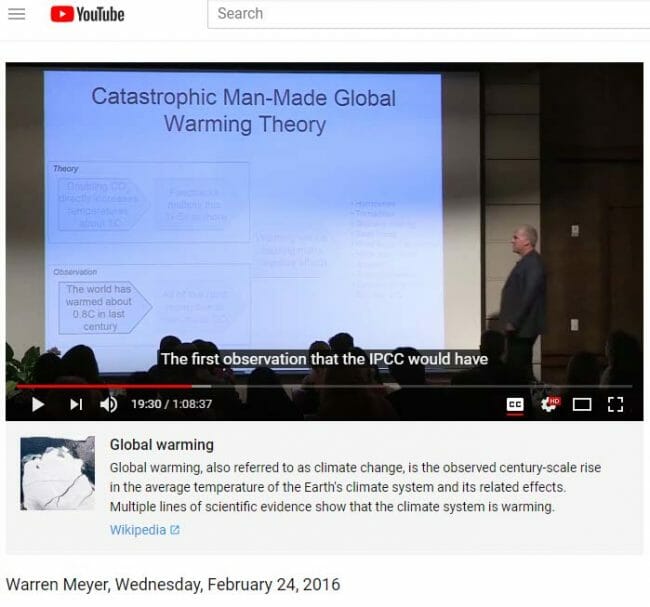
YouTube has adopted a policy of putting information / warning labels on videos by climate skeptics.  Here is a screen shot, the YouTube addition is in the beige box:

This is the only example I know of YouTube doing this -- for example, you can't find information labels on, say, 9/11 Truther videos reading "steel doesn't have to melt to fail" or on Bernie Sanders socialist videos saying "adopting Marxism led to the deaths of tens of millions of people in the 20th century."  So I guess we climate skeptics are considered by Google to be the worst of the worst on the truth scale.

But the truly hilarious part is that I don't disagree with this statement one bit**.  Neither does any other prominent skeptic I know of.  In fact, I have queued up the video to the 19:30 mark and you can watch me say exactly this.


Clearly, Google does not actually know what climate skeptics say.  In fact, much of the video (which despite being 2 years old is still my current position on the topic and a good introduction to the climate debate) is about this very topic -- how what skeptics actually say and what warmists say what we way are so different, and how that SNAFU's the climate debate.  One of my most popular articles in Forbes was on the same topic.

Postscript:  I am not a conspiracy theorist, and try not to assign arcane outcomes in chaotic systems to subterfuge.  But I do find it odd that when I Google myself, in the fourth position is random critique of one of my climate articles.  There have been much more intelligent critiques of me historically than this one, and this particular critique garnered far fewer reads and inbound links than the original article, which shows up nowhere in the search.  I am not persuaded that Google is putting its thumb on the scale in favor of critiques of skeptics, but I could be.

**Though I might quibble with equating climate change and global warming.  They are obviously related but certainly not equivalents.

Softest T-Shirt

I post things like this NOT because I have any fashion or shopping sense but because I happen once in a while to stumble on something I really like.  I personally hate shopping and just want someone to tell me "buy this one, it is the best", sort of like going to Toms Hardware and finding which graphics card is currently the best value. 

When I am working out, I wear Drifit type wicking fabrics, but for other casual times around the house I want a soft t-shirt for lounging around.  Until recently my choice was a Kit and Ace T-shirt that I think had some cashmere in it (maybe this one?).   I can't be sure because there is absolutely no size or sku information in the shirt.  By the way, a note to clothing companies:  I buy clothing in physical stores, but I often want to re-buy the same sku onlie either as replacements or for additional colors and that is impossible if you don' somehow print size and sku information in the item.  Also, and I am told by the women in my family that this is a typically male rant, I am constantly exhausted to find that the item I loved and want to buy again over and over does not exist and has morphed into some other style or sku.  I am happy to keep re-buying the same shorts and shirts and running shoes forever if someone will sell them to me.

Anyway, my new favorite T-shirt and the current leader in my closet for softness is the Cloudknit tee from Outdoor Voices.  Outdoor Voices is a small company in startup mode and can be a little spotty on its inventory availability.  I found it on a vacation weekend in Aspen where they had a pop-up store we happened to walk into.  I love this shirt and bought a pile of them to sleep in (I don't really prefer to sleep in a lot of clothing but my wife is at that special age when she needs to keep the bedroom somewhere around freezing).  The Cloudknit hoodie is also amazing for lounging about the house.  Their "Doing Things" fabric is more for workouts and it is fine but not as spectacularly soft as their cloudknit fabric.

As a reminder, my one other shirt recommendation was for Hawaiian shirts from Tori Richard.  Great concept -- Hawaiian shirt patterns printed on fabrics that actually feel like quality fabrics.  I also like the orange label products because it is a more attractive fit -- most Hawaiian shirts are not very tailored.   If you want to try something different, try their crinkle fabric which I really like but is not loved by everyone.  I just throw them in the washing machine and hang them slightly damp until they dry and they are great.  I used to do the same thing for my Tommy Bahama shirts but if you hang them to dry they become really stiff for some reason.  Tommy Bahama shirts can be quite nice, especially as they age, but you have to tumble them dry to keep them soft, not sure why.  Fortunately neither shirt needs to be ironed (any shirt that requires ironing in my closet -- except for a few dress shirts and my beloved Robert Graham shirts -- immediately goes to Goodwill).

These Are The Folks We Let Criticize Us?

From the Chronicle of Higher Education:

Upset and ashamed, my fellow graduate students and I speak with one another cautiously. We heal, or don’t, alone. People I know are afraid to make any public comment, even on Facebook, where they are friends with older, richer scholars who might one day control their fates. Even I, who have by extraordinary luck options outside of academia, fear what being vocal will bring.

A culture of critics in name only, where genuine criticism is undertaken at the risk of ostracism, marginalization, retribution — this is where abuses like Avital’s grow like moss, or mold. Graduate students know this intuitively; it is written on their bones. They’ve watched as their professors play favorites, as their colleagues get punished for citing an adviser’s rival, as funding, jobs, and prestige are doled out to the most obedient and obsequious. The American university knows only the language of extortion. “Tell,” it purrs, curling its fingers around your IV drip, “and we’ll eat you alive.”

Avital conducts herself as if someone somewhere is always persecuting her. She learned this, I imagine, in graduate school. No woman escapes the relentless misogyny of the academy. The humanities are sadistic for most people, especially when you aren’t a white man. This is understood to be normal. When students in my department asked for more advising, we were told we were being needy. “Graduate school should destroy you,” one professor laughed.

The irony is that those who survive this destruction often do so at the cost of inflicting the same trauma on their own students. Avital, now a grande dame of literary studies, who Reitman alleges bragged to him of a “mafia”-like ability to make or break the careers of others, still feels persecuted. She makes it the job of those around her to protect her from that persecution: to fawn, appease, coddle. The lawsuit against her reads as a portrait, not of a macho predator type, but of a desperately lonely person with the power to coerce others, on pain of professional and psychic obliteration, into being her friends, or worse.

Update on the Phoenix Light Rail Fail

A few weeks ago I posted Valley Metro's own numbers that showed that the billions spent on light rail in the Phoenix area have done nothing but case the stagnation of transit ridership in Phoenix.  Light rail ridership actually fell substantially despite an expensive extension of the line.

Today, the Antiplanner has an update on light rail in Phoenix, and it is not pretty:

As of 2016, light rail carries less than 0.2 percent of all travel in the Phoenix urban area. The 2016 American Community Survey says that the same tiny percentage of commuters take light rail to work, which is unusual as transit’s commuter share is usually much higher than its total share. Phoenix light-rail ridership in the twelve months ending in June, 2018 was down 4.4 percent from the previous twelve months. Transit ridership for Phoenix as a whole is down 5.6 percent for the same time period.

Phoenix is one of many Sunbelt urban areas in which rail transit makes no sense at all. Aside from the Antiplanner’s argument that buses can move more people than light rail, rail systems only make sense where there is a high concentration of downtown jobs that a hub-and-spoke transit system can serve. According to Wendell Cox’s calculations, downtown Phoenix has only about 26,000 jobs, which is just 1.4 percent of jobs in the metropolitan area.

Phoenix is particularly unusual (though not unique) in that its suburbs are actually denser than the city itself. According to the 2010 census, the city of Phoenix has about 2,800 people per square mile, while its suburbs have nearly 3,500 people per square mile. With both jobs and population spread out, the region needs nimble, low-capacity transit if it needs any transit at all.

Arizona State University students make up a “substantial component” of light-rail riders. Until this year, students were able to buy transit passes for 200 for the nine-month school year, plus $75 for the other three months. The same passes would cost other members of the public $768 per year. Despite the steep discounts, student weekday ridership dropped by around 40 percent between 2011 and 2015.

The last paragraph reminds me that I forgot to discuss the issue with ridership and ASU students in my last post.  A huge portion of Phoenix light rail ridership comes from two sources:  subsidized ASU students and fans going to downtown sporting events.  This helps to explain why the commuter share of Phoenix ridership is so low -- essentially, many of the light rail riders are not commuters but in these two other groups.  Why we should be spending billions to subsidize bar crawls for already heavily-subsidized ASU students or to save sports fans money on downtown parking** is beyond me.

He has this good news:

The Phoenix city council is considering delaying or even killing some planned light-rail lines because it is concerned that city streets are falling apart and too much money is being spent instead on an insignificant form of travel.

** much of the downtown parking revenue for sporting events goes to the city and county, so cannibalization of this revenue is yet another hidden cost of light rail.

I Am Tired of Being An Unpaid Laborer For My Own Destruction

For some reason my small business now has to fill out three incredibly time-consuming census reports every year.  I don't know what we did to be punished in this way, but each of these (if one were truly diligent) can take more time than a tax return to fill out.

Several of the reports ask for accounting data in ways no private company keeps accounting data, such that really giving them the number they want would take hours or days of recasting thousands of accounting transactions. I try to give them something reasonable but let's just say they get exactly the quality they pay for here.

There does not seem to be any filter or limit on the amount of time government bureaucrats can demand for this cr*p.  Every bureaucrat seems to have some piece of data they think is desperately needed, so every year each of these reports gets longer and every few years another report is added.  It is particularly frustrating because the government is just going to use this data to justify regulating or taxing me more.  My forced unpaid labor is providing ammunition for the government to make my life harder.

And speaking of unpaid labor:  Last time I wrote something like this about how much I hated this data gathering (at that time I only had to fill out one of these) I had economists write me that this is really important data and without it they could not do their job.  You know what?  I don't demand economists perform unpaid labor to support my job, why do I have to provide unpaid labor to support theirs?  If this is such vitally important data, pay me for it.

You Won't Find the Words "Fired" or "Terminated" In This Article

NY City workers used project housing for orgies while being paid overtime.

Update:  As many of you know, my company privately operates public recreation areas.  One of our sales points vs. public management is, honest to God, that when we have a bad employee we can just fire them.

Life in the Trump Era: Conservatives Now Define Raising Taxes as "Progress"

John Hinderaker of Powerline writes approvingly of Trump's apparent trade deal with Mexico.  First, he quotes the New York Times celebrating the higher taxes:

Under the changes agreed to by Mexico and the United States, car companies would be required to manufacture at least 75 percent of an automobile’s value in North America under the new rules, up from 62.5 percent, to qualify for Nafta’s zero tariffs. They will also be required to use more local steel, aluminum and auto parts, and have 40 to 45 percent of the car made by workers earning at least $16 an hour, a boon to both the United States and Canada and a win for labor unions, which have been among Nafta’s biggest critics.

I am not sure how narrowing the scope of products subject to lower taxes is a "boon" to this country, though I suppose labor unions might be happy and one is suspicious that this is sufficient reason for the NYT to support it.  My suspicion is that these numbers are incredibly carefully tailored by Ford and GM lobbyists to hit a couple of their competitors while missing themselves -- this has all the fingerprints of a classic crony deal that benefits very few powerful groups to the detriment of most consumers.

So the NYT can be expected to cheer for bad crony economics that helps a few unions, but what about Conservatives, who are supposed to understand markets and trade.  Hinderaker writes:

So, from 62.5% to 75% to qualify for zero tariffs. Not exactly radical, but positive.

So broadening a US government tax on US consumers is "positive."  Powerline in the past has rightfully chided Paul Krugman for abandoning his understanding of economics in favor of cheerleading the Democratic team.  Now Powerline is doing the same for Trump.

Well, I Was Wrong about Super Delegates

A couple of years ago, in response to suggestions that the Democratic Party should get rid of super-delegates in their Presidential nominating process, I argued that the Trump election was going to lead to just the opposite response from party officials:  not only would the Dems not eliminate the practice, but I thought the Republicans would want to add super-delegates to give party insiders a way to combat populist candidates like Trump.  Well, I was at least half wrong, as the Dems have apparently substantially reduced the power of super delegates.

The Cycles of Government and the US Constitution

I was in a course this weekend on the rise and fall of the Roman Republic.  One term that was new to me was Polybius's theory of government called Anacyclosis (Polybius was a contemporary of the Roman Republic and actually lived during the time when the seeds of the Republic's downfall were being planted).  Others before and after Polybius had similar ideas but apparently Polybius gets a lot of the credit.  There are two interesting ideas in this theory that I think will have a lot of resonance to folks today.  First, he believed that governments followed a cycle from one-man rule to aristocracy to democracy and back.  Second, and perhaps more interesting, he believed that each of these three forms of government had a good and bad form, and that the good form was inherently unstable and always degenerated into the bad form.

Here is how Wikipedia summarizes the cycle:

Polybius' sequence of anacyclosis proceeds in the following order: 1. monarchy, 2. kingship, 3. tyranny, 4. aristocracy, 5. oligarchy, 6. democracy, and 7. ochlocracy.

According to Polybius' elaboration of the theory, the state begins in a form of primitive monarchy. The state will emerge from monarchy under the leadership of an influential and wise king; this represents the emergence of "kingship". Political power will pass by hereditary succession to the children of the king, who will abuse their authority for their own gain; this represents the degeneration of kingship into "tyranny".

Some of the more influential and powerful men of the state will grow weary of the abuses of tyrants, and will overthrow them; this represents the ascendancy of "aristocracy" (as well as the end of the "rule by the one" and the beginning of the "rule by the few").

Just as the descendants of kings, however, political influence will pass to the descendants of the aristocrats, and these descendants will begin to abuse their power and influence, as the tyrants before them; this represents the decline of aristocracy and the beginning of "oligarchy". As Polybius explains, the people will by this stage in the political evolution of the state decide to take political matters into their own hands.

This point of the cycle sees the emergence of "democracy", as well as the beginning of "rule by the many". In the same way that the descendants of kings and aristocrats abused their political status, so too will the descendants of democrats. Accordingly, democracy degenerates into "ochlocracy", literally, "mob-rule". In an ochlocracy, according to Polybius, the people of the state will become corrupted, and will develop a sense of entitlement and will be conditioned to accept the pandering of demagogues.

Eventually, the state will be engulfed in chaos, and the competing claims of demagogues will culminate in a single (sometimes virtuous) demagogue claiming absolute power, bringing the state full-circle back to monarchy.

He believed that the Roman Republic worked because it was a merger of all three forms of government.  If this seems like a goofy theory, like the balancing of humors for health; or if it seems wrong because we are all taught today that democracy is superior to the other two forms, consider this:  In the US, think of the Presidency as kingship, the Senate (as originally configured in the Constitution) as aristocracy, and the House of Representatives as democracy.  Our Constitution is arguably based in part on Polybius's theory.

What I Am Wondering About Inflation

Tyler Cowen asks, "Why isn’t inflation higher?"  I have wondered that for a while, but monetary policy and related topics in macro are one of the areas I admit that I simply do not understand so I don't write about it.  So rather than offering any hypotheses to Cowen's question, I will ask my own:

  1. Is it possible that inflation exists but it shows up mainly in financial assets (stocks, bonds, perhaps real estate) that don't really factor into standard inflation metrics?  Every step the Fed has taken, as well as other western central banks, appears to me to be crafted to pump money into securities markets rather than into main street.  Certainly we have seen a huge inflation in the value of financial assets and real estate over the past several years.
  2. Expansion of the economy above the rate of productivity improvement should drive inflation, unless there was a lot of excess capacity to soak up.   That may have been partly the case in the US since 2008, but surely that is gone.  Does the still greatly underutilized Chinese and Indian labor force act as excess capacity that prevents inflation from heating up here?  If so, might Trump's trade restrictions interfere with this going forward?

Fixing Tesla

I promised I would not post any more Tesla for a while, and to some extent I am keeping that promise -- no updates here on the SEC investigation or the 420 tweet.  But since I have been critical of Tesla in the past, I thought I would acknowledge that there are good things in Tesla that could and should be saved.  The problem is that Tesla is saddled with a bunch of problems that are NOT going to be solved by going private.  In fact, going private could only make things worse -- given that Tesla already has too much debt and its debt is rated barely above junk bonds, piling on more debt just to save Elon Musk from short sellers is not a good plan.  Here is what I would suggest:

  1. Find the right role for Elon Musk.  Musk HAS to be part of the company, without him its stock would go to about zero tomorrow.  But right now he is CEO, effective head of media relations, factory manager, and chief engineer.  Get him out of day to day management (and off Twitter) and hire real operating people who know what they are doing
  2. Get rid of the dealerships.  Tesla tried to do something different, which is own all the dealerships rather than franchise them out.  This is fine if one has some sort of vision for doing sales and service differently, but Tesla really doesn't.  It does the same things as other car dealerships but just slower since it has not been able to build out capacity fast enough.  And this decision has cost them a tons of growth capital they desperately need, because they have had to build out dealerships most car companies get for "free" because the capital for the dealerships is provided by third-party entrepreneurs.  Also, the third-party entrepreneurs bring other things to the table, for example many of them tend to have experience in the car sales business and a high profile in their local markets with government and media.
  3. If possible, find a partner for the charging network.  All traditional car companies get their fueling networks for free because the network is already built out by the oil companies.  Tesla is building its own, and again this is sucking up a lot of capital.  It is also dangerous, because Tesla has chosen to pursue a charging standard that may not become the industry standard (this is already happening in Europe) and Tesla risks being stuck with the betamax network.  Tesla should see if it can shift this to a third party, perhaps even in joint venture with other EV companies.
  4. Do an equity raise.  To my mind, it is absolute madness Tesla did not do this earlier in the year.   Their stock was trading at $350 and at a $50+ billion valuation at the same time they were burning cash cash at a rate of $3 billion or so a year.  Musk says he can skate through without more capital but he has said this before and it was not true.  Given the enthusiasm for his stock, there is just no reason to run cash poor when there are millions of Tesla fanboys just waiting to throw money at the company.  Even a $5 billion raise would have been only 10% dilution.  Musk says he wants to burn the shorts but ask any Tesla short out there what they would most fear, and I think they would all say an equity capital raise.  $3-5 billion would get Tesla at least through 2019 no matter how bad the cash burn remained and give the company space to solve its operational problems.
  5. Get someone who knows how to build cars building the cars.  I have written about this before -- it is always hard when you are trying to be a disruptor of an industry to decide what to disrupt and what industry knowledge to incorporate.  In retrospect, Musk's plan to ignore how cars are built and do it a different way is not working.  Not only are the cost issues and throughput issues, but there are growing reports of real quality issues in model 3's.  This has to be fixed ASAP.
  6. Bring some sanity to the long-term product roadmap.  This may be a bit cynical, but Tesla seems to introduce a new product every time Musk needs to divert the public's attention, his equivalent of yelling "Squirrel!"  There is the semi, a pickup truck, a roadster and probably something else I have forgotten about.  Even the model 3 lineup is confusing, with no one really knowing what Tesla is going to focus on, and whether the promised $35,000 model 3 will ever actually be built.  This confusion doesn't work well with investors at all, but Tesla has been able to make it work with customers, increasing the buzz around the company because no one ever seems to know what it will do next.  But once real competitors start coming out from GM, Volvo, Jaguar, BMW and others, this is not going to work.  Customers that are currently captive to Tesla will have other options.    Let's start with the semi.  The demo was a beautiful product, but frankly there is no way Tesla is going to have the time or the money to actually produce this thing.   Someone like Volvo is going to beat them to the punch.   They need to find a JV partner who can actually build it.

Update:  If I had a #7, it would be: Invent a time machine and go back and undo the corrupt SolarCity buyout, in which Tesla bailed out Musk's friends and family and promptly proceeded to essentially shut down the company.  Tesla shareholders got nothing from the purchase except a lot of debt.


Here is a Fun Challenge: Be Skeptical of Statistics Even When They Support Your Point of View

I sometimes wonder if the media and the punditocracy have any ability any more to reality-check statistics.  Two examples:

One

Trump supporters were running around in circles patting themselves on the back with this story:

African American business owners are on the rise. According to the Minority 2018 Small Business Trends survey, the number of black-owned small businesses in the U.S. increased by a staggering 400% in a year-over-year time period from 2017 to 2018.

I call bullsh*t on this.  There is no WAY that the number of black-owned businesses increase by a factor of 5** in just one year.  There are millions of black-owned small businesses in this country and there is no way this quintupled** in a year.   It does not pass any kind of smell test.   It is clearly some sort of measurement error, either a small sample size for a survey or a change in data source and definitions from one year to another.  I could go investigate the study and try to figure out the cause but I do not even need to bother because economic and demographic data simply do not change at this pace in one year.

Two

The other example I have is this absurd figure:

A recent survey conducted by OVW and the Bureau of Justice Statistics found that an average of one in four undergraduate females experience sexual assault by the time they finish college.

Here is the deal with this stat:  no one actually really believes it.  Why do I say this with confidence?  Because parents still send their daughters to college -- in fact they fight and scrap and invest huge amounts of time and money to send their daughter to college.  If they really believed their little darling had a 1 in 4 chance of being sexually assaulted, they would never do so.

Here is a point of comparison:  The Japanese brutal occupation of Nanjing, China is commonly known as the "Rape of Nanjing."  It is called this in part because so many local women were raped.  The numbers are fought over by historians, but the best estimate is that 20,000 of the approximately 100,000 women who were in Nanjing at the time were raped by Japanese soldiers, or about one in five.  This means that if the one in four number is correct, then colleges are more dangerous for women than being in Nanjing during the Japanese occupation.  Now, I would venture to guess that if I tried to stuff you daughter into a time machine and send her back to Nanjing on December 13, 1937 you would probably fight me to the death to prevent it.  But parents don't act anything like this vis a vis going to college, ergo no one believes this figure.  So why does everyone keep using it like it is accurate?

** I had put quadrupled but my son just called and reminded me that a 400% increase means quintupled.  Thanks, Nic.  Though I will say there is a good chance the source incorrectly used 400% to mean quadrupled, so I can't rule that out either.

The Good Intentions Generation

This seems to be a generation in which good intentions are enough.  Actually, I am not sure this is exactly right, let me try again.  This seems to be a generation in which the signaling of good intentions is enough.


Socialism will work because we have good intentions for it.  Trade wars will work because we have good intentions.  Tesla is valuable because it has good intentions.

Democratic socialism supporters don't even know what socialism is.  Trump supporters don't understand squat about economics but just feel that Trump genuinely wants to help them.  Tesla bulls don't even try to look at a balance sheet but just really, really love the idea of Elon Musk being a real-life but progressive Tony Stark.  Not sure where I am going with this, but just frustrated this morning trying to talk policy in a world of virtue-signalling.  In the last few elections I have been presented with discouraging but predictable choices.  Now I am presented with a choice between two parties that have both lost their minds.

What Socialists (and Most Other People) Don't Understand About The Oil Industry

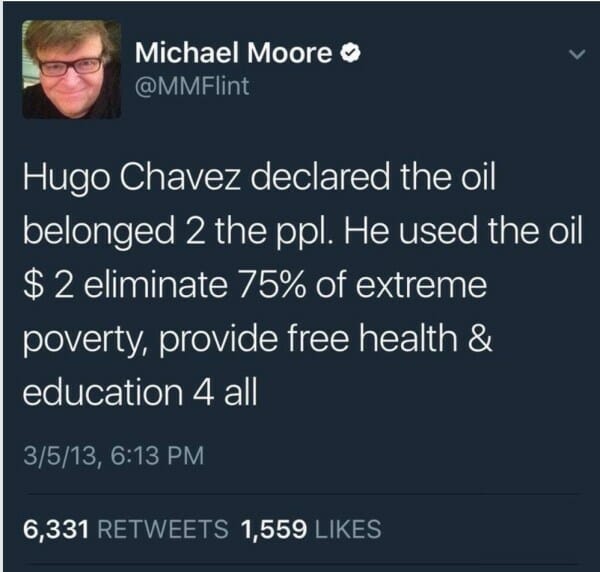
This same failure has happened over and over, at one time or another in Russia and Mexico and now in Venezuela.  Some tried to make it happen in the 1970's in the US, and Elizabeth Warren would still like to try, I bet.  Socialists take over the oil industry and revel in the first months about all they money they are able to divert to "social" expenditures.  Then, in a few year, it all comes crashing down.  This tweet from Michael Moore five years ago gives you a good idea of the thinking.

Socialists have always seen production and wealth creation as some sort of magic, a fountain in the desert where piggy rich people push to the front and take more than their fair share.  Oil looks to them as the ultimate example of this -- wealth just flows out of the ground and evil rich people at Exxon grab it all for themselves.

But in fact, oil is just the opposite of the magic fountain.  It takes a huge quantity of money and brains to get even one drop of it in usable form to your car.  Imagine trying to figure out where even to look for oil when it is hiding far under ground.  Or having to poke holes a mile into the ground from structures standing in 1000 foot deep water in the Gulf of Mexico.  And then transporting the oil hundreds or thousands of miles by pipeline and ship and train and truck.  And then carefully refining the oil almost molecule by molecule in multi-billion dollar facilities.  And then getting the usable parts to the right people, including distribution outlets for you and I on almost every corner of town.

Right now gasoline in Phoenix goes for about $2.85 a gallon, which is about $2.40 before taxes.  This is 60 cents a quart, which compares to the retail price of a bottle of water of about $2.00-$2.50 a quart.  It's a freaking miracle of modernity that you can fill your car this inexpensively.

Anyway, it turns out that oil is the ultimate "you have to spend money to make money" kind of business.  And once you spend all that money, you investment immediately starts dying.  Oil companies have to completely rebuild retail gas stations every 20-30 years.  Refineries have to be constantly updated with really expensive improvements to take advantage of new technologies, to adjust to changing markets and regulations, and to handle different types of crude oil.  And then there is oil production.  Drill a well today and the moment you open it up, the production starts to fall off.  The flow will drop, the percentage of water might increase-- a million things can happen and all of them bad.  To keep wells flowing companies constantly have to reinvest their profits in reworking the wells (fracking and such) and adding enhanced recovery systems.  As fields deplete, new wells have to be drilled in new locations or at new depths, or else whole new fields have to be developed to replace them.

The "greedy and short-term-focused" oil companies reinvest much of their earnings to make sure the supply of oil is sustained.  The "enlightened" socialists harvest all the cash they can and hand it to their cronies, allowing the production assets to fall apart and, eventually, their economy to collapse.

I Spend a Lot Of Time Here Skewering Goofy Technologies, But... I Love This One

As a train enthusiast, I have to admit this sings to me.  I give them double points for being honest that their technology is not yet economic

The wind doesn't always blow, the sun doesn't always shine. So utilities are in search of ways to store surplus energy when they've got it, so they can distribute it later, when it's needed.

The most "duh" approach to energy storage is very big batteries like the ones Elon Musk peddles, which are poised to become a lot cheaper in the next five years. Pumped hydroelectric facilities are another option. Or you can move compressed air around underground caves. But none of these options has emerged as the best way to fix the grid.

Then there's rail energy storage, which is about to get its grand debut. In April, the Bureau of Land Management approved an ARES—that's Advanced Rail Energy Storage—project, conceived by a Santa Barbara-based energy startup called, well, ARES. By 2019, ARES operations head Francesca Cava says, the facility will occupy 106 acres in the excellently-named town of Pahrump, Nevada. By running a train up and down a hill, ARES can help utilities add to and subtract from the grid as needed.

It's a wonderfully simple idea, a 19th century solution for a 21st century problem, with some help from the abundant natural resource that is gravity. When the local utility's got surplus electricity, it powers up the electric motors that drag 9,600 tons of rock- and concrete-filled railcars up a 2,000-foot hill. When it's got a deficit, 9,600 tons of railcar rumble down, and those motors generate electricity via regenerative braking—the same way your Prius does. Effectively, all the energy used to move the train up the hill is stored, and recouped when it comes back down.


CNN, Buzzfeed, NYT, WaPo, AP, NBC, And Politico Attempting to Doxx Manafort Jurors

Just one day after their coordinated virtue signaling about their important role in maintaining a civil society**, a coalition of media companies have filed a motion (pdf) seeking the names and addresses of the jurors in the Manafort trial.  I am a huge supporter of sunlight and disclosure in  government, and perhaps there is a precedent for this, but it seems like a terrible idea.  I have served on two criminal juries in my lifetime and I can guarantee you I would have resisted participation had I known that my name and home address would be released to the public in association with the trial verdict.

CNN in particular has some history in misusing doxxing.  A year or so ago they threatened a Reddit user with doxxing if he didn't stop posting a meme critical of CNN.  Given that probably 95% of the employees of this media coalition probably want to see Manafort convicted, there is real reason for concern how this information might be used.

In FOIA rules, the decisions to release a particular piece of information to one petitioner is a decision to release it to everyone,  I am not sure if similar rules would apply here.  Kind of hoping that Ken White at Popehat chimes in on this.


** A conclusion I am sympathetic to, though I think the media undercuts their argument a bit by acting as thin-skinned and as childish at times as President Trump does.

Update:  Judge denies motion.  Good.

The Meteor Extinction Debate Looks A LOT Like the Climate Debate

This article about a skeptic of the dominant Alvarez meteor-extinction debate is quite interesting and worth a read.  Gerta Keller has had quite an interesting life.  But I will say I found it particularly fascinating comparing details here to the climate debate.  Here are a few example quotes that will seem very familiar to those who have watched the back and forth over global warming, particularly from the skeptic side:

Keller’s resistance has put her at the core of one of the most rancorous and longest-running controversies in science. “It’s like the Thirty Years’ War,” says Kirk Johnson, the director of the Smithsonian’s National Museum of Natural History. Impacters’ case-closed confidence belies decades of vicious infighting, with the two sides trading accusations of slander, sabotage, threats, discrimination, spurious data, and attempts to torpedo careers. “I’ve never come across anything that’s been so acrimonious,” Kerr says. “I’m almost speechless because of it.” Keller keeps a running list of insults that other scientists have hurled at her, either behind her back or to her face. She says she’s been called a “bitch” and “the most dangerous woman in the world,” who “should be stoned and burned at the stake.”

Nobel prize winner Alvarez sounds a bit like Michael Mann:

Ad hominem attacks had by then long characterized the mass-extinction controversy, which came to be known as the “dinosaur wars.” Alvarez had set the tone. His numerous scientific exploits—winning the Nobel Prize in Physics, flying alongside the crew that bombed Hiroshima, “X-raying” Egypt’s pyramids in search of secret chambers—had earned him renown far beyond academia, and he had wielded his star power to mock, malign, and discredit opponents who dared to contradict him. In The New York Times, Alvarez branded one skeptic “not a very good scientist,” chided dissenters for “publishing scientific nonsense,” suggested ignoring another scientist’s work because of his “general incompetence,” and wrote off the entire discipline of paleontology when specialists protested that the fossil record contradicted his theory. “I don’t like to say bad things about paleontologists, but they’re really not very good scientists,” Alvarez told TheTimes. “They’re more like stamp collectors.”

This sounds familiar, dueling battles between models and observations:

That the dinosaur wars drew in scientists from multiple disciplines only added to the bad blood. Paleontologists resented arriviste physicists, like Alvarez, for ignoring their data; physicists figured the stamp collectors were just bitter because they hadn’t cracked the mystery themselves. Differing methods and standards of proof failed to translate across fields. Where the physicists trusted models, for example, geologists demanded observations from fieldwork.

There is pal review

he said impacters had warned some of her collaborators not to work with her, even contacting their supervisors in order to pressure them to sever ties. (Thierry Adatte and Wolfgang Stinnesbeck, who have worked with Keller for years, confirmed this.) Keller listed numerous research papers whose early drafts had been rejected, she felt, because pro-impact peer reviewers “just come out and regurgitate their hatred.”

And charges that key data is not being shared to avoid it falling in the hands of skeptics

She suspected repeated attempts to deny her access to valuable samples extracted from the Chicxulub crater, such as in 2002, when the journal Nature reported on accusations that Jan Smit had seized control of a crucial piece of rock—drilled at great expense—and purposefully delayed its distribution to other scientists, a claim Smit called “ridiculous.” (Keller told me the sample went missing and was eventually found in Smit’s duffel bag; Smit says this is “pure fantasy.”)

Leading to a familiar discussion of scientific consensus

Keller and others accuse the impacters of trying to squash deliberation before alternate ideas can get a fair hearing. Though geologists had bickered for 60 years before reaching a consensus on continental drift, Alvarez declared the extinction debate over and done within two years. “That the asteroid hit, and that the impact triggered the extinction of much of the life of the sea … are no longer debatable points,” he said in a 1982 lecture.....

All the squabbling raises a question: How will the public know when scientists have determined which scenario is right? It is tempting, but unreliable, to trust what appears to be the majority opinion. Forty-one co-authors signed on to a 2010 Science paper asserting that Chicxulub was, after all the evidence had been evaluated, conclusively to blame for the dinosaurs’ death. Case closed, again. Although some might consider this proof of consensus, dozens of geologists, paleontologists, and biologists wrote in to the journal contesting the paper’s methods and conclusions. Science is not done by vote.