Author Archive

Partisans on Both Sides Fervently Believe the Other Side Is More Devious and Less Constrained by Ethics

I try to read an equal number of blogs from the Left and Right.  Now, I am not a masochist so I try to choose the more intelligent folks on both sides (if true dedication to avoiding an echo chamber were to rely on reading both Sheriff Joe Arpaio and Maxine Waters each day, then I just can't do it).

So let me tell all you partisans out there from both the Coke and the Pepsi team something I see every day:  Both your sides believe and say the exact same things about the other side.  Seriously, almost word for word, I could write a book where we just show side by side quotes.   In particular, every partisan fervently believes that their party is too nice and milquetoast and well-behaved to win all the battles it should against the other party, which is devious and bare-knuckles and unconstrained by any ethics.

In the past, the majority of each party seemed willing to accept this lamentable state of affairs and claim the high ground, even when that might amount to a Pyrrhic victory (e.g. Michelle Obama:  "The go low, we go high" or many of the Republican never-Trumpers).

The problem is that when this desire for the high ground breaks down, then all that is left is an ugly realpolitik arms race to the bottom.  It has taken me a long time to really digest the surprising (at least for me) Trump victory.  I have friends that are hard-core partisans for both parties (yes, I know this dates me as failing to pre-screen my friends for political orthodoxy seems a sin nowadays).  I see the same attitude in my Republican friends -- yes we find Trump distasteful in a number of ways, but he is the first national Republican we have seen who will fight down and dirty with Democrats and win political victories.  You see this same attitude on Twitter with Republicans metaphorically carrying Lindsey Graham (!!) around on their shoulders in celebration this week.

Politics are like the NFL -- people emulate what seems to be winning.  Bill Walsh won with the West Coast Offense, and soon there were 30 teams running the West Coast Offense.  The Democrats are going to be looking for the Trumps as well.  I don't know how it doesn't get ugly.

The Democrats' Complaints About the Senate Being Undemocratic Are Pure Whining and Excuse-Making: Here's Why

The Democrats' issue du jour seems to be that the Senate is undemocratic and needs to be abolished.  The argument is that it is not fair that states get two seats each in the Senate regardless of their population, so that the tiny population of Wyoming has the same number of Senate votes as the huge population of California.  These concerns are related to Democrats' frustration with the electoral college, whose votes do not strictly match population because each state gets delegates equal to their number of representatives plus their number of Senators. These are small state protections that evolved as part of a compromise between the 13 states in the original Republic.  A few thoughts on this:

  1. This is an oddly-new concern from Democrats.  They controlled as many as 60 Senate seats as recently as a decade ago.
  2. The non-democratic nature of the Senate is in its very DNA.  Until the late 19th century Senators were not even elected by popular vote, but by a selection process in the state legislature.
  3. For those who treat politics as the be-all-end-all of their lives, this provides an outstanding arbitrage opportunity -- move from California to Wyoming and immediately greatly increase the power of your vote.  I lived in Wyoming for a bit on a ranch south of Glenrock (30 minutes by dirt road from a town of 2000).  Hipsters are warned that they might find it difficult to locate a starbucks or good sushi there.
  4. I am not sure one would design a Senate today the way it was designed 200+ years ago.  But, it has mostly worked.  I am not a Burkean Conservative, but I do think that there needs to be a little more reason than a lost Presidential election and one loss on a Supreme Court confirmation to modify a system that has worked for a long time.
  5. It would be an interesting discussion as to whether the structure of the Senate were positive or negative in the runup to the Civil War.  The obvious answer is that it was bad, in that it forced odious compromises with slavery since the South controlled half the Senate despite its much lower population.  On the flip side, though, one might argue that things could have even been worse had the North not been forced to engage the South for so long to make any legislative progress.  What if the South had left the union 20 years earlier, would the North have had the strength or will to defeat them in 1840?

But here is the real reason that the allocation method of Senators (and Electoral College delegates) is absolutely NOT going to change so that this whole discussion is pointless:  Changing these rules in any way requires a Constitutional amendment.  Such an amendment, to become law, must be ratified by 3/4 of the state legislatures or 38 as things stand now.  But at least half (and probably a bit more since a few states are so damn big) of states will see their power decrease under such rule changes.  Is Wyoming going to vote yes?  Montana?  I am pretty sure there are at least 13 no votes on this.

So stop whining and deal with it Democrats -- you had a filibuster-proof majority in the Senate just over 10 years ago, win some elections and get it back.

Should Republicans Thank Michael Avenatti For Kavenaugh's Confirmation?

Ten days ago, I told my wife that if Brett Kavanaugh is confirmed, he can probably thank Michael Avenatti and his client.  Julie Swetnick's accusations of mass gang rapes held week after week after week were so batsh*t crazy -- and completely unconfirmed by any witnesses when the behavior she described was so public and affected so many people that confirmation should have been easy -- that the Democrats' argument that women never lie and always should be believed was shown to be false to all reasonable observers.  It became too easy for Republicans to convince themselves that all of the women accusing Kavanaugh, not just Swetnick and the other last-minute copycats, were a put-up job by Democrats (a conclusion that was more easy to reach given DiFi's hamfisted attempt to be "tricky" and withhold the Ford accusations to the last minute).  In a well-reasoned world, the veracity of the Swetnick accusations should have had no bearing on the evaluation of Ford's believably, but in the real world of politics it had a huge effect.

I honestly believe that an earlier reveal of the Ford accusations early in the process, without all the nutty copycat allegations, could easily have resulted in Kavanaugh being withdrawn. First, it would have allowed Republicans and Kavanaugh himself to escape early in the process before so many chips were on the table.  Further, if we take Collins's speech at face value, her yes vote really resulted from the Swetnick accusations and I think she might easily have voted the other way with a different process.

A lot of people have come around to this point of view.  One is Robby Soave of Reason:

Democrats, the left, and various other anti-Kavanaugh persons can thank attorney Michael Avenatti for this outcome, at least in part.

The spotlight-stealing lawyer, who also represented Stormy Daniels, is responsible for drawing the media's attention to Julie Swetnick, an alleged victim of Kavanaugh who told an inconsistent and unpersuasive story. Swetnick's wild accusation provided cover for fence-sitting senators to overlook the more plausible allegation leveled by psychology professor Christine Blasey Ford, and to declare that Kavanaugh was being subjected to false smears.

Update:  Michael Avenatti has responded to such criticism on Twitter by saying, essentially, "what was I supposed to do, just ignore the needs of my client?"  No.  What he should have done is honestly thought about the needs of his client rather than just his need for self-promotion ahead of the Democratic primaries.  It is very much a part of a lawyer's job to confirm his client's story and evaluate whether he thinks they have a good case, and then to counsel them on whether or not it makes sense for them given the cost in dollars and public harassment to try to bring the case.  I have had a batsh*t crazy woman who was an ex-employee (who I have never met face to face) decide that I was doing all sorts of crazy things like running an Al Quaeda training camp, organizing a narcotics ring, and stalking her across every Indian casino in the state.  The poor woman has mental health issues and imagines all kinds of weird stuff, and I can be sympathetic now that she is no longer actively threatening me and I don't have to maintain protective orders against her.  At the time she took her crazed stories to any number of lawyers trying to mount a case against me on all kinds of odd bases, and you know what - no lawyer took the case, because pursuing this sort of madness in the legal system would not have done anyone, especially this woman, any good at all.

In the Absolutely Most Predictable Scientific Finding Ever, Solar Roads Are Found to Suck

Long-time readers know that solar roads are like catnip for me -- I can hardly think of a better example of a technology that makes absolutely no sense but gets so much passionate support and funding.  If you are not sure why, here is a primer on why they are predictably awful.

So it turns out that the solar roads I was sure would not work have actually now been built and... they don't work.

One of the first solar roads to be installed is in Tourouvre-au-Perche, France. This has a maximum power output of 420 kW, covers 2,800 metres squared and cost €5 million to install. This implies a cost of €11,905 per installed kW.

While the road is supposed to generate 800 kilowatt hours per day (kWh/day), some recently released data indicates a yield closer to 409 kWh/day, or 150,000 kWh/yr. For an idea of how much this is, the average UK home uses around 10 kWh/day.

The road's capacity factor – which measures the efficiency of the technology by dividing its average power output by its potential maximum power output – is just 4 percent.

In contrast, the Cestas solar plant near Bordeaux, which features rows of solar panels carefully angled towards the sun, has a maximum power output of 300,000 kW and a capacity factor of 14 percent. And at a cost of €360 million, or €1,200 per installed kW, one-tenth the cost of our solar roadway, it generates three times more power.

There is much more.  I am embarrassed to say that when I slammed solar roads all those years, I actually was missing an important problem with them:

Unable to benefit from air circulation, its inevitable these panels will heat up more than a rooftop solar panel too.

For every 1 degree Celsius over optimum temperature you lose 0.5 percent of energy efficiency.

As a result a significant drop in performance for a solar road, compared to rooftop solar panels, has to be expected. The question is by how much and what is the economic cost?

I will add this to the list, thanks.

When I write stuff like this, I get the same kind of mindless feedback that I get when I point out operational issues at Tesla, ie "you are in the pay of the Koch brothers" or "you have no vision."  Well, I am actually putting solar on my roof and will get (hopefully) 45,000 KwH per year, which is about a third of the energy they get from this road but installed for a bit over 1% of the cost of the road.  And the panels are all ideally angled and placed, they are up in the air with absolutely no shade on them at any time of the day, and they don't have any trucks driving over them.

Join Me In the Ostrich Party, Working To Ignore Politics and Escape Mental Health Issues

This came across my desk from one of my campground managers via our internal incident reporting system.  I swear we in this country are having a collective mental health breakdown.  Names obscured to protect privacy:

LadyA was walking by a campsite that was occupied by an unrelated group that was having a discussion and President Trump was mentioned in the conversation. At that point LadyA inserted herself into the conversation and began to curse at them. LadyA then proceeded to her campsite and passed by another camper and began to curse her and her dog. At this point I was driving by when a camper stopped me and informed me of the situation. I proceeded to LadyA's campsite where I found her sitting in a chair and screaming and cursing loudly. I tried to calm her and she was upset to the point where I could not calm her down. She was also on the phone with her friend who had called and was trying to calm her down also. She then began to curse me and when I asked her to stop or I would have to call the County Sheriff's Office, she became combative and I removed myself from the situation and contacted the sheriff's office.  When the Officer arrived we found she had been consuming numerous beers and she was combative to him and he was forced to arrest her and remove her from the campground.  At this point I refunded the last three nights of her reservation. LadyA's friend came in later and removed her belongings.

I will add that I get political emails from both major parties and from their increasingly shrill and over-the-top tone, I wonder if this isn't exactly the kind of citizen both parties are trying to create (as long as they vote the right way).

Luxardo Cherries Are the Bomb

If all you know about maraschino cherries are those unnaturally red, sweet ones you buy in the grocery store, you are missing out.  Luxardo cherries are fabulous and have pretty much nothing in common with those other ones.  They are fabulous in most cocktails, but I love them with bourbon drinks.  I even use them and some of the juice them come in to mix with bourbon to make a quick and easy old fashioned.  Amazon has them in jars and cans but be prepared, they are expensive.

An Interesting Map

There is a cottage industry in creating maps that cause one to look at the Earth in a different way.  The classic of this genre was the one with the southern hemisphere on top.

These usually do not do much for me, but I have to admit I really liked this map -- what the map of the world would look like if we lived in oceans (kind of the BLUE HADES view of the world if you read Charles Stross).  (source)

Never, Ever Trust A Science Story in Major Media like NBC

Most journalists become journalism majors because they had vowed after high school never, ever to take a math or science class again.  At Princeton we had distribution requirements and you should have seen the squealing from English and History majors at having to take one science course (I don't remember ever hearing the reverse from engineering majors).

It should not surprise you, then, that most media is awful at science journalism.  I held off making a comment on this for 3 days figuring it was a typo and they would quickly fix it, but apparently not.  This fits in well with my thesis that the art of sanity-checking numbers has been lost (I added the bold):

The space elevator is the Holy Grail of space exploration,” says Michio Kaku, a professor of physics at City College of New York and a noted futurist. “Imagine pushing the ‘up’ button of an elevator and taking a ride into the heavens. It could open up space to the average person.”

Kaku isn’t exaggerating. A space elevator would be the single largest engineering project ever undertaken and could cost close to $10 billion to build. But it could reduce the cost of putting things into orbit from roughly $3,500 per pound today to as little as $25 per pound, says Peter Swan, president of International Space Elevator Consortium (ISEC), based in Santa Ana, California.

LOL.  The planning for such a structure would cost more than $10 billion.  There is no way that a space elevator can be built for just 1/10 the price of a high speed rail line from LA to San Francisco.  Even at $10 trillion dollars, or 3 orders of magnitude more, I would nod my head and think that was a pretty inexpensive price.

Media Selection Bias is One Reason Many People Have a False Impression of Increasing Extreme Weather

The media will breathlessly promote stories about any weather event in tail of the distribution curve.  I have written many times that this creates a false impression that these events are becoming more common.  Another element of this selection bias is what gets left out.  Does anyone doubt that if we were having a record-heavy tornado season, this would be leading every newscast?  If but if a record-heavy year is newsworthy, shouldn't a record-light year be newsworthy as well?  Apparently not:

source

Which reminds me of this chart Kevin Drum had the other day as "proof" of man-made climate change

I am not going to bother to go to their data source and pick it apart, though my guess is that I could.  But without even looking at the data sources I know this is garbage.  Think about places where there are large natural disasters in the US -- two places that come to mind are California fires and coastal hurricanes.  Do you really think that the total property value in California or on the US coastline has grown only at inflation?  You not only have real estate price increases, but you have the value of new construction.  The combination of these two is WAY over the 2-3% inflation rate.  This effect is magnified by the nature of the metric, which is not total losses but losses over some threshold.  This sort of threshold metric is easy to game, and says nothing for the total losses which would be a better measurement.

By the way, I am wondering how he automatically blames all of these natural disasters on manmade climate change.  Take the most recent, disastrous fires that hit the Redding, California area this year.  That fire started on BLM (federal) land.  When it was small, California State Fire (CalFire) personnel showed up to put it out.  The BLM told them to go away.  The chance to put the fire out when it was small was lost.  How do you blame a fire that was really due to moronic intergovernmental rivalry and bad forest management policy on climate change?

I won't repeat the charts but this post has charts on many extreme weather events and shows that, with the exception of large rainfall events, there is no trend in any of them.

My Favorite Line of the Day

In a serious and worrying article on the Chinese government inserting tiny chips into high-end video processing servers in order to hack into 3rd party systems, Bloombergs Jordan Robertson and Michael Riley write

Elemental servers sold for as much as $100,000 each, at profit margins of as high as 70 percent, according to a former adviser to the company. Two of Elemental’s biggest early clients were the Mormon church, which used the technology to beam sermons to congregations around the world, and the adult film industry, which did not.

I love that.

The whole article is well worth a read.  I am not one to fall for anti-China paranoia but if I was an electronics or computing company, I would be seriously reevaluating my sourcing practices right about now.

Amazon's $15 Minimum Wage Proposal is A Brilliant Way To Get The Government to Hammer Amazon's Competition

Via the WSJ today

Amazon.com on Tuesday said it was raising the minimum wage it pays all U.S. workers to $15 an hour, a move that comes as the company faced increased criticism about pay and benefits for its warehouse workers.

The new minimum wage will kick in Nov. 1, covering more than 250,000 current employees and 100,000 seasonal holiday employees. The company said it also will start lobbying Congress for an increase in the federal minimum wage, which was set nearly a decade ago and is currently $7.25 an hour.

“We listened to our critics, thought hard about what we wanted to do, and decided we want to lead,” said Jeff Bezos, Amazon’s chief executive, in a statement. “We’re excited about this change and encourage our competitors and other large employers to join us.”

Here is the cynical view of this:  Amazon likely is being pressured by the tightening labor market to raise wages anyway.  But its call for a general $15 minimum wage is strategically brilliant.  The largest employers of labor below $15 are Amazon's retail competitors.  If Amazon is successful in getting a $15 minimum wage passed, all retailers will see their costs rise but Amazon's competition will be hit much harder.

(Source)

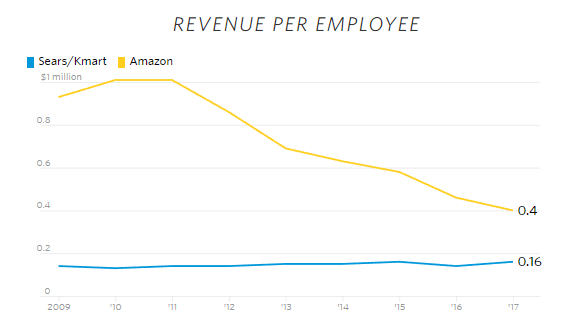
The reason is that due to its internet sales model, Amazon's revenue per employee is MUCH higher than for most retailers -- you can see this in the chart above in a comparison to Sears.  If we had data on revenues per employee in small retail, the numbers would be even lower.  So a minimum wage increase raises costs to Amazon's competitors by a much larger percentage of revenue than it does for Amazon.  In short, Amazon's cost advantage over bricks and mortar retailers would be enhanced by a $15 minimum wage.

Update: Labor Regulation and How It Harms Unskilled Labor

This summer I had the cover story in Regulation Magazine with my article "How Labor Regulation Harms Unskilled Workers:  As government expands regulation of employers, they will increasingly turn to fewer, higher-skilled workers and automation."  (pdf here).  The article was not an academic project, but based on my own experience as a business owner who employs hundreds of workers in unskilled positions.  The premise is that many labor regulations -- not just the minimum wage -- have the perverse effect of making it harder to employ unskilled labor while simultaneously providing incentives to shift hiring from unskilled labor to folks with college degrees, even for unskilled positions.

Because it was not an academic research project, I did not spend a lot of time researching labor statistics, but I can't resist posting this analysis which appeared on Seeking Alpha:

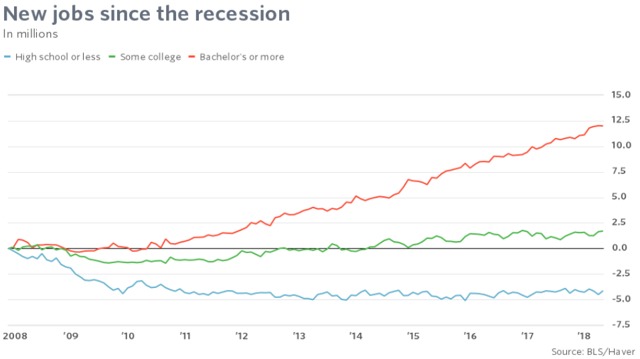
As the economy has grown, employment numbers for unskilled labor have flatlined, never recovering from the last recession.  As I observed:

Fifteen years ago I started my current service business. I love my company and my employees. But if I had it all to do over again, I would never start a business based on employing unskilled labor.  The government makes it too difficult, in far too many ways, to try to make a living employing unskilled workers. Given a new start, I would find a business with a few high-skill employees creating a lot of value.

And I don’t think I’m alone. In the 1950s, 1960s, and 1970s, there was a wave of successful large businesses built on unskilled labor (e.g., ServiceMaster, Walmart, McDonalds). Today, investment capital and innovation attention is all going to companies that create large revenues per employee with workers who have college educations and advanced skills. Only 4% of the employees at Apple, for example, have less than a college degree.
Even in large service-sector companies that employ unskilled labor, much of their investment today is in finding ways to reduce their reliance on that labor. I remember a number of years ago when the Chili’s restaurant chain started putting little electronic displays on their tables. At first the displays just showed advertising and I thought they were an annoying waste of space. But over time the chain began using the devices first to accept payment for one’s food and more recently to take food orders. They are progressively eliminating the need for most of their wait-staff. Every major restaurant chain is doing the same thing: investing in technology to eliminate unskilled workers. Why bother trying to figure out how to serve a rapidly evolving customer demand with workers who are limited by government in a hundred different ways in how and when they can labor? A website or iPad never sleeps, never sues, never needs a lunch break (let alone documentation of that break), never has to have overtime, and doesn’t have its labor taxed.


Elon Musk Sued by The SEC -- SEC Seeks to Bar Him From Leadership of Public Companies

Just to save everyone from sending this to me, Elon Musk has been sued by the SEC.  The details are here, I will not go over all this old ground.  Of course this is just an accusation, and has no immediate effect (except to trash the stock price) until it is settled or proven in court.

I have such mixed feelings for Musk. On one level, it is awesome to see an entrepreneur trying to do build real stuff like rockets and cars. He has all the geeky charm of a 1970's edition of Popular Mechanics, breathlessly hyping captivating but sometimes impractical ideas.  I rode with an acquaintance in his $100,000 Tesla the other day and he loved it. Totally drank the Kool Aid.  Despite my extreme skepticism, he was sure that Elon was going to have same-day body shop repairs for Teslas and could make it work because they only had 3 models of cars with lots of shared parts.  It's the same sort of enthusiasm you see from people who still stand in line first day for the new iPhones. I envy being able to create that as a company.

On the other hand, Musk is just so unsuited to running a public company, is awful at operations, and will end up having cheated a lot of people.  He fails to meet commitments and makes public statements that are transparently absurd.  Just as one example, the other day in response to many delivery problems Tesla has (delivery problems that may actually be due more to efforts to shift 4Q sales into 3Q), Musk said there was a shortage of car delivery trucks and Tesla was starting to build them.  Seriously??? There is zero evidence of a delivery truck shortage and it is absurd to think Tesla had the time or the resources or the skills or knowledge to bang out large truck trailers (that require a variety of DOT inspections and approvals).  Honestly, I can't tell if Musk is the pointy-haired boss from Dilbert who promises absurd things because he is utterly clueless, or if Musk is totally corrupt -- it could be both.  I think his body shop insourcing idea was likely clueless but his SolarCity acquisition was corrupt.

New entries from Jaguar, Audi, and others demonstrate both that Tesla faces a lot of new competition but also that Tesla's original Model S and X still have a lead over competitors.  When the book on the electric car industry is written, I think it will be said that Tesla greatly accelerated the transition to electric cars.  But it is a fact of business history that the pioneer and innovator seldom is the ultimate victor (Lycos, Netscape, Altair, Yahoo, etc).  Tesla has not lost yet, but it still has a huge hill to climb.  Unfortunately, Musk's decisions to do so many things in-house -- own the dealer network, own the fueling network, own the manufacturing, own the body shops, etc. -- is going to require too much capital.

It is pretty clear that Musk is often using Apple as one of his models for what he wants to do with Tesla, and he has successfully created the same kind of almost cultish loyalty as has Apple.  But he ignored a lot of what Apple did.  Apple is a research, software, and design house.  It farms out manufacturing to a partner and sold most of its ipods and iphones initially through third party retailers.  If Tesla had done the same: taking advantage of rich third parties who already know how to sell cars as dealers; working with a consortium to create the fueling network; and going to someone like Kia to do private label manufacturing of the cars -- they might have lost something of the customer magic in the process but they also might be in a much better position to survive.

Update:  Apparently Musk was offered a very, very attractive settlement by the SEC which involved Musk stepping down as Chairman but NOT as CEO, adding a couple new directors, and paying a fine.  It is hard to read this as much more than a slap on the wrist, especially in the context of the SEC now seeking a full bar of Musk from any position at any publicly traded company (hell hath no fury like a government agency scorned).  Frankly, I find this nearly as impossible to understand as the fact that Tesla never raised any equity funding this year when its stock and story were so strong.  Tesla skeptics are arguing that both of these hard-to-explain events stem from the same cause -- that Tesla has some deep dark secret that Musk can't afford for either a new executive or a public offering document to disclose, the same secret (the story goes) that has driven away a number of senior accounting and finance officers in the last several months.  I agree that the existence of such a secret would explain the facts, but I can't imagine what could be much worse than the bad balance sheet and operational data that already is publicly known.

Either Way It Goes, The World Is A Way Worse Place Today: Schrodinger's Nightmare

Via attorney Michael Avenatti, Julie Swetnick has accused Brent Kavanaugh of running a suburban high school rape ring -- over the course of at least 10 parties the punch was doctored and boys lined up outside of bedrooms to gang rape drunk and drugged girls.  According to the accuser, Kavanaugh and his friends raped their way through the Washington suburbs like the Russian Army did throughout the suburbs of Berlin.  All without one single person raising the hue and cry for over 35 years.

It is not even necessary to opine on the veracity of this accusation, because it almost does not matter.  Because the fact of its being made has, no matter what the outcome, proved America to be a far worse place than we woke up believing this morning.  If the accuser is being truthful, then gang rape is a fact of life in our high schools, and everyone is powerless or no one cares to lift a hand to prevent it or stop it -- made all the worse by the leadership of boys who would become future leaders of this country.  And if she is lying, then we see someone shamelessly lying to destroy a man in the name of politics, aided and abetted and enabled by many of the top politicians in this country and perhaps a third of its citizenry.  We are either living in a brutal post-apocalyptic misogynist free-for-all or in a political system corrupted to its very foundation.

Actually, from what I read on Twitter, we are actually living in a superposition of these two, a Schrodinger's nightmare where both are considered true simultaneously by half the population.

Being Skeptical of Data, Even When It Supports Your Position - Fire Edition

This is the, uh, whateverth installment in a series on using your common sense to fact check data, even when the data is tantalizingly useful for the point one is trying to make.

For the last decade or so, global warming activists have used major fires as further "proof" that there is a global warming trend.  Often these analyses are flawed, for a variety of reasons that will be familiar to readers, e.g.

  • A single bad fire is just one data point and does not prove a trend, you need a series of data to prove a trend
  • There is no upward trend in US acreage in fires over the last 10 years, but there is in the last 20 years, which gives lots of nice opportunities for cherry-picking on both sides
  • Acres burned is a TERRIBLE measure of global warming, because it is trying to draw global trends from a tiny fraction of the world land mass (western US); and because it is dependent on many non-climate variables such as forest management policies and firefighting policy.
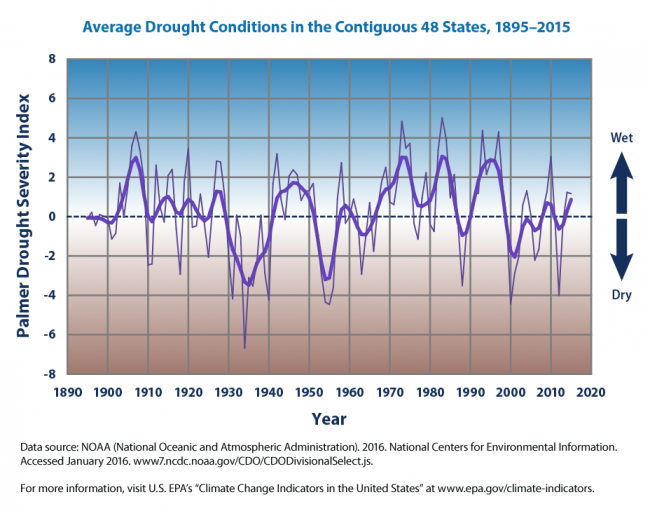
  • The better more direct metric of possible warming harm is drought, such as the Palmer drought severity index, which shows no trend (click to enlarge below)


  • An even better metric, of course, is that there IS an actual upward trend in temperatures.  There is not, however, much of an upward trend in bad weather like drought, hurricanes, or tornadoes.  In this context fire is a third order variable (temp--->drought---> fire) which makes it a bad proxy, particularly when the first order variable is telling the tale.

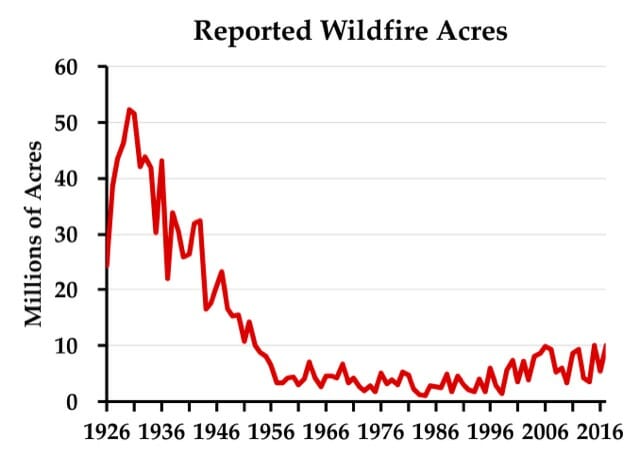
AAAAaaaand then, there is this chart, much loved by skeptics, for long-term US fire history:

I am pretty sure that I have avoided ever using this piece of skeptic catnip (though I could be wrong, I can have moments of weakness).  The reason is that nothing about this chart passes the smell test.  While it is true that the 1930's were super hot and dry, likely hotter in the US than it has been this decade, there is absolutely no reason to believe the entire period of 1926-1952 were so much higher than today.  Was there a different fire management policy (e.g. did they just let all fires burn themselves out)?  Was there a change in how the data was recorded?

Here is my rule of thumb -- when you see a discontinuity like this (e.g. before and after 1955) you better have a good explanation and understanding of the discontinuity.  This is not just to be a good person and be true to good scientific process (though we all should) but also from the practical and selfish desire to avoid having someone come along who DOES know why the discontinuity exists and embarrass you for your naivete.

I have never trusted this chart, because I have not really understood it.  This week, the Antiplanner (who before he focused on transit focused most of his writing on the Forest Service and forest policy) has an explanation.

The story begins in 1908, when Congress passed the Forest Fires Emergency Funds Act, authorizing the Forest Service to use whatever funds were available from any part of its budget to put out wildfires, with the promise that Congress would reimburse those funds. As far as I know, this is the only time any democratically elected government has given a blank check to any government agency; even in wartime, the Defense Department has to live within a budget set by Congress.

This law was tested just two years later with the Big Burn of 1910, which killed 87 people as it burned 3 million acres in the northern Rocky Mountains. Congress reimbursed the funds the Forest Service spent trying (with little success) to put out the fires, but — more important — a whole generation of Forest Service leaders learned from this fire that all forest fires were bad....

This led to a conflict over the science of fire that is well documented in a 1962 book titled Fire and Water: Scientific Heresy in the Forest Service. Owners of southern pine forests believed that they needed to burn the underbrush in their forests every few years or the brush would build up, creating the fuels for uncontrollable wildfires. But the mulish Forest Service insisted that all fires were bad, so it refused to fund fire protection districts in any state that allowed prescribed burning.

The Forest Service’s stubborn attitude may have come about because most national forests were in the West, where fuel build-up was slower and in many forests didn’t lead to serious wildfire problems. But it was also a public relations problem: after convincing Congress that fire was so threatening that it deserved a blank check, the Forest Service didn’t want to dilute the message by setting fires itself.

When a state refused to ban prescribed fire, the Forest Service responded by counting all fires in that state, prescribed or wild, as wildfires. Many southern landowners believed they needed to burn their forests every four or five years, so perhaps 20 percent of forests would be burned each year, compared with less than 1 percent of forests burned through actual wildfires. Thus, counting the prescribed fires greatly inflated the total number of acres burned.

The Forest Service reluctantly and with little publicity began to reverse its anti-prescribed-fire policy in the late 1930s. After the war, the agency publicly agreed to provide fire funding to states that allowed prescribed burning. As southern states joined the cooperative program one by one, the Forest Service stopped counting prescribed burns in those states as wildfires. This explains the steady decline in acres burned from about 1946 to 1956.

There were some big fires in the West in the 1930s that were not prescribed fires. I’m pretty sure that if someone made a chart like the one shown above for just the eleven contiguous western states, it would still show a lot more acres burned in real wildfires in the 1930s than any decade since — though not by as big a margin as when southern prescribed fires are counted. The above chart should not be used to show that fires were worse in the 1930s than today, however, because it is based on a lie derived from the Forest Service’s long refusal to accept the science behind prescribed burning.

There you go, the discontinuity seems to be from a change in the way the measurement is calculated.

By the way, I work closely with the Forest Service every day and mostly this partnership is rewarding.  But I can tell you that the blank check still exists for fire suppression costs and results in exactly the sort of inefficient spending that you would imagine.   Every summer, much Forest Service work comes to a halt as nearly every manager and professional gets temporarily assigned to fire -- something FS employees love because they get out of the grind of their day job and essentially get to go camping.

The One Thing I am Sure About In the Whole Kavanaugh Brouhaha -- That My Policy of Not Meeting With Young Women Alone Is Absolutely Justified

18 months ago, I got a lot of cr*p for this post, including from my wife:

I never meet with young women one-on-one any more. If I am interviewing a young woman for college, we meet in the Starbucks rather than my office. I try to meet with sales people via the web rather than face-to-face, but if a young female sales person does show up at my door and I really must meet with them, we do it downstairs in the lobby and not in my office.

I do not know if Kavanaugh is guilty or innocent at this point of a range of alleged actions that range from boorish behavior to attempted sexual assault. Like most folks I await their testimony tomorrow, but perhaps unlike most folks I have a lot of experience trying to adjudicate he-said-she-said conflicts (in the workplace and with customers) and I am reconciled to the fact that we may never be certain of the truth.

What I do know is that having many prominent people in the media and in the highest levels of government claim that a woman's accusation, without any other due process, is enough to convict a man and destroy his career and reputation just proves to me that my policy is absolutely justified.  Because even if Kavanaugh's accusers are absolutely correct and honest, the next one's may not be, especially if we establish a rewards system for public accusations of this sort.

My wife tells me I am being incredibly unfair -- how can young women ever advance and get mentored if every male business executive (and males still dominate the c-suite) takes this attitude?  Well, let me give an analogy.  Let's assume that in reaction to years of abuse, young female actresses made a pact or formed a union. In doing so they agree to never meet with a male director or producer alone.  Many directors and producers could reasonably complain that they weren't threats, and this action unfairly punishes them by making their jobs harder.  The women would reasonably retort, "perhaps, but as long as the rules are such that if we get assaulted in that room then we have absolutely no recourse for justice -- under these rules we aren't going in to the room.  Sure, it may only be a small percentage are predators, but we can't know who is who until after the damage is done."

Would anyone think this was unfair?  Perhaps they might be accused of overreacting -- and I am willing to accept that maybe I am over-reacting as well.  But I worked 3 years in a refinery, wearing a hard hat and eye protection every minute of that time, and I don't remember anything ever hitting my head or my glasses.  But that does not make these things irrational precautions.

Evolution of the Internet, As Seen Through XKCD

The Failure of Technocratic Government Economic and Energy Policy

The news came out the other day that Porsche will stop making diesel-engine cars.  This is the beginning of the end of significant diesel car production in Europe, and is the ultimate proof that the diesel engine is a dead-end technology choice for Europeans concerned with the environment.

The story is a long one and I will leave you with some links in a moment, but the basic story flow is:

  • European governments are concerned about CO2 production, want to "do something"
  • European car-makers have a lead over the rest of the world in diesel technology, urge governments to choose diesel as the technology of the future, since at the time it was more efficient than gasoline engines.
  • European governments, hot to "do something" and also keen to do it in a way that seems to advantage domestic producers in the high profile automobile trade, promote diesel in a number of ways (including lowering taxes on diesel fuel and diesel car purchases).
  • As Europeans adopt diesel, problems emerge as air quality degrades -- diesels may be more efficient, but have a number of harmful emissions that are far worse than with gasoline engines.  There are tests and standards for these emissions but it is discovered that most manufacturers are cheating on emissions tests.
  • Too late, it is realized that other technologies (electric hybrids, all electric) are pushing well past diesel in terms of efficiency.  Diesel is a dead-end in terms of CO2 reduction, and increases harmful emissions.
  • Emissions tests are tightened, but it is clear manufacturers cheated because they do not have the technology to produce cars people will buy that meet the standards.  Companies like Porsche start to exit the business.

One of the best articles I have found about this history is actually at Vox, that bastion of free market economics and government non-interventionism.

The failure here is entirely predictable and is subsumed in the general criticism of "government picking winners."  As with many such failures, they boil down to information and incentives.  In terms of information, folks in government have no idea of the range of technology choices now and in the future, and how these technology choices might or might not make sense in a broad range of applications.  In terms of incentives, government officials usually have very different true incentives from their publicly stated ones (in this case CO2 reduction).  In the US, the Feds continue to support insanely stupid ethanol subsidies and mandates in part because the first Presidential primary is in corn state Iowa.  In Europe, it may well have been that officials were more ready to support diesel, which Europeans were good at, over hybrids, which Asian companies were good at, no matter what the relative merits were.

If you think that is cynical, even the folks at Vox noticed:

At the time, there were lots of different paths Europe's automakers could have taken to green itself. They could've pursued direct injection technology for gasoline vehicles, making those engines more fuel-efficient. They could've ramped up development of hybrid-electric cars, as Toyota was doing in Japan. But European companies like Peugeot and Volkswagen and BMW had already been making big investments in diesel, and they wanted a climate policy that would help those bets to pay off.

Europe's policymakers obliged. The EU agreed to a voluntary CO2 target for vehicles that was largely in line with what diesel technology could meet. As researcher Sarah Keay-Bright later noted, these standards were crafted so as not to force Europe's automakers to develop hybrids, electric vehicles, or other advanced powertrains.

The result?

Although overall pollution in Europe has gone down over time, diesel vehicle emissions remain stubbornly high. Today, Paris sometimes has smoggy days comparable to those in Beijing. London is struggling with unhealthy levels of nitrogen dioxide. Germany, Austria, and Ireland have NOx pollution well above the legal limits, with vehicles accounting for roughly 40 percent of that output.

The health toll is likely considerable. One recent study estimated that diesel pollution from cars, buses, and trucks in Britain caused 9,400 premature deaths in 2010 alone. It's difficult to pinpoint what fraction of those deaths might have been avoided if emission rules on cars had been strictly enforced all along, but that gives a sense of the stakes.

Even Vox is willing to call for some technocratic humility:

Which brings us to the third takeaway. The future is hard to predict. Diesel cars seemed like a reasonable idea in the 1990s and a disaster today. That suggests that policymakers should have a lot more humility when crafting energy policy. Maybe battery-electric cars will win out, or maybe it'll be hydrogen, or maybe it'll be something else entirely. (Heck, perhaps diesel cars that are genuinely clean could play a role in reducing CO2 emissions.) No one knows for sure.

So one approach here might be to pursue technology-neutral policies focused on preferred outcomes — say, tightly enforced standards that require lower emissions — rather than favoring specific industries and technologies just because they happen to seem promising at that moment in time.

This conundrum is likely to come up again and again. For years, governments have been laying down big bets on emerging clean energy technologies. France did it with nuclear power in the 1970s and '80s. Germany did it with wind and solar power in the 2000s, through feed-in tariffs. The United States has done it with corn ethanol in the past decade.

Done right, this sort of government support can be valuable, helping useful new energy options break into the mainstream against entrenched competition. But there's also a huge risk that governments will end up gambling on badly flawed technologies that then becomethe entrenched competition — and prove impossible to get rid of. The US arguably made that mistake with ethanol, which has had unintended ripple effects on the food supply and deforestation that are proving politically difficult to untangle. The drive for diesel looks like it belongs in that category, too. It's not a story we'd like to keep repeating.

Thus we get to my plan, which eliminates all these political interventions in favor of a revenue-neutral carbon tax.

Thanks, Readers!

A couple of readers pointed out a major flaw in this article about solar and saved me a world of headaches.  Thanks!  I may still do the solar installation in our still near-zirp regime but if I do so I will be more informed.  If ever you think I am making a mistake or making a fool of myself, please let me know.

EASILY The Most Under-Reported Major Story of the Last 25 Years

The reduction in world poverty.

The global population living in extreme poverty has fallen below 750 million for the first time since the World Bank began collecting global statistics in 1990, a decline of more than 1 billion people in the past 25 years.

In a report released Wednesday, the World Bank said the extreme poverty rate had dropped to 10% as of 2015, the latest comprehensive data, and they estimate that the decline has continued over the past three years....

The report highlights the extent to which global poverty has shifted geographically. In 1990, nearly 1 billion of those living in extreme poverty were in East Asia, but decades of rapid economic development in China and other East Asian economies has brought that figure down to 47 million, a decline to a 2% poverty rate from 62%.

South Asia, with most of its population in India, Pakistan and Bangladesh, has seen the number living in extreme poverty fall to 216 million from more than 500 million, to 12% from 47%.

Sub-Saharan Africa has made less progress. Its poverty rate has fallen to 41% from 54% since 1990, but population growth has been so rapid that the number of people in extreme poverty has climbed above 400 million, from 278 million in 1990.

I could say something snarky about Western advice given to Africa being pretty much the opposite of what caused much of Asia to escape poverty, but I will leave this a good news story.  We have had more articles in a week about what one judge did or did not do 30 years ago in high school than their have been in 25 years about this great good news.

Why I Go Back and Forth On Issues of Forced Psychiatric Institutionalization

A few months ago I wrote:

I was among those who has opposed forced institutionalization.  The practice used to be rife with abuse, and when it was really being challenged in the 1970's it was with recent knowledge of how institutionalization for supposed mental health issues had been used in the Soviet Union as a tool against dissent.  And in a world where political partisans still routinely assign negative mental health diagnoses to their political enemies and have even suggested using mental health diagnosis-from-a-distance to unseat the current President, there is still a lot of possibility for abuse.  But seeing that most of those who would have been in state mental hospitals are now in prison or living (and dying) on the streets, I am open to having made a mistake.   I am still not sure, though, who advocates for such people who are without friends and family and would help guard against their abuse.

I understand that the general media explanation of homelessness is to blame it on the cold heart of whoever was the last Republican President in office, but it is hard for me to correlate national policy with trends in homelessness.  I am maybe 70% convinced that the closing of mental health facilities in the 70's and 80's across most cities and states was the main cause, a hypothesis born out by the high rates of mental illness recorded in most homeless populations.  This is why I think so much government spending for the homeless is wasted -- it all focuses on creating homes, I guess just because of our word choice of "homeless".  If we called them the mentally ill, or perhaps "helpless" rather than "homeless" we might investigate other approaches.

I see a number of sources nowadays trying to pin these closures entirely on tight-fisted Republican governors, and I am sure this is partly true.  But this misses an important element -- that civil libertarians had real issues with both the conduct of these institutions (e.g. One Flew Over The Cuckoo's Nest) and the fairness of the forced-institutionalization process.  Also tied up in all this were Cold War stories of Soviet Russia using institutionalization in mental hospitals as a way to dispose of dissidents.  After all, it is a short step from the totalitarian view of ideology (ie that everyone must believe, not just comply) to declaring that any deviation from the official orthodoxy constitutes mental illness.

Which leads me to this story, which got me started thinking about this again:

Marine Le Pen, the leader of the French far right has been left shocked and furious after a court ordered her to be examined by a psychiatrist to determine if she "is capable of understanding remarks and answering questions".

Le Pen, who is head of the former National Front party - now National Rally (Rassemblement National) revealed on Twitter her shock and anger at being ordered to undertake a psychiatric assessment.

The unusual summoning is in relation to Le Pen having tweeted out gruesome propaganda images from terror group Isis that showed the bodies of people having been executed by the so-called Islamic State.

In March Le Pen was charged with circulating "violent messages that incite terrorism or pornography or seriously harm human dignity" and that can be viewed by a minor.

And as part of their investigation it appears magistrates in Nanterre near Paris have ordered Le Pen to visit a psychiatrist for an expert assessment.

"I thought I had been through it all: well, no! For denouncing the horrors of Daesh (Isis) by tweets the "justice system" has referred me for a psychiatric assessment. How far will they go?!" she said on Thursday.

Ms. Le Pen is not really my cup of tea, but this strikes me as a creepily totalitarian action, oddly similar to certain groups in the US that want to take on Trump with mental health claims.  If you are imitating strategies used by Soviet Russia to suppress dissidents, you are probably doing Democracy wrong.


Whether You Are "Allowed" To Discuss Genetic Variability Depends on Which Group You Are Studying

Quillette had an interesting article about a scientific paper, that was mostly a presentation of math and statistical tools, that was essentially suppressed, apparently because it does not fit with current social justice talking points.

In the highly controversial area of human intelligence, the ‘Greater Male Variability Hypothesis’ (GMVH) asserts that there are more idiots and more geniuses among men than among women. Darwin’s research on evolution in the nineteenth century found that, although there are many exceptions for specific traits and species, there is generally more variability in males than in females of the same species throughout the animal kingdom.

Evidence for this hypothesis is fairly robust and has been reported in species ranging from adders and sockeye salmon to wasps and orangutans, as well as humans. Multiple studies have found that boys and men are over-represented at both the high and low ends of the distributions in categories ranging from birth weight and brain structures and 60-meter dash times to reading and mathematics test scores. There are significantly more men than women, for example, among Nobel laureates, music composers, and chess champions—and also among homeless people, suicide victims, and federal prison inmates.

I am not an expert on this and don't really take a position on whether this is truly genetics or nurture, but it does tend to explain a lot of phenomena, like the distribution of boys vs. girls math SAT scores.

But some feminists and SJW's are deeply, deeply invested in the hypothesis that differences in representation of men vs. women in the top tiers of anything are entirely due to misogyny and patriarchy and other bad cultural and societal things (not sure how they explain disproportionate numbers of men in the bottom of distributions).  So a partial genetic explanation is not going to make them happy.  So:

But, that same day, the Mathematical Intelligencer’s editor-in-chief Marjorie Senechal notified us that, with “deep regret,” she was rescinding her previous acceptance of our paper. “Several colleagues,” she wrote, had warned her that publication would provoke “extremely strong reactions” and there existed a “very real possibility that the right-wing media may pick this up and hype it internationally.” For the second time in a single day I was left flabbergasted. Working mathematicians are usually thrilled if even five people in the world read our latest article. Now some progressive faction was worried that a fairly straightforward logical argument about male variability might encourage the conservative press to actually read and cite a science paper?

In my 40 years of publishing research papers I had never heard of the rejection of an already-accepted paper. And so I emailed Professor Senechal. She replied that she had received no criticisms on scientific grounds and that her decision to rescind was entirely about the reaction she feared our paper would elicit. By way of further explanation, Senechal even compared our paper to the Confederate statues that had recently been removed from the courthouse lawn in Lexington, Kentucky.

The interesting part to me is that I have heard a parallel theory of greater genetic variability applied to Africans, though from a different cause.  Rather than being a selectivity phenomenon, it is argued that because Africa is likely the original birthplace of humanity, every other group of people was started by essentially an African splinter group, made up of just a portion of the range of African genetics.  Thus on a global basis Africans should be disproportionately in the extremes -- tallest and shortest, smartest and dimmest, fastest and slowest, etc.

Interestingly (and I admit I am not active in this field so I may be missing something here) the general reaction to this seems to be almost celebratory -- look at all this genetic diversity, to go along with the cultural diversity, in Africa!

Extrapolating Trends from A Single Data Point: The Once In A Lifetime Event

Most of you know I agree there is man-made global warming but am skeptical the extent will be anywhere near most forecasts you see in the media.  For some reason, this earns me the title of "denier."  However, I find that the climate discussion has become boring in the extreme, and I have mostly moved on from it.  But I am still interested in analytical abuses in the media, and long-time readers will know that my favorite is the positing of a trend using but a single data point.  My example today happens to be from climate.

It starts with this tweet:

Obviously he is reacting to the recent hurricane in North Carolina, which turns out to be pretty run of the mill but the media has portrayed as some sort of armageddon.  I could have pulled roughly similar quotes from all kinds of sources.  Several networks did long pieces over the weekend claiming an upward trend in hurricanes without any trend data, but merely from the fact that one made landfall recently.  But anyone who claims be defending science should be held, I think, to a higher standard in making scientific claims.

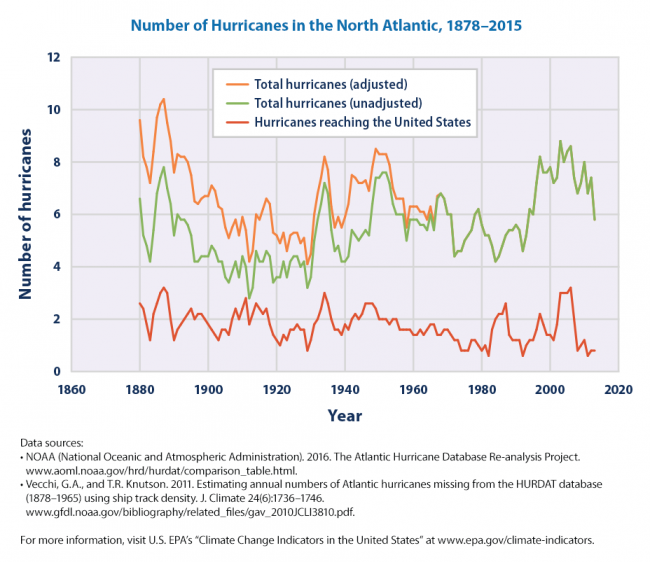
As I asked the March for Science tweeter:  If, say, there is a trend towards more or stronger hurricanes, why does no one ever show a trend chart? They just declare the trend from one data point, like a single hurricane landfall. Every long-term hurricane & cyclonic energy trend chart I have seen is flat to down.  (This is not primarily a climate post but I will post some hurricane trend charts at the end).

There is certainly an upwards trend in the media labelling storms as "once in a lifetime" but it is doubtful that there is actually an underlying trend in storm severity. Even the slightly more meaningful term "100-year _____" is abused.

Consider a 100-year flood in North Carolina, almost certainly a once in a lifetime event for someone in that state unless they live really long.  Since North Carolina is .027% of the world's landmass, there will be, on average, 37 hundred-year floods over land areas the size of North Carolina every single year.   That's 37 once-in-a-lifetime North-Carolina-sized floods somewhere in the world every single year.  Heck, there should be 3-4 thousand-year floods of North Carolina size somewhere in the world every year -- that's three or four once in a millenium floods!  And this same math applies to 100-year heat waves, droughts, snow storms -- you name it.

We can learn a couple of things from this.  First, living through "once in a lifetime" storms every year, somewhere in the world, is not abnormal -- it is expected.  Second, one can see how choices in media coverage could drive an apparent trend.  If the media covered maybe 3 or 4 of these 37 floods when I was young, but covers every one today, it will appear that there is a trend since I hear so much more about them.  But in fact, nothing will have changed except the media.  I will remind you what I wrote on this topic waaaay back in 2012.

Let's take a step back to 2001 and the "Summer of the Shark." The media hysteria began in early July, when a young boy was bitten by a shark on a beach in Florida. Subsequent attacks received breathless media coverage, up to and including near-nightly footage from TV helicopters of swimming sharks. Until the 9/11 attacks, sharks were the third biggest story of the year as measured by the time dedicated to it on the three major broadcast networks' news shows.

Through this coverage, Americans were left with a strong impression that something unusual was happening -- that an unprecedented number of shark attacks were occurring in that year, and the media dedicated endless coverage to speculation by various "experts" as to the cause of this sharp increase in attacks.

Except there was one problem -- there was no sharp increase in attacks.  In the year 2001, five people died in 76 shark attacks.  However, just a year earlier, 12 people had died in 85 attacks.  The data showed that 2001 actually was  a down year for shark attacks.

Once you start looking for this type of thing, the extrapolation of a trend from at most one data point, you will see it everywhere.

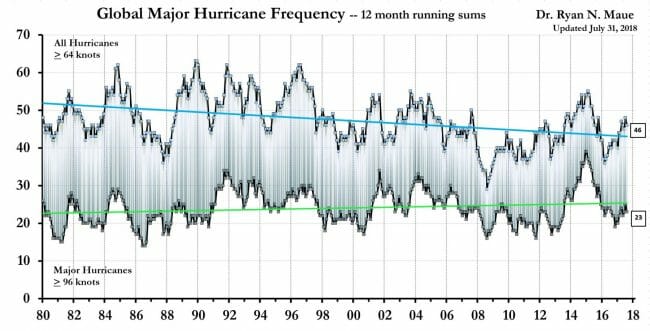
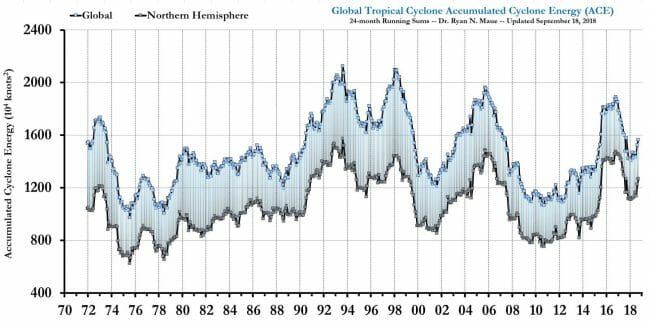
For those still hanging around to the end, here are a couple of actual trend charts on hurricanes (the adjusted line attempts to correct for the fact that earlier eras with no satellites or radar tended to miss some hurricanes) (source at NOAA):
Below are two charts that look beyond just the Atlantic at global cyclones, both from this source.  The first is frequency:
The second looks at accumulated cyclonic energy, which is a sort of time integral of the energy in all active cyclonic storms around the world
Later in the tweetstorm, the same tweeter mentioned as a fact, again without data, "Climate change is increasing drought frequency, impacting everything from agriculture to health. Some studies suggest the consequences of droughts include increased violence and war."  There has been no upward trend in US droughts (negative is more drought-y.
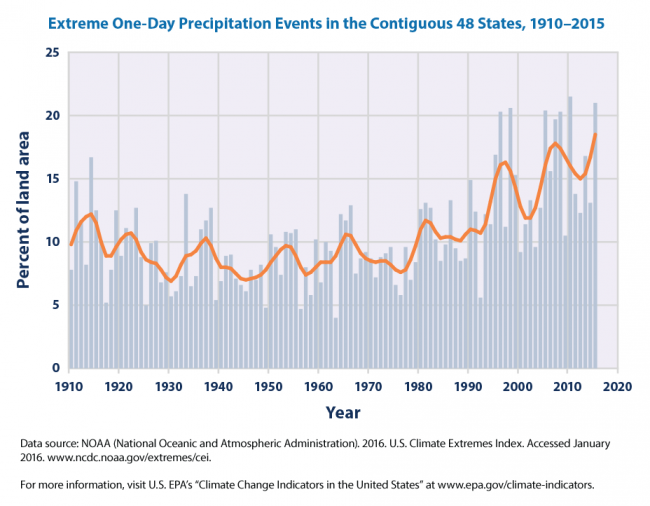
Finally, in the spirit of full disclosure, of all the zillions of things (not directly related to temperature) in weather effects that are blamed on global warming, this is the only one I have found that shows an upward trend recently and could logically be attributed to warming.  Whether this is related to warming or independent or a data measurement issue is (if folks were honest) not well understood
Things Guaranteed to Make Me Do the Opposite

When the first words of an incoming phone call are "Do not hang up..."

Great Moments in Crazy Stock Bubbles -- Are These Investors On Drugs?

As of this moment, Canadian tulip bulb marijuana company Tilray is trading at $146 a share for a total market capitalization of $11.2 Billion.  This is a company that had $10 million in revenues last quarter.   It is trading at a 420x multiple of last year's revenues.  It is up 20% today alone.  The race to own Canadian marijuana stocks in advance of the January 1, 2019 legalization in Canada is simply insane.  I would have attributed this to millenial dumb money leaving Tesla and looking for a new home, but a couple of weeks ago, American alcoholic beverage company Constellation Brands paid $4 billion for just a piece of another Canadian weed company.

Investments at this sort of valuation before the market even is opened are speculative in the extreme.  People will use the argument that "wouldn't you have wanted to be in on the ground floor of Coke or Pepsi or Phillip Morris or Anheuser Bush?"  A few responses:

  1. Buying in at an $11 billion valuation is not really the "ground floor".  $11.2 billion is a higher market cap than Whirlpool or Hyatt or Alcoa.
  2. The beer and cigarette and soft drink industries all started with hundreds, even thousands of competitors.  When RJ Reynolds started his tobacco company, there were 15 other tobacco companies in Winston-Salem alone.  Without your current hindsight, you would have been hard-pressed in the early stages of those industries to pick the winner.
  3. This goes without saying, but we have no idea of the future size of the marijuana market, and even without the risk of trying to predict consumer behavior it is really hard to predict regulatory behavior
  4. Usually only one part of the value chain of a new industry really makes the profits.  We have no idea where that will be in the marijuana business.  In beer and tobacco, the big profits are not with the growers of tobacco and hops, for example.
  5. Early pioneers in an industry are often not the survivors.  Your computer today, is it a Tandy?  Kaypro?  Commodore?  IBM and Compaq don't even make PC's any more.  Apple does but only because it reinvented itself as a phone maker.  And how about those cell phone pioneers?  Is your phone a Nokia?  Motorolla?  Blackberry?

December $145 put options on Tilray are trading around $72 dollars, which essentially means that there are folks betting that the company will lose half its value in the next 90 days.  I can't remember ever seeing anything that extreme.

Update:  Well, a day later it is at over $200 and a $20 billion valuation.  Incredible.