On the Radio
I will be on the Radio at 9:00PM Arizona/Pacific time to discuss the Glendale / Coyotes subsidy. I will be appearing on the Terry Gilburg show on 550 KFYI in Phoenix, also streaming here.
Dispatches from District 48
Author Archive
I will be on the Radio at 9:00PM Arizona/Pacific time to discuss the Glendale / Coyotes subsidy. I will be appearing on the Terry Gilburg show on 550 KFYI in Phoenix, also streaming here.
Apparently, the leftish-progressive talking point du jour is that oil speculators (and wouldn't you know it, those apparently include new libertarian uber-villains the Koch brothers) are artificially raising prices above what a "natural" market clearing price would be.
I have always presumed this to be possible for short periods of time - probably hours, perhaps days. But if, for any longer period of time, market prices (I am talking here about prices for current oil and immediate delivery, not futures prices) stay above the market clearing price one would normally expect from current supply and demand, then oil has to be building up somewhere. People would be bending over backwards to sell oil into the market, and customers would be using less.
If futures speculation has somehow unanaturally driven up current prices, where is the oil building up? I understand the price can go up for future oil, because in futures the inventory is just paper. But the argument is that futures trading is driving up current oil prices. When the Hunt brothers tried to corner the silver market, they had to buy and buy and keep buying to sop up the inventory.
Sure, some folks may be storing oil on speculation (and by the way most oil companies are inventorying oil and gasoline this time of year in the annual build up between heating oil season and summer driving season) -- but storing physical oil is really expensive. And the total capacity to do so incrementally is trivial compared to world daily demand. A few tanker loads sitting offshore is not going to mean squat (total world crude inventory is something like 350 million barrels at any one time, so adding a million barrels into storage only increases inventory by 0.3% or about. Another way to look at it is that storing a million barrels of oil represents about 17 minutes of daily demand. If the price is really being held above the market clearing price, then we are talking about the necessity of buying millions of barrels of oil each and every day and storing them, and to keep doing so day after day after day to keep the price up. And then once you stop, the price is just going to crash before you can sell it because of the very fact that word got out you are selling it.
I dealt with this in a lot more depth here. I want to repost it in full. It's a bit dated (different prices) but still relevant. Note in particular the irony of my friends point #5 -- this was a real view held by many on the progressive Left. Ironic, huh?
I had an odd and slightly depressing conversation with a friend the other night. He is quite intelligent and well-educated, and in business is probably substantially more successful, at least financially, than I.
Somehow we got in a discussion of oil markets, and he seemed to find my position suggesting that oil prices are generally set by supply and demand laughable, so much so he eventually gave up with me as one might give up and change the subject on someone who insists the Apollo moon landings were faked. I found the conversation odd, like having a discussion with a fellow
chemistry PHD and suddenly having them start defending the phlogiston
theory of combustion. His core position, as best I could follow, was this:
Ignoring the Laws of Economics (Price caps and floors)
While everyone (mostly) knows that we are suspending disbelief when the James Bond villain seems to be violating the laws of physics, there is a large cadre of folks that do believe that our economic overlords can suspend the laws of supply and demand. As it turns out, these laws cannot be suspended, but they can certainly be ignored. Individuals who ignore supply and demand in their investment and economic decision making are generally called "bankrupt," at least eventually, so we don’t always hear their stories (the Hunt brothers attempt to corner the silver market is probably the best example I can think of). However, the US government has provided us with countless examples of actions that ignore economic reality.
The most typical example is in placing price caps. The most visible example was probably the 1970′s era caps on oil, gasoline, and natural gas prices and later "windfall profit" taxes. The result was gasoline lines and outright shortages. With prices suppressed below the market clearing price, demand was higher and supply was lower than they would be in balance.
The my friend raised is different, one where price floors are imposed by industry participants or the government or more likely both working in concert. The crux of my argument was not that government would shy away from protecting an industry by limiting supply, because they do this all the time. The real problem with the example at hand is that, by the laws of supply and demand, a price floor above the market clearing price should yield a supply glut. As it turns out, supply guts associated with cartel actions to keep prices high tend to require significant, very visible, and often expensive actions to mitigate. Consider two examples:
Realtors and their trade group have worked for years to maintain a tight cartel, demanding a 6% or higher agency fee that appears to be increasingly above the market clearing price. The result of maintaining this price floor has been a huge glut of real estate agents. The US is swimming in agents. In an attempt to manage this supply down, realtors have convinced most state governments to institute onerous licensing requirements, with arcane tests written and administered by… the realtor’s trade group. The tests are hard not because realtors really need to know this stuff, but because they are trying to keep the supply down. And still the supply is in glut. Outsiders who try to discount or sell their own home without a realtor (ie, bring even more cheap capacity into the system) are punished ruthlessly with blackballs. I have moved many times and have had realtors show me over 300 houses — and you know how many For Sale By Owner homes I have been shown? Zero. A HUGE amount of effort is expended by the real estate industry to try to keep supply in check, a supply glut caused by holding rates artificially high.
A second example of price floors is in agriculture. The US Government, for whatever political reasons, maintains price floors in a number of crops. The result, of course, has been a supply glut in these commodities. Sopping up this supply glut costs the US taxpayer billions. In some cases the government pays to keep fields fallow, in others the government buys up extra commodities and either stores them (cheese) or gives them away overseas. In cases like sugar, the government puts up huge tarriff barriers to imports, otherwise the market would be glutted with overseas suppliers attracted by the artificially high prices. In fact, most of the current subsidy programs for ethanol, which makes almost zero environmental or energy policy sense, can be thought of as another government program to sop up excess farm commodity supply so the price floor can be maintained.
I guess my point from these examples is not that producers haven’t tried to impose price floors above the market clearing price, because they have. And it is not even that these floors are not sustainable, because they can be if the government steps in to help with their coercive power and our tax money to back them. My point is, though, that the laws of supply and demand are not suspended in these cases. Price floors above the market clearing price lead to supply gluts, which require very extensive, highly visible, and often expensive efforts to manage. As we turn now to oil markets, we’ll try to see if there is evidence of such actions taking place.
The reasons behind US oil production and refining capacity constraints
As to his first point, that oil companies are conspiring with the government to artificially limit oil production and refining capacity, this certainly would not be unprecedented in industry, as discussed above. However, any historical study of these issues in the oil industry would make it really hard to reach this conclusion here. There is a pretty clear documented record of oil companies pushing to explore more areas (ANWR, offshore) that are kept off-limits due to environmental pressures. While we have trouble imagining the last 30 years without Alaskan oil, the US oil companies had to beg Congress to let them build the pipeline, and the issue was touch and go for a number of years. The same story holds in refining, where environmental pressure and NIMBY concerns have prevented any new refinery construction since the 1970′s (though after years and years, we may be close in Arizona). I know people are willing to credit oil companies with just about unlimited levels of Machiavellianism, but it would truly be a PR coup of unprecedented proportions to have maintained such a strong public stance to allow more capacity in the US while at the same time working in the back room for just the opposite.
The real reason this assertion is not credible is that capacity limitations in the US have very clearly worked against the interests of US oil companies. In production, US companies produce on much better terms from domestic fields than they do when negotiating with totalitarian regimes overseas, and they don’t have to deal with instability issues (e.g. kidnapping in Nigeria) and expropriation concerns. In refining, US companies have seen their market shares in refined products fall since the 1970s. This is because when we stopped allowing refinery construction in this country, producing countries like Saudi Arabia went on a building boom. Today, instead of importing our gasoline as crude to be refined in US refineries, we import gas directly from foreign refineries. If the government is secretly helping oil companies maintain a refining capacity shortage in this country, someone forgot to tell them they need to raise import duties to keep foreign suppliers from taking their place.
What Oil Traders can and cannot do
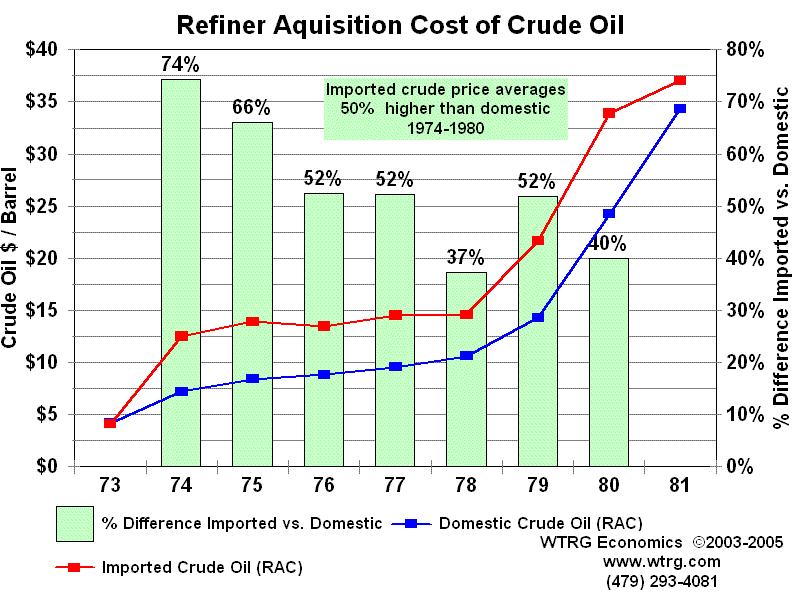
As to the power of traders, I certainly believe that if the traders could move oil prices for sustained periods as much as 50% above or below the market clearing price, they would do so if it profited them. I also think that speculative actions, and even speculative bubbles, can push commodity prices to short-term extremes that are difficult to explain by market fundamentals. Futures contracts and options, with their built in leverage, allow even smaller players to take market-moving positions. The question on the table, though, is whether oil traders can maintain oil prices 50% over the market clearing prices for years at a time. I think not.
What is often forgotten is that companies like Exxon and Shell control something like 4-5% each of world production (and that number is over-stated, since much of their production is as operator for state-owned oil companies who have the real control over production rates). As a point of comparison, this is roughly the same market Toshiba has in the US computer market and well below Acer’s. As a result, there is not one player, or even several working in tandem, who hold any real power in crude markets. Unless one posits, as my friend does, that NY and London traders somehow sit astride a choke point in the world markets.
But here is the real problem with saying that these traders have kept oil prices 50% above the market clearing price for the last 2-3 years: What do they do with the supply glut? We know from economics, as well as the historic examples reviewed above, that price floors above the clearing price should result in a supply glut. Where is all the oil?
Return to the example of when the Hunt’s tried to corner the silver market. Over six months, they managed to drive the price from the single digits to almost $50 an ounce. Leverage in futures markets allowed them to control a huge chunk of the available world supply. But to profit from it (beyond a paper profit) the Hunts either had to take delivery (which they were financially unable to do, as they were already operating form leveraged positions) or find a buyer who accepted $50 as the new "right" price for silver, which they could not. No one wanted to buy at $50, particularly from the Hunts, since they knew the moment the Hunt’s started selling, the price would crash. As new supplies poured onto the market at the higher prices, the only way the Hunt’s could keep the price up was to pour hundreds of millions of dollars in to buy up this excess supply. Eventually, of course, they went bankrupt. But remember the takeaway: They only could maintain the artificially higher commodity price as long as they kept buying excess capacity, a leveraged Ponzi game that eventually collapsed.
So how do oil traders’ supposedly pull off this feat of keeping oil prices elevated about the market clearing price? Well, there is only one way: It has to be stored, either in tanks or in the ground. The option of storing the extra supplies in tanks is absurd, especially over a period of years – after all, at its peak, $60 of silver would sit on the tip of my finger, but $60 of oil won’t fit in the trunk of my car. The world oil storage capacity is orders of magnitude too low. So the only real option is to store it in the ground, ie don’t allow it to get produced.
How do traders pull this off? I have no idea. Despite people’s image, the oil producer’s market is incredibly fragmented. The biggest companies in the world have less than 5%, and it rapidly steps down from there. It is actually even more fragmented than that, because most oil production is co-owned by royalty holders who get a percentage of the production. These royalty holders are a very fragmented and independent group, and will complain at the first sign of their operator not producing fast and hard enough when prices are high. To keep the extra oil off the market, you would have to send signals to a LOT of people. And it has to be a strong and clear signal, because price is already sending the opposite signal. The main purpose of price is in its communication value — a $60 price tells producers a lot about what and how much oil should be produced (and by the way tells consumers how careful to be with its use). To override this signal, with thousands of producers, to achieve exactly the opposite effect being signaled with price, without a single person breaking the pack, is impossible. Remember our examples and the economics – a sustained effort to keep prices substantially above market clearing prices has to result in visible and extensive efforts to manage excess supply.
Also, the other point that is often forgotten is that private exchanges can only survive when both Sellers AND buyers perceive them to be fair. Buyers are quickly going to find alternatives to exchanges that are perceived to allow sellers to manipulate oil prices 50% above the market price for years at a time. Remember, we think of oil sellers as Machiavellian, but oil buyers are big boys too, and are not unsophisticated dupes. In fact, it was the private silver exchanges, in response to just such pressure, that changed their exchange rules to stop the Hunt family from continuing to try to corner the market. They knew they needed to maintain the perception of fairness for both sellers and buyers.
Supply and Demand Elasticity
From here, the discussion started becoming, if possible, less grounded in economic reality. In response to the supply/demand matching issues I raised, he asserted that oil demand and supply are nearly perfectly inelastic. Well, if both supply and demand are unaffected by price, then I would certainly accept that oil is a very, very different kind of commodity. But in fact, neither assertion is true, as shown by example here and here. In particular, supply is quite elastic. As I have written before, there is a very wide range of investments one can make even in an old existing field to stimulate production as prices rise. And many, many operators are doing so, as evidenced by rig counts, sales at oil field services companies, and even by spam investment pitches arriving in my in box.
I found the statement "if oil prices really belong this high, why have we not seen any shortages" to be particularly depressing. Can anyone who sat in at least one lecture in economics 101 answer this query? Of course, the answer is, that we have not seen shortages precisely because prices have risen, fulfilling their supply-demand matching utility, and in the process demonstrating that both supply and demand curves for oil do indeed have a slope. In fact, shortages (e.g. gas lines or gas stations without gas at all) are typically a result of government-induced breakdowns of the pricing mechanism. In the 1970′s, oil price controls combined with silly government interventions (such as gas distribution rules**) resulted in awful shortages and long gas lines. More recently, fear of "price-gouging" legislation in the Katrina aftermath prevented prices from rising as much as they needed to, leading to shortages and inefficient distribution.
Manipulating Oil Prices for Political Benefit
As to manipulating oil or gas prices timed with political events (say an election or Congressional hearings), well, that is a challenge that comes up all the time. It is possible nearly always to make this claim because there is nearly always a political event going on, so natural volatility in oil markets can always be tied to some concurrent "event." In this specific case, the drop from $60 to $35 just for a Congressional hearing is not even coincidence, it is urban legend. No such drop has occurred since prices hit 60, though prices did drop briefly to 50. (I am no expert, but in this case the pricing pattern seen is fairly common for a commodity that has seen a runup, and then experiences some see-sawing as prices find their level.)
This does not mean that Congressional hearings did not have a hand in helping to drive oil price futures. Futures traders are constantly checking a variety of tarot cards, and indications of government regulatory activity or legislation is certainly part of it. While I guess traders purposely driving down oil prices ahead of the hearing to make oil companies look better is one possible explanation; a more plausible one (short of coincidence, since Congress has hearings on oil and energy about every other month) is that traders might have been anticipating some regulatory outcome in advance of the hearing, that became more less likely once the hearings actually occurred. *Shrug* Readers are welcome to make large short bets in advance of future Congressional energy hearings if they really think the former is what is occurring.
As to a relationship between oil prices and the occupant of the White House, that is just political hubris. As we can see, real oil prices rose during Nixon, fell during Ford, rose during Carter, fell precipitously during Reagan, were flat end to end for Bush 1 (though with a rise in the middle) and flat end to end for Clinton. I can’t see a pattern.
If Oil Companies Arbitrarily Set Prices, Why Aren’t They Making More Money?
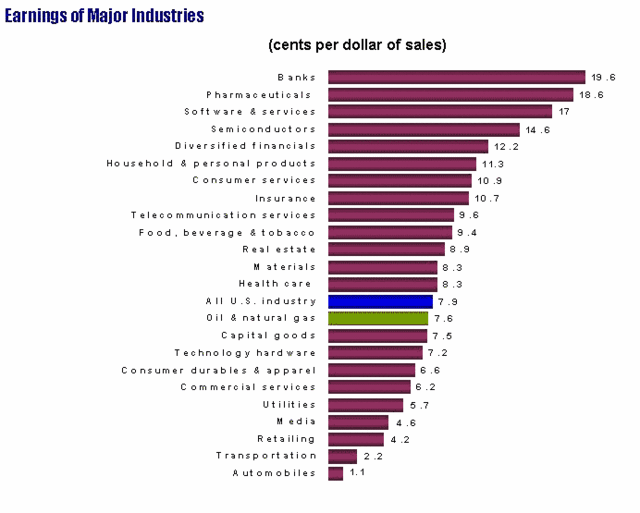
A couple of final thoughts. First, in these heady days of "windfall" profits, Exxon-Mobil is making a profit margin of about 9% – 10% of sales, which is a pretty average to low industrial profit margin. So if they really have the power to manipulate oil prices at whim, why aren’t they making more money? In fact, for the two decades from 1983 to 2002, real oil prices languished at levels that put many smaller oil operators out of business and led to years of layoffs and down sizings at oil companies. Profit margins even for the larges players was 6-8% of sales, below the average for industrial companies. In fact, here is the profitability, as a percent of sales, for Exxon-Mobil over the last 5 years:
2006: 10.5%
2005: 9.7%
2004: 8.5%
2003: 8.5%
2002: 5.4%
2001: 7.1%
Before 2001, going back to the early 80′s, Exxon’s profits were a dog. Over the last five years, the best five years they have had in decades, their return on average assets has been 14.58%, which is probably less than most public utility commissions allow their regulated utilities. So who had their hand on the pricing throttle through those years, because they sure weren’t doing a very good job! But if you really want to take these profits away (and in the process nuke all the investment incentives in the industry) you could get yourself a 15 to 20 cent decrease in gas prices. Don’t spend it all in one place.
** One of the odder and forgotten pieces of legislation during and after the 1972 oil embargo was the law that divided the country into zones (I don’t remember how, by counties perhaps). It then said that an oil company had to deliver the same proportion of gas to each zone as it did in the prior year (yes, someone clearly took this right out of directive 10-289). It seemed that every Representative somehow suspected that oil companies in some other district would mysteriously be hoarding gas to their district’s detriment. Whatever the reason, the law ignored the fact that use patterns were always changing, but were particularly different during this shortage. Everyone canceled plans for that long-distance drive to Yellowstone. The rural interstate gas stations saw demand fall way off. However, the law forced oil companies to send just as much gas to these stations (proportionally) as they had the prior year. The result was that rural interstates were awash in gas, while cities had run dry. Thanks again Congress.
As much as I enjoy seeing Yale circling the drain of self-destruction, I am simply flabbergasted by the most recent discrimination suit it faces from a group of current and former female students.
The Yale group's confidential Title IX complaint to the Department of Education's Office for Civil Rights (OCR) reportedly includes testimony about sexual assaults, but the hostile-environment charge against the university rests as well on a litany of complaints about offensive exercises of First Amendment freedoms. A December 2010 draft complaint letter, obtained by the Foundation for Individual Rights in Education (FIRE), focuses on these "incidents": In 2006, a group of frat boys chant "No means yes, yes means anal" outside the Yale Women's Center. In 2010, a group of fraternity pledges repeat this obnoxious chant outside a first-year women's dorm. In 2008, pledges surround the Women's Center holding signs saying, "We love Yale sluts." In 2009, Yale students publish a report listing the names and addresses of first-year women and estimating the number of beers "it would take to have sex with them."
There are few adults who would not recognize these incidents as stupid, boorish frat-boy behavior not to be emulated. But taking Yale to court, in effect seeking to force the University to punish such speech, takes the current college trend of protection the right not to be offended to absurd extremes.
Consider for a moment that there are radical women's organizations on most college campuses that take it as an article of faith that all men are rapists and all men are complicit in violence against women. How is this speech any less aggressive, though it is treated with complete respect by universities. In fact, many integrate this point of view into required Freshman sensitivity training. Women on compuses routinely engage in speech saying that every man is a guilty felon complicit in awful crimes, and I don't see any men whining and running to Uncle Sugar to protect their delicate ears from offense. At least the frat boys were probably drunk and joking -- the women are sober and dead serious.
Don't not be mistaken -- this is not about rights or freedom, but about a bid for totalitarian control of campuses by a niche group. From Wendy Kaminer
Sad to say, but feminism helped lead the assault on civil liberty and now seems practically subsumed by it. Decades ago, when Catherine MacKinnon, Andrea Dworkin, and their followers began equating pornography with rape (literally) and calling it a civil-rights violation, groups of free-speech feminists fought back, in print, at conferences, and in state legislatures, with some success. We won some battles (and free speech advocates in general can take solace in the Supreme Court's recent decision upholding the right to engage in offensive speech on public property and public affairs). But all things considered (notably the generations of students unlearning liberty) we seem to be losing the war, especially among progressives.
This is not simply a loss for liberty on campus and the right to indulge in what's condemned as verbal harassment or bullying, broadly defined. It's a loss of political freedom: the theories of censoring offensive or hurtful speech that are used to prosecute alleged student harassers are used to foment opposition to the right to burn a flag or a copy of the Quran or build a Muslim community center near Ground Zero. The disregard for liberty that the Obama administration displays in its approach to sexual harassment and bullying is consistent with its disregard for liberty, and the presumption of innocence, in the Bush/Obama war on terror. Of course, the restriction of puerile, sexist speech on campus is an inconvenience compared to the indefinite detention or show trials of people suspected of terrorism, sometimes on the basis of un-reviewed or un-reviewable evidence. But underlying trivial and tragic deprivations of liberty, the authoritarian impulse is the same.
PS- The last part in the first quote about rating women as related to sex is ironic, as, if memory serves, Yale was the location around 1980 when a group of female students created a guide rating male students on their sexual talents. When women do it, it is a brave act of liberation. When men do it, it is sexual harassment.
PPS- My son is going through the college admissions process. All these schools stress how much they are looking for future leaders. How can Yale be so selective that it has an admissions rate around 7% of applicants but still end up with so many people who cannot function in the world as an adult? The women are begging to have a daddy to protect them and the men seem to need a daddy to kick their ass until they act like adults.
My column this week in Forbes is a response to yesterday's Presidential budget speech. An excerpt:
President Obama is working from the assumption that the political leader who suggests painful but necessary budget cuts first, loses. He had every opportunity to propose and pass a budget when he had Democratic majorities in Congress. But Democrats feared that showing leadership on the hard budget choices they faced would hurt them in the November election, so they punted.
Even when Obama did produce a budget, it was the closest thing to a non-entity as could be imagined. A budget that doubles government debt over 10 years and raises interest costs (under optimistic assumptions) to a trillion dollars a year would likely be controversial in any year, but is a non-starter given fresh memories of debt crises in Greece, Ireland and a number of other countries.
Of course there is an 800-lb gorilla in the room that no one wants to acknowledge: Three programs — Social Security, Medicare, and Medicaid — grow in the next 10 years under current rules to at least $2.7 trillion dollars a year. Recognize that this figure excludes all the other so-called non-discretionary payments (unemployment, food stamps, etc.) as well as everything else the government does including the military and Obamacare. The 2021 spending on just those three programs is 25% higher than the total revenue of the federal government from all sources in 2011.
Later in the article, I suggest ten principles that should be the foundation of a budget deal.
Paul Ryan is catching grief for his proposal to convert Medicare from "all the medical care you wish to consume" to grants of $X per year. This seems unimaginable to people (forgetting for a moment that the US functioned for nearly 200 years without it at all).
But what if Social Security were Medicare. What if, instead of giving $X per year, Social Security made an open-ended promise to fund whatever consumption one thought necessary to maintain his or her lifestyle. Can you imagine the fiscal disaster? The horrible incentives
And if Social Security had been structured that way, and we were now trying to change it to fixed grants, what would people be saying? They would say, "what if something unexpected happens - won't that just leave people in the cold?"
Without the Internet, I might have died without seeing Hungarian folk dancers demonstrating a bubble-sort algorithm
via flowing data
Sheriff Joe Arpaio constantly gets a pass for some of the most outrageous hijinx from Phoenix's conservative population that sees him as the last bastion between them and brown-skinned people. Tell someone he is above the law, and he is going to act above the law
As Maricopa County Sheriff Joe Arpaio crows this morning about how his agency busted a total of six illegal immigrants for using fake IDs so they could work at a Mesa dry cleaner, county budget officials unveiled the results of a six-month investigation into how his office is misspending your money.
If you pay taxes in Maricopa County, it's not pretty.
In total, the county finds that Arpaio and his cronies misspent $99.5 million over the last eight years, the majority of which came from the sheriff's detention fund.
"For eight years, you have been signing paperwork that says your budget is balanced, but it's not," County Supervisor Mary Rose Wilcox reportedly told sheriff's officials at this morning's meeting of the Maricopa County Board of Supervisors.
Budget officers reviewed payroll records for 5,700 sheriff's employee salaries from February 2004 to February 2011 and found that much of what employees were actuallydoing was not what they were getting paid to do.
But if he were a Serenity fan, he would know that Saffron is quite arousing.
So a bunch of bloggers agree to write for the HuffPo, a profit-seeking venture, for free. The HuffPo gets bought by another profit-seeking company, though this one is less successful in shrouding its financial goals in a cloud of feel-good progressivism. So the bloggers get mad. But instead of just quitting, they are actually suing the HuffPo for back wages under the Fair Labor Standards Act.
A few observations:
In short, I would say that these folks are utterly without personal honor for filing the suit, but in the current state of labor law they potentially have a case. How sad that would be. And what would be next? A class action suit by product reviewers at Amazon for back wages?
No, Mr. Obama, the fecklessness of politicians does not obligate me to send more of my money to the government.
Three times in my life I have lent money to people in serious financial straits. In every case, they came back to me for more. "X more dollars and I will be home free and can pay you back." In a few cases I came up with a second infusion and in one case I (embarrassingly) actually gave money a third time. In no case was I ever paid back. I haven't heard this phrase in years, but when I was young stock investors had a saying -- "your first loss is your best loss." This was just another way of saying don't throw good money after bad.
Obama and Bush (I haven't forgotten your culpability in all this George) sold the country, or at least Congress, on emergency spending for wars and bailouts and stimulus. This was supposedly one-time spending only for the duration of the emergency. But now Democrats and Obama are treating the peak of this emergency spending as the new baseline, from which cuts are impossible.
This lack of desire to cut spending and a resetting of norms as to "what is normal" is not just a government problem, it is endemic to every organization. Private organizations face this problem all the time. The difference is that when times go bad, private organizations do not have fiat taxation power, so that when they are underwater, they must cut bloated budgets or die. Either way, the problem goes away. Private companies differ from government not in that they don't have problems with beauracracy and risk aversion and deadwood and bloat and bad incentives - because they do. The difference is that private companies cannot get away with allowing this stuff to linger forever, and governments can.
Government will never, ever, ever, ever cut spending unless all hope of new taxes is removed, and even then they will likely try to cut spending on the most, rather than the least, popular programs to build public support for more taxes.
In the early 90's, after the fall of the Soviet Union, we talked about a peace dividend from reductions in military spending. I want a sanity dividend.
Postscript: We like to think that financial problems are due to bad luck, but they usually are due to poor management. The guy I lost the most money with was producing a really interesting boat concept, basically as fun and lithe and fast as a jetski but enclosed so boaters who were less daring would not actually be in contact with the water. I wanted a bunch for rental service at our marinas. But he kept asking for money, saying that he had bad luck with this supplier or that supplier. Eventually, I found out he was in this incredibly expensive commercial lease, and was burning all the money I lent him on useless rent payments. Stupid.
After I graduated from college, I cashed in about $7000 in savings bonds I had accumulated. I was going to make a fortune in the market. After three years I had lost almost all of it -- right in the heart of one of the greatest bull markets in history! A few years later, I was in a situation where I could have really used this money. This was not bad luck or circumstances, I did stupid things. I recognized something that many dentists and doctors never learn - it was possible to be a smart guy who sucked at investing. I was one of them. My investing has been in index funds ever since.
In the eight days preceding the $38.5 billion deficit reduction deal, the national debt of the United Statesincreased $54 billion.
About 20 years ago I did a rail transit study for McKinsey & Company with a number of European state rail companies, like the SNCF in France. With my American expectations, I was shocked to see how overstaffed these companies were. At the time, the SNCF had more freight car maintenance personnel than they had freight cars. This meant that they could assign a dedicated maintenance person to every car and still get rid of some people.
Later in my consulting career, I worked for Pemex in Mexico, where the over-staffing was even more incredible. I realized that in countries like France and Mexico, state-run corporations were first and foremost employment vehicles run for the benefit of employees, and, as distant second, value-delivery vehicles and productive enterprises.
Over the last 20 years, I have seen more and more of this approach to public agencies coming to the US. If nothing else, the whole Wisconsin brouhaha hopefully opened the eyes of many Americans to the fact that public officials and heads of agencies feel a lot more loyalty to their employees than they do to taxpayers.
I see this all the time in my business, which is private operation of certain state-run activities (e.g. parks and recreation). I constantly find myself in the midst of arguments that make no sense against privatization. I finally realized that the reason for this is that they were reluctant to voice the real reason for opposition -- that I would get the job done paying people less money. This is totally true -- I actually hire more people to staff the parks than the government does, but I don't pay folks $65,000 a year plus benefits and a pension to clean the bathrooms, and I don't pay them when the park is closed and there is not work to do. I finally had one person in California State Parks be honest with me -- she said that the employees position was that they would rather see the parks close than run without government workers.
Of course, if this argument was made clear in public, that the reason for rising taxes and closing parks was to support pay and benefits of government employees, there might be a fight. So the true facts need to be buried. Like in this example from the Portland transit system, via the anti-planner.
In 2003, TriMet persuaded the Oregon legislature to allow it to increase the tax by 0.01 percent per year for ten years, starting in 2005. In 2009, TriMet went back and convinced the legislature to allow it to continue increasing the tax by 0.01 percent per year for another 10 years. Thus, the tax now stands at $69.18 per $10,000 in payroll, and will rise to $82.18 per $10,000 in 2025.
At the time, TriMet promised that all of this tax increase would be dedicated to increasing service, and as of 2010, TriMet CFO Beth deHamel claims this is being done. But according to John Charles of the Cascade Policy Institute, that’s not what is happening.
Poring over TriMet budgets and records, Charles found that, from 2004 (before the tax was first increased) and 2010, total payroll tax collections grew by 34 percent, more than a third of which was due to the tax increase. Thanks to fare increases, fares also grew by 68 percent, so overall operating income grew by about 50 percent, of which about 7 percent (almost $20 million) was due to the increased payroll tax.
So service must have grown by about 7 percent, right? Wrong. Due to service cuts made last September, says Charles, TriMet is now providing about 14 percent fewer vehicle miles and 12 percent fewer vehicle hours of transit service than it provided in 2004 (comparing December 2004 with December 2010). TriMet blamed the service cuts on the economy, but its 50 percent increase in revenues belie that explanation.
By 2030, according to TriMet’s financial forecast (not available on line), the agency will have collected $1.63 billion more payroll taxes thanks to the tax increase. Yet the agency itself projects that hours and miles of service in 2030 will be slightly less than in 2004.
Where did all the money go if not into service increases? Charles says some of it went into employee benefits. TriMet has the highest ratio of employee benefits to payroll of any transit agency. At latest report, it actually spends about 50 percent more on benefits than on pay, and is the only major transit agency in the country to spend more on benefits than pay. This doesn’t count the unfunded health care liabilities; by 2030, TriMet health care benefits alone are projected to be more than its payroll.
Bolivia is set to pass the world’s first laws granting all nature equal rights to humans. The Law of Mother Earth, now agreed by politicians and grassroots social groups, redefines the country’s rich mineral deposits as “blessings” and is expected to lead to radical new conservation and social measures to reduce pollution and control industry.
The country, which has been pilloried by the US and Britain in the UN climate talks for demanding steep carbon emission cuts, will establish 11 new rights for nature. They include: the right to life and to exist; the right to continue vital cycles and processes free from human alteration; the right to pure water and clean air; the right to balance; the right not to be polluted; and the right to not have cellular structure modified or genetically altered.
Controversially, it will also enshrine the right of nature “to not be affected by mega-infrastructure and development projects that affect the balance of ecosystems and the local inhabitant communities”.
“It makes world history. Earth is the mother of all”, said Vice-President Alvaro García Linera. “It establishes a new relationship between man and nature, the harmony of which must be preserved as a guarantee of its regeneration.”
Hmmm. There is a big gap between thoughtful conservation and fetishism for the primitive.
Update: By the way, the article says this is being driven by climate change already experienced in Bolivia. I suppose it is possible that rainfall has changed, I don't have the numbers for Bolivia, but temperatures in the tropics have shown no trend up or down for decades. Most of the warming the Earth has seen over the last 50 years (whatever the cause) has been in the Northern Hemisphere and in fact in the upper portions of the Northern Hemisphere. Here are the temps for the tropics. The spikes in 1998 and 2010 are El Ninos years.

This is just a sick, scary, amazing story of a man who came within days of execution because prosecutors knowingly withheld exculpatory evidence. And not something arcane and equivocal, but blood tests that were the wrong type and witness testimony that contradicted the main witness.
The Supreme Court has upheld the effective immunity of prosecutors from any penalties for not following the most basic rules. Forget sanctions or lost law licenses - why aren't these prosecutors on trial for attempted murder? Obviously, with the Supreme Court decision a legislative solution is required, but don't hold your breath -- there is nothing more bipartisan than being "tough on crime" when running for re-election so it is unlikely any safeguards of defendants will be improved.
Hey, why make expensive investments when the government will just give you access to your competitor's infrastructure?
Federal Communications Commission has decided to mandate data roaming by a 3-2 vote. Simply put, major carriers like AT&T and Verizon will be required to let you check your email and perform VoIP calls over their federally-licensed airwaves even if you're actually paying a regional carrier for your cellular coverage instead -- just as they've been required to do for voice and messaging since 2007. As you can imagine, Big Red and Ma Bell aren't exactly jumping for joy at the news, with both threatening to slow expansion into niche markets if they'll be forced to share their infrastructure. The victorious members of the FCC claim that this doesn't constitute common carriage because the big boys still get to negotiate "commercially reasonable" rates. Considering that two dissenting commissioners say that it is, indeed, common carriage, though, and thus beyond the powers granted to the FCC, we imagine we haven't heard the last of this debate.
By the way, the commercially reasonable rate piece is so much BS. I can say from experience that there is no such thing as a true price negotiation when one party is forced to make a deal. In one of my great moments in not reading the fine print, I signed a commercial lease with the National Park Service in which the fine print demanded that I buy the personal property used in that operation from the former tenant.
Well, you can imagine what happened. The contract said I had to buy it at a reasonable market price, but at the end of the day, if they guy insisted on selling me a pile of useless junk for $100,000, my negotiation options were limited because I could not just walk away. Just to really hammer the lesson home to me about being careful in such deals in the future, the former tenant really went the extra mile in taking advantage of the provision. He stripped out every good asset from the operation and shipped in every non-working piece of junk equipment he could find in his other operations -- after all, I seem to have given him an open-ended "put". Only his, shall we say, excessive creativity in the latter eventually saved me, as trying to sell property from other operations (there was even some old couches from someone's house sitting in the boat repair shed) was considered by the NPS to be a violation of the rules and they eventually released me from the requirement.
The sun follows an (approximately) 11-year cycle as sunspots ebb and flow. The peak of these cycles, ie the number of sunspots at the cycle's maximum, is thought to correlate with the strength of the sun's output. In the past, periods with very low sunspot activity through an entire cycle have correlated with very cold temperatures (e.g. the Maunder Minimum and the Little Ice Age).
Well, NASA has updated its forecast for this cycle and it does not look good:
Current prediction for the next sunspot cycle maximum gives a smoothed sunspot number maximum of about 62 in July of 2013. We are currently over two years into Cycle 24. The predicted size would make this the smallest sunspot cycle in nearly 200 years.
The low cycle 200 years ago coincided with a decade or more of wicked-cold temperatures, particularly in Northern Europe (think Napoleon's army freezing to death in 1812).
One of the reasons this probably has not gotten much coverage is that climate scientists have worked hard in the media to attribute the vast majority of past warming, particularly in the period 1978-1998, to ppm changes in CO2 concentration. But this same 2-decade period saw extremely high solar activity (as measured by sunspots) and ocean cycles like the PDO in the warm phase. To maximize how much past warming was attributed to CO2, warming alarmists had to take the fairly absurd position that these ocean cycles and changes in solar output had only trivial effects on temperatures (much more here).
Well, we may find out over the next few years just how trivial Mr. Sun is or is not to the climate. And we may well find out something else many skeptics have said for years -- for activities like agriculture, cooling is way more damaging than warming. In the Middle Ages, agriculture boomed from 1100-1300 even as temperatures rose higher than they are today (at least in Europe). In the first decades of the 1300's, cooling led to agricultural failure and famine, famines that are often credited for weakening the population and thus increasing the mortality from the Black Death a few years later.
Electing law enforcement officers is a terrible idea, but like most of the country, we do it here in Arizona. We shouldn't be surprised, then, when Sheriff's try to pump up their image by portraying themselves as the last bastion against an invading horde.
When it was over, Sheriff Paul Babeu issued a news release declaring that Pinal County is "the No. 1 pass-through county in all of America for drug and human trafficking."
It's a line the sheriff has used countless times - most recently on Thursday in testimony before the U.S. Senate Committee on Homeland Security - as he criticizes the federal government for failing to secure the border.
There's just one problem: There is no data to support the assertion.
In fact, an Arizona Republic analysis of statistics from local, state and federal sources found that, while sheriff's officials do bust smugglers and seize pot, Pinal County accounts for only a fraction of overall trafficking.
The newspaper also found that other headline-grabbing claims by Babeu are contradicted by statistical evidence or greatly exaggerated.
Babeu's County, for example, does not even touch the border. And crime rates in AZ have fallen faster over the last 10 years than the national average, right during the period of high illegal immigration.
Those of you who are regular readers are probably tired of hearing me rant about the proposed Glendale, Arizona subsidy of the Phoenix Coyote's team (here, here, here), a subsidy that runs afoul both of our state Constitution and of common sense. This week, George Will enters the fray, and actually quotes me at the bottom of his column. Most of the column should be familiar to those following the story here, but of course being George Will it is so much pithier than I could tell the story. I liked this bit:
NHL Commissioner Gary Bettman agrees with McCain that the world is out of joint when people can second-guess the political class: “It fascinates me that whoever is running the Goldwater Institute can substitute their judgment for that of the Glendale City Council.” He will learn not to provoke Olsen, who says, “It happens to fascinate me greatly that the commissioner thinks a handful of politicians can substitute their judgment for the rule of law.”
From a commenter at Instapundit
It seems to me that whenever there is a threat of a government shutdown, it’s portrayed as just this side of a tsunami-level disaster. When government workers – teachers, sanitation workers, etc – go on strike, it’s portrayed as the middle-class worker sticking up for himself. Why is it that a government shut-down caused by a desire to spend less money is different than a government shutdown caused by workers failing to do their jobs – isn’t the effect the same?
Its been a long day here. As many of your know, my company privately operates public recreation facilities. We operate nearly 150 campgrounds and other parks on US Forest Service land, helping to reduce the cost of these facilities and keep them open despite declining budgets.
Because we pay all the expenses for the campgrounds and do not accept any government money (we operate solely using the gate fees paid by visitors), keeping these facilities open is not at all dependent on government appropriations. As such, the facilities we operate have never been subject to closure in past government shut downs. The Grand Canyon has to close because it is operated with government employees, but the public recreation areas we operate do not.
Or at least that was the position of the Forest Service until last night. However, this morning, the USFS began to take the position we had to close, despite the fact that the law does not require it. Through most of the day I have had to be on the phone pushing back against this bad idea.
At first, I thought it was some sort of scheme to purposefully make the cost of the shutdown worse, by shutting down public recreation facilities that did not need to be shut down. However, I have come to understand that this is likely driven by a need for "consistency." Senior administration officials were concerned it would be confusing to the public if the National Park Service was totally closed but a substantial number of US Forest Service sites remained open. I have spent a lot of time trying to convince folks that it was dumb to close literally thousands of the most popular recreation sites in the country merely in the name of mindless consistency.
Hopefully we will win the day, and we are starting to see some evidence the Forest Service will see it our way, and allow private operators who do not take Federal money or use Federal employees to remain open serving the public during the busy Easter week.
Yeah, I am a Joss Whedon fan-boy, but I just finished watching both seasons of Dollhouse. I will say that my expectations were low -- I was sort of expecting a revamped Alias with various weekly missions, with the highlight of having Eliza Dushku rather than Jennifer Garner.
The first 3-5 episodes were entertaining but really fell right in line with my expectations. After that, the show got much better. As a whole, the entire show is like a long essay on the banality of evil.
The pace gets a bit crazed at the very end, but that was because Whedon working in three or four years of planned plot development in half a season when he found out the show was being cancelled. A couple of other random notes -- Whedon works in a fresh high-tech take on zombies (really, it makes sense in context) in the season-ending episodes. We also get a couple of guest appearances from the new first lady of sci-fi TV, Summer Glau.
Recommended.
Our winner was Scott Strattner, congratulations! It was a weird year, obviously. Scott won despite getting only one team right out of the final four, though that was pretty much par for the course this year. Here is the top 10:
| Leaderboard after 63 games - See full standings | |||||||||||||||||||||||||||||||||||||
|---|---|---|---|---|---|---|---|---|---|---|---|---|---|---|---|---|---|---|---|---|---|---|---|---|---|---|---|---|---|---|---|---|---|---|---|---|---|
|
|
||||||||||||||||||||||||||||||||||||
I managed to come in 61st, or exactly in the middle. That's actually pretty good since I only got 6 of the sweet-16 right. I lost, though, to every other member of my family.
For all the criticism by the Left of corporate corruption, nothing that goes on in even the most dysfunctional corporations matches business as usual budgeting in Washington. This week in my column at Forbes I present a few vignettes imagining Washington budget logic in a corporate board room. A sample:
Board Member: Let’s get started. After an absolutely disastrous year, financially, we’re now five months into our fiscal year and you still have not presented us with a budget for this year. Why?
CEO Obama: My staff was waiting until their employment contracts were renewed before we presented a budget.
Board Member: Excuse me?
CEO Obama: You remember — many of my associates in the company had their contracts up for review in November. They were afraid they might lose their job if you did not like their budget work, so they delayed introducing any budgets until after you renewed their 2-year employment contracts.
Board Member: That seems unbelievably deceptive and feckless. But let’s leave that aside for a moment. November was still several months ago, why have we seen no budget since then?
CEO Obama: Well, as you know, I have a number of rivals for my job in this company. I want to force one of them to suggest a budget first.
Board Member: Why is that? It seems to me it is your job as leader of this organization to define the budget, particularly given the unprecedented fiscal challenges we face.
CEO Obama: If I propose a budget first, everyone will just shoot holes in it. If I let someone else come forward with the budget, I can snipe at it and make my rivals look worse. In particular, I think that Ryan guy down in Finance may be dumb enough to create a plan. If he does, I can spend so much time making him look bad you will forget I never submitted a plan of my own.
It looks like the simply awful 1099 provision from Obamacare will be repealed.
Wind is not the worst form of alternative energy -- that probably has to go to corn ethanol. But it is close. The consistent experience of European countries that have more wind power than the US is that, because wind is so unreliable, hot backup fossil fuel generation capacity nearly equal to wind capacity needs to be maintained. This means that even when the wind is blowing, it is not reducing fossil fuel consumption in any meaningful way. In other words, billions are spent on wind but without any substitution of existing power sources. Its just pure wasted money.
Anyway, here is a recent study by an environmental group, no less, that found that Britain's wind generation plants are running well under the promised efficiency. That is, of course, when they are even operable and not just broken down. In the latter case, companies go for the quick bucks of up front subsidies, then find that the units are not worth the repair costs when they break.