Archive for 2008

Canada to Join EU Free Trade Zone?

If so, great for them.  The more free trade in the world, the better:

Canadian and European officials say they plan to begin
negotiating a massive agreement to integrate Canada's economy with the
27 nations of the European Union, with preliminary talks to be launched
at an Oct. 17 summit in Montreal three days after the federal election.

Trade Minister Michael Fortier and his staff have been engaged for
the past two months with EU Trade Commissioner Peter Mandelson and the
representatives of European governments in an effort to begin what a
senior EU official involved in the talks described in an interview
yesterday as "deep economic integration negotiations."

If successful, Canada would be the first developed nation to have
open trade relations with the EU, which has completely open borders
between its members but imposes steep trade and investment barriers on
outsiders"¦

A pact with the United States would be politically impossible in Europe, senior European Commission officials said.

I would have said that changing the last statement would be a great goal for an Obama administration that wants to make Europe love us again (did they ever?)  But he has made clear that trade does not count in his definition of good relations, and in fact has already committed to initiating trade wars against our neighbors Mexico and Canada.

I Guess I'm Not Patriotic

I have always been mildly suspicious of the word "Patriotism," particularly when it is used to mean supporting one's country even when it is behaving badly.  I prefer to say that I respect, even love this country for the high values it has historically set for itself.   But when it falls short of those values, it is going to hear it from me, patriotism or no.

But if patriotism is defined as having my money put in someone else's pocket, I am not a patriot.

Thoughts on the Lehman Bankrupcy

While I am not happy to see a historic company go bankrupt, and have vague but unspecific worries about some kind of general cascading financial problem, I am happy to see the government let Lehman go bankrupt without any sort of special intervention or bailout for a number of reasons:

  • Bailouts create awful incentives for other large companies managing their risk portfolios
  • I know many small business people who have gone bankrupt, and I once lost my job in a company bankruptcy.  There is no reason Lehman equity holders and managers should be immune from the same process just because their company is large and old. 
  • Lehman's management has failed to get a positive return from the assets in their care.  A bailout only keeps these assets under the same management.  A bankruptcy puts these assets in the hands of new parties who hopefully can do a better job with them. 
  • I strongly suspect that the hole in Lehman's balance sheet from underwater assets like certain mortgages is large compared to its equity but small compared to its total assets.  If this is true, equity holders will end up with nothing, but most creditors should come out close to whole when everything is unwound.

Like Megan McArdle, I found Obama's recent reaction to the Lehman bankruptcy to be wrong-headed but unsurprising.  Obama is blaming recent financial problems on an overly laissez faire approach by GWB in general (LOL,that's funny) and a lack of strong enforcement by the SEC in particular. 

But one has to ask, what laws were not enforced?  My sense is that these are all perfectly lawful portfolios of mortgages in which the one mistake was systematically being too generous in giving out credit.  Mr. Obama's party has always been a strong advocate of pushing banks to be more generous with credit, particularly to the poor, and of promoting home ownership as a national goal.  If anything, financial institutions are struggling because they were too aggressive in these goals.  McArdle writes:

This was not some criminal activity that the Bush administration should
have been investigating more thoroughly; it was a thorough, massive, systemic
mispricing of the risk attendant on lending to people with bad credit.
(These are, mind you, the same people that five years ago the Democrats
wanted to help enjoy the many booms of homeownership.) Lehman, Bear,
Merrill and so forth did not sneakily lend these people money in the
hope of putting one over on the American taxpayer while ruining their
shareholders and getting the senior executives fired.  They got it
wrong.  Badly wrong.  So did everyone else.

It appears from further Obama statements talking about lack of enforcement for predatory lending laws that the Democrats want to get back on the rollercoaster of whipsawing banks between charges of redlining (you are not lending enough to the poor) and predatory lending (you are lending too much to the poor).

Postscript:  While in retrospect there may turn out to have been laws broken, in situations like this, particularly when a management team is trying to head off a liquidity crisis, these tend to be of the reporting and disclosure ilk.  We saw back during the Enron failure that people tend to assume law-breaking of some sort to be the cause of a major bankrupcy or collapse, and to satisfy this notion the government aggresively pursued Enron executives.  But nothing for which Enron was prosecuted had anything to do with their failure -- all the violations were about disclosure and accounting methodologies.  The company would have still crashed, probably faster, without these violations.

Update:  More here

More on California's Big Dig

The Anti-Planner has more on the California high speed rail proposal I wrote about earlier.  My guess was that the first $9 billion bond issue, on the ballot this fall, would not get the train out of the LA metro area.  Well, I was right and wrong.  The smart money thinks the line will start at the other end, in San Francisco.  But the betting is that for $9 billion the line won't even get out of the San Francisco metro area, making it perhaps as far as San Jose. 

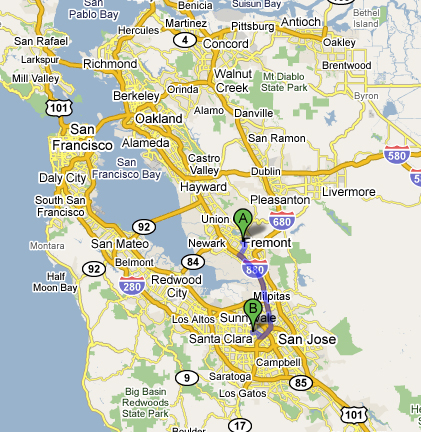
But we have a second data point -- there is a proposal on the table to extend BART from Fremont to Santa Clara for $4.7 billion, a distance (as shown on the map below) about a third of that from San Francisco to San Jose.
Map

I am not sure what high-speed rail technology that they are considering, but a true high-speed line requires special alignments, track, and signaling that should make it FAR more expensive per mile than a BART line (just as an example, a true high-speed line could take miles to make a 90 degree turn, eating up land and reducing alignment flexibility in a very congested and hilly area).  And remember, the BART cost estimate is probably low.

No way these guys get to San Jose for $9 billion, much less to LA for $40 billion.  Just what Californians need with their massive budget deficit:  a brand new white elephant.

Re-Evaluating Home Ownership

Mark Perry has had a series of posts of late presenting the hypothesis that high rates of home ownership in the US may be detrimental as it reduces labor mobility.  The argument goes that homeowners have a harder time moving for new jobs than renters do.

Homeownership
impedes the economy's readjustment by tying people down. From a social
point of view, it's beneficial that homeownership encourages commitment
to a given town or city. But, from an economic point of view, it's good
for people to be able to leave places where there's less work and move
to places where there's more. Homeowners are much less likely to move
than renters, especially during a downturn, when they aren't willing
(or can't afford) to sell at market prices. As a result, they often
stay in towns even after the jobs leave. And reluctance to move not
only keeps unemployment high in struggling areas but makes it hard for
businesses elsewhere to attract the workers they need to grow.

The argument makes sense on its surface, but I am having a bit of trouble buying into it (though I will admit that as an American, I am steeped in decades of home-ownership-boosterism, so I may not be approaching the problem without bias).

On the plus side, the selling a home and buying a new one certainly has more costs than switching apartments, particularly if you add in a moving premium for home owners who can accumulate a lot more stuff than apartment dwellers and the switching costs due to emotional attachment to the current house.  Also, on its face, the argument is similar to criticisms of the economy of the antebellum south, where too much capital was invested in land and assets tied to the land.

However, I see a couple of problems with it.  First, its hard to find an increase in structural unemployment rates in the past decades to correlate to the increase in home ownership.  Second, the costs to change homes has been falling of late as the government-protected Realtor monopoly is finally being broken by technology and commission rates are falling.  Third, my sense is (though I can't dig up the data) that the average time in a home is dropping, meaning homes flip owners more frequently, again indicating a decreasing barrier to moving.

I would, however, be willing to accept that in a high home ownership regime, falling home prices and lengthening for-sale times could exacerbate an economic downturn by slowing mobility and thereby slowing the correction.  I would have argued in the past that this was offset by home equity as a savings tool and a source of cash in difficult times, but that could be different this time around as mortgage policies have tightened, drying up the ability to convert equity to emergency cash.

Is There a Zero-Cost Regulatory Solution to Energy Efficiency?

A while back, I criticized a story in the NY Times, as quoted by Kevin Drum, that said that California had among the lowest per capita electricity usage of any state (true) and that this was because of the intelligent regulation regime in the state (yes, but not the way they meant).  The implication of Drum's argument was that there was some sort of efficiency ideal that a smart group of technocrats could reach at limited cost to the state (false). Specifically, Drum argued:

Anyway, it's a good article, and goes to show the kinds of things we
could be doing nationwide if conservative politicians could put their
Chicken Little campaign contributors on hold for a few minutes and take
a look at how it's possible to cut energy use dramatically "” and reduce
our dependence on foreign suppliers "” without ruining the economy. The
energy industry might not like the idea, but the rest of us would.

My response, in part, was this:

Well, here are the eight states in the data set above that the
California CEC shows as having the lowest per capita electricity use:
CA, RI, NY, HI, NH, AK, VT, MA.  All right, now here are the eight
states from the same data set that have the highest electricity prices:  CA, RI, NY, HI, NH, AK, VT, MA.  Woah!  It's the exact same eight states!  The 8 states with the highest prices are the eight states with the lowest per capita consumption.
Unbelievable.  No way that could have an effect, huh?  It must be all
those green building codes in CA.  I suspect Drum is sort of right,
just not in the way he means.  Stupid regulation in each state drives
up prices, which in turn provides incentives for lower demand.  It
achieves the goal, I guess, but very inefficiently.  A straight tax
would be much more efficient.

As part of a presentation I am working on about global warming and proposed California CO2 abatement bill AB52, I had the occasion to do a bit more research.  All of my data is from the Energy Information Administration, whose page URLs keep changing and thus breaking my links but this index page to data seems to stay the same.

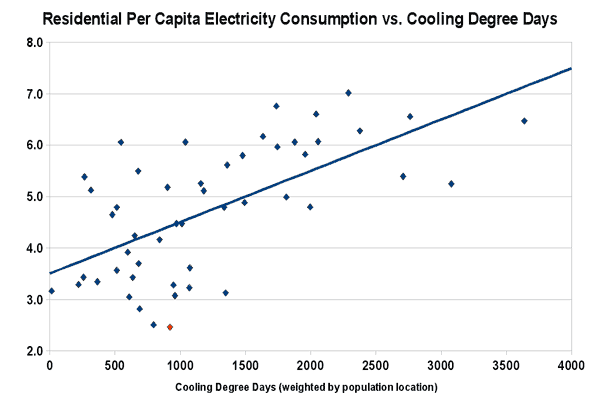
I found three factors that seem to be the main drivers of state electricity demand (which is measured in all of the charts below in thousands of kw-h per capita).  The first factor is climate, and certainly California has one of the milder climates.  The chart below looks at residential electricity demand vs. cooling degree days (weighted for population location).  Each data point is a state, with California is shown as the red data point:
Electricitybystatecdd

We get something similar for heating degree days, with electrical use going down as the climate gets milder, though not as good of a fit, which is not surprising since electricity is less important to heating than cooling.  Since California is well below the line, mild climate can be said to explain some of its lead on other states, but not all.

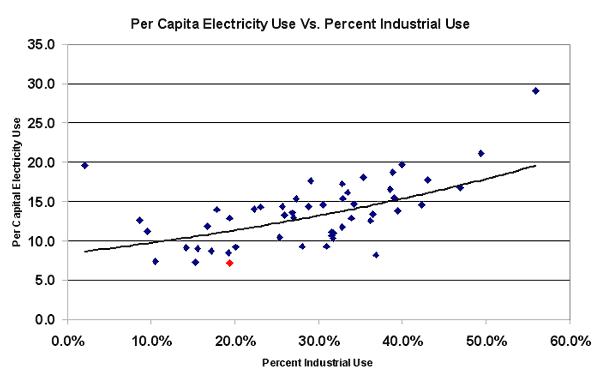
So I looked next at the percentage of electricity demand that goes to industry.  More heavily industrialized states will have a higher total per capita demand, because heavy industry chews up electricity that other types of businesses do not.  It turns out that California has a relatively low industrial use, which is not surprising given the regulatory environment there and the degree to which industry has been chased out of the state (one would have to be a madman to, all things considered, set up a new factory in California).  So here is the same type of chart of total electrical per capita use by state vs. the % industrial demand, again with each data point a state and California in red:
Electricitybystateindust

Again there is a pretty strong relationship, and again we see some but not all of California's low per capita consumption explained.  In effect, states on the left have exported their high-electricity-use industries to the states on the right (or to other countries).

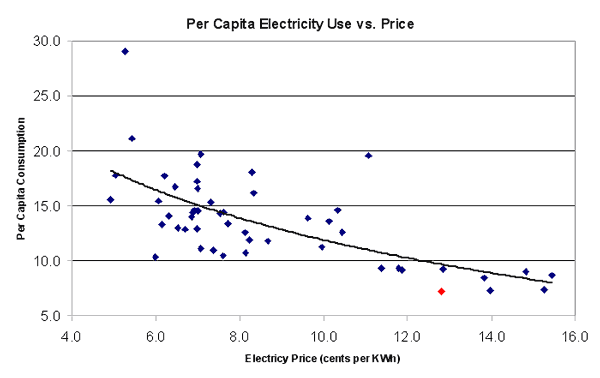
I have saved the most obvious relationship for last:  price.  It turns out unsurprisingly that the states with the highest electricity prices have the lowest per capital consumption:
Electricitybystateprice

Rolling climate, industrial intensity, and price together, these factors seem to explain at least 80% of California's efficiency lead over other states.  California government regulatory policy does indeed drive lower electrical consumption, just not exactly the way they would like you to think.  By chasing industries out of the state and raising electricity costs above those of almost every other state, California has reached a lower per capita consumption level.
Dumbest Thing I Have Read Today

From the department of wishful thinking comes this:

The worst oil shock since the 1970s has put a permanent mark on the
American way of life that even a drop in oil's price below $100 a
barrel won't erase.

Public transportation is in. Hummers are out. Frugality is in. Wastefulness is out....

As prices come falling back to earth, Americans aren't expected to
drop their newfound frugality. The jarring reality of $4-a-gallon
gasoline stirred up an unprecedented level of consumer angst that
experts say will keep people from reverting to extravagant energy use
for years to come - if ever again.

High gas prices prompted calls to lower speed limits to 55 mph in some states and touched off a seemingly endless wave of "Go Green" campaigns.

"I see a permanent shift," said Kit Yarrow, a consumer psychologist
at San Francisco's Golden Gate University who has studied how high oil
prices have affected Americans' buying behavior. "Historically, when
gas prices come down, people use more. But we've learned a lot of new
things during this period and it will be hard to go back to our
gas-guzzling ways."

Really?  I could have sworn people said that in 1972 and again in 1978.  But the SUV and the Hummer were not even invented until after these oil shocks.  He mentions the 55 mph speed limit, but we once had a national speed limit at 55 in the 1970s and we chucked it.  What possible evidence does this guy have, particularly since the recent shock was not nearly as bad as 1972 or 1978.  In fact, you can see that here in this graph of gas price pain:

Gas_prices_2

And, we have not seen the absolute shortages and gas lines we saw in the 1970s.  Usually these weird statements like this published by the AP are the start of some kind of broader political campaign.  The only thing I can guess is that this is the front end of some leftish/Obama polical message that we need to keep slamming on government conservation directives and alt-energy subsidies even as prices fall.

Windows Users: Beware the New iTunes Update

Via ZDNet:

I'm reading lots of complaints about the new iTunes 8 update causing
horrific problems on Windows machines, including widespread reports of
STOP errors, aka the Blue Screen of Death. My colleague Adrian
Kingsley-Hughes has asked readers for reports and Gizmodo has a sketchy post as well.

The author goes on to blame some extra software Apple is "sneaking" into the download.  I tend to doubt there is some deep conspiracy here, but you can read more if interested. (remember Coyote's Law: 

When the same set of facts can be explained equally well by

  1. A massive conspiracy coordinated without a single leak between hundreds or even thousands of people    -OR -
  2. Sustained stupidity, confusion and/or incompetence

Assume stupidity.)

I think I will wait a while before updating, though.

Update:  Apple has a new version of iTunes 8 for windows

Don't Panic!

OK, the light at the end of the tunnel may be a train, but so far it is too soon to panic about bank failures.*  Mark Perry brings us this chart for perspective:
Bank1

Of course, since we are in an election cycle, current problems are going to be portrayed as the worst economy since the Weimar Republic, or whatever.  Perry has a lot more in the post.

Thinking about Jeff Skilling

I was thinking a bit about Jeff Skilling (former Enron CEO) today.  What must he be thinking as a series of large firms that were supposedly far more stable than Enron go down one after the other to liquidity crises much like that of Enron?  Bear Stearns and Lehman, two firms that should have been rock solid, go down in the blink of an eye in a credit crunch, and all we hear from the media is how the firms fell victim to larger forces beyond their control.  At least at Enron they were up-front with the market about their taking on large risks.  Now, the government is running around in the background trying to match-make these failing companies and helping to save at least a squidge of shareholder equity.  The only thing the government did in the Enron collapse was hound Skilling and others into jail.   

Sure, Skilling may have made some overly optimistic statements about his company as he was trying to stave off the crunch, but no more so that the happy-face statements issuing from Bear or Lehman in their final days.  Executives who find themselves in a credit crunch are in a nearly impossible position.  The best way they can serve equity holders is to downplay or even bury bad news to head off the looming crisis of confidence.  But if they do so, they face presecution for making false statements about the company, ironically under laws meant to protect equity holders.

No Surprise To Anyone Who Is a Fan of "The Wire"

One of the recurring themes in HBO's fabulous series "the Wire" was how well-intentioned government officials could be led astray by perverse incentives, and, tied to this, the overwhelming pressure that can build up in government to fix the metrics rather than the problem.

In Charleston, they apparently thought they had a real public school success story on their hands:

Sanders-Clyde is a school in downtown Charleston that serves some of
the poorest students in the county. Most of its children come from the
nearby homeless shelter or public housing apartments. Its test scores
once were the worst in the county, and its future was so bleak that the
county board planned to close it.

Then MiShawna Moore became
the school's principal in 2003. She tailored lessons for students,
helped their parents pay bills, washed students' clothes and opened the
school building on weekends. The school's test scores began to rise.

By
2007, the school outscored state and district averages, far exceeding
the progress of schools with students from similar backgrounds.
Educators hailed Moore as a model for other principals, the community
showered her school with praise, and federal and state awards went to
the school in recognition of its achievement. Moore was so successful
that she was asked to lead a second downtown school, Fraser Elementary,
to duplicate her accomplishments.

But suddenly, the bottom dropped out:

This year, the school's PACT results fell sharply in every subject and at every grade level.

So what changed?  The curriculum?  The students?  No, what changed was who was in charge of compiling the scores.  For the first time, they took the measurement process out of the hands of the person being rewarded for the measure:

This was the first time that the school district monitored the school's
testing. District officials took tests away from the school each night
and put monitors in classrooms daily. Janet Rose, the district's
executive director of assessment and accountability, told The Post and
Courier in May that the extra scrutiny would validate the school's
scores.

Oops.  It seems the former high-flying principal suddenly needs to spend more time with her family

A few weeks after the tests this spring, in a move that surprised
parents and officials, Moore announced that she was leaving Charleston
County.

Hat tip to Andrew Coulson

Volume Gouging

I was just volume-gouged on gasoline today in Atlanta.  I was returning my rent car, and needed to fill the tank.   Stations here seem to fear a hurricane-related gas shortage, to the first station would only sell me 10 gallons maximum.  The second claimed to be out of gas.  At the third I was able to fill my tank the rest of the way.  These stations gouged me on volume, simply because they didn't have the simple courtesy to re-price their product upwards in a shortage in order to ensure continued availability of supply.

By the way, memo to news guys -- telling everyone to run out and fill their tanks RIGHT NOW in order to avoid a possible gasoline shortage will only precipitate said shortage.  If everyone fills his or her tank at the same time, this shifts inventory from large regional reservoirs to individual reservoirs (e.g. gas tanks), the most inefficient of inventory storage models.  Having every car's gas tank go nearly instantaneously from 5/8 full to full requires something like 600 million gallons of draw down from retail and wholesale inventory to car fuel tanks.  The system cannot survive that in 24 hours, and the hypothesized shortage becomes a reality.

Postscript:  By the way, the question of whether to run out and fill your tank tonight is a classic prisnoners dilemma game.  We are all better off if no one does it, but each invidividual probably maximizes his or her well-being by deciding to fill up, so everyone does it.

Flying on 9/11

Seven years ago today, my wife came down to my hotel breakfast meeting at a midtown Manhattan hotel and told us that there was something we needed to see.  We went upstairs to one of my investor's rooms, which had a balcony, and watched the disaster unfold.  Several of our friends died that day, though we wouldn't know that for weeks.  In between was a bizarre cross-country drive from Manhattan to Seattle.

I am on the road again today, and will observe that the airport is pretty empty today.  I don't know if this is an anomaly, or a general reluctance to fly on 9/11.

PS- Ironically, I was making a presentation that morning to potential investors telling them that the commercial airline business, on which our small company depended, was due for a turnaround.  Oops.

Cool Gear

These are really expensive and the performance is limited, but hey, what else would a bleeding-edge buyer expect?   They are super-small LCD projectors to take on the road for presentations and such, and they are barely bigger than an iPod.

Led_projector_toshiba

Local Papers and the Growth of Government

In some sort of synergistic relationship I haven't fully figured out, local newspapers love to cheerlead the expansion of government programs.  Here is a great example, via Rick Perry.  The headline in the Detroit Free Press web site reads:

State venture capital funds starting to pay off

But then we go on to read:

Michigan's two venture capital investment funds are starting to generate results, state economic  officials said Monday.

Since their formation in 2006, the $95-million Venture Michigan Fund
and the $109-million Michigan 21st Century Investment Fund have
invested in six venture capital firms with either a headquarters or an office
in the state. These firms have used the money and other capital to
invest in 11 fledgling Michigan companies that have added 40 workers in
recent years.

The two funds have made investment commitments of $116.3 million, or slightly more than half of their total capital.

So out of $204 million in taxpayer funds (why the state has entered the venture capital business with state funds is anybody's guess) the state has invested $116 million to create 40 jobs.  Given that the notion of the government venture fund was to create state jobs, its not clear how $3 million per job is a really good return.  Further, there is no mention of the government has gotten any kind of financial return from this investment, so I will presume it has not. So how can the paper possibly with a straight face say that the funds are "starting to pay off?" 

Eleven companies with an average of 3 employees each somehow each got $10 million in state funds.  I bet it would be fascinating to see just who these 11 companies are, and how their owners are connected into the political power structure. 

Ecoterrorism Vindicated in England

Apparently 6 vandals who cause $60,000 damage to a power plant in England were acquitted solely on the argument that they were helping stop global warming -- in other words, they admitted their vandalism, but said it was in a higher cause.

It's been a pretty unusual ten days
but today has been truly extraordinary. At 3.20pm, the jury came back
into court and announced a majority verdict of not guilty! All six defendants - Kevin, Emily, Tim, Will, Ben and Huw - were acquitted of criminal damage.

To recap on how important this verdict is: the defendants
campaigners were accused of causing £30,000 of criminal damage to
Kingsnorth smokestack from painting. The defence was that they had 'lawful excuse' - because they were acting to protect property around the world "in immediate need of protection" from the impacts of climate change, caused in part by burning coal.

So the testimony centered not on whether they actually vandalized the power plant - they never denied it - but on whether the criminals were correct to fear global warming from power plants.  I don't know much about British law, but this seems to be a terrible precedent.  Or maybe not - does this mean that I can go and legally vandalize every Congressman's house for wasting my money?

Silly Season is Here

I seldom comment on politics per se, but the whole brouhaha about Obama's use of the phrase "lipstick on a pig" somehow referring to the Republican VP nominee is just silly.  I used the phrase myself the other day.  "Pig" no more was meant to refer to Ms. Palin than using the terms "slavish devotion" or "niggardly" are meant to be racist (though they have similarly been so interpreted). 

PS-  It is entertaining to see that Republicans will play the race/gender victim card as quickly as will the Democrats.

The Opposite Problem

Megan McArdle writes:

Let's be honest, coastal folks:  when you meet someone with a thick
southern accent who likes NASCAR and attends a bible church, do you
think, "hey, maybe this is a cool person"?  And when you encounter
someone who went to Eastern Iowa State, do you accord them the same
respect you give your friends from Williams?  It's okay--there's no one
here but us chickens.  You don't.

Maybe you don't know you're
doing it.  But I have quite brilliant friends who grew up in rural
areas and went to state schools--not Michigan or UT, but ordinary state
schools--who say that, indeed, when they mention where they went to
school, there's often a droop in the eyelids, a certain forced quality
to the smile.  Oh, Arizona State.  Great weather out there.  Don't I need a drink or something? This person couldn't possibly interest me.

People
from a handful of schools, most of them hailing from a handful of major
metropolitan areas, dominate academia, journalism, and the
entertainment industry.  Our subtle (or not-so-subtle) distaste for
everything from their entertainment to their decorating choices to the
vast swathes of the country in which they choose to live permeate
almost everything they read, watch, or hear.  Of course we don't hear
it--to us, that's simply the way the world is. 

I have written before that I go out of my way not to mention my
double-Ivy pedigree within my business dealings because it tends to cause my
employees (who often have no degree at all) to clam up.  I absolutely
depend on their feedback and ideas, and those dry up if my employees
somehow think that I'm smarter than they are and they start to be afraid to "look stupid."

But McArdle's post causes me to think of another reason not to be snobbish about my eastern degrees.  I meet a lot of rich and succesful people out here in the Phoenix area, and I can't remember the last one that had an Ivy League degree.  I am thinking through a few of them right now -- ASU, ASU, Arizona, Kansas State, Tulane, no college, San Diego State....  Getting uppity about my Harvard MBA around here only leaves me vulnerable to the charge of "Person X went to Montana State and is worth $10 million now -- what the hell have you been doing with that Harvard MBA?"  Here in flyover country, college degrees and family pedigree are not really strong predictors of business success.

Now I Understand - Obama Means Five Million New Government Jobs

I have not been able to figure out how Obama gets to a 5 million job creation number from his alternative energy plans.  As I pointed out,

OK, so the total employment of all these industries that might be
related to an alternate energy effort is about 2.28 million.  So, to
add 5 million incremental jobs would require tripling the size of the
utility industry, tripling the size of the utility construction and
equipment industry, tripling the size of the auto industry, tripling
the size of the aircraft industry, and tripling the size of the
shipbuilding industry.  And even then we would be a bit short of
Obama's number.

But now I think I am starting to understand.  Tom Nelson gave me the clue with this article from the town of Frankfort, Kentucky:

Commissioners again discussed the possible creation of a sustainability coordinator position for the city.

Andy MacDonald, of the Mayor's Task Force on Energy Efficiency and
Climate Change, told commissioners that the creation of the position is
"the next critical step" to reduce the city's environmental footprint.

Commissioner Doug Howard brought up the possibility of asking the
city's recycling coordinator to fulfill part of the proposed position's
duties until money is available.

OK, so we need both a recycling coordinator and a sustainability coordinator for a town of 27,741 people (2000 census).  At this rate, that would imply nearly 22,000 government jobs across the country just in the government recylcing and sustainablity coordination field.  Now I am starting to understand.  Obama means five million new government jobs.

Crowding Out Private Alternatives

Due to the very nature of political pressures as well as poor accounting, a lot of government services are provided to the public below their true cost or market clearing price  (there are exceptions, like intra-city mail, but in these cases the government must pass laws to prevent private competition in order to maintain its market share).  When the government provides these below-cost or below-market-price services, it tends to crowd out private options.  So I am wondering why Kevin Drum is so surprised:

I guess rescuing them was the right thing to do. I'm still a little
taken aback by the apparent fact that American banks are now almost
flatly unwilling to make mortgage loans unless they're backed by Fannie
or Freddie, but that seems to be the case whether it takes me aback or
not. So rescue them we must. I suppose my next question is whether it's
worth thinking about how to restructure the American home mortgage
industry so that it can operate efficiently even in the absence of
massive levels of government backup. Or is Fannie/Freddie style backup
just the way the world works these days and there's no point fussing
over it?

As evidenced by the current bailout (and their huge accretion in market share over the last several years), Fannie and Freddie were under-pricing the service they were providing.  So of course, all things equal, bankers will demand the Fannie/Freddie backing because that will be a more profitable product and will be less work for the banker.  This seems like a "duh" kind of thing.  Like the "mystery" of why in Massachussetts, while everyone is obligated to sign up for health insurance, only the ones who were eligeable for free coverage did so.

I have written before of a similar phenomenon in business loans, where loans with SBA backing have crowded out everything else out there, such that a small business really can't find a lender who will make small business loans except with SBA backing.  Bankers are people too, and they can get lazy.  They have come to rely on these government programs, but certainly the lending function would still exist in a robust form if these programs did not exist.  Bankers would have to find other risk-mitigation tools, or else the loans would be more expensive, reflecting that the banks could not get rid of all the risk and had to price that into the loan.

By the way, don't you love the technocratic hubris of "thinking about how to restructure the American home mortgage
industry so that it can operate efficiently even in the absence of
massive levels of government backup."  Why do I, or Drum, or anyone outside of banking have to think about this at all?  I don't personally know the best private alternative to government mortgage gaurantees.  So what?  The financial field has been rife with innovation over the last several decades.  Just remove the government backup and let the the banks figure it out.  And let them go bankrupt when they figure wrong.

Postscript: As an ironic aside, the bank that holds my SBA loans was closed by the FDIC last week, my guess is due to a bad mortgage book in the Las Vegas area.  This doesn't have a lot of impact on me except that as I have paid down my loans, they became wildly overcollateralized, and I was in the process of trying to renegotiate some of my collateral out of the deal.  That will have to be put on hold, I guess.

Update:  More on government crowding out private options, in an entirely different industry:

Basic
dental care in Britain is free to those under 16 or over 60, the
unemployed, students, military veterans and some low-income families.
For others, government dentists offer lower prices than private
practitioners.

However,
the government does not cover cosmetic dentistry, and a recent
reorganization of the way dentists work has prompted many to leave the
public sector. Katherine Murphy, a spokeswoman for The Patients
Association, an advocacy group, said it was proving increasingly
difficult for Britons to get anything beyond basic dental care from
Britain's National Health Service.

Update #2: More on Fannie and Freddie, again via Rick Perry:

The
Fannie Mae-Freddie Mac crisis may have been the most avoidable
financial crisis in history. Economists have long complained that the
risks posed by the government-sponsored enterprises were large relative
to any social benefits.

We
now realize that the overall policy of promoting home ownership was
carried to excess. Even taking as given the goal of expanding home
ownership, the public policy case for subsidizing mortgage finance was
weak. The case for using the GSEs as a vehicle to subsidize mortgage
finance was weaker still. The GSE structure serves to privatize profits and socialize losses.
And even if one thought that home ownership was worth encouraging,
mortgage debt was worth subsidizing, and the GSE structure was viable,
allowing the GSEs to assume a dominant role in mortgage finance was a
mistake. The larger they grew, the more precarious our financial
markets became.

It Sucks to be a Woman

This weekend, I had a conversation with a group of people about the upcoming election.  As is typical in a fairly diverse group, at least one woman said that she was voting for Obama to protect "women's rights."  When pressed, this seemed to boil down to support for abortion rights. 

Boy, I am sure glad that I am a man, where my rights are not narrowly defined around the availability of a single out-patient surgical procedure.  I get to define my rights to include free speech, commerce, property, gun ownership, immunity from arbitrary search and seizure, and habeus corpus.  Even in the narrow world of medical care, I can aspire broadly to rights such as the ability to use medications not necessarily labeled safe and effective by the FDA, the ability to contract for whatever procedures I want even if the government is not willing to pay for them, and the abilty ride my motorcycle with or without a helmet as long as I am willing to bear the cost and consequences of my actions.

I will confess that this broader view of my rights makes voting more difficult, as neither the Coke nor the Pepsi party consistently protects my rights defined this broadly.

The $9 Billion Dollar Toe

A few weeks ago I was amazed at the story of the city of Chicago spending hundreds of millions of dollars to build the terminal rail station of a rail line that had no plan, no route, no approval, and no money.  Why spend hundreds of millions on a station that could well be orphaned?  The reason, I supposed, was to make a toe in the water investment where the public could later be shamed into voting more funds for building a rail line to actually connect to their fabulous new station.

It appears that California may be doing the same thing. This November, voters in that state will have the chance to approve a $9.95 billion rail bond issue.  $9 billion of this is earmarked for building a high-speed rail line from Anaheim to San Francisco.  But current estimates for this line's cost, which are always way too low, are for $30 billion.  Who in their right mind would proceed with a $30 billion (or likely more) project when only $9 billion of funding has been obtained?  Only scam artists, Ponzi schemes.... and the government.

Update:
  Wow!  Boy, I must be dumb or something.  The website supporting this bond issue says that this project will create 450,000 permanent new jobs.  How can anyone oppose that?  This is really amazing, since the entire US railroad industry currently employs 224,000 people, but this one rail line will create 450,000 jobs! 

Update #2:  I like to make predictions about government rail projects, so here is mine for this one:  I don't know what end they are starting with, but if they start from the south, I will bet that $9 billion does not even get them out of the LA area (say past Santa Clarita or Santa Barbara), much less anywhere close to San Francisco.

Good Money After Bad

If the world's citizens will not freely lend the Big Three automakers money of their own free will, then Congress is considering using force to make it happen.

Auto industry allies hope to secure
up to $50 billion in federal t loans this month to modernize plants and
help struggling car makers build more fuel-efficient vehicles.

Congress returns this coming week from its summer break, and the
auto industry plans an aggressive lobbying campaign for the
low-interest loans.

I wrote earlier on why we should not be afraid to let GM fail.  Paul Ingrassia makes this point:

Any
low-interest loans to develop fuel-efficient cars should be made
available to all car companies, not just the Detroit Three. The law
passed by Congress last year is framed to make this highly unlikely.
But if developing fuel-efficient and alternative-energy cars is deemed
worthy of taxpayer subsidies for public-policy purposes, it's just
common sense not to put all our eggs in Detroit's basket.

I would have gone further and said that US automakers are perhaps the last one's one would entrust with limited capital resources to develop such a new technology.  What would have happened to the PC revolution had the government circa 1975 limited all the available investment capital for new computing technologies to IBM, DEC, Honeywell, etc.

Good News on the Free Speech Front

Last year, a University of Delaware student was banned from campus and ordered to undergo psychological testing before he could return.  This was the administration's reaction to another student's complaint about certain content on his website, which was described as "racist, sexist, anti-Semitic, and homophobic."

Now, I have a guess that I would not have thought much of this student's professed opinions, but the first amendment is there to protect speech we don't like from punishment by government bodies such as the state-run University of Delaware.  So it is good to see that the US District Court for Delaware granted this student summary judgment on his free speech claim.

In particular, I was happy to see this:

The court also noted that speech is constitutionally protected when it does not cause a substantial disruption on campus"”even
if an individual student feels so upset by the speech that she feels
threatened by it, and even if university administrators strongly
dislike what is being said. That is, the complaining student's
reaction, together with the administrative trouble involved in dealing
with the situation, was not enough to show a substantial disruption
requiring punishment for Murakowski's protected speech.

This is important.  While it seems odd, college campuses have been the vanguard for testing new theories for limiting free speech over the last several years.  One popular theory is that offense taken by the listener is sufficient grounds to hold speech to be punishable.   This definition kills any objective standards, and therefore is a blank check for speech limitation, something its proponents understand all too well.  It is good to see a higher court very explicitly striking down this standards.

New Unemployment Numbers

US unemployment in August "jumped unexpectedly" to 6.1%, by the oddest of coincidences in the first full month just after new, 12% higher US minimum wages took effect

The unemployment rate is higher than it has been in the United States in the last 5 years, but substantially lower than the rate most Western European countries like France and Germany experience even during peak economic times. 

In response, the Obama campaign is urging further increases to the minimum wage and emulation of labor policy and legislation in France and Germany.