Slowest "High Speed" Connection of All Time

I have a couple of hours down time here at the hotel and was hoping to catch up on a little blogging.  Unfortunately, while the hotel has wireless Internet, it turns out to be the slowest connection of all time.  I finally switched to dial up and got a substantial speed improvement.  At my computer, I actually get a pretty strong wireless signal with a "11.5 MBPS" speed, so I presume there is another bottleneck further up the line.  My guess is that they are using a wireless repeater system and one of the jumps has a bad connection.  Actually, I am surprised this does not happen more often.  Today I am at the Red Lion in Redding, CA, which I will certainly avoid in the future.  I usually go with Hampton Inn, because I have always been happy with their high-speed service and Internet connectivity is more important to me than how nice a bed I get.

Why Judge Nominations Are Suddenly So High Stakes

Over the last 10 years, it certainly appears that the stakes have been raised substantially in judicial nominations, to the point that the approval of federal judges seems to be the number one issue in front of the Senate, even ahead of matters like Social Security reform or tax policy.  Sure, in the 80's we had some high-profile confirmation battles (e.g. Bork, Thomas), but those were for the Supreme Court and might be narrowly interpreted as revolving around issues of abortion and perhaps affirmative action.  Certainly both sides of the abortion debate are gearing up to duke it out over Supreme Court nominations, but most of the current brouhaha in the Senate is over lower level appointments that can't reasonably be interpreted as having much influence on abortion.  So something else must be going on.

To understand what this "something else" is, I want to digress a bit into the analogy of campaign finance (yes, its analogous).  I won't conceal the fact that I think that the most recent round of campaign finance "reform" has been a disastrous infringement on first amendment rights, the implications of which are only just coming to the surface.  However, my opinion of it is irrelevant to the analogy.  While proponents of campaign spending restrictions point to the "corrupting influence" of large sums of money in the election process, what no one ever mentions, though, is why such large sums of money are being spent in the first place.  It is this latter issue on which I want to focus.

The reason that politics have become so high-stakes, at least in dollar terms, is because the government controls so much more of the economy and our lives.  A century ago, the federal government had the power to raise and lower tariffs, and some limited control of the money supply, and occasionally gave out land grants to new railroads, and that was about it.  Today the government can tax an individual or corporation six or seven different ways, determines how much you must pay your employees, controls much of the health care system, holds product design or pricing approval authority for many industries, controls access to critical raw materials, etc etc.  If the government decides it does not like a particular person or industry, it can charge it with billions in extra costs in taxes -- or if it finds an industry politically expedient, it can pump it up with billions in subsidies.    Every year, the government takes literally trillions of dollars from one unfavored class of citizen and gives it to a more politically favored class. 

With stakes this high, it is no wonder that more and more people are willing to pay more and more money to let their voice be heard in the political process.  Greater amounts of money flowing into politics is not a sign of a broken democracy, but just its opposite.  More political spending means more money spent on speech, which in turn results from more people trying to add their voice to the political process more intensely.   Rather than deal with the root cause, the growing power of government to arbitrarily transfer wealth, the country instead lurches from one half-assed attempt at political speech control to another.

So here is where I am going with this analogy.  Today, it increasingly appears to people that the process for approving Presidential judge nominations in the Senate is broken.  The opposition party, first with some tentative steps by Republicans under Clinton and then with wholesale defiance by Democrats under Bush, are increasingly making the appointment of judges tremendously contentious.  I would argue though, as with campaign finance, that the problem is not with the process, but with the changing power of judges.  Over the last 30 years, judges have increasingly gone beyond interpreting and applying law to creating new law on their own, a power that is as constitutionally unjustified as it is unchecked.

To understand this, lets first start with an example of what I would consider appropriately constitutional behavior by judges.  This is an example from a case brought against the Bush Administration, demanding the release of terrorist suspects the administration has held indefinitely.  The Bush administration argued that the war on terrorism was different from other crimes, and that it required an enhanced ability to indefinitely intern suspects.  The US District judge in the case disagreed, and note particularly the language he uses (emphasis added):

U.S. District Judge Henry F. Floyd ruled Monday that the president of the United States does not have the authority to order Jose Padilla to be held indefinitely without being charged.

"If the law in its current state is found by the president to be insufficient to protect this country from terrorist plots, such as the one alleged here, then the president should prevail upon Congress to remedy the problem," he wrote.

I can find no more perfect example of a judge appropriately fulfilling his constitutional role.  For him, the necessity or merit of being able to hold terrorist suspects without charges is IRRELEVANT to him.  Judge Sweet might well consider holding suspects without charges in these cases to be the most necessary thing in the world, or alternately the most reprehensible.  But his job is not to decide if such a power SHOULD exist, his job is to decide if such a power DOES exist.  And he says it does not -- and to call the legislature if you want one, because it is their job to create new law. 

Unfortunately, there is a growing theory of jurisprudence that creates an expanded role for judges.  In this theory, judges are empowered to act sort-of as the institutional Dali lama, the wise person who descends from the mountain from time to time to correct moral lapses made by legislatures.  If you are a Star Trek fan, think of this theory placing judges in the role of the Organians, parachuting into human affairs from time to time to correct moral problems.  As Justice Scalia put it in a recent decision:

The Court thus proclaims itself sole arbiter of our Nation's moral standards, and in the course of discharging that awesome responsibility purports to take guidance from the views of foreign courts and legislatures.

The problem with this theory is two-fold.  First, it calls for making judges the rulers in a benevolent dictatorship, for there really are no checks on judges elected for life who suddenly have the power to create new law.  Sure, the notion of a benevolent dictatorship of people with strong moral compasses has been a compelling notion to some through the centuries, but it never works and always ends up getting abused.  Which leads us to the second problem with the theory, which is that there is no constitutional basis for judges creating new law, nor would the power-paranoid writers of our Constitution ever have allowed it. 

Now, you may be thinking me paranoid to think of judges as taking on the power to write law.  I offer proof in two parts.  First, doesn't the exponentially higher stakes and greater attention today in approving judge appointments point to the fact that judges somehow have more power than they had a few decades ago?  Second, lets look at an example.

I covered this one in this post on media privilege, and quoted from the NY Time editorial:

[Judge Robert Sweet] explained that the United States Court of Appeals for the Second Circuit in New York recognized a qualified First Amendment privilege that protects reporters from being compelled to disclose their confidential sources

Judge Sweet defended the existence of this privilege by saying:

he took note of the important role of confidential sources in news investigations of the Watergate, Iran-contra, Monica Lewinsky and Abu Ghraib scandals

Do you see the difference from Judge Floyd's opinion above.  In this case, the Judge does express his opinion, that confidential sourcing has played an "important role" in unwinding a number of political scandals.  He uses this as a justification to create a privilege for reporters to conceal evidence and ignore subpoenas from a federal investigation.  Recognize, as background, that whatever shield law for reporters that may exist in your state, there is NO press shield law allowing concealment of sources at the Federal level.  And, the First Amendment itself only says:

Congress shall make no law respecting an establishment of religion, or prohibiting the free exercise thereof; or abridging the freedom of speech, or of the press; or the right of the people peaceably to assemble, and to petition the government for a redress of grievances.

I don't see anything in that text that implies that the press can legally get away with obstructing justice while other citizens not in the press, like Martha Stewart, go to jail for obstructing justice.  Now, you might think that the press should have such a privilege.  Heck, I might in fact support some type of privilege.  But the fact is that right now, it does not exist under the law and judge Sweet should have given judge Floyd's answer, which I can't resist paraphrasing:

If the law in its current state is found to be insufficient to protect the media in doing valuable work, then the press should prevail upon Congress to remedy the problem

Now I am sure that I am vulnerable here to Constitutional scholars saying that I am a neophyte to Constitutional Law and I don't understand the chain of court decisions that lead to, in the case above, the press privilege precedent.  I have two responses to this.  First, I am tired of Constitutional Law being made into this arcane specialty where only a few experts can participate in the discussion, like Jesuits arguing about some arcana of a papal encyclical.  The Constitution is a very short and straight-forward document.  Anyone can understand it, and should.  I don't need 10 years of legal training and a piece of paper from the state bar to tell me that I see nothing about hiding information from police investigations in the First Amendment (heck, there are only 50 words there - where can it be hiding?)

My second response is specifically aimed at the chain-of-precedent reasoning for so many of the new rights and privileges that seem to be created nowadays.  Of course, precedent is critical in making law work - Common Law is all precedent and even in our constitutional system, relying on precedent saves a lot of rework (e.g. the Supreme court already decided this case X way so until they revisit it, we will follow that precedent). 

However, something else seems to happen in this chain.  Have you ever taken an original document, and Xeroxed it, and then made a copy of the copy, and then a copy of the copy of the copy, etc. through 10-20 generations?  What happens?  Typically somewhere along the way, some small flaw or spot on the machine causes a spot to appear on the copy.  As the copy is copied through successive generations, the spot grows and begins to stand out, until it is just as much a part of the document as the original text.  The spot, however, is an artifact that is reinforced through generations, like kids repeating a mistake in the game telephone.  That is what some of these court decisions feel like to me.  How did the NY circuit court find a press privilege - well, someone found a very very limited privilege out of thin air years ago, and then another judge used that as a precedent for expanding the privilege, until it is set in concrete today.  Just like the document experts in the CBS memo fraud want to get hold of originals of the documents to remove all the artifacts of copying to make the best decision on authenticity, so I in turn wish that courts would sometimes set aside all those intervening layers of other judges' decisions and just go back to the original damn document and work straight from the Constitution.

Liberals and some libertarians support have supported this theory of jurisprudence to date because to a large extent many of their causes have been net beneficiaries.  And, if history teaches anything, trashing constitutional controls to achieve near-term policy goals nearly always comes back to haunt those who do it. I understand the temptation -- for example, I oppose the death penalty for minors, and left the recent Supreme Court decision on the death penalty out of this post because I thought it a reasonable role for the Court to reinterpret "cruel and unusual".  But others, including Professor Bainbridge whose work I like a lot, and Justice Scalia whom he quotes, would argue that I am letting a favorable outcome blind me to the same problem of courts writing law. 

Postscript:  You may have noticed I did not mention Roe v. Wade.  In fact, I tend to avoid abortion issues like the plague.  In part this is because I have friends that are strongly, perhaps even radically pro-choice and friends who are strongly, perhaps even radically ant-abortion.  Like a lot of Americans, I believe that a fetus is not a human life at conception plus one day and it is very definitely a human life to be protected at birth minus one day, and I worry a lot where the dividing line is in the middle between life and non-life.  However, I will make two comments in the context of this post about Roe v. Wade that I think are fairly belief-neutral:

  1. I have never understood how "privacy" drives legality of abortion.  The clear question is "is the fetus a human life".  If it is not, then since it must instead just be tissue in a woman's body, then I accept her right to do with it as she pleases.  However, if the fetus is a human life, then it has rights of its own and the woman may not violate these except in special circumstances, no matter how much privacy she has.  So the decision is really one of "is the fetus a life"?  The Constitution does not give us much guidance on this question, but typically these types of uncertain decisions have been left to the states.  It is only with Roe v. Wade that the Court began taking on a new role of exercising a moral override over legislatures in certain areas (see Organian / Benevolent Dictatorship example above)
  2. I can't find a privacy right in the Constitution, though I will say I wish it was there, and would support a well-worded amendment in that area.  However, if the Court in its greater wisdom feels like there is a privacy right buried in there somewhere that restricts government intervention into what we do of our own free will with our own bodies, then there are a HELL of a lot of laws out there that need to be declared unconstitutional beyond just anti-abortion law, including:  narcotics laws, prostitution laws, the FDA, the tobacco settlement, alcohol prohibitions, helmet laws, seat belt laws, etc.

Thought on Hosting the Carnivals

I have had a lot of questions about my experience hosting both the Carnival of the Vanities (COTV) and the Carnival of the Capitalists (COTC) in February.  For aspiring hosts, here is an FAQ:

What are these Carnival things?

In 2002 Silfray Hraka was looking for a way for smaller blogs to get more attention - kindof like rural electrification for the Blogosphere.  He came up with the idea of the Carnival of the Vanities, a weekly roundup of posts from smaller bloggers, hosted each week at a different site.  Today, the COTV is in its 128th week and dozens of other spin-offs have been created.

How much of a traffic spike did you see?

This seems to be the number one question.  As a submitter each week to both the COTC and COTV, I usually see between 100-300 new visitors for the post I submitted, depending on how compelling the post's description looks.

For hosting the Carnival, of course, the traffic spike is more dramatic:

My normal mon-tue-wed traffic (unique visits): 300

Day of COTC: 1680

Day after: 500

2 days after: 325

Note that I actually got a bit more traffic from the Carnival of the Vanities:

Day of COTV: 2400

Day after: 600

2 day after: 325

The key of course is Glenn Reynolds linking.  Glenn can't read every small blogger that would like him to link to them, but he does a good job of publicizing various Carnivals that highlight smaller bloggers.   Glenn deserves all of our thanks for this.  By the way, I am pretty sure I got more non-Instapundit traffic for the COTC than the COTV.

I think that I leave my Sitemeter stats un-password protected and that you can view them here (link is to the monthly page but you can navigate around).  Here are the hourly stats for the COTV.  Below you can see my daily visits and page views for February.  I will leave it as an exercises for the reader to figure out when I hosted the Carnivals (COTV was first):

Febt

I do not really know how to track RSS feed traffic, but I think that the above numbers do not include RSS traffic. I do know that in the month I hosted these two carnivals my Bloglines subscribers have gone from 2 to 25.

The only other traffic related observation I can add is that my page views went up even higher on these days.  I generally run at 1.6 page views per visit but on these two days I went well over 2.  Hopefully that means that new visitors were looking around.

Is it hard to host a Carnival?

No, not really, it just takes some time.  I probably spent about 6 hours each to host the carnivals.  The COTC is very easy - submissions end up in a Gmail account in relatively standard format.  About 6 days before the publish date, the COTC folks will send the host an email telling them how to get into the Gmail account.  The COTV doesn't have this submission system, and relies more on the host providing an email contact in advance that people can send submissions to.  Make sure at least a week in advance of COTV that you post on your web site, preferably sticky at the top or with a link high in the margin, instructions for bloggers who want to submit to the Carnival you are hosting.  (Here is my post - I fiddled with the date in Typepad so that it would stay on top of the page for the whole week).

When hosting, do you need a theme?  How about Categories?

Both are optional.  I did a theme for my COTC just for fun, but did not have time, or any good ideas, for my COTV.  I highly recommend categorizing the entries because it makes the reading experience so much easier.  It is not hard to do as long as you put them in categories as you are building the post.

When Hosting, how do you keep up with all of the submissions?

I had 50 submissions for the COTC and 47 for the COTV.  I took everything, by the way, even if the post was a little out of bounds of the rules.  It is not too hard to keep up with the submissions as long as you:

  1. Create a draft template a week in advance and
  2. Add submissions every day rather than waiting to the last minute. The COTC submissions were easier to handle than COTV - COTC submissions came spread out through the week whereas COTV all came in the last 2 days.

A lot of my time was spent reading all the posts.  Not only was this fun, but I preferred to create my own summary of the post rather than just using the submitter's summary (which was often waaaaaay too long).  I tried to be fair as possible to everyone, particularly those I disagreed with.  I will say there were a couple of submissions I just did not understand or get what they were saying in their post -- in these cases, I used their description.  By the way - after you publish your post, check the links!  No matter how careful you were, you will have made some mistakes.

When Hosting, what did you do to publicize the Carnival?

First, I was careful to collect as many trackbacks as I could.  Some submitters included these in their email, but some did not.  Since I read every post, I always skimmed down to the bottom to see if there was a trackback.

Second, I sent every submitter a reply email saying that their post was included and giving them the link and trackback where they would find it on my site.  This did not take as long as you would imagine, since I copied the first one I wrote and just hit reply-paste-send on all the others.  This also let submitters check their links to make sure everything worked.  By the way, you may have a different policy, but I claimed editorial privilege and did not accept an requests to change my summary of their post.

All the submitters will generally send you traffic, as well as a number of regular readers.  As mentioned before, Glenn will generally link as well, and you can send him a brief reminder with the link, though both times I hosted he had the post linked before I thought to email him.

How do I sign up?

Instructions for hosting the COTV are here.  To submit to the COTV, go to Silfray Hraka's main page, scroll down for the list of hosts, and visit the host site for instructions.  Instructions for hosting the COTC are here.  You can submit to the COTC by filling in this form.  A list of other Carnival spin-offs is here.

Good luck

Conservatives and the Oscars

I really didn't want to go here again, but after some thought, I am really amazed at all the disdain for the Oscars coming out of the conservative blogs(CQ,Powerline,LaShawn Barber,LGF).  As I posted here, I thought Rock did an OK job, and for once all the awardees kept their speeches focused on movies rather than their own lame political views. 

However, conservative blogs have pointed out that most conservatives probably got turned off during Rock's monologue, particularly his jabs at GWB, and tuned out.  I am confused just what Rock said that was so horrible.  First, it is expected that monologues like this take some shots at whoever is in the White House.  And Rock certainly did so, but he also took shots at prominent liberals and Hollywood luminaries as well.

Second, just what did he make fun of?  He made fun of going to war and not finding WMD.  Now, I am certainly bright enough to know that the argument for war was more nuanced (heh heh) than just WMD's, but if I was a conservative, I would LOVE it if someone made fun of GWB every day for our WMD intelligence.  If such jokes at his expense occur frequently enough, maybe he will get mad enough to do the real thorough house cleaning of the CIA which is desperately overdue.

The other thing Rock poked fun at Bush for was the growing deficit.  Hey, conservatives out there, what's wrong with that?  Again, I am smart enough to understand there are valid reasons for deficits - wars and recessions are two of them.  Also, I understand that if you want to cut spending, you usually have to cut taxes first, drive the budget into deficit, and use that as a lever for getting spending cuts.  However, Bush has done NOTHING in four years to try to reign in domestic spending, and has done several things (e.g. prescription drug benefit) that greatly increase spending.  Reagan ended up with large deficits but only after putting up a valiant fight with a Democratic-controlled Congress to cut spending.  GWB has a Republican Congress and hasn't even tried.  So what's wrong, even for conservatives, with taking a poke at GWB on deficits?

Oh yes, the blogs have one other complaint - that he said "ass".  You know, whenever I hear this kind of complaint, it just reminds me of Beavis and Butthead going "heh, heh heh, heh -- he said ass -- heh, heh"

Problems at Harvard

Steven Metcalf has an interesting article in Slate on the state of Harvard University.  And, if you don't really care about what messes the twits from Harvard are making of the place (and I don't blame you) it is also a good look at problems in universities in general.  My favorite passage is this one:

From Bradley's descriptions"”and from my own experience"”academia has devolved into a series of now highly routinized acts of flattery, so carefully attended to that one out-of-place word is enough to fracture dozens of egos.

One only has to observe the shrill and over-the-top reactions to some of Lawrence Summers recent remarks to have this ring true.

I actually have several connections to Harvard.  As a high school senior, I was fortunate to have my choice of Ivy League schools, and I chose Princeton over Harvard, in large part because it was obvious even then that the Harvard's graduate schools and faculty egos took precedence over teaching undergraduates.  At Princeton I got to know Neil Rudenstine, then provost of Princeton and later President of Harvard.  Rudenstine was basically far too good a man to run Harvard, sort of like sending Mother Theresa in to run Haiti.  The faculty devoured him, and drove him to a breakdown.

More recently, I attended the Harvard Business School (HBS).  Many of you who are unfamiliar with Harvard would likely assume that the b-school was the snobbiest and most condescending arm of the university.  In fact, the opposite was the case -- the B-school was both isolated from and looked down on by the rest of the university, its isolation reinforced and symbolized by the river that separates HBS from the rest of the campus.  Many an outsider have commented on how approachable HBS students and faculty are as compared to the rest of the university, which is ironic since most of the rest of the university, busy polishing their egalitarian credentials, condescendingly denigrate HBS students for being, well, grubby capitalists rather than lofty intellectuals like themselves.  As a result, HBS crew teams were routinely booed through the entire Head of the Charles regatta, and HBS graduates are booed by the rest of the university at every graduation ceremony.

As a result, Princeton gets much of my time and love and attention and, well, money, while Harvard gets nada. 

Update:  I am reminded that this last feeling about Harvard is not limited to the B-school.  My good libertarian college roommate Brink Lindsey (I wish he would start blogging again) tells me that when he was at Harvard Law, a group of his friends formed N.O.P.E., which stood for Not One Penny Ever [to Harvard].

Marketing the Left and the Right

As a long-time student of the marketing craft, it is interesting for me to look at politics sometimes as a marketplace of ideas, and running for office as a marketing activity.  Though I don't want to overplay the notion of packaging over content in politics, you can find a number of historical examples where good communication helped turn the ideological tide. 

Also, being a libertarian sometimes gives me the ability to sit on the sidelines and see the left-right struggles in this country from the outside, possibly with a bit of perspective, since my team isn't really even on the field.

From this perspective, conservatives have really been running up the score on liberals of late.  This is an outcome I cheer when it leads to freer markets and lament when it leads to broadcast censorship.

A lot of ink and electrons have been used up of late trying to diagnose the reason for this success and what the Left can do to even the score.  Rather than comment on this, I will offer the following as a marketing case study.  Forget whether you agree with everything that is said, but think of each piece as marketing for the left or the right.  I was struck by the contrast of these two articles in part because they came from the same publication, and in part because they touch on many similar themes but in totally different ways:

Which product is more compelling to the average American?  Of course, neither can represent the diversity of either side of the spectrum, but through all the political noise in this country, I think each represents the tone and message that is actually filtering through to voters.  If one side want to claim "but that's not fair... that's not the message we intended for voters to hear" --- well, welcome to marketing. 

By the way, I wrote a piece based on Mr. Morford's here.

Chris Rock and the Academy Awards

Maybe it was just having really low expectations, but I thought Rock was OK last night, though conservative bloggers seemed to have hated the broadcast.  Sure some of the stuff they did flopped (the skit with Adam Sandler comes to mind) but he was moderately funny and while he made fun of a number of people, he was pretty equal-opportunity about it.  And anyone who gets Sean Penn all huffy can't be all bad.  Sure the show may have less gravitas than when Carson hosted it, but compare it to where shows like the Grammy's have gone and it looks like Masterpiece Theater.  And if people want to talk about whether Rock was "serious" enough for the event, they should focus some attention on Al Pacino showing up looking like a homeless person or on Dustin Hoffman trying to present the Best Picture award drunk off his ass.

Other Notes:

  • Was the show producer sleeping with Beyoncé, or was she the only singer available?  Why did we see her three times?  And did all of the songs seem to be totally unmemorable or what?
  • The women's dresses were generally awsome, while their hair generally looked awful (or at least just dull, which is the same for a Hollywood-type).  I loved the return of those sort-of mermaid-shaped dresses.
  • Jamie Foxx was the highlight
  • Seeing Clint Eastwood with his young wife was an inspiration for all of us over-40 males.  Seeing his mom there was even more of an inspiration.

Carnival of the Capitalists

Welcome to the Carnival of the Capitalists.  Many thanks to Silflay Hraka for starting the Carnival of the Vanities, of which this is a spin-off, to showcase smaller blogs to a wider readership.  Look for future Carnivals of the Capitalists at these sites (you can submit articles here):

March 7, 2005 Blogcritics.org
March 14, 2005 The RFID Weblog
March 21, 2005 Beyond The Brand
March 28, 2005 The Mobile Technology Weblog
April 4, 2005 Law and Entrepreneurship News
April 11, 2005 TJ's Weblog
April 18, 2005 Gongol.com

While you're here, feel free to look around -- this post will tell you more about what I do at Coyote Blog.

For this week's Carnival, I have decided to take a bit of a risk, and, in true capitalist fashion, I have taken on a sponsor for this week's Carnival:

This Carnival of the Capitalists is Proudly Sponsored by"¦
ACME
Maker of fine anvils for over 50 years

Continue reading ‘Carnival of the Capitalists’ »

More on the Press and Revealing Sources

In a previous post, I wrote:

There were two interesting court decisions today that each can be summarized as "the press does not have rights or legal privileges beyond those granted to any ordinary citizens"

A number of readers were confused by this, as we have always seen the brave reporter on TV or in the movies protecting their information sources under a "shield law".  Many states, but not all, do in fact have shield laws that give reporters some protection against revealing their sources of information under subpoena.  However, there is no such law at the federal level, and any state laws that exist do not apply to federal courts or subpoenas.

However, despite this lack of an explicit federal shield law, most media organizations argue that the Constitution confers such privilege on them anyway.  Per the NY Times, some judges agree:

[Judge Robert Sweet] explained that the United States Court of Appeals for the Second Circuit in New York recognized a qualified First Amendment privilege that protects reporters from being compelled to disclose their confidential sources

This confuses me - I have read the first amendment many times.  I see the stuff about freedom of the press.  I always naively assumed this meant that they had the freedom to publish any old bonehead thing they wanted, including criticism of the government, without any limitations by the state.  I never realized that this meant that they also had the freedom to evade subpoenas and cover up evidence of crimes, things the rest of us would go to jail for (e.g. Martha Stewart).  Does the fact that the same amendment refers to freedom of religion mean that priests can legally cover up wrongdoing?  Do freedom of speech protections mean that bloggers can hide sources from subpoenas?

I find the judge's logic, as reported by the Times, to be scary:

The judge, Robert Sweet, reasoned, correctly, that the subpoenas for the phone records were the functional equivalent of demanding testimony from the reporters themselves, and he took note of the important role of confidential sources in news investigations of the Watergate, Iran-contra, Monica Lewinsky and Abu Ghraib scandals.

In other words, the Judge thought that allowing the press to hide their sources was useful in some cases historically, so he created a new first amendment privilege.  This is the kid of action that irritates the heck out of me.  What the judge just did in this case is legislate.  He saw a need in society and created a new privilege for a class of citizens based on that need.  You may even agree with his logic - in fact, I may even agree in part with his logic - but it is not his job!  He should be saying: "I'm sorry, as useful as such a protection may be, I see no basis for it in federal law or in the Constitution.  If you think you need one, write your Congressman but for now, there is no such privilege".  UPDATE:  If judge Sweet needs an example, here is one from an unrelated case:

U.S. District Judge Henry F. Floyd ruled Monday that the president of the United States does not have the authority to order Jose Padilla to be held indefinitely without being charged.

"If the law in its current state is found by the president to be insufficient to protect this country from terrorist plots, such as the one alleged here, then the president should prevail upon Congress to remedy the problem," he wrote. (hat tip LGF)

Sounds a lot like my suggestion above, huh?  This strikes me as a good judicial practice - rule on the law as it is, rather than what you think it should be.  We actually don't know whether Judge Floyd thinks that it is a good idea for the President to be able to order terrorist suspects held indefinitely, nor should his opinion matter.

Another Update:  Professor Bainbridge has a good post on yet another case of legislating from the bench.  I am lukewarm on the death penalty in general and am opposed the death penalty for minors, but I still think the Supreme Court is dangerously overstepping its bounds here.  The majority opinion talks about practices in other countries and public opinion - what does that have anything to do with Consitutionality? Those are arguments for legislation banning death penalty for minors in the legislature, not for the Court.

By the way, the Times wants to be able to keep secrets, but gets pretty huffy when other people have the same privilege:

Some judge may have looked at the issue, but we have no way of knowing, given the bizarre level of secrecy that still prevents the reporters being threatened with jail from seeing the nine-page blanked-out portion of last week's decision evaluating the evidence.

I found one other point in this same NY Times editorial to be hilarious.  I have not really commented on the Plame affair, because I found it to be pretty boring.  In fact, it is telling that most discussion of the affair ended the day after the elections.  Anyway, I found this note by the NY Times pretty funny:

Meanwhile, an even more basic issue has been raised in recent articles in The Washington Post and elsewhere: the real possibility that the disclosure of Ms. Plame's identity, while an abuse of power, may not have violated any law. Before any reporters are jailed, searching court review is needed to determine whether the facts indeed support a criminal prosecution under existing provisions of the law protecting the identities of covert operatives.

There is nothing wrong with this statement in and of itself - in fact, I agree.  Its funny only because the Times was the one reporting that it was in fact a crime committed:

Officials are barred by law from disclosing the identities of Americans who work undercover for the C.I.A. That provision is intended to protect the security of operatives whose lives might be jeopardized if their identities are known.

Among those who have cried foul are several Democratic senators, including Charles E. Schumer of New York, who have said that if the accusation is true and if senior administration officials were its source, law enforcement authorities should seek to identify the officials who appeared to have violated the law. Mr. Schumer has asked Robert S. Mueller III, director of the Federal Bureau of Investigation, to look into the case.

The Best of the Web pointed out this even more telling statement from a 12/31/04 NYT editorial.  Note the complete lack of uncertainty as to whether there was any crime committed (emphasis added)

The change was announced by the newly appointed Deputy Attorney General James Comey, who turned the case over to a respected career prosecutor, Patrick Fitzgerald, the United States attorney in Chicago. Mr. Fitzgerald is charged with finding out who violated federal law by giving the name of the undercover intelligence operative to Mr. Novak for publication in his column.

Interesting to see how their perspective changed when the subpoenas landed at their door.  "Law enforcement needs to get to the bottom of this as long as, err, they don't ask us to help".

I'm Confused by this Diversity Thing

For years, women at Harvard argued there needed to be more women on the faculty to support "diversity".  I have always thought that diversity meant that you had a lot of difference - in this case different kinds of people with different skills.  Now, Larry Summers is getting attacked by the female faculty for implying that women are, uhh, perhaps different from men.  Women are insisting that there is no justification for even studying the question of whether women are different than men.  They maintain that women are the same, no argument allowed.  But if they are the same, how is hiring more women contributing to diversity?

My guess is that the comeback of those involved is that women don't have a genetic difference from men, but they have a difference in perspective (political, philosophical, etc).  There are two obvious problems with this:

  • If what universities are really trying to achieve is a diversity of background, perspective, and political/philosophical viewpoints then why don't they hire for and measure diversity based on background, perspective, and political/philosophical viewpoints, rather than the imperfect proxy of black/white, man/woman, etc.
  • And, If what universities are really trying to achieve is a diversity of
    background, perspective, and political/philosophical viewpoints -- they are doing a really crappy job, because universities are pretty dang homogeneous, at least in political viewpoint as compared to the population.

By the way, I was initially negative to Summer's comments myself here.  I still support my criticism that as a leader of a leading, in fact uniquely influential, educational institution, he has an obligation to his institution to be careful what he says.  A CEO today who speaks his mind on political issues is not only ill-advised, but may actually be violating his/her fiduciary responsibility by bringing public censure on the company's shareholders.

However, that said, the degree of hysteria over Summer's comments is mind-boggling, especially when you read what he actually said in context rather than just accept the media summary (basically, he did not say that men were better at math on average than women, he said that men MAY have a higher standard deviation in their skills, leading to a disproportionate number of men being both dolts and geniuses at math and science).  To some extent, the women driving this hysteria actually seem to be publicly reinforcing stereotypes of women being delicate (some silly woman actually said she almost fainted at Summer's remarks)  overly emotional (given their hysterical reaction) and, ironically enough, non-scientific (given the fact that no one has thought to take on Summers scientific query with facts rather than political intimidation).

In my experience, a confident mature woman can make the average man feel bumbling and childish, and have an ability to rise above the fray to bring sanity to a confused situation.  Why can't the grown-ups among the female gender be heard in such arguments? Never mind, the first sentence answers the second.  Besides, I think most confident intelligent women are giving up on woman's organizations anyway.

Blogging is Light - Working on the Carnival of the Capitalists

My Experience Today with Newspapers and the Web

Its been a frustrating day dealing with the Arizona Republic.  The day began pretty exciting as they had a beautiful article in the style section today featuring the handbags my wife creates.

Our first disappointment was the fact that the paper forgot to include my wife's web site in the article, giving readers no contact information in the article if they are interested in the purses.  Then we found that the link to her article in the style section of the Republic online was wrong, and only produced an error.  Now, mistakes like this happen - I actually messed up a link to my wife's web site in this article, but I quickly fixed it when an alert reader noticed.  So I emailed the webmaster at the Republic, and, several hours later, I got an email saying something like "here is the correct link".  But the link online is still broken!  In the time they sent me the email with the correct link, they could have just fixed the link online.  Six hours later, it still is not fixed.  This strikes me as classic dead-tree journalism, thinking in terms of making corrections days or weeks later rather than in real time.

UPDATE:  Yea!  Link fixed.  Wonder if my sending them this blog post helped or if they were doing it anyway.

Kate Groves Handbags Featured in the Newspaper!

Kate Groves Handbags

Hey, look!  We are fashion-blogging here at Coyote Blog today (fellow Princetonian Virginia Postrel would be proud)

We are having fun today as my wife, Kate Groves, had her handmade handbags and purses featured in the weekend style section of the Arizona Republic today!

Of course, being the MSM, they forgot to put her web site in the article, but they have the article and a link to her site here.  Since they only keep the articles online for a week (server disk space must be expensive over there) we have cached the article on Kate Groves handbags here. Kate's website with all of her purse designs are here.

I Was Right

I predicted just a week ago that recent media credibility issues would lead to (misguided) calls for tighter credentialing and licensing of journalists:

I resisted the call by a number of web sites at the beginning of the
year to make predictions for 2005.  However, now I will make one:  We
will soon see calls to bring a tighter licensing or credentialing
system for journalists, similar to what we see for lawyers, doctors,
teachers, and, god help us, for beauticians
.  The proposals will be
nominally justified by improving ethics or similar laudable things,
but, like most credentialing systems, will be aimed not at those on the
inside but those on the outside.  At one time or another, teachers,
massage therapists, and hairdressers have all used licensing or
credentialing as a way to fight competition from upstart competitors,
often ones with new business models who don't have the same
trade-specific educational degrees the insiders have.

Hah, it didn't take a year - it only took a week.  Several commentators point out that those jumping all over the Jeff Gannon affair are effectively arguing for tighter credentialing.  From Glenn Reynolds:

I also think that the people who are trying to inflate this into a big
issue are making a dreadful mistake. I eagerly await the reaction when
the White House responds to this criticism by requiring everyone who
attends a press briefing to make a full financial and sexual
disclosure, and starts rating news outlets as "real" or "fake"
according to bias. (If I were Rove I'd make some rumblings about this
to the press corps, and I'd explicitly cite the lefty bloggers by name,
just to stir up trouble . . . .)

David Corn warns:

There is a need for professional accreditation; space is limited. Yet
there is nothing inherently wrong with allowing journalists with
identifiable biases to pose questions to the White House press
secretary and even the president. And if such a reporter asks a dumb
question--as did Gannon/Guckert (which triggered this scandal)--the
best response is scorn and further debate. Bloggers should think hard
when they complain about standards for passes for White House press
briefings. Last year, political bloggers--many of whom have their own
biases and sometimes function as activists--sought credentials to the
Democratic and Republican conventions. That was a good thing. Why
shouldn't Josh Marshall, Glenn Reynolds, John Aravosis, or Markos
Moulitsas (DailyKos) be allowed to question Scott McClellan or George
W. Bush? Do we want only the MSMers to have this privilege?

I Would Be Thrilled to Admit I'm Wrong

From David Ignatius in the Washington Post (via Captains Quarters):

The leader of this Lebanese intifada is Walid Jumblatt, the patriarch of the Druze Muslim community and, until recently, a man who accommodated Syria's occupation. But something snapped for Jumblatt last year, when the Syrians overruled the Lebanese constitution and forced the reelection of their front man in Lebanon, President Emile Lahoud. The old slogans about Arab nationalism turned to ashes in Jumblatt's mouth, and he and Hariri openly began to defy Damascus....

"It's strange for me to say it, but this process of change has started because of the American invasion of Iraq," explains Jumblatt. "I was cynical about Iraq. But when I saw the Iraqi people voting three weeks ago, 8 million of them, it was the start of a new Arab world." Jumblatt says this spark of democratic revolt is spreading. "The Syrian people, the Egyptian people, all say that something is changing. The Berlin Wall has fallen. We can see it."

I opposed the war in Iraq not because I thought there was any ethical problem in throwing out Saddam, but because it seemed to require an awful lot of time and energy and lives to overhaul one country.  I support a strong US role in the promotion of democracy, but given the long list of totalitarian states in the world, the approach in Iraq seemed inefficient.

However, my argument loses power if our efforts in Iraq start to cause spontaneous changes in other countries in the region.  To be fair, many made this very argument for the war, but I have been skeptical.  I would love to be proved wrong.

All Your Base Are Belong To Us

Update 6/23: Property rights lost 5-4.  More on Kelo decision here and here.  The arguments below are still valid, even if the SCOTUS did not agree.

New_london_base

Photo:  Welcome to New London.  Note the small businesses, which will be happy to serve you until the town of New London takes their property away and gives it to someone they like better

As I have written before, there is a disgusting and increasingly popular trend among city governments to seize private property from one owner and give it to a developer who will build something that will generate more property taxes (e.g. seize house to build a new Home Depot).  This theory of eminent domain is being tested in arguments in front of the Supreme Court around actions of New London, CT to seize private houses and handing them over to a developer so he can build a private marina.  New London argues that it is economically depressed, and it needs to substitute some higher tax paying businesses for lower tax paying homeowners.  Dahlia Lithwick in Slate brings us this telling exchange yesterday between the Court and New London attorney Horton:

Justice Antonin Scalia asks what difference it makes that New London is depressed. What if a city acknowledged that it wasn't doing badly, but just wanted to condemn land to attract new industry? He describes Horton's position as: "You can always take from A and give to B, so long as B is richer." And O'Connor offers this concrete example: What if there's a Motel 6 but the city thinks a Ritz-Carlton will generate more taxes? Is that OK?

Yes, says Horton.

"So you can always take from A and give to B if B pays more taxes?" asks Scalia.

"If they are significantly more taxes," says Horton

"But that will always happen. Unless it's a firehouse or a school," protests Kennedy.

The Court even gave New London's attorney a bit of a lesson on how free exchange of goods requires consent of both parties:

"We're paying for it!" Horton exclaims, noting that no one is taking anything from these minorities.

"But you're taking it from someone who doesn't want to sell. She doesn't want your money," retorts Scalia.

Professor Bainbridge points out why Mr. Horton's payment will also be inadequate:

First, it fails to take into account the subjective valuations placed on the property by people whose families have lived on the land, in at least one case, for a 100 years. In other words, if the Supreme Court rules for the city, the government will be able to seize land at a price considerably below the reservation price of the owners. Second, unlike the prototypical eminent domain case, in which the land is seized to build, say, a school or road, in this case the city is using eminent domain to seize property that will then be turned over to a private developer. If this new development increases the value of the property, all of that value will be captured by the new owner, rather than the forced sellers. As a result, the city will have made itself richer (through higher taxes), and the developer richer, while leaving the forced sellers poorer in both subjective and objective senses

Read the whole thing, its depressing, all the more so since commentators seem to feel that New London will prevail.  To my eye, Mr Horton and New London look no different than Stalin-era Soviet planners.  The Economist (sub. req'd)agrees:

Put simply, cities cannot take someone's house just because they think they can make better use of it. Otherwise, argues Scott Bullock, Mrs Kelo's lawyer, you end up destroying private property rights altogether. For if the sole yardstick is economic benefit, any house can be replaced at any time by a business or shop (because they usually produce more tax revenues). Moreover, if city governments can seize private property by claiming a public benefit which they themselves determine, where do they stop? If they decide it is in the public interest to encourage locally-owned shops, what would prevent them compulsorily closing megastores, or vice versa? This is central planning.

Plenty more commentary at Professor Bainbridge (here and here), Volokh (here and here), Cafe Hayek,  and the Knowlege Problem.  The Institute for Justice is defending the property owners and is at the forefront of this fight - win or lose, they deserve props for their efforts.

Postscript:  I generally don't like the arguments I see in some blogs that go like "why aren't the ___________ [fill in  with liberal or conservative] blogs addressing such-and-such issue?"  Blogs are intensely personal, and since most of us write them as a hobby, there are always going to be issues that just don't really get us fired up.  For example, though many libertarian bloggers expend numerous electrons on gun rights, the topic is generally a yawner for me so I seldom go there.

With that said, it is interesting to speculate where the "progressives" are on this case.  When you see a story of a city making a virtue of taking from poorer people to give to rich developers, one would expect the left to go nuts.  As reason describes it (here and here and here):

... a growing number of governments are using eminent domain to circumvent the conventional real estate market. Eminent domain forces property owners to sell their property to the city while the city then turns around and sells the property to developers. Private developers can reap significant financial gains through this process. Reason finds these decisions are increasingly driven by local politics, not respect for property rights, and give well-connected property developers significant advantages over homeowners and small businesses.

Little guy vs. big guy -- where is the Left?  Well, the problem is that progressives generally support the erosion of private property rights.  They like cases that reinforce the ability of government and politicians to take, redirect, or otherwise control private property for their own goals.  In this case, I presume that they are willing to sacrifice a few little guys in Connecticut for the larger goal of increasing statism.

UPDATE:  Apparently the New London attorney ended on a note of mystery, according to SCOTUSBlog:

The moment of the day came in Kelo when the city's counsel attempted to close by saying, "I want to leave you with just four words," then his time expired. (Although he did say -- using more words, "I see my time has expired so I won't be able to tell you them.") Justice Kennedy then asked the plaintiff's lawyer on rebuttal, "You don't happen to know what the four words were?" Regrettably, he didn't.

Here is my guess for New London's last four words: "Everything belongs to us".  Of course "All your base are belong to us" would have been better, but that is seven words.

Lessons for the UN from the American Civil War

The United Nations is broken -- this is beyond question.   The only thing left to argue about is if it is Worldcom-broken, where the basic business model is OK but the management is corrupt; or Internet-startup-broken, where the whole mission and business model is wrong.  I would contend that the answer is a little of both.

One of the sources of confusion in discussing the UN is that the organization has several very different missions.  These missions fall in roughly two categories:

  1. Distribution of aid and relief, including funds and training for education, public health, and poverty mitigation.
  2. Helping to manage relationships between nations and, sometimes, between nations and their people

The first mission, of administering aid, is plagued mainly by corruption and bureaucratic waste and mismanagement, and would probably be fixable to some extent with better leadership in place.  Personally, I think much of the aid provided is well-intentioned but misguided.  Poverty generally results from corrupt, confiscatory, totalitarian regimes.  As a result, much of the aid (see oil for food in Iraq) gets siphoned off as graft by rulers, and the rest may alleviate some suffering but provides no long-term progress toward fixing the real problems the poor face.  However, given that so many people and nations feel conscience-bound to keep sending the aid, and given that some of the aid does in fact help, a cleaned-up UN is probably a reasonable vehicle for delivering it.

My main focus in this post, however, is on the second UN mission listed above, that of managing the relations between peoples and nations.  The fundamental problem is that we as Americans (rightly) expect the UN to carry a set of values into its dealings with nations that the majority of its member nations do not share.  Here, I am not even talking about contentious issues that even Western democracies might argue about (e.g. abortion, capital punishment) but the basics -- things like free elections, free expression, and free markets.  Just scan the list of member nations, or, even more revealing, the list of countries on the UN Human Rights committee (yep, you can bet that Sudan brings a lot of moral authority to that committee).  The UN is a dictators club.

The best analogy I can come up with is the United States in the decade before the Civil War.  Imagine that rather than being split 50/50, the majority of states in the US at the time supported slavery.  In those circumstances, how much chance would there be that the Congress would successfully pass a law outlawing slavery?  Right, none.  In the same way, it is unreasonable to expect a UN that is majority-controlled by totalitarians to take any meaningful steps to support freedom and plurality.

Until the Civil War, states in the South believed that the Constitution allowed them substantial, in fact near total, leeway in setting their own laws and standards.  While in a Federalist system this is always somewhat true, what the Civil War was really about was the United States establishing that there are certain minimum standards that member-states will be held to, even if enforcement of those standards requires the use of force.   Ever since, though states may vary in terms of tax rates and such, there are minimum standards that are non-negotiable  (though sometimes this gets carried away - was the 55 mile an hour speed limit really a necessary element of these minimum standards?)  The civil rights movement of the 1960's was another such time when the US enforced a minimum standard on its individual states.

Bringing this analogy back to the UN, the UN is weak because there are no minimum standards for membership.  An immoral nation alone is immoral.  A grouping of immoral nations is still immoral - the grouping does not confer any moral authority.  When the UN was founded, it was thought that having as many of the world's nations as possible as members would confer the maximum moral authority on the body, sort of like having a higher turnout in an election tends to increase the perceived mandate and legitimacy of the victors.  Its becoming increasingly clear, though, that having all the nations of the world, many of them dictatorships, as members is in fact destroying any moral authority and effectiveness the UN might have.

Since 9/11, the United States has adopted a dual foreign policy of fighting terrorism and promoting democracy around the world.  Most Americans support these goals, thought many disagree with any number of the tactics over the last several years.  In achieving these goals, it would be far better for the US to be able to pursue them as part of a coalition, an alliance for freedom and democracy, rather than on its own.  As has been made pretty clear, the UN is not going to be that vehicle.  It houses too many terrorists to ever agree to fight terrorists (it cannot even agree on a definition of terrorism) and it encompasses too many totalitarians ever do anything meaningful to fight for individual rights (see Sudan, Congo).  Of course, this doesn't stop the UN from trying to take credit for progress made by others.

What is needed is a new organization with a core group of countries strongly committed to democracy that can act with greater moral authority than any single country but who will not be hamstrung by members who oppose strong interventions because they fear being the next target.  This article by Jonathon Rausch in Reason shows encouraging steps in the right direction:

Since 1996, a handful of foreign-policy wonks have been kicking around the idea of a "democracy caucus" at the U.N. Two administrations, first Bill Clinton's and then George W. Bush's, took quiet but significant steps in that direction. Now, according to Bush administration officials, the concept will be test-flown at the six-week meeting of the U.N. Commission on Human Rights that began on Monday in Geneva.

He concludes:

"United Nations" is an oxymoron. Democracies and dictatorships are mongoose and cobra, with no real hope of uniting except opportunistically. But a community of democracies"”that might just work. It already works in NATO and the E.U. The new community is a fledgling, but many readers of this article may live to see it soar.

UPDATE:  By the way, a reader pointed out to me one other problem the UN has:  their mission has been perverted from one something like "working toward a more peaceful world" to "peace at all costs".  The problem with peace at all costs, and something the American left and many of my fellow libertarians need to do a gut-check on, is that if you seek peace above all else, it means that you are willing to live, literally, with anything else.  That can mean anything from living with genocide (Sudan) to living with totalitarianism (N. Korea) to living with sponsorship of terrorism (Iran, Syria). 

By the way, I will pre-empt the obvious straw man here:  opposing peace at all costs does not mean favoring war as a first option.  I approved of the war in Afghanistan, but opposed invading Iraq, though in the latter case I am hopeful for the Iraqi people and that the example of Iraq may be setting a good example elsewhere, as in Jordan.

My 11-Year-old on Freedom and America

My son had a class project to take pictures of things that represented the good things about America, as well as some of its problems.  He did it pretty much on his own, and I only really saw it when it was done.  Most pictures were pretty typical of such kids' products (a flag, statue of liberty, pretty mountains) while a couple were fairly typical of my son (of eleven pictures, two were of professional baseball stadiums).  There was one picture I thought, while probably the most prosaic, was, with his caption, the most powerful.  Though its a bit over-dramatic, I actually am pleased that he understands just how different other countries can be (grammar needs some work):

100_0696

Caption:  "People sitting and eating and
joking around that is freedom, not being forced into a wall with a gun at your
back."

Carnival of the Capitalists

The new Carnival of the Capitalists is up at the Red Prawn.

The host next week is....me!  Submissions should be sent via the Gongol submission page here.

Top 100 Gadgets of all Time

Mobile PC has a great top 100 list of great gadgets of all time, from the swiss army knife to the pocket fisherman to the iPod.  Really cool idea for a list, and the authors range pretty far and wide for their selections.

CalculatorClapperPongLite_britePocket_fisherman


In Praise of "Robber Barons"

After seeing a piece of my son's history curriculum at school, I realized for about the hundredth time just how poor an understanding most people have about the great industrialists of the 19th century, so unfairly painted as "robber barons".  While it is said that "history is written by the victors", I would observe that despite the fact that socialism and communism have been given a pretty good drubbing over the last 20 years, these statists still seem to be writing history.  How else to explain the fact that men who made fortunes through free, voluntary exchange of products can be called "robber barons"; while politicians who expropriate billions by force without permission from the most productive in society are called "progressive".

To be sure, capitalists of the 19th century sometimes played by rules very different from ours today, but in most cases those were the rules of the day and most of what they did was entirely legal.  Also to be sure, there were a number of men who were fat ticks on society, making money through fraud and manipulation rather than real wealth creation (Daniel Drew comes to mind).  However, most of the great industrialists of the 19th century made money by providing customers with a better, cheaper product.  In the rest of this post, I will look at two examples.

The first is Cornelius "Commodore" Vanderbilt, the person to whom the term robber baron was originally applied (by the New York Times, interestingly enough - some things never change).  While Vanderbilt is perhaps best known for his New York Central railroad, the term was actually applied to him earlier in life in his shipping days, where he made a fortune running steamships in and out of New York City.  Vanderbilt stood accused of overly predatory tactics in moving into rivals territories.  However, in 1859 Harpers Weekly observed (via An Empire of Wealth by John Steele Gordon):

...the results in every case of the establishment of opposition lines by Vanderbilt has been the permanent reduction of fares.  Wherever he 'laid on' an opposition line, the fares were instantly reduced, and however the contest terminated, whether he bought out his opponents, as he often did, or they bought him out, the fares were never again raise to the old standard.  This great boon -- cheap travel-- this community owes mainly to Cornelius Vanderbilt". (sorry, no link available -- I guess they weren't putting their articles online in 1859)

In many ways, Vanderbilt was the Southwest Airlines of his day, and, just like with Southwest today, towns begged for him to serve them because they knew he would bring down rates.  In fact, there is actually another parallel with Southwest Airlines.  In the early days of Southwest, most of the airline industry was regulated such that new entrants competing at lower prices were pretty much excluded by government rules.  Southwest got around these rules by flying only in Texas, where interstate rules did not apply.  Their success in Texas was a large reason for the eventual demise of government regulation that effectively protected fat and inefficient incumbent airlines, with drastically lower fairs the result.

When Vanderbilt first entered the steamship business, most routes were given as exclusive charters to protected monopoly companies, most run by men with friends in the state government.  Vanderbilt took on the constitutionality of these government enforced monopolies and, with the help of Daniel Webster, won their case in the Supreme Court.  Within a decade, the horrible experiment with government monopoly charters was mostly over, much to the benefit of everyone.  While private monopolies have always proved themselves to be unstable and last only as long as the company provides top value to customers, publicly enforced monopolies can survive for years, despite any amount of corruption and incompetence.  Vanderbilt, by helping to kill these publicly enforced monopolies, did more than perhaps any other man in US history to help defeat entrenched monopolies, yet today most would call him a monopolist. 

By the way, there are two charges against Vanderbilt that partially stick.   Those are that he bribed legislators and that he sought out price fixing agreements with his competitors.  Both are true, but both need context. 

To understand the bribery, one has to recognize that NY state passed a law that you could not be convicted of bribery solely on the evidence of the other party involved in the bribe.  In other words, they effectively made bribery legal as long as you were smart enough to do it without witnesses.  The real corruption was in the NY legislature at the time.  While Vanderbilt's motives were likely not always pure, no one who understands the state of NY at the time would deny that Vanderbilt would have been gutted had he not pro-actively played the bribery game himself in Albany in self-defense.

The price-fixing charge is even easier to deal with in context - basically price fixing agreements were entirely legal at the time.  In fact, price-fixing has been thought necessary, particularly in transportation, by politicians of all stripes for centuries - remember as late as the 1970's we had government enforced price-fixing in railroads and airlines.  In the 1930's, FDR via the NRA briefly instituted a government price-collusion scheme on the entire economy.

My other featured industrialist here on hug-a-robber-baron day here at Coyote Blog is John D. Rockefeller.  At one point of time, Rockefeller controlled 90% of the refining capacity in the country via his Standard Oil trust.  He was and is often excoriated for his accumulation of wealth and market share in the oil business, but critics are hard-pressed to point to specifics of where his consumers were hurt.  Here are the facts, via Reason

Standard Oil began in 1870, when kerosene cost 30 cents a gallon. By 1897, Rockefeller's scientists and managers had driven the price to under 6 cents per gallon, and many of his less-efficient competitors were out of business--including companies whose inferior grades of kerosene were prone to explosion and whose dangerous wares had depressed the demand for the product. Standard Oil did the same for petroleum: In a single decade, from 1880 to 1890, Rockefeller's consolidations helped drive petroleum prices down 61 percent while increasing output 393 percent.

By the way, Greenpeace should have a picture of John D. Rockefeller on the wall of every office.  Rockefeller, by driving down the cost of Kerosene as an illuminant, did more than any other person in the history to save the whales.  By making Kerosene cheap, people were willing to give up whale oil, dealing a mortal blow to the whaling industry (perhaps just in time for the Sperm Whale).

So Rockefeller grew because he had the lowest cost position in the industry, and was able to offer the lowest prices, and the country was hurt, how?  Sure, he drove competitors out of business at times through harsh tactics, but most of these folks were big boys who knew the rules and engaged in most of the same practices.  In fact, Rockefeller seldom ran competitors entirely out of business but rather put pressured on them until they sold out, usually on very fair terms.

From "Money, Greed, and Risk," author Charles Morris

An extraordinary combination of piratical entrepreneur and steady-handed corporate administrator, he achieved dominance primarily by being more farsighted, more technologically advanced, more ruthlessly focused on costs and efficiency than anyone else. When Rockefeller was consolidating the refining industry in the 1870s, for example, he simply invited competitors to his office and showed them his books. One refiner - who quickly sold out on favorable terms - was 'astounded' that Rockefeller could profitably sell kerosene at a price far below his own cost of production.   

More here. In fact, many, many of these defeated competitors became millionaires in their own right with the appreciation of the Standard Oil stock they got in the merger.

Eventually the Standard Oil monopoly weakened as most private monopolies do.  Monopolies seldom if ever engage in the price-increase games everyone expects them to, but they do get risk averse and lose vitality over time without serious competition.  This indeed did happen to Standard Oil, and it missed a number of key market turns, such as the Texas oil boom.  By the time is was broken up under the Sherman anti-trust act, Standard's market share had already fallen to 60%.  As would be the case many times in history, the government acted on the economic "threat" of Standard Oil at the very time the market was already doing the job.

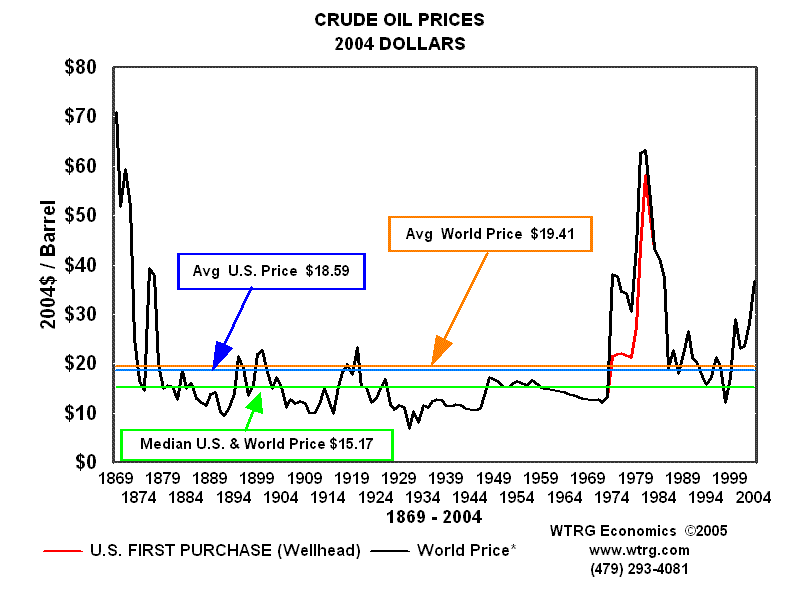
Ever since, people have expended a lot of unnecessary energy getting worried about bigness and monopolies in industry.  I always laugh when "progressives" decry the monopoly power of the oil industry to manage prices.  I worked for the oil industry in the 80s, and if they had the power to manage prices they sure were doing a crappy job of it.  If someone thinks that oil companies have been manipulating prices, they have to explain this chart to me.  If prices are manipulated at all, they look like they are being kept low and stable.

Another great example of monopoly paranoia is the near continuous Microsoft-bashing in the courts.  The most famous anti-trust case was the successful case by Netscape and numerous other Microsoft competitors attempting to kneecap Microsoft, nominally for monopolizing the browser market.  Now lets leave aside the obvious issue of just how consumers are getting hurt by being given a free browser by Microsoft.  The plaintiffs apparently successful argument (incredibly) was that through a series of technology and marketing moves, Microsoft prevented competition.  If that is so, if competing with Microsoft is so hard, then why are 30% of my visitors using Firefox when none used it a year ago.  I use Firefox, and you know what, it took me about 5 minutes to download, install it and start running it.  Boom, monopoly gone.  Lots more on anti-trust here.

UPDATE:  Welcome to the Greenwich Public Schools.  Thanks for linking me from your web site.  Despite my Arizona home today, I actually lived in Greenwich for a while growing up.  You can find other essays on capitalism and individual freedoms here and here, or you can check out Dave Berry, who is much funnier than I am.  If you are looking for a stronger defense of free markets than you can find in most public schools, a good place to start is at the Cato Institute.

"Sin" Taxes Put Perverse Incentives on Government

The government has found over time that it is able to sell higher taxes to the voters on certain items if they can portray those items as representing some socially unwanted behavior. These are often called "sin" taxes. The justification for the tax in its beginning is as much about behavior control as revenue generation.  Taxes on cigarettes, alcoholic beverages and even gasoline and plastic grocery bags have all been justified in part by the logic that higher taxes will reduce consumption.

However, a funny thing happens on the way to the treasury.  Over time, government becomes dependent on the revenue from these taxes.  The government begins to suffer when the taxes have their original effect -- ie reducing consumption -- because then tax revenues drop.  The government ultimately finds itself in the odd position of resisting consumption drops or restructuring the tax so it no longer incentivizes reduced consumption so that it can protect its tax revenue collections.

Cigarettes are a great example.  In this article, via overlawyered, from Forbes (simple registration required):

Big tobacco was supposed to come under harsh punishment for decades of deception when it acceded to a tort settlement seven years ago. Philip Morris, R.J.Reynolds, Lorillard and Brown & Williamson agreed to pay 46 states $206 billion over 25 years. This was their punishment for burying evidence of cigarettes' health risks.

But the much-maligned tobacco giants have subtly and shrewdly turned their penance into a windfall. Using that tort settlement, the big brands have hampered tiny cut-rate rivals and raised prices with near impunity. Since the case was settled, the big four have nearly doubled wholesale cigarette prices from a national average of $1.25 a pack (not counting excise taxes) in 1998 to $2.10 now. And they have a potent partner in this scheme: state governments, which have become addicted to tort-settlement payments, now running at $6 billion a year. A key feature of the Big Tobacco-and-state-government cartel: rules that levy tort-settlement costs on upstart cigarette companies, companies that were not even in existence when the tort was being committed.

So, a tax that was originally meant to punish supposed past wrong doing by cigarette makers is causing problems because it was... actually doing what it was supposed to by hurting those companies.  Lots of good stuff, I encourage you to read it all - basically state governments have gone from opponents of the cigarette companies to their partners.  Antarctic Liberation Front opponent Eliot Spitzer comes in for particular attention.

A second example I discussed comes from San Francisco, where a tax aimed at discouraging use of plastic garbage bags was modified so that it collected more money, but no longer discouraged use of plastic.

A third example comes to us via Vodka Pundit, which points out that California now is considering supplementing their gas tax with a per-vehicle-mile tax.  The gas tax was always effectively a per-vehicle-mile tax, since the amount of gas you used was proportional to the number of miles you drove.  And, of course, the gas tax is far easier to manage than a per-vehicle-mile tax (yes, coming soon, its the odometer auditors!)

So why a need for the new tax?  Well, it turns out that Californians are buying a lot of very fuel-efficient cars, including new hybrids, which reduces gas consumption and thus taxes.  Of course, this is EXACTLY what most people hope the gas tax is doing - helping to conserve gasoline and reduce emissions and incentivizing people to purchase efficient vehicles.  Now California is considering substituting a new tax that collects more money but provides no conservation incentives.

UPDATE:  Welcome Carnival of the Vanities!  If you're looking to kill more time at work today, check out my rant on the recent New London eminent domain case in front of the Supreme Court titled "all your base are belong to us".

More on Private Conservation Efforts

As I wrote here, I think of environmental issues in two categories:

  1. Regulation of pollution and emissions that affect other people's property.  These regulations are essential to the maintenance of a system of strong private property rights.  Without them, we would all be in court every day suing each other for damage to our property or water or air on our land from neighboring lands. Of course, we can all argue about whether set limits are reasonable, and we do.
  2. Regulations of land use that effects only your own land.  This is a relatively new area of environmental law, ushered in by the Endangered Species act and various wetlands regulations.  These regulations say that even if your proposed land use doesn't create any emissions that affect anyone else, the government may still ban your land use for some other environmentally related goal (habitat, watershed, anti-sprawl, the list is endless). 

These land-use laws constitute by far the most distressing area to me in environmental law.  In the worst cases, these laws can result in what are effectively 100% takings of a person's land without any compensation. (Example:  you buy a lot on the ocean for $500,000 to build a beach house.  Before you can build it, new regulations are passed making it illegal for you to build a house on that land.  Yes, you still own the land, but it is now worthless to you since you cannot use or develop it).  Good article on this here (pdf) and a listing of Cato Institute articles on this topic here.

The government is of necessity involved in #1, though we can argue that some regulatory structures are more efficient than others (e.g. trading vs. command and control).  Government involvement in #2 is often a mess, and is one reason why private conservation groups and land trusts have made so much headway.

Reason has recently released a fairly comprehensive roundup of private conservation efforts that goes into much more detail on this topic.

Audit Blogging

Hey, this may be a first -- audit blogging.  I have an auditor from the Washington Department of Revenue in my office right now auditing my last two years sales tax returns.  She's a nice lady and so far the interaction has been pleasant.

Here is the funny thing - she has spent about 3 hours now trying to figure out what tax rates should apply at my various locations, and she is still at it.  I have written several times about the complexity of WA state sales tax variations for lodging, and how they vary by geography (here and here).  OK, if your experienced auditor has to spend hours in frustration trying to figure out what tax applies, the system is too complicated.

Update:  At halftime I am ahead, with WA owing me $800.  Stay tuned.

UPDATE #2:  Small potential setback in the 3rd quarter.  Several years ago I shifted assets (vehicles) I had bought in Arizona and used for years in Arizona to Washington for operations there.  The auditor suggested I may owe use tax on the vehicles in WA.  Huh?  Use tax drives me up a tree in general, but this seems really crazy.  WA is hyper sensitive to this issue because they have high sales taxes and very high vehicle registration fees and neighboring Oregon has not sales tax and lower registration fees.

Its Kyoto Day

Today (OK, its the 16th now, so yesterday) is apparently the start date for the Kyoto Treaty.  You can find examples of my skepticism about the costs and benefits of the Kyoto treaty here.  I won't go back over all that stuff here.

The Washington Post article linked above includes the usual misstatements about global warming, and is fisked here.  I particularly liked this line (emphasis mine):

...by uniting the vast majority of the world's nations, Kyoto could equally be the harbinger of an international model that rewards pollution-cutting innovation and pushes countries and companies to pursue cleaner forms of growth

The implication being that the US is the odd man out of a global consensus.  But then read further:

The pact, ratified by 141 nations, limits emissions from 35 industrialized countries

See the consensus problem?  Yes 141 nations ratified it, but only because 106 of them didn't have to do anything and were exempt.  In fact, they were exempted because the framers of the treaty knew that these countries would not ratify the treaty unless they were exempt. 

I also enjoyed the implication in the article that America's withdrawal from the treaty is solely based on the stand of President Bush.  You very seldom see any mention that the Senate voted 95-0 NOT to sign Kyoto until it was substantially amended, changes that have never been made to the treaty and never will be.  This occurred years before GWB became president.