Trying Feedburner

Tonight, I decided to switch to Feedburner to manage the feeds from my site.  I did this for two reasons:  1) I would like better traffic information on the readership for my feeds and 2) I like some of the configuration options they have.

Both Feedburner and Typepad swear that they have everything set up so that all my existing feed subscribers will now get the feeds via Feedburner without changing their subscriptions (some sort of redirect, I guess).  We'll see.  Please comment if you are having problems.

If you are getting some duplication of posts or some read posts showing up as unread, I am pretty sure that this is a one-time effect of the changeover.  However, if the problem persists, let me know.

My University in the News

"Shouldn't Princeton students have the same rights as their counterparts down the road at Mercer County Community College?"

Princeton is a private institution, and has a greater ability than state institutions to set its own codes of conduct for its students.  That being said, as one who wants Princeton to remain a strong institution, I don't understand what the university's interest is in limiting free speech.  Particularly booing at a play.  The only exception I might make to this are efforts to make sure that invited speakers or scheduled performances can actually be heard and aren't drowned out by protesters, but I don't get the sense that this is what is going on here.

This "unwanted verbal conduct" standard that a number of universities have adopted is absurd, and is only harming students by releasing them into the real world believing that the government will protect them from encountering any criticism.  In this sense, Princeton and other universities are creating students in the modern Islamic mold, teaching them they should somehow be immune to criticism and that they should react with rabid outrage at the first person who says anything negative about them.  The only difference is that these students are being taught to respond with lawyers rather than explosive backpacks, but the outcome in terms of stifled free speech is the same.

Advice for the "Reality-Based" Community

Recently, the so-called "reality-based community" on the left has developed the theory that US oil companies have purposefully dropped gasoline prices from over $3.00 to $2.00 a gallon solely to help Republican re-election prospects in November.  This notion is so insane as to be, well, insane, and I am not even going to bother fisking it any more than I would bother refuting a flat-earth hypothesis.  OK, I can't resist, here are two quick arguments, by no means comprehensive.

  • US oil companies control a minority of world oil supplies, and those folks who do dominate the market (Hugo Chavez, Iran, the Saudis, the Russians) are highly unlikely to be cutting Bush much slack.
  • The implication is that either the old, high price or the current low price is somehow an unnatural contrivance.  If the higher price was a contrivance, ie above the normal market clearing price due to some collusion, then we would have been swimming in oil as supplies outstripped demand, and inventories would be overflowing.  If the current lower prices are a contrivance, then demand should outstrip supply and we should have lines at every gas station.  Of course, neither situation has been observed.

So here is this week's message for the Left:  Economics is a science.  Willful ignorance or emotional rejection of the well-known precepts of this science is at least as bad as a fundamentalist Christian's willful ignorance of evolution science (for which the Left so often criticizes their opposition).  In fact, economic ignorance is much worse, since most people can come to perfectly valid conclusions about most public policy issues with a flawed knowledge of the origin of the species but no one can with a flawed understanding of economics.

Postscript: In fact, the more I think about it, the more economics and evolution are very similar.  Both are sciences that are trying to describe the operation of very complex, bottom-up, self-organizing systems.  And, in both cases, there exist many people who refuse to believe such complex and beautiful systems can really operate without top-down control.

For example, certain people refuse to accept that homo sapiens could have been created through unguided evolutionary systems, and insist that some controlling authority must guide the process;  we call these folks advocates of Intelligent Design.  Similarly, there are folks who refuse to believe that unguided bottom-up processes can create something so complex as our industrial economy or even a clearing price for gasoline, and insist that a top-down authority is needed to run the process;  we call these folks socialists.

It is interesting, then, given their similarity, that socialists and intelligent design advocates tend to be on opposite sides of the political spectrum.  Their rejection of bottom-up order in favor of top-down control is nearly identical.

Update:  From Cafe Hayek, letter to the Washington Post

Dear Editor:

Alleging
that today's falling gasoline prices result from a fiendish plot to
keep the GOP in power, Kenneth Jones is certain that "gasoline prices
will go right back up to $2.75-plus after the [November] election"
(Letters, October 2).

If Mr. Jones is correct, he can make a
financial killing.  All he need do is to invest all of his assets going
long in gasoline futures (which are today about 30 percent lower than
they were in late July).  Indeed, he ought even to cash out all the
equity in his house, max out on his credit cards, and borrow heavily
from his brother-in-law so that he can invest as much as possible in
these futures.

He can then contribute his post-election financial bounty to the Democratic National Committee.

Sincerely,
Donald J. Boudreaux


Some Advice for the Local Libertarian Party

For lack of a better term, I call myself a libertarian with a small-l.  I do not, despite this term, feel much allegiance to the formal Libertarian Party.  I tend to like their platforms more than those of the major parties, but many of their candidates seem unserious to me.

Today I got my first press release from the local LP candidate for Governor.  And what is it about?  The LP candidate jumps into the fray on the Arizona 9/11 Memorial:

Libertarian nominee for Governor, Barry Hess weighs in on the only
thing Democrat Janet Napolitano and Republican Len Munsil can find to
disagree about - the great Arizona 9-11 memorial debate.

When asked for his input, Mr. Hess replied, "It doesn't surprise me
that this is all they can come up with to distinguish themselves as a
reason to vote for them.  The problem is that neither one of them ever
seems to posses the ability to go to the root of the issue.  The very
first thing they should have determined is, what is it?  Is it a
tribute to the innocent lives lost on 9-11, or is it a memorial of the
event?
                
If it is a tribute to the innocent
dead, then the politically-charged slogans are clearly misplaced and
should be removed.  If it is a monument memorializing a tragic event
that is surrounded by a multitude of dubious official explanations of
what actually happened when innocent lives were caught up in something
bigger than them and lost in a politically-induced inevitability, then
the outrage expressed in the slogans is well, and rightfully placed.
                
Why didn't the Republican or the Democrat first establish what it is
supposed to be?  Because they are both just using it as a soapbox, and
it's shameful they would each use it in an attempt to garner votes.
The public really should reflect on the fact that if these are the best
candidates the Republican & Democrat parties could come up with,
maybe neither is their best option for Governor."

When I read the first line, I thought Mr. Hess was going to rightly criticize the major party candidates for focusing on trivia.  But no, he jumps right in himself.  I'm not a big fan of how the memorial turned out, but while the memorial was officially sanctioned by the governor, it was at least all privately funded.  We seem to have many other issues in a state where the government is building the new Berlin Wall that I would think a good libertarian would be more concerned about.

Here would have been my response:

"While the major party candidates focus all their attention on the content of a single
piece of privately-funded sculpture in downtown Phoenix, Warren Meyer criticized both
candidates for their support of a government-funded half-billion dollar monument to
mediocre football
and corporate welfare out in Glendale."

Postscript:  By the way, this government-funded facility is used for its core purpose just 11 days out of the year  (Fiesta Bowl, 2 pre-season games, 8 regular season games) which gives it an occupancy  of 3%.  Supporters will argue that it is used for other events (e.g. a home and garden show) but these events could be held at existing facilities costing 1/10 the amount of Glendale Stadium.  To somehow take credit for these other events is disingenuous, because their move to Glendale likely cannibalizes the revenue of some other government facility, like the convention center.  Most of the cost of the stadium -- visitor amenities, locker rooms, sliding roof, sliding grass floor, seats, etc -- are for football only.  More about why I hate the public funding of stadiums here.

We've Got the First Ammendment on the Run

Great editorial from George Will:

Seattle"”as the comprehensive and sustained attack on Americans' freedom
of political speech intensifies, this city has become a battleground.
Campaign-finance "reformers," who advocate ever-increasing government
regulation of the quantity, timing and content of political speech,
always argue that they want to regulate "only" money, which, they say,
leaves speech unaffected. But here they argue that political speech is
money, and hence must be regulated. By demanding that the speech of two
talk-radio hosts be monetized and strictly limited, reformers reveal
the next stage in their stealthy repeal of the First Amendment.

I was living in Seattle at the time.  These were not political operatives, like a James Carville, moonlighting as talk radio hosts.  They were just radio guys who found an issue, no more or less than say Oprah when she focuses her audience on Alar or BGH or whatever.  Read the whole thing, but note that, in the name of campaign finance reform which is ostensibly about not letting money rule politics, the government is going after the side that was outspent five to one.  But this is not about campaign finance reform.  This is about protecting the government and its officials from criticism.

This is the America produced by "reformers" led by John McCain. The
U.S. Supreme Court, in affirming the constitutionality of the
McCain-Feingold speech restrictions, advocated deference toward elected
officials when they write laws regulating speech about elected
officials and their deeds. This turned the First Amendment from the
foundation of robust politics into a constitutional trifle to be
"balanced" against competing considerations"”combating the "appearance
of corruption," or elevating political discourse or something. As a
result, attempts to use campaign regulations to silence opponents are
becoming a routine part of vicious political combat.

Advice on Growing a Blog

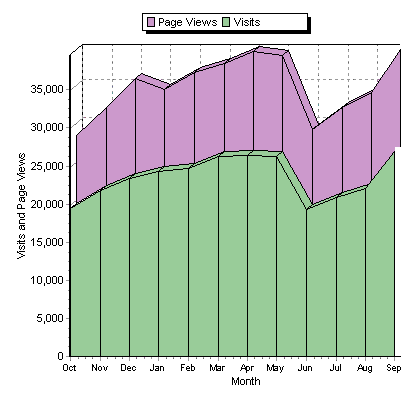
I have tried a bit of everything to grow my blog:  participating in carnivals, signing up for contests, spamming Glenn Reynolds for attention (sorry Glenn).  Here is the lesson I have learned:  You have just got to write a lot.  Other bloggers will notice you and start linking back to you when you write about them.  Walter Olson at Overlawyered has had me guest blog a couple of times, and I don't think I ever emailed him once.  I linked to a lot of his posts, adding my commentary, and he eventually noticed.  Ditto some of the folks at Cafe Hayek, at Reason, and at the Knowledge Problem.  In turn, I have discovered great blogs like Maggies Farm and Catallarchy from my traffic logs.  Write a lot on your blog, and comment on other people's blogs, if you really have energy to burn, and the traffic will show up.  Search engine traffic alone will bring new readers, and the more you post, the more different searches will find you (though some are a bit bizarre).

As a sort of reverse proof of this, here is my traffic profile for the last year.  Nothing spectacular, I am just a small blog, but you can see what happened to traffic when my posting went way down over the summer.  I have in turn been burning up the keyboard in September, and I hit a new traffic high.

Traffic2

Update: Trackbacks used to be a great way to tell folks that you were commenting on a particular post.  Unfortunately, spam has pretty much killed them at most sites, including this one. 

I Don't Understand Apple's Reputation

I really don't understand the good reputation that Apple enjoys as the sort of anti-Microsoft.  iTunes and Quicktime are by far the most irritating and buggy programs that reside on my PC.  Quicktime spams my screen about 20 times a day with a request to check for updates, most of the time returning an error or "the server is down" when I click OK.  iTunes has just hung up yet again during an installation.  That makes something like three versions in a row that has done that.  When iTunes encounters a problem in installation, it leaves one's computer in this weird limbo where the installer refuses to run, saying that an installation is already in progress, but iTunes won't run either.  I remember being in this limbo before, but I can't remember how I got out of it.

Google Has Pissed Me Off

Over the last several weeks, I have fallen in love with the Google feed reader.  It is simple to use, and perfectly matches the way I want to work.  It was as if someone smart at Google ignored all the competitive readers out there and said "how should a reader be built"

Today, Google introduced a new interface which I hate, and said it would soon discontinue the old user interface I loved.  Basically, they threw out the old, simple interface (which was so Google-ish) and replaced it with a Bloglines/FeedDemon/etc. clone.  This new version looks as if a new programmer never read a feed in his life but just went out and tried to copy existing products.  Those of you who like the way bloglines works but would rather a Google branded version will be happy.  Many of us who loved the old version are angry.

I may be reading too much into this, but it seems like a small but definite step in the Microsoftization of Google, replacing simple intuitive software with bloated feature-packed messes.

Update:  Here is how I would describe the difference between the interfaces:  For those who read feeds once and then never come back to them, like reading the paper in the morning then throwing it out, the old interface was perfect.  Those who read feeds more like email, where they read it once but then want to be able to find it again later, or who read non-sequentially, jumping to certain feeds they consider more important than others, will like the new interface much better.  That's why the new interface looks a lot more like the Google email client.  My only disapointment is that there are LOTS of products servicing this latter market, and the old interface was the only product I have found to service the former.

X-Ray Vision

So, since I have been too serious in my posting of late, and since I am too busy getting a proposal out the door to do any real critical thinking, here is Scott Adams on why having X-Ray vision would be a bad thing:

I think the worst super power you could have would be x-ray vision.
Take a look around you right now and ask yourself how many people would
look better without clothes. Not many. And if you could see inside
them, that would be even uglier, but not in every case. You've heard
the saying "She's beautiful on the inside." I think what that means is
that her appendix is more attractive than her face.

The best part about x-ray vision is that you would no longer have to
ask pregnant women if they know the genders of their babies. You could
just look right into the womb with your x-ray eyes and, in all
likelihood, mutate the baby's genetic code. Good times.

If everyone had x-ray eyes, you would hear sentences that you've never before heard, such as:

"Let's take a break. As you can see, my bladder is pretty much topped off."

"Is that the pulled pork sandwich you had for lunch? How was it?"

"Clear the room! Monty "˜s about to launch a zeppelin!"

"I see your baby is a boy. And wow. He's going to be popular."

And last, "You're looking at the umbilical cord, moron."

False Dichotomy

This is one of the oddest false dichotomies I have seen in a long time:

Since 1992, the National Election Study
has asked respondents four questions that collectively make up an
"authoritarian index." The four questions ask you to specify which of
two attributes you value more in children:

  1. Independence vs respect for elders

  2. Self-reliance vs. obedience

  3. Curiosity vs. good manners

  4. Being considerate vs. being well behaved

The first item in each pair marks you as less
authoritarian and the second item marks you as more authoritarian.
After you've answered all four, the scores are added up and normalized
on a scale from 0 to 1, with 1 being the most authoritarian.

It will come as no surprise that authoritarians tend to vote
Republican. What may surprise you, though, is that this has only become
true in recent years.

I am sure this does not "surprise" Kevin Drum's leftish readers, since they so want to think of themselves as freedom- and individual-rights-loving vs. the mean old Republicans, whom I certainly have no desire to defend on this score.

But are these weird false dichotomies or what? 

Why is independence the opposite of respect for elders?  Isn't this like saying Kleenex is the opposite of pudding?  Isn't the opposite of "independence" actually "the desire to mooch off other people"?  Why isn't the opposite of "self reliance" in fact the "desire to have the government run your life for you?"  I mean, I personally have strived (striven??) to have my kids simultaneouly be both curious and have good-manners. 

And is Drum really trying to argue that Democrats are all about the stuff on the left side while Republicans are for all the stuff on the right?  Who in the world is going to believe that the folks who, for example, support Social Security because they think individuals can't be trusted to manage their own retirement savings, are the spokesmen for "independence" and "self-reliance."  As I said in my comments to the post:

As a libertarian, I am thrilled to see you championing the cause of anti-authoritarianism and self-reliance.  I am sure that this means
that we will soon see your opposition to telling people what wages are
acceptable, what features their car must have, where they can and can't
smoke, who they can or can't hire and fire, where they can get their
health care, what schools they are forced to fund, how much fat can be
in their diet, what drug risk trade-offs are acceptable, how steep
their wheelchair ramps have to be, how energy efficient their
appliances have to be, what minimum percentages of minorites must be at
their school in their workforce, why they shouldn't be allowed to shop
at Walmart or buy from Chinese manufacturers, what lisence they need to
braid hair or to sell caskets, etc.

New Deal and Fascism

On a number of occasions, I have pointed to the strong echos of Italian-style fascism in Roosevelt's New Deal, particularly in the National Recovery Act, which was practically a copy of Mussolini's political-economic model.  David Gordon reviews a new book called the Three New Deals which delves deeper into this parallel development on matters of state control of the economy between Roosevelt, Hitler, and Mussolini.

Roosevelt never had much
use for Hitler, but Mussolini was another matter. "'I don't mind
telling you in confidence,' FDR remarked to a White House
correspondent, 'that I am keeping in fairly close touch with that
admirable Italian gentleman'" (p. 31). Rexford Tugwell, a leading
adviser to the president, had difficulty containing his enthusiasm for
Mussolini's program to modernize Italy: "It's the cleanest "¦ most
efficiently operating piece of social machinery I've ever seen. It
makes me envious" (p. 32, quoting Tugwell).

Why did these
contemporaries sees an affinity between Roosevelt and the two leading
European dictators, while most people today view them as polar
opposites? People read history backwards: they project the fierce
antagonisms of World War II, when America battled the Axis, to an
earlier period. At the time, what impressed many observers, including
as we have seen the principal actors themselves, was a new style of
leadership common to America, Germany, and Italy.

Once more we must avoid a
common misconception. Because of the ruthless crimes of Hitler and his
Italian ally, it is mistakenly assumed that the dictators were for the
most part hated and feared by the people they ruled. Quite the
contrary, they were in those pre-war years the objects of considerable
adulation. A leader who embodied the spirit of the people had
superseded the old bureaucratic apparatus of government.

He also gives us a good hint as to why so many people on the left today are trying to find way to paint the American economy as somehow broken or at some historical low point:

He concludes the book by recalling John T. Flynn's great book of 1944, As We Go Marching.

Flynn, comparing the New Deal with fascism, foresaw a problem that still faces us today.

But willingly or
unwillingly, Flynn argued, the New Deal had put itself into the
position of needing a state of permanent crisis or, indeed, permanent
war to justify its social interventions. "It is born in crisis, lives
on crises, and cannot survive the era of crisis"¦.

Katrina, General Patton, and Individual Responsibility

How can you resist that title?  I took this from Stephen Ambrose's wonderful Citizen Soldiers:

Patton entered the town [of Bitburg, Germany] from the south while the fighting was still going on at the northern edge of town.  "In spite of the fact that the shells were falling with considerable regularity, I saw five Germans, three women and two men, re-roofing a house.  They were not even waiting for Lend-Lease, as would be the case in several other countries I could mention [including France]."   Dozens of GIs make the same point:  in Italy and France, the residents left the rubble in the streets, waiting for someone else to clean it up, while in Germany the residents were cleaning up as soon as the battle passed their villages.

Does this make anyone else think of Katrina and New Orleans?  I guess they don't call it the French Quarter for nothing.

Dead Cat Bounce

I don't usually report on the minutia of politics or polling, mainly because it bores me to tears, but I had to make this post because it lets me use one of my all-time favorite terms.  Bush's recent rise in the polls reminds me very much of that great investment term "dead cat bounce."  (If it falls far enough, even a dead cat will bounce).   I've always suspected that many of the technical analysis used on Wall Street to analyze stock trends could be applied to political polls, since they encompass some of the same group distributed consensus building.   I can see it now, Paul Kangas reporting that President Bush is experiencing a break-out to the upside...

By the way, are there really people who change their opinion about the war, about the president, about how they will vote on a weekly basis?  It sure seems like there are 5-10% of Americans who blow around with the wind.  I don't mean change your mind once, like changing your mind on the war.  I mean back and forth every week.  Otherwise, how does one explain the fluctuation in the polls, particularly when the amount of the fluctuation is outside the error range?

Anti-Trust is Anti-Consumer

Yes, for those who are counting, this is something like post number 157 on the mismatch between anti-trust myth and reality.  The myth is that it is about protecting the consumer.  The reality is that anti-trust is an opportunity for companies to get the government to sit on their competitors:

In their new version of Windows dubbed "Vista," Microsoft has included a number of useful features that has several companies rattling the anti-trust sabers once again.

For instance, Adobe Inc., creators of the widely used PDF
document standard, object to Microsoft's built-in functionality that
gives users the ability to create PDF files without having to use
Adobe's own software.

Real Networks, per usual, is protesting that Microsoft is integrating media playback capabilities in the form of Windows Media Player 11, which competes directly with Real Player.

And now Symantec, developers of anti-virus software, is complaining that Microsoft will include their own firewall, which could lower sales of Symantec's own solutions.

And as mentioned above, all three of these firms are appealing to regulators to "solve" what they see as anti-competitive business practices to prevent their sales from eroding.

Surely then, it is only a matter of time before software firms that
make calculators or solitaire protest the inclusion of such services
into Windows. Is not the native support of the English language (and
dozens of others) a clear and present danger to third-parties eeking
out a living?

Soon thereafter, perhaps boutique's specializing in steering-wheels
and headlights may begin to sue automobile companies for integrating a
steering-wheel and headlights into cars. And no one should forget about
those built-in cassette and CD players.

It's hard to see how consumers are hurt by getting more free functionality in their operating system.  Of course, the companies above will work very hard to get the government to require that you pay extra for these components. 

Ah, Vindication

I love it when I get proven right, especially just days after my post, where I said:

I just don't know why conservatives are so afraid to let folks like Khatami speak in the US.
Sure, he is a lying dictatorial human-rights-suppressing scumbag, but
so what?  Its good to let people like this speak as much as they want.
They always give themselves away

And, shazam!  Both Khatami and Hugo Chavez bury themselves in a deep hole with their verbal idiocy.  Both did more for to rally support against themselves in the last few days than a hundred speeches by their detractors.

PS- My company is cutting up all its Citgo cards on Monday.

Cool Automation

My independent work in college was on interfacing micro computers with mechanical devices.  Most of the work was in assembler language on an S-100 bus CP/M computer tied to some simple devices.  In one project, for example, I used an ultrasonic range-finder stripped off a Polaroid camera (brand new auto-focus technology, for the time) and put it on a stepper motor.  I wrote a program to turn it into a radar that painted a picture of the room on the screen.  In the next iteration, I experimented with having it control a "gun"  (a pencil on a stepper motor) and keep it locked onto a moving target in the room.  Seems pretty basic but it was not that easy in 1982  (also, coincidently, the last year I ever ran a mainframe computer program from a card deck).  In the spring of 1983, we programmed electronic devices that managed various functions on an N-Scale model railroad, a dream class for me given that model railroading has always been my preferred hobby.

Anyway, in this context I thought this was really cool:  A Lego robotics machine that solves the Rubiks cube.

Cubesolver1_sm

You've Never Had It So Bad

I guess it's inevitable come election time, but a cottage industry has arisen of late to spread the word that the US economy is broken and that conditions for all but the rich are actually eroding.  This historically has been a winning strategy -- Remember, in late 1992 Bill Clinton campaigned with the absurd (but generally unchallenged in the media) contention that it was the worst economy since the Great Depression.  Most of the lamentations about the current condition of the poor and middle class are presented with the standard populist baggage that the economy is zero-sum, and these groups ills are somehow related to and the result of the income growth of the very rich.

Jacob Hacker of Yale now adds to the chorus, arguing that in addition to worse material fortunes, the middle class faces more risk.  As someone who gave up a good, high-paying job in corporate America for the risk roller coaster of running by own business, I have little sympathy -- after all, I am part of his trend and I happily chose my path.  And its astonishing to me in this day and age anyone can argue that we have too much of a culture of personal responsibility.  Please.

However, rather than fisking this in depth, I will leave the task to my much more capable ex-roommate from Princeton, who also happens to be a senior something-or-other at Cato, Brink Lindsey:

But if we're talking about
security from material deprivation, that's a different story. Let's
start with the biggest risk of all: that of premature death. Back in
1970, during Mr. Hacker's golden age of economic stability and
risk-sharing, the age-adjusted death rate stood at 12.2 deaths per
1,000 people. By 2002, it had fallen more than 30%, to 8.5 per 1,000.
In particular, infant mortality plummeted to 7.0 from 20.0, while the
number of Americans killed on the job dropped to three per 100,000
workers from 18.

Next, look at the two main
indicators of middle-class status: a home of one's own and a college
degree. Between 1970 and 2004, the homeownership rate climbed to 69%
from 63%, even as the physical size of the median new home grew by
nearly 60%. Back in 1970, 11% of Americans 25 years of age or older had
a college or higher degree. By 2004, the figure had risen to 28%.

As to consumer possessions, the
following comparison should suffice to make the point. In 1971, 45% of
American households had clothes dryers, 19% had dishwashers, 83% had
refrigerators, 32% had air conditioning, and 43% had color televisions.
By the mid-1990s all of these ownership rates were exceeded even by
Americans below the poverty line.

No matter how the
doom-and-gloomers torture the data, the fact is that Americans have
made huge strides in material welfare over the past generation. And
with greater wealth, as well as improved access to consumer credit and
home equity loans, they are much better prepared to deal with the
downside of increased economic dynamism.

Mr. Hacker leans heavily on his
findings that fluctuations in family income are much greater now than
in the 1970s. But research by economists Dirk Krueger and Fabrizio
Perri has shown that big increases in the dispersion of income have not
translated into equivalent increases in consumption inequality. In
other words, most Americans are able to use savings and borrowing to
maintain stable living standards even in the face of economic ups and
downs. And those standards are much higher than those of the
all-in-the-same-boat era.

Mr. Hacker, however, shows little
interest in providing such context or balance. Fully committed to what
could be called a "free market bad, big government good" narrative, he
simply ignores data that point in the other direction. Thus he
lambastes reforms such as Health Savings Accounts and Social Security
privatization for shifting risks onto individuals while failing to
mention that the policy status quo imposes massive risks of its own.

I know Brink has been finishing up his new book.  I would love to see him start blogging again.

More Thoughts:  I have a couple of thoughts of my own on the risk issue:

  • Risk, I guess defined as income volatility, may be higher for the average person today that it was in 1970.  However, in a broader context, it is still drastically lower than any time in history or than in most places in the world.  Certainly pre-WWII people had substantially more risk in their income, particularly in the agricultural sector, which dominated the economy of this and other countries through most of history.  In subsistence agricultural economies, every year even the most productive and competent people face not just the risk of income loss but starvation and extinction through factors wholly beyond their control.
  • The vast majority of the risk reduction people experienced in this country after WWII came from the operation of the private market economy, and not from government programs.  It was the incredible productivity growth, export growth, and technology growth of American industry that provided whatever security people might be nostalgic for.
  • Further, the author worries about a risk-shift.  But in the 50's and 60's, there was very little risk in the system.  Corporations faces little risk in world markets, executives at corporations faced little risk to their jobs, and most workers faced little risk.  There has not been a risk shift -- this implies there was once some Atlas that bore the burden of all this risk and has now shrugged.  One might argue that there is more risk in the whole system - corporations are not guaranteed their market share so workers are not guaranteed their jobs.  The author tries to make it a populist argument, as if rich folks are shrugging off risk onto the poor.  The fact is that everyone faces more income volatility today, from largest corporation to lowest paid worker.  The good news, as Mr. Lindsey points out, is that this volatility is around a much higher mean.
  • The costs of income security programs were always funded by workers
    themselves.  There was never a time when this security was provided by a mythical "someone else".  General revenue programs like welfare and defense over
    the last 30 years have been effectively funded by "the rich", since by
    any definition, that is who pays the income taxes.  However, programs
    like social security, Medicare, and unemployment are all based on
    payroll taxes with caps that mean that most of the tax is paid for by
    the poor and middle class themselves  (some of these are technically
    paid as a percentage of wages by the employer, but trust me that they
    have the same effect on take-home pay as if they had been deducted
    directly from the employee's check).  To the extent workers have
    security, it is only because they have been forced to buy and pay for
    an insurance policy.  So again, there can be no shift, because the workers bore the cost of the insurance themseleves.  Are they getting good value for this insurance?  I don't know --
    nobody knows.  Many reform proposals the author worries will further
    increase risk in fact are structured to put this insurance premium back
    in the hands of the worker, to let him or her decide if and how they
    want to spend it to insure themselves.
  • The current obsession with this topic of risk strikes me as a case of white collar bias.  I am not sure anyone but the highest seniority workers ever had this mythological income security in the blue collar sector.  Layoffs and technology-based job obsolescence that created turmoil for blue-collar workers never seemed to touch white collar workers in the same way.  My sense is that what's new today is that middle class white collar workers are now facing these same forces of change, in many industries for the first time.  In fact, a skilled machinist is probably more secure in his job today than an account paybables clerk.  For years, the left has joined unions in criticizing companies like GM for continually cutting blue collar jobs without touching bloated white collar payrolls.  It's odd to see them jump suddenly to the other side of the issue.
  • I hate to point out the obvious, but what government income-risk-management program has gone away since 1970, other than welfare reform?  Social Security, unemployment insurance, food stamps -- they all exist, most at levels higher than 1970.  Government-funded health care programs cover far more people for far more stuff.
  • Certainly some private practices have changed that may affect employee risk.  It is interesting that the author mentioned 401K's.  To Hacker, shifting from defined benefits pensions to 401K's is an increased risk.  I am sure he would point in part to plans like Enron's where 401K holders took a bath because they were encouraged to funnel a lot of their savings into Enron stock.  But most 401K plans don't work that way, and it does not matter since defined benefit plans are even worse.  Defined benefit plans presuppose that the company you work for will remain financially solvent for decades, and they assume workers will never switch jobs, since they are not very portable.  Defined benefit plans are horrible for workers  -- it reduces their flexibility and increases their risk.  401K's are a fabulous, worker-empowering invention and are bad only for a few union leaders and large pension fund managers (e.g. Calpers) who gain political power by virtue of the money they control.
  • Yes, many jobs are less stable, but there is no evidence that there are long-term unemployed people out there.  The nature of the people losing work and the job market today has changed, such that there are much better tools to find new work, and there is more work out there for their skills.  White collar workers today probably find new work easier than blue collar workers in West Virginia ever did in the 1950's and 1960's when the mines closed.  My guess is that most everyone from Enron has found a new job (or jail cell).  There are people in Appalachia who still haven't found a job 40 years after the mine closed.

Congress Votes to Make Schools Fourth Ammendment Free Zones

Via Reasons Hit and Run:

Yesterday, Students for Sensible Drug Policy reports, the House approved the Student and Teacher Safety Act of 2006, which threatens
to withhold federal funding from public schools that do not allow broad
student searches for flimsy reasons, by a voice vote. The bill applies
to any "search by a full-time teacher or school official, acting on any
reasonable suspicion based on professional experience and judgment, of
any minor student on the grounds of any public school, if the search is
conducted to ensure that classrooms, school buildings, school property
and students remain free from the threat of all weapons, dangerous
materials, or illegal narcotics."

An earlier version of the bill used the newfangled standard of
"colorable suspicion," which I reasonably suspect would have amounted
to little more than a hunch. The new standard is stricter in theory,
and the bill stipulates that "the measures used to conduct any search
must be reasonably related to the search's objectives, without being
excessively intrusive in light of the student's age, sex, and the
nature of the offense." Would this allow a mass search of the entire
student body if, say, a teacher suspects that one or two kids have been
smoking pot and is determined to root out the school's marijuana ring?
No doubt these details will be settled in litigation. Since such
litigation can be costly,
it's not surprising that the American Federation of Teachers, the
National Association of School Administrators, and the National School
Boards Association have come out against the bill.

It's sure good to see Congress overturning fundamental Constitutional principles on a voice vote.  Here is a good libertarian poll question:  Which do you think will be used more often in the next five years as an excuse to pare down the Bill of Rights, the "war on drugs" or the "war on terrorism"?

Sanction of the Victim

This has been an incredible week in the ongoing culture clash between the western democracies and radical Islam.  In a series of events right out of the Onion or Monty Python, radical Muslims around the world protested the Pope calling them violent with ... waves of violence.  Once his remarks were proven right in such an obvious and public way the Pope reacted by ... apologizing for his remarks.**   

I am tired of apologizing to radical Islam (for some silly, bland cartoons, for god sakes!)  I am tired of bending over backwards into pretzels to give them the benefit of the doubt.  I am extremely tired of being told these folks are just aggrieved and in reality they share my values, because it is very very clear that they don't share my values.  I am tired of being told most Muslims are peaceful --  when these peaceful folks give their sanction and support to the violent ones and accept the most radical as their leaders. 

Radical Islam is, with the downfall of soviet communism and the painfully gradual opening up of China, the most illiberal force in the modern world. By a long shot.  It treats individual life with contempt, has no concept of rights, and in particular treats women far worse than apartheid South Africa ever treated blacks.  The theocracy we fear from certain Republican 700 Club folks is like 3.2 beer compared to full 200 proof Islamic theocratic fascism. 

I don't know why the left in this country has been hesitant to call out illiberal practices in the Middle East as vociferously as they have in other circumstances.  A part of this hesitation is probably opposition to the Iraq war, and fear that denouncing radical Islam for its faults might somehow give the administration a stronger mandate for more military adventures.  A less charitable explanation is that the hesitation is an extension of political correctness and cultural relativism run wild).

Well, I opposed the Iraq war:  The Augean stables are just too dirty to clean up by sending the military from dictator to dictator. I will go further and say I actually think the terrorist threat is exaggerated (and yes I do remember 9/11) in order to keep giving the FBI more powers and help politicians get elected.  Get tough on terrorism is sort of the new get tough on crime election speak.

But I don't think the threat to liberal values posed by Islamic fundamentalism is exaggerated.  And the first step in fighting it is to not give it, as Ayn Rand would say, the sanction of the victim.  People sometimes email me and say "who are we to talk -- America is not clean."  I will agree we have our warts - and much of this blog is taken up with pointing some of them out.  But what I always tell people, and still believe, is the following:

The US does harm when we fail to live up to our values.  Radical Islam does harm when they successfully pursue what they value.

**Postscript:   I don't pretend to understand all the 13th century quotations in the Pope's speech.  I don't think it matters.  If he had simply said "radical Islam preaches too much violence and it has to stop" he would have gotten the same reaction.  By the way, every person in the world seems to say bad things about the US, many of these comments are untrue or apply only to a minority of our leaders and not to myself. I can't remember anyone ever apologizing to me.   This story  that Muslims will do more violence unless the Pope apologizes some more reminds me of Sir Robin in the Monty Python and the Holy Grail.  "Perhaps if we run away more..."

And here is my message to the right -- I acknowledge that radical Islamic leaders treat apologies, backing-down, etc. as weakness to be exploited rather than preludes to reasonable compromise.   For this reason, I thought the invasion of Afghanistan was a necessity.  However, this general fact does NOT automatically justify the Iraq war.  If it did, it would also justify invading any Islamic country we want.  I still don't understand the strategic sense of Iraq and now we are stuck there, because I agree that once in, backing off will only embolden the radicals in the area to further hi-jinx.

Requiem for the First Ammendment?

This study pops up every year or so, and every time I see it I can't believe the results.  100,000 high school students surveyed, along with 8000 teachers:

  • 54 percent of the students said all newspapers should be able to
    publish freely without government approval, up from 51 percent in 2004.
  • Students say they felt the First Amendment as a
    whole goes too far. In 2006, 45 percent said the First Amendment goes
    too far, versus 35 percent two years ago.
  • In 2004, 38
    percent of teachers thought the press had too much freedom. That figure
    dropped in 2006 to 29 percent. Student attitudes are improving as well,
    though more slowly. In 2004, 32 percent thought the press has too much
    freedom. In 2006, that figure dropped to 30 percent.

I guess I won't panic, as some of this is probably just high school kids being muddle-headed about everything.  It would be interesting to see if these attitudes are being caused more by leftish fears (e.g. political correctness, don't say anything bad about women or minorities or gays or handicapped or...) or by rightish fears (e.g. national security activities)

Hat Tip: Hit and Run

On Not Being Very Helpful

Apparently, my wife has some kind of event tomorrow she needs to look fabulous for, so we went through our usual ritual of her modeling a variety of outfits and soliciting my opinion of their relative merits.  This is hard for me for a couple of reasons.  First, I have no fashion sense (I was an engineer for god sakes).  Second, I have terrible visual memory.   I absolutely dread going to the eye doctor because I can't do those "which is clearer, A or B" tests.  The moment I see B, my mind totally purges what A looked like.  I have the same problem with helping my wife.  If I say I like an outfit, she'll ask if its better than the green outfit I saw a while back.  She might as well ask me the name of my 2nd grade PE teacher. 

Anyway, at the end I eventually say -- yeah, that's definitely the one.  Which is something I learned from golf.

Golf is the most mental of all games.  I can prove that in a simple way - in what other professional sport is every athlete accompanied by a paid psychologist (called a "caddy")?  Caddies will often discuss A or B choices with their golfers.  The golfer might say he wants to hit a soft 7-iron and the caddy will reply that he favors a hard-8.  Anyway, once a good caddy realizes his player has decided on the soft-7, he is supposed to go into support mode:  "That's it.  That's exactly the right club.  Put a good swing on it."

My error tonight was relating this golf caddy analogy to my wife during our discussion of whether she should wear the bustier and the fishnet stockings or the leather outfit with the bare midriff (just kidding, these were unfortunately not the choices I was presented with).  When I finally told her that she definitely had the right outfit, that she had made the right choice, etc., she seems to have lost some confidence in my opinion.  The bright side is that this may be yet another victory for the learned-male-helplessness task-avoidance strategy.

More Anti-Immigration Scare Stats

A while back, I pointed out that immigration opponents seemed to be depending on American's having poor match skills and a pathetic knowledge of history.  Today in this post from Captain's Quarters we find more statistical funny business.  Captain Ed, like many conservatives, have been stumping for the US to build a big honking fence at the border, nominally as part of the war on terrorism.

Of course according to supporters it is only about security, not xenophobia, which explains why the fence proposal in Congress covers both our northern and southern borders since both are equally porous to terrorists.  Oh, wait, the law only covers the southern border?  Oh.  Well, I hope terrorists can't read a map and don't notice that the northern border is three times as long and in many cases more unpopulated and unguarded than the southern border.

Anyway, another "security" argument by immigration foes is that hordes of criminals are apparently pouring across the border, and walls are proposed as a way to stop them.  The Captain quotes Bill Frist:

One of the most important and most effective ways that we can stop
illegal immigration is through the construction and proper maintenance
of physical fences along the highest trafficked, most commonly violated
sections of our border with Mexico.

Take the case of San Diego. According to the FBI Crime Index, crime
in San Diego County dropped 56.3% between 1989 and 2000, after a fence
stretching from the Ocean to the mountains near San Diego was
substantially completed. And, according to numbers provided by the San
Diego Sector Border Patrol in February 2004, apprehensions decreased
from 531,689 in 1993 to 111,515 in 2003.

Whoa. That sounds impressive.  But, remember what I often say on this site -- correlation is not causation.  Indeed, it is not just random chance that he picked the years 1989 - 2000.  Those were the years that nearly every part of the US saw a huge drop in its crime rate.  Using this data for these years, and presuming Frist is using the crime rate index per 100,000 people, which is the stat that makes the most sense, here are some figures for 1989 - 2000:

Crime Rate Change, 1989-2000:
US :  - 28%
Arizona:  -28%
California: - 45%
New York: -51%

Wow!  The border fence in San Diego even had a similarly large effect on crime in New York State!  That thing is amazing.  Oh, and note these are state figures.  My understanding is that the figures for large metropolitan areas is even more dramatic.  So what happened in 1989 to 2000 is every state and in particular every large metropolitan area in the country saw huge double digit drops in crime, and San Diego was no exception.   But Frist tries to give credit to the border fence.

In case you want to believe that Frist does not know what he is doing with these stats (ie that he wasn't intentionally trying to give credit for a national demographic trend to a border fence in San Diego) notice that 1989 was the US crime rate peak and 2000 was the US crime rate low point.  So with data for the years up to 2005 available, he just happens to end his period at 2000.  Oh, and the new style fences he wants to emulate were actually only started in 1996 (and here, search for "triple fence"), AFTER most of these crime gains had been made.  Correlation definitely does not equal causation when the proposed cause occurred after the effect.

For all of you who always wanted to live in Soviet East Berlin, you may soon get a good taste of that experience:

The first fence, 10 feet high, is made of welded metal panels. The
second fence, 15 feet high, consists of steel mesh, and the top is
angled inward to make it harder to climb over. Finally, in high-traffic
areas, there's also a smaller chain-link fence. In between the two main
fences is 150 feet of "no man's land," an area that the Border Patrol
sweeps with flood lights and trucks, and soon, surveillance cameras.

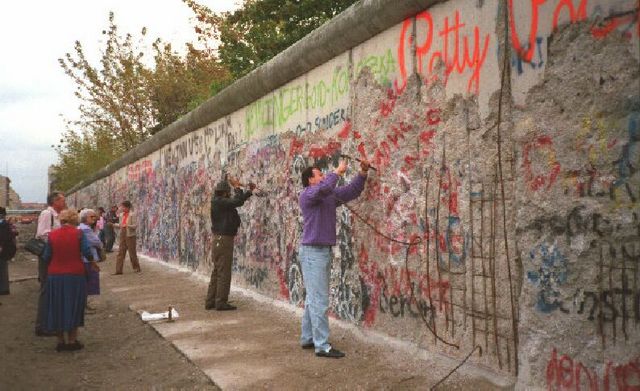
Below are views of Nogales, AZ and Berlin.  Nothing alike.  Nope.  Totally different.

Nogaleswall_1 Berlinwall

Finally, I will give the last word to Frist, bold added.

That's why I strongly support the Secure Fence Act of 2006 "¦ and that's
why I'm bringing this crucial legislation to the floor of the Senate
this week for an up-or-down vote. By authorizing the construction of
over 700 miles of two-layered reinforced fencing along our southwest
border and by mandating the use of cameras, ground sensors, UAVs and
other forms of hi-tech surveillance, this legislation would help us
gain control over every inch of our borders "“ once and for all.

"gain control over every inch of our borders," except, or course, for those 3000 5525 miles (350 million inches) to the north where the people on the other side have the courtesy not to speak a foreign language.  But its hard to demagogue well about a threat from Canadians, since they are mostly WASPs like we mostly are, or at least it has been for the last 100 years or so.  54-40 or fight!

Update: Here is that terrifying Canadian border barrier (from this site).  This demonstrates why our terrorist security dollars need to all be invested on the southern border, since this one is already locked down tight.  Heck, there is one of these babies (below) every mile!  Beware terrorists!

Canada

And don't forget these terrorist-proof border checkpoints along our northern frontier:

  Canada2

But it's not about race.

Update 2:  Yes, my emailers are correct.  I did not actually give Frist the last word like I said I would.  Gosh, I feel so bad about that.

Update 3:  Welcome to readers of my favorite site, Reason's Hit and Run.  It looks like Texas may soon consider a border fence, though with Louisiana instead of Mexico.

Broken Window Fallacy, On Steroids

Economics have a concept called the "broken window fallacy" that many of the media to this day do not understand.  Here is an example:  Every hurricane season, the media always writes a "silver lining" story about how recovery from a devastating hurricane spurred the local economy.  One might assume from this reasoning that it is good to go around breaking windows, since one will make a lot of work for glaziers and boost the economy.  The problem is what is not measured.  What would the money that was spent on window replacement have been spent on instead?  It is a safe presumption that had they not had to repair storm damage, they would have spent the money on something more productive  (test:  if this were not true, everyone would be breaking their own windows).  Advocating the broken window fallacy is a bit like saying that stealing money from banks would increase the savings rate, since people would have to deposit even more money to replace that which was stolen.

Anyway, I bring this example up because today I saw the most amazing example of the broken window fallacy I have ever seen, via Kevin Drum and Business Week:

 Business Week's cover story in their current issue tells us that healthcare inefficiency is what's keeping the American economy afloat:

The
very real problems with the health-care system mask a simple fact:
Without it the nation's labor market would be in a deep coma.  Since 2001, 1.7 million new jobs have been added in the health-care sector, which includes related
industries such as pharmaceuticals and health insurance. Meanwhile, the
number of private-sector jobs outside of health care is no higher than
it was five years ago.

.... The U.S. unemployment rate is 4.7%, compared with 8.2% and
8.9%, respectively, in Germany and France. But the health-care systems
of those two countries added very few jobs from 1997 to 2004, according
to new data from the Organization for Economic Cooperation &
Development, while U.S. hospitals and physician offices never stopped
growing. Take away health-care hiring in the U.S., and quicker than you
can say cardiac bypass, the U.S. unemployment rate would be 1 to 2
percentage points higher.

....Both sides can agree that more spending on information
technology could reduce the need for so many health-care workers. It's
a truism in economics that investment boosts productivity, and the U.S.
lags behind other countries in this area. One reason: "Every other
country has the payers paying for IT," says Johns Hopkins' Gerard
Anderson, an expert on the economics of health care. "In the U.S. we're
asking the providers to pay for IT" "” and they're not the ones who
benefit.

Let's go back to slow-motion instant replay.  What was that first line?

Business Week's cover story in their current issue tells us that healthcare inefficiency is what's keeping the American economy afloat

I am not seeing things, am I?  Did he really write that it is the inefficiency of one of the largest and most ubiquitous and perhaps most important industries in the country that is propelling the economy?  Do I really have to state the obvious?  Do you really think that if all those people were not hired to push paper around in health care they would be sitting unemployed today?  What about all the money either consumers or corporations would be saving from more efficiency -- would that really not have been spent on something else?

In a way, I guess this is sort of consistent with Drum's position on Wal-Mart.  If Wal-Mart is detroying the economy (according to him) by bringing increased productivity to retail, I guess this argument that health care inefficiency helps the economy is at least consistent.  Maybe if we could get our state drivers' license agency folks to take over the whole economy, we would have a boom! And the old Soviet Union must have been an economic powerhouse!

This is some of the worst economics I have seen in a while.  Lefties like Drum often rail against conservatives for being anti-scientific in their opposition to teaching evolution or approving the morning-after pill, but for God sakes the most fundamentalist Bible-belt home schooled conservative Christian probably knows more about the science of evolution than journalists understand about the science of economics.

Technology Bleg

I begin by assuming the answer to the following is "no."  However, just in case, here is my question:  A number of spammers seem to be using my email address as their "reply-to" return address on the spams they are sending out.  Unfortunately, this is all-too-easy to do.  Note, they are not using my account, but just entering my address in the from and reply-to lines (something even I know how to do) on an email sent from one of their accounts.  My question is:  Is there anyway to keep a third party from using your email address in this way?

Fortunately, a couple of layers of filtering (google, then a bayesian
filter) seem to have at least halted the growth of spam in my box and
perhaps even rolled it back a little.  By the way, I still stand by my solution to spam, which is to charge 0.1 cents per email.  Normal eavy users who might send 30-100 emails a day would pay 3-10 cents a day, ie nothing.  Spammers who send 10 million emails would be charged $10,000 for each mass mailing.   

I Do Not Think Your Data Means What You Think It Means

Kevin Drum, building on a story from the NY Times, uses data from the California Energy Commission to make the case that California is the most efficient user of electricity in the country and that this efficiency can be attributed sole to government intervention.  Drum, always on the lookout for an excuse for the government to take over some sector of the economy, concludes:

Anyway, it's a good article, and goes to show the kinds of things we
could be doing nationwide if conservative politicians could put their
Chicken Little campaign contributors on hold for a few minutes and take
a look at how it's possible to cut energy use dramatically "” and reduce
our dependence on foreign suppliers "” without ruining the economy. The
energy industry might not like the idea, but the rest of us would.

On its face, California's numbers are impressive.  The CEC's numbers show California to have the lowest per capita electricity use in the nation, using electricity at half the national rate and one quarter the "least efficient" states.

This would be really cool if it were true that a few simple public policy steps could cut per capital energy consumption in half.  Unfortunately, though I am willing to posit California is better than average (as any state would be with a mild climate and newer housing), the data doesn't say what Drum and the article are trying to make it say. 

The consumption data is from here.  You can see that there are three components that matter - residential, commercial, and industrial.  Residential and commercial electricity consumption may or may not be fairly apples to apples comparable between states (more in a minute).  Industrial consumption, however, will not be comparable, since the mix of industries will change radically state by state.  As an extreme example, states with high aluminum production or oil refining or steel making, which are electricity intensive, will have a higher per capita industrial electricity consumption, irrespective of public policy.  The graph Drum and the NY Times uses includes industrial consumption, which is a mistake -- it is more reflective of industry mix than true energy efficiency.

Take two of the higher states on the list.  Wyoming, at the top of the per capita consumption list, has industrial electricity consumption as a whopping 58% of total state consumption.  KY, also near the top, has industrial consumption at 50% of total demand.  The US average is industrial consumption at 29% of total demand.  CA, NY, and NJ, all near the bottom of the list in terms of per capital demand, have industrial use as 20.6%, 15.1%, and 16% respectively.  So rather than try to correlate electricity consumption to local energy regulations, it is clear that the per capita consumption numbers by state are a much better indicator of the presence of heavy industry. In other words, the graph Drum shows is actually a better illustration of the success of CA not in necessarily becoming more efficient, but in exporting its pollution to other states.  No one in their right mind would even attempt to build a heavy industrial plant in CA in the last 30 years.  The graph is driven much more by the growth of industrial electricity use outside CA relative to CA.

Now take the residential numbers.  Lets look again at the states at the top of the per capita list:  Alabama, South Carolina, Louisiana, Tennessee, Arkansas, Mississippi, Texas.  Can anyone tell me what these states have in common?  They are hot and humid.  Yes, California has its hot spots, but it has its mild spots too  (also, California hot spots are dry, so they can use more energy efficient evaporative cooling, something that does not work in the deep south).  These southern states are hot all over in the summer.  So its reasonable to assume that maybe, just maybe, some of these hot states have higher residential per capita consumption because of air conditioning load?  In fact, if one recast this list as residential use per capita, you would see a direct correlation to summer air conditioning loads.   This table of cooling degree days weighted for population location is a really good proxy for how much air conditioning is needed by state.  (Explanation of cooling degree days). You can see that states like Alabama and Texas have two to four times the number of cooling degree days than California, which should directly correlate to about that much more per capita air conditioning (and thus electricity) use.

In fact, I have direct knowledge of both Alabama and Texas.  Both have seen a large increase in residential per capita electricity use vis a vis California over the last thirty years.  Granted.  But do you know why?  The number one reason for increased residential electricity use in the South is the increased access of the poor, particularly poor blacks, to air conditioning.  It is odd to see a liberal like Drum railing against this trend. Or is it that he just didn't bother to try to understand the numbers?

OK, now I have saved the most obvious fisking for last.  Because even when you correct for these numbers, California is pretty efficient vs. the average on electricity consumption.  Drum attributes this, without evidence, to government action.  The NY Times basically does the same, positing in effect that CA has more energy laws than any other state and it has the lowest consumption so therefore they must be correlated.  But of course, correlation is not equal to causation.  Could there be another effect out there?

Well, here are the eight states in the data set above that the California CEC shows as having the lowest per capita electricity use:  CA, RI, NY, HI, NH, AK, VT, MA.  All right, now here are the eight states from the same data set that have the highest electricity prices:  CA, RI, NY, HI, NH, AK, VT, MA.  Woah!  It's the exact same eight states!  The 8 states with the highest prices are the eight states with the lowest per capita consumption.  Unbelievable.  No way that could have an effect, huh?  It must be all those green building codes in CA.  I suspect Drum is sort of right, just not in the way he means.  Stupid regulation in each state drives up prices, which in turn provides incentives for lower demand.  It achieves the goal, I guess, but very inefficiently.  A straight tax would be much more efficient.

Please, is there anyone in the "reality-based community" that cares that their data really is saying what they think it is saying??