Posts tagged ‘US’

Those Sophisticated Europeans

I honestly thought this was a gag at first.  Those sophisticated Europeans, who are supposedly so much more protective of civil rights and privacy and the like than we neanderthals in the US, are requiring that Spanish executives register details of their sex life with the government:

SPANISH business leaders are being told they have to declare any illicit love affairs - to the stock market.

In an attempt to crack down on insider trading, the directors of
companies quoted on Spain's stock exchange will have to come clean, on
a twice-yearly basis, about anyone with whom they are having an
"affectionate relationship"...

Company directors must also provide information about their wives or
husbands and family, but it is the idea of a "lovers' register" - in
which bosses could have to admit to having affairs or out themselves as
gay - which has sparked reactions ranging from disbelief to fury among
businessmen.

Ricard Fornesa, the president of the huge La Caixa savings bank, described the legislation as "laughable".

A spokesman for another leading Spanish financial house - who would
not be named - was outraged, saying: "If I had a lover, which I don't,
would they expect me to admit it? What next? I get a call from someone
who has found out saying "˜pay me money or I tell your wife'. It's
stupid and it's ludicrous."

I don't think this even requires comment.  Some of course will have nothing to do with it or will remain silent.  Knowing a few Spanish gentlemen, though, I wonder if there will be some who will have the tendency to exaggerate and tack on names.  I would be tempted to submit a list of all the wives of male Congressmen.  I guess I should start working on my submission in case this approach is adopted by the SEC.  Lets see now ... Paris Hilton, the Olsen twins, Laura Bush, Maria Shriver, Martha Stewart, Lassie, the Little Mermaid, ...

Hat tip to Overlawyered.

Not the Comfy Chair! (Updated)

Well, Newsweek has admitted that it screwed up.  Big time:

WASHINGTON (Reuters) - Newsweek magazine said on Sunday it
erred in a May 9 report that U.S. interrogators desecrated the
Koran at Guantanamo Bay, and apologized to the victims of
deadly Muslim protests sparked by the article.

Editor Mark Whitaker said the magazine inaccurately
reported that U.S. military investigators had confirmed that
personnel at the detention facility in Cuba had flushed the
Muslim holy book down the toilet.

The report sparked angry and violent protests across the
Muslim world from Afghanistan, where 16 were killed and more
than 100 injured, to Pakistan to Indonesia to Gaza. In the past
week it was condemned in Egypt, Saudi Arabia, Bangladesh,
Malaysia and by the Arab League.

On Sunday, Afghan Muslim clerics threatened to call for a
holy war against the United States.

"We regret that we got any part of our story wrong, and
extend our sympathies to victims of the violence and to the
U.S. soldiers caught in its midst," Whitaker wrote in the
magazine's latest issue, due to appear on U.S. newsstands on
Monday.

It is not Monday morning quarterbacking to say that they should have known better -- many observers noted the danger right off the bat of posting such an inflammatory story based on only a single anonymous source.

The point I want to make is a different one than the obvious MSM-continues-to-slide-into-the-abyss observation.  That is:  We really, really seem to have dumbed down the whole "torture" thing.  When I grew up, torture was pulling out someones fingernails or whacking their genitals with a stick while they were tied to a cane chair or maybe starving them in a pit for a few weeks. 

Here is my fervent hope:  If I ever find myself imprisoned by hostile forces, I pray that they will torture me by sitting me in a chair and having me watch them flush books down the toilet.  The toughest part will be acting like I am really suffering watching a copy of some document I respect, maybe the US Constitution or Atlas Shrugged or the latest Sports Illustrated Swimsuit issue, swirling down the pipe.  Then, if that does not work, I hope and pray that they then resort to stripping me naked and taking pictures of me in a human pyramid with other prisoners.  I just hope they don't find out that I already did something similar in college.

By the way, while we are inventing a kindler-gentler torture, can we also tone down our dedication to icons?  I have never understood the need to ban Koran flushing or American flag burning.  Both the Koran and the flag are symbols that have meaning to each individual.  If someone wipes their butt in public with the American flag, my  respect for the US and what it stands for is in no way tarnished - only my opinion of the flag-wiper has changed.

UPDATE:  WOW!  How did I miss this one?  I really, REALLY hope they choose this torture for me:

One female civilian contractor used a special outfit that included a
miniskirt and thong underwear during late-night interrogations with
prisoners, mostly Muslim men who consider it taboo to have close
contact with women who aren't their wives...

The female interrogator wanted to "break him," Saar adds, describing
how she removed her uniform top to expose a tight-fitting T-shirt and
began taunting the detainee, touching her breasts, rubbing them against
the prisoner's back and commenting on his apparent erection....

In November, in response to an AP request, the military described an
April 2003 incident in which a female interrogator took off her uniform
top, ran her fingers through a detainee's hair and sat on his lap. That
session was immediately ended by a supervisor and that interrogator
received a written reprimand and additional training, the military said.

Please, no.  Anything but that.  Las Vegas better watch out or it may start losing visitors to Gitmo.  I wonder if this is going to cause a problem for the ACLU, which has been opposing these interrogation techniques at Gitmo.  After all, doesn't this woman have a right to free expression?

Postscript:  By the way, I am serious that I think the media has purposefully dumbed-down the definition of torture to improve their story, and in the process has hurt the US internationally.  However, while I find most of the torture accusations a joke, I still absolutely oppose the whole Guantanamo Bay indefinite detention camp concept.  I don't like allowing US authorities to set up a civil-rights-free zone, and I think it is an incredibly slippery slope that we are climbing on.   And yes, I say this with full knowlege that some bad folks could be released back into the wild.  Guess what -- the American justice system does this all the time.  We have 200 years of history of preferring to let guilty parties go free rather than letting innocent parties rot in jail, and I am not ready to overturn our pretty succesful precendent on this matter.

UPDATE: And to be clear, this is torture, or close enough.  Its good these folks are being brought to justice.   I encourage the media to keep up the pressure on true misconduct -- the gratuitous "wrapped-them-in-the-israeli-flag non-tortures just dillute our focus.  I guess I would also encourage those of you who want to extrapolate from these events to a condemnation of the US military as a whole to inform yourself.  The US military, like any institution of human beings, has criminals in it.  However, that being said, our military has been by far the best behaved occupying force in history, bar none (And, if you don't think they should be occupiers at all, well, blame the politicians that sent them).  For every story of atrocious behavior by a US soldier are 20 stories of soldiers being fair and kind.  The fact that these 20 other stories don't make the paper doesn't make them any less true.

Yalta

GWB seems to have riled lots of folks up over his reference in a recent speech to Yalta.  If you have read any of the comentary from the left, you might be imagining he said all kinds of wild things.  I read much of the commentary before I ever read Bush's words, so I was prepared for a real gaffe.  After reading his speech, I was left wondering if those attacking Bush heard the same speech.  Here is the key paragraph:

As we mark a victory of six days ago -- six decades ago, we are
mindful of a paradox. For much of Germany, defeat led to freedom. For
much of Eastern and Central Europe, victory brought the iron rule of
another empire. V-E Day marked the end of fascism, but it did not end
oppression. The agreement at Yalta followed in the unjust tradition of
Munich and the Molotov-Ribbentrop Pact. Once again, when powerful
governments negotiated, the freedom of small nations was somehow
expendable. Yet this attempt to sacrifice freedom for the sake of
stability left a continent divided and unstable. The captivity of
millions in Central and Eastern Europe will be remembered as one of the
greatest wrongs of history.

I am not sure how you can disagree with this.  I think the US owes Eastern Europe a big appology for selling them out at Yalta.  Now, one can argue that we had some reasons for our actions at Yalta.  First and foremost, we were exhausted from the worst war in history, and no one had the energy to gear up for a new confrontation.  Also, one can argue that it may be 20/20 hindisght that causes us to be more aware of Soviet hegemonic intentions than the actors at the time might have been (though certainly Churchill was fully cognizant of the dangers).  But, no matter how you cut it, small countries like Latvia were wiped out of existance and handed over to the Soviet Union by the Yalta agreement, and Bush's audience was made up of people still stung by this.  I think the comparison to Munich is very apt - the US post-WWII was exhausted and was more than ready to suspend disbelief and hope that appeasing Soviet territorial ambitions would head off a fresh confrontation no one had the will to fight.  Reason's hit and run has a nice roundup and further analysis.

The only explanation I can come upfor the uproar is that FDR, like Reagan and Kennedy, has an incredibly powerful though informal legacy protection society that leaps into action at even the smallest attempt to besmirch his historical halo.  In this case, Bush rightly does not even mention FDR; however, since FDR was the main advocate for pandering to Stalin at Yalta (against Churchill's vociforous but ultimately ignored objections), his defense forces feel the need to jump into action.  I would have hoped that with 3 generations separating us from FDR, we could finally look at him objectively.  He fought a fabulous war, in some sense carrying the whole free world on his shoulders for four years.  But he fumbled the peace, though, and screwed up at Yalta.

UPDATE:  Professor Bainbridge has this nice quote from Latvian President Vaira Vike-Freiberga a few days before Bush's speech:

In Latvia ... the
totalitarian occupation ... of Nazi Germany was immediately replaced by
another "“ that of Stalinist totalitarian communist Soviet Union and was
one that lasted a very long time. The day we shall be commemorating
does have double significance and by coming to the Baltic States
President Bush is, I believe, underscoring this double meaning of these
historic events. 60 years ago when the war ended it meant liberation
for many, it meant victory for many who could truly rejoiced in it.

But for others it meant slavery, it meant occupation, it meant
subjugation, and it meant Stalinist terror. For Latvia the true day of
liberation came only with the collapse of the Soviet Union as it did
for our neighbours Lithuania and Estonia.

Sounds a lot like what Bush said.  Seems like Bush is in pretty good touch with the sentiments of the Latvian people he is speaking to.


A Victory for Fair Use

Via Ernest Miller:

Civil and consumer rights groups have won in the Broadcast Flag case!...

...For those who are unfamiliar with the Broadcast Flag, it was ... it was a regulation promulgated by the FCC
at the request of Hollywood that would have required all HDTV receivers
to incorporate certain copy controls. Starting this July, all HDTV
receivers sold in the US would be required to enforce restrictions on
copying HDTV broadcasts that were tagged with the "Broadcast Flag."
Although you might be able to record HDTV shows, you wouldn't be able
to make additional copies for personal use (such as watching in another
room) without a lot of hassle, if it was possible at all, not to
mention taking a copy to watch at a friend's house. The ramifications
of this authority grab by the FCC were enormous, since it would have,
among other things, essentially given them the power to control
significant aspects of the design of anything capable of using HDTV
signals, i.e., modern PCs.

Good.  Now, will someone address letting me copy DVD's to play on a handheld, hard-disk based device like this one.

Really Lame

Volokh points out this bit of stupidity:

Family Research Council Opposing Vaccination:

New Scientist reports:

Deaths from cervical cancer could jump fourfold to a million a year
by 2050, mainly in developing countries. This could be prevented by
soon-to-be-approved vaccines against the [sexually transmitted HPV]
virus that causes most cases of cervical cancer . . . . [T]o prevent
infection, girls will have to be vaccinated before they become sexually
active, which could be a problem in many countries.

In the US, [however,] religious groups are gearing up to oppose
vaccination . . . . "Abstinence is the best way to prevent HPV," says
Bridget Maher of the Family Research Council, . . . [which] has made
much of the fact that, because it can spread by skin contact, condoms
are not as effective against HPV as they are against other viruses such
as HIV.

"Giving the HPV vaccine to young women could be potentially harmful,
because they may see it as a licence to engage in premarital sex,"
Maher claims . . . .

This is just wrong on any number of levels.  The lamest part of this, beyond the sheer wrongheadedness of it, is it strikes me as a sign that these religious groups are unsure of their own teachings and moral standing.  I will never be confused with a religious expert, but I would think that religious groups would be fighting for abstinence as a positive moral principal.  Trying to deny vaccinations in order to make sexual intercourse incrementally more dangerous and threatening strikes me as a sign that the religious groups have given up on moral teaching and are now relying on bald scare tactics. 

When my kids were about 2, we had trouble with them getting out of bed and coming into our room.  Increasing the likelihood of STD's in order to discourage sex strikes me as similar to if I had spread tacks on the ground around my kids bed to keep them from wandering around at night.  When we come up with an HIV vaccine, are these groups going to oppose that as well?


Five Worst Traits About Taxes

Generally, in any discussion of taxes, I focus on the foundations of
property rights
, to argue that taxation is no different than
stealing.    Most of us agree that grabbing someone else's money at
gunpoint is immoral.  I do not hold to a theory of government that says
that this immoral action is suddenly moral if 51% of my neighbors
sanction it.

Anyway, I am going to leave behind the moral basis (or lack thereof)
for taxes and focus instead on five practical problems that a
well-crafted tax system should be able to avoid.

1.  Complexity and Preparation Time

I probably don't need to go into great depth on this one to convince you that taxes and tax returns are ridiculously complex.  We all know how complicated even the individual 1040 has become, so much so that using tax preparation software is nearly de riguer for most middle class taxpayers.  Last year, our federal and state income tax returns for the company were over 400 pages long.

For a small business, the tax preparation burden goes much further.  For example, the burden of payroll tax preparation, not to mention staying on top of compliance issues, is so high that no sane business person does payroll in house any more.  Quarterly state and federal unemployment and withholding tax returns must be filed, with salary detail to the last penny for every single employee.   As a result, everyone uses a service like ADP, and though this solves the workload problem, it still costs money - about $12,000 a year in our case.  That's not the tax bill, just the cost to keep up with the government paperwork. 

But with payroll taken care of, businesses still must file sales tax returns, excise tax returns, detailed property tax returns, census data requests, labor and commerce department surveys, and of course income tax returns.  Each of these typically have to be done at the state level and in many cases separately for every single county and city where we do business.  Each in and of itself is horribly time consuming - see this example for property taxes, this one for sales taxes, and this one for government surveys

In Kentucky, for example, we have to file quarterly state withholding tax returns, quarterly payroll withholding returns in each county we operate in, a quarterly state unemployment return, an annual property tax return in each county, and annual income tax return at the state level, an annual income tax return in each county, a monthly sales tax return, a monthly survey for the US Department of Labor about Kentucky headcount levels, an annual foreign corporation renewal, a new hire report whenever we hire a new employee, and a monthly report to the workers comp state fund


2.  Disguising the Tax Load

Quick, how much total do you pay in taxes?  Perhaps the greatest innovation of statists in the 20th century was the tax load shell game - the clever balkanization of the tax load that makes it nearly impossible for the average person to truly know how much they pay in taxes to the government.

Start with income taxes.  OK, April 15 has just passed, but even so, how many people know how much they paid in income taxes last year?  For many people, this is the single largest expense they have, but the total amount is disguised by the fact that most income taxes are taken out as direct payroll deduction.  Statists and leftists everywhere in the US should get up in the morning and give thanks for direct payroll deduction -- without it, if every American had to write a single check once a year for the sum total of their annual income taxes, there would have long since been a revolution.

OK, so you don't know how much you paid in federal, state and local income taxes.  But in addition to that, how much did you pay in social security and medicare (typically about 8% of salary)?  Property taxes (typically 1-2% of your home value)?  How about sales taxes (typically 6-9% of your purchases)?  What about vehicle licensing fees and special taxes on hotels and airfare and rent cars?  If you add all these up, the average American pays about 30% of his/her salary in taxes.  The Tax Foundation has a great chart summarizing this shell game, with relative burdens expressed as days of work each year required to pay the tax.  Note that on average, your federal income tax is only 1/3 of the total of what you are paying:
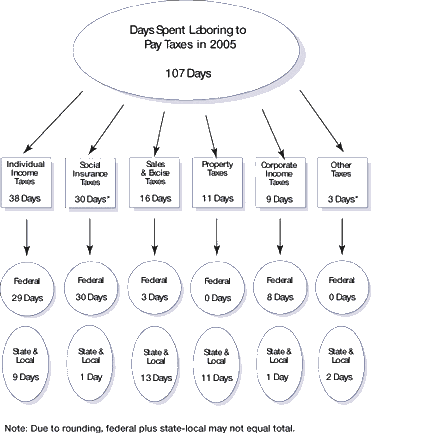
 

Taxchart


So those are the direct ones, but how much are you also paying in higher prices due to government import duties?  What about the 8% FICA and medicare that employers pay on your behalf - how much higher might your salary be if they did not have to pay these?  What about corporate taxes - you may not pay them directly, but they certainly get passed on to you in the form of higher prices and lower dividends.  What else? - try this list on for size.

3.  Taxes on Wealth and Savings

Most taxes are on income or sales, and so they are at least marginally calibrated with an individual's cash flows.  The exceptions to this are property taxes and inheritance taxes.  These two taxes both go after an individual's savings -- property taxes mainly on the home, the primary savings vehicle for most Americans, and inheritance taxes on everything you've saved when you die.

Lets take property taxes first.  Many people complain that modern life has become a treadmill, forcing families to work harder and harder to keep up their lifestyle.  To a large extent, I think this is a myth - people may be working harder but their effective standard of living is way, way higher than say 30 years ago.  But one of the things that definitely creates a treadmill are property taxes. 

Many people have worked hard to pay off their mortgage, thinking they could settle down into their retirement in a paid off house.  Unfortunately, they may find that their home has increased in value so much that their property taxes at retirement are actually much higher than their original payment on the house.  Take the case of a couple who bought their house in an urban area for $25,000 and find its now worth $375,000 forty years later (this is an average urban price increase over the last 40 years).  For simplicity, we will assume the effective tax rate has stayed at $1.50 per $100 for these forty years (though its more likely to have gone up).  In 1965, they paid $375 a year in taxes.  Today, they have to pay $5,625.  In other words, their property taxes today are over 22.5% a year of the original price they paid for the house.  Now, this is all fine if the couple strove to work up the corporate ladder and get promotions and grow their income proportionately.  But what if they didn't want to?  What if they just wanted to buy that house, pay it off, and live modestly selling driftwood sculptures at farmers markets, or whatever.  The answer is, because of property taxes, they can't.  Likely they will have to sell this house, give up the urban life they wanted, and either move to an urban dump they can afford the property taxes on, or they move out to the country.  Here is an example, via Reason, of this process of property taxes forcing out urban residents living small in favor of yuppies living the dream.  It is ironic that a tax initially invented for populist reasons to cut back on wealth accumulation hurts the lower income brackets and those trying to step off of the capitalist treadmill the most.  In fact, it was the poor in the Great Depression who typically lobbied for laws to put moratoriums on property tax collections.

The estate tax has many of the same origins and issues.  The biggest downside of the estate tax is that it tends to force premature sales of productive business assets to pay the tax.  Rather than leaving small businesses in the family, who have the experience and passion to make them work, they typically must be sold to third parties outside the family to pay the estate taxes.  Again, the law of unintended consequences crops up - estate taxes and the sales they force have done more to contribute to merger and acquisition activity, which in turn drives consolidation of economic assets into fewer and fewer corporations.  The tax meant to stifle wealth accumulation among individuals has in fact spurred wealth accumulation among corporations.  While used for many purposes today, LBO's, that bogeyman of the left, were invented to manage this estate tax forced sale problem.

Asymmetrical Information has a thoughtful series of posts going on estate taxes.

4.  Picking Favorites for Special Treatment

One of the defining characteristics of statist politicians of both the left and the right is that they think they are smarter and more moral than the average American, and certainly than the average American businessman.  Statists and technocrats distrust markets and assume that they can succeed in managing the economy in general and individual decision-making in particular where markets have "failed" to reach whatever end-state politicians would prefer.

Therefore politicians insist on using tax policy to reinforce (or discourage) certain behaviors or to influence certain outcomes or to frankly enrich some favored group.  Examples are all around us, but include:

5.  Class Warfare and Punishing Success

Many of the taxes we pay - income, property, estate - have strong class warfare origins.  Heck, the income tax and the Constitutional Amendment that made it possible because Americans were told that only the richest 1% or so would ever have to pay it.  Today, tax debate is littered with class warfare arguments. 

Today, the richest 1% of Americans pay about a third of the total individual taxes, and the richest 10% pay two-thirds.  The richest 50% of Americans pay 100% of the taxes (in the other half, some pay a bit, and some get a bit back in EITC, but the net is zero).  So, a small percentage of Americans pay for the services and government
cash subsidies enjoyed by the majority.  So how do we treat these
people?  As heroes, or benefactors, or as the most productive?  No we treat them as evil parasites who are not
doing their fair share
.

By the way, These shares paid by the rich actually went up after the Bush tax cuts (yes, that's not a typo).  The very fact that this statement might seem unbelievable points to how much ridiculous class warfare demagoguery permeated the last election.  By the way, these numbers are for income taxes.   The numbers for total taxes, including the regressive payroll taxes, yields slightly different numbers but the same results, as outlined in TaxProfBlog today.

The fact is that most "progressive" taxes are in fact punishing the successful and most productive.  The Left loves to wave Paris Hilton around as an example of the useless and unproductive rich who presumably should be taxed into poverty.  They want to obscure the fact that 99% of the rich got to be rich honestly, through hard work, and via the uncoerced interaction with others.  Because saying that your government rewards success with its highest tax rates and confiscates the vast majority of its operating funds from the people who would employ this money the most productively, um, doesn't sound very good.

UPDATE:  I have more here, including a rebuttal of Kevin Drum.

Forest Service May Close Recreation Sites

Frequent readers of this site may know that my day job is running a company that manages recreation sites under concession contract to a number of public landowners, including the US Forest Service.  I take a lot of pride in this job, as our company helps keep recreation facilities open that the government might not have the personnel or the skills or the money to run.  The Forest Service's budget gets cut about every year, such that tax money comes nowhere near covering the cost of managing recreation sites.

Of late, the Forest Service has begun looking to actually close some recreation facilities:

The cash-strapped
U.S. Forest Service can no longer afford to maintain many of its parks
and has started ranking recreational sites, including campgrounds and
trail heads, for possible closure.

Supporters of public lands generally hate the onset of fee-based recreation, and wish it was still possible for all public recreation facilities to be free.  This was a realistic goal back when recreation facilities were cheap to run, but today campgrounds and other such facilities can be tremendously expensive(a single large campground might cost as much as a half million a year to operate), in large part due to actions by the same people who support free use of public lands.  Some examples:

  • 50 years ago, campgrounds labor was essentially free because it could be staffed with volunteers.  With current labor laws, this is no longer possible (even if people still want to volunteer), and a large campground can require hundreds of thousands of dollars of labor to maintain each year, even at minimum wage.
  • 50 years ago, people in the outdoors just drank water from a stream or out of the hand pump.  Today, in certain complexes, we spend tens of thousands of dollars keeping water systems in compliance with complex state laws.
  • 50 years ago, if someone tripped over a root in the forest or twisted their ankle on a rock, they accepted that as a normal risk of being out in nature.  Today, everyone calls their lawyer.  Each year, campground visitors file millions of dollars of lawsuits for accidents once thought to be normal hazards of nature.
  • 50 years ago, active timber sales in the forest helped fund recreation programs.  Today, timber sales in many forests are at an all time low, due in large part to opposition by nature lovers

So, I admit I don't know the person who said this:

"They will close
those sites the public has always enjoyed but which they cannot afford
because they are not profitable," said Scott Silver of the Bend group
Wild Wilderness. "It's the complete perversion of the meaning of public
lands."

But I would bet quite a bit that he supports some or all of the laws and government regulations listed above that make running recreation facilities so much more expensive than 50 years ago.

Update: By the way, though I might disagree with Scott Silver on the necessity of use fees at developed facilities like campgrounds or boat ramps, he is dead on in certain respects:

  • Politicians love to fund splashy new recreation projects, but hate to fund basic maintenance.  This means that at the same time campgrounds and facilities are closing due to lack of maintenance dollars, new facilities are being opened all the time.  This strikes me as absurd. 
  • Recreation facilities on public lands are missing the boat when they attempt to emulate private operations too much.  There are plenty of KOA's next to the interstate with pools and video game rooms.  Campgrounds on public lands have typically taken a different approach and served a different niche, that of providing a more primitive experience closer to nature, and I think its a mistake when they move away from this approach.

Unfortunately, as is often the case, I will never be able to see eye-to-eye with such groups because they refuse to acknowledge that as a private company I can be anything but Darth Vader with secret plans to put up a Walmart in Yosemite or put up billboards along a nature trail.  Crusading socialists often have the funniest ideas about the profit motive.  For example, if I make most of my money at a recreation site catering to people who want a wilderness experience, why in the world would I do anything to interfere with that experience?  It does not matter what the situation or the facts or the company, the first arguments are always that private companies just want to take a natural setting and put up advertising, then build a shopping mall.

By the way, Mr. Silver sees conspiracies among the private recreation companies.  I have sat on some committees in the "evil" organizations he cites, and I will tell you with complete assurance that these groups would have trouble crafting a successful plan to buy a 6-pack of beer from the local 7-11, much less shape government policy to their ends.  But maybe I got left out of all the really cool SPECTRE-type meetings. 

Wealth of Nations

Socialists and "progressives" of various stripes always want to argue that the distribution of wealth among nations is basically due to luck, in large part related to the distribution of natural resources.

This is disprovable in about 2 seconds:  Russia (via Cafe Hayek) and the Netherlands.   Russia, resource-wise, is perhaps the richest country in the world.  It is, our could be, among the largest producers of any number of natural resources, from diamonds and gold to oil and uranium.  But its economy is a disaster.  The Netherlands, resource wise, has about nothing.  There are few third world economic hell-holes that don't begin with infinitely more resources than the Dutch, but the Dutch are among the richest nations in the world. 

Wealth comes not from labor or capital or resources - wealth comes from the mind, and as such requires a rule of law where the mind is free not only to imagine new ideas but to pursue and reap the fruits of these ideas.  As I said in this article:

From the year 1000 to the year 1700, the world's wealth, measured as GDP per capita, was virtually unchanged.
Since 1700, the GDP per capita in places like the US has risen, in real
terms, over 40 fold.  This is a real increase in total wealth - it is
not money stolen or looted or exploited.  Wealthy nations like the US
didn't "take" the wealth from somewhere else - it never even existed
before.  It was created by the minds of human beings.

How?  What changed? 

  1. There was a philosophical and intellectual
    change where questioning established beliefs and social patterns went
    from being heresy and unthinkable to being acceptable, and even in
    vogue.  In other words, men, at first just the elite but soon everyone,
    were urged to use their mind rather than just relying on established
    beliefs
  2. There were social and political changes that greatly increased
    the number of people capable of entrepreneurship.  Before this time,
    the vast vast majority of people were locked into social positions that
    allowed them no flexibility to act on a good idea, even if they had
    one.  By starting to create a large and free middle class, first in the
    Netherlands and England and then in the US, more people had the ability
    to use their mind to create new wealth.  Whereas before, perhaps 1% or
    less of any population really had the freedom to truly act on their
    ideas, after 1700 many more people began to have this freedom. 

So today's wealth, and everything that goes with it (from shorter
work hours to longer life spans) is the result of more people using
their minds more freely.


My Most and Least Favorite Business Activity

In the span of one hour this morning, I got to "enjoy" both my most and least favorite business activity.

My least favorite activity is always paying taxes, but within that broad category (remember that being in 10 states and 25 counties means that I file over 50 different tax returns or one sort or another every year) my least least favorite are business property tax returns.  If you have not run a small business, you may not be aware of what a pain these are (individuals don't have to file them, and large companies have poor schleps in accounting to do it). 

First, business property tax statements usually have to be filed by county, so I have to do a zillion of them.  Second, governments require that you report every year and in great detail on essentially every asset your business owns in a state or county.  A business must report these assets, usually with a description, date purchased, original purchase price and estimate current market value.  Imagine as an individual if you had to report this information on everything in your house - furniture, computers, appliances, tools, etc.  Now imagine doing it for a business, which owns a lot more miscellaneous stuff than you have in your house.

What really irritates me is that filing some of these statements requires the person filling out the statement to take a chance.  Clearly, no one is going to list every asset, down to the last pencil and paper clip -- you are going to establish some reasonable cutoff, and group similar assets into catch-alls like "miscellaneous tools" or "office supplies".  Note however, that this is taking a chance:  In counties that require detailed asset listings, there is never any statutory language like "you can ignore items under $100 as de minimis" or "you can group similar items".  Technically, you are supposed to list them all.  Take my word for it, this is very, very tedious.

But wait, as the Ginsu knife guy would say, for our business there is more aggravation.  We do business as a concession holder on federal lands.  For example, we might run a US Forest Service campground.  By US law, states and counties may not charge the US government property taxes on these facilities.  BUT, certain of the most acquisitive states, including California and Washington, have devised taxes that get around this requirement.  These two states make me pay the federal government's property taxes for them at the facilities I operate.  This is kind of like being forced by law to pay your landlord's taxes for him.  I always find this terribly irritating, all the more so since now that I know the game, when time comes to bid on concessions in these states, I just subtract the estimated taxes from what I am willing to pay the government in rent, in effect ensuring that the US government ends up paying the tax. 

This whole enterprise left me feeling depressed, when a couple who I had called about a manager position at a new store concession of ours at Clear Lake State Park in California called me back.  It turned out this couple is incredibly entrepreneurial, has great business experience, and are very well-suited to running my operation with minimal supervision.  I was thrilled to find them, and they were in turn thrilled to find an outdoor summer job opportunity in a nice location which could be flexible enough to accommodate a person with a disability (one of the couple has Parkinsons).  There is NOTHING I enjoy more than finding great people to work for me, and finding such people is all the sweeter if I can offer them an opportunity that uniquely fits their own needs. 

Congress Appologizes for Spending our Money

In a surprise move, the US House of Representatives, the arm of the government Constitutionally tasked with initiating any new taxation authority, today passed a resolution "apologizing for the way [the Congress] has historically mishandled Americans' hard-earned income".  In part, the resolution reads:

For years, we in Congress have held closely to the notion that we know better than the average American how to spend his or her money.  Facilitated by economists like John Maynard Keynes, we the Congress have increased the government's share of the economy to over 30%, and have invented taxes on about anything, in part by portraying every tax cut a subsidy for the rich, rather than a return of hard-earned income to the productive. 

We have taken the money you might have spent on private schools to fund a public school system that lags most of the Western world.  We have taken the money you might have used to pay your cable bill to pay for a alternative to Nickelodeon and the Discovery Channel, but for effete snobs.  We have taken the money you might have used to buy a new car or a vacation to gift billionaire sports team owners with new stadiums and to subsidize millionaire farmers who have never actually done any farming....[note the resolution continues with examples for another 16 pages]...

We are sorry.

Finally.


When Peace Prize Winners Actually Helped People

Instapundit has several links to biographies of Norman Borlaug, who won the Nobel Peace prize for starting the green revolution and perhaps single-handedly saving hundreds of millions from starvation.  This is a particularly interesting one.

Borlaug won his prize, of course, back when the Nobel Peace prize was actually given to people who made the world a better place.  Today the prize is typically given to whatever person did the most to appease a major dictatorship or terrorist or to whoever was most vocal worldwide in their socialism or  anti-Americanism.  This description of the Nobel committee's criteria may sound flippant, but it is clear to me that the committee is dominated by those who favor peace ahead of anything else.  Which, in real life, means that you have to be ready to live with ... anything else, including murder, rape, genocide, totalitarianism, etc. 

Just look at the list of recent winners.  In 1985 they gave the peace prize to the International Physicians for the Prevention of Nuclear War, who as a group systematically opposed everything the US was doing at the time which in 5 years would result in a true reduction in the risk of nuclear war.    In 1988 they gave the award to the serial rapists in the UN peacekeeping forces.    For God sakes in 1994 Yasser Arafat won, perhaps the single person most responsible for chaos in the Middle East.  In 2001 Kofi Anan won, at the very time he was out-Enroning Ken Lay by helping Saddam Hussein steal $20 billion while enriching his own son with contractor kickbacks.  And of course in 2002 Jimmy Carter won for appeasing just about every dictator in the world, but North Korea in particular (interestingly, Jimmy Carter is the only US president since Woodrow Wilson to win the award.  Can you think of any president in the last 60 years who has done less than Jimmy Carter to create a free and peaceful world?)

As a footnote, it would be impossible for Norman Borlaug to win the Peace prize today.  Greens and environmentalists have never liked him, and the politically correct Nobel Committee would never make a choice today that would irritate these groups.  People like Wangari Maathai who fit into the progressive-green sustainable development camp are preferred, even if they don't have nearly the same impact in actually saving or improving lives.

Notice to Britain

To avoid any potential confusion, here is a notice to Britain and my British readers (all 10 or so of them):  I do not consider myself, my statements, or this blog to be subject to British law, and in particular your libel law.  Now, since I am an American citizen living and publishing in Arizona, you may be confused why this clarification is necessary.  If so, note this article, via Captains Quarters.

The decision today, by Mr Justice Eady, has cleared the way for a libel trial in London sometime this year [against Arnold Schwarzenegger]

Miss Richardson alleges she was libelled by Schwarzenegger and two
campaign workers in an October 2003 article in The Los Angeles Times,
which also appeared on the internet.

The trial is going forward in London later this year.

Let me say that there are many, many things wrong with the tort system in the US, but one of the things we have done right is consistently protected free speech rights (at least until McCain-Feingold), and part of this protection has been resistance to onerous European, and particularly British, libel laws.

The obvious result, if this type of suit becomes successful and pesky, is of course for media to start blocking Internet traffic from British URLs.  Maybe this is a secret plan to have just this happen, so the Beeb can get their monopoly back.

UPDATE:  (via Overlawyered.com)  It appears that US litigator Samuel Hirsch is making his own interpretation of US libel law by suing Morgan Spurlock, the maker of the film "supersize me".  Though one could argue that the film ostensibly was on Mr. Hirsch's side (Mr. Hirsch makes a living in part by suing McDonalds for his clients who lack the ability to control their eating habits), it caught Mr. Hirsch on film making some comments he would rather not have been made public:

Ostensibly, this would make
Mr. Hirsch a prime ally in Mr. Spurlock's quest to edify the nation as
to the adverse affects of eating junk food. The film, however, was not
flattering to Mr. Hirsch in his brief cameo. In his only appearance on
camera, Mr. Spurlock asks Mr. Hirsch about his motivation for being
involved in the McDonald's litigation. Mr. Hirsch's reply? "You mean,
motive besides monetary compensation?" He then added, "You want to hear
a noble cause?"

Mr. Hirsch is suing for

Negligence, Unauthorized Use
of Likeness, Disparagement to Reputation, and Defamation of Character,
Fraudulent Inducement, False Misrepresentation, Damage to Business
Reputation.

Mr. Hirsch must know that he stands little chance of winning in US court, particularly since the film used his own words against him.  So this is intimidation, pure and simple.

It is interesting to note that McDonalds, the main target of the film, has not been dumb enough to sue Spurlock, no matter what they thought of the film.  And imagine if George Bush had tried to sue Michael Moore for the same stuff.  Suits like this are intimidation to shut down criticism, and it is good and right that they cannot win in the US.


Harvard Economist Roland Fryer

Many universities over the last several decades have created race and gender studies programs.  One of the problems with many of these programs has been the appalling quality of scholarship.  The recent broohaha around Ward Churchill at Colorado is but one example -- there are many others.  For example, look how Cal-State Long Beach chose the head of their Black Studies Department:

On September 17, 1971, Karenga was sentenced to one to ten years in prison on counts of felonious assault and false imprisonment. The charges stemmed from a May 9, 1970 incident in which Karenga and two others tortured two women who Karenga believed had tried to kill him by placing "crystals" in his food and water.
       

A year later the Los Angeles Times described the events: "Deborah Jones, who once was given the title of an African queen, said she and Gail Davis were whipped with an electrical cord and beaten with a karate baton after being ordered to remove their clothes. She testified that a hot soldering iron was placed in Miss Davis' mouth and placed against Miss Davis' face and that one of her own big toes was tightened in a vice. Karenga, head of US, also put detergent and running hoses in their mouths, she said."       

The shooting at UCLA caused Karenga to become deeply paranoid and spurred his bizarre behavior. At his trial, the question of Karenga's sanity arose. The psychiatrist's report stated, "This man now represents a picture which can be considered both paranoid and schizophrenic with hallucinations and elusions, inappropriate affect, disorganization, and impaired contact with the environment." The psychiatrist observed that Karenga talked to his blanket and imaginary persons and believed that he had been attacked by dive-bombers.

Eight years later California State University at Long Beach made Karenga the head of its Black Studies Department.

Or, check out the scholarly discussions around choosing the head of Black Studies at UCLA:

In 1965 Karenga founded the United Slaves Organization (US), a group that would rival the Black Panthers on the UCLA campus. The US was more radical than the Panthers, setting off quarrels between the two.
       

The biggest dispute between the US and the Panthers centered around the leadership of the new Afro-American Studies department at UCLA; both groups backed a different candidate. On January 17, 1969, 150 students gathered to discuss the situation. Panthers John Jerome Huggins and Alprentice Carter used the meeting to verbally attack Karenga, much to the dismay of his followers. Two US members, George and Larry Stiner, confronted Huggins and Carter in a hallway after the meeting and shot and killed them.

Universities all raced to create new race and gender-based studies departments, and tenured many  based on their strong opinions and the positive response they would get out of the relevant community, rather than normal academic guidelines.

Anyway, I have, as often happens, gotten away from the point of my post.   The NY Times has a good article on Roland Fryer, who appears to be the leading edge of a new generation set on bringing real scholarship and fact-based analysis to these programs.  (hat tip:  marginal revolution)  I don't necessarily agree with him, for example on paying cash for good grades in school, but I am happy to see his dedication to real analysis and challenging conventional wisdom.

Trade Deficit? Don't Panic!

I have never been bothered by the trade deficit.  Concern over the trade deficit always seems to be a holdover of 18th century mercantile thinking.  The key failure seems to be thinking of wealth as static or zero sum.  In a zero sum world, running a consistent trade deficit might indeed pour all of a countries wealth overseas like a tank springing a leak.

Wealth, of course, is not zero sum.  New ideas, productivity, technology create wealth.  Ever year, the US creates tremendous amounts of new wealth.  If we spend some of it overseas, so what?   

Often, problems like the deficit that seem problematic at a macro level fall apart when studied as part of individual behavior.  Cafe Hayek takes this approach in a nice post on why not to panic about the deficit:

If my paying my Virginia neighbor $10 to mow my lawn creates neither
debt nor other economic problems, how would my paying a Canadian $10US
to mow my lawn create debt or other economic problems? What conceivable
economic difference can the latitude or longitude of the seller's
residence make?

UPDATE: I always felt this same way, from Steve Landsburg:

I hold this truth
to be self-evident: It is just plain ugly to care more about total
strangers in Detroit than about total strangers in Juarez. Of course we
care most about the people closest to us-our families more than our
friends and our friends more than our acquaintances. But once you start
talking about total strangers, they all ought to be on pretty much the
same footing. You could say you care more about white strangers than
black strangers because you've got more in common with whites. Does
that make it okay to punish firms for hiring blacks?....

Stealing assets is wrong, and so is stealing the right to earn a living, no matter where the victim was born.

Do US Soldiers Need Better Weapons Training?

Italian communist Giuliana Sgrena claimed to have been specifically targeted by US troops, and had hundreds, perhaps thousands of rounds shot at her oncoming vehicle from a US checkpoint.  She even claims to have been shot at by a tank.  We mourn the loss of and the needless death of her translator, but must observe that, based on her story, US soldiers don't seem to be able to hit the broadside of a barn.  Courtesy of LGF, here's her car:

Sgrenacarap1lgclick to enlarge image

Note that the front end, which should have taken the brunt, looks almost pristine.  One hit in the windshield, one in the left-front tire, and one or more in the drivers side window.  More pictures here.  More too at Captains Quarters.

Further, Ms Sgrena

said her car was hit by 300 to 400 bullets from an armored vehicle. She said she
was picking up handfuls of spent rounds from the seats.

OK, maybe I was wrong.  If hundreds of rounds went into the car, they must have all gone through that same single hole on the windshield.  That's GREAT shooting.  So I guess what is really needed is better weapons penetration.  Its a pretty pathetic bullet from an armored vehicle that would enter a car and have so little energy left that it would just land on the seats in piles.

Look, here is some advice.  Take it from the CBS memo forgers.  If you are going to make something up, know your subject.  If you are going to forge a memo from a typewriter, make sure you know how typewriters worked.  And if you are going to exaggerate a story about military weapons, make sure you understand weapons.  Rounds entering the car would not build up in a pile on the seat so that she could scoop them up - they would have embedded in things.  And, if enough rounds were fired that they started building up on the seats, then no one would be alive to scoop them up. 

I have no doubt that this was a harrowing experience for all concerned, especially in the midst of their exhilaration at being released.  It was a tragedy that neither the drivers nor the Italian government knew enough about the rules of engagement on that road to recognize that speeding toward a checkpoint might be dangerous.  But it is also clear that Ms. Sgrena is exploiting the death of her comrade for personal and political gain, just as the Italian government is exploiting the incident to take attention away from the fact that they basically just established a bounty for kidnapping westerners.


I Would Be Thrilled to Admit I'm Wrong

From David Ignatius in the Washington Post (via Captains Quarters):

The leader of this Lebanese intifada is Walid Jumblatt, the patriarch of the Druze Muslim community and, until recently, a man who accommodated Syria's occupation. But something snapped for Jumblatt last year, when the Syrians overruled the Lebanese constitution and forced the reelection of their front man in Lebanon, President Emile Lahoud. The old slogans about Arab nationalism turned to ashes in Jumblatt's mouth, and he and Hariri openly began to defy Damascus....

"It's strange for me to say it, but this process of change has started because of the American invasion of Iraq," explains Jumblatt. "I was cynical about Iraq. But when I saw the Iraqi people voting three weeks ago, 8 million of them, it was the start of a new Arab world." Jumblatt says this spark of democratic revolt is spreading. "The Syrian people, the Egyptian people, all say that something is changing. The Berlin Wall has fallen. We can see it."

I opposed the war in Iraq not because I thought there was any ethical problem in throwing out Saddam, but because it seemed to require an awful lot of time and energy and lives to overhaul one country.  I support a strong US role in the promotion of democracy, but given the long list of totalitarian states in the world, the approach in Iraq seemed inefficient.

However, my argument loses power if our efforts in Iraq start to cause spontaneous changes in other countries in the region.  To be fair, many made this very argument for the war, but I have been skeptical.  I would love to be proved wrong.

Lessons for the UN from the American Civil War

The United Nations is broken -- this is beyond question.   The only thing left to argue about is if it is Worldcom-broken, where the basic business model is OK but the management is corrupt; or Internet-startup-broken, where the whole mission and business model is wrong.  I would contend that the answer is a little of both.

One of the sources of confusion in discussing the UN is that the organization has several very different missions.  These missions fall in roughly two categories:

  1. Distribution of aid and relief, including funds and training for education, public health, and poverty mitigation.
  2. Helping to manage relationships between nations and, sometimes, between nations and their people

The first mission, of administering aid, is plagued mainly by corruption and bureaucratic waste and mismanagement, and would probably be fixable to some extent with better leadership in place.  Personally, I think much of the aid provided is well-intentioned but misguided.  Poverty generally results from corrupt, confiscatory, totalitarian regimes.  As a result, much of the aid (see oil for food in Iraq) gets siphoned off as graft by rulers, and the rest may alleviate some suffering but provides no long-term progress toward fixing the real problems the poor face.  However, given that so many people and nations feel conscience-bound to keep sending the aid, and given that some of the aid does in fact help, a cleaned-up UN is probably a reasonable vehicle for delivering it.

My main focus in this post, however, is on the second UN mission listed above, that of managing the relations between peoples and nations.  The fundamental problem is that we as Americans (rightly) expect the UN to carry a set of values into its dealings with nations that the majority of its member nations do not share.  Here, I am not even talking about contentious issues that even Western democracies might argue about (e.g. abortion, capital punishment) but the basics -- things like free elections, free expression, and free markets.  Just scan the list of member nations, or, even more revealing, the list of countries on the UN Human Rights committee (yep, you can bet that Sudan brings a lot of moral authority to that committee).  The UN is a dictators club.

The best analogy I can come up with is the United States in the decade before the Civil War.  Imagine that rather than being split 50/50, the majority of states in the US at the time supported slavery.  In those circumstances, how much chance would there be that the Congress would successfully pass a law outlawing slavery?  Right, none.  In the same way, it is unreasonable to expect a UN that is majority-controlled by totalitarians to take any meaningful steps to support freedom and plurality.

Until the Civil War, states in the South believed that the Constitution allowed them substantial, in fact near total, leeway in setting their own laws and standards.  While in a Federalist system this is always somewhat true, what the Civil War was really about was the United States establishing that there are certain minimum standards that member-states will be held to, even if enforcement of those standards requires the use of force.   Ever since, though states may vary in terms of tax rates and such, there are minimum standards that are non-negotiable  (though sometimes this gets carried away - was the 55 mile an hour speed limit really a necessary element of these minimum standards?)  The civil rights movement of the 1960's was another such time when the US enforced a minimum standard on its individual states.

Bringing this analogy back to the UN, the UN is weak because there are no minimum standards for membership.  An immoral nation alone is immoral.  A grouping of immoral nations is still immoral - the grouping does not confer any moral authority.  When the UN was founded, it was thought that having as many of the world's nations as possible as members would confer the maximum moral authority on the body, sort of like having a higher turnout in an election tends to increase the perceived mandate and legitimacy of the victors.  Its becoming increasingly clear, though, that having all the nations of the world, many of them dictatorships, as members is in fact destroying any moral authority and effectiveness the UN might have.

Since 9/11, the United States has adopted a dual foreign policy of fighting terrorism and promoting democracy around the world.  Most Americans support these goals, thought many disagree with any number of the tactics over the last several years.  In achieving these goals, it would be far better for the US to be able to pursue them as part of a coalition, an alliance for freedom and democracy, rather than on its own.  As has been made pretty clear, the UN is not going to be that vehicle.  It houses too many terrorists to ever agree to fight terrorists (it cannot even agree on a definition of terrorism) and it encompasses too many totalitarians ever do anything meaningful to fight for individual rights (see Sudan, Congo).  Of course, this doesn't stop the UN from trying to take credit for progress made by others.

What is needed is a new organization with a core group of countries strongly committed to democracy that can act with greater moral authority than any single country but who will not be hamstrung by members who oppose strong interventions because they fear being the next target.  This article by Jonathon Rausch in Reason shows encouraging steps in the right direction:

Since 1996, a handful of foreign-policy wonks have been kicking around the idea of a "democracy caucus" at the U.N. Two administrations, first Bill Clinton's and then George W. Bush's, took quiet but significant steps in that direction. Now, according to Bush administration officials, the concept will be test-flown at the six-week meeting of the U.N. Commission on Human Rights that began on Monday in Geneva.

He concludes:

"United Nations" is an oxymoron. Democracies and dictatorships are mongoose and cobra, with no real hope of uniting except opportunistically. But a community of democracies"”that might just work. It already works in NATO and the E.U. The new community is a fledgling, but many readers of this article may live to see it soar.

UPDATE:  By the way, a reader pointed out to me one other problem the UN has:  their mission has been perverted from one something like "working toward a more peaceful world" to "peace at all costs".  The problem with peace at all costs, and something the American left and many of my fellow libertarians need to do a gut-check on, is that if you seek peace above all else, it means that you are willing to live, literally, with anything else.  That can mean anything from living with genocide (Sudan) to living with totalitarianism (N. Korea) to living with sponsorship of terrorism (Iran, Syria). 

By the way, I will pre-empt the obvious straw man here:  opposing peace at all costs does not mean favoring war as a first option.  I approved of the war in Afghanistan, but opposed invading Iraq, though in the latter case I am hopeful for the Iraqi people and that the example of Iraq may be setting a good example elsewhere, as in Jordan.

Its Kyoto Day

Today (OK, its the 16th now, so yesterday) is apparently the start date for the Kyoto Treaty.  You can find examples of my skepticism about the costs and benefits of the Kyoto treaty here.  I won't go back over all that stuff here.

The Washington Post article linked above includes the usual misstatements about global warming, and is fisked here.  I particularly liked this line (emphasis mine):

...by uniting the vast majority of the world's nations, Kyoto could equally be the harbinger of an international model that rewards pollution-cutting innovation and pushes countries and companies to pursue cleaner forms of growth

The implication being that the US is the odd man out of a global consensus.  But then read further:

The pact, ratified by 141 nations, limits emissions from 35 industrialized countries

See the consensus problem?  Yes 141 nations ratified it, but only because 106 of them didn't have to do anything and were exempt.  In fact, they were exempted because the framers of the treaty knew that these countries would not ratify the treaty unless they were exempt. 

I also enjoyed the implication in the article that America's withdrawal from the treaty is solely based on the stand of President Bush.  You very seldom see any mention that the Senate voted 95-0 NOT to sign Kyoto until it was substantially amended, changes that have never been made to the treaty and never will be.  This occurred years before GWB became president.

I Don't Understand "Off the Record"

I haven't blogged at all about the whole Eason Jordan thing, partially because blogging on it would be like adding one extra reporter to the Superbowl, and partially because his comments, while way out of line for head of a journalism organization, didn't seem to be much worse than all the other things he has said over time.

Anyway, I mention it here because whether his comments were "off the record" seems to be an important part of the controversy.  I can't think of any ethical justification for this distinction.  I can understand when comments are "private" (say with my family around my house) or "confidential" (say with my managers about what we are paying someone) or even "anonymous" (such as when a source might be blowing the whistle on their boss).  What, though, does it mean if public comments in a public forum are "off the record"?

The only practical, rather than ethical, justification I can come up with is that someone wants their remarks to be "off the record" when they are telling one audience something different than another audience.  Such as when a politician speaks radically to his/her hard left or right base, but doesn't want moderate voters to hear the extreme positions they are advocating.  Or such as when a US news director makes anti-American comments to an anti-American audience and doesn't want his US viewers to hear.  There is nothing very pretty about either of these situations - why does the media continue to enable this behavior?

The only other argument I can come up with is that the media tends to be so incompetent that they can seldom summarize a speaker's remarks correctly or quote them in context, and speakers know this, so they use "off the record" to protect themselves from the media's incompetence.  But if this is the true justification for "off the record", it is ironic and funny to see the head of CNN news using it.  He is basically saying that "I know in advance that my own organization will get my remarks wrong so I won't allow them to quote me".

UPDATE and PREDICTION:  I resisted the call by a number of web sites at the beginning of the year to make predictions for 2005.  However, now I will make one:  We will soon see calls, from media insiders, to bring a tighter licensing or credentialing system for journalists, similar to what we see for lawyers, doctors, teachers, and, god help us, for beauticians.  The proposals will be nominally justified by improving ethics or similar laudable things, but, like most credentialing systems, will be aimed not at those on the inside but those on the outside.  At one time or another, teachers, massage therapists, and hairdressers have all used licensing or credentialing as a way to fight competition from upstart competitors, often ones with new business models who don't have the same trade-specific educational degrees the insiders have.  As Milton Friedman said:

The justification offered [for licensing] is always the same: to protect the consumer. However, the reason is demonstrated by observing who lobbies at the state legislature for the imposition or strengthening of licensure. The lobbyists are invariably representatives of the occupation in question rather than of the customers. True enough, plumbers presumably know better than anyone else what their customers need to be protected against. However, it is hard to regard altruistic concern for their customers as the primary motive behind their determined efforts to get legal power to decide who may be a plumber.

Such credentialing can provide a powerful comeback for industry insiders under attack.  Teachers, for example, use it every chance they get to attack home schooling and private schools, despite the fact that uncertified teachers in both these latter environments do better than the average certified teacher (for example, kids home schooled by moms who dropped out of high school performed at the 83rd percentile).  So, next time the MSM is under attack from the blogosphere, rather than address the issues, they can say that that guy in Tennessee is just a college professor and isn't even a licensed journalist.

Fortunately, this effort will fail, in part because it is fighting the tide of history and in part because constitutional speech protections would probably invalidate any strong form of licensing (I wish there were similarly strong commerce protections in the Constitution).  Be careful, though, not to argue that this proposal will fail because the idea is stupid, because it can't be any more stupid than this form of licensing (or this one;  or this one).  Here are the various trade-specific licenses you need here in Scottsdale - I would hate to see the list for some place like Santa Monica.  My favorite is the one that says "An additional license is required for those firms which are going out of business."

9/11 Conspiracies

Popular Mechanics has a very readable debunking of many of the most prevalent 9/11 conspiracies.  I am sure conspiracy theorists will generally respond to most of the scientists quoted with the all-encompassing "they're in on it!"  Once you get so many people giving evidence that the conspiracies are incorrect, you drive the conspiracy into the realm of Meyer's Law:

When the same set of facts can be explained equally well by

  1. A massive conspiracy coordinated without a single leak between hundreds or even thousands of people    -OR -
  2. Sustained stupidity, ignorance and/or incompetence

Assume stupidity.

In this case, the word stupidity is unfair.  The 9/11 attacks fall into the category of the "unimagined".  Frank Borman (as portrayed in the awesome mini-series "From the Earth to the Moon", I have not been able to find out if they used his actual words) is speaking to a committee hearing on the Apollo 1 fire that killed three astronauts.  Under intense scrutiny for a set of conditions that in retrospect seemed ridiculously unsafe, Borman described the problem as "a failure of imagination". 

In this case, for example, conspiracy theorists ask why no military plane intercepted the aircraft.  First, I would argue that without any prior precedent, no military commander or politician would have the cajones to shoot down a planeload of innocents on a commercial airliner (now THAT would be conspiracy fodder, had it happened).  Second, though, the article quotes a number of military commanders to say that the US didn't really have the radar coverage or aircraft patrols in place to intercept an airplane attacking from within the country - everyone previously imagined the threat to come from outside our borders, and that is how our defenses were arrayed.

Anyway, read the who article - it is an entertaining roundup of conspiracy theories (people do have good imaginations) and a well-argued debunking of them.  (via Instapundit)

Dutch Ban Display of Dutch Flag

Via Volok:

At the Groene Hart Lycee [an elite high school] in the city of Alphen-on-the-Rhine, the three colors that are the Dutch flag have been looked upon as evil for the past year. No symbols that identify specific groups are considered acceptable and any student may be permanently expelled for coming to school with flags on their clothing, shoes or briefcases. Earlier this week readers reacted with fury to another school in IJsselstein, this school forbids any display of flags because this would provoke students of other nationalities.

I find this amazing.  Apparently, the Dutch flag is considered by some to be insulting to non-Dutch.  A couple of reactions:

  • The Dutch have more to be proud of than any other nation.  The Dutch in many ways led the whole world, or at least the western portion of it, into the modern world of free, secular, capitalist society.  What does it say that they are rejecting this heritage?
  • Somehow in the US we have managed to avoid a connection between the flag and nativism.  For all but a few hard-core America haters, the flag represents the melting pot, not an individual ethnic background.
  • How are we ever going to get out of this culture of hyper-sensitivity, where words and flags have to be banned?  People are suing others every day for huge damages over mere words or gestures or symbols. 

UPDATE:  Volokh has another good post on hyper-sensitivity to mere words in this good post on academic freedom.

More Kyoto Foibles

Silflay Hraka has a nice post on Kyoto and Global warming.  I expressed many of the same thoughts here and here, though Hraka is much more concise and eloquent about it.  However, I missed this bit on Russia:

Europe as a whole may be able to meet its goals thanks to huge potential market in emissions trading brought about by the unprecedented collapse of heavy industry in the former nations of the Warsaw Pact and Soviet Union--graphically portrayed in this pdf from the Guardian--but actual levels of European CO2 output will not fall at all.

That's one reason it was so important for the EU for Russia to ratify Kyoto. Ratification of Kyoto allows that nation to enter into the emissions market, where the EU desperately needs it.

This makes a lot of sense.  I explained here how the Kyoto protocols, and particularly the 1990 date, were carefully structured to slam the US and make meeting targets relatively easy for Europe.  In short, 1990 was the beginning of a massive economic expansion for the US and a decade-long slump for Japan and Europe.  In addition, 1990 marked the date of German reunification and the fall of the Soviet Union -- since this time, thousands of horribly inefficient pollution-producing Soviet industries have shut down, giving Europe a huge reduction credit with no work.  Switch-over from coal to North Seas oil and gas has done the same for Britain.

AP Defends Photo as "Fake but Accurate"

Release from the Associated Press:

Photo of Kidnapped Soldier Fake, But Accurate

London:  We are working hard to authenticate the photograph of the American Soldier we reported kidnapped by Islamic terrorists freedom fighters.  A number of extremist right-wing reactionary bloggers have accused the AP of being duped by a photo of an action figure propped against a cement block.  Bloggers point to differences in clothing vs. standard US combat gear as well as a similarity in appearance to the "Cody" action figure.

The AP stands by its story.  We have engaged a world famous collector of 1970's Barbie dolls that we met in an eBay chat room who has assured us that no action figure clothing ever made could possibly match what is shown in the photo.  We are meeting with our expert next month at the Houston rodeo to review his findings.

Even if the photo is eventually determined to be fake, we still believe it is an accurate representation of our need to find a negative story in Iraq to counterbalance the positive press President Bush has gotten after the recent elections. 

And, in a related story... well, not really related, except it is also about Iraq... OK, actually its related only because I am too lazy to start a new post:

UN officials reacted strongly to the attacks on its recent blogads taking credit for the recent Iraqi election.  Critics called the ads rank hypocrisy, given the fact that the UN funneled over $20 billion of food money to Saddam, opposed the overthrow of Saddam, and cut-and-run from helping to rebuild Iraq at the first sign of violence.  The UN said that the ads were perfectly consistent with its policy, since it "was against elections before it was for them."

Interviews of Iraqi citizens on the street showed strong support for the UN's lack of support.  Said one Iraqi who asked to remain anonymous, "given the UN peacekeepers terrible performance in Kosovo and their serial rape and white slavery in the Congo and their sanctioning of genocide in the Sudan, we haven't really missed them."

Wanted: Foreign Policy Alternative

Forward:  The following post contains criticism of the administration's foreign policy, including the war in Iraq.  However, I am not one who wishes to see Iraq fail, just to make me feel better about my criticisms.  In this critical week for Iraq, I wish the people of that country all the best with their fledgling democracy and I am thrilled that their elections seem to be going well.  Writing from here in the US where millions of people don't bother to vote if it's raining, the people of Iraq who are risking their lives to vote have my deep respect.

Summary:

From time to time, like many libertarians, I tend to isolationism -- but as tempting as isolationism may be, that approach is just not supported by history.  As the richest, strongest nation in the world, we run and hide from the rest of the world. In fact, I think the world is well and truly screwed if the US does not actively involve itself in making the world a better place. Since the cold war ended, the US has the luxury of intervening in world affairs and conflicts solely based on its values, such as promotion of democracy or end to genocide, rather than merely to check Soviet power. No longer do we need to support jerks like the Shah of Iran because we feel we must have allies in a particular area. GWB has outlined a fairly clear foreign policy for using American power to unseat dictators using whatever force is necessary. It is fair for us to oppose this policy for being too impatient, too violent, too expensive, too dependent on the military -- but shame on us for ceding the moral high ground of promoting democracy and opposing totalitarianism, as Democrats and many libertarians have. You can't oppose spreading democracy (or set a low priority to it, as Kerry explicitly said he would) and win with the American people. Heck, this is the Democrats' issue "“ how can they give it up to Republicans? When did pragmatic amorality rather than idealism become the hallmark of Democratic foreign policy? Where is the party of Kennedy and Truman and Roosevelt? Democrats have no one to blame but themselves for not clearly outlining a foreign policy alternative to GWB's for using the US's strength to do good in the world.

Continue reading ‘Wanted: Foreign Policy Alternative’ »

Really Ticking Me Off

Over the last several days, more revelations have emerged that the Bush administration seems to be spending unprecedented amounts of taxpayer money for third party PR support of administration policies.  There is nothing that makes me madder than politicians using my money to help cement their own position in office.  For all the majesty of the office, the President is still the taxpayers' employee, and we should expect an honest accounting of his performance and programs.  What makes this even more ridiculous is that the US Presidency is the greatest bully pulpit in the world -- no one gets more of a chance to get his/her point of view into the public domain than the President.  But Bush is generally a crappy communicator, so he has squandered this opportunity and is forced into paying others to speak for him.

Often business people like myself lament that the government needs to be run like a business - meaning more focus on efficiency and productivity and process improvement.   But there are a number of ways the the government is NOT like a business.  The key difference is that a private company can, at the end of the day, give outsiders the brush-off.  As a private company (with no public stock float) I don't have to tell anyone anything about the decisions I have made or why I made them.  I am not only allowed but expected to pay money (in the form of PR, sales, advertising, etc.) to  put a public spin on my products and services -- this is called marketing.  The government, of course, is not supposed to do this.  They have an accountability to everybody.  (actually, even CEO's of public companies are not supposed to do this either, at least with their shareholders, but they do).

The Bush administration wants to believe they are still running their own private business, rather than a public trust.  They have used 9/11 and the war on terror as excuses to pull a veil of secrecy over decision-making, data, and even mistakes that often have little to do with national security.  They have set a number of unsettling precedents around managing their public image, and their payments for PR and good press fall into this category.