Archive for the ‘Regulation’ Category.

In Case You Thought Anti-Trust Was About Consumers

I could spend all day discussing the follies of anti-trust law.  But one of the memes that still seems to hang on is that anti-trust was designed as a form of consumer protection, with the government protecting consumers from the monopoly power of consolidated enterprises.

I am not enough of a business historian to comment on whether anti-trust has ever been used for consumer protection, but it is clear that it is not any more.  That has been one very expensive lesson we can all learn from the Microsoft anti-trust cases, both in the US and Europe. 

If you remember the US cases, Sun, Netscape, Oracle and other Microsoft competitors, having failed to best Microsoft in the marketplace, went running to the FTC to get them to sit on Microsoft for them.  And they were successful, with a series of high-profile settlements.  Nowhere was there even a hint that these cases were about the consumer -- in fact, the settlement demanded was to remove functionality and free add-on components from the Windows OS, making it less attractive to consumers.

We can see this again in the recent decision by an EU court, which seems very happy to use anti-trust law to step on an American competitor in favor of local companies (my emphasis added).

Microsoft was fined $357 million, on top of the record $613 million
fine it paid in the original order. It also faces new penalties of
$3.82 million a day beginning July 31....

The commission has said that it is concerned about Vista's Internet
search capabilities and method of managing digital rights. Regulators
also are worried about the implications for competitors of a new
technology for saving documents that is similar to the Portable
Document Format developed by Adobe Systems Inc.

Microsoft's chief crime is not doing enough to help competitors compete against them:

The fines announced Wednesday come after the EU told Microsoft to
supply "complete and accurate technical specifications" to developers,
so they could make software for servers that help computers running
Windows, printers and other devices on a network talk to each other. It
accused Microsoft of using its monopoly position with Windows to elbow
into the server software market.

Kroes said Microsoft's earlier efforts had not come even close to a readable manual developers could use.

Again, settlements are taking the form of defeaturing the product consumers get:

Smith said Microsoft had suggested various ways it could offer Vista in
Europe, to address concerns about XPS. One option is to ship Vista
without it, while another is to include ways for PC makers or others to
either remove certain XPS utilities or make them invisible.

And, by the way, this certainly gives one a lot of confidence in the due process the courts in Europe are going to give you as an American:

"In some ways, these fines are only partially about complying with the
... prior case, and half about sending a message to Microsoft that the
European Commission is not going away,"

You get that?  It sounds like a mafioso beating someone up because they didn't show him enough respect.

By the way, I am frustrated with Microsoft and their pricing as well.  Rather than run to the government, though, I have employed this and this and this.

Home Improvement in London

I write in this blog often on my frustrations with regulation, but last night I learned, if I did not know it already, that things could be much worse.  I had dinner with some friends in London who are in the middle of a home improvement and renovation project on their 1830's era townhouse.  Now, I just completed a renovation of my own (1980's era) home in Phoenix, and, while home improvement is always frustrating, I at least had few problems with the city.  Phoenix will let you do about anything you want to your home as long as you respect your setbacks and don't install a nuclear reactor.

My London friends were not so lucky.  Their home is rated a class 2 historic structure, which means it gets a bit less scrutiny than class 1 palaces and stuff, but it still comes in for a lot of regulation.  Their plans had to be approved in detail, and I mean in gory detail, with the local history Nazis.  And this is for a building that really has little historic or aesthetic value (the owners would be the first to admit this) in a neighborhood that was nearly blighted thirty years ago. 

My hosts pointed out the dining room lighting, which was really dim (you could not see your food very well) band told me that the authorities would not let them add lighting fixtures to the room.  No doorways, moldings, or walls could be changed.  The funniest example of this was a doorway cut in a wall 20 years ago.  The government inspector came through the house and said "well, that door is not historic but I like it so you can't change it."  They thought the inspector was joking, but, after a lot of effort to get approval to change the door, found out she was not kidding. 

The staircase to the top floor (originally the servant's quarters) was steep and unsafe for their children, but the inspector insisted it could not be changed because the "logic" of having the servant's quarters accessible by a difficult staircase needed to be maintained.  The homeowners rebuttal that they had no servants and were more concerned with safety than the history of class differences in Britain had no effect.  In several cases where the homeowners argued that the portions of their house they wanted to change was not original to the house (and therefore not covered by restrictions) it was made clear that the burden of proof was on them, the homeowners, and not on the government.

As one other funny sidebar, the basements and below grade areas of these homes apparently don't fall under this scrutiny or are exempted in some way.  As a result, everyone in his neighborhood seems to be tunneling out into their backyards to expand their house.  One homeowner bought three adjacent homes and tunneled out enough area for an indoor underground swimming pool.

Can you imagine if someday the US government decided that those 1970's homes were subject to such historic restrictions?  Suddenly, by government fiat, instead of being stuck forever with insufficient lighting and unsafe staircases, you might get stuck with orange shag carpet and gold-mirrored walls.  If you think this is ridiculous, read this.

Suffice it to say, I am tired of a relatively small group of people imposing their wishes on other people's property, a practice I call eminent domain without compensation.  If you want something specific done to a piece of property, then buy it and have at it.

Bureaucratic Nightmare

I have written before about the silliness of the liquor licensing process.  A regulatory procedure perhaps necessary when the government was trying to drive organized crime out of liquor in the 1930's, its insanely useless today.

For example, last winter we replaced a store building at the same address with a brand new building.  It did not even occur to me that I might have to make any changes to my liquor license.  Surprise!  Here is the paperwork required to activate my existing, already paid-for license at the exact same address, only in a newer building:

Application

Its hard to tell from the picture, but we are talking lots and lots of detail, much of it repeated several times through the application.  And most every page has to be notarized.  How much of this is new and not already on file with my current license?  Just one-half of one page, down in the lower right where I draw the floor plan of the new building.  Everything else is a total repeat of the information on file.

My favorite question I had to answer to move my liquor license to a new building?  They require I give them the date and location of my wedding.

Update: Oh, and it has to be approved by the County planning department, who for several days now have not returned my calls.  And it may have to go in front of the county commisioners.  And I am pretty sure it will have to be publicly posted on the new building for a 30-day comment period, and I will have to pay for an announcement for three weeks running in the local paper.  And then it will probably be approved, just about when it will be time to close for the season.  For those who have not been there, though, McArthur-Burney Falls State Park is gorgeous, and, if I can brag, I think our new building is a big improvement as well.

Big Ben and the Nanny State

By now, most will have heard that the young star quarterback for the Pittsburgh Steelers, Ben Rothlesburger, crashed his motorcycle and sustained head injuries in part because he was not wearing a helmet.  You can bet that someone in the legislature will introduce a helmet law in the next week, since most nanny-state legislation of this type usually gets passed in reaction to one high-profile incident where some legislator can grab some press.

Here is what really upset me yesterday:  Listening to a sports-talk radio station yesterday talking about this accident, I heard a number of people call in and say the following:

"I don't blame Ben for riding without a helmet -- that's legal in Pennsylvania.  I blame the state for not having a helmet law"

Wow - you don't see the death of individual responsibility highlighted any more starkly than that.  Much more on the topic here.

By the way, helmet laws are a particularly interesting bit of nanny-statism, since motorcyclers are such a small percentage of the population.  In most states where this law gets passed, the votes of people who will never ride a motorcycle and for whom the law will always be irrelevant generally overwhelms the wishes of motorcyclers themselves.  I wonder how many women who piously preach that the government can't tell us what to do with our bodies typically vote for helmet laws that tell people, uh, what they can do with their bodies.

Increasingly, you hear people justify helmet laws by saying "well, taxpayers have to pay the medical bill if someone gets hurt riding without a helmet."  I addressed this argument that public health care justifies total control of our lives in this post on health care as a Trojan horse for fascism.  (and here)

Eminent Domain, But Without the Compensation

Our brave city of Scottsdale has come up with this pioneering idea:

Scottsdale's Historic Preservation Commission wants city staff to look
into designating '50s-era garden apartments as an entire historic
district

For those who have not struggled with this, being named a historic building or site can be the kiss of death - basically it means that the government has restricted your ability to do anything with your property.  You certainly can't tear the sucker down and put something more modern on your own land and you have to go through mind-numbing approvals and use special super-high-cost contractors even to do the smallest amount of work on the structure.  In some of the public parks we run, I know of several historic buildings that are falling apart because they have been named historic buildings and the bureaucratic headaches to even stabilize the roof and stop leaks is insurmountable.  (A few years ago I nearly got arrested for putting some tar paper on the roof of a historic cabin to try to stop the rain from getting in and ruining the building.  I was told that they would rather the building crumble to dust than let any non-authentic work be done on it).

Can you imagine having your dated 50's-era ugly home or condo designated so that you can't tear it down?  Does this mean that you can't even update it, to get rid of the avocado appliances? Apparently so:

Valarie Hartzell of Park Paradise, 6936 E. Fourth St., said condo
owners there also are making improvements, but city-approved
contractors balk at installing authentic, and perhaps hard-to-get,
fixtures

The woman driving this effort reveals the thinking so typical of these efforts:

Preservation Commissioner Nancy Dallett said the rare configuration of
the apartments in a single neighborhood may qualify them for a
geographic designation.

"The strength of our district is in the clustering of the apartments,"
Dallett said at Thursday's commission meeting. "I wouldn't want to let
go of any of these within the boundaries."

Don't you love that last line?  Look Nancy, if you want something specific done with this property, buy it yourself.  But don't try to manage property you don't own at costs you don't bear for an outcome you desire.

In a nutshell, such efforts result in the effective taking of the private property to meet some public good, without any compensation.  This is eminent domain without any payment at all, thereby taking Kelo even one step further.

By the way, this means you have about 20 years before your 1970's style house is declared a landmark, and you will be stuck forever with the orange deep shag carpet and mirrored walls, so move quickly on that renovation.

Please, I Would Like Answer

States all require that you register your corporation to do business in that state.  Most all states require that you have a registered agent in that state.  Sometimes this can be an employee, but since we are a seasonal business we have no full-time employees in many states to nominate.  This means that we have to pay an outsider a fee every year just to be this named agent.

And in my experience this person does ... NOTHING.  Zero.  Nada.  Bupkis.  But it is worse than that.  In many states like Minnesota, the secretary of state (who generally manages corporate registrations) absolutely insists that they will send no mail to your corporate headquarters, they will only send mail to your in-state registered agent.  Its like they don't have mail service or phone service that goes out of state in Minnesota.  Unfortunately, many of my agents repeatedly fail to forward this mail to me.  I just paid a $300 fine to Minnesota because I did not respond to an annual renewal notice that was sent to my local agent and never forwarded.

I have asked this question of my readers before but never gotten an answer.  My question is simple:

In this day of modern communications, what is the justification for requiring a corporation to have a registered agent in that state?

Is there any justification?  Or is this just a holdover from some past era when communication was by horse and telegraph.

Price Controls at Work

In many states like California, auto insurance rates have been subject to state price controls for years.  A recent debate over a bill called AB 2840 helps shed some light on the total idiocy of trying to have government set prices.

I have to give you a paragraph of background.  Warning -- the next paragraph is mind-numbingly dull.  Please don't give up.

Apparently, auto insurance rates are higher in California cities in part because claims rates (theft, accidents) are higher in the cities.  The cities, which have a lot of political power, argued that this was unfair that their rates were so much higher than rural folks paid.  State-approved insurance rates were discriminating against cities, they claimed.  I don't know if they made the argument, but they could also have argued that infrastructure costs (sales, claims service) was likely lower in cities per capita because of the concentrated customer base.  So the state insurance board proposed to raise rural rates and cut city rates to make prices to all Californians more even.  Rural folks then freaked, and their legislators have proposed AB 2840 to put things back the way they were before.

So who is right?  How the hell am I supposed to know?  How the hell is anyone supposed to know?  There is absolutely no objective way to settle this argument.  I read the attached article and my eyes just started to blur.  That is why in practice, for all the talk of studies and analysis, issues like this are settled in favor of whoever has more political clout or votes.  Price controls, besides wreaking havoc on supply and demand, always - yes always - result in a transfer of wealth from those without political power to groups that have the power.   That's why politicians love them -- its a great way to raise campaign donations, as groups bid to be on the receiving end of such largess rather than being the sacrificial lamb.  And it's why in a free and just society we use this thing called "markets" to determine prices in most other such complex situations.

If it Passes, I'm Turning Off the Pumps

Per the WSJ($):

Last week the House of Representatives expressed its
collective outrage over high gas prices by voting as a herd, 389-34, to
make gasoline "price gouging" a federal felony.

Really. This command and control legislation reads
like the kind of law passed by the old Soviet Politburo. If an oil
company is found guilty of charging a "grossly excessive" price for
gasoline, it could face a $250 million fine and its executives face
imprisonment. Even neighborhood service station owners could be
sentenced to two years in jail and a $2 million fine for the high crime
of charging too much at the pump.

So what is price gouging?  What is the objective standard that we can all apply to our behavior to know clearly, before the fact, if our actions are legal or illegal?

One small problem is that no one in Washington can seem to define what
constitutes price gouging. Under the House legislation, the bureaucrats
at the Federal Trade Commission would define a "grossly excessive"
price and then, once prosecutors charge some politically vulnerable
target, juries across the country would decide who's guilty and who's
not. A Senate version, sponsored by Maria Cantwell of Washington,
contains terms like "excessively unconscionable price increases" and "a
gross disparity" between the normal price and the price during a
shortage or an emergency.

If this passes, there are two, and only two, ways this can be enforced:

  1. The standards remain incredibly vague, such that there is no objective way to know if you are guilty of a felony until you are in front of a jury listening to the verdict.  Some juries will may decide 6 cents over cost is gouging, others may decide its 50 cents.  But you won't know until you hear the jury's verdict.
  2. In an effort to deal with the problem of having no objective standard in advance, a federal bureaucracy is created to set detailed lists of allowable prices, essentially subjecting retail gasoline sales to price controls.  The prices set by regulators will either be above the price the market would have set, meaning that the price-setting is a meaningless waste of money, or it will be less than that set by the market, such that gas shortages and lines will ensue. 

These are the only two choices.  You only have to look at past history with oil price controls, airline regulation, railroad regulation, wage and price controls, etc. to know just how bad this will end.

As Jeff Flake of Arizona, one of the brave 33 no votes, tells us: "None
of my colleagues actually believes this will reduce prices, and many
realize it will ultimately make shortages worse." Yet this is what
happens when petrified politicians allow mob rule to trump economic
common sense.

My company operates several retail gasoline outlets.  We at best break even and probably lose money on the gas, but we continue to sell it to bring people into our stores and because there are so few other local retailers (we are in very rural areas).  If this law passes, I am just not going to risk going to jail because some economically ignorant jury in the future can't figure out that gas is more expensive in rural areas or because some tragic and sympathetic figure decides to sue me.  I'm out.  And if someone observes that in the rural areas in which we operate, consumers will probably be worse off if we exit, then Congress should have thought of that before they passed this Marxist-populist legislation.

Up to now, it was for this and only this reason that I tended to vote Republican more than Democrat.  I held my nose and looked past family-values-based censorship and stupid drug law enforcement and regulation of sexual choices and xenophobic immigration policies and all the rest of the conservative baggage solely because Republicans tended to pass less stupid dumbshit socialist destructive economic regulation than the Democrats. 

I've always told people that as a libertarian for whom neither party is internally consistent, you just have to pick the issues you vote on.  If I was gay or needed frequent abortions or was Howard Stern, I would vote Democrat.  Trying to run a small business against a growing tidal wave of government taxes and regulations, I often vote Republican.   If every Republican was (were?  I always get that subjunctive thing mixed up) like Jeff Flake, I would continue to vote for them.  Right now, though, I may go back to sitting on my hands or vote for whatever goofy person the Libertarian Party has put forward.

I just can't figure out who is making all these imagined profits.  I don't know any retailers of gasoline who make any real money on gasoline sales.   For god sakes, typical gasoline margins are 5-12 cents a gallon, and the credit card processing fee alone at $3 a gallon uses up 9 cents of that!  And even the great Satan ExxonMobil, in their greatest most profitable quarter ever, made a profit of 9.7% of sales, barely above the US industrial average and well below that of most well-known consumer products companies.  If anyone is making profits they don't deserve, it is Hugo Chavez and the Saudi princes, but I don't think there is much we are going to do about that.  And, if one is concerned with pricing in emergencies, I have actually pleaded for gouging when the alternative was not being able to find gas at all.

If Congress really wants to do something about gas prices, it could consider:

  • Reducing gas taxes, which take more our of a gallon of gas than any private entity makes in profit
  • Opening up exploration in the ANWR and on the US east coast
  • Making it easier to build new refining capacity in the US
  • Restructuring rules to reduce the number of EPA-mandated unique local gasoline blends are required
  • Remove the 40+ cent tariff on important ethanol, which federal rules effectively require in gasoline and which is in short supply domestically

By the way, in the past several weeks, Congress has rejected legislation on every one of these items in favor of this silly gouging legislation.  The WSJ offers this final thought:

If service stations are guilty of extortion because their prices are
rising more than their costs, then are we to have pricing police
preventing homeowners from selling their houses for two or three times
what they bought them for, or movie theaters from charging $6 for
popcorn that costs 25 cents to produce, or Barbra Streisand from
commanding a $1 million fee for a single performance? Now that
Republicans have surrendered to the political expediency of price
controls on big oil, they won't have much standing to stop Democrats
from imposing price ceilings on pharmaceutical drugs, school supplies,
medical equipment, and the like.

Maybe It's Just Too Complicated

The US Congress is considering a federal licensing requirement for all paid tax preparers.  Apparently, even most paid preparers can't get the returns correct:

The senators heard from investigators at the Government Accountability
Office, who found mistakes in virtually every tax return filled out by
commercial chain preparers. The investigators said they looked at a
tiny number of tax returns, and that their conclusions could not be
generalized to the rest of the tax preparation industry.

You know why?  Because I would bet you that the same amount of scrutiny could find errors in every single return submitted.  There is just no way to get it all right.  How about, you know, actually spending some time in Congress making the return easy enough that individuals don't feel the need to seek out paid preparers.  Of course, the real reason for this initiative is that higher-dollar CPA firms and large accounting firms would like Congress to sit on its low-price competition  (note that only chain-type firms were investigated).  As Milton Freedman pointed out long ago about licensing:

The justification offered is always the same: to protect the consumer. However, the reason
is demonstrated by observing who lobbies at the state legislature for
the imposition or strengthening of licensure. The lobbyists are
invariably representatives of the occupation in question rather than of
the customers. True enough, plumbers presumably know better than anyone
else what their customers need to be protected against. However, it is
hard to regard altruistic concern for their customers as the primary
motive behind their determined efforts to get legal power to decide who
may be a plumber.

Of course, the last paragraph of the article demonstrates there is already a solution in place for poor tax preparer service:

Had the IRS found these problems on real returns, many preparers would
have been subject to penalties for negligence and willful or reckless
disregard of tax rules

So why is licensing needed at all?

More on Massachusetts Health Insurance

I loved this email received at Maggie's Farm:

What are you guys smoking over there? Here I am in Massachusetts,
without health insurance, and with a family of four, and all that has
happened is on top of having to pay full freight for my family's doctor
bills, I get fined $1000.00 for the privelege.

I don't want
your stinking welfare greenstamp department of motor vehicle government
cheese copay paperwork foodstamp prepaid doctor tax charity ward let a
million flowers bloom supervision of my family's medical situation,
thank you very much.

Catastrophic medical insurance is
currently illegal in Massachusetts. All they had to do is allow me to
purchase what I could get if I lived 50 miles west, which is REAL LIVE
INSURANCE, that is, they would pay if something unexpected,
substantial, and expensive happened. And it would cost me a couple
hundred bucks a month. But no, I have to pay full freight for every
lamebrain thing that every knucklehead who has a job with benefits
wants tax free, like gym memberships and aromatherapy and acupuncture
and reiki massage and "mental health," ie, I'm a miserable failure as a
human being and I want to talk to another miserable failure that went
to community college for psychology about it, at great expense. Oh,
yes, let's not forget all middle age men that need free blue pills
because what a mean spirited thing it would be [if] middle age men didn't
wander the earth with extra free hardons.

And so "insurance"
becomes paying in advance for others to get what they don't need or
deserve, to the point where "Insurance" costs 1200 a month and if
something catastrophic did happen, would bankrupt me anyway, because
instead of paying $50 for an office visit for an imaginary ailment, but
having a real catastrophe paid for, the powers that be would prefer
paying $5 dollars copay for an office visit to their yogurt enema
wellness healer, but have to chip in 20% for cancer therapy, which
would bankrupt anybody that has to worry about the cost of health
insurance in the first place.

ROFL. I too am a big believer in catastrophic health insurance.  My home insurance does not cover broken light bulbs and leaky plumbing.  My car insurance does not cover air filters.  Why does my health insurance have to cover routine stuff?  I pay for my own health care and this is exactly how my family handles both dental and medical:  We pay regular visits but have catastrophic coverage for major health breakdowns. 

Jeez, I wish I had written that email and could take credit for it.  The blog does not reveal the emailer's identity, but whoever you are you're welcome to guest blog here any time.

Update: About a year ago, my family of four was quoted about $650 a month for the type of full (not catastrophic) medical insurance that the state of Mass. is requiring.  This is about $8000 a year.  This strikes me as by far the most expensive item that any US government has required its citizens to purchase, and given the average GDP of most nations, may be the most expensive item any government in history has required all of its citizens to purchase.  Up to this point, many municipalities have shied away from requiring purchase of $40 smoke detectors.  The only thing that is even within an order of magnitude of this is perhaps car insurance, but even car insurance is not required of every citizen, just the ones with cars (don't laugh, if car insurance laws followed the same logic as this health insurance bill, not having a car would not be a legal excuse for not having auto insurance.)

Update 2:  I am sure I will get the response, "but the supporters promise that the bill will halve the cost of private health insurance.  Right.  Here is a clue:  Except for the reform plan in California pushed by Gov. Arnold, every single state attempt to "reform" workers comp. has resulted in my premiums going up.  I am sure we are all holding our breath for the price drop in passenger rail service and first class mail. 

This plan removes the last people from the market who are price sensitive shoppers of individual medical services (i.e. those who pay expenses out of pocket rather than having them covered by medical insurance).  If you drive down the marginal cost to all consumers to the level of the copay from the much higher true-cost of the procedure, then you are going to get a lot more use of all medical procedures.  Higher use = higher cost.  Higher cost = higher premiums, even when spread over more people.

I am constantly stunned that this concept has to be explained to people.  Let's consider a test that costs $1000 to administer that can detect a very rare type of cancer that only occurs in 1 in 100,000 people.  Well, if they charged you anywhere near the $1000 cost, few people would choose to pay for a test to identify something so low-risk.  But if you could take the test for a $20 copay?  Sure doc, let's do it!  So the insurance pool has to fork over $1000 for a procedure that you might only value at $20.   Also see this post for more along the same lines.  And here too.

Massachusetts Insurance Fiasco

Insurance legislation passed in Massachusetts:

The bill requires that, as of July 1, 2007, all residents of the Commonwealth must obtain flood insurance coverage, even if they don't live in a flood plain.... The purpose of this "Individual Mandate" is to strengthen and stabilize the functioning of flood insurance risk pools by making sure they include people outside of flood plains with no flood risk as well as people who know they live in a flood plain.

What?  We have to get insurance, even if we think there is no risk and the insurance is just wasted money?  Yes indeed, that is correct.  Well, almost correct.  I changed a few words.  The actual wording of the bill, sent to me by reader L Cole, mandates unwanted health insurance rather than unwanted flood insurance:

The bill requires that, as of July 1, 2007, all residents of the
Commonwealth must obtain health insurance coverage.... The purpose of
this "Individual Mandate" is to strengthen and stabilize the
functioning of health insurance risk pools by making sure they include
healthy people (who, if not offered employer-sponsored and -paid
insurance, are more likely to take the risk of not having insurance) as
well as people who know they need regular health care services.

More from Bloomberg.

For years I have criticized the argument which says that the problem with the health care system is that there are too many uninsured people.  My argument was always that there were many people who choose to self-insure, and that the real "problem," if there is one, is how many people there are who need care but can't get it (a much much smaller number that is never discussed). Just look at the attached bill - the justification is that there are people uninsured, not that there are people unserved.  Now we can see the end result:  Instead of fixing the actual problem, which is people who need care not getting it, they fix the problem as it was discussed:  they literally forced people to get health insurance, even if they don't want or need it.  Now some elected weenie can say "in Massachusetts, we have licked the problem of people without health insurance."  Reminds me of this Rush song.

Like many parallel bills proposed in other states, this one requires businesses to provide health insurance or to pay into a state fund if they don't.  But the bill also has this scary provision:

The Free Rider surcharge will be imposed on employers who do not provide health insurance and whose employees use free care. Imposition of the surcharge will be triggered when an employee receives free care more than three times, or a company has five or more instances of employees receiving free care in a year.

First, as an employer, why am I a free rider?  It is not me that received any free services or care.  My employees medical problem is not my fault (or else it would be workers comp).  If I hire someone that takes advantage of government loans to send their kids to college, am I a free rider?  If my employees choose subsidized mass transportation over driving their own cars, am I a free rider? 

Second, I sure hope all you poorer folks with health problems understand that it is now going to be really hard to find a job in Massachusetts.  No employer in their right mind is going to hire someone who may trigger this liability.  This provision would be a disaster for our company, since we tend to hire older retired people (with lots of health problems) for seasonal work (for which it is impossible to structure a health insurance plan).  Fortunately, I guess, Massachusetts is one of the states our company red-lined years ago as a place we will never do business, so this does not change our strategy much.

I have no idea what this will cost taxpayers and businesses in Mass.,
but I am positive it is substantially more than the bill's sponsors have
let on.  And there is a lot of hand-waving going on by supporters who insist that this bill will drive premium costs way down that strikes me as bullshit as well.

Update:  This article in Business Week provides some insight into the 500,000 uninsured in Mass.  Supporters of the bill claim that 100,000 of these are poor people who qualify for Medicare but haven't bothered to sign up.  200,000 are higher income folks who could afford insurance but choose not to buy it.  The other 200,000 are people they claim can't afford it, but surely even if they could, some portion would choose not to buy it.  So by the admission of the bill's supporters, at least 60% and probably more of the uninsured are that way because they choose to be.   Lets come up with a costly socialization of the medical industry in order to force on people something they don't necessarily want or need.

Security as Trojan Horse for Protectionism

I can't help but suspect of late that the whole Dubai ports mess signals an intent by protectionists of many stripes to hop on the security bandwagon as a way to repackage protectionism.  One had but to observe the many Congressmen who up to date have shown very little interest in security issues suddenly becoming born-again hawks with on the Dubai issue.  Democratic politicians who up to this point had opposed any actions targeted at Arabs or Muslims as profiling and hate-based suddenly saw the light and opposed the deal based on absolutely no other evidence than the fact the owners were from Dubai.  I particularly laughed at the quote by Howard Dean lamenting that "control of the ports of the United States must be retained by American companies" (funny, since Dubai-ownership was taking over operations from a British company, not an American company).  The Dubai ports deal opposition was first and foremost protectionism, begun at the behest of a domestic company that lost a bid in Miami and a number of domestic unions.

Now we can start to see this bandwagon grow.  I was in the airport and saw one Congressman (Duncan Hunter, I think, but I am not positive) on CNN proposing new legislation to ban foreign ownership of any infrastructure deemed security-sensitive.  He specifically mentioned power plants, which told me that he was thinking pretty expansively. This is rank protectionism, pure and simple.  You can quickly imagine everything from power plants to oil companies to telephone providers - really just about anyone - coming under the auspices of a critical industry that should be all American.  Just check out the case of low-cost airline upstart Virgin America to see how this security dodge is being used to protect companies from competition and prevent consumers from getting more choices and lower prices (also see WSJ$).

Xenophobia, in terms of this protectionism and the new immigrant backlash, appears to be one of the few bipartisan issues that politicians from both sides of the aisle can get behind.  I fear a new McCarthyism in the works.

Soloman Ammendment Upheld

I must say I was not at all surprised that the Solomon amendment (requiring private universities that accept federal funds to also accept military recruiters) was upheld by the Supreme Court.  I predicted months ago that the left had made its bed on this issue with its strong support of Title IX.

Various law school faculties argued in the case that the Solomon Amendment unconstitutionally violated their rights to freedom of association (by taking away their choice of who can and cannot recruit on campus) and of speech (by forcing the university to support speech, such as military recruiting pitches, that it does not agree with).  I must say that I am both sympathetic and unsympathetic to their argument.  Sympathetic, because there are in fact free speech and association issues here.  The majority opinion notwithstanding, its impossible to make a razor-sharp distinction between prohibitions on "conduct" and prohibitions on expression.  I can't accept Robert's blanket statement that "unlike a parade organizer's choice of parade contingents, a law
school's decision to allow recruiters on campus is not inherently
expressive."  What if, say, Al Qaeda wants to set up a booth?  My accepting their booth would sure as hell be a form of expression, one that I am sure the Right would blast me for. 

I do understand that there is money involved, and the fatuous answer is that "well, they can just turn down federal funds."  Bullshit.  Like it or not (and I don't) the feds have made themselves so ubiquitous, particularly in certain research areas where they have crowded out all private funding, that it is unrealistic to tell them to take a hike.  Though I must say that it is interesting to see the left, which built this huge federal machine, hoist on their own petard.  Besides, the majority opinion said that the funding tie-in was not necessary to pass constitutional muster -- that the government had the power to just straight out compel private universities to accept military recruiters.

However, mostly I am unsympathetic.  Why?  Because these very same ivy league and faculty intellectuals have felt free in the past to step all over the free speech and association rights of the rest of us in similar ways.  As George Will asked in recent column, it would be fascinating to see what percentage of these same people who brought this suit in turn vehemently support, say, McCain-Feingold?  Or, public funding of election campaigns. 

As a business person, this ship sailed years ago.  Freedom of association no longer applies to business people.  The reason?  Well, freedom of association implies the reverse right of not associating with anyone you choose.  But there are phone-book-sized bodies of legislation today with detailed regulations telling me all the people and circumstances in which I cannot choose whom I associate with, or don't associate with (via employment decisions, for example).  For example, my business employs RV'ers who live full-time on the road and form a large transient labor force.  I have tons of applications every year from Canadian and Mexican citizens who would like to work for me, but I cannot hire them.  On the other side of the coin, I have had to actually go to court from time to time to justify why I chose not to hire or to fire someone who is a woman, or older, or handicapped.

And forced speech with which I don't agree?  My company has to, by law, maintain bulletin boards full of posters, messages, statements, etc. that I don't necessarily agree with but are legally required to post on my property as communication to workers.  And these bulletin boards have to be made a bit larger every year.  I don't have to accept any federal money to be absolutely required, at the penalty of heavy fines, to post these communications.

I would be a bit more enthusiastic in my support for these law faculty if I didn't suspect that they have been the very people out in the forefront of trashing my first amendment rights as a business person.

Postscript: By the way, is this even a problem anyway?  At Harvard Business School, the largest recruiters eschewed campus altogether, and conducted all their interviews at offsite hotels.  I would think the military could pretty easily work around these law schools prohibitions. 

I Told You So (Health Care Edition)

For about a year now, I have been arguing that public funding of health care will be used as a Trojan Horse to introduce a near fascist micro-regulation of our lives.  I argue that if the government is funding health care, then they will claim a financial stake in your health, and begin regulating everything from your food intake to your exercise habits, even your risk choices (e.g. snowboarding).  I made this argument here and here, among other places.  The general reaction has been, "gee Coyote, nice theoretical argument but you can put your tinfoil hat away now.  You are being paranoid."

Well, check this out:    (via Reason)

Another doctor who examined the journal report was Dr. Brian
McCrindle, a childhood obesity expert and professor of pediatrics with
a pediatric hospital in Toronto.

He warned that the looming problem must be addressed.

"The wave of heart disease and stroke could totally swamp the public health care system," he said.

He warned that lawmakers had to take a broader view of the looming
problem "” and consider doing things such as banning trans fats and
legislating against direct advertising of junk food toward children.

"It's not going to be enough any more just to say to the consumer 'You have to change your behavior,'" he said.

Notice that he left the second half of his last sentence unsaid.  That second half is "the government is going to have to force them."  Of course, none of this is an issue if we all have personal responsibility for our own health care costs and therefore for the consequences of our own decisions.

Postscript:  By the way, for anyone older than 30 who grew up in the sixties and seventies when all the intelligentsia were painting pictures of Malthusian starvation nightmares, this is GOOD news:

The percentages of overweight children also are expected to increase
significantly in the Middle East and Southeast Asia. Mexico, Chile,
Brazil and Egypt have rates comparable to fully industrialized nations,
James said.

He estimated that, for example, one in five children in China will be overweight by 2010.

The reason for this is not because of some evil corporate conspiracy (though that's what the article attributes it to) but due to the fact that these kids are simply not starving to death any more.  I am absolutely sure that the public health "crisis" from these overweight kids is less of a problem than the public health crisis of 30 years ago, when they were all malnourished and dying of being, well, severely underweight.  I mean, are there any of you out there in the over 40 crowd who didn't get the "there are starving kids in China" guilt trip growing up when you didn't eat your dinner?

Follow-up on Health Care

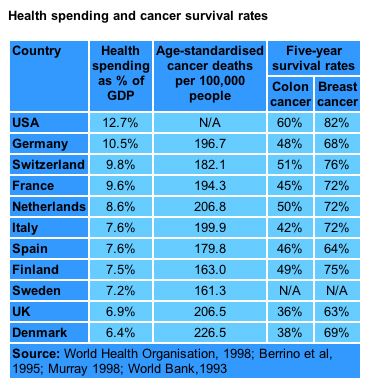
As a follow-up to this post, I wanted to take on the argument that people use against the US's health care system, arguing that it must be worse than other countries socialized approach because it costs so much more.  Well, I am the first to agree that reduced regulation and a better matching of who is paying the cash to who is receiving the services would result in huge cost savings.  However, it may also be true that you get what you pay for, as discussed in Cafe Hayek.  The key chart is shown below:

Survivalrates

One thing I forgot to mention in the previous post was a bit of background of exactly why we have a model where health care is payed for by the employer.  This structure of company-paid health care was not a natural market evolution, but was in fact a direct result of several very distorting government regulations.

Company funded health care plans began in the 1930's and 1940's as a way for companies to try to get around government controls and freezes on wage rates, first instituted with the NRA and later during WWII.  In particular, during the incredibly tight domestic labor markets in WWII, employers struggled with government-mandated wage controls, and used the promise of employer-paid health care as a way to provide higher effective compensation to attract employees, since these non-cash benefits were not counted in the wage freeze calculation.  After the war, the government locked in this practice when the IRS and Congress agreed that company-paid health care was not taxable as regular income, meaning that such health plans were given a strong tax-preference over cash wages.

Finally, if you are not familiar with the appalling experiment in fascism that was the NRA, I wrote about it here.

We Don't Need No Stinking Consistency

For the past 6-months, gas station owners have been under attack by state regulators for their pricing practices just after Katrina, when fears of shut-in Gulf oil production and refining capacity led to a temporary spike in gas prices.  Gas station owners have tried to patiently explain about supply and demand and market dynamics, but to no avail, and are starting to settle:

Sunoco Inc. became the second oil company to
settle a price gouging lawsuit brought by New Jersey authorities,
agreeing to pay $325,000 but admitting no wrongdoing....

As part of a state probe into all oil companies doing business
in New Jersey, more than 100 violations were found at 400 gas
stations in the first week of September, the most common of which
were prices being raised more than once every 24 hours, and
stations showing different prices at the pump compared to their
posted prices, officials said.

Nobody is really getting fined hundreds of thousands of dollars for changing their prices more than once in a day.  Gasoline retailers are getting fined for being unliked, and because politicians find it a populist boon to their reelection to wack on oil companies every once in a while.  One of the reasons that gasoline retailers get fined for petty crap like this is that they are the only retail industry that I know of that actually posts their prices so you can see them on the street when you drive by.  A while back we also highlighted this funny bit of high-handedness in Illinois:

Illinois State Attorney General Lisa Madigan asked 18
operators whose prices jumped significantly after Hurricane Katrina to
donate $1,000 to the American Red Cross or risk a potential consumer
fraud lawsuit, reports the Chicago Tribune.

And you just knew enemy-of-Antarctica and Aspiring Governor Eliot Spitzer couldn't miss out on the populist fun:

Illinois isn't the only state to go after retailers for
price gouging after Hurricane Katrina; New York Attorney General Eliot
Spitzer fined 15 operators $10,000 for pumping up their prices.

Anyway, I guess we still haven't gotten to the "consistency" thing I mentioned in the title.  Having been at the receiving end of such ill-conceived and populist price-gouging and anti-trust lawsuits, what is the gas station trade group doing this week?  Why, appearing in front of Congress to accuse someone else of price-gouging.  In this case, they have dragged credit card companies in front of Congress to demand action on interchange fees:

All consumers pay more at the store and at the pump" as
a result of high interchange rates, added Mierzwinski. He also noted
that "legally suspect" practices have led to market power of the card
associations, and that banks engage in a variety of deceptive practices
to steer customers toward higher transaction fees, such as charging
customers who use PIN debit, as opposed to signature-based debit, which
is much less secure yet carries a higher transaction fee to the
retailer.

Of course, he is all for free markets, as he says with this pious piece of BS:

I believe in the light of day and I believe in free
markets," noted Armour, in explaining what retailers are--and
aren't--seeking with regard to interchange. He stressed that retailers
are not requesting price caps and price controls, but rather a better
understanding of why U.S. interchange rates are so high.

Right.  Then why are we dragging these people in front of Congress, except that you want to use the coercive power of government to change their business practices?  If you have Ralph Nader's PIRG behind you, then you are looking to weild the government's hammer to achieve something you couldn't achieve through free, voluntary association and negotiation.

As a retailer, credit card companies piss me off too, but I don't run to Uncle Sam for relief.  I just don't accept certain types of cards, like ATM cards with PIN verification, since they cost a fortune in fees.   And in a lot of locations, I don't accept cards at all.  We have put ATM's onsite in a lot of places, reasoning that if consumers want debit card convinience, they can pay the fees by using the ATM machine and then paying us in cash.

Getting the Government's Permission to do Business

As I mentioned in an earlier post, we recently won the concession for Elk Creek Marina on Blue Mesa Lake, Colorado.  For the last week, I have been scrambling to take the steps necessary to take over this business without disrupting service to customers. There are a lot of things to do from a customer service standpoint to get the business up and running, but there is a staggering list of permissions and licenses we need from the state of Colorado and other government bodies to be able to conduct this business, particularly since this is our first entry into Colorado.  Here is what we know we need so far, though I caution that this list continues to grow at the rate of 2-3 more items a day as we learn more:

  • Our corporation must register with the Colorado Secretary of State as a "foreign" corporation, foreign in this case meaning that we are registered in another state.
  • To register as a foreign corporation, we need to hire a person to be a "registered agent" to be a contact with the state.  The only real purpose of this person I have ever found is to provide an avenue for mail to get lost
  • We have to register to pay Colorado unemployment insurance tax
  • We have to register to withhold Colorado income taxes from our employees
  • We have to register to pay state corporate income taxes and franchise taxes
  • We have to register to collect sales taxes
  • I think we have to get a special license for collecting electricity taxes, since we sell power to boats at some of the docks
  • We need to go through an extensive application process to transfer three current liquor licenses into our name.  I wrote about liquor license hassles here.
  • The person on the phone today told me a corporation in Colorado cannot own more than two liquor licenses.  If this is true, we will have to form a second company in Colorado, repeating all the tasks above plus the initial work just to form the company
  • I need to fly to Colorado to get fingerprinted for my FBI background check that is needed for the license.  This despite the fact that I have been fingerprinted and background-checked for liquor licenses in several other states.
  • Since the company will hire out fishing guides from the marina, the company has to have a Colorado outfitter license, which includes a 13 page application and very detailed regulations and required contract terms I must use to provide the life-and-death service of helping people find fish.
  • The outfitter license requires that I post a bond, which in turn requires I submit detailed financial and background information to get the bond approved
  • Our managers need to attend food handlers training in Colorado.  Of course, they have attended the exact same course in California, but Colorado wants them to sit through it again within their state's borders
  • We need to fill out a pretty elaborate application to sell Colorado fishing licenses, and may need to post another bond to do so. (Update: Confirmed, we need a $4000 bond).
  • We will likely need an occupancy license from the county
  • We will need a health department inspection and license for the two retail stores, since they sell packaged foods, and a more detailed inspection for the restaurant
  • We will need a fire inspection of the restaurant
  • We will need Coast Guard inspection and certificate for the docks
  • We will need to change the registration of all 45 boats that are kept at the marina for boat rentals  (imagine standing at the DMV to register 45 cars).
  • We will need Coast Guard inspection of all the boats

75 days until we open.  Eeek.

TV Regulation Mess

If my blog was a satellite TV station, the following would be illegal:  Investigators Slam Katrina Response.  (hint - answer is NOT in the attached article, which is random)
.
.
.
I'm sorry, did you miss it?  What did I do that was so wrong?  What I did was let you view content directly from a national content provider.  In the past, Reuters traditionally distributed its content through local distribution arms called newspapers.  This distribution model was required based on old technologies, where printing was a local not a national business.  Now that new technologies allow content providers to distribute their material nationally without these intermediaries, many have chosen to do so, as does Reuters at their web site.  This is one of the many reasons why newspapers today are struggling.

The TV business has historically had the same business model for roughly the same technological reasons.  National content providers (e.g. NBC, CBS) distributed content through local affiliates because broadcasting technologies were very local.  Today, with Satellite and cable, it is perfectly easy for anyone to access the national feeds, like you did in reading the Reuters site above.  EXCEPT, the US Congress has outlawed this practice.  Satellite providers, with a few exceptions for rural viewers, cannot provide viewers with the national feed -- it is illegal.  Unlike with print media, Congress has succumbed to powerful interest groups in the local TV market to protect their dying business model. 

As a result, DirectTV has satellites in space using up bandwidth by broadcasting 50 or more nearly identical copies of the same national feed, because it is forced to use the local affiliate's feed for each local market.   One of many adverse results is that while the price of print content has fallen to nearly zero, the price of broadcast content goes up.  And, from a personal standpoint, I nearly killed myself adjusting an old fashioned TV aerial on my roof last night because that is the only way I can get NBC's Olympics HDTV content, since my satellite provider can't afford to duplicated hundreds of local stations to get the networks on satellite in HDTV under the current asinine rules.  And I refuse to get cable because it was in large part for exactly this reason, to force customers away from satellite to cable, that the must-carry and related rules were passed, and I refuse to give them the satisfaction.

Postscript:  By the way, the Reuters article linked is worth reading too.  Take this snippet:

Richard Skinner, the inspector general of the Department of Homeland
Security, told the committee that FEMA purchased 24,967 manufactured
homes at a cost of $857.8 million to temporarily house Katrina victims.
But most of those homes are unused and the government is paying to
store them, he said.

Nearly 11,000 are sitting are sitting at a
government site in Hope, Arkansas, and are deteriorating because they
were improperly stored, he said.

Progressive Hypocracy

Self-described "progressives" on the left have gone nuts over the past several years over creeping legislative and regulatory inroads made by religious conservatives.  Fascism! They are quick to reply.  The government can't tell us what to do with our own bodies, or in the privacy of our own homes!  Abortion, homosexuality?  Hey, that's our choice, its our bodies.  NSA eavesdropping, warrant-less searches?  Hey, those are our private phonecalls made from our private phones.  Searches of private cars without probable cause to enforce seat belt use?  Hey, what a great idea!

Boston Globe columnist Scot LeHigh editorializes against Massachusetts Democrats attempt to micro-regulate personal behavior:

THIS WEEK, the Massachusetts House of Representatives will face a telling test:
Can it resist a progressive Legislature's ever-present impulse toward pesky
paternalism?

The issue is seat belts, and whether the police will be allowed to stop
motorists upon suspicion that someone in their vehicle is not wearing a seat
belt or only ticket them for that grievous offense if they have first been
pulled over for something else.

This is exactly why I am suspicious of progressives and resist making common cause with them, even on issues where we tend to agree.  For while they talk the libertarian talk pretty well when they want to (abortion with its "I should control decisions over my own body" defense being the most obvious example), progressives also have a very strong streak of "we are smarter than you are and sometimes will tell you what to do because it is for your own good".   As a result, for example, progressives support abortion because a woman should make decisions for her body without government intrusion, but oppose the legality of breast implants and vioxx because a woman should, uh, not be able to make decisions for her body without government intrusion (more on this here).

And what decision could be more about my own body than what level of protection I want to afford myself in a vehicle?  If I choose, for whatever reason, not to wear a motorcycle helmet or a seatbelt, who cares?  It may be a really, really stupid choice on my part, but its my decision for my own body, right?  (By the way, I know that some people will make the 'taxpayers pay for your medical care argument', which I dealt with earlier in my post about government health care funding as a Trojan horse for fascism).

But even beyond the issue of individual decision-making, what about the 4th amendment issues?  It is amazing but true that progressives and the Massachusetts legislature, who would never in a million years give the police, the FBI, or anyone under George Bush's chain of command the right to stop a motorist without probable cause to check for evidence of terrorist intent, are actually endorsing that the police have this power to stop motorists without probable cause for freaking seat belt use.  Is this really the alternative we are being offered today - you can choose fascism to stanch the threat of terrorism or you can choose fascism to increase seat belt use? 

I predict that the left may come to regret setting this precedent, as they have come to regret other expansions of government power that their political enemies have used as stepping stones for their own agenda.  A good example is Title IX, which is beloved by the left for using the fact of federal funding to browbeat even private universities into changing their admissions policies, but has been used as a precedent by the right to browbeat private universities into accepting military recruiters.  Government micro-managing of individual decision-making is only fun as long as you and your gang are the ones doing the micro-managing.

I would love to see someone in Washington making a consistent case for freedom of decision-making for individuals when the decision affects only themselves or others with whom they are interacting in a consensual manner.  But I am not holding my breath.

Regulation and Choice

Andrew Ferguson tells the story of federal regulation of toilets (via overlawyered).  The amazing thing about this story is it is just one examples of thousands -- in other words, its not a humorous outlier, it is the rule of how government works today.  It is a common story of technocrats distrusting market signals and individual preferences, hoping to impose a better order from above, but merely resulting in reduced consumer choice and crappy low-flow toilets even in areas of the country flush with water (sorry, couldn't resist).

The grassroots revolt winked out too. Today's toilets are better than the
first 1995 models, though not as good or as cheap as the toilets of our youth.
U.S. consumers in 2006 can thus buy a worse product at a higher price than they
could in 1992, thanks to the government's insistence on fixing a problem that
wasn't there.

With a chill I remember, from the late 1990s, the look a plumber shot me when
I pleaded with him, quietly, to find me a toilet that worked.

``No way,'' he said. ``I'm not going to jail over a toilet.''

It also is yet another example of regulation primarily being supported by incumbents in an industry trying to limit the number of ways potential new competitors can come at them.  The general effect is always to raise prices and reduce consumer choice.  Ironically, consumer groups are often the worst about this.   In fact, it would be interesting to find even one regulation consumer groups have supported that is not primarily aimed at actually reducing consumer choice - i.e. not of the form "consumers shouldn't buy this because we smarter than they are and we think they should not have it."

Sedona Joins the March to Bureaucracy

Today, the town of Sedona, Arizona joined the ranks of government organizations trying to make business incrementally more difficult.  I operate campgrounds in the Sedona area, and as such I have already registered my business there with:

  • The federal government for social security and medicare taxes
  • The federal government for employee payroll withholding
  • The federal government for income taxes
  • The federal government for federal unemployment insurance
  • The State of Arizona secretary of state and corporation commission
  • The State of Arizona department for unemployment insurance
  • The State of Arizona department of revenue for sales taxes
  • The State of Arizona department of revenue (second time) for corporate income taxes
  • The State of Arizona department of liquor, for liquor license
  • Coconino County tax collector, for property taxes
  • Coconino County health department, for health inspection and certificate

I am sure this list is incomplete, but you get the idea.  I know for a fact that the town already has access to my business information, because they have access to the state department of revenue sales tax database that has all the data they want.  However, I guess so they can feel important -- they want to make sure I have THEIR approval to exist and conduct private transactions with the public as well.  Here is the only rational offered in their letter:

To those businesses operating in the City limits of Sedona:

Help Create Our Economic Future

To Create a viable economic future for Sedona, it is important to know what types of businesses currently exist within the community.  As of January 31, 2006, in order to create a database, all businesses operating in Sedona, or headquartered elsewhere and doing business in Sedona, will need to apply for a business registration.

First, we businesses are already creating Sedona's economic future, and this notion that a couple of people in a small town city clerks office can do anything to add to productivity and economic growth is the worst form of governmental hubris.  Second, though filling out a couple of pages may seem  too small to complain about, we operate in over 200 locations.  Thank God that most of them are in unincorporated area, or we would be filling out hundreds or thousands of pages a year just to help some city clerks with their "database". 

Third, it is interesting to note that Sedona is starting is campaign for their economic future by making doing business there harder.  Sedona reminds me a lot of Boulder, Colorado, where I used to live.  In Boulder, this kind of data request would be the harbinger of some massive new regulation program.  My best guess is that this will be the case in Sedona as well -- this database will be used to justify new regulations and taxes, not less.

I ran corporate planning staff groups at several large corporations.  Every time my staff guys had a new analysis they wanted to do, they often wanted to send out a new requirement to all of our operations managers to report some new data they needed for their project.  As their manager, I tried to be ruthless in defending our operating people, pushing back on my staff guys to find any other way to get the data they need, or to justify strongly the need to ask our folks to report yet another bit of data.  In most cases, the analysis did not justify the work or the data could be acquired some other way, a way that required more work of my staff guys but a lot less from the operating guys who really mattered.  This requests smacks of the exact same thing, except without the adult supervision to push back on their endless data requests.  (Other example here).

This all made me think of this, maybe because my mind works in strange ways. 

The Senate has introduced the "Digital Content Protection Act of 2006,"
a bill that will create "Broadcast Flags" for all digital radio and
television, leading to FCC oversight of all new digital media
technologies from iPods and PSPs to TVs and DVD recorders.

Under the DCPA proposal, digital media technologies would be
restricted to using technologies that had been certified by the FCC as
being not unduly disruptive to entertainment industry business-models.

Beyond my irritation at this whole broadcast-flag-FCC-power-grab raising its head again, it made me think about people's reaction to regulation.  In general, when people actually run into government regulation face to face, they hate it.  That's why with this broadcast flag issue you tend to see a lot of people who generally profess to be comfortable with big government suddenly freaking out, perhaps because this is the first time, beyond the drivers license office or trying to mail a package at Christmas, they every run into the true face of government.  Most corporations today are pretty good at sheltering customers and employees from the mind-numbing regulation they face. 

To all you guys who are fed up with the FCC, let me assure you as a small business owner:  The Department of Labor, Federal Trade Commission, Social Security Administration, Department of Commerce, and every state, county, and city agency you can think of is at least as overreaching and destructive.

The government:  Not to know it is to love it.

Update:  In the past, I have had a field day laughing at left-of-center groups who scream privacy rights at every occasion but support all the intrusion above.  Most recently, I have taken on NOW and the ACLU over this issue.

Dumb Laws

Radley Balko seems to be going state by state, listing recent stupid legislation.  Keep scrolling.  Some examples:

  • Introduced by Sen. Jerry P. Rhoads on January 6,
    2006, to designate the portrait of Daniel Boone entitled "Gateway to
    the West," by Kentucky native David Wright, as the official portrait of
    Daniel Boone.
  • Introduced by Rep. Mitchel B Denham, Jr on January
    3, 2006, to exempt from sales and use tax straw, wood shavings, and
    sawdust used in agricultural or equine pursuits.  (this is from Kentucky, which happens to be the state that required me to have a license to retail eggs).
  • Remote control toy boats may soon be required to
    obey the same speed limits as lifesize watercraft. Bonus points to the
    lawmaker who introduced this one for invoking "the children" in urging
    its enactment.
  • Rep. Richard Morris of Seabrook wants to require elementary schools to teach proverbs.

This is Typical

The left was rightly ticked off a while back when the Bush FDA went against the scientific panel's recommendation and refused to approve the Plan B morning after pill for over-the-counter-sales.  But as I discussed here, the typical political response of our two political parties to such abuses of government power is NOT to reduce the government's power, but to try to redirect the abuses for their own ends. 

So, in this case, the left now is not necessarily upset that the FDA is using non-scientific criteria for approving drugs, they are just upset the FDA is not using their pet non-scientific criteria:

Now an interesting article in the Baltimore Sun
suggests that some left-wingers are also hinting that ethical concerns
should be included in FDA regulatory decisions. In a poll last fall,
the Pew Initiative on Food and Agriculture found
"a strong majority (63 percent) of Americans believe government
agencies should include moral and ethical considerations when making
regulatory decisions about cloning and genetically modifying animals,
with 53 percent feeling that way strongly."

Liberal bioethicist, Daniel Callahan, co-founder of the
Hastings Center in Garrison, N.Y., says that he is leery of having the
FDA rule on moral issues, but thinks that it might want to consider the
financial impact of approving new drugs on the health care system.
Presumably, the regulators might decide that a drug is too expensive
and refuse to approve it although it is safe and effective. The problem
is that deciding to withhold a drug from patients because regulators
think it's "too expensive" is a moral judgment. If the government
doesn't want to pay for an expensive drug that's OK, but why should
regulators forbid consumers, who might want to pay for it on their own,
access to drugs that are safe and effective?

Carol Tucker Foreman, director of food policy at the Consumer
Federation of America, points out that the FDA has already taken into
account non-scientific concerns in some of its regulatory system. For
example, she notes that the FDA requires that irradiated food be
labeled even though there is no scientific evidence that irradiation harms human health. The reason for the labels is that activist groups like Public Citizen
managed to scare some consumers into demanding them in the early 1990s.
Now the question is should the FDA be pushed further down this slippery
slope of non-scientific regulation?

The labeling for irradiated foods is stupid but fairly harmless, but the suggestion to hold life-saving drugs off the market if they are deemed too expensive by some bureaucrats is obscene.  I would suggest you run away screaming from anyone who suggests that this is a "moral" decision.

More Price Gouging Shenanigans

This holiday season, several gasoline retailers found extortion notes from the state AG in their stockings.  In Illinois:

Illinois State Attorney General Lisa Madigan asked 18
operators whose prices jumped significantly after Hurricane Katrina to
donate $1,000 to the American Red Cross or risk a potential consumer
fraud lawsuit, reports the Chicago Tribune.

I would define consumer fraud as getting something from a retailer different than was promised.  I am not sure how it is fraud if retailers put their prices on a great big sign right on the street, and then actually charge those prices as promised.  Unfortunately, we seem to have filled positions of political power with the economically ignorant, who are stuck on cost-based pricing:

"When we're in an emergency situation, such as we were,
retailers have the obligation not to increase their prices to the
general public over what wholesalers are charging them," Hagan told the
Associated Press.

Uh, why?  Retailers move their markup around all the time.  Most every retailer has drastically higher markups on December 1 for Christmas tree ornaments than they do on December 27, but no one seems to complain.  Workers increased the price of their labor post-Katrina, sometimes by a factor of three, and their costs weren't going up at all, so why weren't they gouging?  Its just bizarre how we treat gasoline so much different than every other product we buy.  Perhaps its because they are the only retail product that actually posts their current prices right on the street. 

As I read this article, AG Hagan reminded me of my least favorite Aspiring Governor, fellow Princetonian and enemy-of-Antarctica Eliot Spitzer.  So it was funny when the article continued on to discuss similar actions taken by Spitzer.  This was the quote I loved:

Spitzer told the Press & Sun-Bulletin that
he "hoped it would send a clear message to others that 'you cannot,
under New York law, use an environmental emergency to raise prices.'"

OK, but can I use a massive supply-demand imbalance caused by an environmental disaster to raise prices?  And I sure bet that politicians can use an environmental emergency to raise taxes  (in fact, since NY's gas tax is a percentage of the price rather than fixed, the state of NY did indeed contribute to the post-Katrina price hike). 

Here is my quote back to Mr. Spitzer:

"I hope to send a clear message that the state Attorney General position cannot be used for grandstanding forays against innocent but unpopular business entities* in order to raise one's profile to run for higher office"

*See Dick Grasso, Microsoft, et al.

Update:  More at Professor Bainbridge on Elito Spitzer  (and here)

Sarbanes-Oxley and Enron

Personally, I think you are insane to be a CEO or a board member of a public company under Sarbanes-Oxley.  There is no way I am going to sign a document on threat of prison that no one of the thousands of employees who work for me did anything to screw up the books.  Heck, I run a private company owned only by me where there is no incentive other than to report the numbers like they are, I sit next to my bookkeeper who is the only other one who touches the books, and I still find errors from time to time in past periods.

But what got me going on this post was a TV interview I tuned in the middle of last week.  I can't find a version online or even the name of the people interviewed, but the gist of the discussion was how Sarbanes-Oxley was going to prevent Enron-type situations that bankrupt investors.

I wonder how many people believe this?  Because Enron was going down, with or without the accounting shenanigans.  Its trading-based business model followed a life-cycle that should be familiar to anyone who has been in trading -- that is, they had unbelievable margins early on, but as others figured out what they were doing and duplicated it, the margins narrowed.  As trading margins narrow, the only way to maintain profits is to increase volume, leveraging up your capital into larger and larger trades at narrower and narrower spreads.  This volume strategy requires a very low cost of capital, which means low borrowing costs and a high stock price.  By hiding debt and losses in off-book subsidiaries, the Enron managers may have delayed the ultimate reckoning (by keeping equity prices high and its bond yields low), but the accounting games were not the cause of the failure.  In the same way, the march of long distance rates towards zero ultimately brought down Worldcom, not accounting.  In the latter case, if you borrow lots of money to buy long-distance companies, as Worldcom did,  assuming say 20 cent per minute long distance rates and then the rate goes to 5 cents, you are probably in trouble.

I am all for curbing the imperial CEO and giving shareholders and boards more power to police accounting and establish transparency.  I am not sure SarbOx does any of this.  My gut feel is that five years from now we will view SarbOx as more of an enabler for state attorney general self-promotion (as each races to try to prosecute some high-profile CEO for arcane accounting errors) and tort bar shenanigans.

I am honsetly curious, do any of you, as equity holders, feel better about your equities today with SarbOx than without it, especially given the added expense every company has had to take on?  It would be interesting to test the market's perceived value of SarbOx by allowing shareholders to vote to opt in or out of SarbOx.  Not only would their voting be interesting, but, if they opt out, it would be interesting to see if the stock price goes down (meaning SarbOx has perceived value) or up (meaning SarbOx is mostly perceived as extra regulatory expense).