Author Archive

British Censors Rewriting... the Future?

Government censors often try to rewrite the past, but Reason's Hit and Run passes on this funny story of British attempts to rewrite the future:

Britain's Meteorological Office has instructed forecasters to describe the
country's damp, dismal, seasonal-affect-disorder-inducing, godawful weather in
Bob Rossian terms:

Prolonged sunshine is expected under new "positive" forecast
guidelines issued by the Meteorological Office...

There is no need to dwell on a "small chance of showers" when "mainly dry"
tells a better story. If there are "localised storms" then it must be "dry for
most". Clouds over Manchester mean generally clear visibility for motorway
drivers

I don't know what the Brits are complaining about in a forecast such as "small chance of showers".  In the States, the same forecast would be communicated as "huge, civilization ending storm approaching - details at 11".  When I lived in St. Louis, I remember that the local news successfully predicted 11 of the last 3 snowstorms.

Update:  I appears that the media has also been reporting 11 of the last 3 murders:

Five weeks after Hurricane Katrina laid waste to New Orleans, some local, state
and federal officials have come to believe that exaggerations of mayhem by
officials and rumors repeated uncritically in the news media helped slow the
response to the disaster and tarnish the image of many of its
victims.

Claims of widespread looting, gunfire directed at helicopters and
rescuers, homicides, and rapes, including those of "babies" at the Louisiana
Superdome, frequently turned out to be overblown, if not completely untrue,
officials now say.

The sensational accounts delayed rescue and evacuation efforts already hampered
by poor planning and a lack of coordination among local, state and federal
agencies. People rushing to the Gulf Coast to fly rescue helicopters or to
distribute food, water and other aid steeled themselves for battle. In
communities near and far, the seeds were planted that the victims of Katrina
should be kept away, or at least handled with extreme caution.

I had my own commentary about media malpractice here.

Arizona State University Racially Segregates Courses

I am a big supporter of the work FIRE does to support openness and individual rights in universities.  Today, FIRE turns its attention on Phoenix's own Arizona State University:

State-sponsored racial segregation has found a home at Arizona State University
(ASU).  ASU's ironically named 'Rainbow Sections' of English 101 and 102 have
been advertised on flyers and on the university's website as being open to
'Native Americans only.'

The Foundation for Individual Rights in Education (FIRE) has written to the
university to demand that the classes be opened to all students. Shockingly,
this marks the second time in less than four years that FIRE has been forced to
protest a racially segregated course at ASU.

It is appalling that ASU would resurrect segregated classes five decades
after Brown v. Board of Education," stated David French, president of
FIRE.  "The idea that a class can be 'separate but equal' was discredited long
ago.

The 'Rainbow Sections' of English 101 and 102, ASU's freshman composition
courses, were advertised as "restricted to Native Americans only" on the faculty
webpage of Professor G. Lynn Nelson, the course instructor.  A flyer
addressed to 'Native American Students' states that they 'are invited to enroll
in special Native American sections of ENG 101 and 102.'  It also discusses some
of the differences between the special sections and the 'standard First Year
Composition classes,' making it clear that the special sections offer a
different educational experience.

Anyone heard of Brown vs. Board of Education here?  I wouldn't have a particular problem with private groups offering such education with these restrictions, after all I have said many times that the right of free association implies a right not to associate with whoever you want.  But public institutions have different obligations in this regard.  Its actually not that hard to deal with, and even ASU knows what the solution is:

FIRE last wrote
to ASU in April 2002
to protest a segregated Navajo history class that
limited enrollment to Native American students. At that time, ASU simply dropped
the racial restriction in response to FIRE's letter.

Its OK to have different versions of the same coursework, and probably OK to advertise one version as specially targeted at a particular group, as long as you let individual students make the final decision on which of the University-sanctioned versions are right for them.

Better Late Than Never

Via Instapundit comes the separation of powers is slowly starting to work, with the Senate starting to reign in the Administration:

In a break with the White House, the Republican-controlled Senate
overwhelmingly approved a measure Wednesday that would set standards for the
military's treatment of detainees, a response to the Abu Ghraib scandal and
other allegations that U.S. soldiers have abused prisoners.

Sen. John McCain, R-Ariz., a victim of torture while a prisoner during the
Vietnam War, won approval of the measure that would make interrogation
techniques outlined in the Army Field Manual the standard for handling
detainees in Defense Department custody and prohibit "cruel, inhuman or
degrading" treatment of U.S.-held prisoners.

Its good to see Congress getting off its butt and seeing it stop relying on the Supreme Court to deal with these issues.  I thought this was overdue a while back when I posted this.

Of course GWB, who is the only president in history to go 5 years without vetoing anything, is threatening a veto of this sensible regulation:

The White House has threatened to veto the $440 billion military spending
bill to which the measure was attached, and Vice President Dick Cheney has
lobbied to defeat the detainee measure. White House spokesman Scott McClellan
objected that the measure would "limit the president's ability as
commander-in-chief to effectively carry out the war on terrorism."

Uh, how?  Glenn Reynolds responds:

This resistance seems to me to be a mistake. First -- as Lamar
Alexander noted on the Senate floor, in a passage I heard on NPR
earlier this morning -- it is very much the Congress's responsibility
to make decisions like this; the President might do so in the first
instance, but we've been at war for more than four years and Congress
is actually doing its job late, not jumping in to interfere. If the
White House thinks that the Senate's approach is substantively wrong,
it should say so, but presenting it as simply an interference with the
President's Commander-in-Chief powers is wrong. Congress is entitled,
and in fact obligated, to set standards of this sort. It's probably
also better politically for the White House, since once the legislation
is in place complaints about what happened before look a bit ex post facto.

Perhaps current practices are producing a treasure trove of
intelligence that this bill would stop, but I doubt that -- and if I'm
wrong, the Administration should make that case to Congress, not stand
on executive prerogatives. And this bill seems to be just what I was calling for
way back when -- a sensible look at the subject by responsible people,
freed of the screeching partisanship that has marked much of the
discussion in the punditsphere. That should be rewarded, not blown off.

A Bush veto of this measure is likely to touch off the perfect political storm within his own party.  This would make the trifecta of alienation from the more sober parts of the Republican Party, following on his profligate spending tendencies as revealed post-Katrina and his cronyism as reveled first at FEMA and now with his recent Supreme Court nomination.

Let's Tax These Bubble-Driven Windfall Profits

A number of politicians are calling for taxing "windfall profits" driven by the "price bubble" in gasoline and oil.  Previously, I narrow-mindedly opposed this, arguing that the whole point of the pricing signal being sent is to call for new supplies, which won't happen if the government takes the money away from suppliers.

I say narrow-mindedly, because I have had an epiphany.  I realize now that it is indeed unfair for sellers to benefit from such a pricing bubble.  However, I think the politicians are wrong for looking at oil, since that bubble is only small potatoes.  I propose we start with the much bigger bubble:  In housing prices.  In a time of housing shortages, it pains my heart to Americans profiteering from artificially high prices.  Besides, oil companies actually do something useful with their windfall profits, like finding more oil; home sellers will just blow their proceeds on a big screen TV or something.

My proposal is that the government set a "fair price" for housing, based on a standard rate of appreciation.  The price of the house in a base year, such as 1970, adjusted for the CPI is a good starting point, but a process can be created modeled after Hawaiian gas pricing regulation to set up the exact standard.   Every house in the country then will be appraised.  Any house selling for or appraised for an amount above the 1970 price+CPI adjustment will be deemed as having reaped windfall profits.  The government is authorized to seize 100% of these windfall profits.  When this program is a success, we should then consider a retroactive program to seize windfall profits from the Internet stock bubble.

So, for all you who were supporting government intervention into gasoline pricing and profits, this must make you feel even better, since it is a much, much bigger bubble.  Right?  Or was it somehow more fun when Exxon was a target instead of, say, you?

Update:  I thought it was obvious, but I guess not from the email I have gotten:  I am being sarcastic here.  I would oppose a "windfall" profits tax on oil, houses, Internet Stocks, Pokeman cards, or whatever. 

The WSJ ($?) had this editorial on Saturday:

We keep hearing the word "bubble" to describe
industries with rapid and unsustainable rising prices. Hence, the
Internet bubble, the telecom bubble, stock market bubble, and now, some
analysts believe, a housing bubble. Yet for some mysterious reason no
one speaks of the oil bubble -- though prices have tripled in two years
to as high as $70 a barrel.

Reviewing the history of oil-market boom and bust
confirms that we are in the midst of a classic oil bubble and that
prices will eventually fall, perhaps dramatically. Despite apocalyptic
warnings, the world is not running out of oil and the pumps are not
going to run dry in our lifetimes -- or ever. What's more, the
mechanism that will surely prevent any long-term catastrophic shortages
in energy is precisely the free-market incentive to make profits that
many politicians in Washington seem to regard as an evil pursuit and
wish to short circuit.

The best evidence for an oil bubble comes from the
lessons of America's last six energy crises dating back to the late
19th century, when there was a great scare about the industrial age
grinding to a halt because of impending shortages of coal. (Today coal
is superabundant, with about 500 years of supply.) Each one of these
crises has run almost an identical course.

First, the crisis begins with a spike in energy prices
as a result of a short-term supply shock. Next, higher prices bring
doomsday claims of energy shortages, which in turn prompts government
to intervene ineffectually into the marketplace. In the end, the advent
of new technologies and new energy discoveries -- all inspired by the
profit motive -- brings the crisis to an abrupt end, enabling oil and
electricity markets to resume their virtuous longterm downward price
trend.

The limits-to-growth crowd has predicted the end of
oil since the days when this black gold was first discovered as an
energy source in the mid-19th century. In the 1860s the U.S. Geological
Survey forecast that there was "little or no chance" that oil would be
found in Texas or California. In 1914 the Interior Department forecast
that there was only a 10-year supply of oil left; in 1939 it calculated
there was only a 13-year supply left, and in 1951 Interior warned that
by the mid-1960s the oil wells would certainly run dry. In the 1970s,
Jimmy Carter somberly told the nation that "we could use up all of the
proven reserves of oil in the entire world by the end of the next
decade."

We can ridicule these doom and gloom predictions
today, but at the time they were taken seriously by scholars and
politicians, just as the energy alarmists are gaining intellectual
traction today. But as the late economist Julian Simon taught, by any
meaningful measure oil (and all natural resources) has gotten steadily
cheaper and far more bountiful in supply over time, despite periodic
and even wild fluctuations in the market.

Technorati Tags:  ,

Richer and Warmer vs. Poorer and Cooler

For quite a while, I have wanted to see that someone address the question of comparing a richer and warmer world with a poorer and cooler world, and not just assuming that the latter is superior.  As I wrote here, this is one of the most important questions ignored to date by Kyoto supporters.  Supporters of immediate climate change action shout warnings about the dangers of raising the earth's temperature a degree or two.  But what if that comes at the cost of reducing world economic growth a percentage or two?  There is still a lot of work to be done to understand the impacts of a 1-2 degree temperature rise, but it is very, very well understood what 1-2 extra points of economic growth can do, especially in developing countries.  Economic growth reduces starvation, increases life expectancy, improves health care and sanitation, and increases the ability to survive natural disasters.

The Commons Blog links to this study by Indur Goklany on just this topic.  I have not had time to get through it all -- I am just happy someone is even asking the question -- but the Commons Blog folks have:

If global warming is real and its effects will one day be as devastating as
some believe is likely, then greater economic growth would, by increasing
greenhouse gas (GHG) emissions, sooner or later lead to greater damages from
climate change. On the other hand, by increasing wealth, technological
development and human capital, economic growth would broadly increase human
well-being, and society's capacity to reduce climate change damages via
adaptation or mitigation. Hence, the conundrum: at what point in the future
would the benefits of a richer and more technologically advanced world be
canceled out by the costs of a warmer world?

Indur Goklany attempted to shed light on this conundrum in a recent paper
presented at the 25th Annual North American Conference of the US Association for
Energy Economics, in Denver (Sept. 21, 2005). His paper "” "Is a
richer-but-warmer world better than poorer-but-cooler worlds?"
"” which can
be found here, draws
upon the results of a series of UK Government-sponsored studies which employed
the IPCC's emissions scenarios to project future climate change between 1990 and
2100 and its global impacts on various climate-sensitive determinants of human
and environmental well-being (such as malaria, hunger, water shortage, coastal
flooding, and habitat loss). The results indicate that notwithstanding climate
change, through much of this century, human well-being is likely to be highest
in the richest-but-warmest world and lower in poorer-but-cooler worlds. With
respect to environmental well-being, matters may be best under the former world
for some critical environmental indicators through 2085-2100, but not
necessarily for others.

This conclusion casts doubt on a key premise implicit in all calls to take
actions now that would go beyond "no-regret" policies in order to reduce GHG
emissions in the near term, namely, a richer-but-warmer world will, before too
long, necessarily be worse for the globe than a poorer-but-cooler world. But the
above analysis suggests this is unlikely to happen, at least until after the
2085-2100 period.

It is particularly important to do the economic work using the same assumptions that the climatologists use. As I posted before, climate studies tilt the playing field in the favor of warming by assuming huge economic growth rates in developing nations.  This ups CO2 emissions estimates, because it is also assumed that these countries remain inefficient energy consumers.  I have criticized this approach in the past, since it yields ridiculous outcomes (many of these smaller nations end up with economies larger than the US in 2050).  However, if they are going to insist on these assumptions, that should also be the backdrop for estimating economic impact of reductions. Presumably, since in their model CO2 comes disproportionately from developing country growth, then the costs will be seen disproportionately in terms of reduced developing country growth.  Which will have predictable results in terms of malnutrition, starvation, disease, and shorter lifespans.

Technorati Tags:  ,

OK, Top This

The Club for Growth has identified one of the most ridiculous pieces of government spending I have seen so far. 

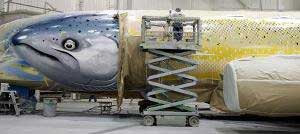
So, you landed a big king salmon this summer? It can't
compare to the colossal king Alaska Airlines plans to land this morning in
Anchorage.

The Seattle-based carrier has painted nearly the full
length of a Boeing 737-400 passenger jet as a wild Alaska king, or chinook,
salmon. The airline has dubbed its flying fish the "Salmon-Thirty-Salmon."

It's a bold promotional move to celebrate wild Alaska
seafood and also the carrier's role in hauling millions of pounds of fresh
salmon, halibut, crab, shrimp and other seafood out of the state each year.

The plane is kind of cool looking, in a creepy sort of way:

Fish

But here is what was buried deep in the article on the "bold" plan:

A local nonprofit agency, the Alaska Fisheries Marketing
Board, gave Alaska Airlines a $500,000 grant to paint the jet. The money came
out of about $29 million in federal funding U.S. Sen. Ted Stevens of Alaska and
his congressional colleagues have appropriated to the marketing board, created
in 2003, to promote and enhance the value of Alaska seafood. The senator's son,
state Sen. Ben Stevens, is chairman of the agency's board of directors.

Maybe they can use the plane to fly the route to New Orleans.  The scary part is the article plays this whole project straight up, as if it is perfectly normal and natural, even bold and innovative.

Spending other people's money, taken from them by force, on projects they don't necessarily support, does not make you bold, or compassionate, or caring, or innovative.  It just makes you a politician.

Maybe He Should Have Worn a Cardigan

Truck and Barter is not very impressed with Bush's call for us all to drive less. 

I'd like to know just why I should conserve. We supposedly live in a
capitalist society based on property-rights and free-trade; why, all of a
sudden, do you ask that I not trust that the price of fuel incorporates all the
scarcities at every level of production? What economic lever broke in the past
month? Why do you think the price system is failing so bad that we need to
"conserve" more than the price signal warrants?

I won't pretend that market prices don't exist, or that markets have suddenly
stopped working; I won't pretend that prices are inefficient allocators of
resources; I won't pretend that I cannot buy as much gasoline as I can afford at
current prices.

Furthermore, Mr. President, I will not pretend that you have legal or moral
authority to tell me how much gasoline I may purchase. I will not pretend that
your feeble call to use less has any impact whatsoever on my psyche. I will not
pretend that the Federal Government knows better than me how much gasoline I
should purchase.

Awesome, well said.  Maybe if Bush had worn a cardigan, like Jimmy Carter did when he asked the same thing, he might have been more successful.  Or then again, maybe Bush should have thought twice about channeling Jimmy Carter on any energy or economics related issue.

By the way, there is much more to the post - make sure to read it all.

Update: This one attracted a number of comments fast.  Here are some additional thoughts

Doesn't it make sense to conserve gas?  Isn't what Bush said correct?

Sure it makes sense, but I didn't need Bush to tell me.  Seeing my average 15 gallon fillup go from $30 to $45 nearly overnight told me everything I needed to know.   I adjusted my driving behavior based on how I value various types of trips.  And so, apparently, did everyone else, as gas consumption in this country dropped almost 10%.  Bush doesn't have to tell you to refinance your home when mortgage rates drop, or to buy less OJ when the orange crop failed -- prices signal these things quite nicely.

By the way, I limited my driving years ago (e.g. I live 1 mile from my office) but not because of gas prices.  Lets say 1 hour of driving gets me 30 miles in the city, and requires 1.5 gallons of gas.  The recent increase in gas prices has increased the cost of that 1 hour of driving by about $1.50.  That is NOTHING compared to how I have increased how I value my free time as I have grown older.  That hour may use up five bucks of gas but hundreds of dollars of my leisure time.  I have often told people that the biggest change you go through getting older is how much your internal valuation of your own free time goes up.  In college, I would wait for 8 hours in a line to get concert tickets at face value.  Today, I buy them market up at eBay, because that 8 hours is now worth far, far more to me than the markup.

Wouldn't voluntary conservation beyond what you have already cut back help reduce gas prices in the US?

Sure, if everyone cut back some percentage more than what they would have already done due to the price increase, then yes that might help push prices down.  Of course every person who did this would lose from doing so.  When the price increases, everyone eliminates their marginal use of gasoline, ie every use or trip that is worth less to them than the cost in fuel.  That means that the trips that remain are worth more to them than the gas (and other)  costs.  Therefore, remaining trips are a net increase to their well-being.  If a remaining trip is then eliminated voluntarily, or the cost of that trip is increased due to the increased hassle of carpooling or using public transit, then their well-being is reduced. 

However, this is the great thing about America:  If you personally value voluntarily reducing your gas consumption to help reduce prices for others, in a free society, no one is going to stop you.

By the way, here is the reason I don't worry about it:  I am old enough to have been driving in the late 1970's.  And I know from experience that allowing prices to shoot up for a period of time, without government price caps or windfall profit confiscation silliness, is going to lead to more supply and lower prices in the future.

Don't you think its unethical not to conserve in times like this?

No.  I don't associate consumption and ethics.  If it is sold legally at a certain price, and I can afford and wish to pay that price, then I don't see that morality or ethics come into play.  While there certainly can be ethical problems spending money unwisely (e.g. blowing money on coke or gambling that was needed to feed your kids), that is a different situation.  I don't feel guilty about consuming gas.

Isn't it a security issue?  Shouldn't we be asked or forced to conserve more to make the US independent of foreign oil?

There is only one time this argument makes any sense - if the world is in a full scale shooting war and all foreign trade and international markets are halted, and then we would have much bigger problems.

Short of the breakdown of world trade and markets, being "independent of foreign oil" is a mirage, an impossible non-goal.  Lets say that the world energy supply and demand was exactly the same as it was today, except that the US produced domestically exactly enough oil to satisfy domestic demand.  But in this case there is still a world market for oil.  The price of oil and gas in this country would not be more or less than it is today, except maybe for a few cents of transportation cost differences.  And if there is an oil supply shock, the pricing in the US will be virtually the same in this hypothetical situation as it would be in today's structure.

Shouldn't the President be doing something?

Sure.  Get the hell out of the way of the people who can fix the problem.  Rethink the regulatory regime that is preventing refinery construction.  Revamp the licensing approach for nuclear power.  Open up oil drilling in proscribed areas.  And find his lost veto pen and ax any dumbshit regulation out of Congress managing energy prices, taxing windfall profits, or attempting to pick winners via subsidies.

Technorati Tags:  ,

Interesting Demographic Data on the Army

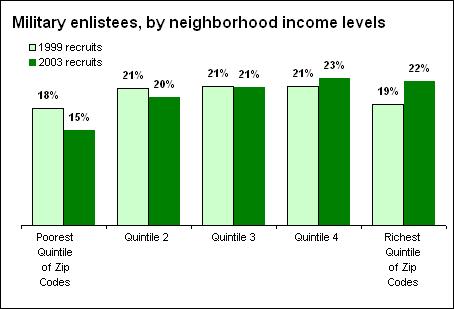
Its always interesting when someone successfully challenges a widely-held assumption.  Like much of America, I have always accepted the notion that the all-volunteer army attracted a disproportionate number of poorer enlistees.  This made sense, since a large part of the recruiting message is one of education and opportunity, which should be powerful inducements to folks trying to get themselves out of poverty.  A few have argued that this is not true, that messages of duty, honor, and country resonate with all classes, but we have all been trained of late by the cynical media that those are dated and powerless concepts.  The main difference in perception about army demographics has been between those who thought the perceived demographic skew was bad and those who thought it just was.  A number folks of late have actually supported a draft due to this perception of a demographic bias.

So it was interesting to see this study by Tim Kane, as unearthed by Mark Tapscott, that tends to explode this myth.  Not having family income data for army enlistees, the study chose as a reasonable proxy the relative wealth of their home zip code.  Based on this methodology, we find that the all-volunteer army actually skews rich rather than poor:

Military_demographics

As with all studies like this, I caveat that I have not seen their methodology, etc. etc.  However, it is interesting in that it is completely opposite of public perception.  Since I didn't really find anything horrible about the old perceived skew, this study doesn't change any of my opinions on the army or the draft, but it will be interesting to see if Charlie Rangel reverses course and starts criticizing the army for being a rich kid's boondoggle.

Zywicki on Miers

I know nothing about Bush Supreme Court nominee Harriett Miers other than she adds yet another possible way for people to misspell my last name.  Todd Zwycki at Volokh has this take, and it doesn't sound too good:

These appointments thus seem to confirm a common criticism of this
President--that he is uninterested in ideas and interested only in
power. While they may both turn out to be perfectly fine Justices, both
Roberts and Miers appear to be both uninspired and uninspiring in terms
of providing intellectual leadership on the Court. The Administration
seems to be narrowly obsessed with winning minor tactical victories
(here, an easy confirmation of a stealth candidate) while consistently
failing to follow-through with meaningful long-term strategic victories
(an opportunity to change the legal culture).

In the end, of course, the lack of a strategic vision means that
even the tactical victories tend to be reversed (for instance,
temporary tax cuts will likely fall victim to the inability to control
spending). As Reagan understood, you have to first have the long-term
strategic vision in mind so that you know when to make tactical
compromises. Ideas are the long-run motivating force of history.
Tactics without strategy, by contrast, leaves you rudderless.

Beyond his evaluation of Miers, I really like his assessment of Bush, which strikes me as dead-on.  I still think Janice Rogers Brown was the choice.

Update:  Apparently, she was on the Dallas City Council when I lived there in the early 90's, but I sure don't remember having heard of her.  And how serious a candidate can anyone be for the Supreme Court if they were on a freaking city council a decade ago -- can you see any of your city council members on the Supreme Court in 10 years?  And by the way, what are the odds that Bush's personal friend and lawyer will do anything to reign in the new powers to suspend habeas corpus that the administration has granted itself.

MS Office in some Trouble

Apparently, this is one of the top new features MS is touting to get people to pay hundreds of dollars a screen for MS Office upgrades:

The new version of Microsoft Corp.'s Office
software will let users save documents in the popular PDF format, as
part of efforts to broaden the appeal of the new Office product and get
people to upgrade.

 Office 12, which is due out by the end of
2006, faces some of its stiffest competition from existing users who do
not see the need to upgrade from previous versions. Microsoft is
aggressively touting new functions, such as the PDF support, to try to
spur upgrades and appeal to people who might otherwise not buy Office
at all. The Office suite retails for between $149 and $499, depending
on which edition a user chooses.

Oooo, that's really going to do the trick.  Kind of like urging you to trade-in your car because the new one has more cupholders.  Of course, Open Office is free, is working great for us, and already has a built-in export to pdf.

Alien and Sedition Acts Return

I fear that this administration has effectively reenacted the much-hated Alien and Sedition Acts of the early 19th century.  Using the "war" on terror as its excuse, the Bush administration is rapidly expanding its ability to grab and hold people indefinitely without charge or trial.  This is not a huge surprise -- many presidents have tried to do similar things in time of war or in reaction to internal security threats.  Much of the Patriot Act was originally proposed by Bill Clinton, after all.

What is new is that the courts and the opposition party are letting him get away with it.

The Sept. 9 court ruling concerning Jose Padilla, an
American citizen locked up in a military prison in South Carolina for
three years, is a case in point. The ruling should send shockwaves
through the American public since the decision seriously undermines
constitutional rights.

A federal appellate court ruled that constitutional rules
that apply to the police do not apply to military personnel.... The federal
government has been given a green light to deprive Americans of their
rights to due process. No arrest warrants. No trial. No access to the
civilian court system. You may not be able to see it on television, but
this court decision is the equivalent of a legal hurricane-and it is no
exaggeration to say that this is a level 5 storm with respect to its
potential havoc for civil liberties.

Federal agents arrested Padilla at O'Hare International
Airport in Chicago just after he arrived on a flight from Pakistan. The
feds claim that Padilla fought against U.S. troops in Afghanistan,
escaped to Pakistan and returned to the United States to perpetrate
acts of terrorism for al-Queda. Instead of prosecuting Padilla for
treason and other crimes, President Bush declared Padilla an "enemy
combatant" and ordered that he be held incommunicado and interrogated
by military and intelligence personnel.
Padilla has not yet had an opportunity to tell his side of
the story. For two years the government would not even permit Padilla
to meet with his court-appointed attorney, Donna Newman. Newman has
nevertheless defended Padilla's rights, arguing that the president does
not have the power to imprison Americans without trials.

Bush has not made any dramatic televised address to the
country to explain his administration's attempt to suspend habeas
corpus and the Bill of Rights, but his lawyers have been quietly
pushing a sweeping theory of executive branch power in legal briefs
before our courts.

I actually am fairly radical on this - I don't think the fact that he is a citizen or not should even make a difference.  Citizenship does not confer rights, and governments don't hand them out -- rights are ours based on the fact of our existence.   While some of the rules of due process may change for non-citizens, just the fact that they are from a different country doesn't give us the right to lock them in a room indefinitely.  This is why I support free and open immigration - there is no reason why a person born in Mexico should have fewer rights to contract with me for a job or a home than an American citizen.  The right to associate, to contract, to agree on wages, to buy a particular home, all flow from being human, not from the US government.

So I wouldn't support Padilla's treatment if he was a Iranian citizen and I certainly don't support it for an American.  Yeah, I know, he may be a bad person.  But we let bad, dangerous people out of jail every day.  Our legal system is structured based on the premise that it is worse to lock an innocent person away than let a guilty person go free.  Its a trade-off that we have made for hundreds of years and I for one am pretty comfortable with.

I also get the argument that we are at war -- in Iraq.  If someone is captured in Iraq, that may be another story.  But Chicago is not in the war zone, by any historic definition of that term (unless you want to use WWII Japanese internment as a precedent, which I doubt).  Just calling it a "war on terror" does not make Chicago a war zone any more than declaring a "war on drugs" makes Miami a war zone where suspected drug users can be put in jail without trial.  Perhaps if Bush could get Congress to officially declare war, he might have firmer legal footing, but I don't think that's going to happen.  As I wrote here:

Yes, I know that there is a real risk, in fact a certainty, that
dangerous people will be let out on the street.  But that is the bias
of our entire legal system - the "beyond a reasonable doubt" standard
and other protections of the accused routinely put bad people back on
the street.  We live with that, because we would rather err in putting
bad people back on the street than in putting good people behind bars
for life.  Give them a trial, deport them, or let them go.  Heck,
airdrop them into Paris for all I care, but you have to let them get
due process or go free.

Sure, terrorists are using our free and open society against us, and its frustrating.  But what's the alternative?  I just don't think there is a viable alternative which says that we should destroy our open society in order to save it.  We've got to learn to be smart enough to work within the rules, and it may be that we have to expect that in the future our freedom comes at some statistical increase in the danger to ourselves (by the way, isn't that exactly the trade-off we have enforced on Iraq, without even asking them -- citizens are much freer that under Saddam but at  an increased risk of terrorism?).

By the way - where the hell is Congress?  Stop grandstanding in confirmation hearings and get to work reigning this stuff in.

It's Alive

Yes, it has a stake in its heart along with a couple of silver bullets, but a number of members of Congress are attempting to reanimate the broadcast flag.  I celebrated its demise here, perhaps prematurely.  I am sad to say that my Congressman John Shadegg, according to Boing Boing, seems to be among the twenty Frankensteins responsible for this effort.  I have given props to Shadegg a couple of times, and now I have to express my deep disappointment in him.

I know, I know. We keep killing
this thing, and it keeps on coming back. But the important thing is
that we keep killing it. Us. They put tens of millions of bucks into
this bid to make technology subservient to the superstitious fantasies
of venal film execs, and we killed it by sending thousands and
thousands and thousands of letters, calls, and faxes to DC. We made it
happen. We'll make it happen again. They're not going to win this one,
EVER

A geography Challenge

Do you think you know your geography?  If so, try this quiz.  I did well on most of the other regions of the world, and even got most of the Balkans and the former Soviet republics rights, but this particular quiz is a bear.  I might have done better back in the day when I was a student of WWII.

Katrina Timeline

The always useful Factcheck.org site has a well-sourced timeline of pre- and post-Katrina rescue efforts and related events.

While you are there, they also have what strikes me as a pretty fair roundup on Administration justifications for the Iraq war, and make the useful distinction between being wrong and outright lying.  Of course, being consistently wrong on intelligence matters is still a fair basis for criticism, but getting of this distinction right is useful for moving discourse along more productively. 

Agenda for UN Internet Conference

COYOTE BLOG EXCLUSIVE!!  We have obtained the preliminary agenda for the upcoming UN Internet Conference in Tunisia.

AGENDA

Day 1

Dinner
Benon Sevan has generously offered to supply dinner from a selection of
the food provided to the Iraqi people under the UN Oil-for-food program.
Unfortunately, it was found at the last minute that no one in the
oil-for-food department has any contacts with companies that actually sell food.
The French delegation has generously stepped in the last minute with
chicken and Vichy water for everyone.

After-Dinner Keynote Address:  Fighting Hate Speech
Wen Jaibao
Premier, China

All of us are concerned with the growth of hate speech on the web.  Spread by foreign anarchists and CIA operatives called "bloggers", these lies present a constant danger to all of our governments..  Premier Wen, whose country under Chairman Mao broke Germany's and Russia's records for the most people sent to government-sponsored sensitivity training, outlines some of the technologies China is using to protect Chinese citizens from foreign deception.  He also will discuss how he got US companies like Cisco and Microsoft to abandon their public principles in exchange for promises of large contracts

Day 2

Pricing for Domain Names
Kojo Annan

Kojo will discuss a number of technical issues associated with domain name pricing.  Among the topics discussed will be "how large a kickback should be demanded of large US companies renewing their domain name registrations", "how should kickback money be distributed between general assembly members", "how can sub-contracts be funneled to key family members", and "how Paypal can be used to facilitate 'courtesy' payments".  Kojo will also discuss the mechanics of Swiss banking as it applies to government Internet supervision.

Pornography on the Web
Hassan al Saud
Saudi Arabian Security Service

Director al Saud will discuss approaches for limiting pornography on the web, such as photos showing NFL Cheerleaders, hot protest babes, or any woman with tattoos, body piercings, or a bare midriff, including nearly the entire UC-Santa Barbara female population.  Al Saud will review his groundbreaking work filtering news service web pages for the names of women and women authors and replacing them with men's names.  Afterwards, al Saud will be signing copies of his bestseller "Gone with the Wind".

Lunch
Robert Mugabe has generously offered to supply lunch from the fine
farms of Zimbabwe.  Unfortunately, unforeseen...technical problems will
make that impossible.  We ask that all delegates go outside the meeting hall and fend for themselves for lunch.

Future of email scams
Dr. Hamzu Kalo
Lagos Nigeria

Many of us are concerned with the growth of email scams.  In this important discussion, Dr. Kalu will discuss topics including "How can other countries get a piece of Nigeria's lucrative email scam business", "how can UN imprimatur be used to increase email scam returns", and "how should government's tax email scam revenue".  Working papers from Dr. Kalo's last conference can be found here.

Shortsighted Nationalization
Hugo Chavez
President, Venezuela

Mr. Chavez will argue his controversial hypothesis that it is shortsighted to immediately nationalize US corporate assets when taking office.  His premise is that it is better to wait 6-12 months, after companies have become complacent, before seizing their operations.  Mr. Chavez will also address the difficult issue of how to attract new foreign investment when every successful foreign enterprise in the history of your country has been nationalized.

Snack Break
Sponsored by Cisco and Microsoft to introduce their joint Internet initiative with the United Nations entitled "We are for freedom and democracy, except when we're not."

Promise of the Internet for Managing elections
Jimmy Carter
ex-President, United States of America

Everyone should be familiar with President Carter's outstanding work courageously certifying the election in Venezuela while challenging corrupt elections in Florida and Ohio.  President Carter will address the topic of using Internet technology for elections.  He will show that paper ballot technology can still leave a potentially dangerous paper trail, while Internet voting allows for nearly total ability to manage elections to make sure that the will of the people is not thwarted by CIA-financed lying upstarts.

Farewell Dinner
Dinner was to be provided by the United States delegation, but US authorities could not provide documentation that no genetically modified foods were used to prepare the meal.  It has been decided that it is better for the meeting delegates to go hungry than risk eating any GM crops.

Transportation
No transportation has been arranged, but officials are encouraged to nationalize any assets they need to reach the conference.

Email
In the spirit of promoting the
Internet and Tunisia's leading role in it, all participants will be
allowed full access to email while in the conference.  All email will
be downloaded by our WIFI (Working-group Investigating Foreign-corruption via the Internet)
and printed out for our guests.  Conference participants should note
that emails with language directly threatening the state** will not be
passed on.

**Note that this includes any references derogatory to the Tunisian government, its officials, and its ruling party, as well as any comments defaming the governments of Libya, Syria, Iran, Venezuela, Cuba, North Korea, or any ally of Tunisia or in fact any other country that is not the United States.  It also includes any references to women without clothes, women working, women driving a car, or women doing anything outside of the house or their male family members' control.  It also includes mentions of provocative terminology and hate speech, including the words freedom, free press, free speech, democracy, property, capitalism, non-Muslim religions, George Bush, the state of Texas, Shiner Bock Beer, or the Dallas Cowboys.  Making fun of the Arizona Cardinals, however, is always OK.
Update:  This column is obviously a failed parody, because to be ironic you have to exaggerate reality at least somewhat.  I may have actually fallen short of reality:

As Tunisia prepares to host the controversial
World Summit for the Information Society in November, Tunisian opposition activist Neila
Charchour Hachicha
informs Global Voices that the online freedom of speech protest site launched by
Tunisians on Monday, www.yezzi.org has
already been blocked by the Tunisian authorities.

The online protest, called "Freedom
of Expression in Mourning
," is organized by The Tunisian Association for the Promotion
and Defense of Cyberspace
(Association Tunisienne pour la Promotion et la
Défense du Cyberespace).

More on the UN Internet conference here as well.


Technorati Tags:  , ,

My Wife's Handbags up For Rising Star Fashion Award

I tried to warn you to buy one of my wife's designer handbags before she got famous.  It may be too late.  Next week she will be a finalist in the Phoenix Rising Star Fashion Awards:

Phoenix may not be an international center of fashion, but it is a hotbed of design.

The Valley brims with independent designers who make everything from
purses to baby clothes to yoga wear, all available at local boutiques
and/or online.

Three promising Valley designers will receive Rising Star awards on Thursday, given by the Phoenix chapter of Fashion Group International,
a networking organization for fashion professionals. Awards are given
in three categories: clothing, accessory and interior design.

Kategrovespurses2
(click image to enlarge)

Sorry, newspaper photos really don't scan very well.  They just had to use the chick with the guitar for the online article, so my wife's photo didn't make the online edition.  Many of her funky handbag designs are online, and I posted here about the last exposure of her designer purses in Yes Magazine.

Technorati Tags:  ,

Thank Goodness

The US has refused to turn control of the Internet over to the UN.  Thank Goodness. (via Instapundit)

A senior U.S. official rejected calls on Thursday for a
U.N. body to take over control of the main computers that direct
traffic on the Internet, reiterating U.S. intentions to keep its
historical role as the medium's principal overseer.

"We will not agree to the U.N. taking over the management of the
Internet," said Ambassador David Gross, the U.S. coordinator for
international communications and information policy at the State
Department. "Some countries want that. We think that's unacceptable."

Beyond the potential fortunes UN officials could make in bribes and kickbacks with such control,

Many countries, particularly developing ones, have become increasingly
concerned about the U.S. control, which stems from the country's role
in creating the Internet as a Pentagon project and funding much of its
early development.

Too bad.  If you don't like it, band together and create your own.  This is classic socialist thinking - don't bother to invest or try to compete, just confiscate the assets of whoever is already successful.

Meryl Yourish, by the way, brings us this delicious irony:  Tunisia, whose government actively censors the web and restricts its people's access to the web, will be hosting the next UN Internet summit:

Facing heated protest, the United Nations on Wednesday defended
Tunisia's hosting of a U.N. summit about Internet access in the
developing world, even though the north African nation has been
repeatedly accused of rights abuses that include blocking Web sites it
dislikes....

the government has blocked access to Web sites belonging
to Reporters Without Borders, other human rights watchdogs, and the
independent press, while police monitor e-mails and Internet cafes.

"It
does question to some extent the U.N.'s credibility that a world summit
on the information society is taking place in a society where access to
some Web sites is restricted," said Alexis Krikorian, of the
International Publishers' Association. "It's amazing that such a summit
would take place in a country like this."

No kidding.  When you think of turning tasks over to the UN, remember that over half the membership and the bureaucracy is dominated by officials from dictatorships.  Turning the Internet over to the UN means turning it over to Robert Mugabe and Hugo Chavez and Fidel Castro and Kim Il Sung.  And to Syria and Saudi Arabia and Iran.  And don't forget China, currently in the middle of the largest and most aggressive government Internet censorship project in the world.

New Chinese regulations governing Internet
news content tighten the noose on freewheeling bloggers and aim to rein
in the medium that is a growing source of information for the
mainland's more than 100 million users.

The day we hand the Internet over to the UN is the day we should start building a new one.

Don't Get Your Hopes Up

Via Glenn Reynolds:

Rep. Mark Udall has joined Republican budget hawks on legislation
that would give the White House new authority to pare congressional
spending bills. . . .

It would authorize the president to pull specific items out of
massive appropriations bills and then force Congress to hold up-or-down
votes on the proposed cuts. It would apply to fiscal year 2006 spending
bills, plus the huge, multiyear transportation plan that critics have
said is loaded with wasteful, pork barrel projects.

Doesn't mean a thing.  A)  Congress will never pass it.  B)  There is no evidence that Bush cares one whit about spending control and C)  There is absolutely no evidence that Bush is willing to veto anything out of Congress, since he already holds the veto pen rust award.

You Readers are Getting a Bargain

Apparently Yale's Econ 109 Microeconomics class has been assigned my post on Business Relocation and the Prisoner's Dilemma as part of this week's reading.  They are paying tens of thousands of dollars to read this site, while my 17 regular readers are getting it for free!  I'm not sure I am a huge Yale fan, given I attended Princeton and later Harvard, but I may have underestimated them now that I know what discriminating taste they have in blog reading.

Interesting Arcana:  The actual reason I think the professor found my article is probably because he used the spelling "dilemna" rather than "dilemma" when Google searching, as I did in the post title.  For some reason, I have always gravitated to this funny spelling with an "n" rather than a second "m".  I don't seem to be the only one - Google has hundreds of thousands of hits for dilemna.  What is the deal here?  I can't find dilemna as an alternate spelling anywhere in a dictionary, but it gets used a lot.  Hell, its in a CNN headline here.  A bunch of the Google hits for "dilemna" are in articles written by university professors.

So here is where you really have to love the web.  It turns out that this has actually been a discussion board topic in a number of places.  Here is part of a thread, for example, on dilemna vs dilemma.

John's note about being certain the word was spelled "dilemna" really hit home for me. It's almost as though at some point in my life I learned that was indeed the correct spelling and somehow had an edge on the masses. As with John, when I write I tend to pronounce words in my mind the way they are spelled - ie. FebRUary, WedNESday, etc. And as a champion speller in my younger days, it only seemed natural that I would be in the know.

As it happens, I'm writing a book right now, and the word came up. Though I spelled it the way I always knew was correct, I decided to double check with the dictionary and suddenly it was as though I was in the Twilight Zone. It was gone. Since dilemna is not as the word sounds, I can't figure out how the situation developed. I'm still convinced the spelling has changed somewhere along the way (ha!). I also recently had this same revelation with the word "pom-pom" (as in cheerleader's) which I always thought I was so smart in spelling as  "pompon." At least pompon is in the dictionary, though it has a slightly different meaning as the head of a chrysanthemum.

The only thing I can conclude is that I must have been living a parallel life in which these words were indeed spelled this way, and somehow made a crossover in recent years ....  (Twilight Zone Theme: do-do-do-do do-do-do-do)

There is a whole string of conjectures like this, but no real answer.  I will admit, now that this guy has, that I too had a certain Ivy-League-smarter-than-the-masses confidence that I had it right.  Ooops.

Happy Birthday

Coyote Blog is one year old today.  I see below that the coyote must be working on a gift for me...

Birthday  Christmas2

I didn't really have any expectations when I started, but I am pretty sure that a quarter of a million page views to date is more than I would have guessed.  I also seem to have recently made "large mammal" status, meaning that NZ Bear probably gives me more credit on the evolutionary scale than does my wife.  Thanks to all my readers.

Fact: Government Failure. Conclusion: More Government?

Frequent readers of this blog, all 12 or so of them, are probably tired of my recent obsession with Katrina examples of how government values control over results (posts here, here, here, here, here, and here, lol).  So I will let someone else say it now:

There has been a lot of political and ideological discussions surrounding
Katrina. Clearly the political sector handled the disaster with great
inefficiency. Yet many people, including (as usual) most of the media, seem to
believe government failure somehow proves we need bigger government.

This is an odd conclusion. If the voluntarily sectors (market and civil
society) fail we hardly conclude that government must shrink. To put it another
way, if Katrina had been handled with great efficiency by the state the same
people would conclude this was an argument for even stronger government. But now
the exact opposite is also taken as meaning we need greater government. I am
curious to know if there is any world development the NYT does not see as
evidence for expanding the welfare state, at the expense of individuals and of
the civil society.

There is much more, from Truck and Barter.

Exhibit #1 for the FEC v. Club for Growth

The FEC is suing the Club for Growth for campaign finance violations, basically arguing that they are controlled by the Republican Party and therefore not an independent political group (or whatever, I can't really be bothered to understand just what argument the FEC is using to trash the First Ammendment).

So I have Exhibit #1 for the trial.  Yesterday I published a blog piece blasting the Republican Party, concluding:

The Republicans are lost.  Combine this kind of spending with their
Patriot Act and Sarbabes-Oxley driven Big-Borther-Is-Watching
intrusiveness, luke-warm committment to free-trade, and bizarre , and I find nothing at all attractive about the party.  Only the economic insanity of the opposition party continues to keep Republicans in power.

If the Club for Growth is a subsidiary of the Republican Party, then why are they linking my post today from their home page? 

Water: The Only Market the Government Screws Up Worse than Oil

Arizona Watch makes a great observation about water use here in the desert.  All-too-often, the anti-growth folks use the water issue to try to make us feel like Phoenix is heading toward some parched apocalypse.  Arizona Watch makes the following point:

Scott Patterson's "Swimming in the desert," is dangerously miss-informed. To
advance his anti-growth agenda, he predicts future water shortages in Arizona
due to urban population growth. Urban growth is not to blame.

Nearly 70% of Arizona's water is used for agricultural purposes. What's more,
the cost of water for agricultural use is significantly lower than for
industrial or household use. The problem is not that people live in this desert,
it's that people inefficiently grow crops in this desert, and the inefficiency
is encouraged by price controls on water. If water costs for agriculture were
not subsidized, then market pricing would ensure a plentiful supply of water for
generations to come.

Read the whole thing for the cites to the actual statistics.  I cannot understand why water can't be sold at a market rate.  If you subsidize water prices, and more people then come to the desert than the water supplies can support, is it the fault of the individuals who show up, or is it the fault of the government that can't seem to allow markets to operate when it comes to water?  This is yet another example of the government creating a problem with regulation, blaming the adverse results on the free market, and using the ensuing mess to justify more regulation.

Farmers in particular are getting paid by you and me, in the form of subsidized water, to try to grow wet-country crops out here in the desert.  This water subsidy is on top of the huge farm subsidies Arizona farmers get, including over $100 million a year in cotton subsidies alone.  The government is paying farmers to dump tons of water on cotton plants in the desert that grow perfectly well without irrigation in many other states. 

Postscript:  Farmers really have done an amazing job lobbying for themselves in this country.  They are particularly succesful here in Arizona, where the largest farms are owned by Indian tribes, that have the added lobbying strength of protected-group status.  The other night I was serving out my painful 7 hours or so in drivers ed. class when it was mentioned that us urban dwellers will get a huge fine for not having our 4 year old strapped down in a car seat, but rural pickup truck drivers in Arizona can legally have a 6-month-old rolling around in the back of a bouncing pickup truck without any restraint and be perfectly legal.  Why the difference?  Because the farmers wanted it that way.

The Death of Small-Government Republicans

My liberal in-laws always give me this strange condescending look whenever it comes up that I have voted for a Republican at some point in time, that same look you might give the otherwise beloved family dog that keeps pooping on the front lawn.  As a libertarian, I seldom fully agree with any political candidate of either party.  Every election is a tradeoff:  Do I vote for the unelectable and perhaps truly odd Libertarian candidate?  Or do I vote for a mainstream party with which I disagree with about half of everything they promote?

So here is how I normally make the decision:  On pure self-interest.  Since, as a small business owner, I am much more likely to need strong protection of property rights than I am going to need an abortion, a gay marriage, or legal marijuana, I end up voting Republican more often than I vote Democrat.  For this reason, the Republican party has generally garnered a good many libertarian votes, and the two most identifiable libertarians in Congress (Flake and Paul) have both called themselves Republican, though I am sure with some reservations.

This relationship, however, may be at an end as Republicans are disavowing their libertarian wing, and returning to their large government tendencies of the 1970's.  Bush and his buddy Tom Delay are turning out to be classic Nixon Republicans.  The most recent evidence comes from the fact that the following is not from our Republican President, or our Republican Speaker of the House, but from the for-god-sakes Washington Post:

But this spirit of
forbearance has not touched the Louisiana congressional delegation. The
state's representatives have come up with a request for $250 billion in
federal reconstruction funds for Louisiana alone -- more than $50,000
per person in the state. This money would come on top of payouts from
businesses, national charities and insurers. And it would come on top
of the $62.3 billion that Congress has already appropriated for
emergency relief.

Like looters who seize six
televisions when their homes have room for only two, the Louisiana
legislators are out to grab more federal cash than they could possibly
spend usefully. ...

The Louisiana delegation has apparently devoted little thought
to the root causes of the Hurricane Katrina disaster. New Orleans was
flooded not because the Army Corps of Engineers had insufficient money
to build flood protections, but because its money was allocated by a
system of political patronage. ...

The Louisiana bill is so preposterous
that its authors can't possibly expect it to pass; it's just the first
round in a process of negotiation. But the risk is that the
administration and congressional leaders will accept the $250 billion
as a starting point, then declare a victory for fiscal sanity when they
bring the number down to, say, $150 billion. Instead, Congress should
ignore the Louisiana bill and force itself to think seriously about the
sort of reconstruction that makes sense.

The Republicans are lost.  Combine this kind of spending with their Patriot Act and Sarbabes-Oxley driven Big-Borther-Is-Watching intrusiveness, luke-warm committment to free-trade, and bizarre , and I find nothing at all attractive about the party.  Only the economic insanity of the opposition party continues to keep Republicans in power. 

More on the Louisiana money grab here.

Playing for Matt Leinert

I will pat myself on the back and say that I called it, way back in week 4 of the preseason and again after week 1:  The Cards, as usual, suck.  The only reason that this is news is that some national sportscasters were drinking the kool-aid and had predicted that this will be a turnaround year for the Cards.  One quarter of watching the Cards get manhandled by Denver's second team in pre-season convinced me that while the Cards had some interesting skill position players, they had no Offensive or Defensive line.  And now, their top player on each line has gone down with an injury. 

This is a team that has never given a crap about its lines, as illustrated by the brilliant trade a couple of years ago of the draft rights to Terrell Suggs (despite his being a hometown ASU hero), perhaps the best young DL in the game, for two mediocre receivers.  Here is Coyote's draft rule number one:  Teams like the Cards that draft receivers in the first round several years in a row are going to suck (hear that, Detroit?)

I said previously this is maybe a 5 win team.  Did I overestimate?  It looks like the Cards have a shot at the Matt Leinert sweepstakes, otherwise known as the first draft choice.  Of course, the Cards being the Cards, they will probably pull out some last second win in the last second of the game to drop out of the first pick, like they did two years ago against the Vikings.  If they do get the first pick, they should trade the pick for linemen or more picks to draft lineman.  Here's why:

  • There is no point in having a good QB and a bad O-line (see Houston Texans in their first year)
  • You can get more value by trading the top 3 picks for lower picks
  • Matt Leinert is going to be uniquely valuable.  Some team will see him as a once in a generation type player and will give up many goodies for him (see Mike Ditka and Ricky Williams)
  • Like Eli Manning and San Diego, Leinert will probably refuse to come play in Arizona anyway