Archive for 2008

$100 Million a Mile

I don't really understand the various issues in this article on the next phase of Phoenix light rail expansion, but this certainly caught my eye:

It will add another $9 million to the $297 million project. But by
acting quickly to make these changes, there aren't expected to be
delays in rail construction. Work is scheduled to start in early 2009
and be completed by 2012.

Opposition to the rail plan arose last fall in the last half mile of
the 3.2-mile light rail line that extends from just south of Bethany
Home Road to Dunlap Ave.

Let's see -- $306 million divided by 3.2 miles is very close to $100 million a mile, and that is even before the inevitable cost overruns cut in (as a rule of thumb, I tend to double estimates of light rail construction costs to estimate the actual final total, and even then I am often low).   It also does not include inevitable operating losses.

Nearly a third of a billion dollars to run a rail line a distance most people could walk in 45 minutes.  For three freaking miles.  As a comparison, three buses could provide service on this same route running at 5 minute intervals for perhaps 1% of this capital cost and a substantially lower operating cost.  And better service, since the frequency would be 3 times higher.  Absolutely absurd. 

More on Phoenix light rail here, and more on light rail in general here.

Postscript: Some of you may be familiar with my light rail bet.  I often bet that a light rail line will cost more to build than it would have cost to buy every  regular daily rider a Prius, and more to operate in a year than it would require to gas up all of these Prius's for a year.  For reference, with a $22,500 cost for a Prius and $306 million (and counting) capital cost, that is enough to buy 13,600 Prius's.  Anyone want to bet that the number of incremental users attracted to the line by this 3 mile extension don't exceed 13,600?

Update:  TJIC does the math -- $1500 per inch!  Fixed link, thanks to commenters.

For His Own Good

The government claims that it is important to crack down on gambling because people who gamble might do themselves financial harm.  Of course, just like the teenager who is thrown in jail because it is better for him than smoking marijuana, so goes the case of Salvatore Culosi:

"¦ Salvatore Culosi "¦ was a 37-year old optometrist in the
Washington, D.C. suburb of Fairfax, Virginia. According to friends,
Culosi was a wealthy, self-made man. He was easygoing and friendly, a
guy who enjoyed his success.

He was also a small-time gambler. Culosi and his friends
regularly met at bars in the area to watch sports, and frequently
wagered on the outcomes of games. The wagers weren't insignificant "”
$50, $100, sometimes more on a given afternoon. But the small circle of
friends also had the means to back up their wagers. No one was betting
the mortgage, here"¦

Fairfax police detective David J. Baucom met Culosi in a bar
one evening last October, befriended him, and was soon making wagers
himself"¦ Baucom began upping the ante, encouraging Culosi to wager
larger sums than what the friends were used to"¦

Baucom eventually encouraged Culosi to wager at least $2,000
in a single day, the lower threshold under which Culosi could be
charged under state law with "conducting an illegal gambling
operation." On January 24 of this year, Detective Baucom assembled the
Fairfax County SWAT team, and marched off to Culosi's home to arrest
him.

According to press accounts, police affidavits, and the
resulting investigation by the Fairfax prosecutor's office, Baucom
called Culosi that evening, and told him he'd be by to collect his
winnings. With the SWAT team at the ready just behind him, Baucom
waited outside Culosi's home in an SUV. As Culosi emerged from the
doorway, clad only in a t-shirt and jeans, SWAT officer Deval Bullock's
finger apparently slipped to the trigger of his Heckler & Koch MP5
semiautomatic weapon, already aimed at the unarmed Culosi.

The gun fired, releasing a bullet that entered Culosi's side,
then ripped through his chest and struck his heart, killing him
instantly.

Trough Leader

Holman Jenkins argues that despite the fact that GM's all-electric car the Volt will likely lose money on every sale, GM knows exactly what it is doing with this program.  The main customer, apparently, is not the end consumer, but the government.  GM is betting that an Obama, beholden in his new presidency to unions and environmentalists, will be open to a massive government subsidy of the US auto industry.  The Volt program may be part of a plan to buff up GM's attractiveness at the government trough:

GM executives are not nuts. They justify the costs and
risks of the Volt as a way of changing GM's image in the minds of
consumers and politicians. To commit a pun, the Volt is GM's vehicle
for making a bailout of GM politically acceptable.

The company has already started signaling it expects
Washington to provide a whopping $7,000 tax credit to Volt purchasers.
In Europe and the U.S., under whatever fuel economy and emissions
regulations prevail, GM also expects special favoritism for the Volt.
The goal is to re-enact the flex-fuel hoax, in which GM receives extra
credit for making cars that can burn 85% ethanol, even if they never
see a drop of such fuel.

CEO Rick Wagoner last week laid out the case to Barack
Obama personally for turning GM into a ward of the state, by way of
direct and indirect subsidies to support a transition to "alternative"
fuel vehicles. GM has done yeoman's work getting its structural costs
(i.e., labor) in line, but shareholders should note that a big part of
the company's turnaround gamble consists also of eliciting favor once
again from Washington after a period in which the domestic auto makers
were nothing but whipping boys on Capitol Hill.

Having Your Trees and Eating Them Too

What I already knew, before today:  When the timber industry was booming, local governments made out well as Federal law gave them a cut of USFS and BLM timber sales dollars in their county.

What I already knew, before today:  Under environmental pressure, serious logging has virtually ended in the National Forest, particularly in northwestern states like Oregon. 

What I learned today:  For the last 15 years, despite the fact there have been no timber sales, the Feds are still paying local government as if there still were timber sales.  The payments last year were $238 million a year to Oregon counties alone.

And for some reason that nobody seems to be able to understand, the local economies have not adjusted structurally to the new economic reality.  I wonder why?

Of the
county's general fund, a full 67 percent -- about $12
million -- had come from the federal timber payments.

Finally, it looks like Congress may cut them off.  Good.  Because the only thing worse than killing an industry for suspect environmental reasons is continuing to pay that industry for not producing anything.

Firfox Hacks

I, for one, welcome our new robot overlords   (link only works in Firefox 3)

Other hacks

Why That Separation of Powers Thingie Makes Some Sense

The NY Times reports, via Hit and Run, that judicial review of Gitmo detainees, which the Administration has steadfastly resisted, may be quite justified:

In the first case to review the government's secret
evidence for holding a detainee at Guantánamo Bay, Cuba, a federal
appeals court found that accusations against a Muslim from western
China held for more than six years were based on bare and unverifiable
claims. The unclassified parts of the decision were released on Monday.

With some derision for the Bush administration's arguments, a
three-judge panel said the government contended that its accusations
against the detainee should be accepted as true because they had been
repeated in at least three secret documents.

The court compared
that to the absurd declaration of a character in the Lewis Carroll poem
"The Hunting of the Snark": "I have said it thrice: What I tell you
three times is true."

"This comes perilously close to suggesting
that whatever the government says must be treated as true," said the
panel of the Court of Appeals for the District of Columbia Circuit.

The
unanimous panel overturned as invalid a Pentagon determination that the
detainee, Huzaifa Parhat, a member of the ethnic Uighur Muslim minority
in western China, was properly held as an enemy combatant.

The panel included one of the court's most conservative members, the chief judge, David B. Sentelle....

Pentagon officials have claimed that the Uighurs at Guantánamo were
"affiliated" with a Uighur resistance group, the East Turkestan Islamic
Movement, and that it, in turn, was "associated" with Al Qaeda and the Taliban.

Next up, the detainee whose mother's gynecologist's dog's veterinarian's great uncle once was friends with a Muslim guy.

The Administration now complains that there is nowhere that this man can be sent back to, and somehow this is supposed to validate his detainment?  He wouldn't have had to be sent back anywhere if he hadn't been snatched up in the first place.  I am willing to believe that this guy may be a bad buy, but we let lots of people we are pretty sure are bad guys walk the street, because for good and valid reasons we rank false detainment of the innocent as a greater harm than non-detainment of the guilty.  Anyone seen OJ lately?

This is Just So Short-Sighted

OK, here is the story to date:  Paradise Valley is a small, very wealthy town within the boundaries of Phoenix.  There is no commercial development allowed in the town except for a series of golf resorts, of which there are a number.  The town had one last large tract of unbuilt land, owned by the Wrigley heirs, I believe, that has for years been zoned for a resort.  There was an auction several years ago in which the land was sold for some figure north of $70 million to a group who wants to build a Ritz-Carlton resort, a hotel chain notorious for bringing riff-raff into communities ;=).  The Ritz group unanimously obtained all the town council and planning board approvals it needed to build.

Except now a ballot initiative will be voted on by the town residents in November as to whether to allow them to build a resort on their own land that is zoned for a resort (my previous report, complete with Zillow maps).  This action is consistent with the absolute resistence that every resident's attempt to do a major remodel of their house encounters from various community groups and zoning bodies.

One lesson, of course, is that local participative democracy can be just as much a threat to individual rights as the worst dictatorship  (though this is not a new lesson -- it was in fact learned in Athens when it was first tried).  But a second lesson is just how short-sighted this is.  I am sure residents convince themselves in each such individual effort that they are somehow protecting their property values.  But in sum, the effect of multiple such efforts is to make people reluctant to invest in property in the town, fearful that some citizens group or zoning body will take control of what they can do with their land. 

I live about 4 houses away from the Town of Paradise Valley in the city of Phoenix, though most of my neighbors and even the US Postal Service think I live in PV.  It used to be, about 10 years ago when I moved in, that living outside the PV boundary was considered a negative.  There was a big enormous value gradient between the nearest PV home and mine, based as much on snob appeal of the address as anything else.  Now, however, the gradient is reversing (hurray for my home equity!)  Real estate agents in my neighborhood who used to hide the fact that the homes are not actually in tony PV (shame on them) now use it as a selling point.  My remodel contractor breathed an enormous sigh of relief when he found out that I was, in fact, not in the town of PV.

Help me out, readers.  I seem to remember there was a name for an economic game where the profit maximizing strategy when playing once was different than if one were playing multiple times in sequence.

PS - If you are confused why a town would consider a Ritz to be bringing down the neighborhood, see here, complete with Zillow maps where not a single surrounding home is going for less than $1.8 million. 

Spitzer's Legacy

I guess it turns out that compensation deals between sophisticated, consenting adults at private firms are not actually subject to approval by the NY attorney general, no matter how much he grandstands:

A state appeals court on Tuesday dealt a devastating blow to the New
York attorney general's efforts to force ex-New York Stock Exchange
Chairman Richard Grasso to return a portion of his $187.5 million
compensation package.

New York Attorney General Andrew Cuomo's
spokesman issued a statement saying he is not pursuing an appeal in the
case. The Grasso case is "over" "¦ "for all intents and purposes," the
spokesman said.

In a 3-1 decision, the New York Supreme Court's
Appellate Division dismissed the two remaining causes of actions
against Mr. Grasso and one against former NYSE director Ken Langone

I wrote much more about this fiasco long ago...

Update:  The AG argues that their real concern was about pay practice in non-profits.  OK, I am sure there are any number of NGOs and museum presidents where there might be real issues with the sophistication of board members.  Go after those folks, then, but there was never, ever any evidence that somehow Dick Grasso pulled the wool over the eyes of financial neophytes on the NYSE Board, babes in the woods such as the CEOs of JP Morgan Chase and Goldman Sachs.  Unfortunately, all these other non-profits tend to be run by folks who are the backbone of the NY Democratic Party.  Even in the Grasso suit, Spitzer had to work a bit to avoid naming prominent Democrats as targets.  For example, there is a lot of evidence that the person most responsible on the NYSE baord for the structure of Dick Grasso's compensation contract was NYSE board member and former NY State Comptroller Carl McCall, but since he is a powerful Democrat, Spitzer did some slick judo to avoid including him in the suit, which still including other NYSE board members.

Oh My God! 40% of Sick Days Taken on Monday or Friday!

I thought this was kind of funny, from the false hysteria department.  The Arizona Republic begins ominously:

If you're already mad about gas prices, prepare to get madder.  Besides paying prices at the pump that were unthinkable a few months
ago, many consumers also are getting ripped off by the pump itself.

Uh, Oh.  I can see it coming.  The AZ Republic has smoked out more evil doings from the oil industry.  I shudder to think what horrors await.

About 9 percent, or about 2,000, of the 20,400 gas pumps inspected this
fiscal year by the Arizona Department of Weights and Measures since
July 1, 2007, failed to pass muster.

Oh my freaking God!  Every fill up, I have a one in 11 chance of my gas being measured wrong.  I just bet those oil companies are coming out in the night to tweak the pump so I get hosed. 

Half of those were malfunctioning to the detriment of customers.

See!  There you go!  Half are to the detriment of customers! 

Oh.  Wait a minute.  Doesn't that mean the other half are to the benefit of customers?  Why would those oil guys be doing that?  This sure isn't a bunch of very smart conspirators.  Could it be that this is just the result of random drift in a measurement device, with the direction of drift equally distributed between "reads high" and "reads low"?

As it turns out, I worked for a very large flow measurement instrument maker for several years.  For a variety of reasons, flow measurement devices can drift or can be mis-calibrated.  To fail the state standard, the meter has to be off about 2.5%, which is about 6 tablespoons to the gallon.  State governments have taken on the task of making sure commercial weights and measures are accurate, and though I think this could be done privately, I don't find it a terribly offensive government task.  Having taken this task on, it is reasonable to question whether it is doing its oversight job well.  But let's not try to turn this into a consumer nightmare by only discussing one half of the normal distribution of outcomes.

Post title stolen from an old Dilbert cartoon.

Vote Yourself A Higher-Cost New Home

Arizona voters will have a chance to raise the price of a new home and reduce the choice they have in the marketplace with an initiative on the ballot this November:

The proposed measure, which requires more than 153,000 certified
signatures to qualify for the statewide ballot, includes a 10-year
warranty on new homes and gives homeowners the right to choose which
contractors with a decade-long, complaint-free record do repair work.

Having shopped from time to time for a new home, I can say that such homes with extended warranties from quality companies do exist in the marketplace - some builders offer this kind of warranty, and some do not.  All this bill is doing is reducing choice.  It is requiring that consumers no longer be offered the choice of a new home without a 10-year warranty, and will require that all homes carry this more expensive option.  I am sure that what people voting for this bill will hope for is that they will be getting today's less expensive house but with a 10-year warranty added, but that is not the way it works.

Second, this will virtually eliminates the small independent builder.  Though they do not produce a large percentage of the total homes, small builders, often individual investors with a single property, are still an important part of the market.  You might say, surely this is just an unintended consequence!  Well, what if I told you the AFL-CIO, the largest organizer of construction workers in large home builders, is the #1 financial supporter of this bill?  That information might change this from an unintended consequence to the #1 rationale behind the bill.

Finally, one can easily argue that the law is forcing people to pay for something that may well have no value.  Individuals trying to game the system can easily start a company, build some houses, pay off owners, fold up the tent, and move on to a new entity.  Consumers are left with a 10-year warranty from a company that no longer exists.  Which is how the roofing game is played by the bottom-fishers in that industry.  Which means customers have to shop around for well-established companies with long track records and good products, which, if they did so, would obviate the need for the bill in the first place.

Provisions give homeowners the ability to sue without the threat of
being responsible for a builder's attorney and expert fees and require
builders to disclose their relationships with financial institutions.

Just what we need - another industry where the plaintiffs have zero cost to launch any frivolous suit they want.

Yet another would require that model homes reflect the types of properties that are for sale.

I have no idea what this means.  Are there really buyers who are dumb enough to walk through a model, say this is the house they want, and then blandly accept a home that is totally different?

What I perhaps found funniest about the article was this bit of political positioning:

The campaign, called the Arizona Homeowners Bill of Rights
Committee, formed in the midst of this year's housing-mortgage
meltdown. And the committee has attempted to draw links between
financing and construction troubles.

"These same companies that build shoddily also were involved in the
housing-mortgage crisis. They were on both sides of this equation. They
were financing homes above people's means and selling homes that were
defective," said Richard McCracken, an attorney for the measure's
sponsor, the Sheet Metal Workers' International Association, Local
Union 359.

This is kind of a hilarious stretch - talk about guilt by association.  Of course, the bill has nothing to day about mortgages, but since homebuilders were associated with those bad mortgage guys, we should feel free to do anything we want to them.

Where Were You Republicans?

As any reader of this blog will know, I am a strong supporter of opening up new areas in North America to oil drilling and freeing companies to develop western oil shale reserves.  Republicans in Congress are currently bashing Pelosi and the Democrats for not opening this development up.  Fair enough, I guess, but where were the Republican for the six years they had both the Congress and the Presidency?

As a libertarian, the situation in Congress simply sucks.  Republicans, who purport to be our allies on economic issues, do nothing of consequence with their six years running Congress.  Democrats, who purport to be our allies on civil liberties issues, immediately roll over on FISA once taking over Congress.  My general observation is that I like both parties better when they are in opposition.

Your State's Gas Tax

I find that in discussing gasoline prices, a lot of people don't know what their state's gasoline tax is.  So, as a public service (hat tip to Mark Perry)

Gastax

Economic Impact of Gas Prices

Are gas prices high or low by historical standards?  That seems like a nutty question, with prices at the pump cracking $4.00 a gallon, but one can argue that in terms of household pain, gas prices are nowhere near their historical highs.

Economist Mark Perry, at his blog Carpe Diem, shows that gas prices are far from their highs as a percentage of household income:
Gas

I thought the analysis could be taken one step further.  Mr. Perry was generous enough to send me his data, and I added a fourth piece of data to the analysis:  the average passenger vehicle MPG by year, as reported at the BTS here.  The MPG data set is spotty, and required some interpolation.  Also, data since 2004 is missing, so I assumed 2004 MPG's for more recent years (this is conservative, since the long-term trend would indicate fleet MPG's probably improved since 2004). 

From this data I was able to create what I think is a slightly improved analysis.  The key for households is not how much it costs to buy 1000 gallons, but how much it costs to buy the gas required to drive their typical annual miles.  Using 15,000 as an average driving miles per year per person, we get this result:

Gas_prices_2

So, while I too think paying $4 for gas is not my favorite way to dispose of my income, in terms of average household pain created, gas prices are quite far from their historic highs.

Dumbest Thing I Have Read Today

Apparently from the lips of Barack Obama, via the WSJ and Tom Nelson:

"I want you to think about this," Barack Obama said in Las Vegas last
week. "The oil companies have already been given 68 million acres of
federal land, both onshore and offshore, to drill. They're allowed to
drill it, and yet they haven't touched it "“ 68 million acres that have
the potential to nearly double America's total oil production."

Wow.  I would not have thought it possible to blame government restrictions on drilling, which the oil companies have decried for years, on the oil companies themselves.  But apparently its possible. 

1.  Just because the Federal Government auctions an oil lease, it does not mean that there is oil there.  And if there is oil there, it does not mean the oil is recoverable economically or with current technology.  Does this even need to be said?

2.  The implication is that oil companies are intentionally not drilling available reserves (to raise prices or because they are just generally evil or whatever).  But if this is the case, then what is the problem with issuing new leases?  If oil companies aren't going to drill them, then the government gets a bunch of extra leasing money without any potential environmental issues.  Of course, nobody on the planet would argue Obama's real concern is that the new leases won't get drilled -- his concern is that they will get drilled and his environmental backers will get mad at him.

Dumbest Thing I Have Read Today

Apparently from the lips of Barack Obama, via the WSJ and Tom Nelson:

"I want you to think about this," Barack Obama said in Las Vegas last
week. "The oil companies have already been given 68 million acres of
federal land, both onshore and offshore, to drill. They're allowed to
drill it, and yet they haven't touched it "“ 68 million acres that have
the potential to nearly double America's total oil production."

Wow.  I would not have thought it possible to blame government restrictions on drilling, which the oil companies have decried for years, on the oil companies themselves.  But apparently its possible. 

1.  Just because the Federal Government auctions an oil lease, it does not mean that there is oil there.  And if there is oil there, it does not mean the oil is recoverable economically or with current technology.  Does this even need to be said?

2.  The implication is that oil companies are intentionally not drilling available reserves (to raise prices or because they are just generally evil or whatever).  But if this is the case, then what is the problem with issuing new leases?  If oil companies aren't going to drill them, then the government gets a bunch of extra leasing money without any potential environmental issues.  Of course, nobody on the planet would argue Obama's real concern is that the new leases won't get drilled -- his concern is that they will get drilled and his environmental backers will get mad at him.

Other Thoughts on Oil Prices and "Speculation"

As a followup to my point on oil prices, here are a selection of posts on oil prices and speculation that have caught my eye of late:

McQ writes about the charge of "inactive" oil leases, which Democrats attempted to use as an excuse for not opening up new lease areas for drilling

Tyler Cowen has a big roundup on the topic, with many links, and Alex Tabarrok has a follow-up.  Cowen discusses rising oil prices in the context of Julian Simon here.

Michael Giberson also addresses speculation, while observing that non-industrial buyers have not increased their position in the futures market as oil prices have risen

Finally, via Scrappleface:

When the U.S. Supreme Court reconvenes on the first Monday in
October, the nine Justices may consider whether the Constitutional
preamble clause "secure the Blessings of Liberty to ourselves and our Posterity" guarantees an individual right to drill for oil.

Now that the court, in a 5-4 ruling on the Heller case, has upheld
the Second Amendment right of "the people," not just state-run
militias, to keep and bear arms, some scholars say the court may be
willing to go the next logical step and recognize the peoples' right to
acquire their own fuel.

Repairing Years of Protectionism

Often, government interventionism is like a wack-a-mole game, with one set of regulations that create unintended consequences that are the justification for more regulation, and so on.

On the bad-worse scale of government interventionism, this is probably one of the better ideas, the State of Florida's buyout of US Sugars cane growing operations around the Everglades  (via bird dog).

Not mentioned anywhere in the article is the fact that sugar-cane production in the US likely would not even exist at all were it not for the substantial import quotas and tariffs placed on foreign sugar.  The US government has had a policy of propping up US Sugar via enforced higher prices.  So after years of the government in effect paying US Sugar to grow cane around the Everglades, the Florida government is now paying it not to.

Willing Suspension of Physics

I went to see the movie Wanted today, mainly because I am home alone and tried to pick the movie I was least likely to take my wife or kids to.

If you like non-stop action movies with computer game physics and lots of CGI close-ups of bullets drilling through people's skulls that were fired by a smoking-hot assassin babe played by Angelina Jolie who actually had to add tats rather than hide them for this role (and, really, who doesn't?), then you will probably enjoy the movie.  The lost opportunity in the film was the very beginning, which sortof tried to be Office Space without being nearly as good.  But there is certainly a big hint that Office Space was on the director's mind -  don't miss the red stapler, though it didn't look like a classic Swingline.

As an additional note, I see from the previews that someone has done a remake of Death Race 2000, though it seems to bear about the same resemblance to the original as the Running Man did to the original Steven King / Richard Bachman book.  The whole fight-against-the-dystopic-state thing seems to have been lost.  By the way, can't they find any actor other than Jason Statham to portray someone who drives cars fast?

As a final shout-out to SF geeks out there, trolling around on IMDB led me, via Morgan Freeman of all people, to this page which seems to imply a Rendezvous with Rama movie is in the works.

Postscript:  I will never be mistaken for a social conservative, but I did find it odd today that in a preview that was supposedly "approved for all audiences" there were numerous F-bombs dropped.  Update:  OK, I can't be sure that this particular preview was "all audiences."  All the ones that followed were, but it may be they have grittier versions of previews they show before R-rated features. 

Clarification:  Sorry if it was not clear, but I actually did enjoy the movie.  Sort of a guilty pleasure.  Fixed Jason Statham's name, thanks to commenter.

A Gross Over-generalization Related to Gender

I try very hard not to fall into the trap of making generalizations related to ethnic or racial groups.  However, I must make a gender-related exception.  There seems to be something about how the average woman's brain is wired that the concept of source switching on a TV set is virtually impossible to comprehend.  I have just had yet another hopeless tech support conversation with a female friend/family member that got "stuck" with cable or DVD material on the TV screen when they wanted to view the other.  Adding to the fun, the female in question was attempting to use a universal remote control which also required mode-shifting to make sure one had the remote set to control the correct component  (another concept apparently particularly difficult for the fairer sex).  Making the tech support challenge harder in this case, the manufacturer of this TV apparently chose not to use the fairly ubiquitous "TV/Video" label for the source-switching functionality, obviating my usual strategy of yelling "TV/video button" over and over into the phone until I get a response.  Fortunately, my second guess of "input" seemed to match a label on the remote.

Yes, I know, all you women will now be rushing from Lawrence Summers' house to mine to set up protests.  I still think that with women dominating on things like relationship management and hygiene standards, and men leading mainly on understanding television source switching and programming remote controls, that women are probably still ahead on points.

My View on Oil Markets

A number of readers have written me, the gist of the emails being "you have written that X or Y is NOT causing higher oil prices -- what do you think IS causing high oil prices?"  Well, OK, I will take my shot at answering that question.  Note that I have a pretty good understanding of economics but I am not a trained economist, so what follows relates to hard-core economics in the same way pseudo-code relates to C++.

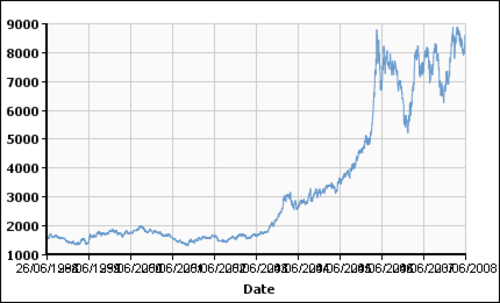
My first thought, even before getting into oil, is that commodity prices can be volatile and go through boom-bust periods.  Here, for example, is a price chart of London copper since 1998:
Copper

While oil prices have gone up by a factor of about four since 1998, copper has gone up by a factor of about 15!  But the media seldom writes about it, because while individual consumers are affected by copper prices, they don't buy the commodity directly, and don't have stores on every street corner with the prices posted on the street.

For a number of years, it is my sense that oil demand has risen faster than supply capacity.  This demand has come from all over -- China gets a lot of the press, but even Europe has seen increases in gasoline use.  Throughout the world, we are on the cusp of something amazing happening - a billion or more people in Asia and South America are emerging from millennia of poverty.  This is good news, but wealthier people use more energy, and thus oil demand has increased.

On the supply side, my sense is that the market has handled demand growth up to a point because for years there was some excess capacity in the system.  The most visible is that OPEC often has been producing below their capacity, with Saudi Arabia as the historic swing producer.  But even in smaller fields in the US, there are always day to day decisions that can affect production and capacity on a micro scale.

One thing that needs to be understood - for any individual field, it is not always accurate to talk about its capacity or even its "reserves" as some fixed number.  How much oil that can be pumped out on any given day, and how much total oil can be pumped out over time, depend a LOT on prices.  For example, well production falls over time as conditions down in the bottom of the hole deteriorate  (think of it like a dredged river getting silted up, though this is a simplification).  Wells need to be reworked over time, or their production will fall.  Just the decision on the timing of this rework can affect capacity in the short term.  Then, of course, there are numerous investments that can be made to extend the life of the field, from water flood to CO2 flood to other more exotic things.  So new capacity can be added in small increments in existing fields.  A great example is the area around Casper, Wyoming, where fields were practically all shut-in in the 1990's with $20 oil but now is booming again.

At some point, though, this capacity is soaked up.  It is at this point that prices can shoot up very rapidly, particularly in a commodity where both supply and demand are relatively inelastic in the short term.

Let's hypothesize that gas prices were to double this afternoon at 3:00PM from $4 to $8.  What happens in the near and long-term to supply and demand?

In the near term, say in a matter of days, little will change on the demand side.  Everyone who drove to work yesterday will probably drive today in the same car -- they have not had time to shop for a new car or investigate bus schedules.  Every merchandise shipper will still be trucking their product as before - after all, there are orders and commitments in place.  People will still be flying - after all, they don't care about fuel prices, they locked their ticket price in months ago. 

However, people who argue that oil and gas demand is inelastic in the medium to long term are just flat wrong.  Already, we are seeing substantial reductions in driving miles in this country due to gas price increases.  Demand for energy saving investments, from Prius's to solar panels, is way up as well, demonstrating that prices are now high enough to drive not only changed behaviors but new investments in energy efficiency.  And while I don't have the data, I am positive that manufacturers around the world have energy efficiency investments prioritized much higher today in their capital budgets.

There are some things that slow this demand response.  Certain investments can just take a long time to play out.  For example, if one were to decide to move closer to work to cut down on driving miles, the process of selling a house and buying a new one is lengthy, and is complicated by softness in the housing markets.  There are also second tier capacity issues that come into play.  Suddenly, for example, lots more people want to buy a Prius, but Toyota only has so much Prius manufacturing capacity.  It will take time for this capacity to increase.  In the mean time, sales growth for these cars may be slower and prices may be higher.  Ditto solar panels. 

Also, there is an interesting issue that many consumers are not yet seeing the full price effects of higher oil and gas prices,and so do not yet have the price incentive to switch behavior.  One example is in air travel.  Airlines are hedged, at least this year, against much of the fuel price increase they have seen.  They are desperately trying not to drive people out of air travel (though DHS is doing its best) and so air fares have not fully reflected fuel price increases.  And since many people buy their tickets in advance, even a fare increase today would not affect flying volumes for a little while.

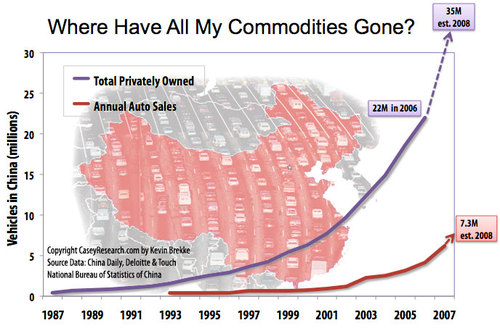
Another such example that is probably even more important are countries where consumers do not pay world market prices for gas and oil, with prices subsidized by the government (this is mostly true in oil producing countries, where the subsidy is not a cash subsidy but an opportunity cost in terms of lost revenue potential).  China is perhaps the most important example.  As we mentioned earlier, Chinese demand increases have been a large impact on world demand, as illustrated below:
Chinaautos

All of these new consumers, though, are not paying the world market price for gasoline:

While consumers in much of the world have been reeling from spiraling
fuel costs, the Chinese government has kept the retail price of
gasoline at about $2.60 a gallon, up just 9% from January 2007.

During that same period, average gas prices in the U.S. have surged
nearly 80%, to about $4 a gallon. China's price control is great for
people like Tang, who drives long distances in his gas-guzzling Great
Wall sports utility vehicle.

But
Tang and millions of other Chinese are bracing for a big jump in pump
prices. The day of reckoning? Everybody believes it's coming right
after the Summer Olympics in Beijing conclude in late August.

Demand, of course, is going to appear inelastic to price increases if a large number of consumers are not having to pay the price increases.

Similarly, there are factors on the supply side that make response to large price increases relatively slow.  We've already discussed that there are numerous relatively quick investments that can be made to increase oil production from a field, but my sense is that most of these easy things have been done.  Further increases require development of whole new fields or major tertiary recovery investments in existing fields that take time.  Further, we run up against second order capacity issues much like we discussed above with the Prius's.  Currently, just about every offshore rig that could be used for development and exploration is being used, with a backlog of demand.  To some extent, the exploration and development business has to wait for the rig manufacturing business to catch up and increase the total rig capacity.

There are also, of course, structural issues limiting increases in oil supply.  In the west, increases in oil supply are at the mercy of governments that are schizophrenic.  They know their constituents are screaming about high oil prices, but they have committed themselves to CO2 reductions.  They know that their CO2 plans actually require higher, not lower, gas prices, but they don't want the public to understand that.  So they demagogue oil companies for high gas prices, while at the same time restricting increases in oil supply.  As a result, huge oil reserves in the US are off-limits to development, and both the US and Canada are putting up roadblocks to the development of our vast reserves of shale oil.

Outside of the west, most of the oil is controlled by government oil companies that are dominated by incompetence and corruption.  For years, companies like Pemex have been under-investing in their reserves, diverting cash out of the oil fields into social programs to prop up their governments.  The result is capacity that has not been well-developed and institutions that have only limited capability to ramp up the development of their reserves.

One of the questions I get asked a lot is, "Isn't there a good reason for suppliers to hold oil off the market to sustain higher prices?"  Well, let's think about that.

Let's begin with an analogy.  Why wouldn't Wal-mart start to hold certain items off the market to get higher prices?  Because they would be slaughtered, of course.  Many others would step in and fill the void, happy to sell folks whatever they need and taking market share from Wal-mart in the process.  I think we understand this better because we know the players and their motivations better in retail than we do in oil.  But the fact is that Wal-mart arguably has more market power, and in the US, more market share than any individual oil producer has worldwide.  Oil producers have seen boom and bust cycles in oil prices for over a hundred years.  They know from experience that $130 oil today may be $60 oil a year from now.  And thus holding one's oil off the market to try to sustain prices only serves to miss the opportunity to get $130 for one's oil for a while.  People tend to assume that the selfish play is to hold oil off the market to increase prices, but in fact it is just the opposite.  The player who takes this strategy reduces his/her own profit in order to help everyone else. 

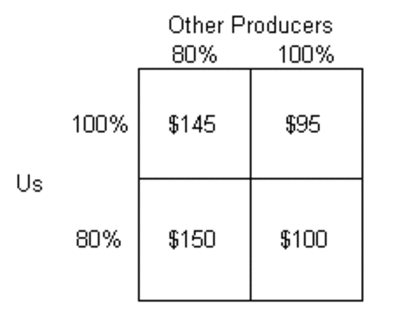
This is a classic prisoner's dilemma game.  Let's consider for a moment that we are a large producer with some ability to move prices with our actions but still a minority of the market.  Consider a game with two players, us and everyone else.  Each player can produce 80% of their capacity or 100%.  A grid showing reasonable oil price outcomes from these strategies is shown below:
P1_3

Reductions in our production from 100% to80% of capacity increases market prices, but not by as much as would reductions in production by other producers, who in total have more capacity than we.  Based on these prices, and assuming we have a million barrels a day of production capacity, the total revenue outcomes for us of these four combinations are shown below, in millions of dollars (in each case multiplying the price times 1 million barrels times the percent production of capacity, either 80 or 100%):

P2

We don't know how other producers will behave, but we do know that whatever strategy they take, it is better for us to produce at 100%.  If we really could believe that everyone else will toe the line, then everyone at 80% is better for us than everyone at 100% -- but players do not toe the line, because their individual incentive is always to go to 100% production.  For smaller players who do not have enough volume to move the market individually (but who make up, in total, a lot of the total production) the incentive is even more dramatically skewed to producing the maximum amount.

The net result of all this is that forces are at work to bring down demand and bring supply up, they just take time.  I do think that at some point oil prices will fall back out of the hundreds.  Might this reckoning be pushed backwards a bit by bubble-type speculation?  Sure.  People have an incredible ability to assume that current conditions will last forever.  When oil prices were at $20 for a decade or so, people began acting like they would stay low forever.  With prices rising rapidly, people begin acting like they will continue rising forever.  Its an odd human trait, but a potentially lucrative one for contrarians who have the resources and cojones to bet against the masses and stick with their bet despite the fact that bubbles sometimes keep going up before they come back down.   

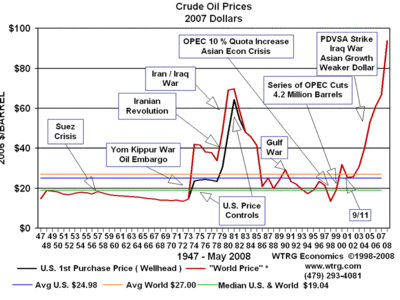
I don't have the economic tools to say if such bubble speculation is going on, or what a clearing price for oil might be once demand and supply adjustments really kick in.  I do have history as an imperfect guide.  In 1972 and later in 1978 we had some serious price shocks in oil:
Oilprice1947

Depending on if you date the last run-up in prices from '72 or '78, it took 5-10 years for supply and demand to sort themselves out (including the change in some structural factors, like US pricing regulations) before prices started falling.  We are currently about 6 years into the current oil price run-up, so I think it is reasonable to expect a correction in the next 2-3 years of fairly substantial magnitude. 

Postscript:  I have left out any discussion of the dollar, which has to play into this strongly, because what I understand about monetary policy and currencies wouldn't fill a thimble.  Suffice it to say that a fall in value of the dollar will certainly raise the price, to the US, of oil, but at the same time rising prices of imported oil tends to make the dollar weaker.  I don't know enough to sort out the chicken from the egg here,

Economic Morons in Europe, but is Congress Much Better?

Via Tim Worstall, Gawain Towler reports this bill in front of the European Supreme Soviet Parliament:

Written declaration on fixing fuel prices
The European Parliament,"“ having regard to Rule 116 of its Rules of Procedure,
A.
Whereas we are witnessing an unprecedented rise in fuel prices, and
this scandalous surge is having a devastating effect on economic
activity in various sectors: transport and other services, industry,
agriculture and fisheries,
B. Whereas in Portugal, the major oil
companies in the first quarter of this year, vis-à-vis the first
quarter of 2007, made net profits of 22.9% (GALP), and consolidated
profits of 36.5% (REPSOL) and 63.4% (BP), which were fundamentally the
result of practising speculative pricing, as a result of the
speculative valuation of oil stocks
bought at lower prices,

1.
Calls for the establishment of a tax, for each Member State, to be
levied exclusively on these profits so as to bring them back into the
coffers of the Member State. This tax should be paid within 60 days
after the end of each quarter, with the value and scope of the levy
depending on the readiness of the oil companies to reduce their
speculative gains thanks to the 'stock effect';
2. The revenue
generated by this tax should be returned on a proportional basis to the
various economic sectors in each Member State;
3. Instructs its
President to forward this declaration, together with the names of the
signatories, to the Council, Commission, and Parliaments of the Member
States.

"depending on the readiness of oil companies to reduce their speculative gains thanks to the 'stock effect'"??  What the *&#$@% does this mean?  What economic concept are they even trying to get at?

Further, I was amazed at the statement that BP made net profits of 63.4%.  It took me a while to figure out that this was the quarter over quarter profit growth, not the profit margin.  I can't tell if these guys are just ignorant or if this is a translation issue into English, so i will give them the benefit of the doubt.  In case you are wondering, BP's net profit margin in the first quarter of 2008 was 8.3% of revenues, which in the grand scheme of industry is actually below average.

One reason fuel prices are so high in Europe is because the government takes more than half of fuel revenues in taxes:

Fuel taxes are also the central issue for truckers in Europe, because
they account for a large portion of the retail price of fuel. Unleadedgasoline
sold for $8.65 per gallon and diesel for $9.62 per gallon Tuesday in
Britain, which charges a flat $3.77 per gallon in fuel duty and imposes
a 17.5 percent consumptiontax on the total price

So, 61% (44% from the $3.77 plus the 17.5%) goes to government and 8.3% goes to the BP shareholders.  So lets tax BP shareholders more to lower the price!

So Where Are They Storing All the Oil?

I find the current political demagoguery that oil speculators are now the ones responsible for higher oil prices to be absolutely laughable.  I am willing to believe that oil supply and demand are perfectly inelastic over very short time periods, meaning that we might expect little change in supply or demand over a couple of days or weeks after a price change, allowing for a fairly free range of speculative excesses.  However, there is every evidence that oil is by no means perfectly price inelastic, and supply and consumption do change with price.  Already in the past few months we have seen, for example, substantial reductions in passenger car miles in this country. 

For any period of time longer than hours or days (or perhaps weeks), any cabal that is somehow manipulating oil prices well above the natural market clearing price is going to have to deal with a problem:  Extra oil.  Lots of it.  Even if the supply side is sticky due to shortages currently in drilling equipment, demand is not.  People are going to use less, and at the same time, every supplier is going to be trying to send every barrel to market as quick as they can  (oil producers know that prices that rise will eventually fall again -- that is the history of oil.  They are all programmed to move as much product as possible when prices are at all time highs).

A lot of dynamics, such as a short squeeze, can create a speculative bulge, but if speculators are somehow purposefully keeping oil prices high for long periods of time, they must be doing one of three things:

  1. Storing a lot of oil somewhere
  2. Creating an extensive system of production controls that keeps oil supply off the market.
  3. Have someone with deep pockets subsidize consumer demand for oil by selling excess oil off at below market prices.

One is just not possible, not in the quantities that would be required.  Two sort of happens in a haphazard and not very consistent way with OPEC, though it is hard to convince me that futures traders in Chicago have an active partnership with large state-run oil companies.  Three is actually happening, with the Chinese government continuing to sell gasoline and other petroleum products at below market prices, but there is evidence that there are limits to how much further they will take this.  Again, I think this is being done for reasons other than cooperation with mercantile exchange traders in the US.

To a large extent, this theory, if it is anything more than just populist capitalism-bashing, is a result of extreme ignorance.  There are an incredible number of people involved in the oil markets every day in numerous countries with numerous different incentives, such a large number that it is impossible to imagine a conspiracy.  There have been a couple of cases of proven petroleum commodity price manipulation in these trading markets - most of these have involved manipulation of prices at the end of the day on certain futures expiration and/or Platt's pricing windows.  The time frame for these manipulations have been on the order of 1-2 minutes.

But here is the best argument against this manipulation for higher prices, and it is amazing to me that no one ever thinks of it.  Sure, there are a bunch of really savvy people in the commodity trading business who are long on oil and want the price to be higher.  But for every seller, there is a buyer on the other side, someone who is at least as savvy and is desireous of lower prices.  Yes, I know it is a complicated concept, but for every trader selling there is one buying.  If there is an extended conspiracy to push up oil prices by speculators, do you really think the buyers are just going to sit on their hands and take it?  And do you really think the exchanges are going to be happy with this behavior, threatening the integrity of their trading system (really their only asset)?  Just ask the Hunt family, which attempted to corner the market and drive prices up in silver, only to have major buyers and the exchanges stop them cold, driving the Hunts in the process into bankrupcy. 

I wrote about this same topic previously here.

Savonarola Is At NASA Now

Cross-Posted From Climate Skeptic. 

In
1497, Savonarola tried to end the Italian Renaissance in a massive pyre
of books and artwork (the Bonfire of the Vanities).  The Renaissance
was about inquiry and optimism, neither of which had much appeal to
Savonarola, who thought he had all the answers he needed in his
apocalyptic vision of man.  For him, how the world worked, and
particularly the coming apocalypse, was "settled science" and any
questioning of his world view was not only superfluous, it was evil.

Fortunately, while the enlightenment was perhaps delayed (as much by
the French King and the Holy Roman Emperor as by Savonarola), it mans
questing nature was not to be denied.

But now, the spirit of Savonarola has returned, in the guise of
James Hansen, a man who incredibly calls himself a scientist.  Mr.
Hansen has decided that he is the secular Savonarola, complete with apocalyptic predictions and a righteousness that allows no dissent:

"James
Hansen, one of the world's leading climate scientists, will today call
for the chief executives of large fossil fuel companies to be put on
trial for high crimes against humanity and nature, accusing them of
actively spreading doubt about global warming in the same way that
tobacco companies blurred the links between smoking and cancer.

Hansen will use the symbolically charged 20th anniversary of his
groundbreaking speech to the US Congress - in which he was among the
first to sound the alarm over the reality of global warming - to argue
that radical steps need to be taken immediately if the "perfect storm"
of irreversible climate change is not to become inevitable.

Speaking before Congress again, he will accuse the chief executive
officers of companies such as ExxonMobil and Peabody Energy of being
fully aware of the disinformation about climate change they are
spreading."

It will be interesting to see
if any champions of free speech on the left can work up the energy to
criticize Hansen here.  What we have is a government official
threatening prosecution and jail time for Americans who exercise their
free speech rights.  GWB, rightly, would never get a pass on this.  Why
does Hansen?

Who the Hell Cares?

Apparently another interest group is claiming that Arizona is "missing out" on jobs in some critical growth industry, and therefore (wait for it) that industry must be subsidized to come to Arizona.

Arizona is getting its "clock cleaned" in the competition among
Western states to land solar-panel manufacturing companies within their
borders, according to the economic-development group that is losing the
fight.

At least nine companies that make solar equipment have passed up the
Valley of the Sun in the last year in favor of neighboring states,
according to the Greater Phoenix Economic Council.

From those nine projects alone, Arizona is missing out on more than 3,800 jobs, $2.3 billion in investment and $732 million in state and local revenues during the next decade, GPEC President and CEO Barry Broome said.

I am too tired to do my usual fact-checking on "incremental" state revenue numbers, but suffice it to say that $732 million in state and local tax revenues is a pipe dream.  There are three or four million people in Phoenix -- why is it we need the government to focus on someone employing 3,800 people?

The article's main "logic" is that our sunny climate should attract solar panel manufacturers.  Why?  I know they're customers may be here, but since most panels today come to Arizona from Japan or Germany, I don't think shipping costs are a big deal for panels.

The proposal is for a transferable income tax credit and property tax relief.  The author says the group is opposed to straight cash handouts, though.  Uh, OK.  And explain to me why a "transferable income tax credit" that the author says can be sold to other companies for cash is different than a cash handout?

I sometimes find it hard to identify the consistent element of what makes for a "desirable business"  (ie deserving of such subsidies) vs. one that is not so deserving.  The only consistent element I can find is that my business is always in the latter group, paying our taxes so that someone else's business and job can be subsidized.  It is for this reason that I generally barf when some group cries that they are not recieving equal proection (ala the 14th ammendment).  Take on tax and subsidy policy that takes from one group to fund another more politically connected group, and then talk to me about equal protection.

Postscript:  Here are the favored industries I can remember in the news of late in Arizona for getting special tax treatment:

Rock and Roll themed amusement park
Solar panel manufacturing
Neutriceutical production
New shopping mall parking lot
Spring training baseball parks

Readers are encouraged to add others in the comments.

Another Thought: I would dearly love to see a solar panel technology that can be rolled out of the factory cheaply in sheets like carpet out of Dalton, Georgia.  However, while I am increasingly convinced that someone is going to invent that technology soon, that technology will not be related to traditional silicon fabrication methods.  Therefore, nearly all of the plants that Arizona is desperately trying to subsidize to move here are likely using dead-end technologies, driven in part by bubble economics and subsidies that are not sustainable as the market grows (see ethanol).  Current silicon and germanium panels make no economic sense anywhere, and survive only due to massive (50% subsidies) and a desire to make a token green statement.

I am sure our local paper was cheerleading for ethanol plants in years past, and it is good we did not subsidize many here, because they are failing all over.  And I can't prove it, but I wouldn't be a bit surprised that one of the reasons our local semiconductor manufacturing operations have shrunk is because of this same effect, with subsidies attracting the least, not the most, viable enterprises.

The Rail Transit Debacle

The Anti-Planner links an absolutely scathing article in the Miami Herald on the absolute disaster they have made of their mass transit system.  This is a great summary:

Miami is just one more example of the points the Antiplanner keeps making about rail transit:

1. Transit agencies might run excellent bus systems. But when they
start building rail, they quickly get in over their heads by optimistic
forecasts, unforeseen costs, and the sheer humongous expense of
building dedicated transit lines.

2. Though all rail systems require periodic expensive maintenance,
few transit agencies set aside any money for this because it is easier
to spend the money now and let future managers worry about the future.

3. Though the rail systems are usually built to serve downtown
white-collar workers, in the end it is the transit-dependent people who
rely on buses who pay the cost.

4. There is only one thing rails can do that buses can't do better,
faster, and more flexibly, and that is spend a lot of your money.

I would like to observe one other thing at work in the Miami example that looks to be exactly what we are facing here in Phoenix in the next election.  Miami offered up a transit tax referendum for something like $800 million.  They promised a mix of highway improvements and rail.  In several cases, including the upcoming referendum in Phoenix, I have tried to warn people that the people who put these referendums together are rail-ophiles.  They have learned, however, that rail alone won't sell a bond issue or tax, so they throw in a bunch of highway improvement promises, which people really will pay for, as window dressing.  Often, however, these improvements never get done, as they are empty promises to sell the tax.  We see exactly this in Miami:

But five years and more than $800 million later, the county has spent more
than half the new money on routine Transit operations and maintenance while adding 1,000
jobs to the payroll.

   There were initial achievements. The county added 11 million miles of bus service, gave
free rides to seniors, and briefly experimented with 24-hour rail. It spent $40 million on
hundreds of tiny public-works projects....

   For example, here is the cost estimate that was attached to the 44 road projects that
county commissioners asked for: $0. The projects have since been estimated to cost
$428.2 million.

   Nor was any money earmarked for an unspecified number of flyover intersections on the
list of promised improvements. Such projects, which involve raising an existing road to
pass over another, cost as much as $18 million apiece today. None have been built.

So this tax was sold in part as a highway improvement tax, but $0 was actually budgeted.  The highway piece was a lie to sell the tax.  Beware Phoenicians.