Entry for Media Style Guide

Here is something I would like to see entered into every media style guide:  "Do not use 'hits' as a measure for web page traffic, except in quotations.  'Hits" has a specific meaning in measuring web traffic and should not be considered synonymous with 'visits.'" 

Machines Have Each Others' Back

Something about this seems oddly Judgement-Day-ish (in the Terminator sense):  Cameras watching cameras.  Via Hit and Run

Princetonian to Coach the Cowboys?

The Cowboys are apparently looking pretty seriously at former Princeton Quarterback Jason Garrett to be their new offensive coordinator, and possibly even head coach.  Garrett is one of two Princetonians with a Super Bowl ring (quarterback Bob Holly being the other) as part of the mid-1990s Cowboys dynasty. Who will ever forget that great Thanksgiving game against the Packers when Garrett (15-26-311-2-1 for the day) outduelled Brett Favre for a spectacular win after trailing 14-3 at the half?   Well, at least I haven't forgotten.

More Useless Government Information Gathering

Apparently I am required by law to fill out an "annual accommodation report" from the US Census.  Just what I needed.  The IRS, state sales tax authorities, and the Department of Commerce all gather this same information, but for some reason the Census Bureau needs me to repackage it for them  ("estimate time only 34 minutes -- thanks alot").  In fact, they need the data so bad that I am required by law to respond to their request. 

Here is the weird part.  First they ask for revenues including both lodging revenues and sales of merchandise, all as one single number.  Then, they ask for "operating expenses" in which they want me to exclude the cost of any merchandise sold.  What is the point of gathering a revenue number that includes merchandise sales but a cost number that excludes the cost of goods purchased for resale?  Bizarre.  My only guess is that this is so they can stack industries up without double counting, but that makes no sense either.  If this were the case, they would ask me to eliminate all product purchases (e.g. toilet paper for the bathrooms, cleaning supplies).  Also, wouldn't they in that case also ask me to leave out services purchased from other companies?

Postscript: The form has this notice:  "Your report to the Census Bureau is confidential by law.  It may be seen only by persons sworn to uphold the confidentiality of Census Bureau information and may be used only for statistical purposes.  The law also provides that copies retained in your files are immune from legal process."

Does anyone above the age of eight really believe this?  Ask major league baseball players what they think about promises of confidentiality and immunity from legal process.  (emphasis added)

With Barry Bonds still in their sights,
federal investigators probing steroids in sports can now use the
names and urine samples of about 100 Major League Baseball players
who tested positive for performance enhancing drugs, following a
ruling Wednesday from a federal appeals court.

The 2-1 decision by the 9th U.S. Circuit Court of Appeals
overturned three lower court decisions and could help authorities
pinpoint the source of steroids in baseball. It could also bolster
the perjury case against the star outfielder, who is under
investigation for telling a grand jury he never knowingly used
performance-enhancing drugs.

Investigators seized computer files containing the test results
in 2004 during raids of labs involved in MLB's testing program. The
samples were collected at baseball's direction the previous year as
part of a survey to gauge the prevalence of steroid use. Players
and owners agreed in their labor contract that the results would be
confidential, and each player was assigned a code number to be
matched with his nam
e.

Did DVD Save 24?

Hollywood seems to treat digital media like DVD as the greatest threat to their existence ever crafted.  But it appears to me that DVD may have saved 24.

From the second season onward, there has been intense pressure on the makers of 24 to convert from their popular serialized format (all 24 episodes are one story arc) to a more usual format where each episode stands on its own.  While prior shows like Alias and X-files have had running story arcs, their individual episodes stood on their own much better than do episodes of 24.  What that means is that 24 does not syndicate well at all, cutting off a very lucrative revenue stream. 

But what makes 24 difficult to syndicate makes it a very popular DVD offering.  In fact, if you look on Amazon, all five seasons are among the top 20-30 sellers in the DVD category.  Incredibly, a DVD of the first four episodes of the new season, which were televised about a week ago(!), is ranked #16.  My guess is that DVD sales do not fully make up for lost syndication revenue (I have no idea of the exact numbers) but these sales must have made it easier to continue down this innovative path.

Who's In Charge Here, Part 2

A few weeks ago I wrote about the changing relationship between attorney and client:

It used to be that clients would suffer some sort of injury and seek
redress in the courts.  To do so, they would hire an attorney to help
them.  The attorney was the hired help, compensated either hourly or
via a percentage of any awards.

Today, the situation is often reversed.  It is the attorney who is
identifying lawsuit targets for class actions and shareholder suits,
and then seeking out clients who can maximize his chances of success.
Clients, who typically make orders of magnitude less than the attorney
in class actions (think 50-cent coupons and $8 million attorney fees)
are selected because they are sympathetic, or give access to a
particularly plaintiff-attractive jurisdiction, or, in cases such as
ADA suits in California, because they have effectively become partners
with the attorney in serial torts.

At that time, the issue was Bill Lerach suing his clients for dropping him as attorney (Because, after all, it was really his lawsuit and not theirs).  This time, the issue is in a class action against Microsoft (emphasis added, via Overlawyered)

Judge Scott Rosenberg ruled Friday that Microsoft attorneys could
not ask the named plaintiffs about their relationship with attorney
Roxanne Conlin. The company's lawyers wanted to question the
plaintiffs, arguing that Conlin had referred to them during jury
selection as "just regular people who bought software" and who
volunteered to step forward to sue Microsoft.

The lawsuit was brought by Joe Comes, a Des Moines businessman who
owns a chain of pizza restaurants, and Patricia Anne Larsen, a retiree
from northwest Iowa, and two business _ Riley Paint Inc. of Burlington
and Skeffington's Formal Wear of Iowa Inc. of Des Moines.

Microsoft attorney David Tulchin said Larsen has been a friend of
Conlin's since 1982, when Larsen held fundraisers for Conlin's failed
run for governor. In 1999, Conlin represented Larsen in an employment
discrimination case against Larsen's former employer, Eaton Corp.

Tulchin said Comes has been Conlin's son's best friend since high school.

Microsoft attorneys claimed Conlin recruited these friends to act as
plaintiffs in the case so she could sue the company
and that her
comments during jury selection opened the door for Microsoft to
challenge the plaintiffs' motivation in filing the lawsuit.

Who would even imagine such a thing?  In this class action, as in many, the class members will probably get coupons while Conlin makes millions.  Or, as Microsoft observes:

Tulchin claimed that Conlin and her co-counsel, Richard
Hagstrom of Minneapolis, have the most to gain in the lawsuit

Attorneys like Conlin know they are vulnerable on this

Conlin said Microsoft wants the jury to believe that class-action
lawsuits are attorney-driven cases brought for money when in reality
they are a way for individuals with small claims to come together to
take on large, powerful companies.

"Businesses like Microsoft have poisoned the public view of these
forms for seeking redress by spending billions of dollars to spread
propaganda. Now they seek to collect on their investment by improperly
suggesting to the jury that the plaintiffs are not real plaintiffs,"
she said.

You think?

Economics is a Science. Seriously.

George Reisman at Mises:

When it comes to matters such as the theory of evolution and
stem-cell research, so-called liberals"”i.e., socialists who have stolen
the name that once meant an advocate of individual freedom"”ridicule
religious conservatives for their desire to replace science with the
dictates of an alleged divine power. Yet when it comes to matters of
economic theory and economic policy"”for example, minimum-wage
legislation"”these same liberals themselves invoke the dictates of an
alleged divine power. Their divine power, of course, is not the God of
traditional religion, but rather a historically much more recent deity:
namely, the great god State.

Traditional religionists believe that an omnipotent God came before
all natural law and was not bound or limited by any such law, but
rather created such natural laws as suited him, as he went along. Just
so, today's liberals believe, at least in the realm of economics, that
the State is not bound or limited by any pre-existing natural laws. In
the case in hand, the State, today's liberals believe, is free to
decree wage rates above the level that would exist without its
interference and no ill-effects, such as unemployment, will arise.

Where have I heard that before?  Oh yeah, I remember:

So here is this week's message for the Left:  Economics is a
science.  Willful ignorance or emotional rejection of the well-known
precepts of this science is at least as bad as a fundamentalist
Christian's willful ignorance of evolution science (for which the Left
so often criticizes their opposition).
  In fact, economic
ignorance is much worse, since most people can come to perfectly valid
conclusions about most public policy issues with a flawed knowledge of
the origin of the species but no one can with a flawed understanding of
economics....

In fact, the more I think about it, the more economics and evolution are very similar.  Both are sciences that are trying to describe the operation of very complex, bottom-up, self-organizing systems.  And,
in both cases, there exist many people who refuse to believe such
complex and beautiful systems can really operate without top-down
control
.

By the way, the author partially addresses the Card and Krueger study on New Jersey fast food that purportedly showed that employment goes up as minimum wage goes up.  Unfortunately, the author does not get into the now fairly well-known problem with this study.  For those who don't know, here it is:

Card and Krueger looked at the employment in fast food restaurants in New Jersey both before and after the minimum wage went up.  Here is the key process fact you need to know -- they did not look at every restaurant, just at some branches of national chains (e.g. McDonalds).  They did not include, say, Joe's sub shop.  The restaurants they studied shared a couple of traits in common:

  • They were all far more professionally managed than the average small restaurant
  • They all had higher labor productivity than the average restaurant
  • They all had far more capital equipment (e.g. automation of labor) than the average restaurant

In other words, they studied the restaurants that were able to incur a wage increase with the least impact on their total costs (and eventually prices).  Follow-up studies have shown that there was probably a real reduction in total restaurant employment in New Jersey in the studied period, but the differences in productivity cited above caused the impact to disproportionately hit small ma and pa operations as opposed to large capital intensive nation chains.  In fact, during this period, the national chains experienced a gain in market share vis a vis smaller shops, as the higher minimum wage made it harder for local shops to compete with the national chains.  So, in fact, what Card and Krueger observed was not an economic miracle on the order of seeing the virgin Mary in your pancakes, but a predictable shift of market share from low capital to high capital competitors in response to higher wage rates.

This theme of regulation, including the minimum wage, advantaging larger competitors is an old one.  I discussed it a while back in the context of Wal-Mart's support for a higher minimum wage:

Apparently, though I can't dig up a link right this second, Wal-mart
is putting its support behind a higher minimum wage.  One way to look
at this is a fairly cynical ploy to get the left off its back.  After
all, if Wal-mart's starting salary is $6.50 an hour (for example) it
costs them nothing to ask for a minimum wage of $6.50.

A different, and perhaps more realistic way to look at this Wal-mart
initiative is as a bald move to get government to sit on their
competition.  After all, as its wage rates creep up, as is typical in
more established companies, they are vulnerable to competitors gaining
advantage over them by paying lower wages.  If Wal-mart gets the
government to set the minimum wage closer to the wage rates it pays, it
eliminates the possibility of this competitor strategy. 

Manufacturing Jobs Myth

From TJIC:

"America cannot be great if most of its workers are in the service
sector"¦" Senator Byron Dorgan (D-North Dakota) declares in his book
"Take This Job and Ship It,""¦

This typical reading of historic manufacturing and service jobs stats is ignorant.  My first rule of quoting a statistic, which I admit I sometimes violate, is to make sure you understand how it is calculated.  Nothing could be truer than with manufacturing jobs statistics.

The best way to illustrate this is by example.  Let's takean automobile assembly plant circa 1955.  Typically, a large manufacturing plant would have a staff to do everything the factory needed.  They had people on staff to clean the bathrooms, to paint the walls, and to perform equipment maintenance.  The people who did these jobs were all classified as manufacturing workers, because they worked in a manufacturing plant.  Since 1955, this plant has likely changed the way it staffs these type jobs.  It still cleans the bathrooms, but it has a contract with an outside janitorial firm who comes in each night to do so.  It still paints the walls, but has a contract with a painting contractor to do so.  And it still needs the equipment to be maintained, but probably has contracts with many of the equipment suppliers to do the maintenance.

So, today, there might be the exact same number of people in the factory cleaning bathrooms and maintaining equipment, but now the government classifies them as "service workers" because they work for a service company, rather than manufacturing workers.  Nothing has really changed in the work that people do, but government stats will show a large shift from manufacturing to service employment.

Is this kind of statistical shift really worth complaining about?  By complaining about the shift of jobs from manufacturing to services, you are first and foremost complaining about a chimera that is an artifact of how the statistics are compiled.  So if we were to correct for this, would manufacturing jobs be up or down?  I don't know, but given on the wailing about "shrinkage" of manufacturing in the US, I bet you would not have guessed this:

Considering total goods production (including things like mining and
agriculture in addition to manufacturing), real goods production as a
share of real (inflation-adjusted) Gross Domestic Product (GDP) is
close to its all-time high.

  • In the second quarter of 2003, real goods
    production was 39.2 percent of real GDP; the highest annual figure ever
    recorded was 40 percent in 2000. See the Figure.

  • By
    contrast, in the "good old days" of the 1940s, 1950s and 1960s, the
    United States actually produced far fewer goods as a share of total
    output, reaching 35.5 percent in the midst of World War II.

So manufacturing is close to an all time high as a percentage of the economy.  There is absolutely no way anyone who looks at this graph can, with a straight face, talk about the "shrinking" of America's manufacturing sector.   If manufacturing employment is somehow down vs. some historical "norm", then that means that manufacturing productivity has gone up faster than service productivity.  So what?  And to the extent there has been a shift, as TJIC writes, who cares?

Yeah, we hates the service sector.

Who needs lawn care, child care, food preparation, legal
services, stockbrokers, professors, blogs, actors, and contract
software engineers ?

Let's get everyone involved in good 19th century atoms-and-mortar activities like raising corn and smelting iron.

Sure, some flakes argue "those are jobs for machines", but we
aim to recapture the glory of our national greatness, when men were
men, women were women, America was strong, and the average life lasted
50 years and ended with pneumonia, a threshing accident, or a crushing
injury.

The same populists who complain today about the shift from manufacturing to services complained a hundred years ago about the shift from agriculture to manufacturing.  And I am sure all of us would much rather be waking up with the sun each day to push a plow.
We Want Less Effective Products

Here is a question for you.  What product is coming under fire from "consumer advocates" for providing more of what consumers are buying the product for?  Answer.

Colts 38, Pats 34

Wow.  That game didn't suck.

Chavez Declared Dictator

Hugo Chavez has had himself declared dictator of Venezuela

Venezuela's National Assembly has given initial approval to a bill
granting the president the power to bypass congress and rule by decree
for 18 months.

President Hugo Chavez says he wants "revolutionary laws" to enact
sweeping political, economic and social changes. He has said he wants
to nationalise key sectors of the economy and scrap limits on the terms
a president can serve.

Mr Chavez began his third term in office last week after a landslide election victory in December.

The bill allowing him to enact laws by decree is expected to win
final approval easily in the assembly on its second reading on Tuesday.
Venezuela's political opposition has no representation in the National
Assembly since it boycotted elections in 2005.

Recognize that Chavez is the man, more than any other world leader, that progressives in this country have adopted as their hero.  Nowhere will you see a better illustration of what end-game progressives are really after.

Trading Big Oil for... Big Corn?

Via QandO, Nancy Pelosi said this:

"It is important to our children's health and their global competitiveness to rid this nation of our dependence on foreign oil and Big Oil interests"

So Nancy Pelosi wishes to rid the nation of American oil companies.  Hoping that this country has come too far to consider something so insane as nationalization, this presumably means replacing oil with some other substitute.  But since energy consumption still will be huge in the future, presumably we are just replacing big oil with big ... something else.  I would never say that oil companies are completely free of rent-seeking impulses, but they are paragons of free market reason compared to companies like ADM, aka big Ethanol, whom Pelosi is likely to favor.

Affirmative Action in Ohio

I got a prospectus recently asking for bids to operate a marina facility in Toledo, Ohio.  Typically, when privatizing a recreation facility, the government issues a contract that is essentially a lease -- they lease the facility to a private company who runs it for profit.  Companies compete for the lease by bidding the rent they will pay for the lease, the winning company being a combination of the best qualified and the one offering the highest lease payments.

This prospectus is very similar.  However, in the bid I noticed a collection of requirements called "affirmative action compliance" that were almost as thick as the description of the facility and the sample lease terms.  In the routine course of operating such a lease, from time to time a private company must do maintenance and construction work on the facility.  For example, marina docks are nearly constantly under re-construction, in a process similar to painting the Golden Gate Bridge (more rebuilding work is presumably required in Ohio when the lakes and rivers catch on fire). 

The state of Ohio seems extraordinarily concerned about the racial makeup of any workers who might do construction on the docks in the course of the marina's operation.  In fact, in this prospectus they have quotas on minority hiring -- you need to have at least 9% minorities and 6.9% female work hours in any construction project you perform.  But it is even more detailed than that.  Because these quotas apply as well to EVERY INDIVIDUAL TRADE.  They list the following trades:

Asbestos workers, boilermakers, bricklayers, carpenters, cement masons, electricians, elevator constructors, glaziers, ironworkers, lathers, operating engineers, painters, plasterers, plumbers & pipefitters, roofers, sheet metal workers, other trades

Not only does the job have to have at least 9% minority hours, but each and every category listed has to have 9% minority hours.   So, overall, you could have 50% of your work force be minorities, but if the folks who constructed your elevator were all white, you fail the test.

*CLUNK*  That is the sound of the prospectus hitting the circular file. 

Hindsight and Risk-based Decision Making

Last weekend I was watching an NFL game (I forget which one) and the team, which already had a solid lead, was considering going for a TD rather than a field goal at fourth and goal.  The announcer was going "Bad idea, bad decision.  Take the field goal and the sure points.  You don't want to risk getting the other team back in the game with the emotional prop of stopping you at fourth and goal."  Well, the team went for it and made the touchdown, after which the announcer said "I guess it was a good decision after all."

But was it?  If you choose to hit a nineteen in blackjack, and pull a deuce, was it a good decision?  If you  placed a 50-50 bet that a normal die roll will come up with a "6", and it does, was that a good decision?  I would say no.  I would argue that both decisions were bad decisions, despite the fact they happened to yield positive results for the decision-maker.  The reason is that, given the information the decision-maker had at the time of the decision, both moves have an expected value less than zero.

I won't bore my audience with a digression too far into expected value and decision trees.  Suffice it to say that the standard approach for making decisions in uncertainty is to list the possible outcomes of the decision, assign values and probabilities to each outcome, and then total up the sums.  The decision that yields the highest value times probability is the is the one that you would expect, on average, to yield the highest value.   Take the example of the bet on the die roll above.  If you bet a dollar, you would win a dollar on a roll of "6", which is a 16.7% probability.  You would lose a dollar on a roll of 1-5, which is a 83.3% probability.   The value of the "don't bet" decision is zero.  The value of the "bet" decision is 16.7% x $1 plus 83.3% x -$1 equals -$0.67.  So the "no bet" decision is best, since at zero it is higher than the negative outcome of the "bet" decision.  Here is a more complete discussion of the decision tree process.

A couple of provisos:

  • When the situation is more complex, the trick of course is to assign the right values and probabilities.  We can assign these exactly for cards and dice, but it's a little harder for something in the business world, like say Enron's decision to enter the broadband business.  But managers are paid the big bucks to do their best.  And managers have tools at their disposal to manage their lack of information.  For example, once you build a base-case, you can ask questions like  "OK, I am not sure about the size of the broadband market, but how large does it have to potentially be to offset the risk involved."
  • Like many real-world processes as the approach the asymptotes,  things get a bit squirrelly for really small probability events, particularly when they have very large financial values (positive or negative) attached.  Small probability positive events are essentially a lottery, and many people buy lottery tickets, even though we know the expected value is less than the price.  I play blackjack too, despite a negative expected value, because I get non-monetary benefits from the play.  Small probability negative events are called disasters, and are things we insure for.  Many times the decision to buy insurance has a negative expected value, but we do it anyway because we would sleep better at night knowing that we may be throwing away a little expected value, but we have pre-empted an event that would bankrupt us.  Here we get into interesting topics of risk profiles and risk tolerance, which I will avoid.

Unfortunately, in evaluating historical decisions, we often ignore the state of facts and risks the decision-maker faced at the time of the decision.  We argue Mead should have pursued Lee harder after Gettysburg, because we know now Lee's army got trapped behind a swollen river. The Chargers shouldn't have traded half their assets** to move up one spot in the draft to get Ryan Leaf.  And Enron should not have entered the broadband business.   We treat the decision makers in each of these as boneheads today (we even threw Skilling in jail, as much for his failed business decision as for any fraud).  But all of these evaluations are based on the outcomes, not on what the decision-makers were facing at the time.  Mead had been in charge of the army for less than a week, had driven Lee from a battlefield for the first time ever, and had a primary charge of defending Washington.  It is hard to believe today, but the Peyton Manning and Ryan Leaf were considered nearly equivalent in quality in the '98 draft, and the Chargers trade might have been perfectly appropriate if they had actually gotten a Manning-quality quarterback.  Enron's vision of broadband looked like it would become an enormous business, which in fact it did, just five years too late for them.

** The Chargers traded an inventory of picks and players to the Arizona Cardinals, who, true to form, did nothing with this goldmine.  The Cowboys, by contrast, arguably built a whole dynasty in the 90's off the slew of picks they got in the Herschal Walker trade with Minnesota.

Hilarious Calculus of Liberal Altruism

I had to say that this, from Janna Goodrich as quoted by Kevin Drum, is absolutely hilarious:

Education is one of the best engines for upward mobility and poor
students cannot afford to pay for higher education on their own. Their
families don't have the physical collateral to borrow money in the
private financial markets nor the savings to pay for the tuition
outright....But if we gave poorer students mostly grant-based aid we'd
be asking for the rest of the society to subsidize those who are one
day going to be wealthier than the average citizen. Two different
concepts of fairness or equality are at play here and I'm not sure if
both of them could be achieved at the same time.

Can you just see the liberals getting twisted in knots?  Oooh, helping the poor is good, but if we send them to college and they get rich, then we are helping rich people, and that's baaaad.  Its like that logic problem where a card says "the statement on the other side is false" and on the other side says "the statement on the other side is true."  Only a liberal could take the happy story of a poor kid going to college and getting rich and turn it into bad news.  I never thought about what a problem education was for liberal ethics, in that it converts sainted victims (e.g poor) into evil exploiters (e.g. rich).  Maybe that explains why they oppose school choice?

By the way, I have about zero sympathy for this whole grants in education discussion.  From an incentives standpoint, it is perfectly reasonable to ask people who are getting public money for self-improvement to share the risk with the public through the debt and repayment obligation they take on.  A lot of people today already don't take good advantage of the opportunity they have while in college, and this is certainly not going to get any better if we give them a free ride rather than loans.

The second problem I have with public funding of grants for education is that colleges and their alumni groups can decide to fix this problem privately if they so desire.  My school (Princeton) makes a commitment that everyone who gets into the school, not matter how poor, will get a financial aid package that will make it possible to attend.  And, the financial aid is all in grants such that the student graduates from one of the most expensive schools in the country debt-free (and yes, the incentives problem worries me some).  All with private money.  We are able to do this because our school makes it a priority and our alumni give the money to make it happen.

I know what you are going to say -- Princeton is full of rich people, so they can afford this.  Yes and no.  First, our alumni do pretty well for themselves, but they also have to help fund financial aid for the highest tuitions in the country.  Other schools with lower tuitions have a lower bar to clear.  Second, while Princeton alums may be wealthier per capita, our alumni population, because we are a small school, is probably one tenth the size of a Berkley or a Texas.  As a result, schools like Texas almost certainly have a much wealthier alumni group in total.  But few of them give back.  It's not a priority for them to create financial aid money for incoming students (instead, T Boone Pickens gives $125 $165 million to the OU OSU football program).  So don't come crying to me that students at your schools need government grants -- you could have funded such a program at your school privately if you had made it a priority.

Postscript: My dad ran numerous fund raising initiatives at the University of Iowa for years.  After decades of effort, I think he has finally despaired of getting state school alumni to donate money for something other than the sports program.

Update:  OK, that's what I get for making a throw-away statement without fact-checking.  Boone Pickens actually gave $165 million to the athletic programs of Oklahoma State, not OU.  I got a bunch of aggrieved emails on this.  Sorry.  Being from Texas, I get all that stuff up in the trans-Red-River region mixed up.

The Flip Side of the Trade Deficit

I originally got to this post at Carls Talk because of the cool map I put in this post.  However, I was really struck by his lament that foreign companies won't sell into Norway because it is too small.  Given that Norway has a trade surplus, you would think that given all the whining in the US about trade deficits that everything would be hunky-dory in Norway and that they would be thrilled that foreign companies wouldn't sell there.  But check this out:

When seeing Norway's GDP in the context of this map, one realizes
why Norway often is one of the last countries U.S. companies consider when
expanding to Europe.

Norway might be an unattractive market when considering expansion
because the market is so small and as a result there is little domestic
competition.  This  has enabled local players to
build monopolies or duopolies with substantial  entry-barriers in many
industries.  Furthermore, the government has sheltered the domestic
market against international competition by adding a hefty import tax
and inconvenient delivery methods on goods purchased outside the
country, rendering international online merchants at a disadvantage
when competing on price and convenience.

On the flip side, if you manage to establish your business here, you
can overcharge your customers and get away with horrendous customer
service.  The average Norwegian customer is not used to good service
and competitive prices.  Online merchants are slow.  Recently it took
four weeks before I received a book shipped to me from a local
merchant.  On a recent trip I recently purchased shoes for our kids in
the U.S.  The selection was superior, and the price:  1/4th of what the
local Norwegian merchant was charging. 

Gee, you mean there is a price consumers pay for protectionism that might offset a few job gains in sugar growing and textiles?

Cool Map

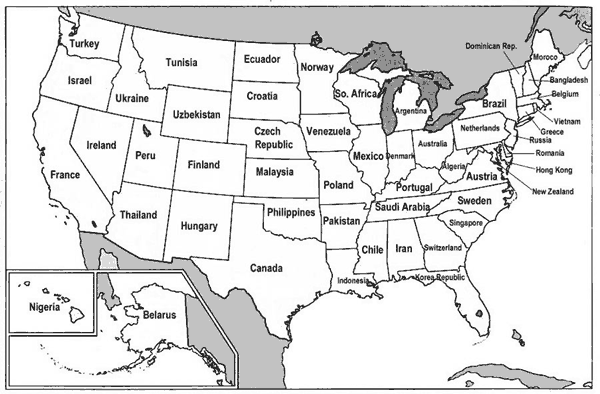
I am having trouble tracing this map all the way to its source, but I thought it was cool enough to show here (via TJIC and Carls Blog).  The map renames each state with a country that has approximately the same GDP as that state.


Countrymap

Check out Russia / New Jersey.  And is it really saying New Zealand and the District of Columbia have the same GDP?

Update:  If you enjoyed this post, check out our (free) comprehensive
guide to the skeptics arguments concerning man-made global warming.

Those Wacky Rent Seekers

My business had its worst results in five years.  Where is my disaster aid?   So while the California Attorney General is suing car makers for global warming and the state is rolling out an anti-warming plan, the Governator is seeking disaster aid for a big freeze?  Seems like they are working against themselves.

I think the citrus farmers should file a class action suit right away against makers of fuel efficient cars and hybrids.  I mean, wouldn't that be hilarious?

Ron Paul For President

It looks like Ron Paul will run for president again, though this time as a Republican (he ran as a libertarian a while back).  Don't let the "Republican" tag fool you.   He is the same libertarian, but this time he is going to try to shake up the Republican party.  (Here is his web site)

This is great news -- particularly given that the Republicans turned on the libertarian wing shortly after the last election  (presumably they feel they lost because they were not statist enough).  It is thrilling to see a legitimate, non-fruitcake libertarian candidate running on a major party ticket. 

This could make the Arizona primary, which is early in the race, a real event.  Arizona's Republican party nabobs are strong McCain guys.  Pitted against McCain and the party leadership is a Republican rank and file that has a strong Goldwater-libertarian streak and that is a bit tired of McCain's shtick.   This may be the first primary in years (maybe ever) that I have gotten excited about.

Phoenix Libertarians

I went to a dinner with a group of local libertarians who have been meeting for decades.  We had a very interesting discussion on government centralization vs. decentralization concerning which approach has been and can expected to be in the future a better framework for protecting liberty (A similar discussion has been raging in the blogosphere, as represented by this post at Volokh and here).  It has been a long time since I have not been the most radical anarchist in the room, so I had a great time. 

Weird Binary World of Sales

This observation is apropos of nothing, but I have noticed something odd about the sales efforts of companies.  They seem to be either too aggressive or downright dormant.

I answer my own phone at work, so every day I hear the parade of people calling me asking for the "person who purchases your printer supplies."  Certain industries, including toner, office supplies, telecom, etc. seem to have irritatingly aggressive sales forces.

And then we have companies like Wham-O.  Yes, the toy guys.  We opened a new snow play area and are selling hundreds of plastic sleds a week.  Unfortunately, we can't find any manufacturer to talk to us about a distribution deal.  So one of my managers spends a part of each week combing every Sams Club and Wal-Mart in Northern Arizona to buy plastic sleds for resale.  I have called Wham-O, a large maker of these sleds, about twenty times.  I have talked to many different people.  I have been referred to several different reps and even the head of the sales department.  And no one will return my call, despite a plea that I want to buy hundreds of sleds a week. 

It is possible that in this Wal-Mart world, volume of this size from one retail outlet is not worth pursuing, but this casualness about making a sale really amazes me.  I would chalk it up to some unique circumstance at Wham-O, but I have had this experience with a number of other companies.  I can't tell you how many times I have left plaintive messages to firms saying "I want to buy a bunch of your product, can someone please call me back to tell me how."

Weird.  Fortunately, we finally had a Canadian company today actually returned our calls and was more than happy to sell us large lots of their product.  Oops, there goes the trade deficit.

Is This Right?

I am really reluctant to post stuff like this without some independent vetting, because so many groups out there will distort reality into pretzels.  That being said, anyone know if this is accurate?  Or maybe point us all to a better source and/or debunking in the comments?

    "Section 220 of S. 1, the lobbying reform bill currently before the Senate, would require grassroots causes, even bloggers, who communicate to 500 or more members of the public on policy matters, to register and report quarterly to Congress the same as the big K Street lobbyists. Section 220 would amend existing lobbying reporting law by creating the most expansive intrusion on First Amendment rights ever. For the first time in history, critics of Congress will need to register and report with Congress itself.

    "The bill would require reporting of 'paid efforts to stimulate grassroots lobbying,' but defines 'paid' merely as communications to 500 or more members of the public, with no other qualifiers.

    "On January 9, the Senate passed Amendment 7 to S. 1, to create criminal penalties, including up to one year in jail, if someone 'knowingly and willingly fails to file or report.'

Mark Tapscott covered this issue here, but I am still not sure I have an accurate read on all this.

Update:  See comments.  As I feared, the above may distort the issue.  Brandon Berg thinks the law kicks in when you communicate to 500 or more members of the public on policy matters and get them to contact Congress.  It is not at all clear why I should have to register to perform such an activity, but this is narrower than implied in the press release above.

Update #2:  I am becomming increasingly convinced that Lieberman and McCain are the same guy.  Even down to their desire to protect incumbent politicians from political speech.

Update #3:  Jacob Sullum is also skeptical that the law is really as broad as advertised above.

New Energy Subsidies

As I wrote before, the new Democratic Congress try to end certain subsidies received by major oil companies.  All fine and good, at least as long as it is really a subsidy and not just an contract obligation they would like to get out of.

One might be led to believe that the Democrats were finally going to address the corporate welfare issues they have been promising to deal with for years.  Unfortunately, it appears that they are really only looking for an excuse for some populist demagoguing against Exxon.  Subsidies still appear to be A-OK:

The Cato Institute's Jerry Taylor and Peter Van Doren are all in favor of eliminating energy subsidies.  By that measure, they find
the House Democrats' 100-hour energy legislation -- H.R. 6, the
Creating Long-Term Energy Alternatives for the Nation Act (aka the
"CLEAN Energy Act") -- to be quite a disappointment.

Energy subsidies, of course, have been a historical disaster.  If you have ever traveled around California, a common site you will see is 1) Windmills that are not working and 2) Rooftop solar fixtures that appear badly broken.  That is because these facilities were installed cheaply as subsidy magnets, rather than actual, you know, investments that made any sense.   Here in Arizona, every third rich persons SUV has this Arizona environmentally-friendly license plate that says the truck is dual-fuel.  When I moved here, I though that was kind of cool.  I know several countries that have good CNG (compressed natural gas) economies in their transportation sector.  It turns out, though, that none of these vehicles actually fill up with anything but gasoline.  Several years ago Arizona had a subsidy for buying dual-fuel trucks that exceeded the cost of conversion, so that everyone did the conversion as a money-maker. 

And these are far from being the worst.  How many billions have been sunk into R&D rat-holes that have produced nothing except some professor's tenure?  Remember that alternative energy and energy conservation technologies are among the hottest sectors in venture capital nowadays.  The VC's I know can't get enough of these projects, and are project rather than money limited.  This means that every subsidy and grant for energy can only go to one of two places:

  • Projects that are already going to be privately funded, so that all they do is displace private funding, which makes them a total waste of taxpayer money
  • Projects that were rejected for private funding as uneconomic or unpromising, such that the spending is a waste unless you assume Congressmen and government bureaucrats are sharper than VC's in picking investments.

My observation is the two political parties differ on subsidies only in terms of style.  The Democrats appear to have no problems with subsidies as long as they go to sympathetic and fashionable companies (e.g. Google via net neutrality) rather than companies they have deemed to be unfashionable (e.g. Exxon).

I Find This Argument Uncompelling

I am skeptical of some but not all global warming claims, but must admit that even as a skeptic, I find this argument by James Lewis uncompelling:

Now imagine that all
the variables about global climate are known with less than 100 percent
certainty. Let's be wildly and unrealistically optimistic and say that
climate scientists know each variable to 99 percent certainty! (No such
thing, of course). And let's optimistically suppose there are only one-hundred x's, y's, and z's
--- all the variables that can change the climate: like the amount of
cloud cover over Antarctica, the changing ocean currents in the South
Pacific, Mount Helena venting, sun spots, Chinese factories burning
more coal every year, evaporation of ocean water (the biggest
"greenhouse" gas), the wobbles of earth orbit around the sun, and yes,
the multifarious fartings of billions of living creatures on the face of the earth, minus,
of course, all the trillions of plants and algae that gobble up all the
CO2, nitrogen-containing molecules, and sulfur-smelling exhalations
spewed out by all of us animals. Got that? It all goes into our best
math model.

So
in the best case, the smartest climatologist in the world will know 100
variables, each one to an accuracy of 99 percent. Want to know what the
probability of our spiffiest math model would be, if that perfect world existed?  Have you ever multiplied (99/100) by itself 100 times? According to the
Google calculator, it equals a little more than 36.6 percent.

The Bottom line: our best imaginable model has a total probability of one out of three. How many billions of dollars in Kyoto money are we going to spend on that chance?

Yes, there is a point to be made that climate is really complicated.  However, I can still make correct and valid directional predictions without knowing the exact state of every variable.  For example, I can say with some certainty that, at least here in Arizona, that the temperature at 4PM is going to be higher than the temperature at 4AM, and probably by many degrees.  I can make this statement despite having no idea what the temperature at either time actually is.

I think one can say that the hypothesis is pretty strong that man-made CO2 is increasing atmospheric CO2 concentrations which in turn is causing some warming.  Where Mr. Lewis probably has a point is on the issue of positive and negative feedbacks.  Most of the warming in the estimates in productions like "An Inconvenient Truth"  relies not on just CO2-driven warming, but warming from a variety of feedback processes.  These feedbacks are really really complicated and not well understood.  I discuss this issue of feedbacks both here and here and here.

(HT Maggies Farm)

Negotiating When Seller's Marginal Cost = Zero

It is an interesting experience negotiating as a buyer when you know two things:

  • Seller has marginal cost approaching zero
  • Seller has lots of competitors who, for my purposes, provide equivalent service

In this case, I was calling Network Solutions to transfer my domain name registrations to GoDaddy, because GoDaddy is substantially cheaper.  Network Solutions sent me a renewal letter to renew at $34.99 a domain.  Yuk!  I began the process of transferring these domains to GoDaddy, who charges in the $8 range.  (By the way, I have been very happy with GoDaddy for my registrations and hosting of simple sites).

Unfortunately, I had a problem with the transfer -- I needed an authorization code for each domain from NetSol and was not sure how to get it, so I had to call their customer service.  Like a good rep, the person asked me why I was leaving, and I said it was because NetSol was too expensive. 

This is where it got interesting.  First, he said that I could stay at Network Solutions and pay just $16 a domain.  I told him forget it, it was still too high.  After some back and forth, and his getting the information I had called for, he finally offered $8 a domain.  That is nearly an 80% discount from the rate they first offered me, and is lower even than the 100 year renewal (LOL) they offer for $9.99 a year.  I turned it down, because it was too late and I was already consolidating my accounts at GoDaddy.

However, if there are those of you out there who are with Network Solutions and want to stay, but want a discount, call their customer service (not tech support) number, click the options for "transfer domains away from Network Solutions".  When you get a guy, tell him you need the authorization number on the domain to transfer it to GoDaddy (this is true).  When he asks you why you are transferring, tell him NetSol is way more expensive than GoDaddy.  And then let him run.  I didn't even ask for a discount.  He just kept throwing them out at lower and lower price levels after I turned each one down.