Dispatches from Zimbabwe

Here are a few scenes from Zimbabwe, stitched together form several posts by Cathy Buckle.  For all of those who support Hugo Chavez, and there are a surprising number in this country, this is exactly where Venezuela would be in a year if it wasn't for its oil.  And it may get there none-the-less (hat tip Q&O):

After three months of price controls the food situation in the country is
perilous and even those who were able to stock their pantries and cupboards are
now in trouble. In a main supermarket in my home town this week there was air
freshener, window cleaner, some vegetables, Indonesian toothpaste and imported
cornflakes from South Africa - one single packet costing more than half of a
teachers monthly salary.  There was also milk being sold from a bulk tank to
people who bring their own bottles and the queue went through the empty shop,
out the door and along the pavement. The line broke up suddenly before 10am when
the milk ran out and the huge shop was suddenly completely empty - nothing left
to sell, no more customers. This situation was a mirror image of conditions at
three other major supermarkets in the town and so we look desperately into
another week of struggle, praying for relief....

Milk is like gold in our town, as it is almost all over the country. When you
appreciate that the shops are empty and there is no food to buy, no protein, no
meat or eggs and now not even bread, you understand that people are desperate
for nourishment. A phone call to the local bulk dairy marketing outlet this week
went as follows:

Q: Hello, Do you have milk please?
A: Nothing.
Q: What about lacto (sour milk)?
A: Nothing.
Q: Any cheese?
A: (Bored) Nothing
Q: Ice Cream! ?
A: (Slightly annoyed) No, we have nothing. We are playing football in the car
park!
...

Standing outside over yet another smoky fire late one afternoon this week, a
Go-Away bird chastised me from a nearby tree. I'm sure this Grey Lourie is as
fed up of me intruding into its territory as I am of  being there - trying to
get a hot meal for supper. For five of the last six days the electricity has
gone off before 5 in the morning and only come back 16 or 17 hours later a
little before midnight. "Go Away! Go Away!" the Grey Lourie called out
repeatedly as my eyes streamed from the smoke and I stirred my little pot. My
hair and clothes stink of smoke, fingers are yellow and sooty but this is what
we've all been reduced to in Zimbabwe. Our government don't talk about the power
cuts anymore and don't even try and feed us with lame excuses about how the
power is being used to irrigate non-existent crops. We all know it's not true
and the proof is there in the empty fields for all to see.

Something else our government aren't talking about  anymore is the nationwide
non availability of bread and the  empty shops in all our towns and cities.
Everywhere you go people are struggling almost beyond description to try and
survive and yet the country's MP's, both from the ruling party and the
opposition, do nothing to put an end to this time of  horror. I have lost count
of how many weeks this has been going on for but it must be around three months.
None of the basics needed for daily survival are available to buy. There is no
flour to bake with, no pasta, rice, lentils, dried beans or canned goods. People
everywhere are hungry, not for luxuries like  biscuits or snack food but for the
staples  that fill your stomach. When you ask people nowadays how they are
coping, mostly they say that they are not, they say they are hungry, tired and
have little energy. This is a national crisis almost beyond description and
people say they are alive only because of " the hand of God."

But No One Shops for Health Care

For a while, I have been trying to highlight that the real problem with health care is that consumers who receive the service do not have any incentive to shop for the best price or to make trade offs on marginal procedures based on price.  The only people who have any incentive to shop are 1) people without insurance and 2) people with high deductibles (like me).  Politicians are trying to eliminate the former group, even if they don't want insurance, and programs like Romney's in Massachusetts actually ban high deductible insurance.

Now, Obama is worried about anti-trust:

The consequences of lax enforcement for consumers are clear. Take
health care, for example. There have been over 400 health care mergers
in the last 10 years. The American Medical Association reports that 95%
of insurance markets in the United States are now highly concentrated
and the number of insurers has fallen by just under 20% since 2000.
These changes were supposed to make the industry more efficient, but
instead premiums have skyrocketed, increasing over 87 percent over the
past six years. As president, I will direct my administration to
reinvigorate antitrust enforcement. It will step up review of merger
activity and take effective action to stop or restructure those mergers
that are likely to harm consumer welfare, while quickly clearing those
that do not.

How can these mergers harm consumers when consumers don't shop for the service and don't care about price in the first place?  Candidates like Obama and Clinton are threatening to create single payer systems that use monopsony power combined presumably with the coercive power of government to hammer suppliers.  Is it any wonder that they are joining together to try to gain some sort of bargaining position for themselves?  In the context of what Obama wants to do with health care buying, this can be thought of more as unionizing than merging.

By the way, does anyone else note the irony of Obama, who wants to create a single supplier for health care (the US Government) lamenting concentration in the health care field?

I am Tired of Paying For People's Winter Vacations

I hire retired couples for the summer to run campgrounds and other recreation facilities.  Since these campgrounds are closed in the winter (most are under 8 feet of snow) I lay most of these folks off in October. 

The vast majority of my employees do not work the winter.  They have other retirement savings that they supplement working for me in the summer and then they take the winter off.   And that would be all of the story, except in  California.  For some reason in California, but not in most other states, all these folks run straight to the unemployment office and file for unemployment over the winter.  For those of you who don't know how unemployment insurance premiums work, the premium I pay as a percentage of wages is based on past claims experience.  In California, I am an "F", the worst category, and have to pay over 6%(!) of wages to unemployment insurance. 

Now in most states, what these employees are doing is illegal.   It is typical of unemployment offices that you have to call in each week and certify that you are looking for work.  If you are not actively looking for work, then you are not eligible, and most states outside CA seem fairly diligent about enforcing the rules.  Last year, not one but two of the people who were claiming unemployment in CA over the winter were in Mexico on the beach the whole time!  I know, because they called me from there to see if they were going to be rehired in the spring.

It was then that I found out why this happens more in CA than in other states.  I called the California state unemployment office and asked them how I could have cases of unemployment fraud (ie claiming unemployment when one is not actually looking for work) investigated.  The person from the state office got very hostile with me.  She said that I was making a very serious charge, and that if I made such a charge, and fraud was not proven, then I could be liable for civil and even criminal penalties for asking for the investigation.  I said forget it, raised prices to customers to cover the extra winter vacation wages I was forced to pay, and moved on.   

The Green Security State

Via Hit and Run:

Chris Martin, Coldplay lead singer founder and frontman of the CleanScapes waste removal agency, is bidding for a piece of Seattle's garbage collection contract.

If
Martin is allowed to implement what he calls "my best idea, my
get-people-riled-up thing," we could all soon be subject to a kind of
garbage audit, too. He wants to bring the equivalent of the red-light
camera to your front curb. Just as the traffic camera captures you
running through a stoplight, CleanScapes' incriminating photos would
catch you improperly disposing of a milk carton. (It belongs in the
recycling bin.)

"We could do it the nice way," he says, meaning
his company would e-mail you pictures of your detritus, along with
helpful information about separating out recyclables. Or, he says,
CleanScapes could send the pictures on to municipal inspectors, and
"the city could enforce its own laws." (While the city has sent warning
letters, no fines have ever been issued, according to Seattle Public
Utilities.)

The vast majority of recycling is a net loss, both in dollars and in energy.  Only a few items (scrap iron, aluminum cans, bulk news print) make any sense at all in curbside recycling programs.  Milk cartons are not one of them.  The rest of the curbside recycling we do is merely symbolism actions that demonstrate our commitment to the cause, much like reciting a liturgy in church (Interestingly, the more honest environmentalists have admitted this, but still support the program because they believe the symbolic action is an important source of public commitment to the environment).

I guess it is not surprising to see folks like Mr. Martin bring the full power of the state to bear to make sure you are sorting your milk cartons correctly.  After all, in previous generations, the powers-that-be in small towns would employ people to watch for folks skipping out on church, and nations like Cuba still use neighborhood watches to spy out political heresy.  It's just a sign of the times that now such tactics are being used to smoke out environmental heresy.

Am I Freaking Prescient of What?

A while back I wrote about racism vs. tattoos, in the context of a story that claimed black players had more fouls called against them than white players in the NBA

My sense is that we make snap decisions about other people based on a
wide range of physical attributes, including height, attractiveness,
clothing, tattoos, piercings as well as visible racial characteristics
(e.g. skin color) and race-related appearance choices (e.g. cornrows).
It would be interesting to see where skin color falls against these
other visible differentiators as a driver of third party decisions
(e.g. whether to call a foul).   My sense is that 60 years ago, skin
color would be factor #1 and all these others would be orders of
magnitude behind.  Today?  I don't know.  While skin color hasn't gone
away as an influencer, it may be falling into what we might call the
"background level", less than or equal to some of these other effects.
It would be interesting, for example, to make the same study on level
of visible tattooing and the effect on foul calls.  My sense is that
this might be of the same order of magnitude today as skin color in
affecting such snap decisions.

In a follow-up I posited that tattoos may be the new black.

Now, Via Overlawyered:

"Some San Antonio apartment complexes are refusing to rent to people with tattoos and body piercings."

Gas Pricing Thought for the Day

Today I was working on a bid for a retail concession in a county park in California.  In these bids we usually promise a set percentage of sales as rent in exchange for the concession and use of certain fixed assets.  One of our standard clauses is to exempt gasoline sales (if there are any) from this rent calculation, because gas sales are so horribly low margin.  Considering the licensing, environmental, and safety issues, gasoline is always a money loser for us that we offer either a) because it is expected, as in the case at large marinas or b) because it gets people in the door to buy other stuff.  And I sell gas in rural areas where I have less price competition than in cities.

It is for this reason that I am always flabbergasted at how much time and attention the government and media tend to pay to retail gasoline pricing.  The portion of my business that is clearly the worst, most unprofitable piece, so much so I have to make special contract provisions for it, gets all the attention for price gouging.   It's like the FEC dedicating most of its labor to investigating Mike Gravel's campaign donations.  I mean, why bother, there's nothing there.

Cool Family News

My daughter was selected to perform as part of the opening number of the Macy's Thanksgiving Day Parade. 

Simply Outrageous

Via Cato@liberty, comes this really outrageous incident:

The Gilpin County Sheriff's Office was
apologizing Monday after a weekend effort to help a research group led
to complaints about what appeared to be a DUI checkpoint - but wasn't....

Sgt.
Bob Enney said deputies assisted the Pacific Institute for Research and
Evaluation in stopping motorists at five sites along Colorado 119 for
surveys on any drug and alcohol use. Surveyors then asked the motorists
to voluntarily submit to tests of their breath, blood and saliva. At
least 200 drivers were tested, Enney said....

They were greeted by "youthful, college" surveyors dressed in jumpsuits and blue generic caps.


"We
had a 10-year-old in the back who's tired, we tell them thanks but no
thanks, we have to get this child back home to bed," Sequeira said.

He said a worker persisted, saying that the researchers would assist in driving the family home if they needed assistance.


When the Sequeiras again demurred, a supervisor offered them a $100 money order.


"We
say, 'No, thank you, we have to get our child home,"' Sequeira
recalled. "At this point, both clones start chortling at us and
ridiculing us."

The problem in this case is that many people don't take the time to even take a 5-minute survey over the phone, much less to pull over on the roadside and donate bodily fluids.  Every market researcher understands this problem, and tries to deal with it.  But the government has one tool in its bag that ordinary private firms do not have:  The coercive power of the government.  Whether they were tested or not, motorists who were in complete obedience to the law were forced to pull over by government law enforcement officials merely to increase their survey response rate.  This is such a typical government solution that I think most people are desensitized to it.

Asymmetrical Explanations

Crime rates seem to bounce up and down over time.  Has anyone noticed that city governments typically ascribe rising crime rates to uncontrollable demographic trends while crediting falling crime rates to improved policing?

The drop comes nine months after Mayor Antonio
Villaraigosa and Los Angeles Police Chief William J. Bratton vowed to
crack down on gangs. But though previous anti-gang campaigns have
involved mass arrests and high-profile sweeps, this effort has been
more targeted.

And in its most radical shift, the LAPD is putting aside decades of
suspicion and turning for help to gang intervention workers, many of
whom were gang members.

....Overall, Los Angeles has recorded [289] homicides so far this
year, with Bratton saying he believes the city will end the year with
the lowest number of killings in 37 years (in 1970, there were 394
homicides). Authorities believe the help of gang intervention workers
has made a difference, but they acknowledge that they can't fully
explain the drop.

By the way, I will be waiting for those who ascribe rising crime rates in Southern California to illegal immigrants to admit their mistake this week.

Commuter Rail: 1. Dig Hole. 2. Pour In Money 3. Repeat

The AZ Republic, long-time cheerleader for our current light rail project, writes another ode to commuter rail.  Today's love note is on the Albuquerque commuter rails system.

Sharon Hedrich heads out a little before 7 each morning for the 20-mile
trip to the law office where she works in downtown Albuquerque. She
used to leave home earlier for the dreaded crawl down the city's
congested freeway.

Driving to work could take 40 minutes or
more, depending on the number of emergencies stalling traffic. Now, she
boards a commuter train, settles into a plush red seat and spends the
half-hour ride reading a novel.

She says the train saves her aggravation - and money.

"I put 7 miles a day on my car instead of 50," Hedrich said recently as
the train zipped toward Albuquerque, New Mexico's largest city. "It's
50 bucks a month for me to ride this. I couldn't even get two tanks of
gas for that."

I am just all aglow for Sharon.  But does the project make sense for the taxpayers of the city and the state (and probably nation) that funded it?  Well, we don't know.  Because the AZ Republic writes 56 paragraphs lauding the system without once telling us anything about the system performance.  Does it cover its costs?  Are city roads visibly less congested?  Is there a net energy savings?  Is there measurably less pollution?  We don't know.  All we know is that three people, Geronimo Trujillo, Briana Duran, and Sharon, like it. 

Well, let's see if we can do the analysis that the Republic couldn't manage.  We are told it has 3000 presumably round-trip riders a day, and the fare for these riders is $50 per month.  That's $150,000 of revenue a month or $1.8 million a year.  How much does it take to operate?  Well, we are not told by the Republic and the Albuquerque authority ties itself in pretzels avoiding the question in this FAQ (question 1) comparing apples to oranges and lemons and bananas and any other fruit that might divert our attention.  But I can absolutely guarantee that it costs a hell of a lot more than $1.8 million.  I am not sure that covers the fuel bill, but it certainly does not cover wages, fuel, maintenance and whatever the state is paying the private owner of the rails for trackage rights. 

Let's see if we can find an analog that does disclose its costs to the public.  The commuter rail system in Northern Virginia called the VRE is about twice as long and carries about twice the passengers as the Albuquerque system.  Its costs are $55.4 million per year, so we can conservatively assume that the Albuquerque system is costing perhaps $20 million a year, a figure that exceeds its revenues by a factor of 11x.  That equates to a taxpayer subsidy of $6,000 per rider per year, which is not atypical for these systems.

And this ignores the capital cost.  Unbelievably, the article does actually mention the capital cost in the 36th paragraph, which is $135 million.  That is $45,000 per rider, or enough to buy two Prius's for each rider.

So Sharon Hedrich is happy?  Of course she is freaking happy.  The taxpayers paid $45,000 up front costs and $6,000 per year so she can save 43 miles of driving a day.  Assuming she has a 20 mpg car, pays $3 a gallon for gas, and rides the train to work 250 days a year, taxpayers are paying $6,000 a year to save Sharon $1,612.50 a year in gas.  If we want to consider gas plus wear and tear on her car at 45 cents per mile, taxpayers are paying $6,000 a year to save Sharon $4,837.50 per year.   The taxpayers would have been better off -- by a LOT -- buying her a Prius and paying her expenses to drive than buying and operating a train for her.  This is consistent with my past number crunching on other urban rail systems here and here.

Does the Republic mention these problems?  Sort of:

The system endured the typical raps against a big public-works project:
It fell behind schedule, an anti-tax foundation called it a bad idea
and there were some startup problems.

Dang those tax foundation guys - always getting in the way of progress!  Thank god such a great idea as subsidizing Sharon "endured" these Luddites.

By the way, I am a long-time train watcher and model railroader.  I love trains.  And, all things being equal and if everything was free in the world, I would love to have more commuter rail trains. Unfortunately, all things are not free.  And in most cases, particularly low-density cities outside the northeast, rail tends to be the most expensive possible option.  As a libertarian, I would rather the government just not appropriate this money in the first place.  But given that they are insisting on spending $135 million plus $20 million a year on transportation, nearly any other conceiveable project would have gotten more bang for the buck.

Update:  Below is a picture of Brianna Duran riding in an empty rail car.  It's good Albuquerque is keeping all those empty seats off the highway.

0930rail

Update 2: Here is the predictable response to the empty seat snark:  Well, it's the people's fault for not choosing such an obviously superior mode of transport.  Wrong.  Its the government's fault for not taking people's preferences into account when spending all that taxpayer money.  A government that adjusts itself to the citizens is a Democracy.  A government that demands citizens adjust themselves to the government is fascism.

Update #3:  I am getting email about the government subsidy of highways.  In theory, this is not supposed to be a subsidy.  The large gasoline prices we pay at the pump are supposed to be for highway funds.  This is actually a pretty intelligent way to pay for roads, because it does a decent job at matching use to fees, with a bit of a penalty thrown in for low mpg cars.  To the extent that gas taxes do not match road costs, I am all for eliminating any subsidy and making them match with the right gas tax.  But I know whatever subsidy there is is not as high as for this rail.  Using the numbers for this example, applied to 100 million US commuters, would imply a capital cost of $4.5 trillion and a yearly operating subsidy of $600 billion.  And this would only cover commuting.  Remember, the people in the story can't give up their cars - rail lines only run a few places.  These costs would be to allow commuters to give up their cars part of the time -- about the same number of roads and cars would still be necessary.

Hillary Proposes Plan to End Abortion, At Least Among the Poor

Much has been said of Hillary Clinton's absurd and fiscally irresponsible populist pandering idea of giving every baby $5000 at birth.

But has anyone thought about what effect this might have on abortion and birth rates among the poor?  Her husband bill took a lot of flak from his own party to take on welfare reform, and reduce the financial incentive for poor single women to have babies.  So now, Hillary is going to revive this incentive?  Every woman who goes in to have an abortion is basically torching a $5000 bill.  She may do more to limit abortions than George Bush.

Postscript: 
Yeah, I know, the program would probably be structured as some sort of bond that doesn't come due until age whatever.  If so, how long do you think it will take payday loan companies to figure out how to factor this bond and pay out now in exchange for the bond's future value.

Declaring Imminent Doman over My Body

Via Q&O:

Again, the grand claim of such a system is it will be more efficient
and less costly. Nary a one of the systems in existence today that I've
read about has lived up to the "efficiency" claim, if access and
waiting times are a measure of efficiency. Every one of them seems to
suffer from lack of access.

Secondly, the "less costly" claim
seems to be accomplished by limiting access and limiting treatment. A
rigid structure with prescribed treatments which disallow deviation.
Imagine the sort of cancer treatment forced on the Japanese attempted
here. Now imagine it with any other chronic disease you can name.

What's the premise at work in a system like that?

Commenting
on the WSJ article, Craig Cantoni, a columnist in Scottsdale, Ariz.,
writes: "Like nationalized health care in other countries, the Japanese
system is based on the premise that the state owns your body."
Therefore, "the state can dictate what medical care can be withheld
from you, either by policy or by making you wait so long for care that
you die in the mean time."

We see all sorts of bloviation
by the left about attacks on our liberty. Yet, for the most part, they
are supportive of the most insidious attack on our liberty you can
imagine with their call for some form of universal health care system
here. And make no mistake, all of the leading Presidential candidates
are talking about an eventual government-run system despite their
obvious spin.

I've said something similar for years.  As one example, I have pointed out that the National Organization of Women's strong support for national health care just demonstrates their utter intellectual bankruptcy, as I wrote here:

What this article really shows is that by going with a single-payer
government system, each of us would be ceding the decisions about our
health care, our bodies, and even lifestyle to the government.  So
surely women's groups, who were at the forefront of fighting against
government intrusion into our decisions about our bodies, is out there
leading the fight against government health care.  WRONG!
Their privacy arguments stand out today as sham libertarian arguments
that applied only narrowly to abortion.  It's clear that as long as
they can get full access to abortion, women's groups are A-OK with
government intrusion into people's decisions about their bodies.

Don't miss their web site, which has sales offers for "Keep your laws of my body" T-shirts right next to appeals to "demand health care for all now."

Are Lies OK if They Are "For The Children?"

Over at Climate Skeptic, some investigation by the folks at SPPI have shown that in her new children's climate propaganda book, Laurie David actually reversed the legend on a key chart showing the 600,000 year history of CO2 and temperature.  Recent analysis has shown, and most all scientists accept, that temperature increases actually preceded CO2 increases by 800 or more years in many of the past glacial cycles.  Since this did not fit her story, David reverses the chart legend, making CO2 precede temperature the way David wants it.  Going right to David's cited source, we find:

On page 103 of their book, David and Gordon cite the work of Siegenthaler et al.
(2005), for their written and graphical contention that temperature lags CO2.
However, Siegenthaler et al. clearly state the opposite:

"The
lags of CO2 with respect to the Antarctic temperature over
glacial terminations V to VII are 800, 1600, and 2800 years, respectively, which
are consistent with earlier observations during the last four glacial
cycles
."

(Siegenthaler et al., 2005, Science, vol. 310,
1313-1317)

More, including the graphs themselves, before and after tampering, at climate skeptic.

Are Lies OK if They Are "For The Children?"

Over at Climate Skeptic, some investigation by the folks at SPPI have shown that in her new children's climate propaganda book, Laurie David actually reversed the legend on a key chart showing the 600,000 year history of CO2 and temperature.  Recent analysis has shown, and most all scientists accept, that temperature increases actually preceded CO2 increases by 800 or more years in many of the past glacial cycles.  Since this did not fit her story, David reverses the chart legend, making CO2 precede temperature the way David wants it.  Going right to David's cited source, we find:

On page 103 of their book, David and Gordon cite the work of Siegenthaler et al.
(2005), for their written and graphical contention that temperature lags CO2.
However, Siegenthaler et al. clearly state the opposite:

"The
lags of CO2 with respect to the Antarctic temperature over
glacial terminations V to VII are 800, 1600, and 2800 years, respectively, which
are consistent with earlier observations during the last four glacial
cycles
."

(Siegenthaler et al., 2005, Science, vol. 310,
1313-1317)

More, including the graphs themselves, before and after tampering, at climate skeptic.

Good Sense Prevails

Every once in a while, good sense prevails, as in the case of a silly Arizona law intended to prevent people from using the names of dead soldiers as part of a criticism of the war.  As I wrote then,

This theory is absurd.  Printing it on a T-Shirt and selling it for
money no more converts this into commercial speech than printing
Maureen Dowd's column on paper and selling it for money makes her
editorials unprotected.

I wondered at the time if this would make Pat Tillman football jerseys (very popular here) illegal.  Fortunately, a preliminary court ruling seems to bring some good sense to the table.

The T-shirts don't fit within the "commercial speech" doctrine,
under which commercial advertising gets reduced First Amendment
protection "” the T-shirts aren't advertising (except insofar as the
cover of any work, such as a book or a magazine, advertises itself),
but rather speech sold for money. And the fact that speech is sold for
money doesn't strip it of protection (whether it's a book, a movie, or
a T-shirt). Even the advertising for the T-shirts is fully protected,
the court concluded, because it is advertising for fully protected
speech, rather than just for a nonspeech product.

Roosevelt and Mussolini

I have elaborated a number of times on the parallels between the National Recovery Act and Mussolini-style fascism, as well as the frank admiration Roosevelt had for what Mussolini was doing in Italy.

David Boaz goes into much more detail

Roosevelt himself called Mussolini "admirable" and professed that he
was "deeply impressed by what he has accomplished." The admiration was
mutual. In a laudatory review of Roosevelt's 1933 book Looking Forward,
Mussolini wrote, "Reminiscent of Fascism is the principle that the
state no longer leaves the economy to its own devices."¦Without
question, the mood accompanying this sea change resembles that of
Fascism." The chief Nazi newspaper, Volkischer Beobachter,
repeatedly praised "Roosevelt's adoption of National Socialist strains
of thought in his economic and social policies" and "the development
toward an authoritarian state" based on the "demand that collective
good be put before individual self-interest."

What if the Interstate Highway System Became Obsolete Every Five Years?

Tim Wu believes he has diagnosed the problems of public Wi-fi.  Public wi-ife is a great idea, he says, but the problem is that municipalities have not recognized they need to spend real money on it.

It's hard to dislike the idea of free municipal wireless Internet
access. Imagine your town as an oversized Internet cafe, with invisible
packets floating everywhere as free as the air we breathe....

Not quite. The basic idea of offering Internet access as a public
service is sound. The problem is that cities haven't thought of the
Internet as a form of public infrastructure that"”like subway lines,
sewers, or roads"”must be paid for.

It could be, however, there are a few tiny differences between public wi-fi and public roads:

  • Any wi-fi system you install today will be dated in three years and obsolete in five. In fact, given the long delay in public projects between design (and presumably technology selection) and deployment, the system may well be obsolete on the day it gets turned on.  Would we have made the same public highway investment we did if roads went obsolete every five years?
  • Roads don't tend to have private competitors.  And when roads are constructed by private entities, say in a new housing development, you can absolutely bet that the municipality doesn't feel the need to invest in "public" roads to run beside them.

Wu admits that both cable and DSL have a much lower cost to serve urban customers, which is why private efforts for urban wi-fi tend to fail.  Free municipal wi-fi will therefore be more expensive to build and operate than if you just provided direct public subsidy payments to poorer people to use existing private solutions.  Further, a huge part of the investment will go towards giving away free access to people who already have internet service from a private supplier and are willing and able to pay for it.

Note that Wu never actually names a goal for municipal wi-fi or a
problem it is solving, just this beautiful vision of a city-wide
internet cafe (are we going to provide municipal coffee too?)  This fascination with municipal wi-fi reminds me of nothing so much as a similar fascination with light rail.  You can see it in his opening comment about the "oversized internet cafe."  This is an aesthetic, not an economic, vision.  Our light rail project here in Phoenix is the same way.  It will haul passengers more expensively and at a far higher investment and with less flexibility than our bus and road system.   With the investment we are putting into the system we could have instead bought cars for every rider and had money left over.  It makes zero sense for the density and commuting patterns of this city, but still we are doing it, because there is a subset of people who love light rail as some sort of pleasing aesthetic vision.  Name any goal either one is trying to solve (e.g. access to transportation or internet) with public investments in light rail or municipal wi-fi and those goals could be solved more cheaply some other way. 

Postscript:  A while back, I wrote about another danger of municipal wi-fi:  That bureaucrats in charge of the system will try to protect their jobs by blocking new competitors:

[the municipal wi-fi authority] can use its government authority to block new entrants. ...  Take another large government network business: The Post
Office.  The USPS tried like hell to get the government to block Fedex,
and almost succeeded.  The government continues to block competition to
the USPS for first class local mail.  Heck, the USPS has tried at
various times to argue that it should have authority over email and the
Internet.  The government blocks new cigarette manufacturers to protect
the settlement money it gets from the old-line tobacco companies and it
blocks usage of Love Field in Dallas to protect D/FW airport.
Bureaucracies never, ever let themselves die, and there is no way a
municipal broadband business will ever let itself be killed by a
competitor - that competitor will be blocked, even if that likely means
that local broadband consumers have to stick with higher costs and
outdated technologies.

You see something very similar with municipal water systems trying to get the government to limit the growth of bottled water.  It happens all the time.  Already, examples exist of municipalities trying to shut down wi-fi competition from private companies.

Boston's Logan International Airport is attempting to pull the plug on
Continental Airlines' free Wi-Fi node, which competes with the airport's
$7.95-a-day pay service.

In an escalating series of threatening letters sent over the last few weeks,
airport officials have pledged to "take all necessary steps to have the (Wi-Fi)
antenna removed" from Continental's frequent flyer lounge....

More on Education and Expertise

A few days ago, I highlighted an article that argued that the problem with public education was that there was not enough expertise and, heaven forbid, enough state level bureaucrats managing the infrastructure.  I pointed out that this is often the argument of technocrats in favor of failing public institutions:  The problem is not the institution, they argue, or its incentives but it just needs the right people in charge.  I argued that, probably like GM, all the expertise in the world was not going to turn around an organization whose DNA had gone senescent.

Alex Tabarrok comes at this issue from a different angle, but with similar results.  Too many of the examples highlighted of successes in public education rely on a super-teacher or super-administrator who overcomes all the organization problems in his/her school to create a success story, one that is usually fleeting and tends to die when that individual leaves  (Jaime Escalante is a great example - most of his math program improvements died after he left).

Tabarrok argues that you can't just keep hoping for more of these unique individuals who can overcome a myriad of bureaucratic obstacles.  You have to reinvent the system so that average capability, poorly motivated workers can still get a good result for students.  I know some will be scared off by the analogy, but this is the kind of thing that franchise restaurants do very well -- plug low-skill, sometimes poorly motivated employees into a system that successfully provides consistent, predictable service for customers.

What we need to save inner-city schools, and poor schools
everywhere, is a method that works when the teachers aren't heroes.
Even better if the method works when teachers are ordinary people,
poorly paid and ill-motivated - i.e. the system we have today. 

In Super Crunchers,
Ian Ayres argues that just such a method exists.  Overall, Super
Crunchers is a light but entertaining account of how large amounts of
data and cheap computing power are improving forecasting and decision
making in social science, government and business.  I enjoyed the
book.  Chapter 7, however, was a real highlight.

Ayres argues that large experimental studies have shown that the teaching method which works best is Direct Instruction (here and here
are two non-academic discussions which summarizes much of the same
academic evidence discussed in Ayres).  In Direct Instruction the
teacher follows a script, a carefully designed and evaluated script.
As Ayres notes this is key:

DI is scalable.  Its
success isn't contingent on the personality of some uber-teacher....You
don't need to be a genius to be an effective DI teacher.  DI can be
implemented in dozens upon dozens of classrooms with just ordinary
teachers.  You just need to be able to follow the script.

Contrary
to what you might think, the data also show that DI does not impede
creativity or self-esteem.  The education establishment, however, hates
DI because it is a threat to the power and prestige of teaching, they
prefer the model of teacher as hero.  As Ayres says "The education
establishment is wedded to its pet theories regardless of what the
evidence says."  As a result they have fought it tooth and nail so that
"Direct Instruction, the oldest and most validated program, has
captured only a little more than 1 percent of the grade-school
market."

I don't know anything about DI and haven't seen the data and so can't comment on its effectiveness.  But I can say that if it works, there is no way it will be adopted in public schools.  Public school systems are run first for the administration bureaucracy, second for the teachers, and only about third for the students.  Anything that serves the latter but reduces the power of the former will never succeed, again because the incentives are not there for better performance.  Only school competition will allow such new models to be tried.

The Road To Fascism Is Paived with Pet Issues

I am looking forward to reading David Harsanyi's book Nanny StateHit and Run has an interview with some good stuff.  I think he gets at the nature of the threat very succinctly:

The problem is each citizen has a pet issue. It may be a smoking ban.
Or the need to coerce the obese to stop stuffing their faces. And when
you add all of those up we have the nanny state. While all these
piddling intrusions can be separately viewed as non-threatening, once
you bundle them together we have a movement with the potential to
inflict tremendous damage on our basic freedoms.

No Delegates for Iowa

When the left lambasts a government intervention into the economy and energy policy, you know the program has to be bad.  From Kevin Drum:

Terrific. Let's see: (a) environmentally speaking, corn ethanol is a
pretty dodgy idea, (b) we're subsidizing it anyway to the tune of $3
billion per year, (c) farmers, as you'd expect, are responding to the
subsidies by reducing the amount of farmland used for food production,
(d) this is driving up the price of staple food worldwide, and (e)
we're going to toss another $10 billion in ag welfare to already-rich
corn farmers on top of all that. Jeebus. Can anyone think of any other
single policy that has as many simultaneous baneful effects? Are we
complete morons?

The only quibble I would have with this paragraph is to change environmentally "dodgy" to "provably disastrous in study after study."  Corn ethanol subsidies and regulations raise gas prices, raise food prices,raise taxes, actually increase total energy use (since it takes more energy to make than it provides) and increases CO2 production.  A lose-lose-lose-lose-lose.

Here is an interesting question:  How much of the current government corn ethanol support and regulation would exist if Iowa has the last presidential primary, rather than the first  (yeah, I know, its a caucus, whatever).

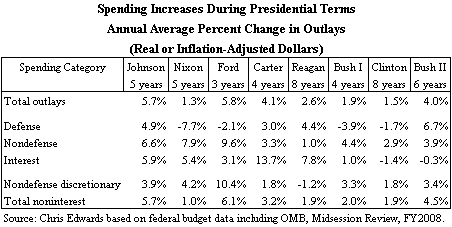
Bush Sucks

Chris Edwards of Cato has the numbers:

Edwards_0907

I always laughed at Democrats that tried to woo me to their party.  Now I laugh at Republicans too.  MoveOn may get mileage out of attacking Bush, but he has done more for the left/liberal cause than Clinton.  Clinton had NAFTA, welfare reform, and (moderated by an aggresive Republican Congress) fiscal sanity.  While he too had an Iraq-like war in Kosovo, he never got sucked into the sweeping nation-building Bush has taken on.

Bush II is also leading this poll for the modern inductee to the free market hall of shame.

Ubelieveable

This is one of the most incredible videos I have ever seen.   It looks like a big wack-a-mole game.  The last half of pious analysis is kind of boring but the first half is incredible.

Don't Ever Lend Money to Politicians

I don't have a problem with someone who has had a bankruptcy in the past.  Bankruptcy is not some Scarlet B that should ruin one for life.  Ideally, its bad enough that folks should want to avoid it but forgiving enough that people can move on and get a fresh start.  Via TJIC

"¦ moderator Tim Russert asked former senator Mike Gravel about Gravel's
somewhat troubled financial history. A condominium business started by
Gravel went bankrupt, and Gravel himself once declared personal
bankruptcy. "How can someone who did not take care of his business,
could not manage his personal finances, say that he is capable of
managing the country?" Russert asked.

Here would be my answer:  "Bankruptcy does not necessarily mean that one has managed finances poorly or that one is somehow guilty of malfeasance.  It can mean those things, but it can also mean that one took a risk on a business vision, did the best job possible, but the vision turned out to somehow be wrong.  Some of the greatest names in American business backed Internet ventures that went bankrupt.  Some were just poorly managed, but many just made poor bets as to what would and would not work over the internet.  When people look at Enron, they assume that there must have been malfeasance for the company to go bankrupt.  And while folks were indeed breaking some laws there, those actions had nothing to do with Enron's bankruptcy.  Enron died because they made some huge bets on things like broadband that didn't pan out."

Here, in contrast, is Gravel's response:

"Well, first off, if you want to make a judgment of who can be the
greediest people in the world when they get to public office, you can
just look at the people up here," Gravel said in a nod to his fellow
candidates.

"Now, you say the condo business," he continued. "I
will tell you, Donald Trump has been bankrupt 100 times. So I went
bankrupt once in business.

Doesn't this guy sound like some overweight guy wearing a wife-beater and sitting in his trailer with a cheap beer watching a baseball game on his old black and white TV, railing against all the rich guys that never gave him a chance?  But the best is yet to come:

who did I bankrupt? I stuck the credit card companies with $90,000 worth of bills, and they deserved it "“ "

People in the audience began to laugh.

"They
deserved it," Gravel repeated, "and I used the money to finance the
empowerment of the American people with a national initiative."

That sound you hear is the dying gasps of individual responsibility.  And what the hell is that last part about "empowerment of the American people?"  Sounds like Gravel is channeling Lee Hunsacker.

Don't Ever Lend Money to Politicians

I don't have a problem with someone who has had a bankruptcy in the past.  Bankruptcy is not some Scarlet B that should ruin one for life.  Ideally, its bad enough that folks should want to avoid it but forgiving enough that people can move on and get a fresh start.  Via TJIC

"¦ moderator Tim Russert asked former senator Mike Gravel about Gravel's
somewhat troubled financial history. A condominium business started by
Gravel went bankrupt, and Gravel himself once declared personal
bankruptcy. "How can someone who did not take care of his business,
could not manage his personal finances, say that he is capable of
managing the country?" Russert asked.

Here would be my answer:  "Bankruptcy does not necessarily mean that one has managed finances poorly or that one is somehow guilty of malfeasance.  It can mean those things, but it can also mean that one took a risk on a business vision, did the best job possible, but the vision turned out to somehow be wrong.  Some of the greatest names in American business backed Internet ventures that went bankrupt.  Some were just poorly managed, but many just made poor bets as to what would and would not work over the internet.  When people look at Enron, they assume that there must have been malfeasance for the company to go bankrupt.  And while folks were indeed breaking some laws there, those actions had nothing to do with Enron's bankruptcy.  Enron died because they made some huge bets on things like broadband that didn't pan out."

Here, in contrast, is Gravel's response:

"Well, first off, if you want to make a judgment of who can be the
greediest people in the world when they get to public office, you can
just look at the people up here," Gravel said in a nod to his fellow
candidates.

"Now, you say the condo business," he continued. "I
will tell you, Donald Trump has been bankrupt 100 times. So I went
bankrupt once in business.

Doesn't this guy sound like some overweight guy wearing a wife-beater and sitting in his trailer with a cheap beer watching a baseball game on his old black and white TV, railing against all the rich guys that never gave him a chance?  But the best is yet to come:

who did I bankrupt? I stuck the credit card companies with $90,000 worth of bills, and they deserved it "“ "

People in the audience began to laugh.

"They
deserved it," Gravel repeated, "and I used the money to finance the
empowerment of the American people with a national initiative."

That sound you hear is the dying gasps of individual responsibility.  And what the hell is that last part about "empowerment of the American people?"  Sounds like Gravel is channeling Lee Hunsacker.

Irony Watch

Via TJIC, really needs no comment:

Nofunds