Who Elected Me This Guy's Parent?

My company, as I have written before, gets hosed on unemployment insurance in states like California where the government does nothing to police cheating.  Many of my seasonal employees take vacations during the winter, but draw unemployment from California because the state has absolutely no interest in really checking to see if they are looking for work (which is a legal requirement of drawing unemployment).

This week I received the  most amazing ruling from California on unemployment.  If you don't understand how it works, the state taxes me a percentage of my payroll in the state as unemployment insurance premiums.  The rate is set so that the premiums I pay are about equal to the payments my ex-employees receive.  This means that the rate can adjust up and down, and also means that any incremental payouts are eventually paid by my company.  The rules are that the employee must have been terminated, not voluntary quit, and can't have been terminated for cause (i.e. theft) though in the latter case states like California give employees a huge benefit of the doubt (so huge, that I have never been able to prove "cause" to their satisfaction, and end up paying the unemployment for people who stole from me).

So I got this notice this week:

The claimant quit your employment on his/her doctor's advice.   A leave of absence was not available or would not have resolved the problem.  Available information shows that the claimant had good cause for leaving work [the claimant admits in a second document to having had a motorcycle accident on his own time]

Great.  The state has agreed to exactly the facts as we submitted them.  Victory at last!  Or not:

Your reserve account will be subject to charges.

An employee of mine has a motorcycle accident on his own time, and my company has to pay his wages while he is hurt?  Why?  Because we were the nearest people at hand to grab the money from?  Who elected me this guy's parent?

The Unwanted "Gift"

When reaching to take a gift from under the tree this morning, my wife did not see the scorpion clinging to the box.  Unfortunately, she got a nasty sting from this little creature.  While bites from the scorpions we have in Arizona are rarely fatal, they can be really painful and debilitating.  My wife's hand and most of her lower arm are almost completely numb and she cannot muster any strength in her hand.  The bite creates an effect much like when circulation just returns, such that she has had pins and needles in her hand all day.  Bummer.

Update: 12 hours after the sting, and her hand is still nearly inoperative and hurts like heck to the touch.  Do not worry, we have called poison control and her symptoms are in the normal band.  Some Arizonans report that it can take weeks for full nerve function to return.  Joy. 

Hat Tip to Larry Niven

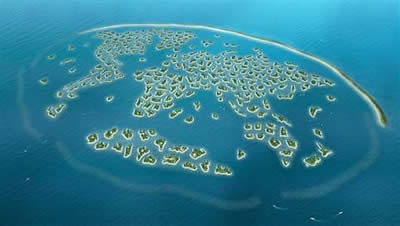
In the book Ringwold and its sequels, Larry Niven wrote of an artifact-world so large that 1:1 scale models of various planets, like earth, were created as islands in its vast oceans.  Not quite 1:1, but here is the same idea:
A109_world

The World is a man-made archipelago of 300 islands in the shape of a
world map. The World is being built primarily using sand dredged from
the sea. Each island ranges from 23,000 m2 to 84,000 m2
(250,000"“900,000 square feet or 5.7"“21 acres) in size, with 50"“100 m of
water between each island. The development will cover an area of 9 km
in length and 6 km in width, surrounded by an oval breakwater. The only
means of transport between the islands will be by boat and helicopter.
Prices for the islands will range from $15-45 million (USD). The
average price for an island will be around $25 million (USD). Dredging
started in 2004 and as of March of 2007 The World is around 90%
complete.

Update:  I have long contended that, at least if you eliminate all entries from the list involving women, that owning an island is the ultimate male fantasy.  Also a good way to "short" global warming predictions, if you are so inclined

Merry Christmas, Happy Holidays

I usually create our Christmas card each year in Photoshop.  Here is this year's effort.  Merry Christmas, happy holidays, and have a great 2008.

Christmas2008

I've Got To Finish A Book Project

I am working on a submission (outline and several chapters) for a book prize that is due December 31, so I may not be posting much over the next week.  The contest is for a novel that promotes the principals of freedom, capitalism, and individual responsibility in the context of a novel (hopefully without 120-page John Galt radio speeches). 

My project is one I have been tinkering with for a while, an update of the Marshall Jevons economist mysteries from the 1980's.  If you are not familiar with this series, Marshall Jevons was a pseudonym for a couple of economists who wrote several murder mysteries that included a number of expositions on how economics apply to everyday life.  Kind of Agatha Christie meets Freakonomics.  I found the first book, Murder at the Margin, to be disappointing, but the second book called the Fatal Equilibrium was pretty good.  I think the latter was a better book because the setting was university life, and the murder revolved around a tenure committee decision, topics the authors could write about closer to their experience.  The books take a pro-free-market point of view (which already makes them unique) and it is certainly unusual to have the solution to a murder turn on how search costs affect pricing variability.

Anyway, for some time, I have been toying with a concept for a young adult book in roughly the same tradition.  I think the Jevons novels are a good indicator of how a novel can teach some simple economics concepts, but certainly the protagonist as fusty stamp-collecting Harvard professor would need to be modified to engage young adults. 

My new novel (or series of novels, if things go well) revolves around a character named Adam Smith.  Adam is the son of a self-made immigrant and heir to a nearly billion dollar fortune.  At the age of twenty, he rejects his family and inheritance in a wave of sixties rebellion, joins a commune, and changes his name to the unfortunate "Moonbeam."  After several years, he sours on commune life, put himself through graduate school in economics, and eventually reclaims his family fortune.  Today, he leads two lives:  Adam Smith, eccentric billionaire, owner of penthouses and fast cars, and leader of a foundation [modeled after the IJ]; and Professor Moonbeam, aging hippie high school economics teacher who drives a VW beetle and appears to live in a trailer park.  There is a murder, of course, and the fun begins when three of his high school students start to suspect that their economics teacher may have a second life.  As you might expect, the kids help him solve the murder while he teaches them lessons about life and economics.  The trick is to keep the book light and fun rather than pedantic, but since one business model in my last novel revolved around harvesting coins in fountains, I think I can do it.

Anyway, wish me luck and I will be back in force come the new year. 

Christmas Tree Recycling

Most cities offer Christmas tree recycling, which for most people just means they haul the brittle, dried-up skeleton of their tree back onto the roof of their car and dump it in some big collection area.  The city then grinds up the trees and uses them for mulch, and infinitely more elegant solution than burying them all in a landfill.

Or is it?

If I were to care about limiting CO2, wouldn't I advocate for wrapping all of those trees in Saran Wrap and burying them in the deepest hole I could find?  Decaying Christmas tree mulch will eventually give up its carbon back to the atmosphere as CO2, or, theoretically worse, trace amounts of methane.  Aren't the holidays a perfect opportunity to sequester all that carbon underground?  While global warming catastrophists argue that young, growing forests sequester carbon from the atmosphere, what they do not mention is that older forests do the opposite, as new tree growth has flattened out and older trees are dying and decaying.  If we really wanted to sequester carbon via forests, we would cut down all the old growth forests and bury the logs, while planting new fast growing saplings.  While no one would advocate for such an approach, the next best approach is to cut down lots of trees and build long-lived houses out of them.

The New Energy Bill

If you want to have mood lighting in your house that dims and doesn't turn everything a weird color, then go out and stock up on light bulbs today because the new energy bill just passed**.  I have already blogged plenty about the stupid stuff in this bill, but apparently Kevin Drum thinks its a good step.  I don't see how anyone of any political stripe can see this as a good bill.  Its just stupid in so many ways.  Yes, I understand as a libertarian, my energy bill would look like:

  1. get out of the way

But I can for a moment place myself in a position where I would imagine being worried about CO2 and dependence on fossil fuels.  For someone who really cares about these things, here is what a rational energy plan would look like:

  1. large federal carbon tax, offset by reduction in income and/or payroll taxes
  2. streamlined program for licensing new nuclear reactors
  3. get out of the way

** I personally have replaced most of the bulbs in my house, out of rational economic self-interest, with CF bulbs.  However, there are about 6 where CF's just won't do the job I need and about 6 more (3 above my shower and 3 outside) where current CF bulbs do not hold up to the moisture.   The desire by government to micro-manage me into using an inferior solution for these 12 locations is the same compulsion that has led to my not having a single toilet in my house that works  (the shower also sucked too until I figured out how to remove the government-mandated flow restricter from the shower head).

Problems With London Congestion Charge

The idea of a congestion charge is a good one.  London, however, is struggling with the implementation.  Apparently, while the number of cars in the congestion zone has gone down, the rush hour congestion has gone up.  Why?  Because the congestion charge does not change by time of day, it is more than high enough to drive out off-hour users, but is not high enough to change the behavior of rush hour drivers.  Basically, they have made the center of London quieter at night.

This is actually not surprising. Economic theory would say that the
demand for travel at rush hour is more inelastic (i.e., less
susceptible to fees) than travel at other times of the day. (If it were
not inelastic, people would be willing to drive in such congestion.) If
fees don't change during the course of the day, they will have the
greatest effect during the hours that are more elastic. A properly
designed fee should temper peak-period demand; a fixed fee instead
tempers off-peak demand.

And, as I can attest from my last visit to London, where I was actually dumb enough to drive a car into town, the way they have implemented the system is not very amenable to time of day pricing. 

Government Whipsaw

TJIC has a great roundup of 20th century lending regulation:

Once upon a time, when we had a free market, bankers made loans to poor people.

Then, FDR came into office, and he and the Democratic Congress
passed laws to pressure banks to stop making loans to poor people.

Then, in the 1980s, Democrats heckled banks for not making
sufficient loans to poor people, and pass laws to force them to change
their ways.

Then, in the 21st century, Democrats heckled banks for making
too many loans to poor people, and passed laws to force them to change
their ways.

Where Have All the Anti-Globalization Rioters Gone?

It has been pretty quiet on the globalization front.  I saw today that Don Boudreaux released his new book on globalization, and I thought to myself -- wow, that was a charged issue a few years ago, what happened to it?   I was in Seattle for the riots and it was a big deal.  Well, in part, I guess the feistiness of the anti-globalization types may have gone down because they are winning -- protectionism is advancing today on many fronts when for a while we had it against the ropes.  In large part this is because the US has virtually abandoned its leadership role on free trade.

However, there is another reason we don't hear much from the anti-globalization folks:  Because they have all joined the global warming movement, deciding that the environmental packaging is a better way to sell socialism and protectionism:

The Social Democrats are calling for sanctions on energy-intensive U.S.
export products if the Bush administration continues to obstruct
international agreements on climate protection, the party's leading
environmental expert said Tuesday.

The move, after the United
Nations climate conference last week in Bali, Indonesia, has won strong
support from the Greens and other leftist groupings in the European
Parliament. Those factions will renew their bid to impose such levies
when the Parliament reconvenes next month.

Regulation Protects Industry Incombents

I often see folks who are arguing for increased government regulation of some industry observe that "even those greedy corporations in this industry support this new regulation."  For example, if a power company takes a public position to support greenhouse gas emissions, then that is used as evidence that such regulation must really be necessary if even the to-be-regulated are in favor.  Greg Craven makes such an argument in his global warming video that I refuted the other day.

There are two very good reasons a company in such a position might publicly support even a bad regulation.  The first is basic politics and PR:  If the regulation appears inevitable and has public support, then it is sometimes better to get out ahead of it and try to curry favor with politicians and the public to manage the regulation's implementation.   We all know corporations give donations to political candidates, but look at how they give them.  Corporate donations correlate far better with "who is expected to win" rather than "who would create the most favorable regulatory environment for the corporation."  In fact, corporations are highly likely to give donations to both candidates in a closely-fought election, and a lot of their giving is after the election, to the winner of course.

The other good reason that companies support regulation in their industry is because a lot of regulation is either designed to, or effectively, helps incumbent companies against new entrants.   I have talked about this many times with the questioning of licensing.  Global warming regulation and carbon trading systems in particular give us another great example:

BBC News understands the industry will be allowed to increase emissions
as much as it wants by the European environment council. Aviation is
the fastest growing source of greenhouse gases. But Europe's
environment ministers look set to reject a plan for a strict cap on
emissions from planes. Instead, airlines will be given a set number of
permits to pollute.

Instead, airlines will be given a set number of permits to pollute.

If
they overshoot their limit they will be allowed to buy spare permits
from firms who have managed to cut emissions elsewhere - manufacturing
industry, for instance.

So, current airlines in Europe will be given carbon permits that presumable support their current business level.  However, any new entrant, or any current player wishing to take market share from another airline, must spend money on carbon credits to grab this market share, carbon credits the current established incumbents got for free.  This in effect becomes a tax on market share gains.  This European-style protection of large corporations is typical, and is why the 30 largest companies in Europe are nearly the same as they were in 1965, but are completely different in the US.

This is also why, though I don't think expensive action on CO2 is justified, I think that if we do so the approach must be a carbon tax rather than cap and trade.   But cap and trade has so much potential for political hijinx and giving special deals to the politically influential that my guess is that politicians will want cap and trade.

Vista Update: Still Floundering

Frequent readers will know that I have reversed all the new Vista machines in our household back to XP and I have banned Vista from any computers purchased in the company (Dell is quite happy to sell XP rather than Vista).  Here is a how-to on how to downgrade to XP.

Now, PC World has voted Vista as the technology failure of the year  (I would also vote the box as the packaging failure of the decade, and the new user interface in MS Office as the hose-your-installed-base gaffe of the year).

I thought this was an interesting fact, from PC World several months ago:

Certainly sales of Vista aren't blowing away XP in stores. Chris
Swenson, director of software industry analysis for the NPD Group, says
that, from January through July of this year, XP sales accounted for a
healthy 42.3 percent of online and brick-and-mortar retail OS sales. By
contrast, from January through July of 2002, after XP's launch in
October the year prior, Windows 98 accounted for just 23.1 percent of
retail sales.

I made a similar observation using Amazon sales rankings of XP vs. Vista here. Finally, just for the heck of it, I checked the OS's of users coming to Coyote Blog.  In the past, our users have demonstrated themselves to be ahead of the technology curve (Firefox eclipsed Explorer as the #1 Coyote Blog brower long ago).  As you can see, Vista barely has 4% share, in a near tie with Windows 2000 and Windows NT and barely edging Linux:
Servers2

HT:  What's Up With That

Government Health Care: Trojan Horse for Fascism

In about the hundredth post in this series, yet another example of government health care costs being used to micro-regulate even the smallest personal lifestyle decisions:

The city that banned plastic grocery bags and styrofoam take-out
containers has found a new cause: your favorite soft drink. San
Francisco may impose a new fee on those big retail stores that sell
them. The purpose is to curb the obesity problem among kids and adults.
Such fee or tax would be the first in the nation.


San Francisco says the obesity problem is costing the city too
much money in health care costs. Studies have linked obesity to
diabetes and heart disease.

"One third of all of our new
on-set diabetics are type 2 because of obesity and this is in children
now," says Robert Lustig, M.D., Endocrinologist, UCSF.

It is perhaps appropriate, given the polls in Iowa, that Mike Huckabee precipitated one of the earliest posts in this series:

Mike Huckabee, the Governor of Arkansas, now
requires annual fat reports. These are sent to the parents of every
single child aged between 5 and 17; a response, he says, to "an
absolutely epidemic issue that we could not ignore" in the 1,139
schools for which he is responsible.

I
just cannot craft any reasonable theory of government where this is the
state's job.   The "obesity" crisis in this country just amazes me.
"Experts" every few years broaden the definition of who is overweight
or obese, and suddenly (surprise!) there are more people defined as
overweight.  Even presuming it is the state's job to optimize our body
weights, is it really the right approach to tell everyone they are too
fat?  Having known several people who were anorexic, including at least
one young woman who died of its complications, is it really a net
benefit to get young people more obsessed with looks and body style?
And what about the kids that are genetically programmed to be
overweight?  Does this mean that years of taunting and bullying by
their peers is not enough, that the state's governor wants to pile on
now?

It is interesting to note that governor Huckabee apparently started
this initiative after his own personal battle with weight loss:

[Huckabee] lost 110lb after being warned that his
weight, more than 280lb after a life of southern fried food, was a
death sentence. A chair even collapsed under him as he was about to
preside over a meeting of state officials in Little Rock.

We
all have friends who have lost weight or gotten into homeopathy or
became a vegan and simply cannot stop trying to convert their friends
now that they see the light.  Now we have the spectacle of elected
officials doing the same thing, but on a broader scale and with the
force of law, rather than  just mere irritation, on their side.  One
can only imagine what report cards kids would be carrying home if
Huckabee had instead had a successful experience with penis
enlargement.  What's next, negative reports for kids with bad acne?
For women whose breasts are too small?  For kids who are unattractive?

Update: I see Q&O posts on the same issue

Yearning for Something Better than Kwanzaa

I have had several emails this week about Kwanzaa, so I guess it is time for my annual Kwanzaa rant.  This article has become an annual tradition at Coyote Blog, I guess to make sure I start the new year with plenty of hate mail.

The concept of a cultural celebration by African-Americans of themselves and their history is a good one.  The specific values celebrated in Kwanzaa, however, suck.  They are socialist -Marxist-collectivist-totalitarian crap.   Everyone seems to tiptoe around Kwanzaa feeling that they have to be respectful, I guess because they are fearful of being called a racist.  However, I find it terrible to see such a self-destructive set of values foisted on the African-American community.  These values are nearly perfectly constructed to keep blacks in poverty - just look at how well these
same values have played out in Africa.

First, understand that I have no problem with people of any ethnic group or race or whatever creating a holiday.  Life is worth celebrating, as often as possible, even if we have to make up new occasions. One of the great things about living in Arizona is getting to celebrate Cinco de Mayo.

Second, understand that Kwanzaa is not some ancient African ethno-cultural tradition.  Kwanzaa was made up in 1966 by Dr. Maulana Karenga.  Karenga was a radical Marxist in the 60's black power movement.  Later, Karenga served time in jail for torturing two women:

Deborah Jones ... said she and Gail Davis were whipped with an electrical cord and beaten with a karate baton after being ordered to remove their clothes. She testified that a hot soldering iron was placed in Miss Davis' mouth and placed against Miss Davis' face and that one of her own big toes was tightened in a vice. Karenga ... also put detergent and running hoses in their mouths, she said."

Interestingly, after this conviction as well incidents of schizophrenia in prison where "the psychiatrist observed that Karenga talked to his blanket and imaginary persons and believed that he had been attacked by dive-bombers," California State University at Long Beach saw fit to
make him head of their Black Studies Department.

Anyway,  I give credit to Karenga for wanting to create a holiday for African-Americans that paid homage to themselves and their history.  However, what Karenga created was a 7-day holiday built around 7 principles, which are basically a seven step plan to Marxism.  Instead of rejecting slavery entirely, Kwanzaa celebrates a transition from enslavement of blacks by whites to enslavement of blacks by blacks.  Here are the 7 values, right from the Kwanzaa site (with my comments in red itallics):

Umoja (Unity)
To strive for and maintain unity in the family, community, nation and race

On its surface, this is either a platitude, or, if serious, straight Marxism and thoroughly racist.  Think about who else in the 20th century talked about unity of race, and with what horrible results.

In practice, the notion of unity in the black movement has become sort of a law of Omerta -- no black is ever, ever supposed to publicly criticize another black.  Don't believe me?  Look at the flack Bill Cosby caught for calling out other blacks.

Kujichagulia (Self-Determination)
To define ourselves, name ourselves, create for ourselves and speak for ourselves

Generally cool with me -- can't get a libertarian to argue with this.  When this was first written in the 60's, it probably meant something more
revolutionary, like secession into a black state, but in today's context I think it is fine.

Ujima (Collective Work and Responsibility)
To
build and maintain our community together and make our brother's and
sister's problems our problems and to solve them together

Um, do I even need to comment?  This is Marxism, pure and simple.

Ujamaa (Cooperative Economics)
To build and maintain our own stores, shops and other businesses and to profit from them together.

OK, I said the last one was Marxism.  This one is really, really Marxism. 

Nia (Purpose)
To
make our collective vocation the building and developing of our
community in order to restore our people to their traditional greatness.

There's that collectivism again

Kuumba (Creativity)
To
do always as much as we can, in the way we can, in order to leave our
community more beautiful and beneficial than we inherited it.

I guess I don't have much problem with creativity and make things better.  My sense though that if I was to listen to the teaching on this one in depth, we would get collectivism again.

Imani (Faith)
To
believe with all our heart in our people, our parents, our teachers,
our leaders and the righteousness and victory of our struggle.

What about in ourselves as individuals?  Through all of this, where is the individual, either individual responsibility or achievement?  It is interesting that a holiday that
was invented specifically to be anti-religious would put "faith" in as a value.  In fact, Karenga despised the belief in God as paying homage to "spooks who threaten us if we don't worship them and demand we turn
over our destiny and daily lives."

However, this is in fact very consistent with the teachings of most statists and totalitarians.  They tend to reject going on bended knee to some god, and then turn right around and demand that men go on bended knee to ... them, or other men.  This is in fact what this "faith" was about for Karenga - he is a statist laying the foundation for obedience to the totalitarian state.  He wants blacks to turn over their destiny and daily lives to their leaders, not to god.

So, in conclusion, Kwanzaa was designed as a celebration of creating a totalitarian collectivist Marxist racist state among African-Americans.  I may well get comments and emails that say "oh,
thats not how we celebrate it" and I will say fine - but Marxism is the core DNA of the holiday, a holiday created by a man who thought Lenin and the Black Panthers were all wimps.

Never wishing to criticize without suggestion a solution, here are alternate values I might suggest:

Freedom
-Every individual is his own master.  We will never accept any other master again from any race (even our own).  We will speak out against injustices and inequalities so our children can be free as well.

Self-Reliance - Each individual will take responsibility for their life and the lives of their family

Pride - We will be proud of our race and heritage.  We will learn about our past and about slavery in particular, so we will never again repeat it.

Entrepreneurship - We will work through free exchange with others to make our lives better and to improve the lives of our children

Education - We will dedicate ourselves and our time to education of our children, both in their knowledge and their ethics

Charity - We will help others in our country and our community through difficult times

Thankfulness - Every African-American should wake up each morning and say "I give thanks that my ancestors suffered the horrors of the slavery passage, suffered the indignity and humiliation of slavery, and suffered the poverty and injustices of the
post-war South so that I, today, can be here, in this country, infinitely more free, healthier, safer and better off financially than I would have been in Africa."

By the way, if you doubt that last part, note that in the late 90's, median per capita income of African Americans was about $25,000, while the per capita income of Africans back in the "old country" was around $700, or about 35x less.  Note further this comparison of freedom between the US and various African nations.  Finally, just read the news about the Congo or Rwanda or the Sudan.

Update:  Even years later, commenters insist on misinterpreting this last point as some sort of justification for slavery.  I am not sure how one can come to this conclusion in an article that drips with disdain for slavery, but folks will find what they want to find.  My mistake perhaps was to presume to speak for African Americans.  It is very possible that the enslavement of their ancestors and the legacy of racist crap that still exists in this country is not balanced by the prosperity blacks now enjoy in America vs. Africa.  So I will merely speak for myself and say the rest of us are immeasurably better off for having you here.
Not a Bailout?

I was watching CNBC over lunch and saw that Alan Greenspan has criticized the President's plan for freezing the interest rates on some adjustable rate loans.  He argued, and I agree, that it is bad to mess with contracts and markets, and bad to stand in the way of a real estate bubble that needs to correct.  He said that if the government feels sorry for certain mortgage holders, it should give them cash.

I am not too excited about giving away cash to people who made bad financing decisions, particularly since I have successfully weathered a couple of tough years in my business brought about in part by rising rates on our businesses adjustable rate loans.  However, I am very much a supporter of being as open and up-front as one can be in government taxing or spending.  For example, I prefer direct payments to farmers rather than price supports.  I prefer a carbon tax to CAFE-type mandates.  In both cases, while both alternatives probably cost the economy about the same in total, the cost-benefit tradeoff is more clear in the first alternative.  Which is why, predictably, politicians usually prefer the second alternative. 

All of this pops into my head because apparently the President's reaction was that he preferred his plan to a "bailout."  Huh?  How is his plan any more or less a bailout, except that the exact costs are more hidden and who pays the costs are more obscure.  The only real difference is that Greenspan's approach is probably less likely to set bad precedents for the future or to make mortgages more expensive for the rest of us, which the President's plan almost certainly will.

Response to Greg Craven "How the World Ends" Climate Video

Apparently, a
video by Greg Craven
called "How the World Ends" has been getting a
lot of attention, supposedly because it prevents an irrefutable argument for immediately taking massive action to fight global
warming.  A newspaper asked me for my response, and I thought I would share it
here as well.  You can find my response posted at Climate Skeptic today.

Everyone Would Be Burying Nuclear Waste

Dave Barry used to joke that whenever he would argue for a free society, the first objection people would have is "but people would all have sex with dogs." ** Now, Barry is just being funny (as usual) but as in all humor, there is a strong core of truth in his observation.  For years, when I argued that private property rights should be absolute, folks would argue "but then everyone would trash their land."  It in fact became incredibly predictable that someone would ask "how would you stop people from burying nuclear waste on their property?"

Um, why would they?  Would you bury nuclear waste in your backyard?  Well, No.  Why not?  Because it would be dangerous to my kids, and it would reduce my resale value.  OK, so why would anyone else?  No answer.

I call this the "you can't give people freedom because they will do malicious things even if it is against their own self-interest" argument, and George Will observes that it is alive and well in the Democratic Party:

Speaking ill of lenders began when homo sapiens acquired language,
hence it is unsurprising that many people who until recently were
criticizing lenders for not making money available to marginally
qualified borrowers are now caustic about lenders who complied. Clinton
is fluent in the language of liberalism, aka Victimspeak, so,
denouncing "Wall Street," she says families were "lured into risky
mortgages" and "led into bad situations" by those who knew better. So, lenders knew their loans would not be fully repaid?

Jesse Jackson speaks of "victims of aggressive mortgage brokers." But
given that foreclosure is usually a net loss for all parties to the
transaction, what explains the "aggression"? Who thought it was in
their interest to do the luring and leading that Clinton alleges? While
granting that "borrowers share responsibility," her only examples are
those "who paid extra fees to avoid documenting their income" and
"speculators who were busy buying two, three, four houses to sell for a
quick buck." Everyone else has been victimized.

This is exactly the point I made back in April, when I said that the mortgage market was about to become a capitalism Rorschach test, acting a a catalyst to reveal everyone's core beliefs and biases about free markets.  Which it certainly has with Hillary.  But we already knew where she stands, didn't we?

** You wouldn't believe the Google hits I get since I made this post. 

Perfect Gift for the Holidays!

From the Business Opportunities Weblog:

Continuing my list of my favorite business books of 2007 brings us to another unconventional one: BMOC.
While the book, by Warren Meyer, is fictional, it does contain a number
of interesting business ideas, including my favorite outlandish
business opporunity of all time: fountain coin harvesting.

Amazon link for BMOC here  (sorry, I tried to get the price cut for the holidays but it really takes a long time for that to work through the system).

I Called This One

I made this prediction way back in February of 2005:

I resisted the call by a number of web sites at the beginning of the
year to make predictions for 2005.  However, now I will make one:  We
will soon see calls to bring a tighter licensing or credentialing
system for journalists, similar to what we see for lawyers, doctors,
teachers, and, god help us, for beauticians
.  The proposals will be
nominally justified by improving ethics or similar laudable things,
but, like most credentialing systems, will be aimed not at those on the
inside but those on the outside.  At one time or another, teachers,
massage therapists, and hairdressers have all used licensing or
credentialing as a way to fight competition from upstart competitors,
often ones with new business models who don't have the same
trade-specific educational degrees the insiders have....

Such credentialing can provide a powerful comeback for industry insiders under attack.  Teachers, for example, use it every chance they get to attack home schooling and private schools,
despite the fact that uncertified teachers in both these latter
environments do better than the average certified teacher (for example,
kids home schooled by moms who dropped out of high school performed at
the 83rd percentile).  So, next time the MSM is under attack from the blogosphere, rather than address the issues, they can say that that guy in Tennessee is just a college professor and isn't even a licensed journalist.

So here we go, here are a few recent such calls for licensing of journalists.  The first via Hot Air:

Supporters of "citizen journalism" argue it provides independent,
accurate, reliable information that the traditional media don't
provide. While it has its place, the reality is it really isn't
journalism at all, and it opens up information flow to the strong
probability of fraud and abuse. The news industry should find some way
to monitor and regulate this new trend....

The premise of citizen journalism is that regular people can now
collect information and pictures with video cameras and cellphones, and
distribute words and images over the Internet. Advocates argue that the
acts of collecting and distributing makes these people "journalists."
This is like saying someone who carries a scalpel is a "citizen
surgeon" or someone who can read a law book is a "citizen lawyer."
Tools are merely that. Education, skill and standards are really what
make people into trusted professionals. Information without
journalistic standards is called gossip.

But that one is downright sane compared to this, from Cleveland's Voice for Social Justice (have you noticed how "social justice" always seems to require forcefully silencing people?):

For every champion of journalism who write stories about Walter Reed or
Extraordinary Rendition Flights, there are two reporters at Channel 19
who care very little about society. For every Seymore Hersh there are five Michelle Malkins or Ann Coulters.   With citizen journalists spreading like wildfire in blogs, we seem to have one Froomkin created, there are five extremist blogs proclaiming the assaults on homeless people everyday....

The Society of Professional Journalists must start licensing
journalists or the government will start doing it for them. We need to
start taking this practice seriously and separate the real journalists
from the fakes. The decisions made by journalists have consequences for
ruining people's lives or for causing grief, suicide or even murder.
The genocide in Rhwanda were carried out using the radio commentators
to urge citizens to kill Tutsis. If journalists want to be taken
seriously they must figure out how to separate the real from the
O'Reilly types. They must set up a structure to license journalists
with an enforcement mechanism to strip bad journalists from practicing
their craft.

This is from the weblog of a bunch of media students:

It scares me to think that the field I will going pursuing when I
graduate might be confused with entertainment reporting "“ things like
"Who Ben Affleck is dating now" and "Will Brad and Jen get back
together." Certainly, these things are news to a select few. I will
not, however, get into the whole tabloid issue. I seems to have sparked
some intense debate with that one a few weeks ago. But, I am worried
that with the onslaught of weblogs and internet news, many readers and
listeners will get confused and think what they're reading and watching
is actually news. I have nothing against web loggers, even though they
are a threat to my future career. But, all of this leads me to question
the professionalism of journalism.

Should we license journalists? This has been a question that has
been debated back and forth for awhile. Many journalists are against
the idea because they believe that that would mean licensing
information and licensing free speech. But I think we need to look at
the issues at hand right now. The news is getting out-of-hand. The
public is being onslaught with an enormous amount of information due to
our increasing rush of technology and it has to be hard for them to
differentiate between real news and opinions being costumed as news.
This is why we need to start seriously considering licensing
journalists. It may be the only real hope for the future of
journalists. With licenses, we can hold on to whatever ethical and
moral characteristics we have left in the news business. There will be
no more "parading reporters" and no more "video news releases." Who
thinks we should pursue this? Who thinks the entire idea is ridiculous?

Some countries are seriously considering it.  Brazil and Indonesia are looking into licensing their journalists.  Here's an article
from Indonesia - even though it's agaist thh idea of licensing it's
still a good example of how serious this debate is becoming

Its good we are taking lessons on free speech and the media from Indonesia and Brazil.  I probably should not make fun of the typos and grammar errors in this post by a "media student" since I make such mistakes all the time.  Of course, I am not a "licensed journalist."

This is not a new issue.  In the early 1980's, the US vigorously resisted attempts by the UN to implement a variety of euphemisms that boiled down to licensing requirements for international journalists.

Environmentalists Want Us To Celebrate Squalor

I really want to thank Michael Tobis at environmentalist hang-out Grist.   For years people have accused me of over-reading  the intentions of climate catastrophists, so I am thankful that Tobis has finally stated what climate catastrophists are after (emphasis in the original, but it is the exact phrase I would have highlighted as well)

Is infinite growth of some meaningful
  quantity possible in a finite space? No scientist is inclined to think
  so, but economists habitually make this
  claim without bothering to defend it with anything but, "I'm, an
  economist and I say so", or perhaps more thoughtfully, "hey, it's
  worked until now".

Such ideas were good approximations in the past. Once the finite
  nature of our world comes into play they become very bad approximations. You know, the gods of Easter Island
smiled on its people "until now" for a long time, until they didn't.
The presumption of growth is so pervasive that great swaths of economic
theory simply fail to make any sense if a negative growth rate occurs.
What, for instance, does a negative discount rate portend? ...

The
  whole growth thing becomes a toxic addiction. The only path to a soft
  landing is down
; we in the overheated economies need to learn not just
  to cope with decline but to celebrate it. We need not just an ideology
  but a formal theory that can not only cope with reduced per capita
  impact but can target it.

Decline isn't bad news in an airplane. Decline is about reaching
your destination. Perhaps there is some level of economic activity
beyond which life gets worse? Perhaps in some countries we have already
passed that point? Could the time where we'd all be better off with a
gradual decline have arrived? How much attention should we pay to the
folks who say we should keep climbing, that there's no way we can run
out of fuel, that we'll think of something?

So there it is, in the third paragraph, with no danger of misinterpretation.  These folks want economic decline.  That's a fancy way of saying "We want you poorer."

I could spend weeks writing about the fallacies and anti-human philosophy embedded in these four paragraphs, but here are just a few reactions.

The Zero Sum Fallacy

Every generation has people, like Mr. Tobis, who scream that we are all living in a petri dish and this is the generation we run out of Agar.  Of course they are always wrong.  Why? 

Well, first, the prime driver of economic growth is not resources but the human mind.  And the world of ideas has no capacity limits.   This is an  issue that Julian Simon wrote about so clearly.   Tobis is trying to apply physical models to wealth creation, and they just don't apply.  (and by the way, ask the passengers of TWA flight 800 if decline isn't bad news in an airplane).

Further, if we talk about the world of resources, we currently use a trivial fraction of the world's resources.  By a conservative estimate, we have employed at most (including the soil we till for agriculture, extracted minerals, etc) less than 0.0001% of the earth's mass.  In terms of energy, all energy (except nuclear) comes ultimately from the sun  (fossil fuels, hydropower reservoirs, etc are just convenient storage repositories of the sun's energy).  We currently use an infinitesimal percentage of the sun's energy. I wrote much more on the zero-sum wealth fallacy here.  And here is my ancestor blogger in Coyote Broadsheet making the same fallacy as Mr. Tobis back in the 19th century, writing on the Peak Whale Theory.

Wealth Benefits the Environment

Just like actual 20th century data tends to undermine catastrophic climate forecasts, experience over the last century tends to contradict the notion that growth is devastating to the environment. 

We can find the best example right here in the environmental Satan called the USA.  The US has cleaner air and water today than in any time in decades.  Because of technology and growth, we can produce more food on less land than ever -- in fact the amount of land dedicated to agriculture has shrunk for years, allowing forests to steadily expand in the US for over eighty years (that is, until the environmentalists got the government to subsidize ethanol).   No one in Brazil would be burning huge tracts of the Amazon if they enjoyed the agricultural productivity we do in the US.  Sure, we have done some things that turn out to be environmentally bad (e.g. lead in gasoline) but our wealth has allowed us to fairly painlessly fix these mistakes, even if the fixes have not come as fast as environmentalists have desired. 

I will confess that the Chinese seem hell bent on messing up their air and water as much as possible, but, just like the United States, it will be the wealthy middle and upper class of China that will finally demand that things get cleaned up, and it will be their wealth, not their poverty, that allows them to do so.   Similarly, I don't think CO2 reduction will do much of anything to improve our climate, but if we find it necessary, it will be through application of wealth, not squalor, that we overcome the problems. 

Here is a simple test:  Which countries of the world have the worst environmental problems?  Its is the poorest countries, not the wealthiest.

Growth / Climate Tradeoffs

For the sake of argument, let's assume that man-made global warming increases severed storm frequency by 20%, or by 3 or 4 extra hurricanes a year (why this probably is not happening).  Even a point or two knocked off worldwide economic growth means hundreds of trillions of dollars in lost annual GDP a century from now (2% growth yields a world economy of $450 trillion in a century.  3% growth yields a world economy $1,150 trillion in a hundred years.)  So, using these figures, would the world be better off with the current level of hurricanes, or would it be better off with four more hurricanes but $700 trillion a year more to deal with them.  Hmmm.  Remember, life lost in a hurricane correlates much higher with poverty in the area the hurricane hit rather than with storm strength, as demonstrated by recent cyclones in Asia.  This general line of reasoning is usually described as warmer and richer vs. cooler and poorer

I cannot speak for Mr. Tobis, but many environmentalists find this kind of reasoning offensive.  They believe that it is a sin for man to modify the earth at all, and that changing the climate in any way is wrong, even if man is not hurt substantially by this change.  Of course, in climate, we have only been observing climate for 30-100 years, while climate goes through decadal, millennial, and even million-year cycles.  So it is a bit hard to tell exactly what is natural for Gaia and what is not, but that does stop environmentalists from declaring that they know what is unnatural.  I grew up in the deep South, and their position sounds exactly like a good fiery Baptist minister preaching on the sins of humanity.

More from Jerry Taylor, who got Tobis started on his rant in the first place.

Postscript:  Here is an interesting chicken or the egg problem:  Do you think Mr. Tobias learned about man-made global warming first, and then came to the conclusion that growth is bad?  Or did Mr. Tobis previously believe that man needed to be fewer and poorer, and become enthusiastic about global warming theory as a clever packaging for ideas most of the world's population would reject?  The answer to this question is a window on why 1)  the socialists and anti-globalization folks have been so quiet lately (the have all jumped onto global warming); 2)  no one in the global warming movement wants to debate the science any longer  (because the point is not the science but the license to smack down the world economy)  and 3)  why so much of the Bali conference seems to be about wealth transfers than environmentalism.

Environmentalists Want Us To Celebrate Squalor

I really want to thank Michael Tobis at environmentalist hang-out Grist.   For years people have accused me of over-reading  the intentions of climate catastrophists, so I am thankful that Tobis has finally stated what climate catastrophists are after (emphasis in the original, but it is the exact phrase I would have highlighted as well)

Is infinite growth of some meaningful
  quantity possible in a finite space? No scientist is inclined to think
  so, but economists habitually make this
  claim without bothering to defend it with anything but, "I'm, an
  economist and I say so", or perhaps more thoughtfully, "hey, it's
  worked until now".

Such ideas were good approximations in the past. Once the finite
  nature of our world comes into play they become very bad approximations. You know, the gods of Easter Island
smiled on its people "until now" for a long time, until they didn't.
The presumption of growth is so pervasive that great swaths of economic
theory simply fail to make any sense if a negative growth rate occurs.
What, for instance, does a negative discount rate portend? ...

The
  whole growth thing becomes a toxic addiction. The only path to a soft
  landing is down
; we in the overheated economies need to learn not just
  to cope with decline but to celebrate it. We need not just an ideology
  but a formal theory that can not only cope with reduced per capita
  impact but can target it.

Decline isn't bad news in an airplane. Decline is about reaching
your destination. Perhaps there is some level of economic activity
beyond which life gets worse? Perhaps in some countries we have already
passed that point? Could the time where we'd all be better off with a
gradual decline have arrived? How much attention should we pay to the
folks who say we should keep climbing, that there's no way we can run
out of fuel, that we'll think of something?

So there it is, in the third paragraph, with no danger of misinterpretation.  These folks want economic decline.  That's a fancy way of saying "We want you poorer."

I could spend weeks writing about the fallacies and anti-human philosophy embedded in these four paragraphs, but here are just a few reactions.

The Zero Sum Fallacy

Every generation has people, like Mr. Tobis, who scream that we are all living in a petri dish and this is the generation we run out of Agar.  Of course they are always wrong.  Why? 

Well, first, the prime driver of economic growth is not resources but the human mind.  And the world of ideas has no capacity limits.   This is an  issue that Julian Simon wrote about so clearly.   Tobis is trying to apply physical models to wealth creation, and they just don't apply.  (and by the way, ask the passengers of TWA flight 800 if decline isn't bad news in an airplane).

Further, if we talk about the world of resources, we currently use a trivial fraction of the world's resources.  By a conservative estimate, we have employed at most (including the soil we till for agriculture, extracted minerals, etc) less than 0.0001% of the earth's mass.  In terms of energy, all energy (except nuclear) comes ultimately from the sun  (fossil fuels, hydropower reservoirs, etc are just convenient storage repositories of the sun's energy).  We currently use an infinitesimal percentage of the sun's energy. I wrote much more on the zero-sum wealth fallacy here.  And here is my ancestor blogger in Coyote Broadsheet making the same fallacy as Mr. Tobis back in the 19th century, writing on the Peak Whale Theory.

Wealth Benefits the Environment

Just like actual 20th century data tends to undermine catastrophic climate forecasts, experience over the last century tends to contradict the notion that growth is devastating to the environment. 

We can find the best example right here in the environmental Satan called the USA.  The US has cleaner air and water today than in any time in decades.  Because of technology and growth, we can produce more food on less land than ever -- in fact the amount of land dedicated to agriculture has shrunk for years, allowing forests to steadily expand in the US for over eighty years (that is, until the environmentalists got the government to subsidize ethanol).   No one in Brazil would be burning huge tracts of the Amazon if they enjoyed the agricultural productivity we do in the US.  Sure, we have done some things that turn out to be environmentally bad (e.g. lead in gasoline) but our wealth has allowed us to fairly painlessly fix these mistakes, even if the fixes have not come as fast as environmentalists have desired. 

I will confess that the Chinese seem hell bent on messing up their air and water as much as possible, but, just like the United States, it will be the wealthy middle and upper class of China that will finally demand that things get cleaned up, and it will be their wealth, not their poverty, that allows them to do so.   Similarly, I don't think CO2 reduction will do much of anything to improve our climate, but if we find it necessary, it will be through application of wealth, not squalor, that we overcome the problems. 

Here is a simple test:  Which countries of the world have the worst environmental problems?  Its is the poorest countries, not the wealthiest.

Growth / Climate Tradeoffs

For the sake of argument, let's assume that man-made global warming increases severed storm frequency by 20%, or by 3 or 4 extra hurricanes a year (why this probably is not happening).  Even a point or two knocked off worldwide economic growth means hundreds of trillions of dollars in lost annual GDP a century from now (2% growth yields a world economy of $450 trillion in a century.  3% growth yields a world economy $1,150 trillion in a hundred years.)  So, using these figures, would the world be better off with the current level of hurricanes, or would it be better off with four more hurricanes but $700 trillion a year more to deal with them.  Hmmm.  Remember, life lost in a hurricane correlates much higher with poverty in the area the hurricane hit rather than with storm strength, as demonstrated by recent cyclones in Asia.  This general line of reasoning is usually described as warmer and richer vs. cooler and poorer

I cannot speak for Mr. Tobis, but many environmentalists find this kind of reasoning offensive.  They believe that it is a sin for man to modify the earth at all, and that changing the climate in any way is wrong, even if man is not hurt substantially by this change.  Of course, in climate, we have only been observing climate for 30-100 years, while climate goes through decadal, millennial, and even million-year cycles.  So it is a bit hard to tell exactly what is natural for Gaia and what is not, but that does stop environmentalists from declaring that they know what is unnatural.  I grew up in the deep South, and their position sounds exactly like a good fiery Baptist minister preaching on the sins of humanity.

More from Jerry Taylor, who got Tobis started on his rant in the first place.

Postscript:  Here is an interesting chicken or the egg problem:  Do you think Mr. Tobias learned about man-made global warming first, and then came to the conclusion that growth is bad?  Or did Mr. Tobis previously believe that man needed to be fewer and poorer, and become enthusiastic about global warming theory as a clever packaging for ideas most of the world's population would reject?  The answer to this question is a window on why 1)  the socialists and anti-globalization folks have been so quiet lately (the have all jumped onto global warming); 2)  no one in the global warming movement wants to debate the science any longer  (because the point is not the science but the license to smack down the world economy)  and 3)  why so much of the Bali conference seems to be about wealth transfers than environmentalism.

Environmentalists Want Us To Celebrate Squalor

I really want to thank Michael Tobis at environmentalist hang-out Grist.   For years people have accused me of over-reading  the intentions of climate catastrophists, so I am thankful that Tobis has finally stated what climate catastrophists are after (emphasis in the original, but it is the exact phrase I would have highlighted as well)

Is infinite growth of some meaningful
  quantity possible in a finite space? No scientist is inclined to think
  so, but economists habitually make this
  claim without bothering to defend it with anything but, "I'm, an
  economist and I say so", or perhaps more thoughtfully, "hey, it's
  worked until now".

Such ideas were good approximations in the past. Once the finite
  nature of our world comes into play they become very bad approximations. You know, the gods of Easter Island
smiled on its people "until now" for a long time, until they didn't.
The presumption of growth is so pervasive that great swaths of economic
theory simply fail to make any sense if a negative growth rate occurs.
What, for instance, does a negative discount rate portend? ...

The
  whole growth thing becomes a toxic addiction. The only path to a soft
  landing is down
; we in the overheated economies need to learn not just
  to cope with decline but to celebrate it. We need not just an ideology
  but a formal theory that can not only cope with reduced per capita
  impact but can target it.

Decline isn't bad news in an airplane. Decline is about reaching
your destination. Perhaps there is some level of economic activity
beyond which life gets worse? Perhaps in some countries we have already
passed that point? Could the time where we'd all be better off with a
gradual decline have arrived? How much attention should we pay to the
folks who say we should keep climbing, that there's no way we can run
out of fuel, that we'll think of something?

So there it is, in the third paragraph, with no danger of misinterpretation.  These folks want economic decline.  That's a fancy way of saying "We want you poorer."

I could spend weeks writing about the fallacies and anti-human philosophy embedded in these four paragraphs, but here are just a few reactions.

The Zero Sum Fallacy

Every generation has people, like Mr. Tobis, who scream that we are all living in a petri dish and this is the generation we run out of Agar.  Of course they are always wrong.  Why? 

Well, first, the prime driver of economic growth is not resources but the human mind.  And the world of ideas has no capacity limits.   This is an  issue that Julian Simon wrote about so clearly.   Tobis is trying to apply physical models to wealth creation, and they just don't apply.  (and by the way, ask the passengers of TWA flight 800 if decline isn't bad news in an airplane).

Further, if we talk about the world of resources, we currently use a trivial fraction of the world's resources.  By a conservative estimate, we have employed at most (including the soil we till for agriculture, extracted minerals, etc) less than 0.0001% of the earth's mass.  In terms of energy, all energy (except nuclear) comes ultimately from the sun  (fossil fuels, hydropower reservoirs, etc are just convenient storage repositories of the sun's energy).  We currently use an infinitesimal percentage of the sun's energy. I wrote much more on the zero-sum wealth fallacy here.  And here is my ancestor blogger in Coyote Broadsheet making the same fallacy as Mr. Tobis back in the 19th century, writing on the Peak Whale Theory.

Wealth Benefits the Environment

Just like actual 20th century data tends to undermine catastrophic climate forecasts, experience over the last century tends to contradict the notion that growth is devastating to the environment. 

We can find the best example right here in the environmental Satan called the USA.  The US has cleaner air and water today than in any time in decades.  Because of technology and growth, we can produce more food on less land than ever -- in fact the amount of land dedicated to agriculture has shrunk for years, allowing forests to steadily expand in the US for over eighty years (that is, until the environmentalists got the government to subsidize ethanol).   No one in Brazil would be burning huge tracts of the Amazon if they enjoyed the agricultural productivity we do in the US.  Sure, we have done some things that turn out to be environmentally bad (e.g. lead in gasoline) but our wealth has allowed us to fairly painlessly fix these mistakes, even if the fixes have not come as fast as environmentalists have desired. 

I will confess that the Chinese seem hell bent on messing up their air and water as much as possible, but, just like the United States, it will be the wealthy middle and upper class of China that will finally demand that things get cleaned up, and it will be their wealth, not their poverty, that allows them to do so.   Similarly, I don't think CO2 reduction will do much of anything to improve our climate, but if we find it necessary, it will be through application of wealth, not squalor, that we overcome the problems. 

Here is a simple test:  Which countries of the world have the worst environmental problems?  Its is the poorest countries, not the wealthiest.

Growth / Climate Tradeoffs

For the sake of argument, let's assume that man-made global warming increases severed storm frequency by 20%, or by 3 or 4 extra hurricanes a year (why this probably is not happening).  Even a point or two knocked off worldwide economic growth means hundreds of trillions of dollars in lost annual GDP a century from now (2% growth yields a world economy of $450 trillion in a century.  3% growth yields a world economy $1,150 trillion in a hundred years.)  So, using these figures, would the world be better off with the current level of hurricanes, or would it be better off with four more hurricanes but $700 trillion a year more to deal with them.  Hmmm.  Remember, life lost in a hurricane correlates much higher with poverty in the area the hurricane hit rather than with storm strength, as demonstrated by recent cyclones in Asia.  This general line of reasoning is usually described as warmer and richer vs. cooler and poorer

I cannot speak for Mr. Tobis, but many environmentalists find this kind of reasoning offensive.  They believe that it is a sin for man to modify the earth at all, and that changing the climate in any way is wrong, even if man is not hurt substantially by this change.  Of course, in climate, we have only been observing climate for 30-100 years, while climate goes through decadal, millennial, and even million-year cycles.  So it is a bit hard to tell exactly what is natural for Gaia and what is not, but that does stop environmentalists from declaring that they know what is unnatural.  I grew up in the deep South, and their position sounds exactly like a good fiery Baptist minister preaching on the sins of humanity.

More from Jerry Taylor, who got Tobis started on his rant in the first place.

Postscript:  Here is an interesting chicken or the egg problem:  Do you think Mr. Tobias learned about man-made global warming first, and then came to the conclusion that growth is bad?  Or did Mr. Tobis previously believe that man needed to be fewer and poorer, and become enthusiastic about global warming theory as a clever packaging for ideas most of the world's population would reject?  The answer to this question is a window on why 1)  the socialists and anti-globalization folks have been so quiet lately (the have all jumped onto global warming); 2)  no one in the global warming movement wants to debate the science any longer  (because the point is not the science but the license to smack down the world economy)  and 3)  why so much of the Bali conference seems to be about wealth transfers than environmentalism.

Public Shaming

Over the last week, I have heard about 20 commercials from our local prosecutor's office informing me that there is a web site I can visit with pictures of drunk drivers.  Uh, why?  Is this supposed to somehow help me, driving down a street at night, such that I might just recognize the oncoming driver from 300 yards away, despite his headlights, as being someone I saw on the web site?

Actually, no.  The prosecutor believes that the criminal justice system does not impose harsh enough penalties, so he is using his office and public funds to add an additional penalty not specified by the court or the legislature: Public shaming.  I was happy to see that Reason picked up this issue today:

Taking Thomas at his word, he is imposing extrajudicial punishment,
based on his unilateral conclusion that the penalties prescribed by law
for DUI offenses provide an inadequate deterrent

In addition, Mr. Thomas is very likely emulating the example of our self-aggrandizing county Sheriff, Joe Arpaio.  Sheriff Joe has built a PR machine for himself at public expense, in large part through extra-legal get-tough-on-criminals show-campaigns like this one. 

Can We Get Over Our Obsession with Agriculture?

Dan Griswold writes today about our depressing continued subsidization of the agriculture business, up to and including gutting any reasonable energy policy in favor of subsidizing corn farmers.

Beyond shear inertia and the fact that Iowa leads the primaries, can anyone really explain this.  For God sakes, we have a cabinet-level position for agriculture, and, in case of a massive Cylon attack, the secretary of agriculture is 8th in line for the Presidency.

Here is some perspective:  Agriculture, even if you include fishing and forestry, accounts for 1.1% of US GDP.  $122 billion of total value added.  Computers and electronic parts is a larger industry.  As is entertainment and recreation.  As is the restaurant industry.  Heck, Exxon and Wal-Mart are probably more deserving of cabinet positions. 

Is it Impossible To Make An Original Observation?

A couple of posts ago, I wondered how Radio Shack still survives when CompUSA is now dead.  Thanks to a reader, I find that the Onion has already plowed this ground:

Despite having been on the job for nine months, RadioShack CEO Julian
Day said Monday that he still has "no idea" how the home electronics
store manages to stay open.

"There must be some sort of business model that enables this company
to make money, but I'll be damned if I know what it is," Day said. "You
wouldn't think that people still buy enough strobe lights and extension
cords to support an entire nationwide chain, but I guess they must, or
I wouldn't have this desk to sit behind all day."

The retail outlet boasts more than 6,000 locations in the United
States, and is known best for its wall-sized displays of
obscure-looking analog electronics components and its notoriously
desperate, high-pressure sales staff. Nevertheless, it ranks as a
Fortune 500 company, with gross revenues of over $4.5 billion and
fiscal quarter earnings averaging tens of millions of dollars.

"Have you even been inside of a RadioShack recently?" Day asked.
"Just walking into the place makes you feel vaguely depressed and
alienated. Maybe our customers are at the mall anyway and don't feel
like driving to Best Buy? I suppose that's possible, but still, it's
just...weird."

I give up.  But the whole Onion article is very funny and worth reading.