Posts tagged ‘amazon’

Amazon's Creepy Normalizing of the Surveillance State

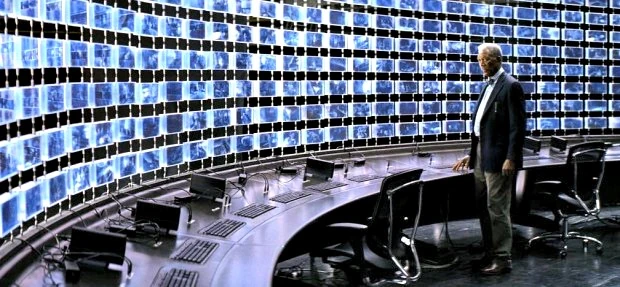
During the Superbowl there was an amazing Rorschach test masquerading as a feel-good Ring doorbell commercial.  For those who missed it, find it here.  Essentially it touts a new service where neighborhood networks of Ring doorbell cameras can combine with Amazon AI to find a lost dog based on an uploaded photo.  Half the population reacted, "isn't that wonderful" and the other half of viewers, of whom I am one, reacted "that's freaking scary."  The network of camera feeds in the commercial looks very similar to Batman's (admitted even by him) dystopian cell phone surveillance array in the Dark Knight.
This is exactly the sort of wedge strategy that our public and private control freaks use to normalize dystopian systems and technologies.  You don't sell surveillance out of the gate with a system that tracks down a person in the neighborhood behind on taxes or child support.  No, you sell it as a system to find that adorable lost dog (notice not even generic pets or certainly not cats because dogs are the new children for this generation**).  They can fight all the backlash by saying, "Oh come on, who can be against finding lost dogs?"  Then, months or years later, the terms and conditions have morphed and broader search capabilities are enabled without the user even knowing (I own a Ring doorbell and I guarantee I never knew this feature was turned on by default or even existed). When it really gets scary, they are not even going to tell you about it.

I do not believe this is just a marketing mistake -- Ring appears to have adopted neighborhood surveillance as their core business model.  I have had a Ring doorbell for years and in its basic form of sending doorbell chimes to your phone and allowing you to see who is at the door and even talk to them remotely, it is a nice product.   I have always liked it.  But over the years I have noticed Amazon/Ring slowly morphing the app from just a doorbell / security tool into a neighborhood surveillance network.  If you have the app, you can see that most of the functionality is now about messaging and notifications shared around the neighborhood, generally dominated by local Karen's putting up panicky posts about someone they saw they thought was creepy.  In the main menu of the app, the very first option after a link to the dashboard is called "neighbors."  This is the neighborhood watch group on steroids.

As a libertarian, what do I have against private neighborhood voluntary surveillance networks?  Nothing, but this is neither voluntary nor private.  As for voluntary, this functionality was added on an opt-out basis with zero notification, at least until this commercial came out.  But what about privacy?

Well, I spent more time in the app yesterday than I probably had cumulatively over 5+ years.  The first thing I did was turn off this advertised feature.  From the main menu (the three bars in the upper left) you need to choose control center (not settings) and then scroll way down to "search party" (that is what they call it, to evoke maybe a bunch of guys with St Bernards looking for a lost hiker) and turn it off.

So while I was in the app I started trying to see if there was a way to block Amazon from sharing all this with the government or other third parties.  There is an intriguing option in the control center labelled public safety which says it controls public safety agency notification settings -- maybe one can block sharing with the government?  Nope.  Turns out this option is just to change what police and other agencies can post to your neighborhood feed.

In the same control center there is a privacy tab.  I clicked on that, but there are no settings.  Only a promise to be really really nice  and make our privacy their highest priority but no specific commitments on data privacy.  Also note the use of "neighbors" over and over.  It is as if they are trying to establish some right to collective privacy (whatever the f*ck that is) instead of individual privacy.
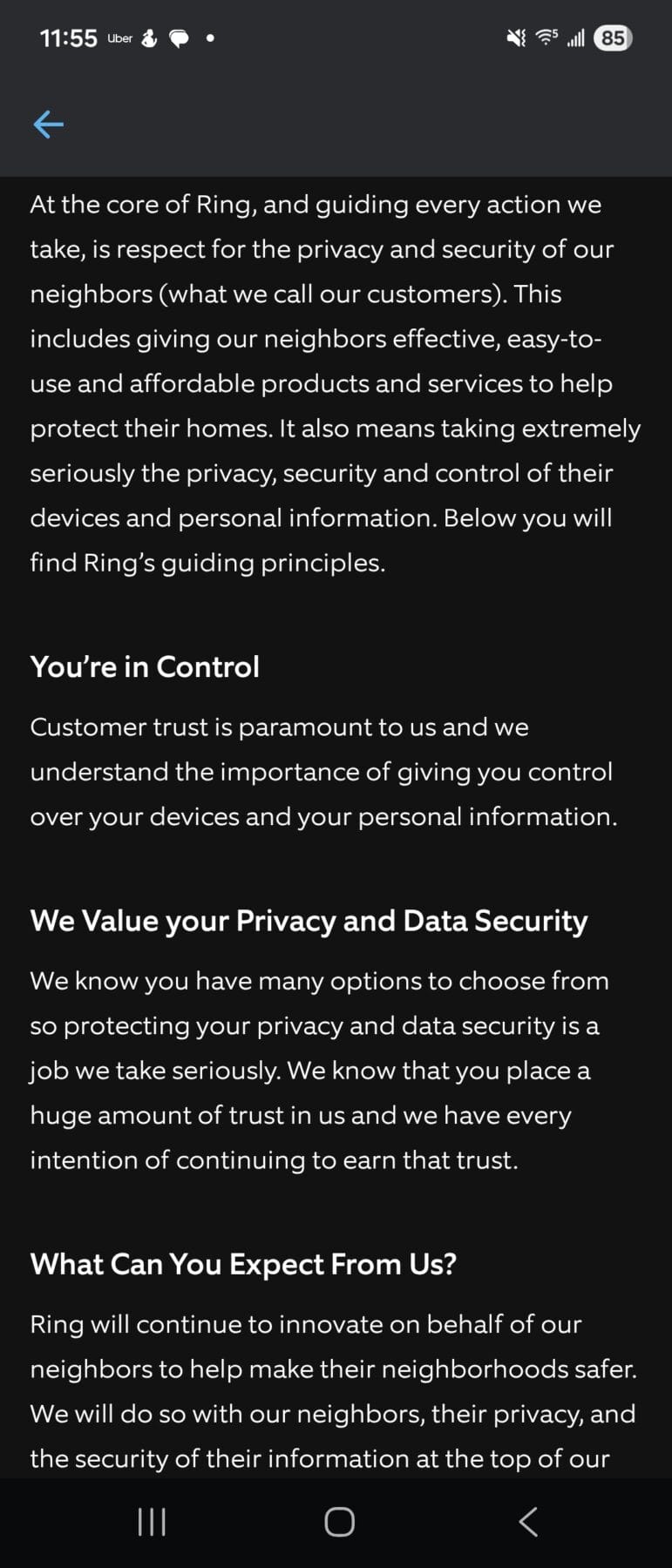
But it does say that I am in complete control so maybe there is a data sharing option somewhere else.  Further down we finally get to the "data management" option.  It says "Request a copy of your data, manage third-part access, or delete your data."  There we go!  Here is the screen you get:
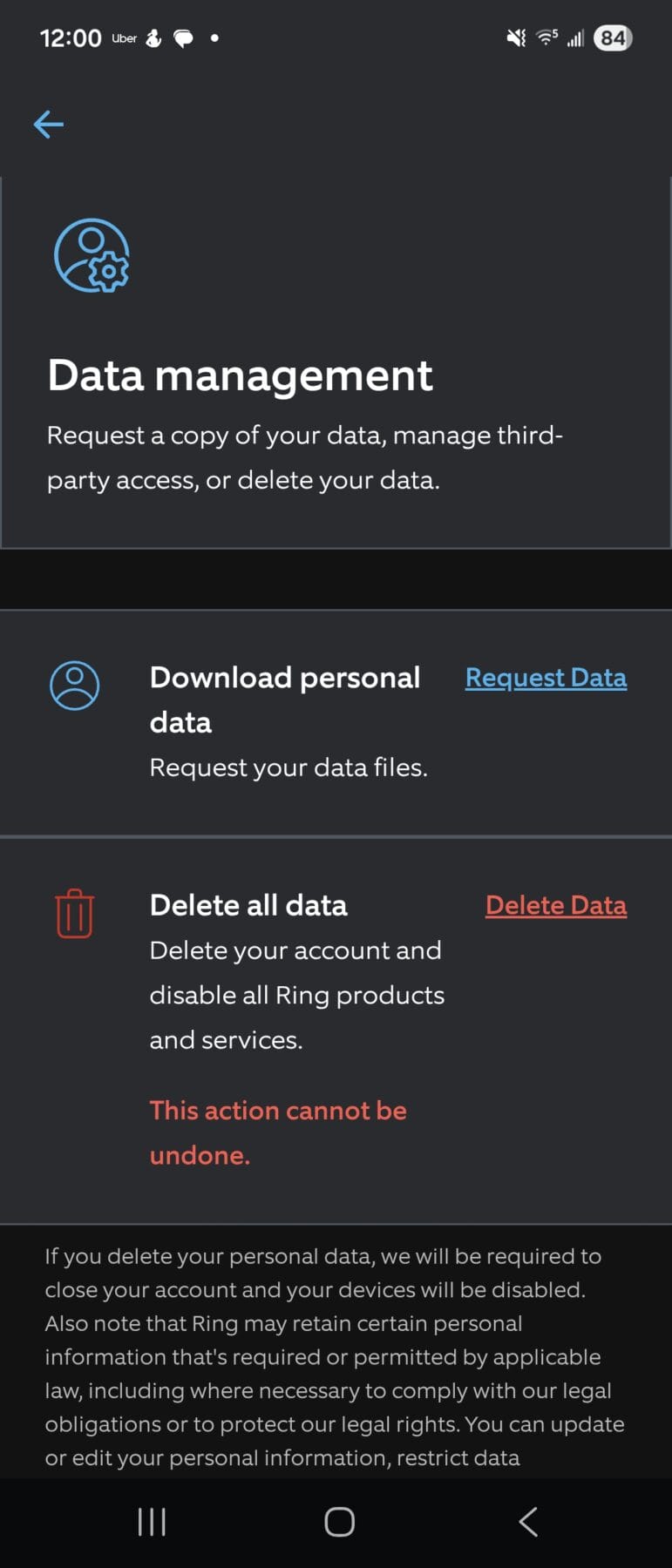
This is the whole screen. Notice anything?  As promised, you can download your personal data, I guess just to see what the CIA is looking at.  You can delete your data, at the cost of bricking your products.  But there is no actual option to manage 3rd party data access.  It is promised in the privacy statement, it is promised in the menu header, but it does not exist.  After an hour on their site and in the app, I still don't know who has access to my doorbell camera image.


**footnote: The other day in Orange County CA I was doing my 4 mile walk through some neighborhoods and I passed 4 young (at least relative to me) women pushing strollers.  When I looked, all 4 strollers had dogs in them, not children.  Some time ago someone said (sorry I can't give credit, can't remember) "dogs are the new children, plants are the new dogs."  I didn't really understand that until recently but I believe it.  I can't remember an airline flight I have been on that had more babies in the cabin than dogs.

Who is the Tax Evader?

Kevin Drum, referencing an article by Christopher Caldwell, says

What is Amazon.com's biggest advantage over its competition? One-click ordering? The ability to go shopping in your pajamas? Its enormous selection? Those all play a role, but Christopher Caldwell thinks the real answer is the fact that Amazon's customers mostly don't have to pay state sales tax...

The latest state to insist that Amazon collect state sales taxes is California. Amazon's response? As in Illinois, they summarily severed the contracts of every one of its affiliates in the Golden State. But that's not all. Like mafia goons going to the mattresses in a gang war, Amazon immediately announced that it would spend millions of dollars to place a referendum on the ballot to nullify the new California law. And in the meantime? Law or no law, they won't be collecting sales tax in California, and that's that.

Amazon customers do have to pay sales taxes, or the substitute in states called a use tax.  So the wording in the post in technically incorrect.  The correct statement is that Amazon does not have to collect the taxes as an agent of the state.

Both Mr. Drum and Mr. Caldwell are likely required by their state to report out of state purchases from online suppliers and pay taxes on these purchases.  Most people don't do it, and I would bet that both Drum and Caldwell do not.  If I am wrong, Mr. Drum is welcome to post a copy of his return.  Otherwise, he and Caldwell are the ones illegally evading taxes, not Amazon.

Clarification: I personally couldn't give a rip about these gentlemen evading taxes the government chooses not to enforce.  Join the ranks of tax protesters, guys!  The point of the post is hypocrisy.

New Kindle?

Via Engadget:

Looks like the rumor of a new larger Kindle is true. Amazon just sent us an invitation to a press conference scheduled for Wednesday, May 6 at 10:30am ET. You know what Amazon does at press events? It launches new Kindles!

As noted by Peter Kafka over at All Things Digital, the location of the Amazon event -- Pace University -- is the historic, 19th century HQ to the New York Times which is said to be partnering with Amazon on the larger Kindle. That makes for a perfect symbolic bridge from old to new media. We'll have to wait and see if newspaper subscribers can be lured across.

I was an early Kindle adopter and love my Kindle 2.  My only complaint is the lack of electronic versions of a lot of older books I would like to read (example -- various James Clavell novels) but I am hoping this is similar to the early phase of CD's and DVD's when publishers had not yet seen the market or had the time to convert older music and movies to the new media.

Price and Value

I am an early-adopter of the Amazon Kindle and must say that I have been thrilled with it, despite a number of design flaws I hope to see fixed in the new version.  Most of my complaints have to do with industrial design, not with the feature set  (from an industrial design scale where iPod=10 and the original MS Vista packaging =0, the Kindle and its case were about a 4.)

I was perusing a number of "reviews" of the Kindle 2 today.  Pre-release reviews can have a really wide spread, as they tend to be populated either by insiders who are trying to promote the product, or by folks who haven't used the product but have some problem with its basic concept (or manufacturer) they want to vent on.  Which makes pre-release reviews worthless.

One such person in the second category is "Bohemian," who seems to want to vent on Kindle because it is not open source, DRM-free, etc.  He is also upset that it does not have built-in solar power, lol.  But the line that really caught my eye is this one:

Overpriced - should be around $100

That is hilarious to me.  The Kindle has been absolutely sold out (at the current price of $300-$400) for months and months.  There is a waiting list, particularly since Oprah recommend it.  So how is the price too high?  My take on it would be the price is too low, since even at $359 demand is exceeding supply.

This is a common mistake by people across the political spectrum -- mistaking one's own personal assessment of value with what a price "should" be.  The correct statement for this review would have been "I would not pay more than $100 for this product."  And in a free society, he doesn't have to buy it.  But obviously there are a lot of people, in fact more people than Amazon can currently satisfy, who think the Kindle is worth at least $359.

By the way, one other note on DRM and proprietary platforms.  I am the last one to spend much time defending DRM, but proprietary platforms are totally normal for new technologies.  The thing that is often ignored about the Kindle is that ... it just works.  You log on, download the books you want, and they are there in seconds and display correctly and reliably.  I lost my first Kindle, and when the second one showed up, all my books from my first Kindle where already on my second.  No crashes, no need for tech support.

People give Microsoft loads of well-deserved cr*p for problems in its software and for playing too many proprietary tricks, but the real reason PC's can be a pain and can be tech support nightmares is because PC's are not very proprietary -- they are really a wide open platform, and try to integrate a hodge podge of components and software from a variety of sources, and sometimes things inevitably go wrong.  People tend to forget that the reason the Mac and the iPod are so compelling in the user-friendliness and stability is that they are proprietary, tightly controlled platforms.

I personally prefer the PC, because I like the flexibility and am not scared off by the occasional integration challenge.  Over time, I have realized that I am in the minority.  Most people want their electronic devices to freaking work, and don't care if they don't have access to the 100-item micro-configuration menu and probably will never have a desire to transfer the book file on their Kindle to be read on the LCD on their refrigerator.

Perfect Gift for the Holidays!

From the Business Opportunities Weblog:

Continuing my list of my favorite business books of 2007 brings us to another unconventional one: BMOC.
While the book, by Warren Meyer, is fictional, it does contain a number
of interesting business ideas, including my favorite outlandish
business opporunity of all time: fountain coin harvesting.

Amazon link for BMOC here  (sorry, I tried to get the price cut for the holidays but it really takes a long time for that to work through the system).