Everyone Except Me, I Guess

Barack Obama, in the Washington Post:

By now, it's clear to everyone that we have inherited an economic crisis as deep and dire as any since the days of the Great Depression

Sorry, maybe I am just cynical from having politicians call 8 of the last 3 recessions the worst economy since the Great Depression**, but I don't think this is the worst crisis since the 1930's.  It's not even the worst since I was born.  The late 70's were worse, the early 80's were worse, and from a financial/banking crisis point of view, the late 80's were worse.

What Americans expect from Washington is action that matches the urgency they feel in their daily lives -- action that's swift, bold and wise enough for us to climb out of this crisis.

Actually what I have come to expect is arrogance, a desire to turn any crisis into increased power for Washington, and general incompetence.  So far, I have not been disapointed.

Our economy will lose 5 million more jobs. Unemployment will approach double digits.

OK, I will take that bet.  5 million more jobs with the base being the January employment numbers.

I won't get back into all the Keynsian arrogance in the rest of the piece -- suffice it to say that the overwhelming assumption is that the government can spend money more productively than can individuals.  But check out this economic jumble:

In recent days, there have been misguided criticisms of this plan that echo the failed theories that helped lead us into this crisis -- the notion that tax cuts alone will solve all our problems; that we can meet our enormous tests with half-steps and piecemeal measures; that we can ignore fundamental challenges such as energy independence and the high cost of health care and still expect our economy and our country to thrive.

I reject these theories, and so did the American people when they went to the polls in November and voted resoundingly for change. They know that we have tried it those ways for too long. And because we have, our health-care costs still rise faster than inflation. Our dependence on foreign oil still threatens our economy and our security. Our children still study in schools that put them at a disadvantage. We've seen the tragic consequences when our bridges crumble and our levees fail.

Is he really implying that our economic problems were cause by use of fossil fuels, health care costs, aging bridges, and classrooms with out enough computers?  Why yes, he seems to be saying just that.  The rest of the piece is dedicated to just those things as a solution to the problem. Seriously, what does any of this have to do with a recession spurred by 1) banking liquidity crisis 2) loss of consumer new worth through falling home prices and 3) panicky statements by senior government officials.  The answer, of course, is nothing.   Basically Obama is pursuing the old "this crisis will be solved by all the piecemeal programs I was pushing before the crisis" argument.

I am sure there are folks who believe these things, if done well, might increase GDP 10 years from now, but is there anyone who really thinks this will create 3 million jobs in the next 18 months?  I am reminded of the old joke, how do you make a million dollars in real estate?  Start with 10 million.  In the same vein, how does the government create 3 million new jobs?  By destroying 5 million others.

By the way, speaking of bait and switch, these solutions Obama focuses on - health information, energy projects, school rebuilding, and highways - account for at most 6.5% of the total tax cuts and spending programmed by the stimulus bill for the first 2 years (34.1 of 525.5 billion, which is a bit outdated because it is based on a CBO report of last week, and has not kept up with the new pork added by Congress since then).

I just can't believe this guy actually represents change for people.  To me, he sounds like a total flashback of every politician from the 1970s, who used to flail around with just this type of rhetoric.  What's next, Whip Unemployment Now?

**Footnote I think I am going to try to trademark "Worst Economy Since the Great Depression" like Pat Riley trademarked "threepeat."  Or maybe just trademark "WESGD."  Here are a couple of past examples:

Clinton / Gore 1992: "Mr. Gore lambasted Mr. Bush for what he called 'the worst economic performance since the Great Depression'".  The US unemployment rate peaked around 7.8% in 1992 and was headed down towards the 6's by the time Clinton was inaugurated.   The 1991-1992 recession turned out to be one of the shortest on record.

John Kerry, 2004: "In his Sept. 2 speech in South Carolina, Kerry claimed the U.S. is suffering 'the greatest job loss since the Great Depression.'"  The 2004 unemployment rate peaked at 5.8% and was headed down into the fours during Bush's second term.  The 2003-4 recession was almost as short as the '92 recession.

For perspective, via Carpe Diem, initial jobless claims as a percentage of the labor force:
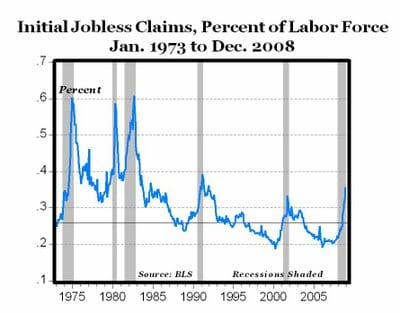
claims2

Prediction: Resurgence of Options in Executive Compensation

Announced today:

President Barack Obama on Wednesday imposed $500,000 caps on senior executive pay for the most distressed financial institutions receiving federal bailout money, saying Americans are upset with "executives being rewarded for failure."...

The pay cap would apply to all institutions that have negotiated agreements with the Treasury Department for "exceptional assistance." Those would include AIG, Bank of America and Citi.

Firms that want to pay executives above the $500,000 threshold would have to use stock that could not be sold or liquidated until they pay back the government funds.

I don't get too worked up about this one way or another.  Once the government is a part owner of these companies, it is perfectly reasonable to expect them to dabble with things like compensation policy, and no surprise that focus of such dabbling would fall on whatever particular hobby horses the party in power seem to obsess about.  Which is reason #4097 why government shouldn't be bailing these guys out.

In terms of executive compensation, options have fallen a bit out of favor as executives have sought more of a guaranteed payday, and changing accounting rules and more scrutiny have made that harder to do with options.  The concern is,  of course, stock prices can fall or even go to zero and that part of the compensation package would be worth zero.  Executives are generally happy to take risks but only with other people's money (people who take risks with their own money are called entrepreneurs).

But in this case, most of these companies' stock is at what is likely to be the bottom, and each has the commitment of the government now not to let them go bankrupt, so the danger of stock values going to zero is, well, about zero.   Would you take warrants in a company priced at the market trough and with the US government guaranteeing the floor beneath you?   I can't think of a better time to get equity or option-based compensation, and so expect to see a lot of it in order to circumvent the $500,000 limit.  And a lot of big paydays 5-7 years hence.

My Fervent Hope

That I never get my business in a situation where I have to spend $45,000 just to lay off a worker.

General Motors is offering buyouts to virtually all of its remaining hourly workers, becoming the latest automaker to try to cut labor costs by giving nervous workers an incentive to leave the company.

The move follows a similar move by Chrysler LLC, which made an offer to its hourly workers on Monday.

The GM (GM, Fortune 500) offer, which takes effect Friday, is less lucrative than the deal proposed by Chrysler, or even offers that GM has made to its hourly staff in the past. The automaker will give most of its 62,000 U.S. hourly workers $20,000, as well as a voucher good towards the purchase of a GM car worth $25,000.

In the past, GM offered between $45,000 to $62,500 to workers to retire early, and $140,000 to employees who left the company and agreed to give up post-retirement health care coverage. Those offers were all cash.

Seriously, is this driven by GM contracts, or is this just GM's choice as an alternative to firing everyone?  There are cases when it makes sense for a company to go through the added expense of worker buyouts vs. layoffs.   The buyouts avoid the bad press of a layoff, they help maintain the company's reputation in the remaining workforce and community, and may not be a bad investment for a company temporarily on hard times that knows good times, and the need to hire more quality employees, are just around the corner.

But seriously, do automakers really have anything to lose at this point to lose?  And if the main reason for buyouts over layoffs is reputational, is this really what we want our tax money funding, the maintenance of the good name of GM management?

Vegas, Baby

Apparently Wells Fargo is catching grief for having an internal conference in Las Vegas.  Tigerhawk defends Wells Fargo.  I don't know if the meeting if the meeting made business sense to hold in the first place (and I don't want to be in the business of caring which is yet another really good reason for the government not to be investing my money in these companies).  But I can tell you that Vegas makes tons of sense for a business conference.

My company has managers located all across the country, which makes it sound like we might be a really big company but in fact we are not.  It just turns out that we have a process that allows us to accept relatively small contracts around the country and still turn a profit.  Being small, and with profit margins well under 10% of revenues, I can assure you that we do not spend any money on items or events that are frivolous or superfluous boondoggles.  Against this backdrop, here are two things I can say with confidence:

  • You have to physically gather all you key managers and/or employees in one place from time to time.  No amount of teleconferencing and email can substitute for occasional face-to-face meetings.  We get all of our managers together for a week once every two years, and I wish I could afford to do it more often.
  • Given the fact that we have to meet somewhere, Vegas is just about the cheapest place in the country to hold a national meeting.  There are tons of cheap flights there from everywhere.  And since the hotels have  away of earning money from visitors that most other hotels in the country do not have (ie from gambling) they discount the rooms below equivalent quality rooms in most other large cities.  On top of this, every hotel I have used for a meeting in Vegas had great meeting facilities and really knew how to provide meeting and catering services.  Finally, many (but not all) of my employees love to go to Vegas, and consider the trip a treat/reward.  So, I get a positive reaction from my employees for taking them to one of the cheapest possible places.  A win-win for sure.

Update on Light Rail Alternative

Yesterday I posted on a new bus system Phoenix is implementing but that appears to cost 30x less than the light rail system we just built.  I wrote Randal O'Toole of Cato, also known as "the AntiPlanner," to see what he knew about this system.  Here is what he was wrote back"

Yes, I've written about it a lot. The best system is in Kansas City, where they didn't feel they had to spend $750,000 to make a $300,000 bus look futuristic.

Take a look at my blog, http://ti.org/antiplanner and search for "bus rapid transit" to see some articles on better bus service. Here is the article about Kansas City BRT: http://ti.org/antiplanner/?p=102

Here is an article about Eugene's bus-rapid transit, which was a stupid waste of money: http://ti.org/antiplanner/?p=21

The only thing good about it is that it didn't waste as much money as light rail. But that's like saying you'd rather be stabbed in the heart with a three-inch knife than a six-inch one.

The Eugene mess he refers to has the city building a dedicated bus lane, something Phoenix fortunately is not considering, opting for a traffic light transponder approach rather than dedicated lanes to try to hold schedules.  Here is a snippet of what he wrote about Kansas City:

In 2005, Kansas City did a wonderful thing: It started a bus-rapid transit system the way bus-rapid transit ought to be done. The transit agency didn't spend hundreds of millions of dollars building exclusive bus lanes. It didn't buy million-dollar buses just to have a semi-futuristic look.

Instead, it simply began running buses on existing streets on rail schedules. That is, the buses stop only once per mile and the operate three to four times every hour from 4:20 am to 11:20 pm. The greater frequencies and faster buses increased ridership by 25 to 30 percent (see page 11), and most of these new riders were new to transit.

The city built inexpensive but easily identifiable transit stops for the route. The buses were regular buses but were "branded," that is, painted in an easily recognizable style. In short, Kansas City achieved the kind of ridership increases that light rail would achieve for a tiny fraction of the cost.

In other words, the basic idea makes great sense, but spending a million bucks a bus (as Phoenix plans) just to make the bus look like a train is crazy.

All true, but I might be willing to give in on the more expensive busses if thats what it takes to kill this crazy infatuation with steel rails.   In the Phoenix Mesa Link example, they are probably spending $4.5 million too much for the train-like busses, but if that gives public officials the ability to walk past the light rail buffet and save the $800 million extra rail would have cost, I might consider that a good investment.

Light Rail Alternative

Apparently, Phoenix is experimenting with a new style of bus transport that looks and operates like a train:

The Mesa Link debuted the same week as light rail. For now, Link involves a fleet of 10 buses. Each $756,000 vehicle carries a transponder to coordinate traffic lights and keep the bus on schedule for a 12-mile run in 45 minutes.

It's the start of a much more ambitious program.

Over the next few months, the Regional Public Transportation Authority, which coordinates Valley Metro bus service, will build stations and add technology to the Mesa line to give it more of the pace and feel of a train.

Basically, they are building the thing to look and operate like a light rail train, only running on tires on the existing road.    The travel time may seem slow, but it is nearly identical to the average speed of our light rail line (20 miles in a claimed 70 minutes, though a number of riders say its slower).  And the capacity is nearly identical.

So with the same speed and the same capacity and similar scheduled service with similar style stations, here is the real appeal:

In 2010, a second line will be created to run 12 miles along Arizona Avenue in Mesa and Chandler. It will feature 10 stations and cost $28 million for construction and the purchase of nine buses. Future lines are planned for Scottsdale Road, Baseline Road and Chandler Boulevard.

The 20-mile light-rail line cost $1.4 billion to build.

Holy cr*p.  $70 million a mile for light rail vs. $2.3 million a mile for this system.   That is 30x cheaper.  The only discernible difference is one runs on steel rails and the other on tires.  Oh, and the rail line, in most places it was built, completely removed up to two lanes of existing roadway capacity, while the bus-type system leaves the roadway intact and just uses a fraction of one lane's capacity.

Now, I would have to sit down and look at the numbers and the service profile to decide if this new bus system made sense financially vs. the old bus system, but why are we even considering extending light rail?  And why oh why did we build this white elephant in the first place.

Conservatives and Police

Radley Balko is having a back and forth with a guest blogger at Patterico over the drug war and violent crime.  Balko is always worth checking out, because while many of us bloggers may call ourselves the new media, we are mostly just a bunch of op-ed pages.  Balko is one of the few major bloggers out there doing real reporting.

One part of the discussion caught my attention:

Second, JRM leaves out the rest of my discussion of police militarization in the piece, which includes the very real, not-made-up statistic based on police department surveys done by Peter Kraska showing the number of SWAT deployments in the U.S. jumping from a few hundred per year in the 1970s to 50,000 or more per year today. Most of these SWAT deployments are to serve drug warrants. JRM can disagree, but my point is that even if these raids don't produce a single gun shot (though we know that's far from the case), that's a disturbing trend. The image of state agents dressed in black, kicking down doors, and wresting people out of bed at gunpoint in order to police nonviolent crimes just isn't one I associated with a free society (oddly enough, some prominent conservatives agree, at least when other countries do it).

Perhaps because I read this as my inbox is filled with Minuteman missives (I don't know how they got the impression I was somehow sympathetic to their cause) asking me to send a valentine to agents Compean and Ramos, but I sometimes really wonder about conservatives.

Conservatives distrust government and government bureaucrats.  Many understand public choice theory.  Many understand how faulty incentives within government can turn even good, smart people into stupid bad actors.

So I am left to wonder why conservatives feel ever so much better about the situation when the government employee is given a gun, and the unique authority to use it on the citizenry?

Coyote Blog First Ever Roundup Post

I don't really do news roundup posts, because losts of other folks do them better.  But there were a few things I wanted to blog on today and just don't have time, and rather than lose them, here they are briefly:

  1. Twitter seems to be the data mining tool of the future.  I have seen a number of dynamic maps and graphs of late using Twitter data.  The NY Times has as good of an example as any with this dynamic map showing twitter content by city and time during the SuperbowlFlowing Data has a bunch more.   Just remember the rules before you data mine:   Cool, trendy application run by hip Internet guys  -- data mining OK.  Bad evil credit card company trying to make billion dollar credit decisions -- data mining not OK.
  2. This is one of the first times I have seen an Internet contest like this go on for so long without a  winner.  Twelve structures, you just need to say which is a church and which is not.
  3. There has always been a certain cognitive dissonance between a) media portrayals of employment at Wal-Mart as equivilent to a new ring in Dant's inferno and b) the reality of lines hundreds of persons long for just a few job openings at Wal-Mart.  Charles Platt was curious about this too, and so set out to work at Wal-Mart to see what it was like.

HT:  Maggie's Farm for the second two.

Repeating Mistakes Over, and Over, and Over...

I have come to the conclusion that politicians believe Americans all have Alzheimers.  And, given the lamentable state of the media, they may be right.

Example 1

We can argue about stimulus and the Depression all we want, but I had, until the last few days, thought the absolute one thing we all 100% agreed on is that the Smoot-Hawley tariffs and the trade war they sparked were one of the leading causes of the worldwide economic death spiral in the late 20's and 30's.  Or not:

The stimulus bill passed by the House Wednesday contains a controversial provision that would mostly bar foreign steel and iron from the infrastructure projects laid out by the $819 billion economic package. A Senate version, yet to be acted upon, goes further, requiring, with few exceptions, that all stimulus-funded projects use only American-made equipment and goods.

Here is a nice story of another "Buy American" steel fiasco.

Example 2

Last year -- I am talking about just 3 months ago -- I thought it was fairly clear that the immediate cause for the financial meltdown for which the TARP bailout was being crafted was the systematic relaxation of underwriting standards that led to large numbers of loans (and their lenders, securitizers, etc) going belly-up.  Folks could argue whether this was because of deregulation or greed or government distortions and interventions, but I thought there was not doubt that poor credit judgment and excessively free credit were at the heart of the problem.  Or not:

House Financial Services Committee Chairman Barney Frank said President Barack Obama will require banks receiving government aid to lend more to businesses and consumers, saying the Bush administration "made a mistake" by not setting stricter rules for institutions getting funds from the $700 billion financial-rescue package.

"I think you're going to see the Obama administration, having learned from that, push for much more lending," Frank said today on ABC's This Week. "There are going to be some real rules in there."

So Frank and Obama are upset that the bailout of banks that were overgenerous on credit did not include provisions to force them to be more generous with credit?

Final thought: At the end of the day, businesses and individuals have a felt need to deleverage.  That is going to cause a recession, end of story.  The Congress's and Obama Administration's obsession with short-circuiting this sensible desire to reduce debt is not only counter-productive, it is offensive.  Banks are sensibly trying to strengthen their balance sheets, but the government wants to stop them.  Individuals are trying to cut back on spending, reduce debt, and save more.  Again, the government wants to stop them, by going to debt and spending for them if consumers won't do it on their own.

Government Licensing = Incumbent Protection

I have written on this topic quite a bit, but via Cato comes another great example of how licensing and regulation, while promoted as consumer protections, much more frequently are incumbent protection against new competitors.  Cato has a video of some folks in Oregon who started a moving business, only to find that sate law effectively requires them to get permission of current moving companies before they can operate  (apparently, someone in Oregon is enamored of medieval guild systems).

How the law works is that when a new mover submits his application for a business license, existing movers can file an objection (which apparently is pro forma).  The new company must then justify to the state why another moving company is justified by the marketplace.  Of course, absolutely no guidance is given how such a thing might be proven.

I would have found this unbelievable, had not my company faced the exact same requirement in another context.  In Shasta County, California, we wanted a liquor license to sell beer at the store we run at McArthur-Burney Falls State Park.  We were told that we could not have a license until we had proven to the County that there was enough demand for another liquor outlet.  It was for our protection, they told me -- we wouldn't want you to get in a situation where you might fail.

I have written about liquor licensing before - if ever there was a regulatory regime whose time was long past, this is it.  The extensive fingerprinting and background checks one must go through to get a license are outdated remnants of a concern for the return of organized crime, a problem that was obviated by legalization  (so that, as usual, the government regulatory regime to fix a problem was instituted at the same moment the problem went away).  Now, the liquor licensing process is used as a club by existing competitors to keep new entrants out.  My bet is that organized crime is now on the other side of the fence, using the liquor licensing process to hammer honest competitors.  And if you really want to see abuse, read the whole Rack 'N Roll saga by Radley Balko.

I bet you are just overcome with suspense wondering if we got our license.  In Shasta County, we eventually succeeded, mainly because the store was in a gated park with an entrance fee, and we could make the argument that competition did not really cross the gates of the park.  Years later, we lost a similar battle in Lake Havasu City, AZ, where a group of local business people have really organized the town to their benefit and use every tool they can, from zoning to licensing, to keep competitors out.

Top Arizona Campgrounds

I don't often mix stuff in about my business, but two of our Arizona campgrounds - Manzanita and Cave Springs, both in the Sedona/Oak Creek Canyon area, were named to the top 10 Arizona campgrounds list by CampArizona.com.

While I am on business news, the NFRA, our trade group, is having its annual conference March 3-5 in San Diego California.  The conference focuses on privitization of public recreation, and may be of interest to any number of public recreation authorities who are currently struggling with budget issues.  Our company alone runs over 100 public recreation facilities, keeping these facilities open to the public and turning an operating cost for public authorities into a source of income.  I am trying to teach our trade goup to blog, and their formative effort is here.

Photosynth

Demonstration of Microsoft Photosynth technology using an collection of inauguration photos.  The arrows at the bottom take you to other mosaics.  Move the cursor over the picture, it white quadrilaterals will appear - these are photo views you will get if you click on it.  Kind of cool -- you could imagine this in a movie, with police hunting for the killer in a large public even, searching through photos, yada yada.

Gratuitous Umlauts

Doogie Horner creates a classification system for heavy metal band names that pretty awesome (click to enlarge).

flow_heavymetal

I saw it first at FlowingData, a website and blog about the graphical representation of data that I can't believe I have never visited before.  Other cool graphics include the Walmart growth video.  Lots of ways to waste time on this site, if you are a geek like me.

Are We Crazy?

I don't think younger folks really comprehend the staggering environmental improvements we have made over the last 40 years.   Virtually every metric you can think of on air and water pollution has improved, not to mention the return to health of a number of high-profile species like the bald eagle.

So I am sure that had you told me in the early seventies that the main toxic threats that the government would be campaigning to protect us from in 2009 were carbon dioxide and salt, I would have thought you were crazy.

Mommy, Mommy, I'm Scared

Via the environmental blog Thin Green Line:

Check out this post on Bay Area Moms revealing that products with high fructose corn syrup contain mercury. Scary!

I have had some experience working with recreation on lakes that have mercury-contaminated fish  (not good for business) so I thought I would check out the articles.  Mommy Files blog here.  Advocacy group quoted here.  Actual study here.  Test results here.

This strikes me as being right at the focal point of where both the environmental and consumer protection movements went off the rails -- the issue of relative risks.  In short, risks for things with scary names (mercury and radiation being two great examples) cannot seem to be processed rationally.  Everything is toxic, at some concentration.  The key is understanding concentration and relative risks, and not panicking when anyone yells "mercury" in a crowded grocery store.

Before I get into this more, it is a little hard to discuss because I can't really find in the study or the advocacy press releases what forms the mercury take in the HFCS -- it may be they just don't know yet.  The form the mercury is in matters.  Most people would be surprised, but while pure liquid mercury is not good for you, but it isn't particularly toxic when compared to other forms  (just ask Sir Isaac Newton, who used to drink the stuff).  Mercury vapor is really bad, as are certain chemical derivatives of mercury, such as the form often found in fish.

So here is some perspective on mercury concentrations, again remembering these standards often apply to specific chemical variants.  The US legal limit on fish is 1 part per million, or 1 ppm.    The legal US limit on mercury in water is 2 parts per billion, or 2 ppb.  One might think that means the mercury in water is more dangerous, but it is actually in a much less dangerous form (according to my imperfect understanding) than the mercury in fish.  However, it is assumed that one drinks more grams of water a day than grams of fish.  This does not entirely explain the 500-fold discrepancy -- my guess is that this is also a matter of attention, as drinking water standards and contaminants get much more headline plan than for fish (again, in part due to a general inability, particularly in the media, to sort through relative risks).

So then we have HFCS.  The worst test value was apparently in Quaker Oatmeal to Go, which had a value of 350 parts per trillion (ppt).  In other words, the worst sample found anywhere had a mercury level nearly 6 times lower than the federal drinking water standard (2 ppb = 2000 ppt).   What this means is that you would have to eat 63 pounds of Quaker Oatmeal to Go a day to have the same mercury risk as drinking 5 liters of water at the federal standard each day.  And that is the worst product.  Only 17 of 55 products tested had any detectable mercury at all, and only 7 had concentrations over 100 ppt.

Don't even get me started on fish.  8 ounces of fish at the federal standard would have the same mercury as 1,429 pounds of Quaker oatmeal.  The risks are not even in the same ballpark.  The oatmeal risk is three orders of magnitude lower than the fish risk.   I wonder how many of the moms who now quiver at giving their kids oatmeal still feed their kids lots of nutritious fish?

The right way to write this story is not "scary!"  The right way to write this story is "Hey, we found some mercury where we did not expect it, this bears further study, but right now the concentrations are so far lower than you would find in many other everyday foods you eat or drink that it's not worth worrying about.  If you really want to protect your kids from mercury, stay away from fish."

Postscript: I lament the passing of sugar in favor of HFCS.  So often food activists gloss over this issue, preferring to imply it is some kind of corporate conspiracy to give us worse food.  But in fact, the main blame for this shift lies entirely on Congress, which maintains absurdly high sugar tariffs and a continued blockade of Cuba that give us among the highest sugar prices in the world.  Faced with this reality, food manufacturers cleverly found an alternative.   I prefer good old sugar, and implore Congress to ditch corporate welfare for sugar manufacturers

Phrase That Needs to Be Expunged From The Political Lexicon: "Peer Reviewed"

Yesterday, while I was waiting for my sandwich at the deli downstairs, I was applying about 10% of my conciousness to CNN running on the TV behind the counter.  I saw some woman, presumably in the Obama team, defending some action of the administration being based on "peer reviewed" science.

This may be a legacy of the climate debate.  One of the rhetorical tools climate alarmists have latched onto is to inflate the meaning of peer review.  Often, folks, like the person I saw on TV yesterday, use "peer review" as a synonym for "proven correct and generally accepted in its findings by all right-thinking people who are not anti-scientific wackos."

But in fact peer review has a much narrower function, and certainly is not, either in intent or practice,  any real check or confirmation of the study in question.  The main goals of peer review are:

  • Establish that the article is worthy of publication and consistent with the scope of the publication in question.  They are looking to see if the results are non-trivial, if they are new (ie not duplicative of findings already well-understood), and in some way important.  If you think of peer-reviewers as an ad hoc editorial board for the publication, you get closest to intent
  • Reviewers will check, to the extent they can, to see if the methodology  and its presentation is logical and clear -- not necesarily right, but logical and clear.  Their most frequent comments are for clarification of certain areas of the work or questions that they don't think the authors answered.
  • Peer review is not in any way shape or form a proof that a study is correct, or even likely to be correct.  Enormous numbers of incorrect conclusions have been published in peer-reviewed journals over time.  This is demonstrably true.  For example, at any one time in medicine, for every peer-reviewed study I can usually find another peer-reviewed study with opposite or wildly different findings.
  • Studies are only accepted as likely correct a over time the community tries as hard as it can to poke holes in the findings.  Future studies will try to replicate the findings, or disprove them.  As a result of criticism of the methodology, groups will test the findings in new ways that respond to methodological criticisms.  It is the accretion of this work over time that solidifies confidence  (Ironically, this is exactly the process that climate alarmists want to short-circuit, and even more ironically, they call climate skeptics "anti-scientific" for wanting to follow this typical scientific dispute and replication process).

Further, the quality and sharpness of peer review depends a lot on the reviewers chosen.  For example, a peer review of Rush Limbaugh by the folks at LGF, Free Republic, and Powerline might not be as compelling as a peer review by Kos or Kevin Drum.

But instead of this, peer review is used by folks, particularly in poitical settings, as a shield against criticism, usually for something they don't understand and probably haven't even read themselves.  Here is an example dialog:

Politician or Activist:  "Mann's hockey stick proves humans are warming the planet"

Critic:  "But what about Mann's cherry-picking of proxy groups; or the divergence problem  in the data; or the fact that he routinely uses proxy's as a positive correlation in one period and different correlation in another; or the fact that the results are most driven by proxys that have been manually altered; or the fact that trees really make bad proxies, as they seldom actually display the assumed linear positive relationship between growth and temperature?"

Politician or Activist, who 99% of the time has not even read the study in question and understands nothing of what critic is saying:  "This is peer-reviewed science!  You can't question that."

Carbon Tax vs. Cap and Trade

Coyote, December 2007:

I can for a moment place myself in a position where I would imagine being worried about CO2 and dependence on fossil fuels.  For someone who really cares about these things, here is what a rational energy plan would look like:

  1. large federal carbon tax, offset by reduction in income and/or payroll taxes
  2. streamlined program for licensing new nuclear reactors
  3. get out of the way

Ronald Bailey, today:

Interestingly, Sen. Bob Corker (R-Tenn.) suggested to Gore during the hearing that a better proposal would be to impose an across-the-board carbon tax which would then be reimbursed entirely by cutting the payroll tax.

He has much more on problems of cap and trade in the article.  I have written many times on a carbon tax vs. cap-and-trade, indexed here.

Another Selling Point for Phoenix Light Rail

Share a ride with a prisoner:

Maricopa County sheriff's deputies may soon begin taking some inmates to Fourth Avenue Jail on Metro light rail in a bid to cut costs.

The Sheriff's Office announced its intent to transport inmates using the light rail from 44th and Washington streets to the Fourth Avenue Jail in order to eliminate parking fees. MCSO estimates that the new system can save about $72,000 in transport fees.

Seems to be some funny economics at work if the city charges the Sheriff more money for parking a car at the jail than it does for at least 3 people to ride the metro.

Anyway, count on Sheriff Joe to ease any tension you might have with this share-a-ride program:

"There is nothing to be concerned or worried about as my deputies will be armed," Sheriff Joe Arpaio said in a press release.

Great, but who is going to protect me from the sheriff?  And why does this statement remind me of the famous Al Haig "Don't Worry, I'm in charge" press conference?

I Beat the Market

Almost exactly 10 years ago, on my son's 5th birthday, I bought him some large scale (G-scale) trains and track.  It was a logical present given that I have always been a model railroader myself, though with smaller scale trains (HO and now N) and a different approach (for example, I fabricated my own track rather than buying it).

Anyway, I bought 4 boxes of track from the leader in large scale, LGB, for $85 a box  (I know because the price tag is still on the boxes).  We used the track only lightly and indoors.  Over the holidays, 10 years later, we decided to get rid of it.  I almost just gave it way, but put it on eBay instead.

Well, apparently LGB went out of business, and its track is still very much in demand on eBay.  I sold the boxes for an average of $200 a box.  That is an annual return, even leaving out the use we got out of it, of 8.9%.  Compare this to the 10-year return of the S&P500 index as of 1/2/09 of -1.4%.  Can you say, "found money?"

Is Obama Exchewing Executive Power, Or Just Redirecting It?

Radley Balko is justifiably happy that Obama is chucking the the theory that the President can detain people indefinitely at his whim:

President Obama yesterday eliminated the most controversial tools employed by his predecessor against terrorism suspects. With the stroke of his pen, he effectively declared an end to the "war on terror," as President George W. Bush had defined it, signaling to the world that the reach of the U.S. government in battling its enemies will not be limitless.While Obama says he has no plans to diminish counterterrorism operations abroad, the notion that a president can circumvent long-standing U.S. laws simply by declaring war was halted by executive order in the Oval Office.

Key components of the secret structure developed under Bush are being swept away: The military's Guantanamo Bay, Cuba, facility, where the rights of habeas corpus and due process had been denied detainees, will close, and the CIA is now prohibited from maintaining its own overseas prisons. And in a broad swipe at the Bush administration's lawyers, Obama nullified every legal order and opinion on interrogations issued by any lawyer in the executive branch after Sept. 11, 2001.

It's worth emphasizing again here these steps Obama's taking effectively limit his own power. That's extraordinary.

But here is my cynical side coming out:  It is easy to limit your own power in areas in which you have no desire to exercise it.  Obama is doing great work here that needs to be done, but he is also not really giving up anything he cares to have.  I could just as easily have written a story that said that Bush took brave steps to limit the power of the executive branch over CO2 emissions.

When Bush wanted to listen to phone conversations or to hold people incommunicado for years, he could have gone to Congress to seek such authority, or used the authority he already had but which was (rightly) limited by oversight from the judiciary.  But terrorism was "too important" to bother with that stuff, so he did it by executive fiat.

So the real test, in my mind, is to see Obama's attitude towards executive power in an area where he really wants to get something done, and might not have the patience to wait for Congress.   Obama is a different kind of guy, right?  He would never expand executive power and short-circuit Congress just because he was in the hurry for something, would he?

President Barack Obama signed an executive order to force the auto industry to produce more fuel-efficient cars, an act he says will begin a new era of global leadership for the U.S.

I thought this was particularly clever rhetoric for continuing to gut the 10th Ammendment.

"The days of Washington dragging its heals are over," he declared, saying it should be easier for states to adopt tough fuel-efficiency rules. "My administration will not deny facts; we will be guided by them. We cannot afford to pass the buck or pass the burden onto the states."

We are not grabbing power here in Washington, we are just relieving them of the burden of governing themselves.

Update: By the way, I do believe the current version of the CAFE legislation gives the NHTSA and the EPA the ability to change the standard, so technically the administration has this power.  However, typically changes to regulations must go through a public disclosure, comment, and review process, with a number of key requirements like economic impact studies.  The reasons for these requirements is to try to offset (imprefectly) the enormous power Congress is delegating to the Administration in these regulations.

Per Wikipedia (yeah, take it with a grain of salt) the CAFE legislation says:

Congress specifies that CAFE standards must be set at the "maximum feasible level" given consideration for

  1. technological feasibility;
  2. economic practicality;
  3. effect of other standards on fuel economy; and
  4. need of the nation to conserve energy.

Obama, impatient with following the process (where have we seen that before?) cuts through it with an executive order.   No one has gone through this process of making these tradeoffs -- Obama and a few advisors picked a number and ordered it into being.  By doing so, he is in effect violating the spirit if not the actual text of the legislation in which the power to set CAFE standards was delegated to the agencies under him.

Peering Into the Details of The Stimulus Bill

The CBO is out with its scoring of the stimulus bill (pdf).  Kevin Drum seems to think it refutes my statement that it would be impossible to have any kind of real infrastructure impact in the next 1-2 years.  Drum says:

Specifically, they estimate that in the spending portion of the bill, $477 billion out of $604 billion would be disbursed either this fiscal year or in the next two fiscal years. That's 79% of the total.

I guess opinions can vary on this, but that strikes me as pretty good. What's more, most of the spending that comes in FY2012 or later is either for projects that simply take more than two years to complete (highways, school repairs) or infrastructure improvements that have long-term paybacks (renewable energy programs). There are a few other items in the out years that are more arguable, but they add up to a pretty small portion of the bill.

This is correct on its face.  But here is the issue, and what drives me crazy about politicians and their enablers like Drum.  This is being sold as an infrastructure bill.  And even by Drum's admission, all the infrastructure spending is in the out years, well beyond any reasonable time frame for the recession.

Picking through the report, the "spending"  (I object to calling tax cuts "spending") in the next two years, the recession window, is mainly in these categories ( I get slightly different numbers than Drum)

  • Tax cuts of $223.2 billion (lost revenue + outlays)
  • Transfer payments $202.2 billion
    • Unemployment & Child Support:  $42.2 billion
    • Health Insurance Assistance:  $36.6 billion (lost revenue + outlays)
    • Medicaid: $76.9 billion
    • Food Assistance:  $10.8 billion
    • Health and Human Services (unspecified):  $14.9 billion
    • Employment and job training:  $2.9 billion
    • School/College loans:  $14.7 billion
    • Housing assistance:  $3.2 billion
  • State government "stabilization":  $31.4 billion
  • Defense:  $6.2 billion
  • Other: $62.5 billion
    • Increase in department budgets  $28.4 billion (estimated, may be low)
    • Real infrastructure spending (mainly schools, federal buildings, highways, and other transit)  $26.7 billion (at most!)
    • Green energy / energy programs  $7.4 billion (at most!)

So do you see my point. The reason so much of this infrastructure bill can be spent in the next two years is that there is no infrastructure in it, at least in the first two years!  42% of the deficit impact in 2009/2010 is tax cuts, another 44% is in transfer payments to individuals and state governments.  1% is defense.  At least 5% seems to be just pumping up a number of budgets with no infrastructure impact (such as at Homeland Security).  And at most 6% is infrastructure and green energy.  I say at most because it is unclear if this stuff is really incremental, and much of this budget may be for planners and government departments rather than actual facilities on the ground.

So don't call this an infrastructure bill.  This is a tax cut and welfare bill, at least in 2010 and 2011.   I guess I can understand a rush to do things like the welfare pieces, but that would argue for splitting the bill, into an emergency transfer payment appropriation and a infrastructure appropriation that can be studied and debated in more depth.

But that is never going to happen, because what we see is a unique kind of political synergy.  The bundling of these two very difference spending streams gives yields two political advantages:

  1. The infrastructure piece, despite being less than 10% of the bill, allows politicians to call this "investment" and "green energy" and "infrastructure" which sell better with sections of the public than "welfare" and "transfer payments."  The minority infrastructure pieces allow Congress and Obama to call the bill new and forward looking, rather than the imitation of 1970s legislation that it really is.
  2. The emergency pieces of the bill allow politicians to stuff numerous bureaucracy increases and pork spending into the bill that would not stand up to scrutiny.  Despite the fact that much of this spending will not occur for years, they can keep saying "rush, emergency, hurry" to deflect scrutiny and criticism.

Update: The National Review has a lot more detail here.

Light Rail and Energy Use

Politics is full of premises that people take on faith without actually testing against facts.  One such premise is that light rail investments reduce energy use and CO2 output.  But data from the USDOT, as I posted before, shows that light rail at average occupancy and autos at average occupancy are in an energy dead heat.   Driving a hybrid or even high fuel efficiency conventional automobile, even solo with no passengers, uses less energy and produces less CO2 per passenger-mile than light rail.

A group critical of the Denver light rail system brings us another data point.  In their report (pdf), compiled from the official figures of the Denver transit authority, they claim:  (via the Anti-Planner)

Denver's light-rail trains use 4,400 British thermal units (BTUs) and produce 0.78 pounds of CO2 per passenger mile. By comparison, the average SUV uses about 4,400 British thermal units (BTUs) and produces 0.69 pounds of CO2 per passenger mile.47 In other words, people who ride Denver's light rail when gasoline prices rise are not saving energy: they are merely imposing their energy costs on other taxpayers. If oil prices rise again, people can save more energy by buying more fuel-efficient cars than by riding energy intensive rail transit lines

Quite a while back, I made a light rail bet.  I said that for the capital cost of constructing these systems, I could purchase every regular rider a Prius, and with the annual operating deficit each year could purchase gas for all these Prius's for a full year.  This bet has not yet proved wrong (LA example), even for heavy rail (Albuquerque example).  Now,though, in addition to being more cost effective, the hybrid is also more energy efficient.

Postscript: I am sometimes criticized for not including the highway construction cost in my Prius bet.   First, a new highway lane has far more capacity than most light rail lines, and is far cheaper to build.  I don't think anyone, even light rail supporters, dispute this.  Light rail is generally supported over highways for what I would call aesthetic reasons -- light rail just strikes some people as more elegant a transportation solution.  All the traffic carried by most light rail lines is generally a small fraction of a single highway lane.  The congestion argument is a chimera, and is never supported, even in the fine print of transit authority statistics.  From Denver's internal projections:

Now, RTD says the line will cost more than $600 million, which is a lot for a mere 11 route miles. Moreover, RTD has changed the proposed technology to something it calls "electric multiple-unit commuter rail," which sounds something like the Chicago Electroliners or some of the Philadelphia commuter trains.

For this high price, the DEIS reports incredibly trivial benefits. The proposed rail line is projected to take 0.0085 percent of cars off the road. Of course, that's for the region as a whole, but in the corridor it will take a whopping 0.227 percent of cars off the road. A handful of buses could do as well.

Cool Picture

At first I thought the picture here was pretty lame - big deal.  Composition, not great.  Detail, blah.  But then I started zooming in.  And in.  All the way to the point I could almost play the music from the sheet music of the band in the lower center of the picture.

Frédéric Bastiat, Call Your Office

From the AZ Republic:

The owner of a glass company accused of a $132,000 scheme to smash Scottsdale school bus windows and profit from the repairs has been indicted.

A Maricopa County grand jury returned the Jan. 22 indictment against Troy Jason Vollberg, 34, who was arrested Friday by Scottsdale police....

documents accuse Vollberg, owner of Tri-State Glass, of being the mastermind behind an effort nearly two years ago to bilk the Scottsdale Unified School District out of hundreds of thousands of dollars to replace broken bus windshields.

Investigators claim Vollberg paid Scott Sloan $5,000 to find a person to knock out the glass, and then paid Mike Olivares $15,000 in April 2007 to break out the front windshields of 70 school buses in a Scottsdale bus yard.

Vollberg, whose company was a subcontractor for the school district, charged the district $134,000 to repair the windshields.

Police documents say Vollberg pocketed the money and used it for a "trip to Las Vegas and new tires for his truck."

Arrested for acting on the broken windows fallacy!  If only we could do the same with the Congressional authors of the stimulus bill.

Only In France

Via Q&OFormer French President Mauled by Clinically Depressed Poodle

Former French President Jacques Chirac was rushed to a hospital after being mauled by his pet dog who is being treated for depression, in a dramatic incident that rattled the ex-president's wife.

The couple's white Maltese poodle, called Sumo, has a history of frenzied fits and became increasingly prone to making "vicious, unprovoked attacks" despite receiving treatment with anti-depressants, Chirac's wife Bernadette said.

As an aside, does anyone else of my generation remember the Saturday Night Live fake commercial for "Puppy Uppers" and "Doggy Downers?"  Do you remember how this seemed, you know, like a ridiculous spoof?  (video here).

Update: By the way, here is our white Maltese, who to date has not received any of the benefits of veterinary psycho-pharmacology, but who is a great dog none-the-less.

snugs4