Prosecuting Those With Bad PR

CEO's of companies struggling on the brink of failure often make happy, confident public statements that all is well.  Is that a crime?

Well, it depends on how you look at it.  It comes down to a CEO's fiduciary responsibility to the company's investors, and how that is regulated for public companies.  We think of fibbing to inflate the company stock poorly serves investors, but what about when the company is facing a liquidity crisis?  Isn't public optimism in a liquidity crisis exactly what is needed to serve shareholder's interests?  Consider Treasury Secretary Paulson, and his near criminal declaration of a financial crisis, and the effect these ill-considered statements have had on the economy.

It is hard for me nowadays not to think about Jeff Skilling, who sits in jail for making what the jury thought to be overly optimistic public statements about the company's financial health  (I know you are thinking that he was put in jail for all that off balance sheet accounting and gimmickry, but in fact the prosecution never chose to bring these charges in the trial).  Even Skilling's jury, which was pretty clearly predisposed to convict, seemed to acknowledge that he did not make these statements for personal gain.

So why is Skilling in jail and not, say GM CEO Rick Wagoner?  Wagoner was making a lot of happy-face statements just a few months before his company acknowledged they were facing chapter 11 if Congress did not bail him out.  For extra credit, Wagoner told Congress $15 billion would be enough of a bailout, when he had to have been pretty confident it was not going to come close to cover the hole he faced.

Tom Kirkendall asks some of  the same questions, and looking at the cases he cites, it seems fairly clear that the difference between prosecuted and un-prosecuted CEO's has more to do with their like-ability, celebrity status, and general PR position than their specific actions.

Postscript: I have actually been thinking about the Enron bankruptcy a bit lately for another reason.  Remember that massive natural gas shortage we had when Enron went bankrupt?  Neither do I.  That's because chapter 11 is a pretty well-oiled process in this country.  Enron shareholders, bondholders, and management lost most their investment (and their jobs) but Enron's productive assets and skilled employees didn't disappear.  Enron's assets were bought by other companies who hopefully will employ them more profitably and productively than Enron had.

The same goes for GM.  We have a well-understood and proven process for taking a company like GM through bankruptcy.  However, we are instead replacing this well-understood and practiced process with a new process, called something like "Congressionally-managed restructuring funded with taxpayer dollars."  Does anyone really think this new process is better than the one we have?  Its only advantage, at least to some, is that it may preserve some management jobs, and shareholder and bondholder value, at the expense of taxpayers and any real effort for long-term reform of how GM's assets are managed.

The Stimulus Time Delay

From the WSJ, via TJIC:

The stimulus bill currently steaming through Congress looks like a legislative freight train, but given last week's analysis by the Congressional Budget Office, it is more accurate to think of it as a time machine. That may be the only way to explain how spending on public works in 2011 and beyond will help the economy today.

According to Congressional Budget Office estimates, a mere $26 billion of the House stimulus bill's $355 billion in new spending would actually be spent in the current fiscal year, and just $110 billion would be spent by the end of 2010. This is highly embarrassing given that Congress's justification for passing this bill so urgently is to help the economy right now, if not sooner.

And the red Congressional faces must be very red indeed, because CBO's analysis has since vanished into thin air after having been posted early last week on the Appropriations Committee Web site. Officially, the committee says this is because the estimates have been superseded as the legislation has moved through committee. No doubt.

In addition to suppressing the CBO analysis, Democrats have derided it. Appropriations Chairman David Obey (D., Wis.) called it "off the wall," never mind that CBO is now run by Democrats. Mr. Obey also suggested that it would be a mistake to debate the stimulus "until the cows come home." We'd settle for a month or two, so at least the voters can inspect the various Congressional cattle they're buying with that $355 billion.

The reason this is so was explained by yours truly last week.  In short:

A year from now, any truly new incremental project in the stimulus bill will still be sitting on some planners desk with unfinished environmental impact assessments, the subject of arguments between multiple government agencies, tied up in court with environmental or NIMBY challenges, snarled in zoning fights, subject to conflicts between state, county, and city governments, or all of the above.  Most of the money will have been spent by planners, bureaucrats, and lawyers, with little to show for in actual facilities.

Paypal in Trouble?

A few days ago I posted on the security hole I discovered in Paypal where payments to my email were flowing to someone else's account.  After denying the problem for quite a while, Paypal finally admitted it.

In the last two days, I have had two other problems with Paypal.  The first was that an account hold was slapped by Paypal on my account.  Apparently I accessed the account from an IP address (maybe a hotel on the road?) they had never seen me at before and so they froze my account until this morning when I had to spend an hour convincing them in various ways I really did control the account.

The second issue was when Paypal put a hold on a payment I received.  At first, I was ticked off at the buyer, thinking that person had received the item and then was trying to keep his money.  But it turned out the buyer had nothing to do with it.  Again, the Paypal computers saw the buyer account had been relatively inactive and held the payment until the buyer called in and convinced them the payment was legitimate.

Now, at some level, one can say that Paypal is trying to protect my money.  But if fraud is so prevelent in Paypal that these kind of onerous fraud checks and constant account and payment freezes are becoming the norm, then it may well be that their business model is in trouble.  Like strip searches at the airport, it may increase security but it may also kill the business.

If you had asked me five years ago, I would have said it likely that by 2009, we would have an online payments system that involved some type of digital certificates on individual computers tied to either a payment system or one's credit card number.  My corporate cash management account works this way, but the retail world does not.  Part of the problem is that there is only limited consumer incentive to demand such a system.  Currently, most fraud costs are pushed by card companies unto retailers rather than consumers (who can fairly easily void a fraudulent payment) reducing the percieved cost of low security.

Postscript:  It is always interesting to listen to the tone of customer service agents.  I talked to four different Paypal agents this morning, and the fairly clear undertone of their responses to my rants about these problems was "it's as bad around here as you think it is."

The Other Reason Stimulus Won't Work

Frequent readers will know that I do not buy into the Keynesian multiplier effect for government spending.  But there is an even better reason why the stimulus bill will never work:   it is simply impossible to break ground on any new government construction project in less than a year.

A year from now, any truly new incremental project in the stimulus bill will still be sitting on some planners desk with unfinished environmental impact assessments, the subject of arguments between multiple government agencies, tied up in court with environmental or NIMBY challenges, snarled in zoning fights, subject to conflicts between state, county, and city governments, or all of the above.  Most of the money will have been spent by planners, bureaucrats, and lawyers, with little to show for in actual facilities.

The couple of exceptions I can think of are:

  • The project has already been proceeding for years, and thus is just about to start construction anyway.  Which implies the spending is not incremental and that we are just substituting federal dollars for local dollars in completing local projects, never a good idea.
  • It may be possible to get a repair project going faster, but even that is probably impossible.  The contract award process alone can take up to 6 months, and it is probably no accident that federal highway funds are one of the few areas the government budgets multi-year.

To illustrate, let me tell a story.  We operate a marina and campground on a lake in Ventura County, California.  The marina office and store used to be a small floating building attached to the dock and floating on the lake (this is a fairly typical arrangement in small marinas).  The County decided it, for whatever reason, did not like having a floating store building any more, and it wanted the floating building closed and a new modular building put in a corner of the parking lot, on dry land.

So we get a modular building and park it in the parking lot near the dock entrance, as ordered.  Having been required by the county to take these steps, we were subsequently shocked to find that a variety of County offices refused to permit the new structure.  Eventually, it took nearly 4 months and $10,000 in fees to obtain the 8 County permits and approvals we needed to park a trailer in the parking lot.   And this does not include the cost of a fairly senior manager spending half his time chasing down all these approvals.  At one point, the County demanded a soil sample, and so we had to have a company come out and saw into the concrete parking lot to obtain a sample of the soil underneath.  God knows how long it would take to approve new construction on virgin land with water, sewer, etc.

Finally, some of you might be thinking that these government hurdles would be easier for the government itself to clear.  Wrong.  You have never, ever seen a government employee display as much energy as they will muster when they think another government agency is bypassing his or her authority.  I made a presentation a while back to a group of county commissioners in California, and it seems like most of their jobs involve dueling with various state agencies and local governments.

Good Stuff From Obama

Well, I was cynical about Obama giving up executive power, as politicians generally have a different view of runaway government power once that power is in their hands.  But some good stuff has come out already:

  • Obama rescinded Bush's 2001 executive order allowing former presidents, vice presidents, and their heirs to claim executive privilege in determining which of their records get released to the public. Even better, he's requiring the signature of both his White House counsel and the attorney general before he can classify a document under executive privilege.
  • Issued a memorandum to all executive agencies asking them to come up with a new plan for open government and complying with FOIA requests. He is also instructing three top officials, including the U.S. attorney general, to come up with a new policy on open government. The new policy would replace the existing policy, infamously set by a 2001 memo from John Ashcroft that instructed federal agencies to essentially to take every measure they can to refuse FOIA requests.
  • Put a freeze on the salaries of top White House aides.
  • Suspended the military trials at Gitmo, and is expected to issue an order closing Gitmo as soon as today.

That's a really good start.  I am now more optimistic that we might actually get some rollbacks of government power vis a vis FISA and the Patriot Act.  The Fourth Amendment took a serious beating since 9/11, and hopefully it is not too late to roll back the precedents set over the last 7 years.

Of course, all of these activities are reductions of executive power in areas in policy areas Obama wants to undo actions by GWB.  The real test will be to see his approach to executive power in areas where he wants to go past GWB.  A good example is carbon dioxide regulation, where it has been suggested Obama should take the issue out of Congress's hands and establish a regulatory regime by executive fiat.

While we are on wish lists, I have often told my Republican friends that a fault of Bush's that did not get enough press was his apparent lack of willingness to provide adult supervision to Congress.  Congress needs to be shamed occasionally to stay on task and not drift off into feeding fests at the trough, and only the President can really do this.  Bush did not have the desire to face down a Republican Congress, and probably had lost all his credibility by the time he faced a Democratic Congress.  Harry Reid and Nancy Pelosi will take a lot of baby-sitting to avoid veering off into their worst behaviors, and it will be interesting to see if Obama will do so.  I think it is in his interest to do so.  Already, the ridiculous stimulus bill Pelosi has crafted threatens to embarrass him.  If I were Obama, I would be furious.  He expends his early political capital for a stimulus bill, and gets a total porked-up lobbyist's-fantasy from the House.

The Money Pit

Even with the government throwing money at it in multi-billion dollar chunks, GM seems to be sinking too fast for even the Treasury department to keep it afloat:

The target date for General Motors Corp. to get its second installment of government loans passed last week, but a top company executive says he expects the money to arrive in the next several days.

Fritz Henderson, GM's president and chief operating officer, said without the second installment of $5.4 billion, the company would run out of cash long before March 31.

In December, the Treasury Department authorized $13.4 billion in loans for GM and another $4 billion for Chrysler to keep both automakers out of bankruptcy. GM received $4 billion late last year and was to get $5.4 billion Jan. 16 and another $4 billion on Feb. 17, the day it is to submit its plan to show the government how it will become viable.

Henderson told the Automotive News World Congress in Detroit that the money is critically needed to pay its bills. He attributed the delay in receiving the second installment to the Treasury Department's workload and the change in administrations.

"If we don't get our second installment of the funding we'll run out of cash, it's that's simple," he said. "We've been finalizing what we need to do. We anticipate receiving it. But it's critical that we receive it."

The AP article above actually softpedals GM's money burn rate by saying GM received the first $4 billion "last year."  While technically correct, the fact is that GM received the money "last month."  So it appears that GM's burn rate may be as high as $4 billion a month, and that is before we necessarily even hit bottom in the recession. This should be absolutely unsurprising, as GM was burning through about $2.5 billion a month of cash pre-recession, when times were good.

It is just incredible that Congress and the Administration (old and new) are spending this much money to help GM management hang on to their jobs and to protect GM bondholders.  GM assets are not going to go away in a bankruptcy, but they may end up in hands that are more capable of using them productively.  Just to get one tiny glimpse of the incompetence at work here, note this:

Henderson also disagreed with United Auto Workers President Ron Gettelfinger who said on Monday that that a mid-February deadline for General Motors and Chrysler to complete their restructuring plans may be "almost unattainable" and that the automakers may have been set up to fail.

So, through the fairly strong economy of the last several years, GM has been burning through cash but did not see the need to have a restructuring plan (for most companies, having an operating cash flow deficit at the top of the business cycle is a pretty big red flag, but apparently not so at GM).  GM managers showed up in Washington to demand taxpayer money, and still didn't have a plan.  Chagrined, they showed up again to beg humbly for money, and they still didn't have a plan  (and frankly lie about their likely cash burn rate).  Three months later, in February, they may still not have a restructuring plan.

Inauguration Day Party Pooper

OK, I was really going to remain silent today, because no one seems to want to hear a rant about today's imperial coronation.  But as I sit here watching the press coverage and waiting for John the Baptist to show up, and as I observe the general cultish hysteria and the swooning of normally serious adult people, I just can't help myself.  For a libertarian like myself, it's like watching people line up at 3am to be the first to be in the store when McDonald's switches its fountain drinks from Coke to Pepsi.   Heck, I was creeped out by the cult following of Ron Paul this year, a politician I agree with a lot, so I certainly am going to get the willies from the love-fest for an admitted statist like Obama.

I am not enough of a historian to speak for much more than the last thirty years, but the popularity of non-incumbent political candidates has typically been proportional to 1) their personal charisma and 2) our lack of knowlege of their exact proposals.  Seriously, can you name any other difference (on the plus side) between Obama and Hillary other than these two?  We forget, but GWB was the unknown newcomer in 1992.  As was Clinton and Carter.  Reagan was an exception, but was running against an incumbent who really had a terrible four years, and Bush I was an exception as well, though he was running against one of the weakest candidates and campaigns the Democrats have fielded in 50 years.  Folks are excited about Obama because, in essence, they don't know what he stands for, and thus can read into him anything they want.  Not since the breathless coverage of Geraldo Rivera opening Al Capone's vault has there been so much attention to something where we had no idea of what was inside.  My bet is that the result with Obama will be the same as with the vault.

There is some sort of weird mass self-hypnosis going on, made even odder by the fact that a lot of people seem to know they are hypnotized, at least at some level.  I keep getting shushed as I make fun of friends' cult behavior watching the proceedings today, as if by jiggling someone's elbow too hard I might break the spell.  Never have I seen, in my lifetime, so much emotion invested in a politician we know nothing about.   I guess I am just missing some gene that makes the rest of humanity receptive to this kind of stuff, but just for a minute snap your fingers in front of your face and say "do I really expect a fundamentally different approach from a politician who won his spurs in .... Chicago?  Do I really think the ultimate political outsider is going to be the guy who bested everyone at their own game in the Chicago political machine?"

Well, the spell will probably take a while to break in the press, if it ever does -- Time Magazine is currently considering whether it would be possible to put Obama on the cover of all 52 issues this year -- but thoughtful people already on day 1 should have evidence that things are the same as they ever were, just with better PR.   For God sakes, as his first expenditure of political capital, Obama is pushing for a trillion dollar government spending bill that is basically one big pork-fest that might make even Ted Stevens blush, a hodge-podge of every wish-list of leftish lobbyists that has been building up for eight years.  I will be suitably thrilled if the Obama administration renounces some of the creeping executive power grabs of the last 16 years, but he has been oddly silent about this.  It seems that creeping executive power is a lot more worrisome when someone else is in power.

It has been suggested by some that today is less a cultish corronation but a big victory party in the battle against racism.  Well, I am certainly willing to accept it on those terms.  I have been arguing for years that it is time to declare victory on the worst aspects of race and gender discrimination, and move on to problems of interest to all races (like individual freedom or giving kids options to escape crappy public schools).   Unfortunately, I fear that too many folks in power are dependent on the race/gender/class wars continuing, so you and I may think we are declaring victory, but those with power over our lives have not.

Update: Just to be clear, I am not reacting to Obama per se, but to the reaction to Obama. Had someone pointed a gun at my head and forced me to vote for Obama or McCain, I would have voted for Obama. He is no worse than other politicians (I hope) and likely better than most.

Go Cardinals

I have no vocal chords as I screamed them out yesterday at the game as the Cardinals beat the Eagles to win the NFC championship.  Yesterday's game was one of the more unlikely events I have ever personally witnessed, and caps an incredible playoff run where a team that just 45 days ago was absolutely pathetic somehow found themselves in week 16 of the season.   During the final Eagle drive (the one around 2 minutes to go, not the pathetic last play) the crowd was the loudest I have ever heard at any sporting event  (the previous personal best was probably some games at the old Palestra in Philly, the home of "Big 5" basketball).

Anyway, this screen shot from weather.com  seemed appropriate:

cold_day

Run Away!

Megan McArdle said a few days ago:

My reasoning for thinking of this as a depression, rather than a recession:  roughly, that we don't understand how to get in or out of it.

I have no doubt that unwinding serious problems with mortgage loans and the housing bubble would have pushed us into some kind of recession.  But one can easily argue that the bank failures in the 1980s and the housing market in places like Texas were far worse in the 1980's than they were in late 2008.  In fact, there is a fair amount of evidence that current mortgage and foreclosure problems are mainly limited to 4 states (Arizona, California, Nevada, Florida).

If one argues that we now have something worse than a run-of-the-mill recession (which I am still dragging my feet on admitting), then I think I know the cause:  economic hypochondria.  Yes, we may have a cold, but we have convinced ourselves it's cancer.

It all began with one man:  the US Treasury Secretary.  Who decided in October to scream to all the world that the US and all its financial institutions were facinig systemic disaster.

FDR did at least one thing I thought fairly clever.  One day, he declared a bank holiday, and told the country he was going to inspect all the banks.  And a few days later, a few were closed and the rest opened up, suddenly certified by the US Government as healthy.   He did exactly the opposite of Paulson - he faked it.  No way he really knew if all the other banks were healthy, but he saw a crisis of confidence and he bluffed.  The same way, in fact, Jeff Skilling bluffed (and went to jail for) when he faced a liquidity crisis and the leaders of Bear Stearns and many others have this year as well.  But Paulson screamed to the world "liquidity crisis" and we may not know much about how to get in and out of them, but we do know that such a statement is usually a self-fulfilling prophesy.

Once Paulson struck the match, everyone else had a reason to contribute to the fire.  Obama loved it, because a financial crisis could be laid at the door of Republicans.  The media loved it, because they always like to headline pending disasters and it supported their guy Obama.  Banks learned to love it, as they soon found that if the country bought the "disaster" story, they might get free government handouts.  And then GM and others saw an opening to stampeded the government into more handouts.  In one of the great ironies of all time, the looming depression became the greatest gravy train of all time, spawning what literally will be the largest pork-fest in all of history.

So what do the rest of us think?  Well, we might still have our jobs, but it sure seemed like we might lose them soon.  Just watch the news.  And our company joined right into the panic.  I have cut expenses and jobs like crazy in anticipation of a drop in revenue I haven't even seen yet!

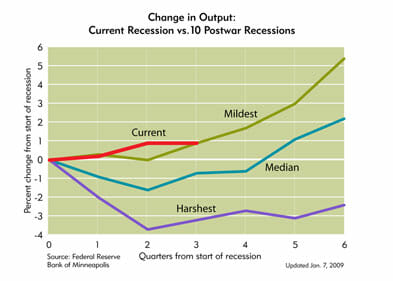
Can I prove that this is anything more than just a libertarian fantasy-rant?  Not really.  The only potential proof I can offer is as follows.  If my story is correct, then we should see layoffs occurring faster than actual drops in output.  We should see job cuts in anticipation of, rather than as a result of, falling demand.  To which I offer these two charts, via Alex Tabarrok:

onetwoPostscript: To be fair, economists who look at this stuff much more deeply were calling out deep problems long before Paulson screamed fire in a crowded movie house (example).  I am not say we would not have had a recession, but the speed and depth of the drop may well have been affected by his mismanagement.

The Tip O'Neal Bill

Well, it appears that Democrats who were angry at the cost of the Iraq war (a feeling to which I was always sympathetic) are attempting to even the score by spending approximately the same amount in a single bill.

Looking at the stimulus bill was kind of an odd experience for me.  Despite everything I preach here about politicians, I must have, somewhere in my deep back brain, under the onslaught of cultish media attention, absorbed some small hope that maybe perhaps Obama was really different.   Then I looked at the stimulus bill.  It is all the same crap that various folks have been trying to peddle unsuccessfully for years, repackaged in a hurry-up emergency form to avoid close scrutiny.  This is politics as usual, but even more so.  Jeez, this easily could have come from Tip O'Neal.  Everywhere you look in the bill, it smells. And Republicans are almost going to have to go along because they have pissed away any credibility they have by doing the exact same thing under the guise of TARP.

By the way, if you are confused about Keysian stimulus, here it is in a nutshell:  The economy is contracting some as people deleverage from over-spending and an asset bubble.  I mean, that's certainly what we are doing in the Coyote den, setting goals for both de-leveraging the business and our household.  But folks are worried, because while this has happened many times, one of those times we had a depression.  So the government does not want you to deleverage.  It wants you to spend and spend.  But it knows you won't, and that it has not yet accumulated enough power to force you to.  So it will borrow and spend for you.  Government stimulus means that when you are trying to save and reduce debt, government is going to run up debt in your name.

By the way, for those wondering how well this works, the last time we tried it was during the aforementioned depression, and the depression lasted another 8-10 years.

Phoenix Building Codes and The Safety of Children

A few posts ago I discussed some of the onerous build code hurdles we had to pass in retrofitting our house to pass a pool inspection.  In short, the code is designed to keep small children from getting out of the house on their own to a pool area.  Dead bolts must be 54" off the ground where they cannot reach them, the doors must have automatic closers (and thereby be difficult for small children to open) and windows cannot open wide enough to allow the kids to pass.  This is, of course, nominally for the safety of kids.

I pointed out one obvious critique of this regulation:  the vast, vast majority of kids do not drown in pools by sneaking out of the house.  They drown in pools when their parents know full well they are outside and fail to supervise them closely.

But I failed to discuss an even more obvious critique.  Can anyone see any possible problem with making it impossible for small children to exit the house?  Perhaps, say, in a fire?   Once I bring my house up to code, because none of the children's wing of the house has any window or door except to the pool area, the state will have made it absolutely impossible for small children to escape in a fire.   Yes, the state has forced me to turn the back of my house into a fire trap for kids.  That is, of course, unless I reverse all the changes 5 seconds after the inspector leaves my property, which of course I would never, ever do because I am a good American who pledged allegiance to the state every shool day of my childhood.

Letter to Schwarzenegger on Unemployment Insurance

A letter I am drafting currently.  If you don't know how unemployment taxes work, see here.

Governor Schwarzenegger:

As a business operating in California as well as twelve other states, I have the ability to compare the regulatory and business climate across states.  And while I could discuss many issues with the state of California regulatory affairs, I will focus on just one in this letter:  administration of the state unemployment insurance program.

All the states have an unemployment insurance program with roughly similar rules.  The fund will pay workers some percentage of their past earnings if they are terminated for reasons other than with cause from their last employer and are actively seeking new employment.  Employers are typically charged an insurance rate as a percentage of wages that is based on past unemployment claims by ex-employees of that company.

Before I provide my observations on the problems in the California system, let me provide some data that helps indicate that California is indeed unique.  Here are our unemployment insurance rates by state  (we have roughly the same business profile in each state, though if anything our business is less seasonal in California so one might expect, all things being equal, that our rates in California would be lower than average)

New Mexico:  0.03%

Texas:  1.06%

Florida:  1.02%

Arizona:  3.30 %

Michigan:  1.5%

Colorado:  0.9%

Wisconsin:  0.25%

Minnesota: 0.40%

California:  6.2% + 1.1% disability adder

You can see that our rates in California are double that of any other state, and more than 6 times our average.  Further, the California rate could actually be higher by our experience, as 6.2% is the cap.  By the way, we did a study a while back as to why our Arizona rates were so high.  It turned out most of the claims were from people who had recently moved from California, and grew up under the California system.

In interacting with the California state unemployment system for a number of years, our company has observed two issues that raise costs:

  1. It is virtually impossible to convince unemployment office workers that an employee was fired for cause.  It is very clear they see their mission as making everyone eligible, and thus even a guilty plea of outright theft has not been enough to have the state unemployment office agree that a firing was "for cause."
  2. The state unemployment office does absolutely nothing to ensure that a worker collecting unemployment is actively seeking work, as is required by legislation.  We run a seasonal business, and our workers have told me the unemployment office tells them that it is perfectly fine to work 6 months and take the other 6 months off on unemployment.  I have had employees vacationing in Mexico for 6 months still collecting unemployment.  When I reported this fact to the state unemployment office and said that these workers obviously could not be actively seeking work in California, I was told by the workers comp. customer service staff that if I made such a claim, and did not succeed in proving it, I was subject to fines and even incarceration for making a false charge.  Of course, I dropped it.

No matter what the text of the legislation says or what you are told by the managers of the system, the front-line employees who make the decisions that drive costs see it as their job to ensure maximum payout to any individual, regardless of whether they are honestly looking for work or not.  I have, just as a test, asked trusted employees to call the unemployment office to ask about benefits.  They were told that they didn't really have to be looking for work, that no one would check, and that all they had to do was call in and say they were looking for work and they would get paid.  Your unemployment office was practically begging them to take as much money as they could.

Government, In One Sentence

"Meanwhile, the city's legal department is looking to see what, if anything, it can do about the First Amendment banner."

Via Radley Balko.  The city told Herb Quintero that he did not have the right to paint a mural on the side of his building, and had to cover it up.  So he did, with a banner containing the text of the First Amendment.  Image from here.

NP_299968_CLIF_MURAL_1

Speaking of building codes, we are about to get some repairs on our pool inspected.  To pass the inspection on our pool, though, we have to spend thousands of dollars inside of our house.  Phoenix building codes require all kinds of crazy rules for home entry doors to the pool area.  For example, they all have to be self-closing and have to have deadbolts 54" off the ground, which I can assure you that no house built normally actually has. No window can open more than 4 inches.  This is a problem for us, because we have a series of French doors opening to the pool area, giving us 9 separate doors we have to modify or replace.  We are lucky we are grandfathered and don't have to put a fence around the pool area as new homes do (our backyard is fenced of course, but regulations require new homes to have a fence around the pool itself).  I know a lot of folks whose first activity in buying a new home is to pay someone to rip out the fence once the home passes inspection.

The rationale is to keep kids from drowning, I guess, but the number of kids who drown by sneaking out through 5 inch window gaps, or even unlocked doors, is vanishingly small  (the number of kids that drown in homes with no small kids is also small).   Kids drown when parents know they are outdoors but fail to supervise them closely.  We have no small kids in the house, but when we did, we supervised them very closely and put them through swim school before they were five.  But politicians, when there is a high-profile drowning, feel they need to "do something."  Since they can't legislate good parenting, they add to the already bloated building code, often sticking in pet requirements of lobbyists representing particular building materials and services.

Well, it turns out there are any number of companies in Phoenix who specialize in getting your home ready for this inspection.  They will come in and install all kinds of temprorary hardware, then come back after the inspection and remove it (filling and patching screw holes and the like).  Talk about dead-weight loss.

This Is Change?

Under Bush:

  • Iraq Invasion:  Hurry, we need this, emergency, rush, no time to argue, trust us
  • Patriot Act and Related Legislation:  Hurry, we need this, emergency, rush, no time to argue, trust us
  • TARP I:  Hurry, we need this, emergency, rush, no time to argue, trust us

Under Obama:

  • TARP II:  Hurry, we need this, emergency, rush, no time to argue, trust us
  • Stimulus bill(s):  Hurry, we need this, emergency, rush, no time to argue, trust us

Change we can believe in.

On a related note, Greg Mankiw looks at this graph in the TED spread:

ted-spread

And says:

[The TED spread's] decline suggests that the TARP is working and is certainly good news

Really?  You get all that from this chart?  I am not an economist, but I would have said the TED spread spiked up and came back down quickly in a very similar manner to any number of fear-induced price spikes, and had already fallen a fair ways before TARP was approved and had fallen a lot before the first dollar flowed (it is hard to read the chart, but by October 24 it had fallen to around 2.5).  This strikes me as pretty post hoc ergo propter hoc reasoning.  One could as easily say that the recent fall in oil prices was due to the most recent energy bill from Congress, but I am not sure even the most hard-core statist could say that with a straight face.

The longer-term history of the TED spread shows many such spikes, all of which came to earth quickly without a trillion federal dollars:

ted-spread-500x363

The Prisoner Online

Apparently Patrick McGoohan has passed away.  I suspect his death will further reinvigorate interest in the Prisoner series, a 17-episone show following a spy trying to come in from the cold, but who finds himself in an surreal small town structured for maximum surveillance and to try to extract as many secrets from him as possible.  A nice statement on the individual vs. the state, 1960s style.  I have not seen every epiosode, but I enjoyed most of it, right up to the ending, which I confess I didn't totally get but seemed to undermine the individual vs. the state theme and convert it to some Freudian surrealism.  If you become intrigued, you don't necesarily need to shell out to Amazon because AMC is streaming all the original episodes online in preparation for a remake they are producing this year.

Another Reason Why We'll Never See A Carbon Tax, But Instead Will Get A Crazy Cap-And-Trade Scheme

I have written enough on how much superior carbon taxes are to cap-and-trade as a CO2 reduction methodology (if we really are going to do "something," which I hope we don't).  An index of these articles is here.

In the title, I say "another" reason, becuase the number one reason we won't see a carbon tax is that politicians greatly prefer an indirect tax over a direct one, even if it is far more inefficient.  This was explained directly and clearly to me by the author of California's cap-and-trade program.

Close behind this, in second place, is the fact that cap-and-trade spawns a dizzying array of lobbying and special interest influence possibilities that carbon taxes do not, and all those lobbyists mean more power and campaign contributions for politicians.

But here is another reason why it will never happen:  Too many very influential Democrats have substantial investments in start-up companies whose entire existance depends on living in the cracks of cap-and-trade, particularly in generating various dubious offset schemes.  Al Gore is the most obvious example, but apparently Obama's new climate czar Carol Browner sits on boards of such companies as well.

A Paypal Security Hole and Poor Customer Service Judgement that Made it Worse

I have been having problems for a while receiving Paypal payments to my business account.  Today, I received an account notification for someone else's paypal account.  I have received phishing and spoof emails before, but I was pretty sure this one was legit.  I contacted the other person whose account notification I had received (they were horrified at that security breech, by the way), and sure enough, they were honest enough to admit they had been receiving some mystery payments they could not account for, which we quickly determined were mine.  I asked them to check their email addresses on their account, and sure enough, for some reason neither of us could fathom, my email address was listed as a secondary address on their account.  This is the same email that is the primary on my Paypal account, something Paypal claims is impossible.

I asked the other user to not touch it for a minute, and said I wanted to try an experiment.  I called Paypal and got a real person (a slog in and of itself) and described the situation:  I had solid reason to suspect that my email address on my account was on someone else's account as well.  They said that was impossible.  I insisted it might be possible.  Eventually, the customer service agent relented and said they would run a search (I presume they search their data base for my email address and check for multiple hits, an assumption later confirmed by the supervisor).

Well, the customer service agent returned and said "I am happy to tell you your account is fine and no one else has your email address."  She actually said the "happy" thing in a chirpy voice.  I said that now I was REALLY worried, as I had definitive evidence my email is on another account, and if their search programs are not finding the issue, I have no confidence that it is not on more accounts.  After getting nowhere with this, I asked for a supervisor.

I explained all of the above, and the supervisor admitted the first agent did not tell me the whole truth.  She said, "yes, in fact we did find your email on one other account and eliminated it.  The problem was on just that one other account.  We have had this problem a few times and are still trying to figure out why it happens because it should be impossible."  Fine.  But why did the customer service agent feel the need to lie?  I guess technically it was correct for her to report that my email was not on any other account, as they had eliminated the duplications before they took me off hold.  It just seems to be in the institutional nature of organizations to cover their errors and not admit them.

I guess this sort of thing might work with the average computer user who is unsure of his skills and can be convinced that he misunderstands the problem.  And to be fair, all of computer and software customer service seems to work this way, trying to convince users it was their error rather than a bug.  But in my case, knowing for an absolute fact that there was an error, this approach only panicked me more, as I became worried not only with the security hole in their payments system, but with the fact that the company was apparently unaware of the hole and unable to detect it.

The other issue is that I actually think I know how this happened, but neither the agent nor their supervisor took the time to try to get any background information on me that might help them diagnose what is obviously a bug in their system they have been chasing unsuccesfully.  It is a bit like having a mystery epidemic where a disease is spreading via an unknown vector but no one is doing any research into the patients' histories.  Yeah, I know they can't put a priority on every bug fix, but I would assume that for a payments processor a bug that allows money to flow to the wrong person might be of some priority.

Postscript: Not that it matters to any of you, but here is my hypothesis.  I actually had done a transaction with this other user years ago.  This user did not have a paypal account at that time, but one can actually send money via credit card to someone with a Paypal account even if the person sending money does not have an account.  The other user sent me the money with her Visa card from a public terminal, but called me because she could not complete the form because she did not have an email address.  I told her just to plug mine in, and if I got any emails on the transaction I would mail them to her.  Years later, she was more sophisticated and opened up her own Paypal account.  My hypothesis  (really, the only explanation that works) is that at the time she signed up, the Paypal computer went back into its records, found her name from this old transaction, and automatically attached the old email address (mine) from that transaction to the new account as an additional email.  Since this email was not entered via the data entry screen, it bypassed the duplicate email name check which presumably happens at data entry.  It is a back door that allows duplicates in.  I strikes me someone intheir development group might be interested in this hypothesis, since this is one of those bugs it is hard to track down, but no one asked.

All You Need To Know To Evaluate Government Health Care Proposals

OK, maybe not all, but there is really one critical issue at the heart of almost all the issues in health care.  It drives whatever cost problems might exist in the system, drives many of the quality problems, and is a source of much of the current dissatisfaction (at least from the middle class) with the current health care system.

For every proposal, you should make sure you understand 1) Who is choosing the amount and quality of the care and 2) who is paying the bills and is therefore trying to pay attention to the cost of care.

What the hell does that have to do with anything, Coyote?  What are you getting at?  Well, perhaps I can begin my explanation by talking about something, practically anything, other than health care.

Take purchasing a car.  When I need a new car, who determines what car I end up with?   Why, I do.  And who pays for the car and shops around for a price that makes sense in the context of the perceived value of the car?  Why, I do again.  The person who uses the car, the person who chooses the type and quality of the car, and the person who pays for the car are all the same person.

This clever procurement model of integrating the payer, the shopper, and the user all into a single individual is one we use for, well, just about every product and service we buy.  Milk, Internet service, DVD's, house painting, airline tickets -- all the same model.

OK, lets consider a model that does not work this way.  Let's say someone just rear-ended your car and, miracle of miracles, they actually have a good, solid insurance policy that owes you for your car repairs.  In this case, you will be consuming the repair services, and have the incentive to find the absolute best, cost-no-object body shop you can find to do the best, most fabulous job fixing your car, because someone else (ie the insurance company) is paying.  The insurance company has a different incentive.  They want to get off with as small a loss as possible, to protect their profitability as well as keeping prices low for future policy-holders.  They are going to want you car fixed cheap, particularly since you are probably not even their customer.  They are going to try to deliver the minimum.

No surprisingly, people tend to get ticked off in these situations, as they grind against the opposing incentives of the insurance company.  It's one reason that the insurance field is highly regulated (because nowadays people complain to their Congressman whenever they get irritated).  It's also a measure of how ineffective regulation is in really managing this friction, since despite zillions of government rules people still get pissed off.  The reason is that there is simply no good solution.   Both parties want a solution at the extreme end of a cost-value scale, neither have much of an incentive to compromise, and neither will be happy with a solution in the middle of these extreme incentives, and no amount of government fiddling with the tradeoff point is going to change this.

OK, but in this example, at the end of the day, it is just a car, and probably this is a once-in-a-lifetime event.  What if we replace "car" with "baby daughter" or "grandmother" or "your life?"  Now, as Bill Murray says, the kidding around is pretty much over.  It is a recipe for an incendiary disaster.  Which is exactly what we have in health care.

If we take these three roles - user, service quality specifyer, and payer/price shopper - there are very few places in medicine today where these three roles are united.  Further, despite the fact that the vast majority of the problems in US health care are demonstrably from this role separation, none of the plans currently being considered by Obama or Congress unify these three parties.

With my high deductible medical policy, I am actually one of the few middle/upper class folks who actually shops for health care.  And I can tell I am in the minority by the reaction I get from doctors and medical services companies, that look at me like I am from Mars when I ask for detailed pricing, or when I order less than the full and complete battery of potential tests and services based on my own judgment and price/value trade offs.  Folks in the medical profession are used to people saying "whatever, the insurance company is paying for it."

We all know the straights that the auto industry is in, but can you imagine how bad their price and product would be if everyone had some sort of policy that purchased just about any car they wanted for them whenever they wanted it?  What do you think would happen to the prices at your grocery store or at BestBuy if the proprietors of those stores knew, absolutely knew, that you were not even going to look at a price tag before you bought what you wanted?  So why do we expect anything but inflated pricing in the health care field?

Devon Harrick via Carpe Diem writes

The market for medical care does not work like other markets. Providers typically do not disclose prices prior to treatment because they do not compete for patients based on price. Payments are usually not made by patients themselves but by third parties "” employers, insurance companies or government (only 12% of medical costs are paid directly by patients, see chart [below]). And the amounts paid are not really market-clearing prices; they are "reimbursement" rates negotiated with bureaucratic institutions and networks. Furthermore, when providers do not compete on price, they usually do not compete on quality either. In fact, in a very real sense, doctors and hospitals are not competing for patients at all "” at least not in the way normal businesses compete in markets.

medical-1

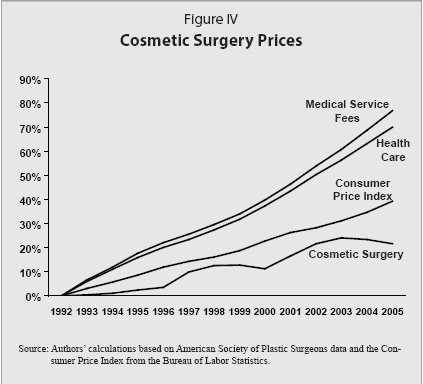
The author above has an interesting analysis.  The one exception to the separation of roles in medicine is cosmetic surgery.  Not covered except in special circumstances by most insurance, cosmetic surgery is something the individual must pay for and thus has a tendency to shop for.  The results in prices are clear.
medical-2

This pricing differential is all the more compelling because itis probably opposite what most people would initially assume.  As cosmetic surgery tends to be a luxury good, one might expect it to have the higher-than-average inflation rate that many luxury goods have had over the past 10 years.

The flip side of the pricing situation is the incredible dissatisfaction that seems to permeate health care customers.  Because the users aren't paying the bills, health care providers have little incentive to provide good service, as even with bad service the value they provide will be able to exceed the user's price of zero, or close to zero.

But, like with the body shop in the collision, someone is indeed paying the bills.  And that someone faces a choice -- either let customers run amuck and buy absolutely as much health care as they want, or try to ration or restrain the care users receive in some way.  So, when Joe and Mary want the 9th sonogram performed just to make sure their fetus is still doing great, the insurance balks at the cost as unnecessary.  The insurance company is upset, because they feel like Joe, Mary, and their doctor are milking the insurance for unnecessary procedures.  Joe and Mary get upset, because they feel like the heartless insurance company doesn't care about their little darling baby.  Everyone calls their Congressman to tell him or her that they are unhappy and could the government please intervene to make them happier.

And so we get to current health care proposals.  Folks have, rightly, come to the conclusion that a system where the user benefits from the service and decides how much and of what quality should be consumed, while someone else pays, is not sustainable.  However, in response, no one in power is suggesting we end the split.  Instead, they are suggesting that the role of service determination and payment/price-shopping be performed by the government.  We as a consumer will just have to trust that the government will make this price-value tradeoff somehow close to how we would make it for ourselves.

But of course, this is absolutely freaking impossible.  First and foremost is the problem that the government can only choose one policy for everyone embodying a single point on the trade off curve.  But we have 300 million people with 300 million different preference functions.  No one is going to be happy.  Second, the government is a terrible shopper.  We all know this to be true.  So why do we think they are going to suddenly become wizards when it comes to health care?  Third, the government is a terrible administrator.  As a monopoly provider, they simply don't have the inventive to be either responsive of cost-effective.  Again, we all know this to be true, so why are we so willing to hope that things will suddenly change for health care?

The only thing that makes any sense at all to me is to try to give the user of health care some financial incentive to participate in the price value tradeoff and shopping process.  I know that I have simultaneously saved a ton of money as well as substantially increased my health care shopping IQ since our family adopted a high-deductible health insurance policy.  Incredibly, however, this is one solution that absolutely is off the table -- for example, the first step Massachusetts took in their single payer system was making it illegal for consumers to buy the kind of high-deductible insurance I have.  Illegal!

Hey! An Award!

In the 75th Annual (lol) Maggie's Farm blog awards, Coyote Blog tied with Tigerhawk (good company) for best Princeton Alum Blog.  Thanks!

OK, One Coyote Likes Light Rail

Sent to me by a reader, picture from this article.

coyotemax1

Fortunately, there seem to be plenty of empty seats for him ;=)

Knitted Handbag Patterns

Well, blogging has been light again as I a) watched the incredibly unlikely prospect of the Arizona Cardinals hosting a NFC Championship game become a reality and b) built yet another new web site, this one for my wife.  My wife has for several years had a business selling designer handbags and other fashion accessories, for which she has won a number of awards.  This week she is kicking off a new business selling knitted handbag patterns.  You can guess who was named, in absentia I might add, the new business's CTO and webmaster.

Anyway, not wishing to add another platform to my stable of web site solutions, I built it using wordpress using a template that may be suspiciously familiar to Coyote Blog readers.  No appologies here, because I spent way too much time making the transaction engine work (it turns out that digital fulfillment is actually harder, rather than easier, to implement than regular mail and ship).   Since this is basically a hobby of mine rather than a real job, getting one template to work flawlessly using css is my limit.

Anyway, check her out if you are interested (or even if you are not, she will be thrilled to see some traffic).

kt_bag_pattern

PS-  before I get comments, I know there is something wrong with the image manipulation system I used as the site is hanging up serving up resized images.  Working on it.

Men are From Mars, Women are from Venus, and GM CEOs are from Another Universe

Wow!  How far out of touch with reality can you be?

General Motors Corp. Vice Chairman Bob Lutz said he is looking forward to having a "car czar" in place so U.S. automakers have someone sympathetic to its needs in Washington.

"We will have someone to talk to about the pain being inflicted on use [sic] for no unearthly [sic] reason," Lutz said Sunday on the sidelines of the North American International Auto Show.

Via the Libery Papers

Un-Freaking-Believeable

A month ago, the Arizona Cardinals mailed me (as a season ticket holder) my playoffs tickets.  I usually don't advertise myself as an Arizona Cardinals season ticket holder, just because numerous academic studies have demonstrated that this fact is not highly correlated with the average person's perceptions of intelligence.

Because of logistics and time limitations, when one gets NFL playoff tickets one typically gets a ticket for every possible game the team could play in.  Because there was an oddball small statistical chance the Cardinals could host an NFC championship game if a) the Cardinals won two playoff games, which has never happened in franchise history and b) all the top 3 seeds lost, they sent me NFC championship game tickets.  My son and I literally laughed out loud when we saw them.  Hosting an NFC championship game with a franchise that has not hosted any sort of playoff game for 60 years seemed, well, laughable.

Well, I just ran to my desk to make sure I actually kept the tickets, because with the Eagle's win today the Cardinals will actually be hosting the NFC championship game next week.  Go Cards!

Paging JM Keynes

I don't think I need to even bother expressing to my regular readers my utter disdain for this kind of trough-feeding:

Overall, the article notes "the mayors of all 641 cities [represented by the U.S. Conference of Mayors] are asking for $96.6 billion in federal funds for 15,221 municipal projects." Whole bit here.

Here is my question for supporters of this bailout garbage as an economic stimulus.  I understand that in Keynesian economics, government spending has a multiplier effect that causes it give a bigger boost to the economy than private spending  (I don't agree, but I understand that people believe this and understand the faulty assumptions that get them to this conclusion).

But under what economic theory are we operating now that says that having the federal government borrow or raise taxes to spend on municipal projects has a greater stimulus effect than having local governments do it?  None, of course.   What is happening is that a bunch of munipal government weenies are going to Obama and saying "we don't have the credibility, support, and or cajones to raise taxes.  You seem to be hot now, can you do it for us?"

Can You Say, "Moral Hazard?"

Moral hazard is the term for what occurs when one shelters an entity from the full cost or downside of taking risks.   The result is that the entity will tend to take on more risk than it would have had it had to bear the full costs.  For example, if a company knows that the government will make up the shortfall if its pension investments suffer, it will tend to invest in high-risk, high-return investments that reduce the company's need to contribute funds in the good years.   This is sometimes called privitizing profits and socializing losses.

One of the problems with demonstrating moral hazard is that the hazard often occurs years after the action (usually a government action) that creates the hazard.   But this week we have an amazing opportunity to see moral hazard operating within days of a government bailout:

Immediately after GMAC became eligible for TARP money, GM reduced to zero the interest rate"¦ on certain models. This, of course, penalizes GM competitors, including Toyota, Honda and other "transplants" whose cars are made in America by Americans for Americans, and Ford, which does not have the freedom of maneuver conferred by TARP money because Ford is not taking any"¦

GMAC has begun making loans to borrowers with credit scores as low as 621, a significant relaxation of the 700 minimum score the company adopted just three months ago as it struggled to survive. America's median credit score is 723"¦

If you pay people trillions of dollars in response to a bad behavior (in this case, credit lenience) then you will just encourage more of that behavior, even if everyone achnowleges it to be a bad behavior.