The Box

I just finished "The Box," which is a history of container shipping.  Never has any book I have read elicited so many laughs from my family.  Nothing says "geek" like reading a book about shipping containers.

But, for those of you who might similarly be turned off by the subject matter as unpromising, I can say this is easily one of the most interesting business books I have ever read.    It is fascinating to see how the entire economics of an industry can be changed not by some arcane advance in silicon, but by a metal box.  In a period of about 20 years, the entire merchandise shipping business, which had remained virtually unchanged for thousands of years, was completely reinvented.  Every ship and every port had to be replaced.  Moreover, these changes resonated far beyond shipping, as they enabled much of the global manufacturing revolution of the last generation.

Because pre-container shipping and transport were so highly regulated, the book provides a great window on how regulation affects innovation, and vice versa.  It also focuses quite a bit on how unions and in particular union work rules affected industry economics, and how these unions reacted to change in the industry.

And of course, the book allows us to look at any number of interesting business strategy issues:

  • Is being a first mover an advantage, or a disadvantage?  Sea-Land reaped a number of first mover advantages, but it also got hurt badly when a number of the earlier investment choices they made turned out to be wrong.  Several late movers, who invested after ship designs had been through two or three generations, did quite well.  Others did not.
  • Who makes money investing into this kind of change?  A few early SeaLand investors made out well, the equivalent of angel investors, but later investors did poorly.  And it is not at all clear that anyone making massive, billion dollar investments ever really made great returns.  Like the airline industry, the industry quickly hit over-capacity and prices dropped.  It is clear shippers won big, but did it really make sense for anyone to invest in this business?  The best strategy I can come up with was followed by Maersk, which basically sat out until late and then bought up assets on the cheap out of bankruptcy from early participants.

This situation was reminiscent of a business case I had at HBS about the beginnings of the high fructose corn syrup (HFCS) market.  It was run as a computer simulation among teams.  Basically, almost not matter what everyone did, the industry ended up in over-capacity and everyone lost money.  The only successful strategy was the Wargames approach ("the only winning move is not to play').

Double Standard

Jeff Skilling of Enron essentially sits in jail for being too publicly optimistic about his company's prospects in the face of a liquidity crisis  (despite popular perceptions, he was not convicted for accounting issues associated with off balance sheet entities).

I didn't follow the trial that closely, but my sense is that Skilling denied this charge.  But even if he had admitted it, it strikes me that he would have had an interesting case in his favor.  US securities law takes as an absolute core principle that relevant information must always be disclosed quickly and completely to both shareholders and potential shareholders alike.  It presumes that total openness is the best way to serve shareholders.

But in a short-term liquidity crisis, openness is the kiss of death.  As we have seen over the last 6 months, the merest hint that a liquidity crisis may exist at a company creates a real crisis, even if one did not exist before.  Liquidity crises are crises of confidence among short-term lenders, and the only way to fight such a crisis is to build confidence.  So what happens if the best way to serve shareholders is to keep silent about problems?  What if the best way to fulfill one's fiduciary responsibility to maintaining shareholder value is to be overly rosy in one's pronouncements during difficult times?

Fast forward to the Bear Stearn failure last year, from the Economist:

As recently as March 12th, Alan Schwartz, the chief executive of Bear Stearns, issued a statement responding to rumours that it was in trouble, saying that "we don't see any pressure on our liquidity, let alone a liquidity crisis." Two days later, only an emergency credit line arranged by the Federal Reserve was keeping the investment bank alive. (Meanwhile, as its share price tumbled on rumours of trouble on March 17th, Lehman Brothers issued a statement confirming that its "liquidity is very strong.")

And now, we hear that the Federal Government urged Bank of America's Kenneth Lewis to do exactly what Lay and Skilling were convicted of.

Federal Reserve Chairman Ben Bernanke and then-Treasury Department chief Henry Paulson pressured Bank of America Corp. to not discuss its increasingly troubled plan to buy Merrill Lynch & Co. -- a deal that later triggered a government bailout of BofA -- according to testimony by Kenneth Lewis, the bank's chief executive.

Mr. Lewis, testifying under oath before New York's attorney general in February, told prosecutors that he believed Messrs. Paulson and Bernanke were instructing him to keep silent about deepening financial difficulties at Merrill, the struggling brokerage giant. As part of his testimony, a transcript of which was reviewed by The Wall Street Journal, Mr. Lewis said the government wanted him to keep quiet while the two sides negotiated government funding to help BofA absorb Merrill and its huge losses.

Federal Reserve Chairman Ben Bernanke and then-Treasury Department chief Henry Paulson pressured Bank of America Corp. to not discuss its increasingly troubled plan to buy Merrill Lynch & Co. -- a deal that later triggered a government bailout of BofA -- according to testimony by Kenneth Lewis, the bank's chief executive.

Mr. Lewis, testifying under oath before New York's attorney general in February, told prosecutors that he believed Messrs. Paulson and Bernanke were instructing him to keep silent about deepening financial difficulties at Merrill, the struggling brokerage giant. As part of his testimony, a transcript of which was reviewed by The Wall Street Journal, Mr. Lewis said the government wanted him to keep quiet while the two sides negotiated government funding to help BofA absorb Merrill and its huge losses.

Many observers found it odd when Skilling was convicted of giving false information to shareholders but not for insider trading.  The implication, then, was that Skilling was guilty of lying to shareholders but not for personal gain.  Why then, people asked, did he do it?  It is becoming increasingly clear that putting on a happy face during an impending liquidity crisis is the only responsible approach for a leader to take.  Whether he goes to jail for it or gets rewarded by the Feds for it comes down to, what?  PR?

Update: In fact, one can argue that the Enron situation is more honorable than the BofA situation.  Enron management was trying to protect the value of Enron shareholders.  In the case of BofA, the feds demanded that BofA management hide information in order to complete a transaction that BofA shareholders might rightly oppose.

Government Intrusiveness Fact of the Day

To get a liquor license for my corporation in California, I must tell the state where I was married and on what date(!)  This is about the weirdest thing I have been asked on a form for my corporation.  Of course this is on top of the usual over-the-top list of requirements to get a liquor license which include providing the state with:

  • Fingerprints of owners and officers
  • Name of bank and checking account numbers
  • Name and address of accountant
  • Name and address of attorney
  • For every owner and officer:
    • Spouse's name
    • Home address
    • Home phone number
    • Drivers license number
    • Social Security number
    • Height, weight, eye and hair color
    • Value of home
    • Value of investments
    • Debts and mortgages
    • Net worth and Personal income history (again for each as individuals, not for the corporation).

The entire application, including forms and drawings, requires hours and hours to complete.  As is usually for government forms packages, the same information is requested on multiple forms.  To apply for two licenses requires two entire sets of forms filled out, signed, and notarize separately, despite the fact that 99.9% of the information is the same.  My wife and I have to fill out extensive, totally identical personal affidavits multiple times, despite the fact that the exact same forms with all this information are already on file with the State of California for other liquor licenses the company holds in the state.

The purpose, of course, is twofold:

  • To make sure we are not fronting for Al Capone, a problem that went out of date about 5 minutes after the repeal of prohibition, but still drives licensing requirements 75 years later.
  • To make the process arcane and onerous enough to discourage us from entering the business in California, or, as a minimum, to force us to hire a consultant to help us with the process, the profession of which is 99.9% dominated by ex-California ABC employees.  The harder the process is, the better the prospects for their post-retirement consulting gig.

Public vs. Private

I believe most of my regular readers know that in my day job I am involved in privatization of public recreation.  For fairly obvious reasons, I never blog about the public recreation agencies with whom I work.  In particular, I don't think its fair that an agency that is at least visionary enough to consider private management of its recreation have its dirty laundry spread all over my blog.

But there is one situation with a particular state parks organization that is driving me so crazy that I must share the story publicly, but I will do so without revealing the state. I have no reason to believe that what I describe is unusual.

The state parks organization runs a bit fewer than thirty parks and campgrounds, whereas our company runs over 150 public parks and campgrounds.  Their total operation budget for parks is about the same as my company's annual expenses.  The state parks organization gets about 20% of all its labor hours donated for free by volunteers, whereas we are prohibited by the Fair Labor Standards Act from accepting volunteer labor.  Their parks are spread all over a large state, ours are spread from Washington to Florida.

By scale and scope, our company is reasonably considered larger and more complex, though the state has some reporting requirements I do not have.  There are two major differences between us, though, which are telling:

  1. Including myself, our company has 3.5 people on the corporate staff with total corporate office space of about 700 sq ft. -- everyone else is dedicated to and works at a particular facility.  This state parks organization has scores of people working in a dedicated headquarters building with tens of thousands of square feet of space.
  2. Demand for public recreation is booming, as people are looking for low cost recreation opportunities.  Our pre-season camping reservations, for example, are at an all time high.  We have had to scrape deep, but we are investing hundreds of thousands of dollars in expansion money this year to address opportunities to serve more visitors.  This state parks organization is cutting back parks.  It has closed a number of parks, and plans to close more, and has cut most of its investment.  To my knowledge, it has done nothing to address headquarters staff costs, nor is it able by state rules to take any credit in its budget for expected increases in park fee collections.

The staff level bureaucracy problem is just endemic to government.  I would love to look at the growth of staffing of public schools by type of employee over the last 30 years -- my bet would be that the total number of teachers is flat to down while the number of administrators and assistant principals have skyrocketed.

Update: I have had parks employees writing me guessing that I was writing about their organization.  They made the point that their parks organization is not comparable to ours, as their organization had been saddled with a number of non-recreation missions that were expensive (e.g. preservation, certain environmental goals, historical interpretation, etc)  This is certainly true, though not of every parks organization or necesarily the one about which I was writing.  But one could argue that this kind of mission creep is a failure point in public agencies.  While there are incentives for this to occur in both public and private organizations, there are fewer corrective mechanisms in the publis sphere to push back.  In fact, in the public sphere, new missions are a blessing because they often carry new funding.  In the private sector, new missions threaten to dillute results and are more resented.

Chaos Has Gotten A Bad Rap

There are two words that really separate us hard-core libertarians from small-government Republicans and civil-liberties-focused Democrats:  Chaos and Anarchy.  Libertarians love chaos and anarchy, while most Americans still cringe from these words.  For most folks, chaos is some Road Warrior-style dystopia and anarchy is Molotov cocktails sailing into passing cars.

But chaos and anarchy are in fact the hallmarks of a free society.  They imply a bottom-up society where the shape and pattern of everything is driven by the sum of individual decisions, each decision made with that person's own optimization equation of his or her best interests, constrained only by the requirement they interact with other people without use of force or fraud.   Our wealth, our technology, our modern economy are all born out of this chaos.

I have heard it said that capitalism is not a system, it is the anti-system.  This is the true beauty of capitalism -- it is the only way for human beings to interact with each other without compulsion.    Every other approach to organizing society involves some group of people using physical force to coerce other people.

This does not mean that every individual decision made, every investment choice, or every business model in a free society is mistake-free.  Society and the economy are in fact riddled with mistakes.  The HAVE to be, when one considers that the shape of this country is the sum of literally billions of individual decisions, small and large, made every day.  The key, however, is that the outcomes are generally robust  to mistakes, even large ones.  Business people, for example, who make large mistakes see their business fail and their capital disappear and their assets repurchased in bankruptcy by other business people who may well make better, smarter use of them.  Costly mistakes only persist when they are enshrined by law and enforced by government, and thereby protected from the forces that tend to act to correct them.

But despite all we owe to our capitalist system that fundamentally strives on anarchy, we attend schools run by large authoritarian institutions, like the Catholic Church or the US Government, which train us from an early age to fear chaos.  This is not surprising, because the opposite of anarchy is control, regimentation,  and top-down planning, all the things that authoritarian institutions strive to have us meekly accept.   Large investments in public education in Western countries have always been in times of rapid expansions of state power and control.  This was true in France in the early 19th century and Germany in the early 20th.  It is even true in the US.  If you doubt this, and want to claim that public education is all humanitarian, then why does the state make it so hard to opt out?  The ultimate argument of every opponent of school choice is always some gauzy notion that public schools create a "shared experience," which sounds a lot like indoctrination to me.

The current administration is dominated by technocratic planners.   For them, any process that is not being controlled top-down by "smart" people like themselves is by definition a failure.   When I say that the current administration is reminiscent of Mussolini-style fascists, I am not implying that folks are going to be rounded up soon and sent to camps.  I mean that the animating assumptions -- that any process controlled top down is more efficient than one that is allowed to operate bottom-up and chaotically -- are similar.  FDR, for example, and much of the American intelligentsia were driven by very similar assumptions, and the National Industrial Recovery Act (fortunately struck down by a non-packed Supreme Court) was pretty directly modeled on Mussolini's economic planning system.

Examples?  Well, the GM/Chrysler situation is a great one.  One can easily paint a story that Obama's work to avert bankruptcy at these companies is just a crass political handout to powerful unions who supported him.  But, just as easily, one can portray these efforts as a man who is uncomfortable letting the fate of a large sector of the economy play out beyond his control.  Obama killed school choice in Washington DC despite fairly strong evidence of its success, because, again, everyone being educated in his or her own way just cedes too much control.

Another good example is this one, from the Anti-planner:

Ron Utt, the Antiplanner's faithful ally, has uncovered the first steps of President Obama's plan to force smart growth on those parts of the country that managed to escape the housing bubble. The departments of Transportation and Housing & Urban Development have signed a joint agreement to impose smart growth on the entire nation.

Under the agreement, the departments will "have every major metropolitan area in the country conduct integrated housing, transportation, and land use planning and investment in the next four years." Of course, nearly all of the metropolitan areas that already did such integrated planning suffered housing bubbles, while most of those that did not did not have bubbles. The effect of Obama's plan will be to make the next housing bubble much worse than the one that caused the current financial crisis.

Obama first hinted about this plan in a town hall meeting in February. "The days where we're just building sprawl forever, those days are over," he told a group in Fort Myers, Florida. "I think that Republicans, Democrats, everybody recognizes that that's not a smart way to desig, n communities." Not everybody.

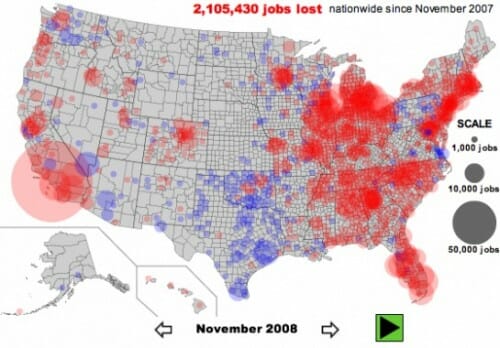
As a note on city planning, I will not claim a direct causality, because I am the first one to warn of the danger between directly correlating two variables in a complex system, but check out this map of job losses in the recession, noting the situation in Houston as the least planned city in the country.
job-losses

Thoughts on Cuba

  1. I am thrilled that we many finally be opening up to Cuba.  I would throw the doors wide open to free trade, travel, and interchange.  I think it is perfectly reasonable to rethink a strategy after fifty or so years of failure.
  2. I am depressed to see Obama kissing Castro's butt.  I shiver to contemplate the future love-fest between Obama and Chavez
  3. My approach would have been:  Fidel, you and your system of government are evil.  However, isolating your people from the rest of the world so they don't know how bad they have it is just doing you a favor.  We are going to kick your ass with openness, rather than embargoes
  4. Oh, and by the way, we are going to end sugar tariffs and hopefully start purging HFCS from our food in favor of good old, high-octane pure cane sugar.

Update: According to Radley Balko, Obama is giving Castro moral support without any real increase in openess.  Bummer:

At the OAS meetings last week, Obama refused to renounce Cuba's human rights violations, including its imprisonment of political dissidents. It's usually risky to criticize someone for what they didn't say or do, but in the world of diplomacy the absence of any explicit criticism of Cuba's political suppression was conspicuous, and almost certainly wasn't accidental. At the same time, Obama has backed down from his position in the Democratic primaries to open up U.S. trade with Cuba (he actually came down from that position during the general election campaign).

In other words, America's new Cuba policy seems to be one of gradual rapprochement when it comes to engagement with Cuba's authoritarian government, but continued isolation and punishment of Cuba's people. That's unfortunate.

Obama did allow for more visitation between Cuban-Americans and their families on the island last week, but while that's a welcome change, it wasn't particularly bold, brave, or risky. There was almost no political downside at all to the change.

Defending our Borders

Via the Arizona Republic:

"Non-native turtles removed from zoo"

Avoiding Bankruptcy to Hose the Creditors in Favor of Politically Stronger Stakeholders

I have predicted it a number of times vis a vis Chrysler, including back in February:

It is criminal that this [restructuring plan] is going to Congress, not a bankruptcy judge.  This is a conspiracy of management (looking to hold onto their jobs and equity), equity holders, and employees to usurp value from the senior debt holders, who would normally be first in line in a bankruptcy.

or in March:

there is a clear set of winners and losers in a bankruptcy "” and there is enough case law on it that all the players at GM know it and they know into which category they fall.  Those who are lower down the food chain are hoping that putting the restructuring in Obama's hands rather than those of the bankruptcy process will improve their outcomes.

Oh, gee, you say, the Anointed One would not be so crass as to used this way, would he?  From Megan McArdle

The government is trying to play hardball with the Chrysler creditors, asking them to accept 15 cents on the dollar when they're likely to get more in a liquidation.  That's not a haircut; it's more like what they do to you the first day of boot camp.

Welcome to the Emergency Room. Can I See Your Insurance Card and Polling Numbers, Please?

From Mickey Kaus:

Democratic blogger Ezra Klein appears to be positioning Dem health care reforms as a way to cut costs, on the grounds that a reformed system will be able to make "hard choices" and "rational" coverage decisions, by which Klein seems to mean "not providing" treatments that are unproven or too expensive--when "a person's life, or health, is not worth the price." Matthew Yglesias' recent post seems to be saying the same thing, though clarity isn't its strong suit. (He must have left it on Journolist.)

...

The "rational," cost-cutting, "hard-choices" pitch isn't just awful marketing--I don't even think it's accurate. Put it this way: I'm for universal health care in large part precisely because I think the government will be less tough-minded and cost-conscious when it comes to the inevitable rationing of care than for-profit insurance companies will be. Take Arnold Kling's example of a young patient with cancer, where "the best hope is a treatment that costs $100,000 and offers a chance of success of 1 in 200." No "rational bureaucracy" would spend $20 million to save a life, Kling argues. I doubt any private insurance company is going to write a policy that spends $20 million to save a life.  But I think the government--faced with demands from patient groups and disease lobbies and treatment providers and Oprah and run, ultimately, by politicians as terrified of being held responsible for denying treatment as they are quick to pander to the public's sentimental bias toward life--is less likely to be "rational" than the private sector.

That is to say, the government's more likely to pay for the treatment (assuming a doctor recommends it). So it's government for me.

He comes oh-so-close to getting it right, but then falls short.

Klein is right that the pressure will be to ration care -- we already see such rationing being seriously considered in Massachusetts (the model of choice for Democrats) under the weight of massive expenditures.

But Kaus is correct that if some high-powered and well-funded interest group gets behind a certain procedure, cost-effective or not, the government overlords of the program will likely approve it.   As a result, for example, no potential treatment for breast cancer will ever be denied given the proven strength of women's groups lobbying for breast cancer treatment (already, breast cancer research is hugely over-funded vs. other diseases given its mortality, due in large part to this powerful lobbying).

But it is not one dynamic or the other.  Both will exist.  There will be huge pressures to cut back somewhere, as costs skyrocket.  And there will be huge pressure from certain interest groups to fund treatment for certain diseases in unlimited amounts.  The result will not be, as Kaus posits,  that everything will be funded more than it is today -- the result will be that certain procedures and conditions with strong lobbying and political muscle will get funded more, with the difference being made up from cutting funding for conditions and procedures without a well-organized lobby.

Access to care will no longer be determined by money, but by political pull.  (Yeah, I know, it's Ayn Rand's world and we all just live in it).

The Obama Years In Two Sentences

The perfect storm: arrogant preachy leftists throwing money at useless things - and rational but amoral capitalists running around picking up the money.

The only loser is the taxpayer who is on the hook for all that money.

Via TJIC.  The Corporate State in a nutshell.

Why People Are Angry

deficit-poster2

I am just flabbergasted that so many commentators have so much trouble understanding this.

I May Have Been Wrong When I Said Government Officials Weren't Dumb

I often say that most government officials are not dumb or evil, they just have bad incentives that make them act that way, and they look dumb because they attempt to tackle problems that even a 250IQ can't solve (e.g. planning the economy).

But I may have been wrong.  Evidence is mounting that people in Congress, at least, really are just plain dumb.  From an interview on NPR:

[Congressman Henry] Waxman: Well, there have been scientists brought together to see if they could figure out the science and make it clear whether this is a danger or not, whether it's a danger that's a great one or one that we can postpone for a while, and the overwhelming consensus of all the leading scientists that have looked at this issue is there is a warming of the planet, it's manmade, caused by our burning of carbon fuels, and it's happening faster than anybody ever thought it would happen.

We're seeing the reality of a lot of the North Pole starting to evaporate, and we could get to a tipping point. Because if it evaporates to a certain point - they have lanes now where ships can go that couldn't ever sail through before. And if it gets to a point where it evaporates too much, there's a lot of tundra that's being held down by that ice cap.

If that gets released we'll have more carbon emissions and methane gas in our atmosphere than we have now. We see a lot of destruction happening because of global warming, climate change problems, so we've got enough warning signals and enough of a scientific consensus to take this seriously.

Oh my heavens, we are certainly in good hands.  Via Tom Nelson.

Postscript: For those who slept through high school science:

  • North Pole ice melts, it does not evaporate (liquids evaporate).  Occasionally a solid will go straight from a solid to a gaseous state (e.g. with dry ice) - that is called sublimation.  Ice on Kilimanjaro, for example, sublimes rather than melts.
  • There have been a number of years this century, including several times in the 1930's, when the Northwest Passage opened up in the summer, so a recent opening was far from the "first time."
  • The ice cap does not hold down the tundra.  The concern, as I understand it, is that large stretches of Siberia are essentially permanently frozen peat bogs.   If the permafrost (which is under the tundra) melts, this allows the previously frozen organic matter to start to decompose, releasing methane which is a strong greenhouse gas.
  • When Waxman refers to a tipping point, he means that a positive feedback cycle, much like nuclear fission, is created causing temperatures to accelerate rapidly.  As an aside, such runaway positive feedback processes are rare among long-term stable natural systems, as at some point, given 5 billion years of history, they should have already run away by now.  Why temperatures would reach a tipping point now when they did not in millennia past when both global temperature and CO2 levels were much higher remains unexplained by Mr. Waxman and other tipping point advocates.
  • As of today, global sea ice extent is higher than the last 30 year average.  (this graph is updated regularly)

Thoughts on Reaction to Tea Party Protests

I would have liked to have checked out our Phoenix Tea Party the other day, but I had another event at the same time I could not miss.  I find the reaction to these protests kind of funny, especially from the left.  I get a sense that they feel like large protest rally's are their particular mileau, and are reacting as if someone has violated their copyright.

But I thought this type of reaction was especially telling:

Rep. Jan Schakowsky (D-Ill.) blasted "tea party" protests yesterday, labeling the activities "despicable" and shameful."

"The "˜tea parties' being held today by groups of right-wing activists, and fueled by FOX News Channel, are an effort to mislead the public about the Obama economic plan that cuts taxes for 95 percent of Americans and creates 3.5 million jobs," Schakowsky said in a statement.

"It's despicable that right-wing Republicans would attempt to cheapen a significant, honorable moment of American history with a shameful political stunt," she added. "Not a single American household or business will be taxed at a higher rate this year. Made to look like a grassroots uprising, this is an Obama bashing party promoted by corporate interests, as well as Republican lobbyists and politicians."

I am not particularly surprised that an elected official would be upset at a populist movement to limit the power and scope of government.  In a real sense, these rallies are about limiting Schakowsky's power, so her opposition is to be expected.

HOWEVER, typically in the past American politicians of both parties would at least pay lip service to low taxes and individual freedom.  But apparently no longer.  What is scary to me is that politicians no longer seem to feel the need even to put lipstick on the pig.

Propping Up the Las Vegas Home Electronics Market

Regulation in California has generally been good for the relocation-related businesses in Nevada in Arizona.  Now, California is looking to prop up the home electronics retailers in neighboring states:

"To reduce the electrical draw from TVs, the commission has proposed the nation's first mandatory energy limits on televisions -- limits that many large LCD and plasma TVs on the market do not meet.

"'We want to get rid of energy-guzzling televisions,' said Adam Gottlieb, spokesman for the state energy commission.

"The proposed rules would take effect from 2011 to 2013, eventually cutting the use of power by 50 percent.

"But only one-fourth of TVs now sold in the state meet the standard

From the San Francisco Chronicle via Al Tompkins via Overlawyered.

Interest Grows for Receiving Government Handouts

The AZ Republic has an article today entitled, "Interest grows for solar plant at city landfill."  It is telling who is interested:

It's a sign of the growing interest in Arizona's renewable-energy market, as solar manufacturers, civil engineers, investors and attorneys showed enthusiasm for the $1 billion project

I am quite sure that a number of solar engineering firms and parts manufacturers are interested feeding off a billion dollar project.  Now, the article tries to anticipate my concern about this being a government pork-fest by saying the project "would be financed and built by the private sector."  This is an odd statement given this note a couple of paragraphs later:

That would help the solar company meet a strict deadline to apply for hundreds of millions of dollars in federal stimulus funds....

the economic-stimulus package provides grants of up to 30 percent of construction costs if companies can break ground by December 2010, said Brian Rasmussen of California-based BrightSource Energy Inc., a potential bidder.

So the billion dollars is privately financed, except for the real estate provided by the city and the $300 million in federal government funds and a gauranteed above-market subsidized purchase price for the power from the public utility plus any number of other government subsidies and incentives to be named later (such as government municipal bond financing).

The Problem With Wind

I have an innate confidence in technology.  For example, while I understand solar to be uneconomic for powering my house today, I fully expect that to change.  I look forward to the day, not that far in the future, when I can take my Arizona house off the grid, at least during the day.

In contrast, though, it may be that wind power can't be fixed, in large part due to its inherent unpredictability.  Sure, solar has a problem as well, in that it doesn't work at night.  But at least the times when solar is off here in Arizona (ie when it is dark) are predictable and coincide with lower load periods.  Wind is utterly unpredictable and variable, and its peaks and troughs are unrelated to peaks and troughs in electricity demand.

So, if the grid is to reliably supply sufficient power to meet demand, wind must have a backup.  And there is the rub.  Because just about every technology that might currently be used as a backup takes a really, really long time to start up.  Small gas turbines can be producing electricity from a cold stop pretty quickly, but a large coal-fired power plant can take days to go from a cold stop to producing electricity.  This is in part because there are a series of steps where A has to precede B which must come before C to start plants up, and partially just because immediately heating the whole system up would cause the plant to blow up just from the thermal stresses.

So, to back up wind power, traditional fossil fuel plants have to be kept warmed up with turbines spinning.  This means that fossil fuels are burned but no electricity is produced.  I mentioned in a previous post that the largest utility in Germany estimated that 48,000MW of wind capacity was in fact allowing the shut down of just 2000MW of traditional fossil-fuel powered capacity.

A recent article in the National Post argues the Danes are seeing absolutely no substitution from their substantial investment in wind.

There is no evidence that industrial wind power is likely to have a significant impact on carbon emissions. The European experience is instructive. Denmark, the world's most wind-intensive nation, with more than 6,000 turbines generating 19% of its electricity, has yet to close a single fossil-fuel plant. It requires 50% more coal-generated electricity to cover wind power's unpredictability, and pollution and carbon dioxide emissions have risen (by 36% in 2006 alone).

Flemming Nissen, the head of development at West Danish generating company ELSAM (one of Denmark's largest energy utilities) tells us that "wind turbines do not reduce carbon dioxide emissions." The German experience is no different. Der Spiegel reports that "Germany's CO2 emissions haven't been reduced by even a single gram," and additional coal- and gas-fired plants have been constructed to ensure reliable delivery.

Indeed, recent academic research shows that wind power may actually increase greenhouse gas emissions in some cases, depending on the carbon-intensity of back-up generation required because of its intermittent character.

It probably comes as no surprise that the Danes have the highest electricity costs in Europe.  The article goes on to call wind power in the US a "huge corporate welfare feeding frenzy."

Update: Well, the Danish wind industry certainly seems to be in good hands (via Tom Nelson):

Ditlev Engel, president and chief executive of the Danish wind-energy company Vestas, said anecdotal evidence about birds being caught in turbine blades and other environmental horror stories do not usually hold up under scrutiny.

"Do people think it's better all those birds are breathing CO2? I'm not a scientist, but I doubt it," said Engel, whose company is expanding its U.S. manufacturing and distribution operations. "Let's get the facts on the table and not the feelings. The fact is, these are not issues."

LOL - Nothing like a paragraph that simultaneously includes the phrase "Let's get the facts on the table" with the hypothesis that a couple hundred ppm increase in CO2 concentrations hurts birds.  By the way, from the same article, a lot of discussion of the environmental impact of renewables due to their out-sized use of land.  Clearly an issue for solar and wind, and possibly for others:

One of the biggest challenges renewable-energy projects pose is that they often take up much more land than conventional sources, such as coal-fired power plants. A team of scientists, several of whom work for the Nature Conservancy, has written a paper that will appear in the journal PLoS One showing that it can take 300 times as much land to produce a given amount of energy from soy biodiesel as from a nuclear power plant. Regardless of the climate policy the nation adopts, the paper predicts that by 2030, energy production will occupy an additional 79,537 square miles of land.

I am always amazed at the number of environmentalists that laud the Brazilian ethanol push, given the out-sized effect that industry has had in carving up the Amazon rain forest.  As a disclosure, I am a member of the Nature Conservancy, and wild land preservation is my environmental interest of choice, though I prefer to pursue it through private means (ie via private purchases of land for conservation purposes).  The Nature Conservancy used to spend most of its money for this purpose, though of late it has diverged, as so many environmental groups have, into lobbying government to force people to achieve its ends for them rather than to pursue these ends through non-coercive means.

100% Surveillance of Congress

Apparently the  NSA is under some heat for proposing to monitor the communications of a member of Congress thought to be meeting with terrorist suspects:

While the N.S.A.'s operations in recent months have come under examination, new details are also emerging about earlier domestic-surveillance activities, including the agency's attempt to wiretap a member of Congress, without court approval, on an overseas trip, current and former intelligence officials said. . . .

The agency believed that the congressman, whose identity could not be determined, was in contact "” as part of a Congressional delegation to the Middle East in 2005 or 2006 "” with an extremist who had possible terrorist ties and was already under surveillance, the official said. The agency then sought to eavesdrop on the congressman's conversations, the official said.

The official said the plan was ultimately blocked because of concerns from some intelligence officials about using the N.S.A., without court oversight, to spy on a member of Congress.

I have a counter idea.  Why don't we monitor all the communications of all of Congress all the time and post it on a web site.  If they want to exercise ultimate power over us, we can then exercise ultimate scrutiny over them.  Unfortunately, in the world of the future, Congress is likely to be the only group exempted from monitoring.

Great Experience

My son got to play a high school baseball game today at Chase Field, right after the Diamondbacks game was over.  It was really cool to see the kids on a major league field, though unfortunately his team ran into a buzz saw and lost.

chase1

Asked after the game what he thought, he said " We gotta play 'em one day at a time.  I'm just happy to be here. Hope I can help the ballclub.  I just want to give it my best shot, and the good Lord willing, things will work out."

Fighting the "Hegemonic Modern Human Rights Discourse"

Kudos to Harvard, for bravely standing up against the defenders of human rights when no one else is willing too.  From the Harvard Islamic chaplain, who further expresses the great wisdom he sees in executing apostates from Islam.  Good to see that Harvard hasn't gotten any saner since I left.

Postscript:  This is the faculty that claimed moral superiority over Lawrence Summers?  I can see what's coming next -- its wrong to question why women are under-represented in science, because we should just stone them all instead.

via maggies farm

Taxes = Power

On tax day today, we should remember a key reason why taxes keep going up:  Taxes equate to power for elected officials.  The more money they have to spend, the more power they have.  The more money they have to spend, the more people have to kowtow to them and send campaign contributions either to 1) score a share of the loot or 2) get a special deal or treatment on their own taxes.

We have a sense that there is more corruption than ever in politics, but I think its demonstrably true that people and politicians are not any more or less evil than they were 100 years ago.  The only difference is that the sums in play from political influence are so much larger.  Its a concept I try to explain to people all the time.  The way to fix corruption in politics is not through campaign finance reform, it is through reducing the size of government.  Because no matter what restrictions one puts in place, if we set up a system where it pays to invest in politicians, then people will find a way to do so:

In a remarkable illustration of the power of lobbying in Washington, a study released last week found that a single tax break in 2004 earned companies $220 for every dollar they spent on the issue "” a 22,000 percent rate of return on their investment.

The study by researchers at the University of Kansas underscores the central reason that lobbying has become a $3 billion-a-year industry in Washington: It pays. The $787 billion stimulus act and major spending proposals have ratcheted up the lobbying frenzy further this year, even as President Obama and public-interest groups press for sharper restrictions on the practice.

The paper by three Kansas professors examined the impact of a one-time tax break approved by Congress in 2004 that allowed multinational corporations to "repatriate" profits earned overseas....The researchers calculated an average rate of return of 22,000 percent for those companies that helped lobby for the tax break. Eli Lilly, for example, reported in disclosure documents that it spent $8.5 million in 2003 and 2004 to lobby for the provision "” and eventually gained tax savings of more than $2 billion.

These returns rival those in the narcotics trade, and you know how well we have performed in stopping that.  We are seeing this effect right now in Arizona, where the County Commissioners of Pima County (centered on Tucson) are under investigation for rigging electronic voting machines to pass a recent tax increase.

Under the scrutiny of criminal investigators, election workers in Phoenix have spent the past week in a painstaking recount of 120,821 ballots that were cast three years ago for a Pima County transit tax.

The primary objective is to determine whether someone rigged the election by tampering with the optical-scan polling machines in Pima County, transforming "no" votes into "yes" votes.

The ballot measures wound up securing a half-cent increase in sales tax to provide cash for roads, buses and other transportation projects.

The reason -- taxes are power, and more taxes are more power.

Absolutely Inevitable

If you move solar panels out of the Arizona desert, they are going to produce less electricity.  You almost don't have to tell me where they are going -- if they are currently close to the optimal spot for maximum solar energy production, then moving them is bound to reduce their output.

Seems obvious, huh?  So why is it so difficult to understand that when the government moves capital and other resources away from the industries where the forces of market optimization have put it, output is going to go down.

Subsidizing renewable energy in the U.S. may destroy two jobs for every one created if Spain's experience with windmills and solar farms is any guide.

For every new position that depends on energy price supports, at least 2.2 jobs in other industries will disappear, according to a study from King Juan Carlos University in Madrid.

U.S. President Barack Obama's 2010 budget proposal contains about $20 billion in tax incentives for clean-energy programs. In Spain, where wind turbines provided 11 percent of power demand last year, generators earn rates as much as 11 times more for renewable energy compared with burning fossil fuels.

The premiums paid for solar, biomass, wave and wind power - - which are charged to consumers in their bills -- translated into a $774,000 cost for each Spanish "green job" created since 2000, said Gabriel Calzada, an economics professor at the university and author of the report.

"The loss of jobs could be greater if you account for the amount of lost industry that moves out of the country due to higher energy prices," he said in an interview.

We all know from reading the media that the Obama administration is 1) full of brilliant people way smarter than the rest of us and 2) driven by science.  So this insightful exchange between a reporter and White House spokesman Robert GIbbs vis a vis this Spanish study should come as no surprise:

Q: Back on the President's speech today, a Spanish professor, Gabriel [Calzada] Álvarez, says after conducting a study, that in his country, creating green jobs has actually cost more jobs than it has led to: 2.2 jobs lost, he says, for every job created. And he has issued a report that specifically warns the President not to try and follow Spain's example.

MR. GIBBS: It seems weird that we're importing wind turbine parts from Spain in order to build "” to meet renewable energy demand here if that were even remotely the case.

Q Is that a suggestion that his study is simply flat wrong?

MR. GIBBS: I haven't read the study, but I think, yes.

Q Well, then. (Laughter.)

In two sentences, Mr. Gibbs demonstrates that 1) He is an idiot and 2) He has no respect for science.  The correct, intelligent response would be "I can't comment, I have not read the study yet."  Mr. Gibbs does deserve credit for being an apparent master of the non-sequitur.  I have been trying to think of an eqivilent formulation.  The best I can come up with is to suppose someone said that "publicly funded sports stadiums generate no new economic activity and are just a taxpayer subsidy of sports owners, players, and ticket holders" and getting the response that  "how can this be when people still go to the games?"

I was afraid that all this braininess in the White House was going to eliminate the humor from Administration pronouncements but I see that won't be the case.

Detainment by Any Other Name Still Stinks

First an apology  (a real apology, not one of my snarky non-apologies).  On a number of occasions I have written that I thought torture accusations at Gitmo were overheated and a distraction from the real issue -- unlimited incarceration by executive order.

It turns out that what I would very much describe as torture has occurred at Gitmo.

Torture of detainees at Guantanamo Bay has been systematic, extensive and a matter of deliberate policy, says a report originally prepared in 2007 by the International Committee of the Red Cross. Obtained by journalist Mark Danner, the report, which detailed the complicity of medical personnel in the mistreatment of detainees, has been posted online (PDF) by the New York Review of Books.

Techniques practiced at Guantanamo and elsewhere on the 14 detainees examined in the 41-page report include suffocation by water, prolonged standing with arms chained above their heads, beatings, confinement in a box, sleep deprivation and other tactics that involve both physical and psychological abuse. While written in somewhat technical terms, the report emphasizes that the detainees' treatment "amounted to torture and/or cruel, inhuman or degrading treatment."

I am not unaware that the world is a dangerous place, and is filled with people who want to do us harm no matter how nice we are, precisely because we are nice (and rich of course).  But there is a line we draw in a free society over which we do not cross, even at the risk of our own safety, because it imperils our own humanity.  I believe the treatment described in this report crosses that line.

That being said, it is increasingly clear that I was right in one sense - the focus on torture has completely occluded the detainment issue, so much so that Obama appears to be getting away with actually adopting an even more onerous detainment policy than the Bush administration.

The Obama administration said Friday that it would appeal a district court ruling that granted some military prisoners in Afghanistan the right to file lawsuits seeking their release. The decision signaled that the administration was not backing down in its effort to maintain the power to imprison terrorism suspects for extended periods without judicial oversight.

More from Glen Greenwald:

Back in February, the Obama administration shocked many civil libertarians by filing a brief in federal court that, in two sentences, declared that it embraced the most extremist Bush theory on this issue -- the Obama DOJ argued, as The New York Times's Charlie Savage put it, "that military detainees in Afghanistan have no legal right to challenge their imprisonment there, embracing a key argument of former President Bush's legal team."  Remember:  these are not prisoners captured in Afghanistan on a battlefield.   Many of them have nothing to do with Afghanistan and were captured far, far away from that country -- abducted from their homes and workplaces -- and then flown to Bagram to be imprisoned. Indeed, the Bagram detainees in the particular case in which the Obama DOJ filed its brief were Yemenis and Tunisians captured outside of Afghanistan (in Thailand or the UAE, for instance) and then flown to Bagram and locked away there as much as six years without any charges.  That is what the Obama DOJ defended, and they argued that those individuals can be imprisoned indefinitely with no rights of any kind -- as long as they are kept in Bagram rather than Guantanamo.

This is the Kind of Argument That Drives Libertarians Nuts

I was just floored at Glenn Greenwald's defense of the recent DHS report that

defines "rightwing extremism in the United States" as including not just racist or hate groups, but also groups that reject federal authority in favor of state or local authority.

His defense of this report is apologetically that you did it to us, now we are going to do it to you.  Or, more succinctly as he put it in the title of his post, that conservatives reap what they sow.  Or even more simply, in the language of a student explaining a fight to a teacher, "they started it."

This is just unbelievably cynical.  What happened to principled opposition of infringements of individual rights?  What about us libertarians, who are singled out equally as terrorism suspects for holding beliefs similar to those of Thomas Jefferson, but who did criticized Bush as well?  Jeez, this is just so schoolyard, like a bunch of silly kids shouting that the other guy dissed them first.  Do you Democrats and Republicans ever listen to yourselves?  I could take Greenwald's rant on whiny Republicans and substitute only the words "republican and conservative" with "democrat and liberal" and get an identical Free Republic post.  Do you really think this kind of response really answers the issue?

And really, all this is just window dressing for the real issue, the fact that the DHS is spending millions of man-hours creating virtually content-free publications.  I have only skimmed the report, but is there anything here a state or local law enforcement official would find remotely useful?

Surprise of the Week, Wherein I Give Kudos to Kevin Drum on a Tax Post

This post from Kevin Drum didn't start auspiciously, repeating the leftish meme that the tax day protests were all Astroturf events.  But I must admit I had a real double-take on his last paragraph, wherein he points out something about tax polls that most people seem to be missing:

With Tax Day coming up, and astroturf tea parties being organized around the country, a lot of people have been linking to polls showing that most Americans aren't, in fact, actually unhappy with the amount of income tax they have to pay.  Gallup, for example, reports that 61% of Americans think the amount they're paying this year is fair. Or there's this one, also from Gallup, that asks directly whether the amount you're paying is too high or not:

Not bad!  49% think their income taxes are just fine or even a bit low.  Except for one thing: this chart shows exactly the opposite of what it seems.  Consider this: about 40-50% of Americans pay no federal income tax at all1.  That's zero dollars.  I think we can safely assume that these are the people who think that their taxes are about right.  What this means, then, is that virtually every American who pays any income tax at all thinks they're paying too much. There are various reasons why this might be so (a sense of unfairness regardless of amount paid, a fuzzy sense of how much they're paying in the first place, simple bloody-mindedness, etc.) but overall it's not exactly a testament to our collective willingness to fund the machinery of state.

Outstanding.  Which only leads me to wonder why, if he realizes this, does he believe that people might not spontaneously organize protests, rather than it having to be a Rove-Fox News plot.  I think the answer to that is the Left just can't shake their own perception that protest marches belong to them in the same way the Right feels that AM Radio is their media to rule.  (What, by the way, does that leave for libertarians, other than Rush, Ayn Rand, and Firefly reruns?)

The U.S. and the World

I see a lot of news stories about Obama supporters scratching their heads at why Obama did not get more respect from other nations.  Why do these countries continue to heap scorn on the US as the US contributes more and more to international efforts?

Here is a hint:

  1. These other countries share President Obama's attitudes about the rich
  2. As far as the rest of the world is concerned, the US is rich

The rich in this country pay for most of the programs Obama takes credit for.  When folks say that Obama "cares", he does so with the money of America's rich.  In return, he heaps nothing but scorn on the rich, blaming them for any economic problems that may exist and criticizing them for not paying enough taxes.

Mr. President, the other countries of the world treat you and this country exactly like you treat the rich, and for the same reasons.  If that frustrates you, look to your own values first.