Best Criminal Strategy: Join the Spokane Police

I did a double take when I found these two stories back to back in my feed reader

  1. Via TJIC (welcome back!) Spokane policeman gets drunk, chases another patron out of a bar,  participates in a drunken car chase, shoots the other man in the head, and then initiates a cover-up.  Acquitted and paid $150,000 in back pay.
  2. Via Photography is not a Crime (one of my new favorites) Spokane policeman caught peeking into bedroom of 14-year-old girl (possibly after making obscene phone calls) and then  gets in a fight with police who show up.  Charges dropped by accommodating prosecutor.  The officer did have to accept a "last chance" agreement with the force (having already had a history of discipline problems) but since this is his third last chance agreement, I do not think that word means what Spokane thinks it means.

This Can't Possibly End Well

Forget for a moment the real scientific questions about the future magnitude of anthropogenic global warming.  Just imagine the abuse of this new proposed statute, given that incredibly difficult nature of causality in a complex, chaotic system like climate:

An under-the-radar provision in a House climate bill would give plaintiffs who claim to be victims of global warming a way to sue the federal government or businesses, according to a report Friday in The Washington Times.

The Times reported that Democratic Reps. Henry Waxman of California and Edward Markey of Massachusetts added it into a bill they authored.

The provision, which was just released, reportedly would set grounds for plaintiffs who has "suffered" or expect to suffer "harm" attributable at least in part to government inaction. The provision defines "harm" as "any effect of air pollution (including climate change)," according to the Times. Plaintiffs could seek up to $75,000 in damages a year from the government, with $1.5 million being the maximum total payout.

Remember that it was just weeks ago that the President of the United States blamed flooding in North Dakota on global warming.  If flood damage that resulted from a colder-than-average winter and near record snowfall can be blamed on anthropogenic global warming, then anything can.

Headlines I Never Expected to See In My Lifetime

On the cover of the WSJ today, "US Cargo Ship Repels Pirates."   So there weren't any Spanish treasure gallions to attack instead?

Best Book You Haven't Heard Of

Well, I won't assume you have not heard of it, but until recently I knew nothing about Frank Chodorov and his book "The Rise and Fall of Society."  Having read it (it is a very fast read - you can blaze through it before you are even 25% of the way through John Galt's monologue in Atlas Shrugged), I rank it as a must-read for libertarians.  The Mises Institute sells it and discusses it here.

A Civil Disobedience Idea

I have been toying around with a protest idea over the last few days, one that I hope would excite both civil libertarians interested in privacy as well as small government libertarians fed up with government social micro-engineering:

Skip the Census

It was all fine and good in 1810 when they were mainly allocating Congressional Districts, but today the census is the main vehicle for allocating huge amounts of extra-Constitutional federal spending, and provides the information legislators use to justify any number of new taxes and spending programs.   Its time for us to all take those census forms and just circular file them.  I think that this is a particularly powerful act this time around given the emphasis the Obama administration has put on the census as part of its policy initiatives.

In my own business, I get Federal census forms and labor department surveys and tourism board surveys -- stacks of these things -- and I toss every one of them into the trash.  I have zero need to help provide government with the ammunition to further rape my wallet and trash my rights.

I would value your opinions on this.

A Federal Tax on Market Share Changes

It is a recurring theme on this blog:  Large corporations who currently dominate their industries generally accept, even encourage, government regulation.  Generally, as industry leaders, they have the opportunity to shape regulation to their liking, and most regulations preferentially help the large corporations over the small, and help incumbents over new entrants.

And here is yet another example, though it is one many of us have been expecting.  Contrary to campaign rhetoric, it appears that Obama's proposed cap-and-trade system will give CO2 certificates to current incumbents for free.  Only new entrants to the market, or those who wish to grow, will have to pay for them.  This in effect makes the system a federal tax on market share changes.  Laws like this are supported by industry leaders in the same way that sitting Congressmen always love campaign speech restrictions.

The next thing to watch for is whether there are provisions for carbon offsets.  Such offsets are an accounting nightmare, and a virtual Disneyland for rent-seeking.  More on cap-and-trade vs. carbon tax here.  More on offsets here.  And more on why this is all silly in the first place here.

More Cargo Cult Regulation

Apparently, the Obama administration may soon put limits on short-selling.  If so, this is cargo-cult thinking at its worst.  Prices fell really fast, so it must be the sellers' fault!  If we could just stop all this selling, then prices would never go down!

Here is my previous explanation of why short selling is in fact a critical tool to moderate bubbles, adding to the irony that we should be considering limits on this tool while suffering a bubble-induced recession.

At the start of the bubble, a particular asset (be it an equity or a commodity like oil) is owned by a mix of people who have different expectations about future price movements.  For whatever reasons, in a bubble, a subset of the market develops rapidly rising expectations about the value of the asset.  They start buying the asset, and the price starts rising.  As the price rises, and these bulls buy in, folks who owned the asset previously and are less bullish about the future will sell to the new buyers.  The very fact of the rising price of the asset from this buying reinforces the bulls' feeling that the sky is the limit for prices, and bulls buy in even more.

Let's fast forward to a point where the price has risen to some stratospheric levels vs. the previous pricing as well as historical norms or ratios.  The ownership base for the asset is now disproportionately made up of those sky-is-the-limit bulls, while everyone who thought these guys were overly optimistic and a bit wonky have sold out. 99.9% of the world now thinks the asset is grossly overvalued.  But how does it come to earth?  After all, the only way the price can drop is if some owners sell, and all the owners are super-bulls who are unlikely to do so.  As a result, the bubble might continue and grow long after most of the world has seen the insanity of it.

Thus, we have short-selling.  Short-selling allows the other 99.9% who are not owners to sell part of the asset anyway, casting their financial vote for the value of the company.  Short-selling shortens bubbles, hastens the reckoning, and in the process generally reduces the wreckage on the back end.

Megan McArdle hilariously commented:

I don't understand why the Commission doesn't focus on something more effective, like installing lavish statues of Mammon on trading floors so that traders can better propitiate him.

Update: By the way, this could be argued to be just another piece of corporate welfare.  CEO's hate short sales of their stocks, and would love Congress to ban the practice altogether.  The fact that the practice enforces accountability on them, I am sure, has nothing to do with it.  The reality is that if buying and selling are thought of as voting for or against a company's or asset's value and prospects, then banning short selling is a way of disenfranchising most of the world from this process.

By the way, not that I think it should matter from a policy perspective, but have you noticed that the shorts seem to be right an awful lot?  In retrospect, more shorting of bank and insurance stocks 3 years ago would have been a good thing.

(Temporary) Respite for Wal-Mart and Exxon

I wonder if the board rooms of Wal-Mart and ExxonMobil are enjoying their probably temporary respite from being first to be set on by the pitchforks.  At least for now, I think the public has decided that there are worse things than companies that reliably provide essential products and services for single-digit margins and without taxpayer bailout money .

Park It Next To Your DeLorean

A nice example of the car that perhaps encapsulates a whole decade is on sale this week.  Does not appear to have been in the movie, but its pedigree is close.

Regulation as Incumbent Protection

This is a great example of a point I often make about regulation aiding incumbents and large companies against smaller companies and upstarts.  From the DC Examiner, via Radley Balko

Philip Morris, openly and without qualification, backs Kennedy's and Waxman's bills to heighten regulation of tobacco.

Philip Morris stands to benefit from this regulation in many ways. First, all regulation adds to overhead, and thus falls more heavily on smaller firms. Second, restrictions on advertising help Philip Morris' Marlboro, a brand everyone already knows, by keeping lesser-known brands in the shadows. (Existing restrictions on advertising have already helped Philip Morris in this regard, with an added benefit spelled out in Altria's annual report: "Marketing and selling expenses were lower, reflecting regulatory restrictions on advertising and promotion activities. "¦ ")

Finally, if the bill passes and the FDA gets added control over the industry, Philip Morris, more than any of its competitors, will have access to those bureaucrats and agency heads making the decisions. For all these reasons, RJ Reynolds and other tobacco companies oppose the bills Kennedy and Waxman are pushing.

The Emerging Corporate State

I very seldom include really long excerpts from articles, but this is perhaps the most telling article I have read to really give you a feel for what the new government ownership of the automakers really means.

It sounds crazy: Just a week after the White House scolded Chrysler LLC for relying too much on gas guzzlers, the company is heading to a marquee auto show Wednesday to unveil a new SUV.

Chrysler insists the Jeep Grand Cherokee, which clocks in at 20 mpg in its two-wheel-drive version and 19 in four-wheel-drive, is a crowd favorite and a crucial part of its lineup.

"This is a very important vehicle for us. It's one of the primary legs of the Chrysler stool," Chrysler spokesman Rick Deneau said. "Customers have told us they want this vehicle and that it's the right size."...

The White House slammed Chrysler for having a product lineup so heavily weighted with trucks and SUVs. It added that the automaker does not have enough products in the pipeline to meet an expected increase in demand for small cars.

But Chrysler is standing by the Grand Cherokee. It's profitable, recognizable and the No. 2-selling vehicle in the Jeep lineup. Grand Cherokee sales fell by almost half during the first three months of the year, but its market share has remained steady, according to Autodata Corp....

Karl Brauer, editor in chief of the automotive Web site Edmunds.com, said it may be hard for Chrysler to please both the government, which is demanding greater fuel efficiency from the Big Three, and its customers, many of whom still demand big cars.

"It would be far more foolish for Chrysler to abandon its core competencies in the Jeep brand lineup than it is to come out with a new" Grand Cherokee, Brauer said.

I hardly know where to start with this.  Some thoughts:

  • As expected, the administration does not really care about the near-term recovery of GM and Chrysler, or, if they care, they are totally ignorant as to the realities of the US car market and the sources of Chrysler's profitability.   They care about enforcing a particular political agenda that has little to do with, and may actually conflict with, the health of the company.
  • We have hit a new low when the President of the United States has a strong opinion on and reaction to what car a private company chooses to feature at an auto show.
  • We REALLY have hit a new low when my newspaper thinks its "crazy" that a private company would follow its own marketing intuition rather than the dictates of the US President as to what car they should feature at an auto show.  The AZ Republic just assumes the company should do whatever Obama tells them to.
  • "Expected increase in demand for small cars"  -- Expected, by whom?  Hybrids are currently losing market share.
  • It takes years to develop a new car, so this particular variation of the Cherokee has been in the pipeline for a while, and millions of dollars have likely been invested in it.  And the product line makes money, unlike many other Chrysler cars.  But the Administration wants them NOT to sell it?  It takes years to change a company's auto portfolio, but Obama is going to throw a hissy fit because they have not done it in two months?  Don't they know who he is?
  • The article even gives the data one needs to understand why buyers don't share Obama's need to downsize their car.  Based on numbers in the article, this SUV uses $235 more gas a year than the Camry (which I guess is a more politically correct car choice).  That is $19.60 a month.  Assuming a car payment of $450 per month, that is about 4% of the car payment.  In other words, the difference in gas use is a TRIVIAL expense for the person who can afford to buy the car in the first place.  Over 5 years, the cumulative extra gas to fuel the SUV costs about the same as the 16" alloy wheel option on the Camry.

Every day, I have an increasing sense that we are creating a dictatorship run by a grad school public policy seminar.

I am sure that Obama really believes, in his heart, that Americans really want smaller cars rather than SUVs.  So what?  By acting on his own preferences, he is breaking what I call marketing rule #1:  Never assume ones own personal preferences are shared by the marketplace.

I wrote the following in the comments to this post where a good Bay Area greenie had expressed similar views (that automakers are hurting because they are producing the wrong cars that Americans don't want):

I have been a marketer all my life. As such, one of the first rules of survival I learned was to never overlay my own personal preferences on the marketplace. GM has had this problem for years, with insular design teams locked in some weird 1970s design world.

But you and others are simply repeating the mistake, with a different set of perspectives -- you assume your personal preferences in cars represent that of the majority of buyers, and you wish to use the fiat power of government to enforce those preferences. It is a recipe for fiscal disaster. I promise you what people buy, for example, in rural Arizona is not the same thing that people buy in SF, no matter how much those on the coasts want to forget that flyover country exists.

I actually think there is decent evidence that a lot of people do want what GM is offering, given their market share. Why do people always say they make cars that no one wants to buy, when they sell 10 million of them each year? I will confess the GM product line does nothing for me, but so what? Others seem to like it, and, unlike many, I don't look down my nose at them for doing so.

The problem is not necessarily their product line, but their cost position. The average price of new cars has not risen for 15 years. Much like in computers, consumers now expect ever better cars for the same or lower price each year. GM is still producing cars with a mindset built in an era of a three-company domestic monopoly, where 4% annual price increases were routine. Their competition is producing like they are Dell or Toshiba, recognizing that they are never going to get price increases and ruthlessly driving down costs.

Update: This is relevent, even if not directed specifically at autos:

Er, industry also knew how to make low-flow toilets, which is why every toilet in my recently renovated rental house clogs at least once a week.  They knew how to make more energy efficient dryers, which is why even on high, I have to run every load through the dryer in said house twice.  And they knew how to make inexpensive compact flourescent bulbs, which is why my head hurts from the glare emitting from my bedroom lamp.    They also knew how to make asthma inhalers without CFCs, which is why I am hoarding old albuterol inhalers that, unlike the new ones, a) significantly improve my breathing and b) do not make me gag.  Etc.

In fact, when I look back at almost every "environmentally friendly" alternative product I've seen being widely touted as a cost-free way to lower our footprint, held back only by the indecent vermin at "industry" who don't care about the environment, I notice a common theme: the replacement good has really really sucked compared to the old, inefficient version.  In some cases, the problem could be overcome by buying a top-of-the-line model that costs, at the very least, several times what the basic models do.  In other cases, as with my asthma inhalers, we were just stuck.

Often "industry reluctance" to offer green products is actually industry understanding of customer reluctance to buy them.

Another Fallout From the War on Drugs: Asset Seizures

One of the least-discussed but quite important fallouts from the war on drugs has been the incredible power we seem to have handed police authorities to seize assets.  While theoretically, it should be impossible to be fined or punished without being convicted, in fact it is perfectly possible for police to shut down businesses and impose enormous fines without trial through this confiscation authority.   Here is just one recent example that came up this morning:

The FBI on Tuesday defended its raids on at least two data centers in Texas, in which agents carted out equipment and disrupted service to hundreds of businesses.

The raids were part of an investigation prompted by complaints from AT&T and Verizon about unpaid bills allegedly owed by some data center customers, according to court records....

According to the owner of one co-location facility, Crydon Technology, which was raided on March 12, FBI agents seized about 220 servers belonging to him and his customers, as well as routers, switches, cabinets for storing servers and even power strips. Authorities also raided his home, where they seized eight iPods, some belonging to his three children, five XBoxes, a PlayStation3 system and a Wii gaming console, among other equipment. Agents also seized about $200,000 from the owner's business accounts, $1,000 from his teenage daughter's account and more than $10,000 in a personal bank account belonging to the elderly mother of his former comptroller.

FBI agents displayed their usual level of competance when it comes to technology-related matters:

Faulkner says the FBI appears to have assumed that all the servers located at Crydon's address belonged to him, and didn't seem to understand the concept of co-location.

This is over a private billing dispute?  The FBI claims its a much bigger matter - since there was fraud involved as one of the target companies faked some credit references.  Oh, OK, then go right ahead and seize all the family's iPods.

I Was Afraid of This

Unchecked executive power seems to be a bad thing only when weilded by the other guy:

The Obama administration is again invoking government secrecy in defending the Bush administration's wiretapping program, this time against a lawsuit by AT&T customers who claim federal agents illegally intercepted their phone calls and gained access to their records.

Disclosure of the information sought by the customers, "which concerns how the United States seeks to detect and prevent terrorist attacks, would cause exceptionally grave harm to national security," Justice Department lawyers said in papers filed Friday in San Francisco.

Kevin Bankston of the Electronic Frontier Foundation, a lawyer for the customers, said Monday the filing was disappointing in light of the Obama presidential campaign's "unceasing criticism of Bush-era secrecy and promise for more transparency."

"Trust Me" is not supposed to be the defining principle in the Constitution for the excercise of power.

More, via Cory Doctorow:

Every defining attribute of Bush's radical secrecy powers -- every one -- is found here, and in exactly the same tone and with the exact same mindset. Thus: how the U.S. government eavesdrops on its citizens is too secret to allow a court to determine its legality. We must just blindly accept the claims from the President's DNI that we will all be endangered if we allow courts to determine the legality of the President's actions. Even confirming or denying already publicly known facts -- such as the involvement of the telecoms and the massive data-mining programs -- would be too damaging to national security. Why? Because the DNI says so. It is not merely specific documents, but entire lawsuits, that must be dismissed in advance as soon as the privilege is asserted because "its very subject matter would inherently risk or require the disclosure of state secrets."

What's being asserted here by the Obama DOJ is the virtually absolute power of presidential secrecy, the right to break the law with no consequences, and immunity from surveillance lawsuits so sweeping that one can hardly believe that it's being claimed with a straight face. It is simply inexcusable for those who spent the last several years screaming when the Bush administration did exactly this to remain silent now or, worse, to search for excuses to justify this behavior. As EFF's Bankston put it: "President Obama promised the American people a new era of transparency, accountability, and respect for civil liberties. But with the Obama Justice Department continuing the Bush administration's cover-up of the National Security Agency's dragnet surveillance of millions of Americans, and insisting that the much-publicized warrantless wiretapping program is still a "secret" that cannot be reviewed by the courts, it feels like deja vu all over again."

The Dead Hand's Apprentice

Via the WSJ

The Treasury Department has decided to extend bailout funds to a number of struggling life-insurance companies, helping an industry that is a linchpin of the U.S. financial system, people familiar with the matter said.

The department is expected to announce the expansion of the Troubled Asset Relief Program to aid the ailing industry within the next several days, these people said.

sorcerers-apprentice

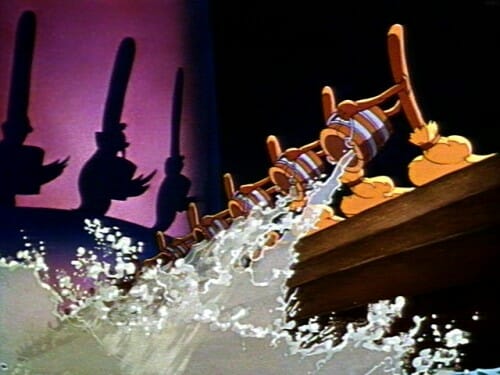
Seriously, how far does this go?  Does anyone else picture scores of brooms with pales of water exiting the Treasury building?  It's like one of those farces where each new action to fix a crisis creates a new crisis that is even larger.

76% Vote to Live off the Other 24%

Via CBS:

Almost three-quarters of Americans think it is a good idea to raise taxes on people making more than $250,000 per year, according to the latest CBS News/New York Times poll.

In fact, two-thirds of Americans think the tax code should be changed so that middle-class Americans pay less than they do now, while "upper income" people pay more.

Imagine three quarters of the diners in a restaurant suddenly standing up and walking out the door.  As they leave, they announce that the remaining patrons should pay their tabs for them.  Fair?

Really Missing the Point

We libertarians and critics of large government will often criticize this or that initiative as being misguided, or dumb, or counter-productive, or too costly, or whatever.   Too often we do so in the context of the particular personalities involved -- e.g. Bush is going to far, Obama made a mistake, Pelosi is trying to do something dumb.  This tends to give the impression that these are individual mistakes, with the corollary that if we could just get better people in government, these mistakes would not occur.

I see this reaction -- that its the quality of the people, not the system itself, at fault -- all the time.  Of course, it was a common one on the left for years during the Bush administration -- if only we had our guys, smarter guys, non-fundamentalist guys, scientific guys, whatever -- in there, things would work.  Republicans, though, did the same thing for years with Congress  -- if only we'd get those liberals out of the Congressional majority, we would run things intelligently  (anyone remember the Contract with America?).

Two examples bring this most recently to mind.  The first from Radley Balko:

This is sort of amusing. Salon writer Andrew Leonard concedes the unintended consequences of excessive regulation and bad lawmaking, walks right up to the edge of embracing libertarianism, then shrugs it off with, "And that might be one of the most distressing results of decades of being told that government is the problem "” we hear a story like Hayes', and think despondently, you know, they were right, rather than squaring our shoulders and reapplying ourselves to the wheel." Yeah. Keep reapplying yourself to that wheel. If we can just get the right people in charge"¦.

The second is perhaps the clearest statement of the fallacy I have ever seen, from the Washington Post's columnist Richard Cohen via Reason:

In Ronald Reagan's famous formulation, "government is not the solution to our problems; government is the problem." This statement, at the very heart of the so-called Reagan Revolution, denigrated government and the people in it. Reagan's statement withdrew John F. Kennedy's invitation to the intellectually gifted to come to Washington and see what they could do for their country. Reagan sent a different message. Government service is for the lame, the cautious. If you really want to do something for your country, shun Washington and make money. It was morning again in America -- whatever that meant.

It is to Barack Obama's immense credit that he has reversed Reagan's reversal. Washington crackles with people on a mission. Brains are once again in vogue, if only because Obama has them in abundance. Not for him the aw-shucks affectation of the previous eight years, when instinct was extolled and ideology trumped analysis. We are in a mess, and one of the reasons is that people who might have noticed or done something about it had been told to stay out of government.

In our scandal-soaked culture, it is de rigueur to denigrate public officials and to search for the inevitable conflict of interest. But here are people, such as [Lawrence] Summers, who have put aside wealth and lavish perks for government service. They have their reasons, sure, but whatever they are, we -- not they -- are the richer for it.

Seriously, gag me with a spoon.  Forgetting the fact that these guys are sacrificing nothing, and in fact get rich fast after office based on the power and contacts they have amassed, this just really misses the point.

The problem is not bad people.  In fact, I have said for years that with a very few exceptions, there are no bad people in government.  There are just 1) really bad incentives; 2) really bad information; and 3) problems that are not amenable to command and control.

People who believe as do Cohen simply will never accept #1 and #2, no matter how much evidence is brought to bear.  We ought, they say, to be able to find public service monks who are both brilliant and un-swayed by such incentives or information asymmetries.   Sure, the incentives are to deliver benefits to small, visible, powerful minorities even when those benefits dwarf the costs, as long as those costs are dispersed and less visible.  But their guy will be smarter and will avoid this trap.  Never mind how many free trade economists turn into protectionists once they enter the administration, succumbing to the pressure of the visible (e.g. GM jobs) over the logic of the invisible.

But lets look at #3, because this does not get nearly enough attention.  It seems incredible to me, particularly in current times, but how often do you hear someone make the case that the government simply cannot achieve a certain goal?  Almost never.  We argue about expense and constitutionality, as we should, but is it even possible for even the smartest people to make GM profitable this year?  Or to make toxic bank assets go away without economic pain?  Or stop a sufficiently motivated terrorist from killing people?  Could it be that we simply have to endure a recession, rather than firing off trillions of dollars to try to "do something" about it?

One of the things that I have learned as a systems-dynamics specialist in mechanical engineering is that there are systems out there so chaotic and so complex we cannot hope to even adequately describe them, much less effectively manage them.  The details of flow in a waterfall, of a smoke plume from a cigarette, of weather and climate ... and of the economy and individual action in a society are so complex as to defy human understanding.

Our interaction with the natural world is a great example.  We used to act with a certain hubris - like, "we can manage the deer population."   I think several decades of trying to "manage" animal populations have taught us a certain humility.   What if, for example, we wanted to increase the deer population in Yellowstone?   Well, we could put out feeders full of corn, but we might then find that by domesticating the deer, we have in fact doomed them long-term.  We could kill their natural predators, but we might find that these predators were also eating something else, possibly something that competed with the deer.  We could kill whatever competes with the deer for food, but again we might cause imbalances in other populations.  Or we could actually be successful, and increase the deer population, and then find it quickly devastated as they outgrow their food supply and habitat area.

We describe these problems by saying that these actions in complex systems carry "unintended consequences".  The problem is that when I use this term in a political world the reaction is "well, that's just an artifact of poor design - my guy will be smart enough to avoid them."  But here is another way to put it:  "Unintended consequences" is a simple way of saying that in a nearly infinitely multi-variate, hugely complex system (like the economy), it is impossible to narrowly target changes to a single variable without all the other variables in the system being effected, often in ways impossible for us to predict in advance.  In this context, "unintended consequences" are not avoidable design defects -- they are absolutely required.  They are unavoidable.  They are an absolute fact that politicians cannot wish away (but if they are clever, they can hide, at least until after reelection).

Sometimes, I wonder how my education had such a different impact on me than on others.  I could easily be called part of the over-educated elite -- magna cum laude at Princeton, first in my class at Harvard Business School.  Folks with similar backgrounds in this administration seemed to have walked away from similar educations with a deep confidence that they can run or fix anything -- Take over GM, run it successfully where decades of industry experts have failed, manage its turnaround better than a coterie of experienced bankruptcy guys -- No problem!  I just can't even imagine thinking this way.  If anything, I walked away from my mechanical engineering degree with a deep sense that most complex systems would always be out of my analytical reach, and I walked away from Harvard Business School with an understanding of just how hard it is, even as the top boss, to move and drive change in large organizations.

Some older thoughts on this topic, in relation to technocrats, here.
Public Saftey Fail

Via Radley Balko, here is a great article on 5 great public safety measures that failed, and why.  Here is one brief excerpt, on why speed limits fail:

Because, and this surprised the hell out of us, people aren't completely retarded. As it turns out, people tend to drive at speeds they feel comfortable driving. Yes, there are reckless madmen out there, but they're not going to obey a couple of digits on a sign anyway. It just becomes a make-work project for traffic cops.

Scientists Can Be Morons Too

I was in the audience yesterday at Arizona State for something they called the Origins conference, which attracted a lot of top scientists to talk about issues related to the origins of life and the universe.  Towards the end there was a panel discussion that was less scientific, and more focused on "future of science" and "science and public policy" type issues.

What I observed in this discussion was amazing.  Folks who likely set very high standards of proof and rational thought in their own disciplines threw all such concerns out the window when talking on these public policy topics.  In fact, in the same sentence, I heard participants decry the rise of anti-scientific Luddites and then make wild, unsupported statements of their own that are laughably easy to disprove.

Here are some semi-random observations:

On Scientific Education: The panel went on and on about how schools are somehow failing to make science interesting and magical or whatever and are killing interest in science.  One woman who used to work with Carl Sagan said every kindergartner should be taken out to look at the stars and think about alien races.  While I am not one to defend schools too much, I do think that this gauzy view of education is a crock.  For some number of years, kids can be engaged with science and nature with gee-whiz demonstrations and participation events and spurring a general sense of wonder, and elementary school teachers who can do so should be treasured.

But at some point, discipline has to kick in.  To be good at physics, for example, requires a deep, deep knowledge of math.  It means hours and hours and hours of stultifying work learning to solve various forms of partial differential equations (just to choose one example near and dear to my heart).  Or, to choose another discipline, I just don't think that memorizing isomers in organic chemistry is ever going to be magical.   I believe this happy feel-good approach to science is in fact part of the problem.  Kids may get to age 13 thinking black holes are cool, but they are utterly unprepared for the work it is going to take to go to the next level of understanding.   I think this is in some sense why so many hard science PHD's are foreign -- their culture and early education is preparing them better for the hard stuff that requires discipline to master.

On Obama: The panel members all agreed that the change in US administrations meant an enormous turnaround in the future of science in the US.    Really?  I understand the problems with the Bush administration, but does anyone really think that the quality and quantity of scientific endeavor in its full scope across the country is going to measurably change because Obama has several Nobel laureates among his advisers?   It's like saying the Earth's rotation is going to measurably change if we all jump up and down at the same time.   How can people who analyze complex systems for a living throw out everything they know about such analysis when then look at the government and the economy?

On Economics: I swear one of the panel participants got up last night and said that the US economy is tanking because we have failed to make investments in science, while other countries who have made such investments are doing well.  That one sentence, from someone who is nominally a scientist, has four unsupported, and I think unsupportable, statements in one sentence:  1.  That the US has somehow refrained from investing in science, against some unidentified benchmark (the past?  the Platonic ideal?); 2.  That current economic problems stem from this lack of investment, rather than, say from the housing bubble and poor banking decisions; 3.  That other countries have made more investments in science than the US; and 4.  That these countries are prospering while our economy is in the tank (who??).  And everyone nodded their head at this.  No one challenged this.

On the Politicization of Science: The panel lamented the politicization of science, which they say is a phenomenon that has arisen solely over the last 10 years.  Ignoring this perversion of history, I was amazed at their solution.  For example, one member lamented the pushback in teaching of evolution in certain public schools.  Her solution, however, was for scientists to get even more political, ie to fight fire with fire.  That seems to miss the point.  I would have thought a better solution was to merely eliminate the politicization.  For example, taking government out of the business of setting curricula, e.g. by allowing school choice, would eliminate the role of government in choosing sides in science teaching issues altogether.  Why escalate the problem when we can eliminate it?

On the Profit Motive: The hostility to the profit motive was astonishing.  One guy on the panel had the temerity to mention that maybe changes in scientific output were driven by changing expectations of making money from such investment.  We then had to endure a 5-minute interlude where each member jumped in to assure the world that neither they or anyone they knew or anyone with any real credibility were driven by anything but a pure and idealistic desire to understand the universe.

Update: I have been reminded rightly that this panel does not necesarily represent the mass of the Origins effort, and in fact this panel was much more skewed to media and public policy.  This post is solely in reaction to this one panel, and the rest of the conference was great, dedicated mostly to hard science, and a real learning experience for me.

Liquidity or Insolvency?

This is an update to these two posts on the Geithner toxic asset / bank bailout plan.  In those posts, we looked at a hypothetical investment with a 50/50 chance of being worth 0 or 200.  From this, we said that the expected value was 100, and looked at payout scenarios under the Geithner plan.

A number of folks wrote me that I had missed part of the point of the Geithner plan.  The original assumption of the plan was that the banking system is in a liquidity crisis, and fire sales of assets are reducing the pricing of such assets well below their expected hold-to-maturity value.  According to the Treasury white paper:

Troubled real estate-related assets, comprised of legacy loans and securities, are at the center of the problems currently impacting the U.S. financial system...The resulting need to reduce risk triggered a wide-scale deleveraging in these markets and led to fire sales. While fundamentals have surely deteriorated over the past 18-24 months, there is evidence that current prices for some legacy assets embed substantial liquidity discounts...This program should facilitate price discovery and should help, over time, to reduce the excessive liquidity discounts embedded in current legacy asset prices.

Their point is, in our example, that the asset worth 100 is only trading at, say, 50 due to a liquidity discount and the point of the plan is to make this discount go away.

This does make it clearer to me how these guys are justifying this program.   If we look at the program on the original analysis, based on expected values of assets held to maturity, we got this profile of returns:

geithner-plan1

The bank returns in the analysis were based on the alternative of hold to maturity.  It is all a zero-sum game - gains at the banks and investors come directly out the the taxpayer's pocket.

If, however, one assumes the asset is trading below expected value, say at 50, due to a liquidity discount, then Geithner can argue the banks get a higher return for the same taxpayer subsidy IF the returns are based on a base case of selling out at the fire-sale market price.

geithner-plan2

In this case, with these assumptions, we get some "free value" or a multiplier effect of the taxpayer subsidy equal to the liquidity discount.

Is this a valid way of looking at it?  Well, the first problem is that this seems like an awful lot of money to spend of taxpayer money just to eliminate a fleeting (in the grand scheme of things) liquidity discount.  Banks have a zero-subsidy alternative to achieving the same end, which is simply to hold the investments to maturity, or until the market eliminates the liquidity discount.  Those of you who own a home know that you are going to take a hit on value if you have to sell now, while the market is a flooded with homes for sale, vs. two or three years from now.  Anybody proposed lately to bail ordinary folks out of this liquidity discount?

But perhaps the more telling criticism of Geithner's assumptions come from a recent paper by a group of Harvard Business School and Princeton professors who have looked at the current market pricing of these toxic assets, and have found little or no liquidity discount.

"The analysis of this paper suggests that recent credit market prices are actually highly consistent with fundamentals. A structural framework confirms that bonds and credit derivatives should have experienced a significant repricing in 2008 as the economic outlook darkened and volatility increased. The analysis also confirms that severe mispricing existed in the structured credit tranches prior to the crisis and that a large part of the dramatic rise in spreads has been the elimination of this mispricing."

Three conclusions are drawn:

  • Many banks are now insolvent. "...many major US banks are now legitimately insolvent. This insolvency can no longer be viewed as an artifact of bank assets being marked to artificially depressed prices coming out of an illiquid market. It means that bank assets are being fairly priced at valuations that sum to less than bank liabilities."
  • Supporting markets in toxic assets has no purpose other than transfering money from taxpayers to banks. "...any taxpayer dollars allocated to supporting these markets will simply transfer wealth to the current owners of these securities."
  • We're making it worse. "...policies that attempt to prevent a widespread mark-down in the value of credit-sensitive assets are likely to only delay "“ and perhaps even worsen "“ the day of reckoning."

Update: Critics of the study argue the authors only looked at the most liquid portions of the toxic asset portfolios, thus missing the problem they claim to be studying.  From this brief critique, they seem to have a point.

Michael Rozeff looks at the paper's findings in the context of Austrian economics, and concludes that in fact, Geithner and company are delaying a recovery in lending, as bankers are frozen in a game of chicken, hoping to make things bad enough to attract government subsidies without making them so bad the institution fails before subsidies arrive.

By contrast, the Austrians, as well as other financial analysts, have argued from the outset that the basic problem is not liquidity of the financial system. The argument on the Austrian side is that the banks and other financial institutions have not been in trouble because there is not enough liquidity to buy their loans. They are in trouble because they made bad loans that are worth far less than their values as carried on the banks' books. The banks are often insolvent. Furthermore, these banks do not want to and refuse to sell these loans at the low values to get the liquid funds they want. They are playing politics. They are getting a better deal (a) by shifting some of these loans to the FED in return for Treasury securities, and (b) getting bailed out by taxpayer funds.

In the Austrian interpretation, the banks have waited while the government came up with various devices to bail them out with other people's money. The latest is the Geithner PPIP that uses an FDIC guarantee to private parties to buy the bank loans at prices above market value. In the same vein, the accounting regulatory authority known as FASB has just allowed the banks leeway not to carry these bad loans at their market value by voiding the mark-to-market rule.

My Commute: 1.9 Miles

I could drive a Caterpillar D6 to work and still use less fuel than most folks do in their commute.  That is because I choose to work less than 2 miles from my office, out here in the northern suburbs of Phoenix (and, when it is not 110 degrees out, there is a bike path that takes a more direct route that is even shorter).  There is no place I would choose to live anywhere near the central business district of Phoenix;  if my job was downtown, rather than in my suburban neighborhood, my commute would increase to sixty minutes per day rather than six.

So, I wonder why the movement of jobs from city centers to suburbs has the Brookings folks so upset.  If your remember, urban planning types lamented the move of homes to the suburbs, saying this increased commuting time and energy use.  Now that the jobs are moving out to the suburbs as well, close to where people actually live (rather than where the planners want them to live), this increases gas use and commute times as well?

Since 1998, almost every major American metro area has seen a drop in the share of employment located downtown as jobs have increasingly moved into farther-out suburbs, exacerbating "job sprawl" "“ a phenomenon that threatens to undermine the long-term prosperity of the nation's vital economic engines, according to a report released today by the Brookings Institution.
...
""˜People sprawl' has long been known for its effect on the environment, infrastructure, tax base, quality of life, and more. Now, we must recognize what "˜job sprawl' means for the economic health of the nation," stated Elizabeth Kneebone, author of the report and senior research analyst at the Metropolitan Policy Program.

"The location of jobs is also important to the larger discussion about growing the number of jobs," said Robert Puentes, a Brookings senior fellow. "Allowing jobs to shift away from city
centers hurts economic productivity, creates unsustainable and energy inefficient development, and limits access to underemployed workers."

The economic productivity argument has me totally flummoxed.  Are they really arguing that companies purposely reduce their own productivity and access to labor?  Why?  This makes no sense, and as the Anti-Planner points out, goes totally unproven in their study.

The only possible argument I can see is a government one, that somehow suburb infrastructure by being more spread out is more costly per person than urban infrastructure.  But this is a point that has never been well proven, and is a classic case of looking at just one variable in an multi-variate system.  Sure, I would guess the total miles of sewer pipe and roads per person is greater in the suburbs than the city.  But the cost of land acquisition, infrastructure construction, and maintenance are all lower.  It is not at all clear how these balance, and the authors do not even try to figure it out.  I would be surprised if the government infrastructure costs per person in, say, Scottsdale is really higher than in Manhattan.

In fact, if there is an issue here, it strikes me it is more a government pricing issue than a demographic issue.  If government is somehow taking a loss on suburban vs. urban infrastructure, then it needs to rethink its tax structure to appropriately set property taxes and fees to match actual costs.  But I think we all know that this is NOT the problem.  Where suburbs are separate cities from the inner cities, those cities tend to have lower taxes and healthier budgets than their inner city cousins, giving the lie to the statement that suburban infrastructure is somehow more expensive (or, as a minimum, that any increase in costs are more than offset by other cost advantages to government of the suburbs).

And all this ignores the individual rights issue of why government should be influencing the shape of people's living and commuting choices at all.  Note the very suggestive words in the Brookings press release -- "Allowing jobs to shift away from city centers hurts economic productivity," as if the location of my employees requires government approval.   It's amazing to me that the children of the sixties grew up to be such control freaks.

The New Government Motors

The following actually seems real, though I had to check the date three times to make sure it wasn't April 1.  However, it appears that having cut R&D for most new vehicles and concept cars, GM is doubling down on this vehicle for the New York auto show:

ob-dl221_segway_g_20090407005950

No word yet on Federal crash test results, though I guess since the Feds own the company now they can waive whatever requirements they wish.

Postscript: Its probably a pretty cool technology, and I am sure it would be fun to scoot around in.   But the company is hemorrhaging billions of dollars of cash a month and someone is still funding this?  This can't be made in any of its plants, and can't reasonably be sold in any of its dealerships.   GM would have to sell millions of these to have any kind of impact on its financials, and it is highly unlikely there is any such market.  I therefore am waiting for someone in the Obama administration to say "this is exactly the type of thing GM should be doing."

In the Future, Only Governments Will Own Video Cameras

Having heard that Phoenix has been coming down hard on folks for the "crime" of photographing in public places, The Northern Muckraker went to take a look.  The Photography is Not a Crime blog has a partial transcript:

Hester: I'm free to go, correct?

Guard 1: Not yet.

Hester: Am I being detained?

Guard 1: Are you videotaping my building?

Hester: Am I free to leave?

Guard 1: You're are free to leave, go "¦  but if I catch you videotaping the building again you will be arrested by the Phoenix Police Department.

Hester: On what charge, sir?

Guard 1: On charge of "¦ we'll talk to the Phoenix Police Department about it.

Guard 2: You're not supposed to videotape any federal court building.

Hester: What law?

Guard 2: National Security Act.

Guard 1: Oklahoma City, that's why.

Guard 2: It all comes down to Homeland Security and all that.

Guard 1: If you want to talk to our Homeland Security people, we can arrange that right now and we will detain you.

He further observes that the National Security Act, passed in 1947, does not seem to have any mention of video recording.

Update:  Apparently, according to an official Houston PD statement, photographing and taping a police officer is sufficient probably cause for being charged with "assault on a police officer."

Mr. Haven admitted to verbally disagreeing with Officer Dickerson. He also admitted to photographing the police vehicle and Officer Dickerson, and taping their conversation. Under these circumstances, it is not unreasonable for Officer Dickerson to have believed that Mr. Haven's relevant actions, taken as a whole, constituted more than "speech only" [and therefore constituted sufficient probable cause for arrest]

We Have a Winner

For the first time in years, we have a winner in our bracket contest even before the Finals are played.  Publicity shy Steve Anonymous is the winner, no matter who wins tonight.  He has North Carolina to win, but no one with Michigan State is close enough to catch him.  Congratulations!  As usual, I entered the sweet-16 in the top 10, but then just got crushed on the second weekend.  After having 12 of the Sweet-16 correct, I only had 3 of the final 8 correct.

Free Markets, Not Pro-Business

Timothy Carney has a really interesting deconstruction of the US Chamber of Commerce agenda, and it is a good reminder of the forces at work pushing this country towards a corporate state (similar to France and Germany).  When large corporations lobby via the Chamber of Commerce, it is apparently not for low taxes and free markets, but rather targeted interventions and subsidies.  The article does not have a money quote I could find, but this should give you an idea of what the author discovered in the Chamber of Commerce rankings of Congressmen:

On the House side, it's a similar picture. The Republican with the lowest Chamber score was [Ron] Paul.   Even Rep. Barney Frank, D-MA, who wants to regulate everything except Fannie Mae, scored 14 points higher than Paul on the Chamber's scorecard.

Suffice it to say a ranking system that has folks like Ron Paul last is not based on free markets and small government.  Apparently, the Chamber marks down Congressmen who did not vote for all the bailout and stimulus packages, did not vote for various alternative energy subsidies, and did not vote to expand college loan subsidies.

The victor of almost any new regulation or licensing program is typically incumbents, and particularly large incumbents.  In my own business, there have been a series of new government regulations added over the years, with the effect that an industry formerly dominated by hundreds of ma and pa operators has consolidated to barely four or five players.  No one else can afford the compliance costs.  Licensing is almost always incumbent protection, and the government even frequently turns over the approval process for new entrants to the current incumbents (e.g. medicine and law).  And subsidies are almost by definition support incumbents over potential new entrants.

Postscript: In terms of incumbent protection, keep an eye on carbon permits.  There will be a ton of pressure to give free or discounted permits to current incumbents, as was done in Europe.  This would be a huge structural barrier to competition, as incumbents can service their current market share for free but new entrants (or expansions of existing entrants) will require expensive new permits.

Unintended Consequences

This story in the Nation was a pretty classic example of intended consequences at work:  (via the Anti-Planner)

Thanks to an obscure tax provision, the United States government stands to pay out as much as $8 billion this year to the ten largest paper companies. And get this: even though the money comes from a transportation bill whose manifest intent was to reduce dependence on fossil fuel, paper mills are adding diesel fuel to a process that requires none in order to qualify for the tax credit. In other words, we are paying the industry--handsomely--to use more fossil fuel. "Which is," as a Goldman Sachs report archly noted, the "opposite of what lawmakers likely had in mind when the tax credit was established."

As I understand it, the paper companies had a process that has for decades been 100% biofuel powered, but if they now mix in some diesel fuel, they can get a tax credit under a provision that gives such credits for using a 50/50 diesel/biofuel mix.   Obviously, the indended consequence were to get 100% diesel fuel users to mix in some biofuel, but the law was not written in a way to preclude the opposite.

I found nothing particularly new or unique about this example, but I did find the author's reaction depressing.  Apparently, for Christopher Hayes, this is a failure of private enterprise, not of government:

I've come to expect that even nobly conceived laws will be manipulated and distorted for private ends. But once in a while I hear a story that gives me the queasy feeling that I'm nowhere near cynical enough...

the episode is a useful reminder of the persistently ingenious ways the private sector can exploit even well-intentioned legislation

First, the notion that the whole bio-diesel law was "nobly conceived" is a total hoot.  Basically this law was originally a politically-motivated subsidy of a powerful political lobby (farmers and agribusiness) that most science has demonstrated to have zero impact on its nominal target (CO2 production).  So all that is happening here is that one narrow business interest has hijacked the subsidy intended for a different narrow business interest.   Seriously, I probably should know who this author is, but can anyone who has covered Washington for, say, a week or more really attach  "noble" and "well-intentioned" as modifiers to "legislation" with a straight face?

Second, as a back-check on all the "well-intentioned" stuff, note that there has been no movement to change the original law now that this exploit is understood.  Why?  Because, Mr. Hayes says, the paper industry has a powerful political lobby.  I am having a hard time reconciling the picture of a group of folks in Congress failing to fix an expensive exploit in a law due to political pressure from 8-10 corporations with the view that these same guys passed the original law nobly and with the best of intentions.

Finally, there seems to be a general reaction, particularly on the left, that if Congress were just smarter then this would never happen.  But it HAS to happen.  It is a mathematic certainty.  No one, no matter how smart, can make changes to a single variable in a nearly infinitely large, chaotic, and multi-variate system like the economy and understand fully what the consequences will be.  It's absurd hubris to think otherwise.