Pathetic

Somehow I am on a couple of Minutemen / anti-immigration email lists  (I suppose I was put there by a staffer that did not read my site very carefully).  Anyway, I got this from some such group called the ALIPAC:

While hyper political correctness tries to hold sway in America as not to offend or disrupt trade with our Mexican neighbors to the south, the official name of the new flu pandemic is Mexican Flu and not the PC terms 'Swine Flu' or 'H1N1'.

Swine Flu and H1N1 are terms that describe large volumes of flu like viruses and not the specific strain at hand. Traditionally, pandemic flu strains are named after their points of origin. The point of origin for the new H1N1 pandemic flu, with swine flu DNA components is Mexico.

"It's a sad day in America, when you can't even call this pandemic strain by it's proper name 'Mexican Flu'," said William Gheen. "We are calling on all members of the media and citizens alike to refer to this pandemic virus as the Mexican Flu."

The World Health Organization (WHO) and several nations are now referring to the new H1N1 pandemic strain from Mexico as the 'Mexican Flu' which is now the official name.

The last three global pandemic flu viruses were named the Hong Kong Flu (1968), the Asian Flu (1957), and the Spanish Flu (1918).

Yeah, I am just sure these guys would have issued this same press release had the virus originated in Canada.  The attempt here to try to tar an entire ethnic group by hanging this flu around their necks is so transparent that I can't believe someone actually had the guts to issue this press release.  And I find it hilarious that a strongly Conservative group suddenly is looking piously to a UN organization (the WHO) for "official" guidance.  That had me laughing out loud.

I am glad he mentions the Spanish Flu, because it both 1) proves the author is historically illiterate and 2) shows the danger of trying to hang blame for a pandemic on one particular country.

First, it is pretty clear that the Spanish Flu did not begin in Spain.  As I understand it, as the world's governments clamped down on the media and suppressed news of the pandemic, the Spanish media was (relatively) unregulated.  The world therefore had a lot of its first reports about the flu from Spain, even though the first cases were not there, so people got in the habit of referring to the Spanish flu.

In fact, America firsters at the ALIPAC need to be really careful on this naming thing.  One of the leading theories of the Spanish flu's origins was that it began in the US (possibly Kansas or Boston) or at least that the mutation to its more deadly form occurred in the US, and then was brought to Europe by American soldiers.   I suppose if the ALIPAC is willing to call the 1919 flu the American Army flu, then I will call the current one the Mexican flu.

By the way, we as Americans should be very, very careful trying to demonize and wall off Mexico over this flu.  Because it might feel good here, but around the rest of the world most nations are lumping the US and Mexico together as the source, so any worldwide calls for closing borders and isolation are likely to backfire against the US.

It's Supposed to be Painful

Megan McArdle points out the real problem that carbon taxes and other CO2-abatement approaches have -- they only really work if it they are painful.  I mean, the whole point is not supposed to be to raise government revenue or just arbitrarily raise prices.  The whole point is to change behaviors, and the most powerful tool for behavior change is price changes.

Global warming activists are talking about 80% CO2 reductions.  This is an enormous number, especially since the relative cut has to be even higher to account for future growth, as reductions are generally pegged to current (or as in Kyoto, past) CO2 emissions levels.

A 40-cent gas tax is not going to do it.  Or, looking at how much behaviors changed when gas prices recently went up to $4, a $2.00 gas tax is not going to do it.  The Europeans have $6+ gas taxes and that is not enough to reach the levels activists want for this country.   It is likely going to take $10+ gas to even start to get the reductions in use and the shifts to much more expensive carbon-less technologies that would be required to hit 80% type goals.

All this means that we are NEVER going to have a carbon tax that really reflects the necessary rates to hit the emissions targets Obama and the alarmists claim to be committed to.  That is why we will get backdoor taxes that try to hide the tax and shift the blame away from Congress.    But none of these schemes, including cap and trade, will have any meaningful impact unless they lead to consumer price increases that change behaviors of the end users**.  But these approaches are preferable to lawmakers, as they somewhat disguise the relationship between legislation and prices, and give them some ability to blame private companies for the price increase, even where these increases are the inevitable result of carbon caps.

Postscript: This is further complicated because the major technologies the government is attempting to subsidize as part of meeting these goals are virtually useless.  Two in the transportation sector - ethanol and electric vehicles - are of questionable merit.  Ethanol has about zero efficacy in reducing Co2, and may actually increase it (but it is essential if one wants to win the Iowa caucuses).  Electric vehicles have some potential, but their impact is dependent on how electricity is generated.  Based on the current mix, shifts to electric vehicles just shift emissions from one place to another without much net reduction.  If someone were to propose a massive nuclear and electric vehicle program, they might convince me they were on to something.

**PS#2: I suppose you could reach these goals without fuel price increases.   Two alternatives:

  • Mandate certain transportation and other technology solutions, as well as certain limits (e.g. maximum house size, maximum number of TV's, etc).  This still has cost, though, in terms of enormous losses in personal liberty as well as likely enforced higher costs of major purchases, like cars.  So this is still likely a price increase, it just shows up in a different place.  Also, this may well not work -- there is very good evidence that without price changes in fuel, consumers react to higher MPG in their cars by driving more, thus sibstantially dilluting the carbon effect.
  • Enforce carbon limits combined with price caps on fuel and electricity.  This would be effective, probably, but of course would result in massive shortages of gas and electricity.  The rationing challenge would be enormous.

Friday Picture

Love this picture of 30 Rock, via Shorpy (including full-size image)

30-rock-small2

I'm Glad She Is OK

Queen Beatrix of the Netherlands survived an assassination attempt, though several of her staff and onlookers were not so lucky.

Years ago, my parents actually hosted Queen Beatrix's visit to Houston.   As a libertarian, I don't have much use for hereditary monarchy, but she was quite approachable and helped smooth over my wtf-am-I-doing-here nervousness at the event.  She also paid a visit to Princeton University while I was there, so she's got that going for her too.

Can We Afford to be This Forthright?

Radley Balko linked to this article for a different reason (at least I think it was for another reason -- I actually can't figure out why he linked to it, but all those Reason guys are often too hip for me to follow).  But I thought this line was funny:

An off-duty Essex police officer could face charges for shooting his allegedly neighbor's dog after it tangled with his Pug, state police say.

"Allegedly neighbor's dog?"  Is the fact that he is a neighbor in doubt?  Or is the ownership of the dog in doubt?  Or is it the species of the animal that is in doubt?

I Don't Think It Will Work This Way

From the Economist via TJIC:

the United Automobile Workers "¦ can own half of Chrysler's stock and a third of General Motors' stock if everything goes through"¦

anti-labour activists might also feel a bit of cheer. As Conor Clarke points out, today's events can only have one of two consequences:

It will change the incentives of the unions"”such that they realize their demands were bad for the company"”or it will run the company (further) into the ground and leave the union to pick up the pieces.

Worker ownership rarely works the way it's expected, so it's entirely possible that the UAW has sped up its own demise by cutting this deal.

I don't have any hope that it will work out this way.  The only incentive alignment that will exist is that union ownership of GM will align Congressional incentives to issue GM a near infinite stream of subsidies, bailouts, tax breaks, import restrictions, consumer incentives, etc.

We are switching ownership of GM from a politically fragmented and unorganized group (ie current GM shareholders) to a single organization that already has political clout and massive political lobbying infrastructure  (UAW).  Just look at the large corporate states of France and Germany.  Union involvement in corporate management doesn't change union practices, it changes government practices.

Update from Q&O:

There's some interesting stuff out there to read about the Chrysler bankruptcy, like people asking "why wasn't this done in the beginning"?

Simple answer - in the beginning there was no way to secure the UAW a majority stake in the company. Now, as Felix Salmon points out, that's been accomplished

We'll Take Our Chances on the Judge

Given the deal Obama is trying to foist on them, it is no surprise bondholders are ready to take their chances with bankruptcy court.  I makes me sick to see Obama piously calling out these bondholders as if they are somehow corrupt and evil, when in fact their only crime is not to take the hosing Obama is trying to give them:

According the Treasury-GM debt-for-equity swap announced Monday, GM has $27.2 billion in unsecured bonds owned by the public. These are owned by mutual funds, pension funds, hedge funds and retail investors who bought them directly through their brokers. Under Monday's offer, they would exchange their $27.2 billion in bonds for 10% of the stock of the restructured GM. This could amount to less than five cents on the dollar.

The Treasury, which is owed $16.2 billion, would receive 50% of the stock and $8.1 billion in debt -- as much as 87 cents on the dollar. The union's retiree health-care benefit trust would receive half of the $20 billion it is owed in stock, giving it 40% ownership of GM, plus another $10 billion in cash over time. That's worth about 76 cents on the dollar, according to some estimates.

In a genuine Chapter 11 bankruptcy, these three groups of creditors would all be similarly situated -- because all three are, for the most part, unsecured creditors of GM. And yet according to the formula presented Monday, those with the largest claim -- the bondholders -- get the smallest piece of the restructured company by a huge margin.

This seems to be by political design

From the WSJ via Reason

Changing Their Story

I am not shocked that Obama is full of sh*t --  all politicians are.  But I am constantly surprised at just how awful the press has become.

Here was the Arizona Republic towing the government line, attempting to stampede the country into subsidizing the auto companies because bankruptcy would be a disaster:

Advocates for the nation's automakers are warning that the collapse of the Big Three - or even just General Motors - could set off a catastrophic chain reaction in the economy, eliminating up to 3 million jobs and depriving governments of more than $150 billion in tax revenue.

Industry supporters are offering such grim predictions as Congress weighs whether to bail out the nation's largest automakers, which are struggling to survive the steepest economic slide in decades.

Even if just GM collapsed, the failure could bring down the other two companies - and even the U.S. operations of foreign automakers - as parts suppliers run out of money and shut down....

Automakers say bankruptcy protection is not an option because people would be reluctant to make long-term car and truck purchases from companies that might not last the life of their vehicles.

There was absolutely no background on the chapter 11 process, or any mention by this reporter or in any subsequent AZ Republic article that bankrupcy meant anything but liquidation and disaster. Not even a hint that many large companies, including the largest company based in Phoenix -- US Airways -- have operated seamlessly through chapter 11.

It was left to bloggers like myself to remind folks that the businesses and assets don't just go *poof* in a bankruptcy, and in fact it is generally in creditors' interests to have the company continue to operate.

So, now that Chrysler is heading for bankruptcy, Obama's incentives are now to make chapter 11 look friendly instead of menacing.  And the AZ Republic is finally, after 6 months of coverage, explaining what this really means:

Bankruptcy doesn't mean the nation's No. 3 automaker will shut down. A Chapter 11 bankruptcy filing would allow a judge to decide how much the company's creditors would get while the company continues to operate. The goal is for the whole process to happen quickly, Obama said, perhaps within a couple months.

I thought this was priceless:

[Obama] said a group of investment firms and hedge funds were holding out for the prospect of an unjustified taxpayer bailout.

"I don't stand with them," Obama said at the White House event.

I actually don't think this is true -- as secured creditors, they are FIRST in line in a bankruptcy.  Obama has effectively told them to voluntarily move to the back of the line, and they reasonably said "no way."  Obama is miffed that they have not taken his royal direction, but I think they are correct they will get more out of a process run by bankruptcy law rather than one run by political pull.

But, even if hedge funds had this expectation of a taxpayer bailout, who in the hell do you think has given them reason to have this expectation?  Can anyone say "moral hazard?"

Priorities and the Precautionary Principle

Indur Goklany (pdf) has deconstructed the IPCC climate forecasts and models and finds something interesting -- for all the forecasts of catastrophe, it is hard to find it in the actual IPCC numbers  (vs. off-the-cuff statements by folks like Al Gore).

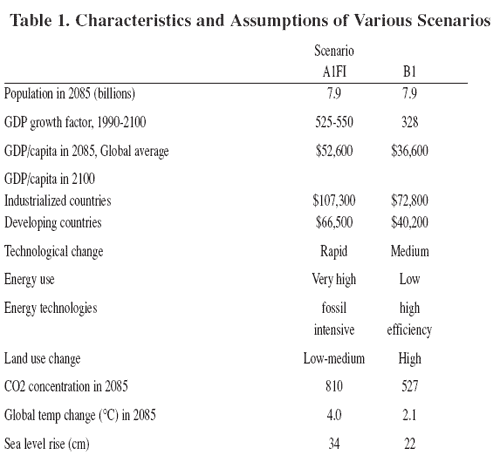
First, one needs to understand the basis for the various scenarios crafted by the IPCC.  I will leave some out, and focus on Goklany's analysis of just two - the IPCC A1F1 and B1 scenarios.  (the charts below have been edited to simplify them to just these two scenarios)

scenarios

One can think of A1F1 being close to a "do nothing" scenario on CO2, what is often called a Richer but Warmer scenario.  The B1 scenario represents fairly large interventions in Co2 use and investments in energy technologies, with lower CO2 concentrations and as a result lower but still positive GDP growth  (it takes only a small change in GDP growth to result in large changes in GDP 80 years hence -- the miracle of compounding).  This is the cooler but poorer scenario.  I know the Left has a fantasy that climate legislation is somehow an economic engine, but most economists on this reality plane achnowlege a tradeoff between CO2 intervention and economic growth.

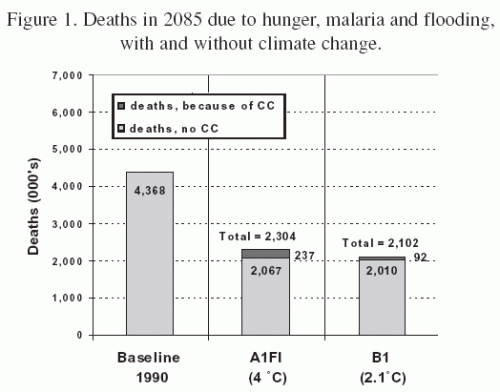
Goklany collates the impact on mortality from these two scenarios in the IPCC report:

mortality

Note that I am not even bothering to quibble with the IPCC numbers, which I could.  I have written plenty that these temperature increase forecasts are based on assumptions of positive feedback in the climate that make little sense.  Further, it makes little sense that the poorer and less advanced world in B1 would have lower base mortality than the richer, more advanced world.

Nevertheless, we can make three observations:

  • The difference in mortality from "do nothing" to "strong intervention" is small, and I would suspect hardly statistically significant
  • The improvement in mortality from advancing technology and wealth from the 1990 baseline dwarfs the effects of climate change
  • The mortality improvements from massive focus on climate change are trivial compared to those that could be achieved with much less expensive focus on other issues.

Hat tip to Watts Up With That, who has more here in a guest essay by Goklany.

I Find Your Lack of Faith Disturbing

I am trying to figure out what kind of thinking this post from Kevin Drum represents:

According to people "familiar with the talks," several of Chrysler's bondholders have rejected the government's deal, which amounted to paying them off a little more than 30 cents on the dollar.  So that means it's probably Chapter 11 time.  Blecch.  I hope the holdouts all end up getting less from the judge than they would have gotten from Obama.

There is only one possible reason** for Obama's attempt to avert a Chrysler bankruptcy -- he is trying to divert value from one group who would get it under a bankruptcy to another group.  There can be no other explanation for what he is trying to do, and in fact evidence is pretty strong that he has been trying to get creditors to take less so unions, who supported his election, can get more.

What has happened is that creditors have refused to get bullied by this near-unprecedented intervention by a US President in a bankruptcy case and are holding out for what they feel is the best way to recover as much as possible of what they are owed (no one is coming out whole).  In this context, Drum's pique really seems petty.  Rather than press for the money they are legitimately owed, the creditors should have bowed down, I guess, to the King's wishes and given up their money to those courtiers who were smart enough to back the King's coronation.

What Drum is probably most upset about is that it is now clear that both Bush and his guy Obama have spent tens of billions of dollars of taxpayer money to absolutely no end, just delaying a bankruptcy that would have been better for economic recovery if it had happened six months ago.

** There is one other explanation -- Obama may feel like he is better able to mediate a bankruptcy than a bankruptcy court and judge with decades of experience in the field.  I hope this kind of hubris is not the case, but for this administration it is very possible.  Obama is every bit as unaware of his inability to achieve his goals through shear force of will in domestic policy as GWB was in foreign policy.

Incentives Matter

Right now, local, state and federal governments are closing schools and curtailing civil liberties in what will likely turn out to be a vain attempt to curb the spread of swine flu.  For those, like me, who are shaking their heads at some of the unbelievable over-reaction going on in government in response to swine flu, we should not be surprised.

We have trained government officials, just like Pavlov's dogs, to over-react to hypothetical crises.  Just as one example -- the Homeland Security department has a history, in disasters, of being both grossly ineffective and for wasting billions of dollars.  Which do they get punished for?  Sure, there are a few stories about Katrina waste, but the enduring legacy is the sense that the Bush Administration moved too slowly and did too little.

As a result, we see a massive multi-trillion dollar government waste-fest in response to a deep but not unprecedented recession.  We saw civil liberties thrown out the window in reaction to 9/11.  And we see the government issuing orders left and right to be seen as "doing something" about the impending flu epidemic.  Because politicians currently fear the charge of inaction far more than the charge of wasting a trillion dollars or curbing civil liberties.

Global warming alarmists lament that Americans don't understand the precautionary principle.  I would say just the opposite -- the whole government is run by the precautionary principle -- that near infinite prophylactic spending is justified by even minuscule risks of something really bad happening.  This is the recipe for bankruptcy.

Update:  And, right on queau, a precautionary principle link between global warming and flu from arch-alarmist Steven Scneider:

Stephen Schneider of Stanford University who paints a worst case scenario for global warming in a commentary in the journal, said the studies make it seem like scientists know where there's a solid danger line for emissions, when they don't. The papers acknowledge there is a 25 percent chance the limit should be lower. Schneider said that's a pretty big risk when the consequences of being wrong are severe. "If you had a 25 percent chance that walking into a room would give you serious flu, would you?" Schneider asked.

Here is the problem with this an all similar analogies -- they ignore cost, both in terms of dollars and individual rights.  Better examples would be:

  • Would you walk out of a prison cell into freedom if there was a 25% chance of catching the flu when you rentered society?
  • Would you walk into a room if there was a million dollars sitting on the floor for the taking but there was a 25% chance you might get the flu by picking up the money?

By the way, Steven Schneider is the hero of hard science who said this:

We have to offer up scary scenarios, make simplified, dramatic statements, and make little mention of any doubts we have. Each of us has to decide what the right balance is between being effective and being honest.

More on this kind of post-modernism in the sciences here.

The New Obama 5-Year Plan

We really couldn't be more screwed when it is up to an NPR reporter to make the argument for free enterprise:

EPA Administrator Lisa Jackson told NPR's Michelle Norris yesterday: "The President has said, and I couldn't agree more, that what this country needs is a one single national road map that tells automakers who are trying to become solvent again what kind of car it is they need to be designing and building for the American people." Norris then asked: "Is that the role of Government though? That doesn't sound like free enterprise." Jackson responded: "Well it is free enterprise in a way."

via Maggies Farm.

Update: Q&O has a great post deconstructing Obama's view of government as health care planner.  Very frightening.

Encouraging News on Windows 7

Most of my readers know that I have been a Vista hater  (I still am by the way -- I have one machine running Vista SP1 and it drives me crazy -- just last night I had to reboot three times, each time just to be able to clear some permission state that would not let me delete a file).

The early returns look good for Windows 7, particularly for those of us looking for a home media sharing platform (the only reason I use Vista at all is because I have been toying around with Vista Media Center and a media extender, but more on that in a future post).  Here is Engadget:

The mood at Microsoft seems (understandably) high about this release. It's clear that lots of folks see this as the big, shiny band-aid for many of the Vista woes that people have been experiencing -- and in many ways, that's exactly what it is. If you're at all curious about what Microsoft has been up to, you should absolutely grab this install and take it for a spin (when you can); there is a metric ton going on here, and it's certainly worth taking a second look at. Bottom line, though? This is still Windows, and it's still got a lot of Vista in it. If you weren't feeling it the first time around, there may not be enough here to convince you otherwise. However, this is a valiant effort from Microsoft and it shows that the company does understand it's burned some bridges throughout the last three years -- this is a big step for them both in technique and tone, and that's certainly not lost on us.

Staggeringly Low Productivity

I was amazed by this:

Total k-12 expenditures in this country were about $630 billion two years ago (see Table 25, Digest of Ed Statistics 2008). The efficiency of our education system is less than half what it was in 1971 (i.e., we spend more than twice as much to get the same results "” see Table 181, same source).

So if we'd managed to ensure that education productivity just stagnated, we'd be saving over $300 billion EVERY YEAR. If we'd actually seen productivity improvements in education such as we've seen in other fields, we'd be saving at least that much money and enjoying higher student achievement at the same time.

Truth Is Not a Defense

I am not really that interested in the underlying story about Orlando police chief Val Demings (the examples of screw-ups are pretty mild as police malfeasance go).  But Demmings has gone the extra mile of threatening to sue a blogger who is critical of her.  My general policy in such a case is to give the blogger lots of free links.  Nothing better limits this kind of stupid attempts at censorship than having them backfire into national attention.  The money quote comes from Demings attorney, who says, "Truth is not always a defense."

Smearing Risk Around Like Peanut Butter

My kids have  a trick that I am sure is not unique to our household.  Faced with some type of food they do not like, they have become quite creative and artistic in spreading the mass of food around their plate, in a (generally) vain attempt to fool mom and dad that some of the food has disappeared.

After reading the scathing WSJ article this morning on the BofA / Merril Lynch deal, one has to wonder whether the feds were attempting the same trick with risk.

Like Welch, I welcome the WSJ as late arrivers to the bailout-skeptics party.

Bankruptcy Query

Megan McArdle outlines some of the latest terms of a GM creditor settlment.  The interesting facts for me were:

  • Creditors get 10% of equity in exchange for $27 billion in concessions  ($2.7B per percentage point)
  • Employees get 39% of equity in exchange for $10 billion in concessions ($0.26B per percentage point)

McArdle argues that there are good reasons bankruptcy courts tend to give labor a good deal, and having argued all along to allow bankrupcy courts to sort this mess out following the usual rules, I am not going to reverse myself.

But is it really the case that, push come to shove, bondholders get a deal 10 times worse than employees?  If this is the case, I am surprised people ever buy bonds in a company with a large employee retirement overhang.

Newspapers are Under-Scale

I am sure I could rattle off a myriad of problems at newspapers - changing lifestyles, the explosion of free content over the Internet, competition from cable TV, etc.  Built into these trends are some structural problems that newspapers probably cannot overcome.  At some point, there comes a time of survival when you have to stop fighting trends and start figuring out how to make money in the new regime.

Here is one thing I can say with certainty:  Every single newspaper in this country, with the possible exceptions of the WSJ and USAToday, but including the NY Times, are under-scale.

How do I know?  Just listen to the situation.  If they cut costs, they fear the quality of the product will fall and they will lose readership.  But the readership is already not covering costs and is in fact already falling.  This is a classic death-spiral of an under-scale entity.  It almost does not matter what caused the company to suddenly be under-scale when it previously was fairing OK -- technology change, new competition, shifts in customer expectations in habits, or all of the above.

There is no tweaking one can do in an underscale business.  One either needs to get much bigger, or find a defensible niche.  The latter is hard in the newspaper business, since these publications have essentially focused on just one metropolitan area or city, its hard to find a tighter niche that both has a customer following and would allow massive cost cutting.   Community newspapers are one example.  The only forward-looking idea I can come up with is a metropolitan sports-only daily.  Could such a thing sell in New York?  Possibly -- one can argue that is what the Dallas Morning News is, a sports daily with some news sections attached.

This scale problem should not be a particularly surprising finding.  The local newspaper business has always known it had a scale problem.   With thousands of newspapers across the country all reporting many of the same stories, there has always been a huge issue of duplication of effort.  Newspapers took a swipe at this problem with the formation of the Associated Press, which effectively acts as a shared reporting resource.

But it has been decades since this model has even been tweaked.  In that time, sophisticated new readers expect more than just bland 5-paragraph AP stories, and newspapers who rely on such content find most of their stories online for free, if not in their own paper, then in others.  And most large papers have been progressively tempted, for a variety of reasons, to have their own writers on national stories.  Ever seen the press pool for a Superbowl game?  The staff and talent they have built that could serve a whole country is only serving one city.

Many other local distribution models are dying or dead.  Local TV network affiliates were created when local re-broadcast was the only technologically feasible approach to getting TV signals to homes.  They survive today only through constant lobbying which has produced must-carry rules on cable and TV operators, or most of us would be just fine getting the network feed without local content (after all, how many folks watch CNN and FOX and MSNBC?).  Local auto distributorships and beverage wholesalers similarly fight rear-guard actions in the legislature against new national channels.

I think the time has come for publications like the NY Times to give up its city-centric model and go to full-bore national distribution.  My Arizona Republic has 4-5 standard sections plus an additional section (e.g. "Scottsdale") customized to my neighborhood.  I don't see why such a model would not work nationally  (the WSJ does something a bit similar but it is only customized regionally).  I would love a Washington Post delivered here that had an Arizona/Phoenix section and possibly a local sports section.

I can hear the cries now - but what about competition?  We will see thousands of newspapers collapse to 7 or 8 national brands.  But this is a false view of competition here.  Right now I have one newspaper choice.  Even having two or three national offerings with an Arizona section would increase my choice substantially.

Another Idea

Apparently, the Obama administration is worried about the shortage of GP physicians.  Personally, I think anything we do within the present framework, or more onerous government interventionist approaches likely to be proposed by Obama, will fail at reversing this problem.  If plumbers were not allowed to contract directly for price and scope of service with individual homeowners they serve, and were forced instead to fill out 23 yards of paperwork just to get paid rates that were set by government bureaucrats, subject to thousands of pages of regulations any one of which could cause his payment request to get rejected, we would have a shortage of plumbers too.

However, since no one in Washington currently seems to be in the mood topromote commercial relationships in medicine that mirror how we contract for every other product and service, I guess we can nibble at the edges of the problem.  David Bernstein suggests:

I have yet to see in any of these articles one simple reform proposed: abolish the requirement of an undergraduate degree before attending medical school, and turn medical school into a five or six-year post-high school program instead. This would eliminate two or three years of debt, and, perhaps even more important, the opportunity costs of two or three years of college. Right now, an aspiring physician must go to college for four years (and take many classes that have nothing to do with his future career), then medical school for four years, and then typically do a poorly paid internship and then residency for another five years. By the time this aspiring physician goes into practice, he will be at least thirty-one years old, and have eight years of student loan debt.

I have a better solution.  Why do we have a one-size-fits-every-corner-of-the-medical-field education and licensing at all?  Why do I need to pay for someone with 8 years of college and five years of residency to put three stitches in my kids' cut?  Or to write a Viagra scrip?  In dentistry, why do oral hygienists all seem to be in dentists' offices?  Why do I need to pay the overhead of a dentist to get my teeth cleaned?

We shouldn't really be surprised, I guess, about this licensing approach -- when the government turns over the licensing board to the incumbents of the industry being licensed, they have every incentive to choke off supply and to kill any initiative that might create low-cost competition for themselves.

So the licensing system that is all or nothing -- you are either a full-fledged medical doctor that can handle anything, or someone who is allowed to handle nothing.  This is reinforced by the payment system we have, where people do not bear the marginal cost of the services they consume.  So, since every office visit costs them the same (zero or a fixed copay), they might as well ask for the most experienced and over-educated guy they can find -- it's not costing them any extra.

Well, this is true for most people.  I have a high-deductible health insurance policy, and we often consider the price of different alternatives. Here is an example.  I am a healthy person, but still go in for a physical each year.  Nothing complicated happens in these visits.  Surely there could be some kind of less-trained traige MD who could conduct such screenings, passing folks on to the full-fledged doctors if anything unusual pops up.  If you told me that I could be seen by such a person for $100 or a full MD for $300, I would certainly consider it, particularly since the triage guy's schedule probably runs smoother as he doesn't get bogged down with the unexpected -- he just passes those folks on.

Obama's Budget Plan

I like TJIC's analogy for explaining the staggering depths to which the Obama administration is going to look for budget cuts:

Lots of folks are having fun pointing out that Obama's "$100 million budget cut" on a $3.69 trillion budget is pretty small potatoes.

Speaking of small potatoes, here's my analogy:

A Big Mac has 540 calories.

A small McDonalds French Fries has 230. Looking at the picture at the McDonalds website, I could believe that there are maybe 42 fries in there, so call it perhaps 5.4 calories per individual fry.

So, Obama's budget is like saying

"Please give me 370 Big Macs "¦ and one french fry. No, not "a small order of fries." Just a single, lone french fry.

Wait.

Actually, I'm trying to lose weight.Cancel that french fry - I'll just have the 370 Big Macs.

What, Was Ralph Nader Busy?

Per Overlawyered:

Mothers Against Drunk Driving is anything but an uncontroversial organization, as the Washington Times, Radley Balko, and our own archives make clear. Among the bad, sometimes awful ideas with which it has been identified are a reduction of the blood alcohol limit to 0.4 (meaning that for some adults a single drink could result in arrest), blanket police roadblocks and pullovers, the 55 mph speed limit, traffic-cams, and the imprisonment of parents who knowingly permit teen party drinking, to name but a few. Of particular interest when it comes to the policies of the National Highway Traffic Safety Administration (NHTSA), it has backed proposed legislation demanding that costly breathalyzer-ignition interlock systems be foisted on all new cars, whether or not their drivers have ever committed a DUI offense; it's also lined up with the plaintiff's bar on various dubious efforts to expand liability.

Now President Obama has named MADD CEO Chuck Hurley to head NHTSA. Drivers, car buyers, and the American public had better brace themselves for a season of neo-Prohibitionist rhetoric, nannyist initiatives, and efforts to criminalize now-lawful conduct. It won't be pretty.

Olson has tons of history linked on his site.

Now We Know The World Is About to End...

... because an Arizona Cardinal will be on the cover of EA's Madden 10 game.  Actually, Larry Fitzgerald of the Cardinals will share the cover with Troy Polamalu of the Steelers.  I suppose believers in the Madden curse can take heart that it may not have much affect on the Cardinals, who have historically been dogged by plenty of curses of their own making.   Maybe there is some sort of acquired immunity.  Great choice, though, as Larry Fitzgerald is not only rediculously talented and exciting to watch, but also seems to be as good of a guy as one can find in professional sports.

Repeating the Same Mistake, Over and Over

Flowing Data draws my attention to this nutty chart in the New Scientist  (I have never read the New Scientist, but my experience is that in periodicals one can generally substitute "Socialist" for the word "New").  Click to enlarge.

minerals-running-out-lol

Will the world really run out of Indium in 5 years?  Of course not.  New sources will be found.  If they are not, then prices will rise and a) demand with be reduced and b) efforts to find new sources will be redoubled.  Push come to shove, as prices rise too much, substitutes will be found (which is why John D. Rockefeller probably saved the whales).  Uranium is a great example -- sure, proved reserves are low right now, but companies that mine the stuff know that there is tons out there.  That is why they are going out of business, there is too much supply for the demand.  Any spike in price would immediately generate tons of new developed resources.  And even if we run out, there are enormous quantities of thorium which is a potential substitute in reactors.

Absolutely no one who was old enough to be paying attention to the news in the 1970s could have missed charts very similar to this.  I remember very clearly mainstream articles that we would run out of oil, titanium, tungsten, etc. by the early 1990's.  Seriously, name one commodity we have plain run out of (*cough* Julian Simon *cough*).

People say, well, the resources have to be finite and I would answer, "I suppose, but given that we have explored and mined about 0.000001% of the Earth's crust and none of the floating mineral reservoirs in space (called asteroids), I think we are a long, long way from running out."

You would think that the guys running this analysis would get tired of being so wrong so consistently for so many decades, but in fact their real point is not about resources but about the US and capitalism.  The point of the chart is not really to say that the world will credibly run out of tungsten, but to tell the world that it is time to get out their pitchforks because the US is stealing all their wealth and resources.  It is an age-old zero-sum wealth fallacy that has never held any water, but remains a powerful talking point among socialists none-the-less.

For socialists, wealth is not created by man's mind and his effort -- it is a spring in the desert with a fixed flow rate.  It just exists to be taken or fought over.  The wealthy, by this theory, have not earned their wealth, they are just the piggy ones who crowd to the front of the line and take more than their share from the spring.  Unfortunately, socialists have never been able to explain why the spring, which flowed so constantly (and so slowly) for thousands of years, suddenly burst forth with a veritable torrent in lockstep with the growth of capitalism in the west.  And why it seems to dry up in countries that adopt socialism.

Postscript: A while back I posted on the New Economics Foundation  (remember what I said about "New") and their claim the world had just gone into ecological debt.

Contempt of Cop

Carlos Miller at Photography Is Not a Crime coins a term (at least it is the first time I have heard it) for certain arrests called "contempt of cop."  I think it is a great term that summarizes a whole class of actions that many police officers treat as crimes, but in fact are no such thing.   People are getting arrested in public spaces committing no crime every day in this country for charges like "failure to obey" or  "photographing a police officer."  Police like to feel like they have absolute authority on the streets, that they are mini-dictators of the patch of ground within their field of view.   This is a fantasy, but as with all fantasies, folks get really upset when other folks try to dispel their fantasy.

The scary part is that the few who get off quickly are generally the ones who have had their incident video-taped.  Which is probably why police are working so hard to try to make photographing and videotaping of police illegal.  Because they know that in situations of he-said-she-said, the cop will win down at the station and among his buddies at the DA, particularly if his fellow cops will, as is typical, fabricate corroborative stories.  Citizen video tends to break this power imbalance.

One of the most notorious contempt of cop cases to make headlines was last year's arrest of an Albuquerque TV news videographer. Because that incident was caught on video, charges were dropped against the videographer and the cop was terminated.

That incident also prompted  Albuquerque Police Chief Ray Schultz to issue a new policy stating that officers were not to arrest people for "refusing to obey" unless that person was already being arrested for another crime or physically keeping the officer from carrying out his duties.

Defense attorneys derisively call the refusing to obey charge "contempt of cop" and claim that APD routinely violates residents' First Amendment rights when they use it.

Help Me Out, My Organic Chemistry is Rusty...

The Thin Green Line passes on an editorial from today's SF Chronicle:

California should continue to lead the way in the fight against climate change by requiring cleaner-burning fuels in this state.

The state Air Resources Board is scheduled to vote today on whether to force refiners and distributors to reduce the "carbon intensity" of the transportation fuels they sell, starting in 2011. The so-called Low Carbon Fuel Standard represents a critical step toward this state's commitment to reduce overall emissions of heat-trapping gases by a third by 2020.
Passage of a California cleaner-fuels standard would intensify the pressure on Congress to make a national commitment to promote lower-carbon options to gasoline and diesel.

Holy moly, I never thought of this?  It's brilliant!  Let's just legislate that hydrocarbons should have less carbon!  And tell the refiners to figure it out.

In all seriousness, assuming this is not just insane (which may be a poor assumption in CA) I presume they have something in mind here.  Does anyone know what opportunity they see, because I sure don't.  Here is why I am confused:

Basically transportation fuels are made up various hydrocarbon chains.  The shortest is methane, CH4, then C2H6, then C3H8, etc.  As the chains get longer, the molecule gets heavier  (for example, CH4 is a gas at room temperatures; C3H8 is propane, which is a gas but a liquid under pressure in our BBQ tanks; C8H18 is octane and liquid at normal car operating temperatures.)

Motor fuel is a careful blend of many different molecules, and is actually frighteningly complex (the above just discusses straight chain forms, there are also rings and other shaped hydrocarbon molecules).  There are literally hundreds of specs it has to meet, and several present difficult tradeoffs that must be carefully balanced.  Trying to make one spec can easily put one out of another spec.  So this is an optimization equation with a lot of constraints.

All things being equal, decreasing the carbon intensity of fuel basically means making it lighter, with shorter molecules.  Why?  Well, look at the molecular equations.  Basically a straight chain hydrocarbon is C(x)H(2x+2).  Shorter molecules get a higher ratio of their BTU's from combustion of hydrogen vs. larger molecules get a higher ratio of their BTU's from carbon.

So, it is correct that burning propane in a car vs. currently formulated gasoline will be less carbon intensive, with only the teeny tiny problem that most cars today cannot burn propane.  Modern engines are carefully built to run most efficiently (valve design, cylinder pressure and size, air mixtures, fuel injection)  on a certain range of gasoline, and that range is moderately narrow.  And, besides the pure physics of engine design, lightening up motor fuels will create a variety of secondary problems -- for example, lighter fuels tend to have higher vapor pressures and volatility that can cause vapor lock in engines on warm days.  Another way to reduce carbon intensity is to go from ring molecules (e.g. benzine) to straight chains of the same size, but this creates other problems, for example in maintaining octane numbers.

And speaking of unintended consequences, my understanding is that environmentalists like diesel engines, because the best diesel technologies today are far more efficient than gasoline engines.  But diesel is a heavier, more "carbon intensive" fuel than gasoline.  So is the carbon dioxide emissions from a heavier fuel in an engine that is more efficient less or more than a typical gasoline engine?  Who knows, and the answer is probably "it depends" anyway.

Update: I think I have figured it out.  The California legislature is going to mandate changing the size of the 2p valance shell, allowing more hydrogen molecules per given carbon molecule.