Huh?

From the NY Times, I am having a hard time reconciling these statements from the same article:

First statement:

The law provides a partial exemption for certain health plans in existence on March 23, when Mr. Obama signed the legislation. Under this provision, known as a grandfather clause, plans can lose the exemption if they make significant changes in deductibles, co-payments or benefits.

About half of employer-sponsored health plans will see such changes by the end of 2013, the administration says in an economic analysis of the rules.

Second statement:

About 133 million Americans are in group health plans from employers with 100 or more employees, the administration said, and most "will not see major changes to their coverage as a result of this regulation."

My translation:  Yes, you will lose your current health plan despite Obama's promises, but he doesn't want you to realize this until 2013, conveniently just after the next presidential election.

US Incarceration Rates

Combine an incentive for politicians of both parties to demagogue for "tough on crime" legislation with an over-broad approach to legislating anything seen as bad behavior by the majority as a crime, and you get the highest incarceration rates in the world.  Scary charts, with incarceration rates growing entirely out of proportion to crime and population.

Discussing Private Management of Public Parks

Yours truly, talking to a New York audience on private management of public parks.   Much more at this siteDave Kimmel, who is running for the New York Legislature, hosted the discussion.

Keeping State Parks Open With Private Management from Warren Meyer on Vimeo.

By the way, if you are still publishing on YouTube, fine... they have a very large audience.  But if you only just need a platform and not YouTube's audience, you should be on Vimeo.  Higher quality and no length restrictions.

Well, You Had To Expect This Was Coming

Via the Washington Post:

President Obama urged reluctant lawmakers Saturday to quickly approve nearly $50 billion in emergency aid to state and local governments, saying the money is needed to avoid "massive layoffs of teachers, police and firefighters" and to support the still-fragile economic recovery.

In a letter to congressional leaders, Obama defended last year's huge economic stimulus package, saying it helped break the economy's free fall, but argued that more spending is urgent and unavoidable. "We must take these emergency measures," he wrote in an appeal aimed primarily at members of his own party.

Of course, in retrospect we have learned that the first stimulus was mostly about saving government jobs as well, rather than creating any private stimulus.   Government workers are among the Democrats most reliable political supporters, and the SEIU, among other organizations, have had close ties to Obama for years.  State and local governments are finally facing some accountability for spending and being forced to roll back spending increases of the last few years that have far outpaced inflation and population growth, so of course Obama wants to short-circuit this accountability process.

Think about this -- every one of these bailed out governments have certainly had local legislative deliberations and likely votes on bonds and tax increases over the last year.  If their problems still persist, its because the local taxpayers don't want to pony up any more money for their local government and the local legislators refuse to cut spending sufficiently.  So if Smallsville, California won't pony up more money for their government and won't balance their budget, why should I be on the financial hook to bail them out?

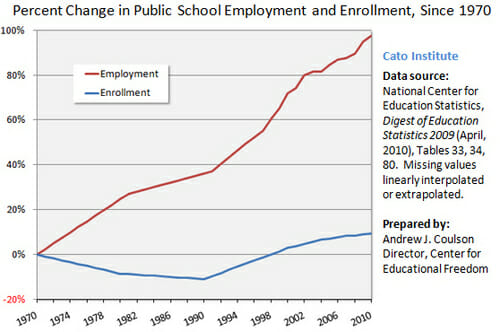
Andrew Coulson looks at one of these groups, teachers, and wonders what all the fuss is about -- its about time we laid some public school employees off after years of rapidly declining productivity:

I have been looking for a good excuse to clear my reader cache of a whole series of articles on government salaries and pensions, and this seems a really good time.

Much like the bailout of billionaires on Wall Street, the government worker bailout is targeting a group already doing much better than their peers in private industry.  (via Carpe Diem)

Related, via Carpe Diem:

"Who are America's fastest-growing class of millionaires? They are police officers, firefighters, teachers and federal bureaucrats who, unless things change drastically, will be paid something near their full salaries every year--until death--after retiring in their mid-50s. That is equivalent to a retirement sum worth millions of dollars.

Chris Edwards has a related essay, focusing on federal government pay.

Matt Welch looks at two DC-area counties and shows how their relative financial health is closely related to their hiring and pay policies.

Immigration Debate May Get Uglier (and Nuttier) Here in Arizona

Readers know I oppose recent Arizona immigration legislation and enforcement initiatives.  I don't think government should be stepping in to effectively license who can and can't work in this country, and am thus a supporter of open immigration (which is different from citizenship, please note).  As I support open immigration, both from a philosophic standpoint as well as a utilitarian perspective, I don't support laws to get tougher on illegal immigrants, any more than I support laws to get tougher on the failed practice of drug prohibition.

That being said, reasonable people can disagree, though some for better reasons than others.  But I don't see how all these folks who support tougher laws on immigration with the mantra that it is all about the rule of law can justify this piece of unconstitutional garbage:  (Hat tip to a reader)

Buoyed by recent public opinion polls suggesting they're on the right track with illegal immigration, Arizona Republicans will likely introduce legislation this fall that would deny birth certificates to children born in Arizona "” and thus American citizens according to the U.S. Constitution "” to parents who are not legal U.S. citizens. The law largely is the brainchild of state Sen. Russell Pearce, a Republican whose suburban district, Mesa, is considered the conservative bastion of the Phoenix political scene....

The question is whether that would violate the U.S. Constitution. The 14th Amendment states that "all persons, born or naturalized in the United States, and subject to the jurisdiction thereof, are citizens of the United States. No state shall make or enforce any law which shall abridge the privileges or immunities of citizens of the United States." It was intended to provide citizenship for freed slaves and served as a final answer to the Dred Scott case, cementing the federal government's control over citizenship.

But that was 1868. Today, Pearce says the 14th Amendment has been "hijacked" by illegal immigrants. "They use it as a wedge," Pearce says. "This is an orchestrated effort by them to come here and have children to gain access to the great welfare state we've created." Pearce says he is aware of the constitutional issues involved with the bill and vows to introduce it nevertheless. "We will write it right."

I didn't like SB1070 that much, but as ultimately amended it was not nearly as radical as this.  I think those of us who feared SB1070 as a first step on a slippery slope should feel vindicated by this.

Police and Accountability

I have written before that the inexpensive handheld video camera is perhaps the most important innovation in police accountability in my lifetime.  So of course, the police want them banned.

In response to a flood of Facebook and YouTube videos that depict police abuse, a new trend in law enforcement is gaining popularity. In at least three states, it is now illegal to record any on-duty police officer.Even if the encounter involves you and may be necessary to your defense, and even if the recording is on a public street where no expectation of privacy exists....

In short, recordings that are flattering to the police - an officer kissing a baby or rescuing a dog - will almost certainly not result in prosecution even if they are done without all-party consent. The only people who seem prone to prosecution are those who embarrass or confront the police, or who somehow challenge the law. If true, then the prosecutions are a form of social control to discourage criticism of the police or simple dissent.

Folks who read Radley Balko or Carlos Miller will not find a lot new hear, but it is a very good overview of an issue that is hot among blogs but rarely if ever makes the major media.

After an encounter with the public goes wrong, the police have historically been able to make up any story they want and make it stick, in many cases shifting the blame to innocent civilians.  It is scary to see how many times this happens, with the officer's story shown to be a lie by cameras on site (and even then it can be hard to get the police to investigate).  Only the combination of cameras and YouTube (to publicize the video so it can't be ignored) have begun to bring some justice to these encounters.

HT Alex Tabarrok

CBO Makes the Same Point I Have Been Making

One point I have been making for a long time on health care is that all the studies showing waste and unproductive spending in health care are irrelevant to government policy because at the end of the day, the Federal government does not know how to capture these savings.  The CBO says basically the same thing in a chart from a recent presentation.  The chart is titled "Reducing Growth in Federal Health Spending"

On the upside:

  • There is considerable agreement that a substantial share of current spending on health care contributes little if anything to people's health.
  • Providers and health analysts are making significant efforts to make the health system more efficient.

On the downside:

  • It is not clear what specific policies the federal government can adopt to generate fundamental changes in the health system. That is, it is not clear what specific policies would translate the potentialfor significant cost savings into reality.
  • Efforts to reduce costs increase the risk that people would not get some health care they need or would like to receive.

I am pretty confident from my experience with a high-deductible health care plan that the only way to start capturing savings is for individuals who recieve care to have the incentives and decision-making power to make cost-benefit tradeoffs in their own health care procurement.  This, however, is the absolute last thing this administration and Congress would ever allow, with the latest bill actually forcibly removing what small incentives that remained for individuals to make these tradeoffs.  All we are going to get are command and control care cuts  (based on the political power of the particular service or drug provider rather than medical efficacy) and price controls.

More at South Bend Seven

Great Moments in Government Process Innovation

I have noticed recently that the TSA has created split lines at many airport security screening posts - one for experienced travelers and one for "casual" travelers - i.e. noobs.

I have no problem with the basic idea.  Long ago I began advocating special lines for public electronic devices (airport boarding pass machines, supermarket self-checkout, ATM's) for people with IQ's over 90 because I always seemed to get behind the person who had never even seen a keyboard in their life.

But the actual execution of this concept in airports is laughable.  In the last 4 airports I have been in, the split between passengers who know what they are doing and those who don't is only through the screener who checks ID.  Even the lamest travel noobs are generally able to cough up an ID and boarding pass without too much trouble (though I will say I always seem to get behind the guy traveling on some bizarre 1930's-era League of Nations passport that seems to take forever to process).  However, after this ID screening the two lines come back together and everyone is mixed again.  Just in time to hit the x-ray screening station, where inexperienced travelers can hold up the line for hours.

I Joke About My Son Being a Yankees Homer, but...

I joke about my son being a Yankees homer, but he has some work to do before he can reach this level of sports passion.  Awesome rant.

We're Sorry, Larry

Larry Summers caught a lot of grief for a statement that has been oft-misreported:

"It does appear that on many, many different human attributes- height, weight, propensity for criminality, overall IQ, mathematical ability, scientific ability - there is relatively clear evidence that whatever the difference in means - which can be debated - there is a difference in the standard deviation, and variability of a male and a female population."

Carpe Diem brings this chart, visit the link for more explanation.

Personally, I don't have a lot of problems with the gender hypothesis, but I am skeptical of our ability to test intelligence.  I think most of us in the real world have enough experience to understand that the people we meet have a range of cognitive abilities, but I am not sure it is even possible to put a number on this, particularly since my experience is that there are many categories of intelligence and intelligence in one area is not intelligence in another.  Besides, I think most IQ tests are dominated by logic problems where one's ability to solve them improves with practice and training -- but this is counter to the idea we are somehow testing some property separate from education or training.

Update: As to the idea of different intelligences, I will offer myself as an example.  In my prime, I was pretty freaking good at advanced math, and later in life I got pretty good at deconstructing business problems that were pretty complex.  But I can't spell my way out of a paper bag, and I have a horrendous proof-reading ability (as all my readers will know by now).  I can stare at text over and over and still miss obvious errors.  I have a fabulous memory for concepts and problem-solving approaches, and I can recite the entirety of Monty Python and the Holy Grail from memory, but have almost no ability to retain a name, date, or phone number.

Chinese Factories

TJIC writes:

Chinese factory conditions may not be the exact cup of tea for a San Francisco graphic designer or a Connecticut non-profit ecologist grant writer "¦ but they're, by definition, better than all the other alternatives available to the Chinese workers (or the factories would find it impossible to staff up).

I wrote previously:

One morning, a rice farmer in southeast Asia might faces a choice.  He can continue a life of brutal, back-breaking labor from dawn to dusk for what is essentially subsistence earnings.  He can continue to see a large number of his children die young from malnutrition and disease.  He can continue a lifestyle so static, so devoid of opportunity for advancement, that it is nearly identical to the life led by his ancestors in the same spot a thousand years ago.

Or, he can go to the local Nike factory, work long hours (but certainly no longer than he worked in the field) for low pay (but certainly more than he was making subsistence farming) and take a shot at changing his life.  And you know what, many men (and women) in his position choose the Nike factory.

Update: In an interesting question of incentives, Foxconn, the manufacturer much in the news for a rash of suicides at its plant in China, apparently pays about 10-years salary to the families of workers who kill themselves.  They have ended the practice, worried that they are incentivizing some of the suicides.

Their Only Idea

Further proof that the only cost control idea the Obama administration ever had was service cuts and price controls.

Health and Human Services is once again playing freelance actuary, demanding that the health insurers hold down increases in the premiums for their Medicare Advantage plans.  As far as the administration is concerned, this is a two-fer.  When people have to pay more for their insurance, they tend to ask what the hell good this gargantuan new health care bill is doing--not the question you want them asking as they head to the polls.  But in the case of Medicare Advantage, there's another benefit.  The health care reform bill mandated a substantial cut in payments to Medicare Advantage providers, which everyone expects will translate into cuts in the extra services that Medicare Advantage plans now provide.  If they make those cuts a year early, maybe the administration gets to claim that the cuts don't have anything to do with the new health care bill.

Of course, for the insurers, it's not such a good deal.  The administration doesn't seem to have offered any evidence that insurers are overcharging; basically, they're saying that they ought to underprice their product, even if that means losing money.  Which is what has happened in Massachusetts, where the state insurance regulator refused substantial rate increases, even though as far as I know they never found an actuary to sign off on their orders.  The insurers posted big losses shortly thereafter.

The Most Irritating Use of My Tax Money

I find many of the uses politicians make of the money they take from me to be irritating.  But perhaps the worst of them all is to use my money to fund their own election campaigns when they can't get enough people to voluntarily contribute.  Which is why I am happy to see the Supreme Court put a injunction on Arizona's politicians take tax money to re-elect themselves law.

Today the Supreme Court blocked "matching funds" for candidates under Arizona's Clean Elections Law while it decides whether to hear a First Amendment challenge to the system. Under the law, participating candidates receive one taxpayer dollar for each dollar spent by their privately funded opponents (or by groups sponsoring messages for their benefit) above a certain threshold. The Goldwater Institute and the Institute for Justice, representing politicians and activists who are challenging the law, argue that it penalizes people for exercising their right to freedom of speech by using taxpayer money to undermine the impact of their message. In January, U.S. District Judge Roslyn O. Silver agreed, concluding that Arizona's campaign finance system "burdens"¦First Amendment rights, is not supported by a compelling state interest, is not narrowly tailored, and is not the least restrictive alternative." Last month the U.S. Court of Appeals overturned Silver's decision and lifted her injunction against the delivery of matching funds. Today's stay effectively reinstates the injunction until the Court either rejects the case or accepts and decides it.

"The Supreme Court's decision today will allow the 2010 Arizona election to occur without the government placing its thumb on the scale in favor of those politicians who receive government subsidies," says Institute for Justice senior attorney Bill Maurer. "The purpose of this law was to limit individuals' speech by limiting their spending. But the First Amendment does not permit the government to restrain Americans from robustly exercising the right of free speech."

I'm Pretty Sure We Are Not Going to Get Any Deficit Reduction

Via Reason, from the man Obama personally appointed to lead the Deficit Commision

"America needs a 21st century economic plan because we now know the market-worshipping, privatizing, de-regulating, dehumanizing American financial plan has failed and should never be revived, worshipping the market again," Stern said in remarks at the annual conference of the liberal activist group Campaign for America's Future in Washington on Monday."It has failed America and everyone that works here," Stern said.

Stern said the changes that Obama and Democrats in Congress have made are nothing short of a "revolution" that will move the American economy from national to international.

"This not our father's or our grandfather's economy," Stern said. "We're as far today from the New Deal as the New Deal was from the Civil War. And we cannot drive into the future looking in the rear view mirror."

He said the progressive movement must build on the past and look to the future as the economy is transformed "from a manufacturing base, to a service, finance, knowledge, green, Internet, and bio-science economy."

"This revolution's going to only take 30 years," Stern said. "No single generation of people have ever witnessed this much change in a single lifetime. [...] And as we've witnessed now in the absence of a simple and realistic way forward, people "“ even us "“ sometimes resist the future or try to turn back the clock to days that are now long gone."

I am not sure I have ever heard anyone sound more like a scabby beauracrat in Atlas Shrugged.  Can you believe this dweeb along with Barrack and the gang who can't shoot straight taking credit for the transformatoin of the economy?  As if these guys have anything to do with the rise of new industries and technologies, except to make their birth and growth more difficult through strangling regulation and taxes.

The last paragraph about progressives and change is an interesting one in the context of this old post of mine, where I discuss how progressives most hate free markets for their constant change and unpredictability. Here is an excerpt:

Beyond just the concept of individual decision-making, progressives are hugely uncomfortable with capitalism.  Ironically, though progressives want to posture as being "dynamic", the fact is that capitalism is in fact too dynamic for them.  Industries rise and fall, jobs are won and lost, recessions give way to booms.  Progressives want comfort and certainty.  They want to lock things down the way they are. They want to know that such and such job will be there tomorrow and next decade, and will always pay at least X amount. ...

Progressive elements in this country have always tried to freeze commerce, to lock this country's economy down in its then-current patterns.  Progressives in the late 19th century were terrified the American economy was shifting from agriculture to industry.  They wanted to stop this, to cement in place patterns where 80-90% of Americans worked on farms.  I, for one, am glad they failed, since for all of the soft glow we have in this country around our description of the family farmer, farming was and can still be a brutal, dawn to dusk endeavor that never really rewards the work people put into it.

This story of progressives trying to stop history has continued to repeat itself through the generations.  In the seventies and eighties, progressives tried to maintain the traditional dominance of heavy industry like steel and automotive, and to prevent the shift of these industries overseas in favor of more service-oriented industries.  Just like the passing of agriculture to industry a century ago inflamed progressives, so too does the current passing of heavy industry to services.

In fact, here is a sure fire test for a progressive.  If given a choice between two worlds:

  1. A capitalist society where the overall levels of wealth and technology continue to increase, though in a pattern that is dynamic, chaotic, generally unpredictable, and whose rewards are unevenly distributed, or"¦
  2. A "progressive" society where everyone is poorer, but income is generally more evenly distributed.  In this society, jobs and pay and industries change only very slowly, and people have good assurances that they will continue to have what they have today, with little downside but also with very little upside.

Progressives will choose #2.  Even if it means everyone is poorer.  Even if it cuts off any future improvements we might gain in technology or wealth or lifespan or whatever.  They want to take what we have today, divide it up more equally, and then live to eternity with just that.   Progressives want #2 today, and they wanted it just as much in 1900 (just think about if they had been successful "” as just one example, if you are over 44, you would have a 50/50 chance of being dead now).

Update: What does the line about shifting form a national to international economy mean?  It must be some kind of progressive code phrase that does not mean what it sounds like, since most progressives and this administration tend to be opposed to free trade and have a strong tendency towards protectionism.  After all, these are the same guys that sympathize with the anti-globalization rioters at various G8 conferences.

Hilarious Misdirection

Progressive green web site the Thin Green Line takes on subsidies for petroleum products, saying that reducing such subsidies could immediately have a major impact on CO2 production.  Fine with me, I am no fan of subsidies by governments of any private activities, though I don't live in fear of CO2.

However, the author, trying I guess to buff his progressive credentials in a sort of typical knee-jerk for green writers, tries to imply all this largess is somehow flowing to large oil companies, and the implication is that western nations like the US are subsidizing folks like Exxon and BP:

The timing couldn't be better: With BP's oil continuing to pollute the Gulf Coast, the question of how much our alliance with the oil industry really costs us is at the front of the everybody's mind.

The International Energy Agency released an early draft of a report documenting, for the first time ever, how much the fossil fuel industries get in subsidies each year (H/T Grist). The timing is, of course, coincidental: The IEA's work stems from an agreement made at this years G20 conference that subsidies of fossil fuel industries should be phased out as part of international efforts to reduce carbon emissions.

So "” drum roll, please! "” how much money are the energy giants taking in? $550 billion a year.

But the author is, I believe, misunderstanding the study and the underlying economics (no surprise there from a green progressive writer).  This is from a study of 37 developing, not rich, nations.  There is no way these guys are paying $550 billion in cash into private oil company pockets.  In fact, most of these countries barely let the private oil companies even play, or force them into some marginal operator role subservient to their state oil company.

If these countries are subsidizing producers at all, the vast majority who are getting such largesse are large state-run companies, not western private oil companies.

However, my guess (and I have not seen the report yet) is that what they mean by most of these subsidies is actually selling fossil fuels to their citizens at below-market prices.  These subsidies are not transfers of state dollars to oil companies at all, but below-market pricing of oil products to consumers by state-run oil monopolies.   The people getting subsidized here are poorer consumers, not private oil companies.  Countries like China, Iran, Iraq and even Venezuela (run by progressive heart throb Hugo Chavez) sell petroleum products way below market prices to their citizens.  I am fairly certain this is the half trillion dollar subsidy the report refers to.

So we have the ultimate irony of a "progressive" lamenting government-subsidized energy for poorer people in developing nations.  Wow, I never thought I would say this, but if this is the progressive position, I agree with it.  The whole situation does highlight the difficult tension between development and CO2 reduction programs, and reinforces my argument that aggressive worldwide CO2 abatement will mainly hurt the poor.

Welcome to Phoenix...

...where cold fronts drop the temperatures into the 90's:

While an excessive heat warning is in effect through Monday, temperatures are expected to plunge into the mid-90s by the weekend, according to the National Weather Service...

The large drop in temperatures can be attributed to a cold front that is expected to move through Arizona on Friday, Leines added.

Dispatches from the Corporate State

From the WSJ:

Robert Brownson long believed that his proposed development here, with its 200,000-square-foot Wal-Mart Supercenter, was being held hostage by nearby homeowners.He had seen them protesting at city hall, and they had filed a lawsuit to stop the project.

What he didn't know was that the locals were getting a lot of help. A grocery chain with nine stores in the area had hired Saint Consulting Group to secretly run the antidevelopment campaign. Saint is a specialist at fighting proposed Wal-Marts, and it uses tactics it describes as "black arts."...

Supermarkets that have funded campaigns to stop Wal-Mart are concerned about having to match the retailing giant's low prices lest they lose market share. Although they have managed to stop some projects, they haven't put much of a dent in Wal-Mart's growth in the U.S., where it has more than 2,700 supercenters"”large stores that sell groceries and general merchandise. Last year, 51% of Wal-Mart's $258 billion in U.S. revenue came from grocery sales.

Read the whole article.  There hardly appears to be any major grocery chain or related union that has not contributed significant dollars to preventing their competitor from doing what they have already done - built a store in town.  Knock me over with a feather that Chicago is a major example, training ground for our President and promoter-in-chief of our emerging corporate state.

The only sustainable monopolies are those enforced by the government, which through licensing, regulation, zoning, or all of the above, squash upstart competitors at the expense of consumers in favor of politically connected incumbents.

Answer: 36 to 38

Question:  How many years does it take for a typical government / green investment to pay off?

Example 1:

Mesa got $1 million in federal stimulus money to replace 2500 traffic lights with LED's. That's $400 a light which probably includes the cost of installation. Once they are operational, Mesa expects to save $0.028 million per year in electricity costs. At that rate, it will only take 35.7 years of savings to get the $1 million back.

Example 2:

Nine turbines from seven manufacturers, including Reno's Windspire, are being installed to test their performances in different environments. The first turbine was installed at the sewer plant in Stead and the second at Mira Loma Park.The nine turbines and several solar projects together are a $3.5 million investment, before $1.7 million in energy rebates are applied to reduce that cost. The projects are expected to save 788,932 kilowatt hours a year for an annual savings of $91,000 a year [a 38-year payback].

The latter example actually over-estimates the payback, because it ignores the substantial maintenance costs of wind turbines (what percentage have you actually seen running?) as well as the systematic over-estimation of their power output.  Incredibly, the SF Chronicle's green writer/blogger actually brags up the Reno boondoggle.

Postscript: In the comments of the wind turbine article I added, in response to the projects green credentials:

But, you say, its not about return on investment but CO2 reduction. OK, lets look at that, forgetting for a minute whether Reno taxpayers should be paying extra for electricity to reduce global temperatures by 0.00000000001C.

Let's consider an alternate investment in gas turbine electric generation, and assume it and the wind turbines are displacing coal-fired power. Per Kw-H, gas turbines are going to, even including the fuel, produce power for a fourth or less the cost of wind with these relatively small turbines. And gas is plentiful and most of it comes from the gold old USofA (or at least North America).

But it's not zero emission you say. OK, but if it is 1/4 the cost that means that it can displace four times as much coal power for the same investment. And it is as low of CO2 emissions per btu as you can get in a fossil fuel. In fact, 4X of gas generation would reduce CO2 emissions more than 1X of wind. So even in terms of CO2 emissions, wind here is a bad investment.

I Found This Site Useful For New Business Pro Formas

I often have to try to put together a staffing plan and pro forma for new business opportunities in states or utilizing professions with which I am unfamiliar.  I have no idea how accurate it is overall, but so far this site has been a useful site for figuring out what market wages for certain positions may be.

Family Blogging

My son has decided to stay focused on ranking, lists, and sports.  Thus he has renamed his blog.  So far his score is

Total Blog Posts:  3

Blog Names: 2

The Government Would Never Be This Short-Term Focused on Quarterly Accounting... NOT

If you have worked in a large corporation, you probably have witnessed some end of quarter or end of year sales push, to buff up the current period's results.  People who buy cars often get the advice to buy at the end of the month or year to take advantage of this motivation.  A great example of this was in the book Barbarians at the Gate, where RJR would load the channel at the end of each quarter with tons of extra inventory to buff up quarterly profits.  Of course, this just creates the incentive next year to load the channel even more to top the previous quarter's profits that were pumped up by loading.

All of this is both rational and irrational.  From a shareholder standpoint it is irrational -- the end of the reporting period is arbitrary and all the company is doing is shifting some sales a few days, rather than generating new ones.  It can even be negative for shareholders, as in the RJR case when loading caused inventory to sit on shelves for longer and get stale and thereby less appealing to customers.   For employees of the company, this can be entirely rational depending on their incentives.  While pulling sales forward to get a better grade or commission for this quarter feels good now, it can make the next quarter harder.  But who knows what will happen in the next quarter?  In a high turnover world, I could be in a new job or new company next quarter.  Anyone who has worked with corporate incentive programs knows that it is impossible to eliminate all the unintended consequences -- all one can do is minimize them.

But supporters of government superiority to private enterprise argue that this is exactly why government is superior, because it does not have these short-term focused goals.  HAH!

Politicians are among the worst at this.  It used to be they would do short term things to get elected, leaving the following election to take care of itself.  Now, they will take short term actions just to dominate the current news cycle.  Next week? That's an eternity, we have problems now.  Every single action taken over the last two years by both this and the previous administration and the current one relative to the economy have been totally short-term focused.  Let's bail everyone out.  Moral hazard?  That's the next administration's problem.  Just look at cash for clunkers, where the government paid $4000 for cars that blue-booked for $1500 all to pull September sales into August.  But they won the news cycle in August!

But the actual reason for my rant is a note I got from the Arizona Department of Revenue.  Apparently they have a program where large filers have to do a special report to pre-pay June sales tax** collections by June 29  (rather than by July 20 when they would usually be due).  As is so often the case, the law has been changed such that a special requirement for large filers had its threshold changed such that small-medium filers like myself also now have to play.  This is a sort of 13th report one must file (we file reports monthly) and the processing of it takes a lot of private time, plus the state has to hire a number of temps and pay overtime to receive this filing.

So why the special requirement?  Well, Arizona is on a July-June fiscal year, so June 29 is just about the end of their fiscal year.  And they are on a cash accounting basis (like most governments) so any cash that comes in the door, even if it is for a pre-payment of a future liability, counts as current period income.  This means that the state is spending a lot of overtime money shifting income by 21 days just to make its current period look better -- just like RJR or any other dynsfunctional private company.

But what makes this even more short term is that it only works once -- the first time.  It will make the first year this trick is applied look better, but then every year after will go back to being the same, with July losses to the prior year offset by June gains from the forthcoming year.  In fact the only way this game can work twice is if the threshold for pre-paying is lowered -- which is why I am having to fill out an extra form and pay a large bill 3 weeks in advance.  Arizona is looking for another one time gain.  And the larger the gain, the harder it will be to unwind this stupid costly process in the future.

** Footnote:  Actually we don't have a sales tax but a "transaction privilege tax."  However, that term gets me so infuriated, as it is based on the premise that private commercial transactions can be made only as a privilege granted by the government, that I refuse to use the term.  Right from the AZ DOR web site:  "the tax is on the privilege of doing business in Arizona."  Barf.  Don't let anyone tell you Arizona is a wild, libertarian, free market state.
I am All About Public Service

This weeks public service message - how to do CPR.

Hat tip the Frisky

Hollywood Prequels

How to be a Retronaut has prequel trailers by Ivan Guerro.  I thought they were pretty clever.  Here are two examples but he has more:

Ranking Baseball Players

I have been encouraging my son to take up blogging on... well, anything.   I hope it will be a way for him to practice his writing, learn a few computer skills, and exercise some critical thinking.   So he has finally gotten started, and of course the teenage male mind turns to ... ranking baseball players.  Check his post out, and be sure to give him grief in the comments for being a Yankee homer.

More Stimulus Follies

Readers will remember my chart the other day on the effects of the cash-for-clunkers auto stimulus program:

Folks who understand this dynamic will not be surprised by what is going on in the housing market now that free taxpayer cash for home buyers no longer is being handed out

Everybody take a nice long look at today's Pending Home Sales Index from the National Association of Realtors, because it's just about the last positive picture we're going to see for a while.

Yes, the index rose even more than expected, as buyers rushed in to take advantage of the home buyer tax credit.And yes, those numbers will show up in Existing Home Sales in May and June, but then look out.

This index is based on contracts signed in August, and that's how the credit was set up; you had to sign your contract by April 30th and close by June 30th in order to get your $8000 if you're a first time buyer and $6500 if you're a move up buyer.

And then came May, traditionally the height of the spring housing season.

Mortgage applications to purchase a home began to sink. Now, four weeks later, mortgage purchase applications are down nearly 40 percent from a month ago to their lowest level since April of 1997.