Liberty or Voting: I'll Take Liberty

Couldn't agree more with the thoughts in this post from TJIC:

I was discussing this with Dan Geer the other day "“ the fact that individual liberty (social, economic, etc.) is the goal, and democracy (political "liberty") is just a tool to get there "¦ and not even a particularly good tool.

I'd be all in favor of a limited constitutional monarchy, if the result was "“ integrated over time "“ more social and economic freedom....

Leftists don't understand this at all "“ they think that the freedom to vote for your choice of bully who will lord it over everyone else is the paramount right, and they don't recognize economic liberty at all.

I said something similar in this post on why I don't necessarily treasure the right to vote.

Now, don't get me wrong, the right to vote in a representative democracy is great and has proven a moderately effective (but not perfect) check on creeping statism.  A democracy, however, in and of itself can still be tyrannical.  After all, Hitler was voted into power in Germany, and without checks, majorities in a democracy would be free to vote away anything it wanted from the minority "“ their property, their liberty, even their life.   Even in the US, majorities vote to curtail the rights of minorities all the time, even when those minorities are not impinging on anyone else.  In the US today, 51% of the population have voted to take money and property of the other 49%.

I go on to discuss what things are more important to a good government than voting.

Retirement, From An Entrepeneur's Perspective

A while back another entrepreneur/blogger wrote and asked me about investment choices for retirement.  My philosophy on retirement seems to be a lot different than that of others, and I think owning one's own company changes some of the dynamics of retirement investing.   Note that this advice is not right for everyone, and maybe no one, so read at your own risk.  I publish it because the person I wrote suggested I do so, and after weeks of crazy intense work schedules I finally have the time.

A blogger wrote me about his despair at finding appropriate investment vehicles for his retirement savings.   With relatively equal chances of 1) a long period of Japan-like slow growth or 2) a high inflationary period triggered by trying to avoid #1, both bonds and equities looked bad, and while real estate may have some value plays when things finally bottom out, neither of us has the time to pursue that.  [since our emails, International equities are something I have moved money into, both as a diversification play as well as a way to short the dollar].

As I wrote him in one email

There is still a good chance of returning to normal growth in the middle somewhere, but both those bookends [inflation and stagnation] loom much larger than they might have, say, in my calculations five years ago.  I have trouble figuring out what to invest in when both are possibilities.  Equities?  Great for hedging inflation but suck if there is a lost decade.  Bonds would make sense in that case, but their interest will be low and they will be awful if inflation ramps up.  If I really knew we would get inflation and devaluation, I would be leveraging like crazy because inflation transfers wealth from creditors to debtors.

As a result, I said that my main investment for my free capital was debt reduction and de-leveraging of my own business.  Paying down debt has the advantage of having an absolutely predictable return and it reduces risk.   This makes double sense for me as I have put new expansion investments in my business on hold until a variety of government issues from health care to tax rates become clearer.  (For example, in health care, because my company is an oddity, with seasonal part time workers mostly on Medicare already, no one can yet tell me what my future costs will be.  Estimates range from +0 to +20% of revenues!)

The key to my business, which may be very different from others, is that I make big investments to gain long-term contracts, but once captured, these contracts give my business a fair amount of stability and predictability.  Further, in the latest recession, my business has proved to be either counter-cyclical or at least recession-proof to some extent, as 2009 was actually a blow-out record year for us.  Given these facts, I am able to put a higher percentage of my net worth into my own business as an investment, without having to diversify as much in case of business trauma.  And I prefer this.  Given the choice of investing in a company I barely know on the NYSE or mine, which I understand and control, I prefer the latter.  Also, returns on capital from buying or investing in private small businesses can be much higher (with higher risk of course) than in traditional equities -- see my whole series on buying a small business.

But here is where I really differ from most people:
I take a very different view of retirement.   When I worked in grinding corporate jobs (e.g. up until I was about 40) I was very focused on retirement.  Now that I am doing something that is not brutally stressful,  I hardly think about retirement.   The whole concept of retirement now seems weird.  I have, after a lot of hard work, gotten my business to the point where I can generally work as hard as I want to -- if I don't work hard, the business does not grow but I have good people such that it doesn't fall apart either.  I compete with people who are running businesses in their late 70's who are still having a good time.  I can take nice trips when I want to, take the day off if I need to, or whatever.  My business actually has an off-season so I can be more relaxed part of the year.

My advice to this particular entrepreneur was to maybe reconsider the paradigm of "retirement."  After all, the the long history of the world, retirement is a new concept that is barely 100 years old.

Are you the shuffleboard and golf type?  What do you imagine yourself doing after retirement?  I think you need some protection against becoming infirm or senile, but if you are healthy and vigorous, are you the type to get bored fast?  As an example, nearly all of my 400 employees are retired, but they all got bored and wanted something to do.

Here is an alternative, entrepreneur's way to think about planning for retirement:  How do I work really hard building a business that in 10 years will have a position such that it spits out some level of cash without effort on my part and can still grow if I want to spend time on it.  I am surrounded in Scottsdale by people who have done exactly this after giving up a corporate job.  At some point they took their savings from their 30s and 40s and dumped it into a business where they could still have the lifestyle they wanted.  Buying or building the right company is sort of like buying a bond with an attached warrant whose value is related to how hard you want to work.

As I implied earlier, this is not an appropriate approach for every small business.   The problem with technology businesses, for example, is that they never seem to mature into that latter predictable-cash-flow-stable-market-share phase.  One is always running in place.  One lesson I never forgot from my corporate years:  In the industrial sector, I often saw people making loads of money selling bushings or some such whose design hadn't changed since 1920.  It led me to this strategy:  Find a market with barriers to entry, which may well not be very sexy, and spend ten years battering you way in, and then relax behind those walls.  (As to sexy, the very first two classes of the first year Harvard Business School strategy course were a sexy cool software business and a boring stable industrial product business.  Of course,the boring stable water meters made a fortune, while the software business never made a good return on capital.  Beware of sexy businesses -- see: Airlines).

One other paradigm I would challenge is the notion everything you do as an entrepeneur has to be started from scratch.  Many entrepreneurs have fun doing this but the prospect of doing a bootstrap startup when you are 70 years old is exhausting.   Such entrepreneurs who have had a life of serial startups might consider a new phase in their business career as they get older, when they have saved enough assets to perhaps buy into an existing business rather than starting from scratch.  I cannot tell you how many interesting small businesses there are that come up for sale with a guy who has an interesting product and has made some progress but can't manage his way out of a paper bag and thus hits some growth ceiling.  I bought just such a core to my current business 8 years ago.  These businesses require a lot of due diligence, because they are a real mixed bag, but I bought mine in an asset sale for 3.5 times EBITDA (which is an entirely typical price).  Try buying Wall Street equities for 3.5 times EBITDA!  If you pick the right business, and you are a good manager, there is not a better investment out there.  Again,  see my whole series on buying a small business.

Of course this investing-for-retirement is higher risk, because one bets a substantial portion of his net worth on his own business.  But for those with confidence in their own ability, I find it a lot more compelling to bet my capital on myself rather than on guys I don't know running the Fortune 500.

Getting the Feds to 20% of GDP

I thought this Federal budget proposal by TJIC was interesting for a couple of reasons.  Not the least of which is the sight of TJIC trying to be reasonable and compromising.  Libertarians (as with other political extremists, and make no mistake we are extremists) tend to skew between those who want anarcho-capitalism and will accept no less and those who seek for improvements at the margin, believing that the world is only going to change so much.  I would normally put TJIC in category 1 but it is interesting to seem him delve into category 2.  Even I, normally a category 2 guy, can't totally get behind this plan as there are just two many programs, in the words of David Stockman, that need to be zeroed out.

Great Moments in Government Paternalism

Not sure this even requires comment.

Chandler's new City Hall comes with some features that have municipal workers and visitors scratching their heads. Like the restroom signs that tell people not to drink out of the urinals and toilets.

...

A few employees have been cracking jokes and speculating about what it would take to make them slurp from potties when water fountains and sinks are a few feet away.

"I'm glad that I saw that sign because I was very thirsty and looking for a means to quench my thirst," Mayor Boyd Dunn quipped. "Seriously, I'm certain there's some regulation out there that requires that type of sign."

Twitterbot

Once upon a time, years ago, I actually had one of the original twitter accounts.  I had  (I guess I still have it) a really short name, sort of the equivalent of having a 2-letter URL.  I quickly gave it up for a variety of reasons, the most compelling of which is I find it impossible to say anything I want to say in 140 characters.  I am just not a master of the glib and witty little phrase.  Even one of my shortest blog posts ever, which read

My summary on the immigration debate:  Republicans want immigrants who work but don't vote.  Democrats want immigrants who vote but don't work.

does not make the cut.   These thoughts return to me when I see this:

Nigel Leck, an Australian software developer, grew tired of debating climate realists on Twitter so he created a spambot to "wear down" his opponents. The bot, @AI_AGW, scans Twitter every five minutes looking for key phrases commonly used by those who challenge the global warming orthodoxy.  It then posts one of hundreds of canned responses hoping to frustrate skeptics. CFACT's Twitter account @CFACT (follow us!) often receives many of these unsolicited messages each day. Since the bot became active on May 26, 2010, it has sent out over 40,000 tweets, or an average of more than 240 updates per day!

Technology Review gushed that Leck's bot "answers Twitter users who aren't even aware of their own ignorance." Leck claims that his little bit of trollware is commonly mistaken as a genuine Twitter user leading the unsuspecting to sometimes debate it for days. Eventually it wears people down.

Here is a good rule of thumb:  Anyone on either side who thinks anything substantive can be argued for or against the science behind the hypothesis of catastrophic man-made global warming in 140 characters can be safely ignored.

Fiat Garbage

Radley Balko has a fascinating discussion about a switch in government policy in Fountain Hills, AZ  (a suburb of Phoenix and a town I visit for various reasons all the time).  Apparently, residents of the town got to actually select from competing trash vendors (lucky folks!) until recently when the town selected and enforced a monopoly trash provider.  Balko has a fascinating discussion of why progressives seem to universally support this decision and oppose the previous choice-based approach.

It may be odd at first to see a self-styled progressive mocking someone for criticizing a corporation for exercising too much power.  John Cole writes sarcastically:

My GAWD. I feel so violated. I'm going through my bills before the Steelers game and I just realized that Allied Waste is contracted to pick up my trash, so my personal liberties have been impinged by the creeping totalitarianism of nanny-statism. To show solidarity with the oppressed Fountain Hills trash protesters, I am going to dress up in my "Don't Tread on Me" t-shirt, stand at the edge of my driveway at dawn during trash pick-up on Thursday, and throw pocket constitutions at the sanitation workers. We shall overcome, patriots!

This from a progressive bunch who runs to the government for legislation when their Big Mac has one too few pickles on it.  If you can understand why progressives attack any corporation that they voluntarily do business with for having too much power, but defend any corporation backed by government authority, you will start to figure out exactly what progressives are really after.  Just remember that progressives have a deep distrust of individual choice related to any activities that don't touch on sex.  And they are much more comfortable with lines of accountability that run through government officials (elected or not) rather than accountability enforced by competition and individual choice  (more on progressives here).

I will just add this to the story -- Fountain Hills is a suburb to which the verbs tony, wealthy, and exclusive could all apply.  Given its position in the foothills around Phoenix, it is perhaps one of the most attractive suburbs in the metropolitan area.  It is the last place one would point to as having some sort of problem with unkept houses and rotting garbage.  This is entirely a power play by the city -- it has nothing to do with the quality of the area.

Brad Warbiany has even more on the story here.

Mostly unrelated facts about Fountain Hills

  1. Fountain Hills was a development of the McCulloch family (of chain saw fame) as was parts of Lake Havasu City.  Both developments had a centerpiece attraction.  Fountain Hills has a spectacular fountain (one of the five highest in the world) while Lake Havasu City has the transplanted London Bridge.  As to the latter, the story goes that McCulloch thought he was buying the much more dramatic Tower Bridge, which American tourists often confuse with London Bridge.  As a further aside, I met the guy once who did the gunnite on the bottom of the transplanted London Bridge.  He was a pool guy and applying it over his head rather than under his feet was fairly new to him.  He said he never allowed his little kids to sing "London Bridge is Falling Down" in his presence, it made him too nervous.
  2. Our egregious Sheriff Joe Arpaio lives in Fountain Hills.  On a recent crime sweep of his home town, which he claimed had nothing to do with immigration, he arrested (or at least detained) almost all people of Mexican decent, in fact more Mexicans than I thought one could find in Fountain Hills, even on a bet.

Two Americas

Two Americas:  Those who use the coersive power of the government to take money for themselves, and those who have to earn it by giving value for money in non-coerced , arms-length transactions.

Via Carpe Diem, which has more thoughts on the trend

Note:  I have seen folks defend this type of chart by saying it is just the function of  the inflection point of a normal distribution creeping by inflation across a dividing line.  But look the $180K+ in 2010 vs. the $150K+ in 2005.  By inflation, a $150,000 salary should not have increased to more than $165,000, but we see more than twice as many people making $180K plus today than made $150K plus five years ago.

Quantitative Easing: Wacky Progressive Economics or Financial Annealing?

This post is based on playing around with some analogies to try to understand quantitative easing in my own mind.  I can't decide if this approach is helpful or just wanking.  I fear it is the latter, but if we banned all banned all intellectual wanking in blogs,  my feed reader would be virtually empty.

I haven't really written much about the Fed's latest round of quantitative easing, dubbed QE2.  Basically they plan to print some significant fraction (I see different numbers in different articles) of a trillion dollars and use the newly created money to buy government bonds  (they don't actually print the money but create it out of thin air in the memory banks of computers).  As I understand it, the theory is that this will boost the price (and thus reduce yields) on the government bonds on the balance sheets of private banks.  This will in turn have two effects:  improve (at least on paper) the balance sheets of banks, hopefully making it more likely to lend; and it will reduce the yield on the bonds on their balance sheets, hopefully making private loans look like a better investment in comparison.

I am not an economist, and so won't get embroiled in issues I don't understand, but it strikes me that even if one accepts the theory of QE, it will be difficult to have any measurable impact as long as Congress  and the administration keeps generating new debt at astounding rates.

But what is really happening here is that the dollar is being devalued.  This is one of the semantic quirks that make me laugh -- when Argentina or Zimbabwe do this, its called devaluation.  When a western nation does it, it is called quantitative easing.  Because, uh, we are much smarter or something.   But I have to believe that a lot of progressives have hitched their wagon to QE2 out of the hope for some inflation (wow, the revenge of William Jennings Bryant).   Because inflation and dollar devaluation would nominally achieve some of the goals they are hoping for, including:

  • making Chinese imports more expensive, creating a wealth transfer from consumers to a few politically powerful exporters
  • re-inflating the housing bubble while devaluing long-term fixed rate mortgages, creating a wealth transfer from creditors to debtors
  • continuing the wealth transfer from average workers (who typically don't have COLA's) to government and union workers (who typically do have COLA's)
  • acts as wealth transfer from individuals to government since it creates an effective income tax rate increase, as key income levels in the tax tables, particularly where AMT kicks in, are not indexed for inflation

It is impossible to argue that devaluing a currency is a path to wealth generation.  It can't be, though progressives, as always, are willing to tolerate a total reduction of wealth as the price for the type of re-distributions discussed above.

But excepting the re-distribution arguments, it strikes me that the only possible argument for this devaluation is that the economy is somehow trapped in a local minima from which the escape energy is too high.  This would make QE a bit like annealing in a metal, where metal that is heated up and cooled too fast can be hard and brittle.  The only way to get it to be ductile is to re-heat it and then allow it to cool slower.

This is kind of a pretty comparison, but in large part it is probably BS.  The economy is way, way, way more complex and multi-variate than crystallization in a metal.  Even if we were trapped in a local minima, which by the way it is pretty much impossible to determine, we don't know what kind of energy should be applied to the system to move it out.  In fact, if we wanted to use this analogy, it would make far more sense to me to remove barriers to entrepreneurship and wealth creation which likely form a large part of the energy barrier that keeps us in such a local minima.  In fact, the annealing analogy would likely point one in the direction of decalcifying markets and increasing labor mobility rather than massive government interventionism.  It is much easier for me to argue that the missing energy is entrepreneurship rather than liquidity.  Apparently, the German finance minister agrees with me:

The American growth model, on the other hand, is in a deep crisis. The United States lived on borrowed money for too long, inflating its financial sector unnecessarily and neglecting its small and mid-sized industrial companies. "¦I seriously doubt that it makes sense to pump unlimited amounts of money into the markets. There is no lack of liquidity in the US economy, which is why I don't recognize the economic argument behind this measure. "¦The Fed's decisions bring more uncertainty to the global economy. "¦It's inconsistent for the Americans to accuse the Chinese of manipulating exchange rates and then to artificially depress the dollar exchange rate by printing money.

Update: Chinese bond rating agency downgrades US treasuries

The United States has lost its double-A credit rating with Dagong Global Credit Rating Co., Ltd., the first domestic rating agency in China, due to its new round of quantitative easing policy. Dagong Global on Tuesday downgraded the local and foreign currency long-term sovereign credit rating of the US by one level to A+ from previous AA with "negative" outlook.

A Politician I Actually Like

The only thing more disappointing than most libertarian candidates for office are Republican and Democratic candidates for office.  So my list of politicians I like and would be willing to actively support is pretty short, encompassing Arizona Senator Jeff Flake and I am not sure who else  (I had been moderately comfortable with my the House Representative John Shadeg, but his retirement has led to his replacement by Ben Quayle -- yes, of that Quayle family -- of whom I am pretty skeptical.)

A while back at a Reason Foundation cocktail party I met former NM governor Gary Johnson.  I liked what I saw of him there, and I still like him as I have learned more about him.   Check out this profile in the New Republic.

Daylight Savings Time

Dear Rest of the Country

Hope you are having fun changing all your clocks.  Do you remember how to change that one on your oven?  Yeah, neither do we.

-- Sincerely, Arizona

My past articles on why, even if it once saved energy, DST likely is counter-productive here.

The Man Who Saved the Whales

My new Forbes column is up, and discusses two of the most vilified men in history.  One ended (at least for a while) the blight of government enforced monopoly in industry.  The other saved the whales.

Incredible Bread Machine

I thought this was ironic....

Germany--Standing in Aisle 1 of a local Aldi supermarket, between the €2.59 ($3.62) bottles of sparkling wine and the packaged bread, German master baker Wolfgang Schäfer is in enemy territory.

The third-generation baker lobs 15 cents into the massive, beige-colored automat before him, presses a button and cocks his ear to the machine for any clues to what's transpiring inside. Almost instantly, a warm wheat roll plunks into the bin below.

"Not even two seconds," says the 55-year-old Mr. Schäfer, who had switched out of a white shirt embroidered with his family bakery's insignia into a less conspicuous checkered button-down for the stealth fact-finding mission. "Whatever goes on in there, it's certainly not baking."

What exactly does happen inside the automats has become a matter of dispute between Aldi Süd, a discount supermarket chain, and most of Germany's 15,000 traditional bakeries, since the company began installing the machines in hundreds of its German stores this year. The automats are emblazoned with the word Backofen, or "baking oven," and pictures of bowls of whole grain and bouquets of wheat. Aldi markets the rolls and bread the machines dispense as "fresh out of the oven--direct into the bag."

But to thousands of German bakers, Aldi's freshness claim is half-baked. Worse, they charge, it misleads customers who might equate the German discounter's baked goods with the bread they and their employees knead, shape and bake through the wee hours of every morning.

The German Bakers' Confederation, steward of the country's centuries-old bread-making tradition, is taking Aldi Süd--one of the two companies that make up the Aldi empire--to court on claims of deceptive advertising. Aldi Süd says it rejects the claims in the lawsuit.

...in the context of this (see part IV)

This is a legend of success and plunder
And a man, Tom Smith, who squelched world
hunger.
Now, Smith, an inventor, had specialized
In toys. -So, people were surprised
When they found that he instead
Of making toys, was BAKING BREAD!

The way to make bread he'd conceived
Cost less than people could believe.
And not just make it! This device
Could, in addition, wrap and slice!
The price per loaf, one loaf or many:
The miniscule sum of under a penny....

If you never have read the whole poem, do so.  In concludes thus:

Price too high? Or price too low?
Now, which charge did they make?
Well, they weren't loath to charging both
With Public Good at stake!
In fact, they went one better They
charged "monopoly!"

No muss, no fuss, oh woe is us,
Egad, they charged all three!
"Five years in jail," the judge then said.
"You're lucky i's not worse.
Robber Barons must be taught
Society Comes First!"

Now, bread is baked by government.
And as might be expected,
Everything is well controlled;
The public well protected.
True, loaves cost a dollar each.
But our leaders do their best.
The selling price is half a cent.
(Taxes pay the rest!)

Mixed Feelings Today

I always have mixed feelings about party changes in Washington, because I have little faith the Coke party will taste much different than the Pepsi party.  But I am happy about divided government, so I will take that as a positive.

Unfortunately, while many of the Republican sweeps around the US were based on opposition to deficit spending, bailouts, taxes, and Obamacare (all issues I can readily agree with), victories in AZ came mainly in a wave of xenophobic anti-Mexican hysteria, with our governor (now re-elected) campaigning on crazy fantasy sh*t like Mexicans beheading people and leaving their bodies in the desert.  The Governor "reiterated her assertion that the majority of illegal immigrants are coming to the United States for reasons other than work, saying most are committing crimes and being used as drug mules by the cartels."

California State Agencies

Couldn't They Just Give Him Another Peace Prize?

Hope and change, as they say:

The Obama administration has secured pledges from senior Mideast leaders to continue their fitful peace negotiations until after next month's U.S. midterm elections, largely to avoid handing the Obama administration an embarrassing diplomatic setback before the Nov. 2 elections.

Israeli and Palestinian officials told McClatchy Tuesday that efforts to reach a compromise would continue until at least Nov. 3, a move they said "served the current American government."

"The time frame we are following has been designed around the elections in America," said a senior member of the Palestinian negotiating team. "We have been asked not to issue announcements that could embarrass negotiation officials."

By the way, I don't think that it is a sign of growing love for the anointed one that both Palestinian and Israeli officials chose to leak this.

Light Rail Killing Another Bus System

As predicted by skeptics of light rail, like myself, the Phoenix light rail system is starting to kill bus service.  This is a familiar pattern -- in most cities that have added rail, from LA to Portland, total transit ridership has fallen as light rail systems have been built.  That is because rail is so expensive, and its costs are mostly fixed (ie bond payments for construction costs) and absolutely inflexible (ie you can't shift routes).  Since rail costs far more, even orders of magnitude more, per rider than buses, this means that even with modest increases in total transit budgets, total ridership falls when capacity is being shifted to much higher cost rail.  Bus service is inevitably cut, because even if you close rail lines, the costs remain.

So here we are, in Phoenix.  The article is mainly about the regional transit coalition falling apart, which I have no opinion or interest in, but you can see what is going on anyway.

A bad economy has meant that building a regional bus system in the Valley is no longer a regional endeavor.

A half-cent sales tax was supposed to be the magic bullet that paid for transit and roads. But as tax revenues continue to shrink, cuts to the plan have become inevitable.

Avondale leaders say the toll includes the decimation of future West Valley bus routes and the end of the regionalism that Proposition 400 promised....

Paul Hodgins, capital-programming manager for Valley Metro, which operates the transit system,said every region took a 25 percent cut in transit dollars.

Here is what is going on, though the article only sort of alludes tangentially to this way down in the last 2 paragraphs.  Half of the transit dollars in the sales tax increase went to rail, and half to buses.  The rail money is almost all for debt service on capital spending which has already occurred.  This money has to be spent or the local authorities will default on their bonds.  The other half was for bus operations.

Now, there is a 25% cut in the sales tax dollars from this sales tax increase.  The half that went to rail can't be touched.  So the 25% cut results in a 0% cut in rail and a 50% cut in buses.  Further, since bus service carries a lot more passenger trips per dollar spent than rail, this 25% cut will end up affecting well over 50% of the total ridership that benefited from the sales tax funds.

It is clear from the article that folks probably understand this, but no one from the AZ Republic to the transit agencies are yet ready to admit it.  Expect the proposed solution to be in the form of more taxes rather than a rethinking of transit strategy.  Rail is an albatross, and I wonder how often it has to drive failures like this before people start recognizing it as such.

Sheriff Joe May Finally Get Nailed

Most everyone knows that Al Capone was finally nailed for tax evasion, rather than murder, robber, extortion and all the more heinous crimes for which he was mostly likely guilty.  For years, an unfortunately relatively small group of us here in Phoenix have tried to see Sheriff Joe Arpaio brought to justice, or at least removed from office, .   Lacking the success so far, Arpaio may finally go down for fraud in his management of County funds.

In something that should be a surprise to no one, even his supporters, the supremely arrogant Arpaio did not like state law and the county supervisors rules on where he could spend different parts of his budget.  So it appears he created a shadow payroll system that has only just been discovered that has been paying different people different amounts for different purposes than what shows up in the official County payroll systems, and has been doing so for over a decade.

Deputy County Manager Sandi Wilson and her staff in the Office of Management and Budget for months have worked to figure out how extensive financial problems are, and she expressed shock at the hidden system.

"They've developed a system that basically tracks where they are working versus where they are being paid, and they did not update the official database, which led to the potential problems," Wilson said. "I think they deliberately hid this info from us."

The employee-tracking database was in a secure criminal-justice computer system accessible only to the Sheriff's Office. Control of access to that system, known as ICJIS, has been the subject of a long-running and expensive legal battle during the past two years.

County administrators say they were puzzled by the sheriff's willingness to sue over what they viewed as minor issues related to control of the ICJIS system. The fight by the sheriff to block county access to the system has cost more than $1.6 million.

County officials believe Sheriff's Chief Deputy David Hendershott sought to limit access to the system to hide the shadow payroll records it contained. Those records showed that potentially hundreds of employees who did no work in the jails were being paid with detention funds.

"That's a reasonable conclusion to draw, but we don't know for sure," Irvine said. "From Maricopa County's perspective, the ICJIS dispute and lawsuit has made no sense."

County officials sent information on the payroll system to the U.S. Attorney's Office for review. That office is conducting a separate abuse-of-power probe of Sheriff Arpaio, his employees and others.

The article fails to mention it, but I believe that the county computer facility mentioned above was the same one that Arpaio sent armed deputies storming in to take over about a year ago.  At the time, no one really bought his explanation that it was about protecting sensitive criminal information from prying eyes.  I hypothesized it was to take control of an email server that had incriminating information about Arpaio, but now it turns out it may have been to protect his shadow payroll system.

Awesomest Defender of Private Property I Had Never Heard Of

From Scouting New York

001

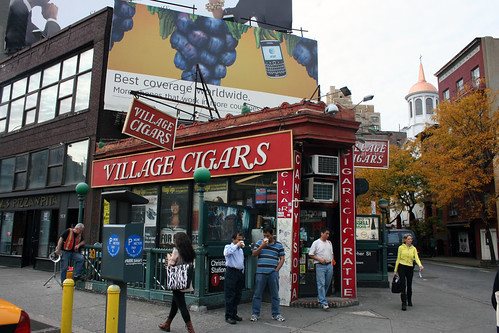
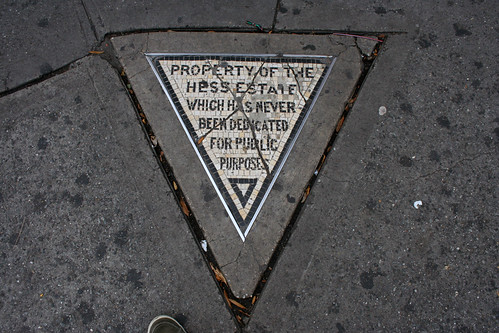
Set into the sidewalk is a small triangle (see my sneaker for size comparison), with the mysterious message: "Property of the Hess Estate Which Has Never Been Dedicated For Public Purposes."

002

In 1910, the area around Christopher Street and Seventh Avenue was being widened by the city. Over 300 buildings were condemned and razed under Eminent Domain laws, including a 5-story apartment building called The Voorhis belonging to David Hess.

Hess fought the city fiercely to save his building but lost, and by 1914, this small triangle was all that was left of his property. Thinking he'd been suitably beaten down, the city asked Hess to voluntarily donate the minuscule triangle for use as part of the public sidewalk "“ but Hess refused, and had this mosaic installed on July 27, 1922. Though it inevitably became part of the sidewalk anyway, anyone who walked over the triangle couldn't help but be reminded of Hess' battle.

I would like to buy it from the Hess family and erect a triangular pedestal with a suitable statue on top, perhaps Atlas with the globe bouncing away, giving a one finger salute to the city.

Awesome. Happy Halloween

Hat tip: South Bend Seven

And I will repeat my best ever Halloween Pumpkin:

Pumpkin1 Pumpkin2

(click on pictures for larger view)

Can You Prove You Are Not An Illegal Canadian Immigrant?

This is pretty funny -- a comedian challenges folks in downtown Phoenix and demand they prove they are not illegal Canadian immigrants.

Radley Balko is Freaking Brilliant

His response to a commenter should not be missed.  An excerpt:

Let's move on. I'm going to get a bit more critical now, so prepare yourself. Let's start with this:

What a sniveling little shit of a post from a sniveling little shit of a man.

This really feels lazy to me. You can do better. "Sniveling little shit" is already overused to the point of cliche. It is evocative, so I probably could still have lived with it had you only used it once. But to use it twice, and in the same sentence, really left me wishing you had come up with something more creative. Perhaps you were using repetition as a rhetorical device, but it really reads as if you just got tired of coming up with colorful ways to express your contempt for me. Which is disappointing, because those first couple lines really had me wanting to believe that you hated me. If I could offer a suggestion: This might be a good time to return to the puss-oozing lesion metaphor. I think it serves you well in a couple ways: It vividly and luridly conveys your disgust for me, and it links me in the minds of your readers to something quite unpleasant"”a festering wound. And a call-back is always a good way to keep your audience on its toes. You might even add some extra ickiness the second time around. For example, you might set the sore on someone's genitals, or perhaps on an anus. That's the beauty of writing! You are in control!

Pay to Play

From the WSJ:

The wide-ranging pay-to-play probe concerns whether investment firms like Mr. Rattner's former firm, Quadrangle Group LLC, were held up for fees and favors to secure access to lucrative business from New York's $125 billion public-pension fund.

So government officials, who have all the power, demand bribes from businesses in order for those businesses to participate in a certain market, and when discovered it is the private businesses that are being investigated?

This is just so typical of government, where pay-to-play rules are in fact legislated for businesses from bars to taxicabs.  I can't do anything new in Ventura County without bringing a whole series of checks to the County planning offices -- nearly every single department must be paid off before I can do something as simple as remodel a bathroom or revamp a store.  None of this is under the table, mind you, it is entirely up front and nominally legal.

Coyote on Reason.TV: Private Management of Public Parks

Check out this most recent Reason.TV video, if for no other reason that it features you humble correspondent in much of the video.    It is unbelievable that they pulled something this coherent out of my nervous babbling.

There are few things that I find more painful than watching myself on TV, but this came out well and I enjoyed the experience. Paul Feine is the sort of hip, pony-tailed SoCal libertarian all us old boring dudes want to be like.

What Both the Coke and The Pepsi Parties Have In Common

Legislators in both parties share one common belief -- that after millions of dollars and years of effort getting elected to their position, they don't want to hear anyone tell them their power is somehow limited.

"That somehow or other these are unconstitutional because they're not enumerated within the powers of the constitution, that somehow or other we should just be eliminating these, I think that is out of the mainstream," Sen. Lisa Murkowski (R-AK) said on MSNBC.

No campaign rules or financing "reform", or even a wholesale change in Congressional makeup from the Pepsi to the Coke party, is going to change anything unless the fundamental problem of the expansion of government power is addressed.

Awesome

Why Can't Chuck Get His Business Off the Ground?  Go watch, from the IJ  (the IJ is what the ACLU should have been if they were not founded by Stalinists).