Archive for the ‘Government’ Category.

The Most Money Every Spent With The Least Scrutiny

We will be posting on the stimulus bill for months and years, because it will take that long to figure out what was in it.  Congressman who voted for it may never know what they actually voted for.  Veronique de Rugy takes a first swing at it:

Total spending amounts to $792 billion, with $570 billion in direct spending and $212 billion in tax provisions. These numbers don't include the massive amount of interest that will accrue on the increased debt. If we include that, the total amount comes to $1.14 trillion.

Supporters of the package describe the legislation as transportation and infrastructure investment, the idea being to use new spending to put America back to work while at the same time fixing decrepit infrastructure. However, only 17 percent of the discretionary spending in this package is for infrastructure items. More worrisome still, the final version lacks any mechanism to ensure that spending will be targeted toward infrastructure projects with high economic returns

De Rugy actually overestimates the infrastructure spending, because she looks at the spending over 10 years.  Since the stimulative effect of infrastructure spending in this recession is, at most, limited to 2009-2010 spending, and since the infrastructure spending is more back-end loaded, the percentage is much lower in the first 2 years -- something like 6-7% as I calculated here (I will go back through the CBO reports with an update when I get a chance, but Kevin Drum links them here, hilariously saying they "scored well."

Unfortunately, even this seems to wildly underestimate the true cost of the bill.  In creating the bill, Congress increased the general operating funds for zillions of departments and programs  (remember, 80+% of the spending is departmental budget increases, not infrastructure construction).  However, they show these increasing disappearing after a couple of years.  We all know that Democrats consider removing an increase to be "a massive cut" so we can assume that at some point, these budget increases will be extended for eternity.  If one makes this more realistic assumption, then the cost of the stimulus bill is over $3 trillion!  [update:  Carpe Diem demonstrates this with a nice set of graphs]

My other project I am working on is to look at some of the "shovel ready" projects on the mayor's list here  (warning!  600 page pdf!!) in the Phoenix area.  My incoming hypothesis is that any project on here either:

  1. Is not shovel ready, as it takes years to get a project through planning, procurement, and environmental permitting, but once anyone in DC finds that out, they won't take back the money, -OR-
  2. Is something that the local residents, who will enjoy the benefit, refused to fund, raising the question as to why the rest of us should fund it.

I won't spill the beans yet, but here are a few tastes from the Phoenix area:

  • A major upgrade to the water system of the town of Paradise Valley, a small community embedded in Phoenix which is, by a fairly good margin, the single wealthiest zip code in the state.
  • A lot of solar.  Solar is a particularly good choice for this list because 1)  Obama has a hard-on for it, so he is unlikely to question it  2)  Solar's problem is high capital cost vs. the amount of electricity produced, but if someone else is paying the capital cost....

No Comment Necessary

wsjpic

From the WSJ, via Carpe Diem

Conservatives and Police

Radley Balko is having a back and forth with a guest blogger at Patterico over the drug war and violent crime.  Balko is always worth checking out, because while many of us bloggers may call ourselves the new media, we are mostly just a bunch of op-ed pages.  Balko is one of the few major bloggers out there doing real reporting.

One part of the discussion caught my attention:

Second, JRM leaves out the rest of my discussion of police militarization in the piece, which includes the very real, not-made-up statistic based on police department surveys done by Peter Kraska showing the number of SWAT deployments in the U.S. jumping from a few hundred per year in the 1970s to 50,000 or more per year today. Most of these SWAT deployments are to serve drug warrants. JRM can disagree, but my point is that even if these raids don't produce a single gun shot (though we know that's far from the case), that's a disturbing trend. The image of state agents dressed in black, kicking down doors, and wresting people out of bed at gunpoint in order to police nonviolent crimes just isn't one I associated with a free society (oddly enough, some prominent conservatives agree, at least when other countries do it).

Perhaps because I read this as my inbox is filled with Minuteman missives (I don't know how they got the impression I was somehow sympathetic to their cause) asking me to send a valentine to agents Compean and Ramos, but I sometimes really wonder about conservatives.

Conservatives distrust government and government bureaucrats.  Many understand public choice theory.  Many understand how faulty incentives within government can turn even good, smart people into stupid bad actors.

So I am left to wonder why conservatives feel ever so much better about the situation when the government employee is given a gun, and the unique authority to use it on the citizenry?

Repeating Mistakes Over, and Over, and Over...

I have come to the conclusion that politicians believe Americans all have Alzheimers.  And, given the lamentable state of the media, they may be right.

Example 1

We can argue about stimulus and the Depression all we want, but I had, until the last few days, thought the absolute one thing we all 100% agreed on is that the Smoot-Hawley tariffs and the trade war they sparked were one of the leading causes of the worldwide economic death spiral in the late 20's and 30's.  Or not:

The stimulus bill passed by the House Wednesday contains a controversial provision that would mostly bar foreign steel and iron from the infrastructure projects laid out by the $819 billion economic package. A Senate version, yet to be acted upon, goes further, requiring, with few exceptions, that all stimulus-funded projects use only American-made equipment and goods.

Here is a nice story of another "Buy American" steel fiasco.

Example 2

Last year -- I am talking about just 3 months ago -- I thought it was fairly clear that the immediate cause for the financial meltdown for which the TARP bailout was being crafted was the systematic relaxation of underwriting standards that led to large numbers of loans (and their lenders, securitizers, etc) going belly-up.  Folks could argue whether this was because of deregulation or greed or government distortions and interventions, but I thought there was not doubt that poor credit judgment and excessively free credit were at the heart of the problem.  Or not:

House Financial Services Committee Chairman Barney Frank said President Barack Obama will require banks receiving government aid to lend more to businesses and consumers, saying the Bush administration "made a mistake" by not setting stricter rules for institutions getting funds from the $700 billion financial-rescue package.

"I think you're going to see the Obama administration, having learned from that, push for much more lending," Frank said today on ABC's This Week. "There are going to be some real rules in there."

So Frank and Obama are upset that the bailout of banks that were overgenerous on credit did not include provisions to force them to be more generous with credit?

Final thought: At the end of the day, businesses and individuals have a felt need to deleverage.  That is going to cause a recession, end of story.  The Congress's and Obama Administration's obsession with short-circuiting this sensible desire to reduce debt is not only counter-productive, it is offensive.  Banks are sensibly trying to strengthen their balance sheets, but the government wants to stop them.  Individuals are trying to cut back on spending, reduce debt, and save more.  Again, the government wants to stop them, by going to debt and spending for them if consumers won't do it on their own.

Peering Into the Details of The Stimulus Bill

The CBO is out with its scoring of the stimulus bill (pdf).  Kevin Drum seems to think it refutes my statement that it would be impossible to have any kind of real infrastructure impact in the next 1-2 years.  Drum says:

Specifically, they estimate that in the spending portion of the bill, $477 billion out of $604 billion would be disbursed either this fiscal year or in the next two fiscal years. That's 79% of the total.

I guess opinions can vary on this, but that strikes me as pretty good. What's more, most of the spending that comes in FY2012 or later is either for projects that simply take more than two years to complete (highways, school repairs) or infrastructure improvements that have long-term paybacks (renewable energy programs). There are a few other items in the out years that are more arguable, but they add up to a pretty small portion of the bill.

This is correct on its face.  But here is the issue, and what drives me crazy about politicians and their enablers like Drum.  This is being sold as an infrastructure bill.  And even by Drum's admission, all the infrastructure spending is in the out years, well beyond any reasonable time frame for the recession.

Picking through the report, the "spending"  (I object to calling tax cuts "spending") in the next two years, the recession window, is mainly in these categories ( I get slightly different numbers than Drum)

  • Tax cuts of $223.2 billion (lost revenue + outlays)
  • Transfer payments $202.2 billion
    • Unemployment & Child Support:  $42.2 billion
    • Health Insurance Assistance:  $36.6 billion (lost revenue + outlays)
    • Medicaid: $76.9 billion
    • Food Assistance:  $10.8 billion
    • Health and Human Services (unspecified):  $14.9 billion
    • Employment and job training:  $2.9 billion
    • School/College loans:  $14.7 billion
    • Housing assistance:  $3.2 billion
  • State government "stabilization":  $31.4 billion
  • Defense:  $6.2 billion
  • Other: $62.5 billion
    • Increase in department budgets  $28.4 billion (estimated, may be low)
    • Real infrastructure spending (mainly schools, federal buildings, highways, and other transit)  $26.7 billion (at most!)
    • Green energy / energy programs  $7.4 billion (at most!)

So do you see my point. The reason so much of this infrastructure bill can be spent in the next two years is that there is no infrastructure in it, at least in the first two years!  42% of the deficit impact in 2009/2010 is tax cuts, another 44% is in transfer payments to individuals and state governments.  1% is defense.  At least 5% seems to be just pumping up a number of budgets with no infrastructure impact (such as at Homeland Security).  And at most 6% is infrastructure and green energy.  I say at most because it is unclear if this stuff is really incremental, and much of this budget may be for planners and government departments rather than actual facilities on the ground.

So don't call this an infrastructure bill.  This is a tax cut and welfare bill, at least in 2010 and 2011.   I guess I can understand a rush to do things like the welfare pieces, but that would argue for splitting the bill, into an emergency transfer payment appropriation and a infrastructure appropriation that can be studied and debated in more depth.

But that is never going to happen, because what we see is a unique kind of political synergy.  The bundling of these two very difference spending streams gives yields two political advantages:

  1. The infrastructure piece, despite being less than 10% of the bill, allows politicians to call this "investment" and "green energy" and "infrastructure" which sell better with sections of the public than "welfare" and "transfer payments."  The minority infrastructure pieces allow Congress and Obama to call the bill new and forward looking, rather than the imitation of 1970s legislation that it really is.
  2. The emergency pieces of the bill allow politicians to stuff numerous bureaucracy increases and pork spending into the bill that would not stand up to scrutiny.  Despite the fact that much of this spending will not occur for years, they can keep saying "rush, emergency, hurry" to deflect scrutiny and criticism.

Update: The National Review has a lot more detail here.

The Stimulus Time Delay

From the WSJ, via TJIC:

The stimulus bill currently steaming through Congress looks like a legislative freight train, but given last week's analysis by the Congressional Budget Office, it is more accurate to think of it as a time machine. That may be the only way to explain how spending on public works in 2011 and beyond will help the economy today.

According to Congressional Budget Office estimates, a mere $26 billion of the House stimulus bill's $355 billion in new spending would actually be spent in the current fiscal year, and just $110 billion would be spent by the end of 2010. This is highly embarrassing given that Congress's justification for passing this bill so urgently is to help the economy right now, if not sooner.

And the red Congressional faces must be very red indeed, because CBO's analysis has since vanished into thin air after having been posted early last week on the Appropriations Committee Web site. Officially, the committee says this is because the estimates have been superseded as the legislation has moved through committee. No doubt.

In addition to suppressing the CBO analysis, Democrats have derided it. Appropriations Chairman David Obey (D., Wis.) called it "off the wall," never mind that CBO is now run by Democrats. Mr. Obey also suggested that it would be a mistake to debate the stimulus "until the cows come home." We'd settle for a month or two, so at least the voters can inspect the various Congressional cattle they're buying with that $355 billion.

The reason this is so was explained by yours truly last week.  In short:

A year from now, any truly new incremental project in the stimulus bill will still be sitting on some planners desk with unfinished environmental impact assessments, the subject of arguments between multiple government agencies, tied up in court with environmental or NIMBY challenges, snarled in zoning fights, subject to conflicts between state, county, and city governments, or all of the above.  Most of the money will have been spent by planners, bureaucrats, and lawyers, with little to show for in actual facilities.

The Other Reason Stimulus Won't Work

Frequent readers will know that I do not buy into the Keynesian multiplier effect for government spending.  But there is an even better reason why the stimulus bill will never work:   it is simply impossible to break ground on any new government construction project in less than a year.

A year from now, any truly new incremental project in the stimulus bill will still be sitting on some planners desk with unfinished environmental impact assessments, the subject of arguments between multiple government agencies, tied up in court with environmental or NIMBY challenges, snarled in zoning fights, subject to conflicts between state, county, and city governments, or all of the above.  Most of the money will have been spent by planners, bureaucrats, and lawyers, with little to show for in actual facilities.

The couple of exceptions I can think of are:

  • The project has already been proceeding for years, and thus is just about to start construction anyway.  Which implies the spending is not incremental and that we are just substituting federal dollars for local dollars in completing local projects, never a good idea.
  • It may be possible to get a repair project going faster, but even that is probably impossible.  The contract award process alone can take up to 6 months, and it is probably no accident that federal highway funds are one of the few areas the government budgets multi-year.

To illustrate, let me tell a story.  We operate a marina and campground on a lake in Ventura County, California.  The marina office and store used to be a small floating building attached to the dock and floating on the lake (this is a fairly typical arrangement in small marinas).  The County decided it, for whatever reason, did not like having a floating store building any more, and it wanted the floating building closed and a new modular building put in a corner of the parking lot, on dry land.

So we get a modular building and park it in the parking lot near the dock entrance, as ordered.  Having been required by the county to take these steps, we were subsequently shocked to find that a variety of County offices refused to permit the new structure.  Eventually, it took nearly 4 months and $10,000 in fees to obtain the 8 County permits and approvals we needed to park a trailer in the parking lot.   And this does not include the cost of a fairly senior manager spending half his time chasing down all these approvals.  At one point, the County demanded a soil sample, and so we had to have a company come out and saw into the concrete parking lot to obtain a sample of the soil underneath.  God knows how long it would take to approve new construction on virgin land with water, sewer, etc.

Finally, some of you might be thinking that these government hurdles would be easier for the government itself to clear.  Wrong.  You have never, ever seen a government employee display as much energy as they will muster when they think another government agency is bypassing his or her authority.  I made a presentation a while back to a group of county commissioners in California, and it seems like most of their jobs involve dueling with various state agencies and local governments.

Good Stuff From Obama

Well, I was cynical about Obama giving up executive power, as politicians generally have a different view of runaway government power once that power is in their hands.  But some good stuff has come out already:

  • Obama rescinded Bush's 2001 executive order allowing former presidents, vice presidents, and their heirs to claim executive privilege in determining which of their records get released to the public. Even better, he's requiring the signature of both his White House counsel and the attorney general before he can classify a document under executive privilege.
  • Issued a memorandum to all executive agencies asking them to come up with a new plan for open government and complying with FOIA requests. He is also instructing three top officials, including the U.S. attorney general, to come up with a new policy on open government. The new policy would replace the existing policy, infamously set by a 2001 memo from John Ashcroft that instructed federal agencies to essentially to take every measure they can to refuse FOIA requests.
  • Put a freeze on the salaries of top White House aides.
  • Suspended the military trials at Gitmo, and is expected to issue an order closing Gitmo as soon as today.

That's a really good start.  I am now more optimistic that we might actually get some rollbacks of government power vis a vis FISA and the Patriot Act.  The Fourth Amendment took a serious beating since 9/11, and hopefully it is not too late to roll back the precedents set over the last 7 years.

Of course, all of these activities are reductions of executive power in areas in policy areas Obama wants to undo actions by GWB.  The real test will be to see his approach to executive power in areas where he wants to go past GWB.  A good example is carbon dioxide regulation, where it has been suggested Obama should take the issue out of Congress's hands and establish a regulatory regime by executive fiat.

While we are on wish lists, I have often told my Republican friends that a fault of Bush's that did not get enough press was his apparent lack of willingness to provide adult supervision to Congress.  Congress needs to be shamed occasionally to stay on task and not drift off into feeding fests at the trough, and only the President can really do this.  Bush did not have the desire to face down a Republican Congress, and probably had lost all his credibility by the time he faced a Democratic Congress.  Harry Reid and Nancy Pelosi will take a lot of baby-sitting to avoid veering off into their worst behaviors, and it will be interesting to see if Obama will do so.  I think it is in his interest to do so.  Already, the ridiculous stimulus bill Pelosi has crafted threatens to embarrass him.  If I were Obama, I would be furious.  He expends his early political capital for a stimulus bill, and gets a total porked-up lobbyist's-fantasy from the House.

The Tip O'Neal Bill

Well, it appears that Democrats who were angry at the cost of the Iraq war (a feeling to which I was always sympathetic) are attempting to even the score by spending approximately the same amount in a single bill.

Looking at the stimulus bill was kind of an odd experience for me.  Despite everything I preach here about politicians, I must have, somewhere in my deep back brain, under the onslaught of cultish media attention, absorbed some small hope that maybe perhaps Obama was really different.   Then I looked at the stimulus bill.  It is all the same crap that various folks have been trying to peddle unsuccessfully for years, repackaged in a hurry-up emergency form to avoid close scrutiny.  This is politics as usual, but even more so.  Jeez, this easily could have come from Tip O'Neal.  Everywhere you look in the bill, it smells. And Republicans are almost going to have to go along because they have pissed away any credibility they have by doing the exact same thing under the guise of TARP.

By the way, if you are confused about Keysian stimulus, here it is in a nutshell:  The economy is contracting some as people deleverage from over-spending and an asset bubble.  I mean, that's certainly what we are doing in the Coyote den, setting goals for both de-leveraging the business and our household.  But folks are worried, because while this has happened many times, one of those times we had a depression.  So the government does not want you to deleverage.  It wants you to spend and spend.  But it knows you won't, and that it has not yet accumulated enough power to force you to.  So it will borrow and spend for you.  Government stimulus means that when you are trying to save and reduce debt, government is going to run up debt in your name.

By the way, for those wondering how well this works, the last time we tried it was during the aforementioned depression, and the depression lasted another 8-10 years.

Government, In One Sentence

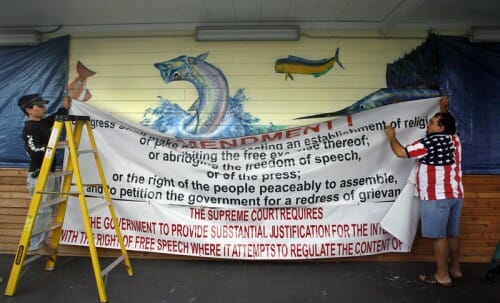
"Meanwhile, the city's legal department is looking to see what, if anything, it can do about the First Amendment banner."

Via Radley Balko.  The city told Herb Quintero that he did not have the right to paint a mural on the side of his building, and had to cover it up.  So he did, with a banner containing the text of the First Amendment.  Image from here.

NP_299968_CLIF_MURAL_1

Speaking of building codes, we are about to get some repairs on our pool inspected.  To pass the inspection on our pool, though, we have to spend thousands of dollars inside of our house.  Phoenix building codes require all kinds of crazy rules for home entry doors to the pool area.  For example, they all have to be self-closing and have to have deadbolts 54" off the ground, which I can assure you that no house built normally actually has. No window can open more than 4 inches.  This is a problem for us, because we have a series of French doors opening to the pool area, giving us 9 separate doors we have to modify or replace.  We are lucky we are grandfathered and don't have to put a fence around the pool area as new homes do (our backyard is fenced of course, but regulations require new homes to have a fence around the pool itself).  I know a lot of folks whose first activity in buying a new home is to pay someone to rip out the fence once the home passes inspection.

The rationale is to keep kids from drowning, I guess, but the number of kids who drown by sneaking out through 5 inch window gaps, or even unlocked doors, is vanishingly small  (the number of kids that drown in homes with no small kids is also small).   Kids drown when parents know they are outdoors but fail to supervise them closely.  We have no small kids in the house, but when we did, we supervised them very closely and put them through swim school before they were five.  But politicians, when there is a high-profile drowning, feel they need to "do something."  Since they can't legislate good parenting, they add to the already bloated building code, often sticking in pet requirements of lobbyists representing particular building materials and services.

Well, it turns out there are any number of companies in Phoenix who specialize in getting your home ready for this inspection.  They will come in and install all kinds of temprorary hardware, then come back after the inspection and remove it (filling and patching screw holes and the like).  Talk about dead-weight loss.

Can You Say, "Moral Hazard?"

Moral hazard is the term for what occurs when one shelters an entity from the full cost or downside of taking risks.   The result is that the entity will tend to take on more risk than it would have had it had to bear the full costs.  For example, if a company knows that the government will make up the shortfall if its pension investments suffer, it will tend to invest in high-risk, high-return investments that reduce the company's need to contribute funds in the good years.   This is sometimes called privitizing profits and socializing losses.

One of the problems with demonstrating moral hazard is that the hazard often occurs years after the action (usually a government action) that creates the hazard.   But this week we have an amazing opportunity to see moral hazard operating within days of a government bailout:

Immediately after GMAC became eligible for TARP money, GM reduced to zero the interest rate"¦ on certain models. This, of course, penalizes GM competitors, including Toyota, Honda and other "transplants" whose cars are made in America by Americans for Americans, and Ford, which does not have the freedom of maneuver conferred by TARP money because Ford is not taking any"¦

GMAC has begun making loans to borrowers with credit scores as low as 621, a significant relaxation of the 700 minimum score the company adopted just three months ago as it struggled to survive. America's median credit score is 723"¦

If you pay people trillions of dollars in response to a bad behavior (in this case, credit lenience) then you will just encourage more of that behavior, even if everyone achnowleges it to be a bad behavior.

A Critical Turning Point

Via TJIC:

The steel industry, a bellwether for the state of the nation's economy, is looking to the government for a huge investment program: up to $1 trillion over two years.

Government can't create capital -- it can only force it to be reallocated and, to a small extent, move it forward from the future.   Given that there is some sort of fixed amount of investment capital in the economy, then, it strikes me that we are rapidly approaching the point where we are giving to Congress the job of allocating the vast majority of the country's available investment capital.  And if that prospect does not scare you, and it should, consider this:  Congress has made it fairly clear the three criteria it will use to select the recipients of capital:

  • They must have a business model that has been proven a failure (by poor performance, eroding market share, and/or near bankrupcy)
  • They must have strong, powerful unions with the historically proven ability to dictate terms to management
  • The company and its key stakeholders must be strong supporters of the party in power

They say the government does things that private parties can't or won't, and that is certainly true here since I cannot imagine any private investor allocating capital on these criteria.

Whatever Is The Most Important to You, We Are Cutting That First

The very essence of business decision-making is prioritization and trade-offs.  The same is true in the government, its just that the objective function is reversed:

GM is warming up the propaganda engine for the next run at Congress. "Look, the first thing we had to cut was our electric car program!".

And here I thought that because GM has still, after 30 years, failed to realize their business model needs to change that maybe management there were slow learners.  But they seem to be very, very adept at learning the government game.

When I was in the corporate world, if I wanted extra funds for my projects, I would have to go in and say "Here are all my projects.  I have ranked them from 1-30 from the most to least valuable.  Right now I have enough money for the first 12.  I would like funding for number 13.  Here is my case."

But the government works differently.  When your local government is out of money, and wants a tax increase, what do they threaten to cut?  In Seattle, it was always emergency services.  "Sorry, we are out of money, we have to shut down the fire department and ambulances."  I kid you not -- the city probably has a thirty person massage therapist licensing organization and they cut ambulances first.   In California it is the parks.   "Sorry, we are out of money.  To meet our budget, we are going to have to close down our 10 most popular parks that get the most visitation."  The essence of government budgeting brinkmanship is not to cut project 13 when you only have money for 12 projects, but to cut project #1.

I can just see me going to Chuck Knight at Emerson Electric and saying "Chuck, I don't have enough money.  If you don't give me more, we are going to have to cut the funds for the government-mandated frequency modification on our transmitters, which means we won't have any product to sell next month."  I would be out on my ass in five minutes.  It just floors me that this seems to keep working in the government.  Part of it is that the media is just so credulous when it comes to this kind of thing, in part because scare stories of cut services fit so well into their business model.

So of course, with billions of dollars of waste, absurdly high labor costs, stupid-large executive compensation, etc., GM chooses to cut funding the project that is most important to Congressional Democrats and the new Obama administration.

We're All Technocrats

The auto bailout is dead, at least for now:

A bailout-weary Congress killed a $14 billion package to aid struggling U.S. automakers Thursday night after a partisan dispute over union wage cuts derailed a last-ditch effort to revive the emergency
aid before year's end.

Republicans, breaking sharply with President George W. Bush as his term draws to a close, refused to back federal aid for Detroit's beleaguered Big Three without a guarantee that the United Auto Workers would agree by the end of next year to wage cuts to bring their pay into line with U.S. plants of Japanese carmakers. The UAW refused to do so before its current contract with the automakers expires in 2011.

Good.  Chapter 11 was made for this kind of situation, and folks will quickly come to understand that productive assets don't go *poof* in a bankruptcy  (though equity values can).

By the way, you will note that Senate Republicans did not suddenly become economic libertarians.  Their objection seems to be that the bill does not micro-manage the auto industry they same way they would want to micro-manage the auto industry.  You can see in these political battles that Congress brings its usual identity politics to these decisions:  Republicans want to hammer the unions, Democrats want to hammer executive pay.  Which is why these restructuring discussions don't belong in Congress.

Add GM, Ford, and Chrysler to this List

Via TJIC, who had a much better title, "poor credit risks remain poor credit risks, even after you give them a free pony"

Recent data suggests that many borrowers who received help with mortgage modifications earlier this year tended to re-default on their payments, a top U.S. banking regulator said on Monday.

"The results, I confess, were somewhat surprising, and not in a good way," said John Dugan, head of the U.S. Office of the Comptroller of the Currency, in prepared remarks for a U.S. housing forum.

"Put simply, it shows that over half of mortgage modifications seemed not to be working after six months," he said.

You can absolutely, without a doubt, add the Big 3 to the list of folks who will be facing default once again just months after getting their first dollop of federal money.

No Issue Too Small To Get Attention from the State

Criminalizing everything:

License-plate frames that celebrate your favorite college or sports team become illegal next month if the frame obscures the state's name.

Starting Jan. 1, police can stop you if "Arizona" isn't clearly visible at the top of the plate. Violators will be fined an average of $135, plus court fees, depending on the city where the violation is discovered.

Wow, while the police are chasing after that guy with a joint, lets make sure we also have the boys in blue vigilant for this.  And I am sure this new law will be enforced as equally and fairly as all the others and these guys will be he first to get tickets:

On Tuesday, half the 26 vehicles in the Arizona Senate parking lot bore frames obscuring the word "Arizona."

Yeah, right.  This is just another "probably cause" for Sheriff Joe Arpaio and his boys to pull over every person with brown skin they run into.

A Civics Lesson in One Sentance

A month or two back, I was participating in the California Regional Council of Rural Counties annual meeting.  At this conference, I was there to have a sort of informal debate on climate change with Joe Nation, a former California State legislator and currently a private consultant on climate issues.

To some extent my role was frustrating for the audience, because they were already stuck with complying with California's AB32 (a sort of state CO2 cap and trade system) and arguing that such legislation was pointless only served to upset them  (my presentation, both in powerpoint and video is here).  By the way, we often lump "government" together, but I can tell you that while the governor and the legislature of California may be 100% behind CO2 alarmism, the county commissioners were very sympathetic to the skeptic position.

Anyway, towards the end of my presentation I made a plea for a carbon tax over cap-and-trade, and said in fact that California's AB32 was living proof of my argument.  The California Air Resources Board (CARB), which is tasked with implementing the plan, has already added hundreds of people to its staff and worked for over two years, is still no where near finished with rule-making.  The complexity, and the battling political constituencies, is simply mind-boggling.  It is already clear that the result is going to be a Byzantine, Rube Goldberg structure of detailed industry-specific reporting and permitting rules.  Nearly 100% of CARB's time is taken up today with various groups running to them begging for some sort of special treatment (think "carbon bailout" and you will get the idea).  No one thinks the process is fair or rational.

Under cap-and-trade, every single industry will report greenhouse gasses, have industry and firm-specific limits, myriads of permits, etc.  For example, we had detailed discussions that day of how cattle flatulence will be treated and measured.  The alternative is a carbon tax, which is dead simple.  There is one single rate to set - the tax per weight of carbon in fuel.  Fuels with more carbon per BTU, like coal, thereby get higher taxes.  The system works like a sales tax, and could be administered by the BOE (who runs the California sales tax system) in its sleep.

The cap-and-trade system is far more expensive than a carbon tax.  By the basic laws of supply and demand, both systems have to raise the cost of burning certain fuels by about the same amount to get about the same reduction in use.  But the cap-and-trade system brings a huge overhead burden, both in government bureaucracy as well as compliance costs, that make it far, far more expensive for the same amount of benefit.  Until he started sitting on the boards of companies who depend on these inefficiencies in the cap and trade system to make money, Al Gore advocated a straight carbon tax over cap-and-trade.

But we had an opportunity that day.  Because the man who claims to be the author of AB32 is none other than Joe Nation, who was right there in the room.  So we asked him why he took this approach.  Here is what he said, really a civics lesson in one sentence:

I tried pass a carbon tax first, but there was absolutely no support for it among legislators [the same ones who overwhelmingly supported AB32]

If you can understand why this is, you can understand a lot about government.   Because all these concerns that you and I might have about crafting rational public policy are not important to legislators.  Here is how they think about it:

  • Private implementation and compliance costs are meaningless to legislators.  There is no public measurement or accountability for these costs, and most of these costs fall on businesses, who can be ignored as unsympathetic in political discourse.  I operate in Mono County, California, and they put out a new set of reporting requirements driven, they said, by the needs to save a few hours a year of their auditors' time.  But compliance with these new rules costs our company 10-20 hours, at least, a year.  And we are just one of many, many companies reporting.  I complained that it was crazy for them to ask taxpayers to spend hundreds of hours of labor to save them just a few, but they could not have cared less.
  • For legislators, particularly in California, creating large new bureaucracies is good.  It creates a patronage relationship between the legislators and these new government employees that is almost quasi-feudal.  Public employees are an enormous source of support for incumbent politicians, and these bureaucracies also offer future employment opportunities for legislators once they leave office (nice article here).
  • First, last, and always, the vast majority of politicians are gutless.  That means if they can pass the same tax in a way that is more hidden (ie cap-and-trade vs. carbon tax) they will prefer this approach, even if it means the tax is substantially less efficient.  In the case of cap-and-trade, since costs are hidden and spread around like peanut butter rather than easily identifiable, they can pretend the costs don't exist and, if someone starts worrying about rising electricity costs that result, simply blame the rising costs on the evil power/oil/coal/etc companies.  Obama has brilliantly taken this one step further, by outrageously claiming, in the broken windows fallacy of all time, that cap-and-trade will actually boost the economy through green job creation.
  • A carbon tax gives politicians very little room to extract personal value from the electorate.  Really, there is only one number for everyone to argue over.  But cap-and-trade is a Disneyland for lobbyists.  There can be special exemptions, industry specific caps, firm-specific caps, geography-specific caps.  Once everyone sees the first few guys giving campaign donations and parading into CARB for special treatment, everyone feels like they have to in order to avoid being the one guy left out.  My guess is that cap-and-trade will spawn more lobbying than any other legislation in US history.  And politicians, no matter what their public stance, love lobbying, because everyone who comes to ask them for something knows there has to be a quid pro quo.

Update:  A number of related thoughts and posts here, at Reason.

Additional Thoughts on Letting GM Die

I have gotten a lot of email on my posts about allowing GM to die.  Here are a few thoughts:

  1. No matter what our mutual preferences, GM is not actually going to die.  It will go in to chapter 11 and reorganize, and, as that law intends, will continue to operate through that reorganization.  While Lehman and Enron liquidated, they were really special cases having more to do with financial than operating assets.  In the last 20 years, Texaco, PG&E, Worldcom, Delta, and UAL have all passed through chapter 11, and all operated their businesses through bankruptcy.  In fact, all of Enron's pipelines and other operating assets are running A-OK right now, just under new ownership.  Do you remember all those news stories about massive natural gas shortages because Enron's pipelines all stopped operating when it declared bankruptcy?  Yeah, neither did I.
  2. You are welcome to write me about how I suck because your job at GM (or retirement, or health care, or all of the above) is important to you if that helps you psychologically to manage a terrible and stressful time.  But, to cause me to back off my opinion about GM and the bailout, you need to tell me why your job is more important than someone else's job.  Because, unlike private enterprise, the government does not create wealth, but can only move it around (with a leaky bucket, at that).  GM has wasted hundreds of billions of dollars of investment, so having the government invest money to save your job will likely cost >1 job somewhere else.  Just because we don't, and may never know, who that specific person is does not make this an ethical choice. 
  3. I too, all things being equal, value having a healthy auto industry in the US  (which in fact we still have -- it just happens the headquarters of many of the companies that run the plants are over in Japan).  However, if you wish to argue that the bailout is necessary to save a US auto industry, you in fact need to argue that the current set of managers/contracts/systems/performance measures/organization/etc. of GM are better able to manage the employees and assets of GM than a different owner with different managers and approaches.  Because having GM fail does not make the assets or trained people disappear, it merely makes it more likely they will be managed by a different entity.  So all a bailout does is save the GM entity that manages these assets and people.

Get Bob Cratchitt to Do It

The Town of South Attleboro, MA sent out wildly threatening past due letters for folks with balances as low as 1-cent  (thereby investing at least 42 cents to get one back).  In response to charges that this was stupid, City Collector Debora Marcoccio responded:

A computer automatically printed the letters for any account with a balance remaining, and they were not reviewed by staff before being sent out, Marcoccio said.

"It would be fiscally irresponsible for me to have staff weed through the bills and pull out any below a certain amount," Marcoccio said. " And what would that amount be?"

What, are we living in the 19th century with clerks in a musty room preparing bills by hand?  This fix probably requires one whole entire line of program code in the billing system to fix.  I could probably teach myself to code whatever language the payroll system is written in (my guess is COBOL, which, god help me, I already know) in less time than this woman has spent fielding complaints and media inquiries.  Compare this to what TJIC has to do just to get the mail out.

And don't you love people who don't even have enough spine to make a simple decision about the cutoff for minimum bill size.  I have found this is one of those things the government is really, really bad at -- making decisions under uncertainty  (which covers about all decisions, except routine ones embodied in SOP).  Government has no incentives, in general, for productivity, or production, or customer satisfaction.  The only time government employees get feedback at all is when they get negative feedback from having someone yell at them for making a decision that some higher-up didn't like..  So if a decision is not justifiable either by past precedent/SOP or explicitly by the rules, it is not made.

By the way, I had a personal programming milestone last night.  I finally built a website without using a WYSIWIG editor that formatted the way I wanted it to all in CSS without a single table.  I predict that now that I have finally gotten a decent handle on CSS, which mainly consists of learning all the workarounds for when it doesn't work as you would expect, that someone is about to introduce a whole new system for formatting web pages.

Thanks Bush Family

Update:  Chart below is not correct.  It's enough in error that I have deleted it.  Author explains here.

William Biggs has a bunch of charts showing historic federal outlays, but below is his chart for year-over-year changes in federal outlays per capita, adjusted for inflation:

CHART DELETED

Obama Transition Site Gets Stealth Edit

Last week I quoted from the Obama transition site:

The Obama Administration will call on Americans to serve in order to meet the nation's challenges. President-Elect Obama will expand national service programs like AmeriCorps and Peace Corps and will create a new Classroom Corps to help teachers in underserved schools, as well as a new Health Corps, Clean Energy Corps, and Veterans Corps. Obama will call on citizens of all ages to serve America, by developing a plan to require 50 hours of community service in middle school and high school and 100 hours of community service in college every year.

Now, it says this:

Obama will call on citizens of all ages to serve America, by setting a goal that all middle school and high school students do 50 hours of community service a year and by developing a plan so that all college students who conduct 100 hours of community service receive a universal and fully refundable tax credit ensuring that the first $4,000 of their college education is completely free.

Ben Smith and others argue that Obama never said it was mandatory.  Fortunately, I got a screen shot of the "require" language before the Obama department of Truth got to the page (click for full size):

obama-service-plan

Thanks to Walter Olson for bringing the swap to my attention.

Postscript: 100 hours for $4000 is a pretty good deal.  Not many private sector employers offering $40 an hour to recent high school grads.  Everyone out there OK with the government paying the equivalent of $80,000 a year salaries to 18-year-olds for sorting food at the food bank?

Refresher: It seems that some basic definitions are in order.  If one is required to work at a certain task, he is not a volunteer.  If one is paid $4000 for 100 hours of labor, he is not a volunteer.  A volunteer is someone who works of his or her own free will without monetary compensation, solely for the satisfaction of helping out.

Public Administration Majors Score Dead Last on GRE Scores

Can't say this surprises me:

test_scores

Seriously - couldn't you have predicted the last three in advance?

No Thanks, We're Waiting on Our Bailout

Via a reader:

An auction that netted $7.5 million in bids on 56 distressed Utah properties fell through last week after the owners -- three banks and two private lenders -- decided they may get a better deal by holding out for the government's bailout plan.

"There were buyers, but we couldn't sell the homes because free enterprise has gone out of the market," said Eric Nelson, founder of Las Vegas-based Eric Nelson Auctioneering.

His company on Sept. 30 put up for sale 56 foreclosed properties and lots, most of which are in Utah County.

The auction, held in Salt Lake City, attracted thousands, including 200 bidders who bid between $275,000 and $615,000 for 10 luxury homes in Midway and Murray that were appraised at between $525,000 and $652,000. They bid between $26,000 and $100,000 for 44 custom lots in Mapleton, Elk Ridge, Lehi, Alpine, Ogden, West Haven and Willard that were valued between $112,000 and $290,000 a piece.

The most-expensive properties on the auction block included a $1.2 million unfinished home in Draper, which attracted the highest bid at $615,000, while a 62-acre parcel in Park City that's valued at $3.5 million, snagged the highest bid at $1.125 million, said Eric Taylor Nelson, the company founder's nephew.

But all those bids were rejected late last week...

"This has never happened before. In the 25 years we've conducted lender-owned auctions, we've consistently closed over 95 percent of all high bids," Nelson said.

"The stock market's historic drop last week and the bailout plan are some of the main reasons why the lenders rejected the bids," he said. "They're thinking, 'Why sell the properties for 50 cents on the dollar when they may get 75 cents or 80 cents through the bailout?' "

First Democratic Agenda Item: Grow Union Membership

Because they have done such a good job helping workers in the auto and airline industries.

auto_jobs

From the WSJ here.  Its all part and parcel of the "stagnant middle class income" fib, discussed here.

Another State-Run Oil Company Fiasco

And it couldn't happen to a nicer guy (hat tip to a reader):

Venezuela's daily oil production has fallen by a quarter since President Hugo
  Chavez won power, depriving his "Bolivarian Revolution" of much of
  the benefit of the global boom in oil prices...

The state oil company, PDVSA, produced 3.2 million barrels per day
in 1998, the year before Mr Chavez won the presidency. After a decade
of rising corruption and inefficiency, daily output has now fallen to
2.4 million barrels, according to OPEC figures. About half of this oil
is now delivered at a discount to Mr Chavez's friends around Latin
America. The 18 nations in his "Petrocaribe" club, founded in 2005, pay
Venezuela only 30 per cent of the market price within 90 days, with
rest in instalments spread over 25 years.

The other half - 1.2 million barrels per day - goes to America, Venezuela's only genuinely paying customer.

Meanwhile,
Mr Chavez has given PDVSA countless new tasks. "The new PDVSA is
central to the social battle for the advance of our country," said
Rafael Ramirez, the company's president and the minister for petroleum.
"We have worked to convert PDVSA into a key element for the social
battle."

The company now grows food after Mr Chavez's price
controls emptied supermarket shelves of products like milk and eggs.
Another branch produces furniture and domestic appliances in an effort
to stem the flow of imports. What PDVSA seems unable to do is produce
more oil.

Venezuela has proven reserves of 80 billion barrels,
but estimates suggest that it may possess 142 billion barrels - more
than anywhere else except Saudi Arabia....

All
this means that Venezuela has missed much of the benefit from the oil
boom and, now that prices are falling, Mr Chavez faces huge financial
problems. Nobody is sure at what point his government would be unable
to pay its bills, but most sources consulted believe this would
probably happen if oil falls to $80 a barrel. Yesterday, oil was
trading at $79.80.

More on "peak oil" being at least partially a function of state mis-management of promising oil reserves here.  Jim Kingsdale estimated last year, when prices were over $100 for oil, that oil prices would probably trade under $50 if the reserves were controlled by private companies rather than government buffoons.