Archive for the ‘Government’ Category.

California Schadenfreude

From Zero Hedge:

The hoped-for April spike in personal income tax revenues for the State of California fell once again below theoveroptimistic assumptions used to get the budget to “balance.” Instead of the $9.4 billion that the government had counted on collecting in April, it only collected $7.4 billion, according to the nonpartisan Legislative Analyst's Office. A 21% shortfall! In addition, corporate taxes were $450 million below forecast. After months of “disappointing” tax revenues, the total shortfall in income taxes now amounts to $3.5 billion for fiscal 2012 ending June 30.

The budget, supposedly balanced when it was passed last summer, had been spewing red ink from day one. Tax revenues were one problem. Expenditures were the other. The most recent re-revisions pegged the deficit at $9.2 billion. That was a few weeks ago. Now it’s going to be re-re-revised to nearly $12 billion.

Just how bankrupt does a budgeting process have to be for a budget that is supposedly in balance turn out to be $12 billion overdrawn barely 9 months later?  I have a California state tax refund on my desk -- better cash it quick or else its going to be replaced by scrip again.

The same article has this interesting tidbit about California high speed rail:

The CHSRA plan assumes that it would cost 10 cents per passenger mile (the average cost of carrying one passenger one mile at a given load factor) when international high-speed rail systems averaged 43 cents per mile, according to a report that just surfaced. The low-cost leader was Italy with 34 cents per mile; at the upper end were Germany and Japan with 50 cents per mile; Amtrak’s Acela Express, though not truly high speed, was in the middle with 44 cents per mile. And in California, it’s going to be 10 cents per mile?

The CHSRA correctly assumes that train tickets compete with air fares and the cost of driving, which, despite our incessant complaints, are lower in California than overseas. Thus, the US market requires cheaper tickets. And to make the project appear profitable, and thus more digestible for the taxpayer, the CHSRA lowered its projected operating costs to less than a quarter of the international average.

But if actual operating costs are 43 cents per mile and not 10 cents per mile, annual subsidies of $2 billion to $3 billion would be required just to keep the trains running, according to the report. Yet, AB3034, the California High-Speed Train Bond Act, makes these subsidies illegal. A conundrum that the Legislature, the Administration, and the CHSRA have so far successfully ignored.

Loyalty to the State Day

Unbelievable.  Obama has declared May 1, the traditional day used by the Soviet Union to celebrate the power of the state through military parades and such, to be "loyalty day."  Not "let's respect what America stands for" day or "celebrate liberty day" but "promise unthinking loyalty to our government masters" day.

This is particularly ironic as the other major competing proposal for Mayday is as a remembrance for the people killed by communism.  So, your choice today.  Salute the victims of out-of-control state power, or pledge your loyalty to the state.

Weird, Who Would Have Predicted This?

I wrote on the day of Obama's inauguration:

I will be suitably thrilled if the Obama administration renounces some of the creeping executive power grabs of the last 16 years, but he has been oddly silent about this.  It seems that creeping executive power is a lot more worrisome when someone else is in power.

From Charlie Savage in the New York Times:

As a senator and presidential candidate, he had criticized George W. Bush for flouting the role of Congress. And during his first two years in the White House, when Democrats controlled Congress, Mr. Obama largely worked through the legislative process to achieve his domestic policy goals.

But increasingly in recent months, the administration has been seeking ways to act without Congress. Branding its unilateral efforts “We Can’t Wait,” a slogan that aides said Mr. Obama coined at that strategy meeting, the White House has rolled out dozens of new policies — on creating jobs for veterans, preventing drug shortages, raising fuel economy standards, curbing domestic violence and more.

Each time, Mr. Obama has emphasized the fact that he is bypassing lawmakers. When he announced a cut in refinancing fees for federally insured mortgages last month, for example, he said: “If Congress refuses to act, I’ve said that I’ll continue to do everything in my power to act without them.”

It is Supposed to be Hard

South Bend Seven helped me think through the more general point I was trying to get at in this post.  I am simply sick of the incessant whining from this administration that it's too hard to get legislation through Congress and that difficulty justifies the Administration to start unilaterally exercising legislative powers via executive decree and the stretching of numerous regulatory authorities.

But here is the deal - its supposed to be hard to add new laws and, particularly, to expand the power of the government.  Hard, but not impossible.  Even when something is ruled unconstitutional, there is a mechanism to amend the Constitution.  In fact, we have actually done it 27 times.  But nowadays we don't even want to bother.   We have Presidents of both parties that just invent new executive powers and who put pressure on the Courts to agree to broader and broader Federal powers.

I am not sure we will ever have another Constitutional Amendment in my lifetime.  Already at 41 years since the last one (not counting the odd 27th amendment) this is the longest span in history without an Amendment being passed.  We just can't be bothered to do things the right way.  Don't believe me?  Does anyone believe that if the income tax was invented today, anyone would bother with its Constitutional issues and decide an amendment is necessary.  Or even more telling, in 1917 we honestly believed a Constitutional Amendment was needed for the federal government to regulate and ban alcoholic beverages.  If that's true, where is the amendment that is required to ban marijuana, cocaine, or heroin?  We dond't bother with one, because by the time we regulated these substances we had pretty much abandoned the concept (written into the document in several places and reiterated in the 9th and 10th amendment) that the Constitution conferred enumerated powers.  Because that just made it too dang hard for politicians to exercise more and more power over us.

Scandal for Engaging in Legal Activity

The Secret Service prostitution scandal in Columbia is interesting.  My understanding is that prostitution is legal in the particular area where this occurred.  So in effect we have a scandal here about engaging in a legal activity.  Things that would convert this to an actual scandal in my mind:

  • The officers were on duty, or were on call in some way that there are rules about what they can be doing which they violated (in which case I would be more worried about the drinking)
  • The call girls were hired with taxpayer money  (it is only legal to give taxpayer money to corporate whores like Solyndra, not Columbian whores).  Bobby Patrino might have survived the adultery scandal if he hadn't paid her with his employer's money.

The most likely issue is one  of representation.  "You can do whatever you want on your own time, but not when you are representing us."    As in most scandals, the biggest crime will turn out to be bringing negative attention to one's employer.  With which I can sympathize.  If these bozos brought negative attention to me when they were travelling on business representing me, I'd fire them in a second.

Which gets me thinking that I could easily get sued for doing so.  I am pretty sure I don't have a rule in the employee manual that says you can be fired after getting in the papers for haggling with prostitutes.    Even though common sense says that by embarrassing the company they are putting their jobs at risk, common sense does not rule the legal world of employer law.   In my experience, the whole legal process is tilted against the employer, with the presumption being that the employer is a rapacious asshole firing people for no reason unless proven otherwise  (you are saying your employees are "at will?"  I laugh at your naivete).   The employee would just say that there was no rule against getting negative publicity for hiring prostitutes on a business trip and that their activity was entirely legal where it occurred.

Since it is entirely unlikely I will add a morality clause to our employee manual, I think I will add something about actions that bring harm or disrepute to the company.

Thanks, Joe

Maricopa County will likely settle three suits against Joe Arpaio and Andrew Thomas for about $2 million.  This is on top of nearly $1.5 million in defense costs the County has already incurred in the cases.   Apparently, they consider themselves lucky to be getting off that cheap.

House Flipping Commercials? Already?

Today on the radio I heard a commercial for a company promising to teach me the exciting art of flipping houses.  I could buy and resell houses up to three at a time in less than 30 days.

I guess I thought it would take a bit longer for this nuttiness to come back.  I do know some smart people who are buying undervalued houses, putting a bit of money in them, and putting them on the rental market.  Converting owner-occupied homes at the bottom of the market to rental properties makes sense to me, particularly since the ones I know are doing it with all equity.

However, I presume the folks tuning into the radio don't have that much equity, and anyway they were explicitly using the word "flipping" in the commercial rather than talking about rental income.  I wonder who is lending on this stuff?  I tried to refi my mortgage about 6 months ago on a 40% LTV but as a self-employed person it was a pain in the ass.  Who's financing house flipping?

(yeah, I know, the answer probably is "all of us, via Fannie and Freddi or some other dumb government program).

More Glendale Follies

I almost hate beating on the silly folks who run the City of Glendale even further, but they keep screwing up.

One of the reasons I think that city officials like those in Glendale like to dabble in real estate and sports stadiums is what I call the "bigshot effect."  They don't have any capital of their own, and they don't have the skills such that anyone else would (voluntarily) trust them to invest other people's money, but with a poll of tax money they get to play Donald Trump and act like they are big wheels.  The Glendale city council did this for years, and when their incompetence inevitably led to things starting to fall apart, they have simply thrown more money at it to try to protect their personal prestige.

But unfortunately, incompetence generally is an infinite reservoir, and apparently the City has screwed up again.  Years ago, when the City promised the rich people who owned the AZ Cardinals a new half billion dollar stadium, they put a contract to that effect on paper.  Granted, this was a sorry giveaway, spending hundreds of millions of dollars for a stadium that would be used by the Cardinals for 30 hours a year, by the Fiesta Bowl for 3 hours a year, and by the NFL for a Superbowl for 3 hours every 6-7 years.  But, never-the-less, the City made a contractual agreement.

And then, in its rush to be real estate bigshots, the city turned about 3700 parking spaces promised contractually to the Cardinals over to a developer to create an outlet mall (of the sort that has been quietly going bankrupt all over the country over the last few years).  Incredibly, the city did this without any plan for how to replace the parking it owed the Cardinals.  To this day, it has no plan.

Apparently, there were also some shenanigans with $25 million that had been escrowed to build a parking garage.

The demand letter also blames the parking problem on the city's dealings with Steve Ellman, Westgate's former developer and a one-time co-owner of the Phoenix Coyotes. The letter states that Ellman's relationship with the city has been "characterized by a lack of transparency."

The letter raises questions about a January 2011 arrangement in which the city and Ellman equally split a $25million escrow fund that had been earmarked to build a parking garage in Westgate, the team said.

Ellman put that money in escrow in 2008 after failing to keep a promise to the city to provide a set amount of permanent parking in Westgate.

By early 2011, half of that money went back to Ellman's lenders as part of a deal to try to keep the Coyotes in Glendale, while the city received the other $12.5 million in the account.

What a mess.  This is what happens when politicians try to be bigshots with our money.


Most Honest Government Web Site

Congrats to New Mexico for this picture on their Department of Revenue site.  This is EXACTLY how I feel when I am trying to track down some bizarre new tax I have just found out that we may owe.

That Constitution Thingie

I missed this from Volokh a while back, but since our Con-law-professor-in-chief has done so poorly defending the Constitutionality of the PPACA, someone gave Congress a crack at the job:

Most of us know that when then-Speaker Pelosi was asked where the Constitution gives Congress the power to enact an “individual mandate,” she replied with a mocking “are you serious? Are you serious?”

Here are a few more pearls of constitutional wisdom from our elected representatives.

Rep. Conyers cited the “Good and Welfare Clause” as the source of Congress’s authority [there is no such clause].

Rep. Stark responded, “the federal government can do most anything in this country.”

Rep. Clyburn  replied, “There’s nothing in the Constitution that says the federal government has anything to do with most of the stuff we do. How about [you] show me where in the Constitution it prohibits the federal government from doing this?”

Rep. Hare said “I don’t worry about the Constitution on this, to be honest [...] It doesn’t matter to me.” When asked, “Where in the Constitution does it give you the authority …?” He replied, “I don’t know.”

Sen. Akaka said he “not aware” of which Constitutional provision authorizes the healthcare bill.

Sen. Leahy added, “We have plenty of authority. Are you saying there’s no authority?”

Sen. Landrieu told a questioner, “I’ll leave that up to the constitutional lawyers on our staff.”

Make Men Pay

After some noodling with 30 year term policies for 50-year olds fitting my wife and my descriptions, the Coyote think tank has unearthed this devastating chart:

This is based on quotes for $1,000,000 in term insurance on a 30-year policy as quoted at Quickquote.com for a fifty-year-old man and woman  (male: $2990, female $2020 or 48% more expensive for men).

What is your reaction to this?  If it is something like, "no sh*t, women live longer so their insurance is going to be cheaper," then you are a normal rational human being that understands that more expensive risks require higher premiums.

But the Obama administration does not see things this way at all.  More expensive premiums for more expensive risks are used by the administration to demagogue to favored constituency groups that they are somehow being hosed and only Obama can protect them.  I mean, why else would the Administration release this chart:

Just a few weeks ago a grad student from Georgetown became famous for talking about all the expensive and special needs that women have that need to be covered in health insurance.  So of course their insurance is more expensive.

Here is a perfectly accurate way to re-label this chart

So here is the Obama algorithm.  If men are more expensive to insure, men should pay the difference.  If women are more expensive to insure, men should pay the difference.

When Bad Things Happen to Well-Intentioned Legislation

My Forbes article is up for this week, and discusses 10 reasons why legislation frequently fails.  A buffet of Austrian economics, Bastiat, and public choice theory that I wrote for the high school economics class I teach each year.

Here is an example:

3.  Overriding Price Signals

The importance of prices is frequently underestimated.  Prices are the primary means by which literally billions of people (most of whom will never meet or even know of each others' existence) coordinate their actions, without any top-down planning.  With rising oil prices, for example, consumers around the world are telling oil companies:  "Go find more!"

For a business person, prices (of raw materials, labor, their products, and competitive products) are his or her primary navigation system, like the compass of an explorer or the GPS of a ship.  And just as disaster could well result from corrupting the readings of the explorer's compass while he is trekking across the Amazon, so too economic damage can result from government overriding price signals in the market.   Messing with the pricing mechanisms of markets turns the economy into a hall of mirrors that is almost impossible to navigate.  For example:

  • In the best case, corrupting market prices tends to result in gluts or shortages of individual products.  For example, price floors on labor (minimum wages) have created a huge glut of young and unskilled workers unable to find work.  On the other side, in the 1970s, caps on oil prices resulted in huge shortages in the US and those famous lines at gas stations.  These shortages and gas lines were repeated several times in the 1970's, but never have returned since the price caps were phased out.
  • In the worst case, overriding market price mechanisms can create enormous problems for the entire economy.   For example, it is quite likely that the artificially low interest rates promoted by the Federal Reserve over the last decade and higher housing prices driven by a myriad of US laws, organizations, and tax subsidies helped to drive the recent housing and financial bubble and subsequent crash.  Many will counter that it was the exuberance of private bankers that drove the bubble, but many bankers were like ship captains who drove their ships onto the rocks because their GPS signal had been altered

The Geography of Government Aid

Say what you want about the NY Times, but they are the lords of interactive info-graphics.  Note you can play with the date as well as, on the left, which component of benefits you want to view.

Money Does Not Corrupt Politics, State Power Corrupts Politics

Kevin Drum asks whether money corrupts politics, and comes to the conclusion that it does.  I disagree.

Money does not corrupt politics, the expansion of state power corrupts politics.  Every time the state gains a new power to take money from person A and give it to person B, or to throttle company A's business in favor of company B, private individuals start to scheme how they might access that power to their own benefit.

Think back to the much smaller US government of the 19th century.  Don't you long for the day when political corruption mainly meant packing the Post Office with one's kin?  It is absolutely no coincidence that the largest political scandal of that century (the Crédit Mobilier) accompanied the largest expansion of Federal power in that century (the Federally-funded construction of the Transcontinental Railroad).

Political corruption follows the power.  Sure, this power is often bought in dollars, but if we were to entirely ban money from the political process, the corruptions would remain.  And it would shift payment from money to other goods, like quid pro quo's, barter, and access to grass roots labor supplies.  Anyone remember machine politics?

Here is an example from an Administration schooled from an early age in Chicago machine politics

The Heritage Foundation has issued a new report that charges the Obama administration sent presidential earmarks, taxpayer dollars, to Democratic lawmakers to help convince them to vote for controversial proposals such as cap and trade and the health care bill.

“When you examine the recipients of those grants, there were at least 32 vulnerable house Democrats who received significant federal grant money during the run-up or directly after the votes on those pieces of legislation,” says Lachlan Markay, one of the authors of the report.

The amount of earmarks spiked around the time of difficult votes such as cap and trade, then dropped, only to spike again around controversial financial regulations known as Dodd/Frank, and spiked the most just before the vote on the health care bill....

On their websites, lawmakers didn’t advertise their votes, but did tout at length the money they’d gotten for various local projects.

“As a way to counteract the negative voter sentiment that would come from voting for unpopular legislation,” says Markay. “These were attempts to make sure that constituents knew they were bringing money home to their district.”...

Numbers from the non-partisan Congressional Research Service show that the value of administration earmarks under President Obama increased by a 126 percent in his first two years in office and the actual number of administrative earmarks increased by 54 percent.

Those are dramatic increases that are 11 times more than Congress itself increased earmarks, which the White House did not explain today.

By the way, of all the ways that access to political power can be bought, political spending under our current rules is by far the most transparent.   Just as in narcotics or prostitution, a ban wouldn't eliminate it, it would simply drive it further underground and into other forms of currency.

What's the Difference?

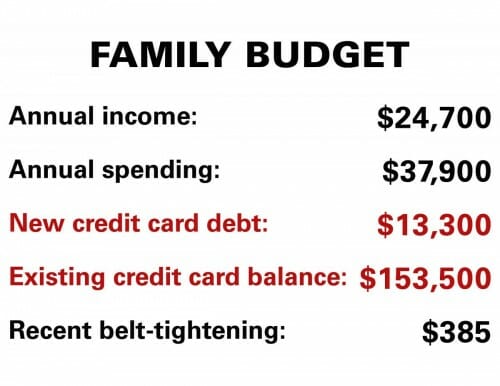
What is the difference between this hypothetical family budget and the US Government's budget?

One answer is:  eight zeros, because these are essentially the US budget numbers with eight zeros knocked off.

A second answer is:  Prisons and the printing press.  Because the biggest difference is that in the family budget context, everyone sees these numbers as simply insane, while on the national level at least half of folks think they are just fine.  The difference is that the US government can take money from other people at whim and by force, backed by the threat of incarceration.  And if that fails, it can print money  (actually using bits and bytes rather than the printing press, but that's just a detail) to pass the cost of its extravagance onto other people in the form of inflation.

Update:  The chart above probably over-estimates the belt-tightening.  If you really wanted a comparable situation to today's federal government, the example would say that the family spent $37,000 last year, proposed to spend 38, 285 next year, but agreed to only spend 37,900 for a $385 "cut", said cut being claimed despite the fact that actual spending will be $900 more than last year.

Will Reality Never Set In?

I had thought the situation in Greece would eventually hammer home for everyone the perils of reckless enlargement of the state and deficit spending.  But apparently, it is not to be.  This is how Kevin Drum describes the core problem in Greece:

the austerity madness prompted by the 2008 financial collapse

So the problem is not a bankrupt state, but the "austerity" which by the way has at best carved only a trivial amount out of spending.  And it was triggered not by a ballooning deficit as a percent of GDP and an inability to meet interest and principle payments, but by the US financial crisis.

This is willful blindness of absolutely astounding proportions.  Which means the same folks are likely just rehearsing to ride the US right into the same hole.

David Brooks Big Idea: Learning About Self-Reliant Productive Culture in the DMV

Apparently, the gap between the productive and hard-working and those with less productive habits is growing larger.  David Brooks suggests that the productive be forced into a couple of years of government servitude.  The idea, as I understand it, is for the productive to teach the less fortunate how to be more diligent and productive in the context of a shared experience in an unproductive government make-work program.  Sort of like teaching your teenager good work habits by putting him in DMV internship.

Seriously, I suppose I understand how class-mixing at the point of a gun might expose the wealthy to classes and cultures they have never encountered.  But how is working together in some service brigade with a post office-trained manager on a government paycheck going to teach the welfare-and-food-stamp set anything new about productive work and self-reliance?

In Praise of Utah

I sat through a series of sessions held with legislators today in Utah, and I must say I was pretty impressed with the fiscal sanity that has ruled this state through the last 10 years, and saw it successfully through the recent downturn.  When tax revenues were up last decade, they were doing crazy, nutty things like actually building up their rainy day fund.  And they are already talking this year about contributing to rather than withdrawing from this fund.  They still do silly politician-stuff (the law to name a state gun comes to mind) but overall a good session, facilitated by a terrific, scrappy group called the Utah Taxpayers Association.  These guys had the governor, the Speaker of the House, the President of the Senate, and numerous legislators participating.  I am not sure our larger and much better funded Goldwater Institute in AZ could do as well.

As an added bonus, I found myself sitting with a talking to Billy Casper, two-time winner of the US Open and Master Champion.  Turns out Mr. Casper is in roughly the same business I am, lending his name and time to a large firm that privately manages public golf courses.

Bonus Utah Observation:  You would expect a state with a large LDS influence to have oddities in its alcohol laws, but other than state-run liquor stores (which can be found in a number of other states, alas) I observed nothing too odd.  What I had not thought about was coffee.  There are very few Starbucks here, due in large part to LDS prohibitions on caffeine.  I know a lot of software firms moved here -- I wonder how they even function without large supplies of Mountain Dew Code Red?

Oh, and I know you don't think BBQ in Utah, but Pat's is freaking awesome.  My competitor who is based on the area was nice enough to buy me lunch.  And just in time, as about an hour later it was announced I had just won a large contract from him.

SOPA Prediction

Glen Reynolds reports that opposition to SOPA has caused Congress to pull back a bit.  My prediction:  They will kill this particular bill, and we will all pat ourselves on the back for it going away, but they it will get slipped into the back of some defense authorization bill while no one is looking and become law anyway.  This kind of pandering to Hollywood and increased government control over speech and the Internet is just too appealing for Congress to pass up forever.

The Only Winning Move is Not to Play

The 5-year old transcripts of Federal Reserve Board meetings .  Bernanke & Geithner basically yawn at concerns raised about housing prices and mortgages.

Let's be clear.  Unlike most of those who are likely commenting on this, I do NOT blame these folks for being wrong about the direction of the incredibly complex economy, and how one or two factors might influence the whole.   My sense has always been that it is impossible to be consistently right.

What I do criticize is the hubris of making major top-down Federal policy decisions that require that these folks be consistently right.  It's simply madness, and I am exhausted with the continuing reaction of both the media and most politicians that if we only had the right folks making these decisions, all would be well.  The reality is that these decisions are impossible to make, and will virtually always lead to gross mis-allocations of capital and resources in the economy that lead to recessions.

Update:  Here is one example

JUNE 28-29: In summarizing Fed officials’ views, Bernanke notes how it’s getting more and more difficult to make forecasts, describing the economic situation as “exceptionally complicated.” Since housing is particularly hard to project, Bernanke calls it “an important risk and one that should lead us to be cautious in our policy decisions.”

So, this seems like an admirable statement of humility.  Given these remarks, the group did nothing, right?  Of course not ... they raised interest rates a quarter of a point.


Name the Industry

Name the industry where 99.9% of the time, public policy has an explicit goal to substantially reduce worker productivity.   Answer.

Thinking About Medicare and Social Security

Neither Medicare nor Social Security should be government programs.  The government essentially takes on two roles in these two insurance programs:  1) To subsidize the premiums of low income Americans; and 2) To use its power of coercion to force everyone to participate.  I have no stomach for the latter role and the former could be much more cheaply achieved with some sort of voucher or credit program.

But these programs are not going away.  While both need reform, it may turn out to be politically impossible to even reform them.

But if we take off the table for a moment their existence and their basic structure, there is still an enormous problem we might fix:  pricing.  There is absolutely nothing more deadly to an economy than a false or corrupted pricing signal.  But that is clearly what we have with these two programs.  The Medicare "premium" (tax) taken out of every paycheck is clearly way too small to cover true actuarial costs of this program.  And while Social Security rates may have been set right if the premiums were really being kept in escrow for the future, the fact is that the so-called trust fund has been raided into oblivion by past government spending programs  -- Social Security taxes need to be reset to reflect that fact.

The result, of course, will be a substantial increase in both payroll taxes.  I am not a big fan of tax increases, and find taxes on labor to be among the worst.  But as long as we hold on to the collective notion that these are insurance programs and the taxes we pay are premiums, its time to stop fooling Americans into thinking that the premiums they are paying are truly sufficient to fund their benefits.  Maybe after we reprice the "premiums" to their true actuarial value, we can then have a real debate about the structure and existence of these programs.

100.012%

The Teacher Salary Myth -- Are Teacher Underpaid?

My new column in Forbes addresses a topic I wrote about over 6 years ago, and got a ton of feedback on.

The problem with salaries for government workers like teachers is that, in a monopoly (particularly one enforced by law), the usual checks and balances on compensation simply don’t exist.  Let’s say a private school gives its teachers a big raise, and has to raise its tuitions to pay for those higher salaries.  Parents are then left with a choice as to whether to accept the higher tuitions, or to look elsewhere.  If they accept the higher fees, then great — the teachers make more money which is justified by the fact that their customers percieve them to be offering higher value.  If they do not accept the higher tuition, the school withers and either changes its practices or goes out of business.

But what happens when the state overpays for teachers (or any government employee)?  Generally, the govenrment simply demands more taxes.  Sure, voters can push back, but seldom do they win in a game dominated by concentrated benefits but dispersed costs.  On a per capita basis, teachers always have more to fight for than taxpayers, and are so well-organized they often are one of the dominant powers in electing officials in states like California.  This leads to the financially unhealthy situation of a teachers’ union negotiating across the table from officials who owe their office to the teachers’ union.

We might expect this actually to lead to inflated rather than parsimonious wages.  To see if this is true, we have a couple of different sources of data within the Bureau of Labor Statistics (BLS) to help us.

Click through to see the numbers, which tell the story pretty clearly

Fannie and Freddie: Worse Than We Thought

From Edward Pinto at the American

Fannie and Freddie entered into agreements accepting responsibility for misleading conduct discovered by the SEC, including:

1.    As of June 30, 2008, Freddie had $244 billion in subprime loans, while investors were told it had only $6 billion in subprime exposure.

a.    Freddie knew it was inadequately compensated for the risks it was taking. For example, it was taking on “subprime-like loans to help achieve [its] HUD goals” that were similar to private fixed-rate subprime, but the latter typically received “returns five to six times as great,” says the complaint.

b.    Freddie had concerns about risk layering on loans with an LTV >90% and a FICO <680. (Yet, in Freddie’s disclosures it only noted risk layering concerns on loans with an LTV >90% and a FICO <620. This is a major difference since only 10 percent of its loans fell into the LTV >90% and a FICO <620 category, while nearly half fell into the LTV >90% and a FICO <680 one.)

2.    As of June 30, 2008, Fannie had $641 billion in Alt-A loans (23 percent of its single-family loan guaranty portfolio), while investors were told it had less than half that amount ($306 billion, or 11 percent of its single-family loan guaranty portfolio).

3.    The SEC complaint disclosed that Freddie had a coding system to track “subprime,” “other-wise subprime,” and “subprime-like” loans in its loan guaranty portfolio even as it denied having any significant subprime exposure.

These suits are important because they demonstrate that Fannie and Freddie “told the world their subprime exposure was substantially smaller than it really was … and mislead the market about the amount of risk on the companies’ books,” said Robert Khuzami, director of the SEC’s Enforcement Division.