Author Archive

California Housing Shortage

Perhaps the largest barrier to housing availability and affordability in places like California are permitting rules, land use restrictions, and construction codes that make it absurdly expensive, or even outright impossible, to construct new single or multi-family housing.  Part of this is a conspiracy of current homeowners to protect and increase the value of their property -- after all, new home construction inevitably reduces their property value (or future escalation) by adding competing inventory and/or by creating congestion and loss of property-value-enhancing open space.  Another part of this is "everything bagel liberalism" where every program has to achieve every Leftish goal -- eg we want new housing but it has to have solar and appliances with a minimum SEER and use recycled materials and have a certain number of units set aside for protected groups and create a conservation easement on part of the land, etc etc -- until even units that can get permitted are too expensive for all but the very wealthy.

But another barrier to housing availability and affordability that is less talked-about is the combination of rent control and tenant protections for existing housing stock.  Alex Tabarrok links to a great video from a Santa Monica homeowner on why he would never rent his home given the local regulations.  The key part is only a couple minutes and Tabarrok has done a fact check on most of the claims and found them to accurately represent local real estate law.  If you are not a video person (I am not, as information density is often too low, Tabarrok summarizes the key points).

The narrator's proposed rent is clearly at the high end of the market, but all his arguments apply at least as well to less expensive rentals.  As some of you know, in my former business life I operated campgrounds on public lands under a lease/concession arrangement with the public authority.  Several of the larger campgrounds had sections that were basically trailer parks occupied by long-term residents rather than overnight visitors  (It is a little known fact that many famous National Parks had these trailer villages -- we operated one of the last ones on NPS land at Lake Mohave).  Some of these trailers were basically weekend homes for people living somewhere else, but many provided affordable living spaces in poorer rural communities.

All these same tenant laws in the linked article applied in these trailer parks, and management was a nightmare in California.  Every tenant had a tenant-rights lawyer on speed dial and any effort to take the smallest action against them -- even enforcement of published rules -- often met with a legal rejoinder.  But here is the ironic part -- the situation has become so hard to manage that several California county governments, themselves author of these very rules, were requiring us to slowly close down the residential parts of their campgrounds because the rules made operation impossible.  And by slowly close down I mean sssslllllooooowwwllllyyyyyy -- closing down the trailer park is not considered proper cause for eviction, so the only way to clear it out is to, over a period of literally decades, wait for the tenants to die or move away.  Even on Federal land, where state and local rules technically don't have to apply and one has the full power of the Federal government, the NPS gave trailer park residents 10-years notice the residential leases were going to end and they still have been in court having to fight for the change every one of those years.

Many people in California let their house sit empty rather than face these hassles, and it is completely understandable.

Housing Affordability -- Where Everyone Is Wrong

There is one simple answer to why housing costs rise faster than inflation and incomes -- restricted supply mated with subsidized demand.   In many locales the supply of housing is restricted by the government (rent control, growth limits, expensive and time-consuming permitting, etc) and in every part of the country housing is subsidized by the government (mortgage loan guarantees, tax deductibility of mortgage interest, section 8 housing vouchers, etc).  The net result HAS to be rising rents and home prices.

I bring this up because we are in the insane situation that both the Left and Right are proposing to attack housing affordability by.... subsidizing demand and restricting supply.  Trump's idea is to extend government mortgage guarantees to 50-year mortgages.  All this is likely to do is increase the prices of houses to absorb the new lending limits.  We saw this in another sector -- college tuition -- where there is hugely subsidized demand and increased student loan limits led to almost one for one increases in tuition.

The Left -- from LA to NY -- is advocating for the same thing it always advocates for: rent control.  Rent control is a boon for current renters who have their rents locked in at unreasonably low rates but is a disaster for new entrants to the rental market because the construction of new rental properties drops significantly with rent control (actually the supply can go negative as current rentals are converted to owned units).  Rental rates are nominally kept in check but homelessness soars.  In addition, rent control has the under-appreciated harm of reducing labor mobility, as one cannot afford to move out of a rent-controlled unit to seek better employment.

The Middle Class is Shrinking -- And That's a Good Thing

An important goal of Marxist thought is the proletarianization of the middle class -- to convince great numbers of people in the office worker and shopkeeper classes that they are not beneficiaries of a rising tide of success but are no better than coal shovelers in a boiler room, victims of capitalist oppression that need to join the revolution. It is impossible to view the recent mayoral election in NYC as anything but a sign of their success.  People in NYC wail about how dehumanizing it is to sit in an office for 8 hours a day.

Socialists have been brilliantly successful at creating bad outcomes via institutions they control or policies they promote, and then blaming those bad outcomes on capitalism.  Probably the most brilliant success has been the shittification of higher education.  Socialist-controlled universities create sky-high expectations for their degrees, and reinforce these expectations with rampant grade inflation that makes every student feel like a success -- even when they do almost no work.  Academics on the Left route students into degrees and classes with absolutely no economic value (e.g. Paraguayan Feminist Poetry) and then dump them into the world -- after loading them down with $250,000 or more of debt -- with no possible path to reaching the promised expectations or even paying off the debt.  And when all this inevitably fails, the academic apparatchiks who live high on tuition money are quick to blame the failure on "capitalism."  And since these schools no longer teach students much about reasoned engagement with difficult and complex ideas -- and in fact encourage emotional reasoning, virtue-signaling, and just wailing in anger on TikTok over logical argument -- voters respond that "yeah, it must be capitalism's fault."

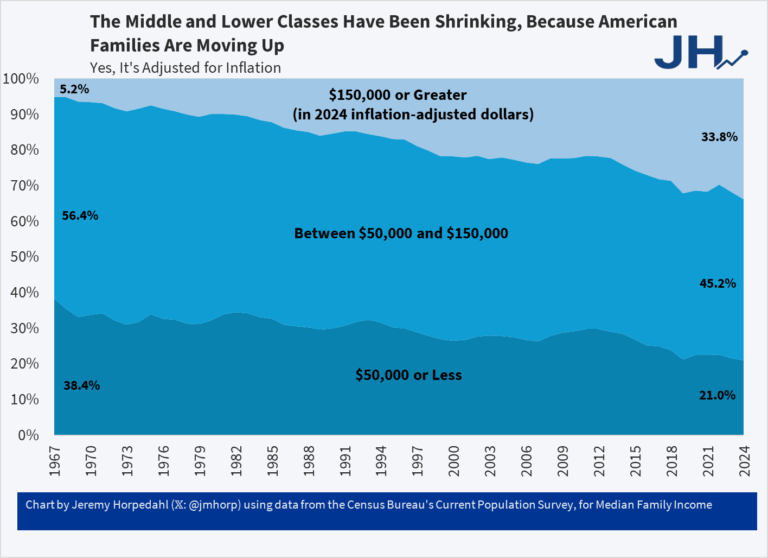
Anyway, in the context of all the turgid articles about the shrinking of the middle class and the failures of capitalism for the middle class, consider this which is all in 2024 $ (source):

Yes the middle class is shrinking -- because people in it are becoming richer.  They are not (on average, certainly there are individuals who go up and down) getting poorer because the poorest band on this chart is shrinking even faster than the middle class.  This is an enormous freaking victory for most everyone, but yet we are electing radical communists to tear down capitalism.  Incredible.

Postscript:  About a dozen years ago when my son was looking at colleges, like many parents I sat in a number of college admissions department presentations about the school.  All these presentations were remarkably similar -- my kids and I started calling them the "how we are unique in the exact same ways every other school is unique" speeches.

But another thing I noticed quickly was all the encouragement of students that if they go to their school, they will all go out and change the world the moment they graduate.  I guess it is good to be encouraging but this is a ridiculous expectation.  Except for perhaps a half dozen kids a year across the whole country, no one changes the world at 22 with an expensive degree and little life experience.  I have great respect for my son but at 22 he was happy to get a job with a beer company managing complex pricing lists and evaluating channel profitability.  It was work that was of value to the company but it was certainly not changing the world.  But he gained some great experience with data analysis, how to work in an organization, how to manage his time, etc. that were building blocks for better jobs or perhaps a future entrepreneurial excursion.  He learned what he was interested in doing, which focused his future learning plan.

For myself, I eventually helped shape a new industry but I didn't even get started on that path until my forties.  I had the opportunity to get fairly useful degrees at two renowned schools (Princeton engineer, Harvard MBA), but what I learned there was like 5%, at most, of the knowledge I used to eventually be successful.

Perhaps I am just old now and every older generation thinks this same thing, but haven't you noticed that many 22-year-olds that enter an organization today in an entry-level position seem to think they are in charge?  I have been asked to speak to young people about school and careers and one of the things I tell them is that at 22 they are not going to be advising presidents, they are going to be updating pricing lists.  And that is OK.  Deliver value to the company and learn from it what you can.  I think a lot of young people would be happier and in a better position to manage their learning and career if someone had just told them "your entry-level job is probably going to suck -- do a good job and work for something better."

Rare Earths Are Rare in the US Only Because We Choose To Export Environmental Challenges

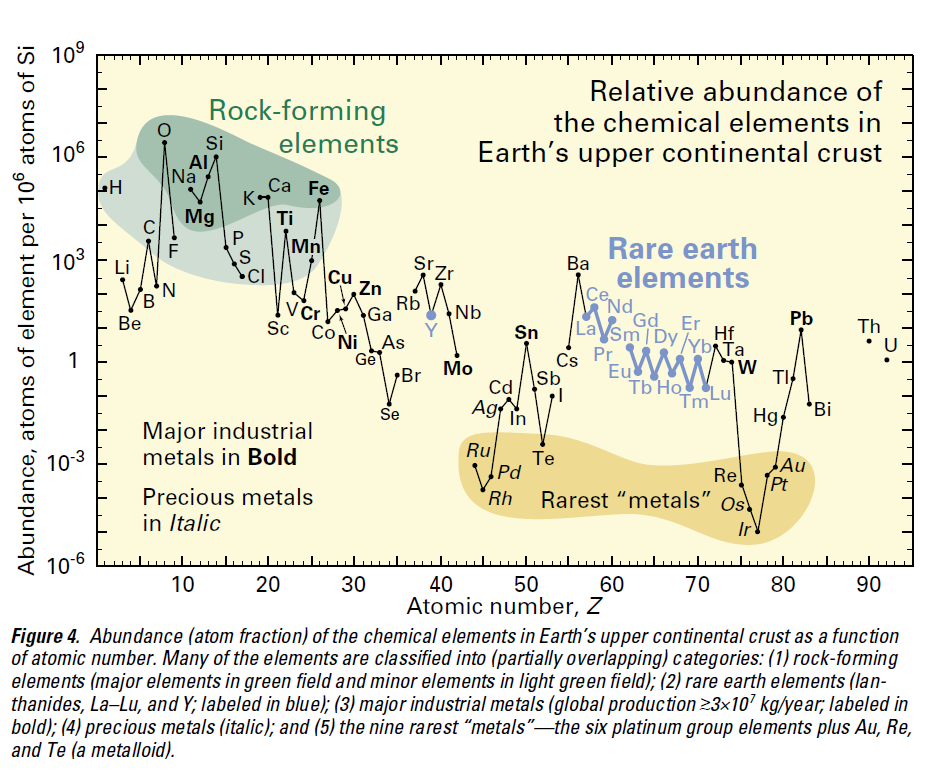
As has been said by many commentators, rare earths are not particularly rare.  Via source, here is an estimate of their abundance in the Earth's surface:

Note by the way the Y-axis is logarithmic so small changes in vertical position can mean a factor of 10 or more difference in concentration.  But the rare earths are not unreasonably far off fairly common industrial metals like lead, nickel, copper, and molybdenum and well more common than gold, silver, and mercury.

I am not a geologist but my gut feel is that there are plenty of rare earths in the US.  The problem is that the process of mining and concentrating the minerals is ecologically relatively expensive -- often large strip mines are involved with a lot of tailings and waste and sometimes dangerous chemicals used in the concentration process.  By the time some of these materials starting coming in demand, most companies had written off the US as a viable place to even look -- why bother exploring if you are never going to be permitted to produce anything.  Thus much of the world's production has been outsourced to countries like China and poor nations in Africa (or the worst of all worlds -- Chinese mines in Africa) that don't necessarily give a sh*t about the environment.

From an environmental standpoint, this is actually a terrible situation.  The US has more wealth and a fair amount of will to take environmentally sensible approaches, so exporting the nasty stuff is not a great long-term solution.  California by the way is the worst about this, intent on kicking out everything from coal-fired electricity generation to oil refining from the state but happy to buy the products of these industries from less environmentally-sensitive areas.

Breaking New Ground for This Blog: Kamala Harris Was Right (at Least Once)

I really thought I would never post this, as I think Kamala Harris is in the dictionary next to "extreme Peter Principle," but she was right when she said that her loss to Trump was the closest Presidential loss this century, at least when looking at the popular vote.  John Hinderaker tries to argue otherwise:

I suppose Harris was referring to the irrelevant “popular vote,” but her claim isn’t true there, either. By far the closest of the seven elections in terms of popular vote was 2000, where the margin was only around 500,000 votes. By that yardstick, the 2024 election was a distant second, with Trump’s margin over Harris being around 2,300,000 votes.

Sorry, but the year 2000 is not in this century.  It was the last year of the last century.  Yes, I know this has already been litigated around Y2K in the court of public opinion and my side mostly lost because we just pissed everyone off who wanted to celebrate a round number, but that does not mean I am wrong.

When you were born, you started out as age 0.  After one month you were age 1/12 a year.  At your first birthday you were one year old.  On your hundredth birthday you have lived exactly a century.  People analogize the calendar to this, but they are wrong.

The reason is that there was no year 0 on our calendar.  The first day after BC times (or BCE if you are up on modern academic jargon) was January 1 of the year 1.  That means that the post-BCE world was not one year old until January 1 in the year 2.   The era turned one but we call it year 2.   The first decade did not end until December 31 in the year 10, and January 1, 11 was the beginning of the next decade.  The first century did not end until December 31 in the year 100 and the second century began on January 1, 101.  In the same way, this century (and millennium) began January 1, 2001 (queue:  Also Sprach Zarathustra).

Now, I am pretty sure this was NOT Harris's reasoning but I really, really hope she adopts it because I would love to see her try to explain it in an interview.

Once You See Communism From the Inside, It's Often Too Late to Get Out

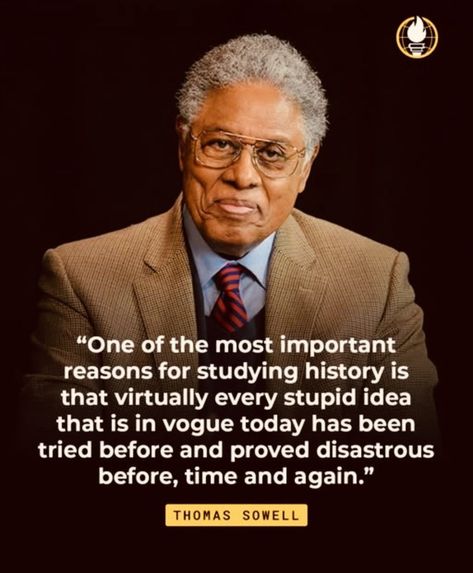
There is generally no good way to run large scale A/B political experiments.  Which is why, at least until the current college generation, we all thought the study of history was so important.  What happens when we slam on high new tariffs?  There is a lot of theory, but we don't have to entirely rely on theory because we have hundreds of years of adding and subtracting tariffs that we can study.  In the same way, we can discuss in theory why socialism does not work (incentives, knowledge limitations on central planning, the free rider problem, the incentives for fraud and abuses, etc) -- but we don't have to trust that.  We can look at history and see what happened when Communism or hard-core socialism was tried in the Soviet Union, Maoist China, Vietnam, Cambodia, Venezuela, Eastern Europe, Argentina, and most of the countries in Africa at one time or another.

Incredibly the historical experience is absolutely clear -- communism leads to poverty and loss of individual liberty.  Every time.  It's like 0 for 65.  It's failure is the greatest betting lock in the world.

But here we go again in NYC, the home of all the people who consider themselves more sophisticated than you and I, with yet another love affair with communism.  The blindness on display is really disheartening.  Polls show that a number of groups including Blacks and young people have a very positive view of socialism.  It would be fascinating to get a few in a room for a focus group to see how they even understand that term, or how much they know about socialism over history.   And don't even get me started on the "Queers for Gaza" crowd -- these are people with $60,000 a year educations who know absolutely nothing.

Today on social media I saw a lot of posts from NYC folks telling the world happily they were proudly voting for Mamdani.   So much so someone was circulating a picture of two women celebrating Khomeini's revolution in Iran who ended up respectively killed and exiled [I cannot vouch for the authenticity].  There certainly were many celebrating in those early days of the Iranian Revolution.  Unfortunately, as it turned out, as bad as the Shah may have been he was also the single greatest friend of women of the time in the Middle East (which had a lot to do with why the Islamic groups hated him) and his flawed but fairly western nation would be replaced by the gender apartheid they have today.  Today there are folks on the Left who seem ready to uncritically support any revolution as long as it gets rid of Trump, a flawed man but also one who is miles short of the Shah (or Hitler of course, or Syngman Rhee).

Somehow, people cannot put this all together from numerous historical examples, but have to find out for themselves by dragging all of us yet again into the abyss.  I am pretty sure if you went in a year later you would find a lot of people devastated by the transition and their participation in it, but by then of course it is too late -- these folks have no voices any more.

Eventually people and nations sometime emerge and re-enter the free world.  Eastern Europe did in the early 1990s.  The Vietnamese people eventually became exhausted with the worst excesses of communism and have opened up some, as have China and Russia.  But in many of these cases two generations had passed, or in the case of Russia even more.  Folks who emerged from Communism and finally had a voice were not hesitant to describe the horrors.

Back in the 1960s and 1970s, it became fashionable among American academics (who else?) to downplay the problems with communism in general and with Stalin and the Soviet Union in specific.  A consensus of sort had developed in these academic circles that the Soviet Union was not that bad.  This consensus was at least temporarily blown apart after 1989, when intellectuals of the newly freed Eastern European states joined the academic conversation and made it very clear just how bad things were on any number of dimensions.

But there is actually one historical exception where a nation whose people originally ranged from communism-curious to overtly communist actually experienced hard core totalitarian communism for 3-4 months, and then were freed -- South Korea in the second half of 1950.  What we call the Korean War started when Kim Il-Sung's totalitarian communist regime in North Korea invaded South Korea in mid-1950.  The initial assault was wildly successful, and eventually the US-backed (technically UN-backed but let's be real) South Korean army was clobbered, giving up the capital Seoul in days and retreated until they were holding just a tiny sliver of the country.  Late in the year a US amphibious invasion at Inchon caught the North Koreans totally by surprise and quickly liberated the South (though the war would go on for much longer due mostly to McArthur's antics.

Many South Koreans initially welcomed, even celebrated, the North Korean invasion.  The US in its 1945-1950 occupation had been even more ham-handed than usual in Korea, and blew up many formative democratic institutions out of fear that they were somehow communist puppets (and employed a lot of really bad Koreans who had collaborated with and tortured for the Japanese).  Koreans were tired of their leader Syngman Rhee, a strong man and US puppet in the mold of the Iranian Shah, who abused, imprisoned, and even killed opponents.  In a move that will surprise few today, the teachers and professors of Seoul almost 100% enthusiastically welcomed the North Koreans and pledged loyalty to their cause.

But as in Iran after the Shah, people looking for change were not very careful in evaluating exactly what that "change" was going to be.  Very quickly Kim Il-Sung and his forces initiated efforts that would be very familiar later in Maoist China or the Khmer Rouge's Cambodia -- struggle sessions and endless interrogations where enormous classes of people were outright executed for the crime of, say, having a father who was a landholder.  Soon, even passionate folks on the South Korean Left started to see that the communists were far worse than what they had before.

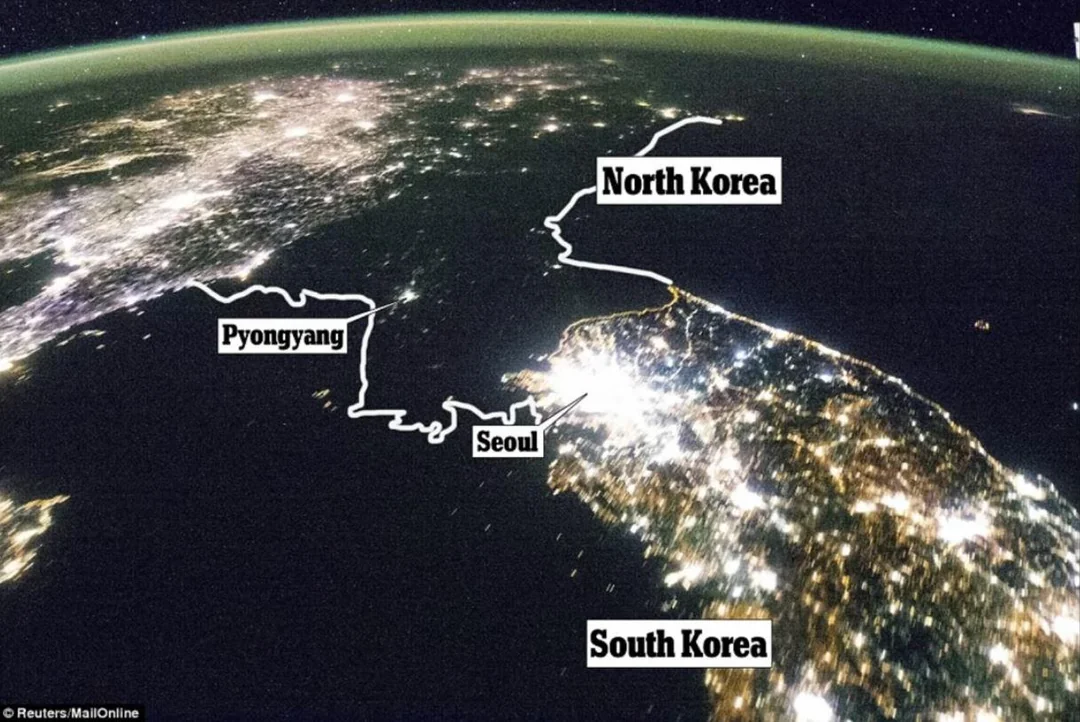
And then, unlike Russia, China, Cambodia, Vietnam, Eastern Europe, etc -- the people of South Korea were liberated after four or five months.  The survivors of this period thus had a unique perspective that few in the free world would possess -- they survived a brief sample of communism from the inside.  The result was complicated -- a country that became a bastion of anti-communism for decades but also was probably all too accepting of dictatorial leaders who would promise to be strongly anti-communist.  I will summarize it this way -- I am not an expert on Korea but both the books I have read on this period came to the same conclusion -- it is impossible to overstate the importance of this five month period on the subsequent history and outlook of the South Korean people.  Today, the two Koreas offer perhaps the best A/B test ever for communism vs (sort of) capitalism.

Fortunately, New Yorkers can still move to Florida. Though this is by no means guaranteed.  California on several occasions has proposed a steep exit tax on the assets of rich people trying to escape the state.

Postscript #1:  A small bit of historical irony:  Many progressives see abortion availability as the single most important litmus test of a free society.  Ask them why they don't vote for a more reasonable candidate of the other party, they are likely going to say "because Republicans all enslave women by banning abortion."   While I hold a pretty centrist position on abortion (legal and easy at conception+1 day, highly restricted at birth-1 day), this litmus test is pretty ironic as you could not get a car or a TV or enough food but the one thing you could get in the Soviet Union was an abortion -- in fact the Soviet Union may have had the highest abortion rate in history, driven by the miserable conditions their citizens lived in.

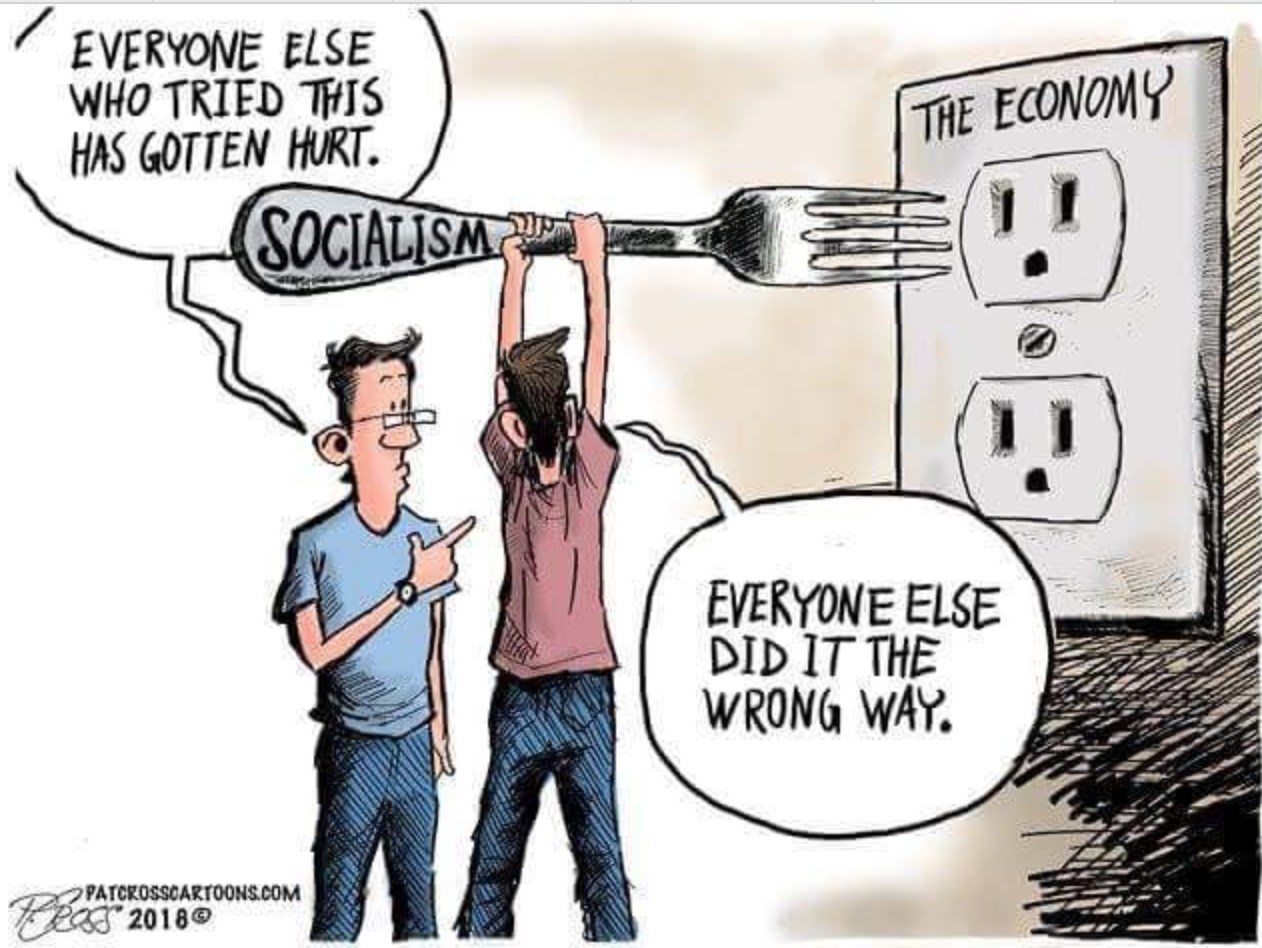
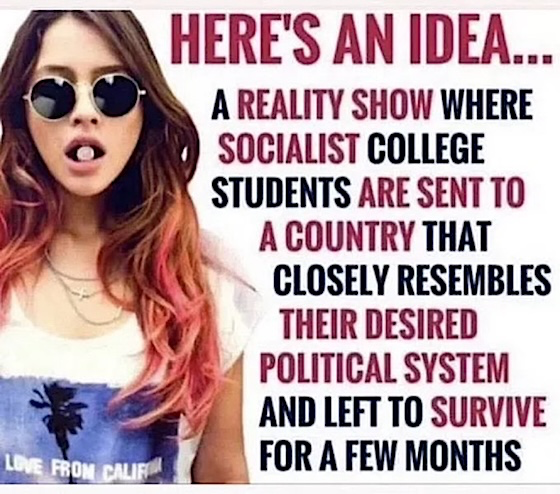
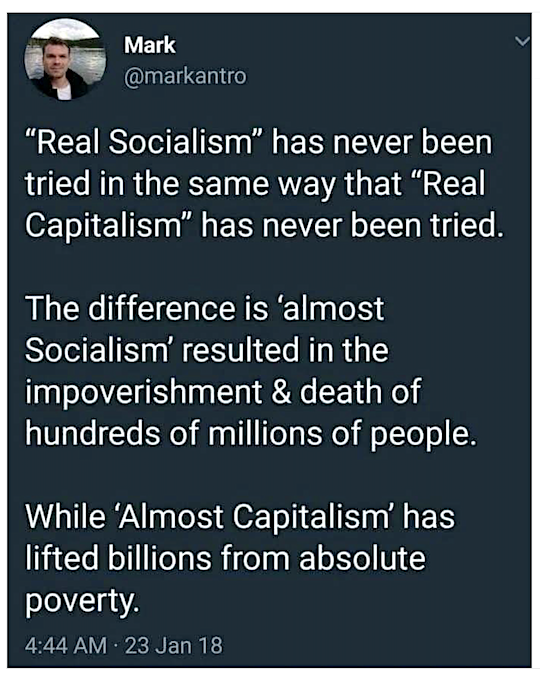
Postscript #2: I could paste in about 200 memes here but here are some of the most relevant:


Synthetic Modern Pop

El Gato Malo (@boriquagato) wrote a piece the other day about modern pop/rock music, saying in part:

there is nothing because music is product.

it became pure product, produced by product managers with hand picked performers chosen to dance and vamp and papered over with autotune and post-production. it’s music by committee and front folks by casting call.

damn near all of them are just stage performers. all the money is in concert tours now. it’s about flying over the crowd on your fairy chariot and packing in the kids.

it’s fricking disney.

and rock and roll that ain’t.

it’s also hideously uncreative, arch-conservative, play-it-safe marketing as lacking in gritty realism as it is in fun.

it starts to take on the repetitive aspects of a compulsory floor routine.

I don't really disagree, but normally I would have just passed over it as another generational rant -- yada yada autotune yada yada etc.  But three things grabbed my attention.

One is that his conclusion for what to do about it is subtle but kind of awesome.  It really struck me the more I thought about it.  I won't ruin it, you will have to hear it from him by clicking through.

The second reason this grabbed my attention is that I had just watched a bit of the Netflix series Pop Star Academy: KATSEYE about the creation of kpop group from scratch, in a totally synthetic manner that goes even beyond Gato's rant.  I could only watch so much, because there was not really anyone likeable on the show and it is produced in the totally irritating fake reality show format where you know everything is semi-scripted because who the f*ck acts normally with a camera following them around all day?  Every dance move down to that signature kpop girl band wink is scripted and rehearsed endlessly.  It is a synthetic reality show about the creation of a totally synthetic band.

The third reason that this piece got me thinking is that I had just watched Kpop Demon Hunters, a wildly successful animated movie improbably about a kpop girl group who are also demon hunters fighting off a soft of apocalypse.  And you know what?  Despite the animated movie being as synthetic as it possibly could be, it was far more enjoyable and the characters more endearing than anything in Pop Star Academy.  At least in Kpop Demon Hunters, they were using the synthetic nature of the animated medium to explore creative new ideas, vs. the case of KATSEYE working to deliver the absolutely expected.

I am not a music expert to go much deeper on this, but I will refer you to another aging white guy who is a music expert: Rick Beato, who has built a second or third career as an internet teacher and critic.  He has many videos on the topic of modern pop music but this one addresses roughly the same issues discussed above about the hugely synthetic nature of modern pop.

You can see from the comments that a lot of folks hate such observations.  Perhaps it is simply a different aesthetic generationally,  I have often made the observation that when I was in high school, a party that had a DJ rather than a live band was considered by all to suck.  When my kids were in high school, the preference reversed, with kids greatly favoring a DJ to a live band.   I have always chalked this up to a preference among modern kids for high production values -- they want to hear the carefully produced original, maybe even further produced by the DJ, rather than a cover by some local garage band.   I personally think that live music in a small venue has a raw energy that almost always trumps studio production, but it is not crazy for someone to disagree.

However, it does leave one wondering about creativity and radical new frontiers in music.  If all the competition is in production values, then you get higher and higher levels of production values aiming at the expected rather than anything really new.   You can't just have a great singer, you have to have a great singer who is attractive and can dance and is backed by a world class song-writing, production, and PR team.  Its hard to figure out after watching Pop Star Academy where this can go from here.

It is in this context that I think Gato's suggestion for improvement is surprisingly apt.

Postscript:  I will somewhat counter my own thesis -- the 1960s also saw a real competition on the production end of music -- Phil Specter waking everyone up to the production end, followed by Brian Wilson who tried to outdo Specter with Pet Sounds, and then the Beatles crafted the masterpiece Sergeant Pepper in specific response to Pet Sounds.   Later in the decade producers like Alan Parsons on Dark Side of the Moon further pushed the envelope.  But perhaps it is just my age bias, but this all felt like it was pushing boundaries into new things, rather than more reliably delivering the expected.

I Challenge Anyone To Come Up With the Statutory Support for This

Via the WSJ (free link here)

The U.S. will impose an additional 10% tariff on Canada, President Trump said on Saturday, a punitive measure in response to an ad campaign that he said misrepresented comments by former President Ronald Reagan.

“Because of their serious misrepresentation of the facts, and hostile act, I am increasing the Tariff on Canada by 10% over and above what they are paying now,” Trump posted on his Truth Social platform on Saturday.

The ad campaign, released by the Canadian province of Ontario, uses audio from a 1987 radio address delivered by Reagan, in which he explains that despite putting tariffs on Japanese semiconductors that year, he was committed to free-trade policies. While tariffs can look patriotic, Reagan said, “over the long run such trade barriers hurt every American worker and consumer,” lead to “fierce trade wars” and result in lost jobs.

Obviously based on the law where Congress delegates the power to set tariffs to the President in any case where another country is perceived as dissing us.  To the extent there is a funny part in all this, it is this portion:

Trump had threatened to cut off trade talks with Canada on Thursday over the ad, claiming it misrepresents Reagan’s comments, and was being used to influence the U.S. Supreme Court ahead of a hearing on the administration’s tariffs next month.

The Supreme Court is set to evaluate several complaints that have argued (with much justification, imo) that President Trump's tariffs go well beyond any statutory authority he might have (the President very clearly has zero Constitutional authority to set tariffs as the power to do so is 100% explicitly vested in Congress, so any power he does have must be an explicit delegation of power from Congress).  If the WSJ is correct in the above statement, it is hilarious to think that Trump believes his case on tariffs at the Supreme Court will be aided by an even more outrageous arbitrary exercise of such unilateral taxing power.

Credit Where It is Due to Trump -- Hostages Returned, Peace In Gaza Seems More Possible

The hostages appear to have been released from Gaza, which is a huge step forward after 2 years of violence.  Not only is this a joy for their families, but it also likely makes ongoing violence in Gaza much harder for both parties.  I had initially thought Trump was making progress by being the "crazy man" in the negotiation who might do anything (sort of like trying to play poker with a 16-year-old).   And a lot of the Left is likely to continue to treat it that way.  But from everything I have read in the last few days, Trump's team did a lot of hard diplomacy all over the Arab world, carefully corralling every potential Hamas supporter and getting them all to tell Hamas it was time to settle (here and here for example).

This should not be surprising -- Trump showed a similar facility with negotiating in the Arab world in his first term with the Abraham Accords and really did not get enough credit for it.

So tomorrow Trump will likely tick me off again but for today he should be thanked for his work on this deal.

Postscript: and no, great work negotiating this peace deal does not convince me he has some super-brain master plan behind the tariffs

The Path to a Banana Republic

I don't know who this is, but this X post by Cynical Publius has been quoted by a number of Conservative sites.  This represents a VERY common attitude among Conservatives and deserves to be quoted in depth.  In regards to the prosecution of Letitia James he writes:

You see, for many years now Democrats have believed that they could do basically whatever they wanted to Republicans, whilst Republicans were still bound by the Old Rules of comity and respect.

Those were the New Rules. (Hat tip, Kurt Schlichter.). They thought we would never adopt the New Rules.

We did.

The James indictment says to Democrats: “You no longer can assume that we will let you do whatever you want to us. We will do to you what you did to us. And we will be merciless until you prove you will never do it again.”

The particular beauty of the James indictment is that she brought the most scurrilous and ridiculous of charges against Trump, while the record shows that James clearly committed the basic federal crimes she has been charged with.

Here’s the other thing. Federal laws are so complex and capacious that pretty much every one of us breaks a federal law every few months without knowing that we did. There has long been a tacit understanding in this regard that politicians would not take advantage of this with regard to mere “footfaults” on nonsense laws. But Democrats decide to abandon that too. New Rules. That we now follow. Suck on it, Democrats. You get what you paid for.

(But to repeat; James charged Trump with nonsense; Trump charged James with a verifiable crime.)

That last part is likely true, though it is not clear that very many people are prosecuted for it.  It is certainly NOT true for the Comey prosecution, which as currently charged is a total crock [update:  this is not to say that Comey is guilty of abuse of power charges -- it is simply to say that the current charges are cr*p].

Whatever the case, Mr. Publius appears to be working from the assumption that getting tough on the Left with actions like this is the only way to de-escalate all the lawfare -- I suppose the logic being that bullies back down when challenged and forced to face accountability.  This is clearer in some of the comments to the post:

This is the FAFO (f*ck around, find out) stance being taken by many Republicans, reflecting the decision-making rules of playground and bar fights. But for all that we overuse fight analogies when referring to politics, the correct behaviors in a Constitutional Republic which emphasizes the rule of law are different than in a bar fight.  Precedents really do matter, and even more so precedents that are repeated and reinforced by the political opposition get set in stone.  Mr. Publius is correct in saying that any person is likely guilty of something given the web of detailed, illogical, and self-contradictory Federal and state laws and regulations.  That is all the more reason to avoid degenerating into tit for tat lawfare as this legal environment makes lawfare all too easy -- against most anyone.  Our out of control regulatory state creates an environment like a dry overgrown southern California ravine on a hot day during a drought.  The Biden administration started some fires but ultimately they were contained -- Republicans should remember that despite everything (maybe because of all the lawfare end the sympathy and anger it engendered) their guy was elected.  The response now should be to exercise great care until the fire danger is reduced.  Instead, Republicans want to whip out the flamethrower.

I get called a simp or a cuck or worse for wishing turn back the clock on lawfare.  But historically we revere people who did just that.  The best examples of this occurring are from the early history of the US, such as in the election of 1800 when Jefferson just edged out Aaron Burr in a contentious election.  I am sure the Federalists were mighty pissed at Mr. Jefferson -- hell, their anger still resonates today in an extremely popular modern Broadway musical -- but they honorably turned over power to their hated rival. Looking farther back into history, Mr. Publius has adopted a nom de plume presumably from on interest in Roman civilization, or at least in how our founders admired the Roman republic.  But he needs to go back and re-study how the Roman republic died, a victim of 150 years of steadily escalating precedents that eroded the norms of the old republic.  I suggested in the online comments he might want to change his online name to "Graccus" to acknowledge the similar path he is pointing towards in this country.

Or perhaps even better historical examples are the famous blood feuds like between the Hatfields and the McCoys.  At what point in this feud do you think that retaliation and escalation by one party "taught the other a lesson" or caused the other to back down and de-escalate?   Never, which is why such feuds ended only when everyone was dead.

But an even better way to refute this Mr. Publius's position is to, for a moment, accept the author's premises about the Democrats.   There is an old political joke that goes like this:

This is sort of funny, but there is actually a better meta joke associated with this I will come back to in the postscript.  But I think we can confidently ascribe this position to the author Publius and to many other Republicans.  They are convinced that the Democrats are evil and that Republicans are well-intended but stupid because they always let Democrats get away with everything and are always to civilized to really fight back.  Just read the comment thread above.

But let's assume this is true for the moment.  If the Democrats are really always historically evil and law-breaking, what the hell makes one think that being more bare-knuckled is going to change them?  If they are evil, are you really expecting them to say "hey, you got me, we went too far, let's dial it back" or are they just going to respond by going to 11 the next time?  The author's strategy fails based on his own assumptions.  Unless his strategy is to turn the US into a banana republic.

Postscript:  The meta joke embedded in the joke quoted above is that believing this statement is one of the few bipartisan political beliefs that exist.  Republicans and Democrats BOTH will agree to this statement with a smile ... with the one small difference that Democrats will assume it was written by one of their own and thus that Republicans are the evil party and Democrats are the stupid party that play the game too genteelly.  And both the Republican and the Democrat presented with this passage would be shocked and outraged that their opposition would believe its the other way around.

Which brings us back to the case in question.  Let's generalize the last line in the Publius post above as "the charges against our guy were a politically-motivated crock, while our charges against their guy are just and fair."  Both R's and D's believe this absolutely from their perspective right now.  Their lawfare is righteous, the other guy's is evil.  So how is escalation of the lawfare going to achieve anything except a degeneration into banana republic politics?

Postscript #2:  I am not a Republican so I am probably not an appropriate source of advice to them.  But the Republican opportunity in my mind is to drive a wedge between mainstream traditional Democrats and the increasingly crazy, sometimes violent far-Left progressives.  This is something Trump seems pretty good at, when he can avoid chasing some new squirrel.  But I can tell you that one thing mainstream traditional Diane-Rehm-listening Democrats are NOT going to like is anything that feels like undermining the rule of law.  Republican bare-knuckle lawfare is not going to sit well, and is going to drive them into the arms of the crazies, no matter whether the Republicans think Democrats "started it" or not.  Republicans are actually winning the PR battle on the shutdown (first time in my whole life that has happened) and Trump has been pretty good at painting Democrats into defending extreme positions on 80-20 issues.  Taking immigration as an example -- where I am a strong supporter of increasing immigration limits so this is frustrating to me -- Progressives have made the whole immigration cause about protecting a few named, obvious felons from deportation.  And thus losing the PR battle.

Against this backdrop of Progressive own-goals, arresting violent rioters and serial felons will likely get grudging approval even among some Democrats; putting Comey in jail for contempt of Congress is only going to feel good to Republicans and can do nothing but hurt their popularity in the middle.

Prediction -- What Will End The Shutdown

Currently, most Americans seem to be largely carrying on as normal during the Federal government shutdown.  I know I am able to pretty much completely ignore it.  Looking at front pages of sites like the WSJ and CNN, stories on the shutdown are still there but are certainly not the lead, center pieces.  This is the government employee's nightmare, where they effectively go on strike and no one notices.

So where will enough public pain come from to force concessions on one or the other party in Congress? The game used to be closing high visibility public parks to tick the citizens off, but a lot of parks are still open today under private management (I know, my company operates hundreds of them).  Want to see the volcano erupting in Hawaii?  The Volcano House we operate in the National Park is still open.

My new hypothesis came from my wife, who was worrying the other day whether we would be able to make some critical flights in early November.  I initially scoffed, but thinking about it more, I think the TSA and more particularly the FAA may be the key to this shutdown.  Already this year, antiquated systems from years of government mal-investment combined with understaffing and poor training have led to manpower shortages and sick-outs in certain locations, particularly Newark.  Now, the FAA is apparently working unpaid. If they were walking out when they were being paid, things can only get worse with them not being paid.  I can easily imagine rising flight cancellations that will get great play in the media -- TV news is very experienced at showing masses of people camped out at the airport due to cancelled flights and interviewing people with heartbreaking stories about weddings and such missed.  Three or four days of that kind of mess leading the news each night and the R's and D's will quickly find some sort of accommodation.

This is all ironic, and somewhat infuriating to this libertarian, as the FAA and TSA should have been privatized years ago, and such privatization works just fine in Canada.  This issue of privatizing the FAA actually came up last April during the bad Newark slowdowns but the Trump Administration passed on the opportunity.  If the FAA is the entity that generates the most pain in the shutdown, these discussions might get restarted.

On Having Zero Agency

I am not sure I remember too much from my high school philosophy class, other than the lesson that I probably would not be actively pursuing a career in philosophy.  But I remember one discussion about displaying one's rebellious nature by doing the exact opposite of whatever an unfavored person said.  The teacher made the point that if you always did the exact opposite of what person X says, then you are just as much ruled by X as any of X's most cultish followers.  In such a case you have completely abdicated your agency to X.

I took the lesson from that, which I still try to follow to this day, that you have to process people's actions and ideas one by one.  Certainly this is not to say that there is no room for trust and reputation.  If  I have found myself agreeing with someone historically and they have been proved right on certain topics time and again, I am going to give their next statement a lot of credence -- but I am still going to mentally challenge it to some extent.  And for individuals, this sort of reputational trust can vary by topic.  If my wife gives me a read on a person, I am going to assume she is correct; if she opines on navigation issues when we are walking around an unfamiliar city, I am going to treat that with a lot more skepticism.

Most will have guessed where I am going with this -- the opposition to Trump has reached this point of zero agency.   Smart people I know will mock everything Trump says, even if it is something they would normally agree with or at least entertain.  People who are extraordinarily skeptical of all medication suddenly think that concerns about Tylenol during pregnancy are totally absurd.  The whole Tylenol story is actually pretty interesting -- a Harvard dean's imprimatur seems to tick the credentialism box that was so prominent in COVID, but a look at the quality of the research and the money involved tends to make one very skeptical.  And of course a lot of what RFK says makes me skeptical.  The whole story is a really interesting, including appeals-to-authority issues we had during COVID, only with the parties reversed.  But no one really looks because if Trump said it, it must be mocked.

This tendency of the Left to throw away all agency when it comes to evaluating policy during this Administration is a target of great mockery on the Right.  Memes such as the one below are everywhere.

I have been thinking about all this because I have been trying to figure out why I have zero energy to blog of late.  Every time I sit down to the keyboard, I am exhausted in advance.  And I think the reason is (for me) the immense effort to parse current politics on a case-by-case basis and communicate it in a way that people will read rather than going ballistic because I didn't pass a belief conformity test in the first paragraph.  I once told someone that I feel like the last person in America who can opine on Trump's actions case-by-base, though of course that is an exaggeration (and something of an affectation I admit).

You can read through these pages and see that I have written that Trump's trade policy is dead wrong, his attempted expansions of Presidential power are dangerous as hell, his need for petty revenge and his love of trolling the media online are beneath the dignity of a President.  But write one thing like, "The Russian collusion charges ... turned out to be complete inventions of the opposition party" and all the agency-less litmus testers ask me why I am always defending the guy.  Crazy.  By the way, I will say it and be done with it -- the Russian collusion story was BS, it smelled like BS from the beginning, and was actually a scandal in that it was clearly engineered by the opposition party.  And it likely had more to do with Trump's 2024 election than any other single factor [other than Biden's dementia] because the unfairness of it energized his supporters.  Russia collusion was Wile E Coyote Acme rocket of political issues, reliably blowing up in Democrat's faces.

For me, the worst manifestation of all this is seeing people actively cheering setbacks in Trump-led peace processes (eg Ukraine, Gaza).  Are you guys f*cking crazy?  I understand being skeptical of Trump's international actions, though to be honest I have not seen him do much internationally that is better or worse than other recent Presidents.  For example, yes he lawlessly blew up that suspected drug ship (to absolutely no benefit that I can see) but Obama and Bush droned Middle Easterners over and over.  Be that as it may, if someone can stop the killing on reasonable terms in either of these areas, they have my total support.

Tammany on the Potomac

Apparently the Trump Administration is going full Tammany Hall:

The administration also seems keen to rescind federal funds awarded under President Joe Biden, like the billions of dollars in clean energy grants to states in the Inflation Reduction Act (IRA) and the Infrastructure Investment and Jobs Act (IIJA).

This would be a good idea, if it were applied smartly. Instead, the administration seems to prefer dinging members of the opposing political tribe rather than effecting any sort of across-the-board changes.

"Nearly $8 billion in Green New Scam funding to fuel the Left's climate agenda is being cancelled," OMB Director Russell Vought wrote Wednesday in a post on X. While there is not yet an official announcement, he added that there would be "more info to come" from the Department of Energy. Vought said the newly rescinded funds would come from terminating projects in California, Colorado, Connecticut, Delaware, Hawaii, Illinois, Maryland, Massachusetts, Minnesota, New Hampshire, New Jersey, New Mexico, New York, Oregon, Vermont, and Washington.

If it feels like those 16 states have something in common, it's true: All voted for then-Vice President Kamala Harris, Trump's opponent, in the 2024 election. In fact, other than Maine, Rhode Island, and Virginia, Vought's list includes every single state that didn't go for Trump.

Trump would be justified in wanting to rescind all such grants. Instead, he's apparently content to let states who voted for him keep the cash. This naked partisanship is unseemly, but unfortunately par for the course under Trump. It's also particularly ironic, since red states were much bigger beneficiaries of Biden-era grants.

The article goes on to explain that most of the large payments went to Red states under the law, so rescinding them only from blue states takes some explicit effort. Look, the IRA was clearly a big enormous pork barrel waste of money from the very beginning.  I would not be surprised if every dollar in it were political payoffs.  But this use of the money as a partisan bludgeon as if Trump were a modern-day Tom Shanahan is outrageous.

Postscript:  In fact, Republicans missed a perfectly justified and in my mind acceptable way to bludgeon blue states:  Elimination of the State and Local Tax (SALT) deduction on federal income taxes.  There is zero justification for having citizens of low-tax states forced to subsidize more profligate states via their Federal taxes.  And no economic reason why the Federal tax code should give special breaks for state income taxes but not for state and local sales taxes, gas taxes, property taxes, etc.  In Trump's first term Congress capped the SALT deduction, impacting mostly high tax blue states, and I had zero problem with that.  But Republicans in the most recent BBB walked away from that by substantially raising this cap.

It is Alive!

My first playfield replacement and complete overhaul of a pinball machine is complete (video below is lame because it is hard to play both flippers and hold a camera at the same time).  The flippers need their position adjusted a bit and I want to work on the sensitivity of the pop bumpers, but otherwise I think everything is working as it should.  All the LED lighting looks great -- that is why the one bumper up front looks brighter as I am testing a new LED in that as well.  All the mechanical parts including the flippers and drop targets we completely taken apart and cleaned, and a lot of the switches were replaced.  My next hurdle is I want to repin the circuit board connectors in the back box and work on the exterior paint job.


Understanding the Government Shutdown

Trump's Quest for Revenge is Leading Republicans Over the Edge

Last week I spent a bit of time looking at the indictment of James Comey (not hard, it's barely a page long).  At first I thought I must be missing some pages.  The indictment is for lying when Comey told Congress that he had not "authorized" an employee to leak the Hillary Clinton investigation to the WSJ.  But everyone agrees, apparently even the prosecutors, that Comey did not even know about the leak or intention to leak before it happened.  It looked to me like the whole case was built on the argument that Comey "authorized" the leak by not opposing it after he found out about it.  Could that really be the case? Seriously, that is flimsier than even some of the NY prosecutions of Trump.  As it turns out, to their credit, a number of prominent Conservatives are rallying to mock the indictment.

I get it that Trump and his supporters have some reasons to be frustrated by events over the past 8 years or so.  The Russian collusion charges that turned out to be complete inventions of the opposition party.  The prosecutions by the NY AG for (at best) borderline victimless crimes for which no one in history had ever been previously prosecuted.  The over-prosecution of rank-and-file January 6 protestor-rioters. The "election denier" prosecutions in multiple states that look a lot like attacks on political speech (particularly when similar statements made by Democrats in 2016 went un-prosecuted).

But there are two possible responses to this frustration:

  1. Hold public hearings to publicize the evidence of any wrongdoing.  Fire people in law enforcement who violated the rules or abused their position.  Work hard to change the rules, controls, and accountability mechanisms so it is much harder for such abuses to be duplicated in the future.  And trust the process to work (after all, Trump overcame most all the various legal proceedings against him).
  2. Go the opposition one better by doing all the same stuff, just harder

Approach number 1 holds out some hope of de-escalating abusive practices in the system and prevent further degeneration into banana-republic style political retribution after every election.  Approach number 2 is fraught with risks of spiraling out of control and creating precedents that Democrats will gleefully use when inevitably back in power.

Of course, Trump and his FAFO (f*ck around, find out) crowd have chosen #2.  They strongly believe that the far Left is violent and lawless and that Republicans have historically been far too genteel in how they play politics and that only by extreme responses can they get, uh... I don't know what.   Do they expect the Left to back down?  If Trump's supporters are characterizing the Left accurately, by Trump's own assumptions it is unlikely the Left will back down.  Republicans are risking a further devolution of the American polity -- is it for revenge only?  For the feelz of it?  What is the endgame they envision, or do they even have goal here other than watching the other side burn?

Postscript:  All of the above is also true in the realm of speech and cancel culture.  Conservatives have clearly born the brunt of cancel culture and speech limitations over the last 10-20 years (just as the Left bore the brunt in the 1950s and 1960s).  The Kimmel firing was a great example of Trump's ability to score an own-goal when he has the lead.  The initial reaction to Kimmel's reality-defying statement created sympathy for the Conservative cause, at least until Trump's FCC head lawlessly issued threats to ABC's broadcast licenses, threats echoed later by Trump himself.  Suddenly a story that that should have been about Kimmel's absurd statement and falling ratings became about the Trump Administration's lawlessness.  Had this Administration just STFU, the Leftish late night hosts would have continued their downward spiral and been an object lesson to programmers that maybe they do not want to program for just 30% of their audience.

I am sure Republicans want to send a message about cancel culture but Executive threats are just not going to work.  Of the hundreds of media articles on the whole Kimmel mess, I did not see a single one (excepting the explicitly Conservative press) that mentions Roseanne Barr or Gina Carano.  Using retribution to highlight past injustices is not going to work when the media will not acknowledge or mention past injustices -- in the media Republican retribution is portrayed instead as a first strike.

I will leave the last words on this to Ted Cruz, someone I think is very smart but with whom I often disagree.  This is from the WSJ

Mr. Carr “says, ‘We can do this the easy way or we can do this the hard way,’” Mr. Cruz told his listeners, quoting Mr. Carr. “That’s right out of ‘Goodfellas.’ That’s right out of a mafioso coming into a bar going, ‘Nice bar you have here. It’d be a shame if something happened to it.’”

The Senator added that he’s no fan of Mr. Kimmel, but he warned conservatives that government power abused in this way won’t hurt only the left. “What [Mr. Carr] said there is dangerous as hell,” Mr. Cruz continued. “It might feel good right now to threaten Jimmy Kimmel, but when it is used to silence every conservative in America, we will regret it.”

Exactly right.  I am not sure that Trump's supporters understand the damage they may be doing to our political environment (and if you are reading this and saying "the other side started it", then you don't get it either), but they are also damaging their future selves.  Remember Coyote's Law.

Postscript #2:  I will offer Republicans a piece of advice I often give to other business people: If you are in a dispute with another person or entity, be satisfied if you get what you want.  Do not hold out for sorrow or contrition because you are never, ever going to get them to feel guilt or honestly admit error.

Postscript #3: In thinking about it, the Comey prosecution is similar to some of the Trump prosecutions in that in both cases, I think the prosecutions are effectively acting as proxies for suspected real crimes committed that no one could prove.  Almost everyone discuss this with (depending on if they are Red or Blue team) will say about one or the other that a certain prosecution may be weak but the person is clearly dirty.  Sorry, but this is not how the US legal system is supposed to work.  I grew up in the South when it was still possible that a cop who killed/arrested/prosecuted/jailed a black man for something they did not do could argue that "yeah, but I am sure he was guilty of something."

Postscript #4:  I will remind everyone that both parties equally think the other party is lawless and their own party is too genteel. I have many times seen writers of the Left and Right lament this about their sides in writing on the same day.   I guarantee anyone from the Left reading what I wrote above about Republicans thinking themselves too genteel are saying "Republicans are the violent, lawless ones, not us!"

OK, I Finally Took It Apart

I have put off dealing with the large drop target assembly, but finally it was time.  It is now cleaned up and in pieces. I hope it goes back together.


Good God -- Trump Seems to Be Trying to Settle All Family Business Today

For a few halcyon days after the tragic murder of Charlie Kirk, Trump and Republicans were actually getting a bit of sympathy and probably had an opening to reframe some of the political discourse.  But in true Trumpian style, the Administration has gone to 11 in their over-reaction to some Lefties being, let's say, less than sad at Kirk's death.  I get it that Trump and his followers are (probably rightly) grouchy about some of the BS prosecutions of Trump and his supporters over the last 8 years, not to mention the mostly fabricated Russia collusion impeachment.  But Trump seems to have found his moment for vengeance and anyone who calls for him to turn the other cheek on some of this stuff gets labelled a cuck.

Here is what I have catalogued so far:

I will say again what I have said before -- Republicans are acting like they will be in power forever -- but they won't.  Remember Coyote's Law.  At some point their political opposition will be in power and all these precedents will come back to bite them.  Particularly in this case because almost every one of these is an authoritarian power that Republicans fought under Democratic administrations.  As mentioned before, Republican's defended cake bakers (and pharmacists and many others) against laws mandating they provide services against their conscience.  Republicans have fought against laws based on making hate speech illegal, laws that are dragging the Brits down the toilet as we speak.  It was Republicans who fought to get rid of equal time in broadcasting and stopped the FTC from bludgeoning Conservative talk radio hosts.  Republicans have fought for years against having their mainstream groups labelled as white supremacist terrorists by the SPLC (I believe the SPLC so designated Charlie Kirk's organization).   Not sure if they have had same issues with Visas, but they sure as hell will as Democrats will find a way to evict Conservative immigrants in retribution (looking at you Elon).

Trump Begins De-Regulation At Exactly the Wrong Spot

Via Zero Hedge:

President Donald Trump suggested Monday on Truth Social that companies should stop filing quarterly earnings reports and instead move to a semiannual schedule. Trump’s call to replace quarterly earnings reports with semiannual filings revives a debate that also surfaced during his first term.

I presume Trump wants to be a deregulator and free marketeer here, but he is going at it exactly wrong.  The best free market approach to capital markets is to make sure investors have information to make quality decisions about their investments.   Then, you can clear out all of the other underbrush of regulation and quasi-parental oversight of markets and leave decisions to individual responsibility.  The first, lightest touch regulation is for corporate financial transparency.  Its not the first regulation you would eliminate, its the last one you hang on to.

In addition, six month waits for corporate numbers is way too long.  It can take as much as 60 days after the reporting period is over for results to be released, so that problems that start occurring in January would not come out of the closet until August or even September.  Enron finally blew up when the chickens finally came home to roost in its third quarter 10-Q.  Were they allowed to put this off for 3 more months the damage could only have been worse.

Of course, if the government changes this rule it does not mean that exchanges such as the NYSE and NASDAQ will change their rule to match.  It is still very possible that absent a federal 10-Q requirement the exchanges would still require such reporting.

Follow-ups to My Post on Charlie Kirk

Some follow-up thoughts on this post about the murder of Charlie Kirk.

  • Pam Bondi has proven herself unqualified to be America's lead attorney.  First she talks about a hate speech exception to the First Amendments which does not exist.  Then she threatens to prosecute service providers who refuse service to someone she disagrees with.  I understand that there is an enormous gulf between laymen's understanding of the First Amendment and settled law (and her boss is one of the worst offenders, at least in his understanding of libel law), but there is no excuse for the US Attorney General to be reinforcing public myths and misunderstandings on this critical topic.  It is particularly incredible to see a Republican AG take these positions, as Republicans have for years fought Progressive attempts to make hate speech illegal and have defended any number of service providers (eg bakers who won't make a cake for gay weddings) who have refused service over matters of conscience.  I will give her credit though for rallying even Progressive MSNBC to attack the notion of a hate speech exemption.
  • I have been critical of Republicans for going overboard on cancellation demands (eg so-and-so should be fired) over reactions to the Charlie Kirk shooting.  But I have to give them kudos for almost as one coming down on their own party and hammering Pam Bondi's ignorance.  I had thought that Republicans seemed ready to eat whatever dog food the Trump Administration served, but it is good to know there is something they will send back to the kitchen.
  • For all the over-the-top invective I have seen this week, most people (whether they admit it or not) assume there will be no rioting this weekend as Republicans tend not to riot, loot stores, and burn buildings when they are upset.  To some extent I think January 6 was notable because it was such an exception to this.  I live in Phoenix where the Charlie Kirk funeral is this weekend and -- unlike in some past national explosions on the Left -- no one is boarding up the stores in Scottsdale this week (after the 2020 riots caused millions of dollars of damage in Scottsdale Fashion Square, we had prophylactic boarding up several other times after, including around the 2020 election when store owners feared a violent response on the Left if Trump were to win).  It should go without saying, but violence is not speech and is not First Amendment protected.  Maybe we can get Pam Bondi to say that violence is protected by the First Ammendment to get Progressives to finally accept that it is not.
  • With all the words spilled this week over this terrible event, I still think what the Utah governor said was the best:  "We need to learn to disagree better."  Which actually is an initiative he has been pursuing for several years.  I have not looked at his program, but I always have some skepticism on such efforts.  Like tax harmonization which always turns out to have all taxes set to match the highest one, calls for cooperation across political divides often boil down to giving more power to the state on the issues the Right wants and giving more power to the state on issues the Left wants.
  • The last time there was some violence against Conservative speakers on campus, many universities responded by instituting onerous security rules and fees on Conservative groups trying to bring their speakers to campus.  I hope universities don't go down this road, but it would be typical of them.  Universities have trained their students and faculty for decades that Conservatives are beyond the pale and thus should not be engaged as doing so would legitimize them.  It's like a 19th century English Duke being encouraged to sit down and share a meal with his long-time butler -- it just is not going to happen.
  • My wife really likes the Left-Right-Center podcast / radio show.  I confess I have not listened to it as I don't listen to radio and have mostly eschewed non-history podcasts.  I feel like the information rate in audio is too low for my patience level (I listen to audio books at least at 1.5x and don't even get me started on how much I hate voicemail).  But I do think given how on-point the show's concept is to what I think we need more of, I will have to give a listen.  I have always loved Bryan Caplan's Ideological Turning Test concept and try to force myself through the exercise when I get overly angry about some issue.

The Folks Cheering Charlie Kirk's Murder Are Awful, But...

I would describe myself as an intellectual and a pacifist.  Not a pacifist in the sense that I would accept any outrage to avoid violence, but a pacifist in the sense that violence is way down my list of solution approaches to any problem.  My first, second, and third options are always to try to have a reasoned discussion.

So I was particularly horrified by the news of the murder of Charlie Kirk.  While I frequently disagreed with his positions, and do not share his religious zeal, he was doing exactly what I would have liked to do and what I wish everyone else did – engage in reasoned debate with those who disagree.  He was a model for non-violent engagement with one’s opponents and to be killed while engaging in such debate is a terrible irony.

I can’t find the post but a while back I wrote about what I would do as a college president to combat cancel culture and the toxic intellectual environment on many campuses.  My lead recommendation was to ban the heckler's veto but require that every campus speaker make themselves available for at least an hour of open discussion and debate after any presentation.

As to the motives of the killer in this case, I am not sure I really give a sh*t.  It is an exceedingly popular but absurd game to try to count coup on one’s political opponents based on the actions of a single fringe participant in some of their beliefs.  In my lifetime pretty much every major public assassination of this type has been by someone who turned out to be mentally unbalanced or a total loony.  I am not sure how much value there is to parsing the motivations of the mentally ill – I remember all the attempts to pin the actions of the nut who shot Gabby Giffords on Sarah Palin, which turned out to be 100% a political points-scoring exercise and 0% useful in understanding anything useful.

What has worried me more than the confused politics of mentally ill kills has been watching the public reaction to Luigi Mangioni's cold-blooded murder of Brian Thompson.  Instead of treating him like Charles Manson, we instead see young progressive women treating him like a Teen Beat cover boy.  People have contributed over $1 million to his defense fund and the “Luigi Mangione Access to Healthcare Act" is a real ballot initiative gathering signatures in California at this moment – presumably the Initiative’s promoters felt Mangione’s name had positive marketing power in the California progressive community.

Equally, anyone should be horrified by folks going online to celebrate Charlie Kirk's murder.  Many examples of such social media celebrations have been dredged up and archived by Conservative commentators.  They are all awful, though it is hard to determine just how representative they are of general feelings on the Left.

There is a funny dynamic in which both team Red and team Blue believe their side to be well-behaved while the other side is steeped in violent rhetoric.  There is a reason for this, as alluded to earlier:  Opinion-makers from both teams love to explore the other team's fringe supporters to look for craziness, and inevitably find it.  They amplify those crazy opposing fringe views to their own supporters, building the impression among their supporters that the other side is violent and dangerous.  But since most folks don't read across the red-blue line, they don't see such accusations of their own side.  In fact they are confused if you mention to them that their side has violent rhetoric, because they honestly may never have seen it in the mainstream sources they read.

I once had a feature on this blog where I would take advantage of being one of the few to read both sides of the aisle to post interesting juxtapositions from Left and Right.  One of the most common I saw (and still see) is the statement "our side loses too much because we are too genteel, we need to start being more bare-knuckled like the other guys."  I once saw this on the same day at Conservative Powerline and from Progressive Kevin Drum.

A typical formulation of this you will see a lot is "we need to start playing by their rules"  or "they made the new rules so they are going to have to live with them now" or even to an extent the "FAFO" mantra used by Trump supporters nowadays. At this moment the Left is blaming Charlie Kirk's death on the Right's violent rhetoric and is saying the Right needs to have a timeout while the Right responds to his death by urging its supporters that it is perhaps time to stop being so genteel and passive.  Both see Charlie Kirk's death through a lens where their side is well-behaved and the other is toxic and violent.

All of this is a (typically) long-winded intro to what I actually was going to write about, which is the people getting fired for posts on social media celebrating Charlie Kirk's death.  In particular, a lot of these seem to be public school teachers and public university professors.  And I can understand the concern one would have if their kid had a teacher who in their private hours was celebrating violence on social media.

But here is the "but" from the post title.  If this stuff is actually happening in the classroom, then these terminations may stick.  But otherwise, if they were terminated for private speech in their free time, it is very likely administrative or legal appeals will result in these teachers being back at work very soon.  Public school teachers are public employees, no different than clerks in the DMV.  And it is highly unlikely that they can be terminated over their private protected speech.  Celebrating a death is protected speech.  Even saying "such and such public figure should die next" is protected under many circumstances.  Of course this is going to drive the Right crazy when "liberal judges" send these folks back to work, but it is going to happen.**

As ugly as this stuff is, it is also depressing to see the Right engage in cancel culture after so many years of being its victim.  Yes, I know folks like Amy Wax and other educators with libertarian or conservative opinions have had to fight suspensions and terminations over their speech.  And some of these statements are really awful, but a gay parent or student might argue that anti-gay statements by a teacher are equally awful.  The acceptability of speech is often in the eye of the beholder and thus the very reason why its legality needs to be absolute.

I am not a Conservative but I am an opponent of much of the Progressive / woke / Marxist dogma and thus make common cause with Conservatives on some issues.  But I find myself drifting apart from Conservatives of late on tactics, even on issues where we agree.  It is impossible to call a trend after just a few days, but a LOT of Conservatives are responding to the Charlie Kirk murder by saying its time to stop being so genteel and to play by what they perceive as the Left's rules,  Folks like myself who respond to escalation by trying to de-escalate are treated as losers, rubes, patsies, etc.

Well, I hate the totalitarian Marxist woke culture on the Progressive Left.  And I am coming to hate the Conservative FAFO response (where they have adopted a term from drunken bar fights).  I am determined to find a reasoned way out.  Which, by the way, is exactly what I think Charlie Kirk was trying to do.  Perhaps instead of FAFO, Conservatives organized an initiative where many of them went to campus and propped up Charlie's "prove me wrong" sign.

I would find it horrible if we were to further escalate the most toxic elements of the current political culture as the primary memorial to a man who tried as hard as anyone to de-escalate them.  De-escalating does not mean one is giving up advocating for you are passionate about, it means trying to get there in a reasoned, collegial manner.

In this way, I'm with Charlie Kirk.


** Postscript:  Don't like having crazy progressive idiots for teachers of your children?  Instead of working to get them fired -- there are too many! -- advocate for school choice.  I don't think there is a bigger problem in this country than the state of the K-12 education system.  It is the meta-problem from which many, many others flow.  We have got to stop giving the same people who run the DMV and the Post Office a virtual monopoly on our kid's education.  I have had the resources to send my kids to private school -- and I have seen how much better it can be.  My kids in K-5, for example, went to a private school with very high standards that taught math and reading at a high level and cost less per year than the Phoenix public school system pays per pupil of the same age.

Earlier this year I wrote in the context of a post about racism:

I do think the system goes wrong for blacks but it is not in any arena controlled by the proud boys.  And I  have a strong opinion on where that system failure lies:  K through 12 education, and probably even more specifically K-5 education.  We have affirmative action in the workplace for blacks.  Why?  Because there do not seem to be enough prepared candidates so we give less-prepared candidates a leg up.  Before that we have affirmative action in college for blacks.  Why?  Because there do not seem to be enough prepared candidates so we give less-prepared candidates a leg up.  We keep changing the SAT test.  Why?  Because blacks historically struggle to score as well as whites and other races on the test.  We keep changing (lowering) high school graduation requirements.  Why?  Because to many black children fail to graduate with the higher standards.

All of this stuff are after-the-fact attempted work-arounds that avoid fixing the real problem:  K-12 education is totally failing black kids.  Any root cause failure analysis would get to this conclusion.  You want to say that systemic racism exists?  Well here is the place where the system is totally failing one race.  If I were more of an expert, I could probably tell you which grade it is where things go off the rails but my guess is that it is an early grade where reading and basic math are not getting taught.  And it has little to do with money -- school districts like East St Louis have some of the highest per-student spending numbers in the country but their kids graduate completely unprepared for modern life.

If I were the biggest racist in history and wanted to come up with a Dr Evil scheme to destroy blacks in America, I could not come up with a better plan than the K-12 education system, particularly in many large cities.

Dear Republicans...

Dear Republicans,

I am sorry I have not had time to write sooner, and I only have time for a short missive.  But I want you to know that you are NOT going to like living with the precedents that Trump is setting right now for Presidential power.

I know you have convinced yourselves that you will be in power forever.  Believe me, I know -- the Democrats thought the same thing after 2020 and even more so after the 2022 election.  And I know some of the court challenges at the margin have been nutty -- the injunction against Congress legislatively cutting funding to certain organizations was completely baseless, for example.  These crazy court challenges at the bleeding edge have allowed you to convince yourselves -- wrongly -- that all of Trump's actions are perfectly normal and legal and all the legal actions are unjustified.   You will not like future administrations firing Republican commissioners from typically bipartisan organizations.  You will not like Presidents setting tariff rates (or by extension other tax rates) at will.  You will not like a Federal Reserve that is a lapdog to the current administration (perhaps the only thing that can make the Fed worse than it is already).  You will not like Presidential powers that trump state and local governments on even the smallest details.

You all need to relearn Coyote's Law -- never give the government (or particularly the President) powers you do not want your worst enemy to wield, because sure as hell your worst enemy will be in charge some day.  Yes, I know previous administrations pushed the envelope on Presidential power.  Unfortunately, when faced with an opposition party in the prior administration that took a bad precedent from level 4 to an 8, both parties will likely NOT respond by de-escalating but by pushing the 8 up to 11.

Pinball Progress

I am still thinking about how I can systematically engage with this administration without it becoming a full-time job.

So in the mean time, pinball restoration!  I moved everything to the new playfield and completed about 200+ solder joints.  I fired the thing up, with some trepidation, inserting one fuse, testing, and then another fuse, with the General Illumination fuse first and the solenoid fuse last.  After finding just a few shorts, and a few swapped wires, and one drop target where I reversed input and output on the sensors, everything is mostly working.  After these photos were taken I get the pop bumpers installed and a few other details like the coil that puts the ball in play.  Next up siderails and all the playfield details.  I still have not cleaned up the huge 7 drop target monstrosity that is really the core of the game.


For and Against Dropping the Atomic Bombs on Japan

I missed the anniversary of the atomic bombing of Japan and VJ day as I was busy with travel. 

Including long-term effects, perhaps 200,000 people were killed by the atomic bombs dropped on Hiroshima and Nagasaki.  This has led to 80 years of questions about whether the bombs should have been dropped.

Best Argument Against:

Nuclear weapons are a horrible weapon that had little or no military value were they were dropped in Japan.   Their sole role was mass killing civilians, something we and most nations considered a war crime until about 1940.  While the US was not the one to initially break taboos against terror bombing of civilians, we joined in enthusiastically given that strategic bombing fit so well with our technological and economic advantages, not to mention a national sense that bombing was a "cheaper" way to win a war, at least in terms of US casualties (a bias that has never really gone away).  For everything written below, I still think this argument dominates, though for reasons stated below it was an impossible position at the time.

Worst Argument For:

"The atomic bombs in Japan killed fewer people than the fire bombing of Tokyo."  This is a lame moral position, boiling down to "well, we did worse stuff."

Worst Argument Against:

A very common argument against the bombing was that the blockade of Japan was working and would have eventually strangled Japan and brought it to its knees.  This is likely true.  But starvation and related diseases were already killing as many as 50,000 or more a month, and likely higher.  Even with the sudden end of the war and the reopening of trade and some American food aid, there were hundreds of thousands of Japanese civilian deaths due to hunger and related diseases.  Opponents of the bomb frequently argue that the blockade alternative was more humane somehow, but 6 more months of Japanese holding out would likely have led to the deaths - slow, horrible deaths - of far more Japanese than died in Hiroshima and Nagasaki.

Contemporaneous Arguments For:

  • I don't think modern audiences understand how tired Americans were of the war.  There was simply zero support for a decision to spare Japanese civilians in exchange for a longer war and more American death.
  • There is an ongoing argument about how many American lives were saved by not having to follow through on the American invasions of Japan.  Personally I think we would have seen at least 10x the casualties suffered on tiny Okinawa, which would mean 500,000 American casualties invading Japan.  Opponents of dropping the bomb have argued, implausily I think, that the total would have been 100,000 or less than the death toll in Hiroshima and Nagasaki.  But this is only American casualties.  In Okinawa the Japanese army and civilians died at a rate 5x that of American killed and wounded.  So even at the lower estimate of 100,000 US military dead the total human death toll would have been over a half million.
  • The leadership of Japan was simply not going to budge and make peace on any sort of terms close to unconditional surrender.  Some said they were interested in a negotiated peace, but on terms the US would never have accepted (eg Japan holds on to Manchuria).  After the first bomb no one in the Japanese leadership changed their position.  After the second bomb almost no one changed their position -- only a shift by the Emperor and a few of those around him turned the tide, and even so there were last minute efforts to thwart peace among hardliners (up to and including attempts to steal the recordings of the Emperor's broadcast and take the Emperor into custody "for his own protection").
  • There was likely some racism involved in the decision, but had the bomb been available we would probably have bombed the mayonnaise-white Germans given the opportunity.  Weird racist theories would pop up about the Japanese from time to time  -- eg that the shape of their eyes would affect their vision and thus make them poor pilots, a theory that got disproved pretty dramatically early in the war.  But Americans  never could understand the cultural norms that caused Japanese soldiers to fight to the last man, even when the fighting was pointless.  It looked to Americans like a death cult, and completely alien, and eliminated any small empathy that might have existed after 4 long years of war.

Ex Post Argument Against:

  • The Russians were coming.  The Russians invaded Manchuria after the first bomb was dropped.  The bomb may have slightly accelerated their time table but not by much.  In line with their previous commitments at international conferences (and their own desire to grab some territory), they were preparing to invade in August of 1945 (3 months after the defeat of Germany) and had spent much of the summer moving troops across Siberia.  By this time the US, which had begged Russia to join the war with Japan in 1944, was starting to regret this decision.  The Russians were quickly and immensely successful, rolling through the Japanese forces like they did not exist.  They had plans to invade the island of Hokkaido within weeks.  This terrified Japanese hardliners -- who were strongly anti-communist -- as well as the US which was already coming to suspect that the Russians were not going to leave the Eastern European countries they had overrun.  We could have left the hard fighting for Japan to the Soviets, but we did not want the Soviets permanently ensconced in the Japanese Islands.  You can see this fear in some of the American actions -- in particular how fast the second bomb was dropped.  When the Russians invaded the whole time-table accelerated with the US racing to end the war with Japan before the Soviet steamroller took too much territory.  While leaving it to the Russians would have saved American lives and prevented the atomic bombings, it almost certainly would not have reduced total Japanese deaths and long-term suffering.

Ex Post Argument For:

  • Nobody has dropped one since.  Counter-factuals are always hard, but personally I am convinced that if the bombs had not been dropped on Japan, some idiot would have dropped them somewhere else -- perhaps on a large Chinese city in the Korean War.  This is an awful argument to make, I admit, but perhaps only a demonstration of their horror changed attitudes about atomic bombs.

Tariff Updates: Random Number Generation, Cronyism, and Premature Optimism

A few updates on Trump's continuing tariff saga:

RNG

I challenge any human being to decipher any sort of rational (even an irrational but consistent) algorithm behind Trump's tariffs.  Every day it is another random number superseding the prior random number.  It is economic policy by whim.

Cronyism

Today Trump slapped a 100% tariff (see RNG point above) on semiconductor imports.  It is difficult to comprehend a worse policy for the American economy had the President been dedicated to crashing things here on purpose.  Consistently he slaps huge tariffs on commodity manufacturing inputs (chips, steel, aluminum) that are critical for the high-value-added products that are made in this country.

But leave that aside, what particularly caught my eye is this:

Trump announced he would impose a 100% tariff on chip and semiconductor imports, but would exempt companies moving production back to the United States

Apple seems headed for the first exemption, which they also received in Trump's first term and his tariffs then.  Why Apple?  One could argue that Apple has some of the highest gross margins of any manufacturer in the US and is perhaps most able to bear the tariffs.  But this has nothing to do with fairness, it has to do with cronyism and political pull.  Say what you will about all of the companies one thinks of as political manipulators, but no one holds a candle to Apple.  They have used their size and clout and money to manipulate dozens of state and local governments all the way up to things like international tax law.  In this case, the are apparently going to get an exemption because of the "promise" to invest lots of money in US manufacturing:

With CEO Tim Cook standing next to him in the Oval Office as the president announced a fresh (and very laughable) $100 billion investment plan by Apple which it would then add to the $500 billion already pledged over the next 4 years (which is ridiculous since Apple spent $43 billion in capex in the past 4 years and generated less than $100 billion in net income in its best year)...

Apple had previously pledged to spend $500 billion in the US over the next four years, an acceleration over its prior investments and previously announced plans, adding about $39 billion in spending and an additional 1,000 jobs annually. The announcement will bring Apple’s cumulative commitment to $600 billion, and appears to be an ad hoc bundling of pretty much everything on the income and cash flow statements, including CoGS, SG&A, CapEx, buybacks and so on. The previously-planned $500 billion was said to include work on a new server manufacturing facility in Houston, a supplier academy in Michigan and additional spending with its existing suppliers in the country.

Why does this sound familiar?  Oh yes, because Foxconn made the exact same promise 8 years ago to build a huge plant in Wisconsin in exchange for dodging the Trump tariff hammer:

Initially, Foxconn was to build a Generation 10.5 facility that would manufacture large LCD screens. The project was to be an investment of up to $10 billion that would deliver up to 13,000 jobs.

The state legislature passed a $2.85 billion tax incentive package that required Foxconn to meet certain hiring and capital investment benchmarks during the next 10 years in order to receive the tax credits.

The company also received a $150 million break in sales taxes, bringing the total state package to $3 billion.

The village of Mount Pleasant and Racine County were put in charge of paying property owners for the land and upgrading the infrastructure.

How did this work out?  Basically they bailed and terminated most of the project once Trump was out of office.  Instead of 13,000 employees there were barely 1000 and less than a billion dollar was spent, a good portion of that government rather than private money.  Elon Musk did pretty much the same thing in New York, abandoning most all of his job creation and investment promises.

The same thing has happened all the time -- corporation grabs current government regulatory benefits in exchange for promises of investment sometime in the future.

Absolutely no one should take this sort of thing credulously.  This is a crony giveaway to a power corporation, and nothing else.  It is Apple getting preferred treatment in exchange for giving Trump a nice press release item.  I would be shocked if the final number is even 5% of these promises.

Premature Optimism

I see this sort of thing coming from a lot of (formerly) economics-rational Conservatives but it is really disappointing to see it from the WSJ news (not opinion) section:

Six months into the experiment, with more tariff announcements likely in the coming days, the economy hasn’t crashed. Inflation has ticked up but not soared. Consumers aren’t finding empty shelves.
This is a common theme on the Right -- that tariff opponents are wrong because the economic numbers look fine.  But there are a number of reasons why the economy isn't apparently suffering too badly due to tariffs, beginning with the on-again off-again nature of Trump's rulemaking which has likely caused companies to defer major pricing changes until there is more certainty.  In addition, Trump is making odd exceptions to the tariffs specifically to hold down their effect on goods being bought and imported right now for the Christmas shopping season.  And 2Q likely saw a rush of economic activity as individuals and companies made purchases ahead of tariff deadlines.
But the main reason for no change is one of time.  I am going to use an example I have used before in the context of Fed policy-making, but makes sense here as well:
Let's say you are standing in New Orleans and are on the phone to some guy controlling a dam on the Mississippi River up in Minnesota.  The water level is low in New Orleans and you want them to open up.  So the guy in MN says OK and opens up the flow.  The next day in New Orleans the river is still low.  You tell everyone the guy in MN is having no effect.  You call him to open up more.  This proceeds to repeat itself for several days, seeing the water still low and calling to open the MN dam more.  Finally about a week later New Orleans is flooded.
This example makes it sound ridiculous but this is what happens all the time with macroeconomic policy, particularly when effects are flowing through a complex and lengthy international supply chain.  Just to pick the first example that came to mind, think of one of the greatest economic shocks of my lifetime, the October 1973 oil embargo.  US unemployment did not rise above average 1971-1972 levels until a full year later, and the unemployment rate and recession did not peak until two years after the embargo.  Even large shocks take time to percolate through the economy.
Many of Trump's tariffs have not been in effect for more than a few weeks and most only for a few days.  Generally positive 2Q corporate earnings reflect the time period from April-June -- the steel in a GM car or the camera module in an iPhone were likely priced and purchased for 2Q sales back before Trump was even inaugurated.  So there is no possible way tariffs could be showing up in any meaningful way yet in prices or corporate profitability, and it is ludicrous to count coup over current economic data and pretend that these data mean that tariffs are not going to have negative effects.  It is embarrassing to watch Conservatives who should know better lured into supporting economic insanity that even 6 months ago they would never have tolerated.
However, there is one economic stat that might already be affected by all the tariff chaos and this is private corporate investment.  Every indication is that private commercial investment has fallen because no company is going to make major investments in this crazy changing regulatory environment (an effect known to economists as regime uncertainty).  However, as mentioned above, promises of investment may be skyrocketing but actual real money spending for new plant is not.