Posts tagged ‘Privacy’

Amazon's Creepy Normalizing of the Surveillance State

During the Superbowl there was an amazing Rorschach test masquerading as a feel-good Ring doorbell commercial.  For those who missed it, find it here.  Essentially it touts a new service where neighborhood networks of Ring doorbell cameras can combine with Amazon AI to find a lost dog based on an uploaded photo.  Half the population reacted, "isn't that wonderful" and the other half of viewers, of whom I am one, reacted "that's freaking scary."  The network of camera feeds in the commercial looks very similar to Batman's (admitted even by him) dystopian cell phone surveillance array in the Dark Knight.
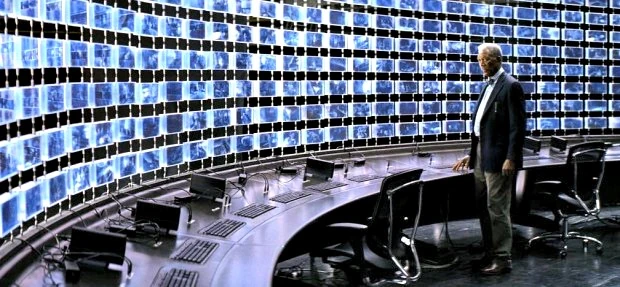
This is exactly the sort of wedge strategy that our public and private control freaks use to normalize dystopian systems and technologies.  You don't sell surveillance out of the gate with a system that tracks down a person in the neighborhood behind on taxes or child support.  No, you sell it as a system to find that adorable lost dog (notice not even generic pets or certainly not cats because dogs are the new children for this generation**).  They can fight all the backlash by saying, "Oh come on, who can be against finding lost dogs?"  Then, months or years later, the terms and conditions have morphed and broader search capabilities are enabled without the user even knowing (I own a Ring doorbell and I guarantee I never knew this feature was turned on by default or even existed). When it really gets scary, they are not even going to tell you about it.

I do not believe this is just a marketing mistake -- Ring appears to have adopted neighborhood surveillance as their core business model.  I have had a Ring doorbell for years and in its basic form of sending doorbell chimes to your phone and allowing you to see who is at the door and even talk to them remotely, it is a nice product.   I have always liked it.  But over the years I have noticed Amazon/Ring slowly morphing the app from just a doorbell / security tool into a neighborhood surveillance network.  If you have the app, you can see that most of the functionality is now about messaging and notifications shared around the neighborhood, generally dominated by local Karen's putting up panicky posts about someone they saw they thought was creepy.  In the main menu of the app, the very first option after a link to the dashboard is called "neighbors."  This is the neighborhood watch group on steroids.

As a libertarian, what do I have against private neighborhood voluntary surveillance networks?  Nothing, but this is neither voluntary nor private.  As for voluntary, this functionality was added on an opt-out basis with zero notification, at least until this commercial came out.  But what about privacy?

Well, I spent more time in the app yesterday than I probably had cumulatively over 5+ years.  The first thing I did was turn off this advertised feature.  From the main menu (the three bars in the upper left) you need to choose control center (not settings) and then scroll way down to "search party" (that is what they call it, to evoke maybe a bunch of guys with St Bernards looking for a lost hiker) and turn it off.

So while I was in the app I started trying to see if there was a way to block Amazon from sharing all this with the government or other third parties.  There is an intriguing option in the control center labelled public safety which says it controls public safety agency notification settings -- maybe one can block sharing with the government?  Nope.  Turns out this option is just to change what police and other agencies can post to your neighborhood feed.

In the same control center there is a privacy tab.  I clicked on that, but there are no settings.  Only a promise to be really really nice  and make our privacy their highest priority but no specific commitments on data privacy.  Also note the use of "neighbors" over and over.  It is as if they are trying to establish some right to collective privacy (whatever the f*ck that is) instead of individual privacy.
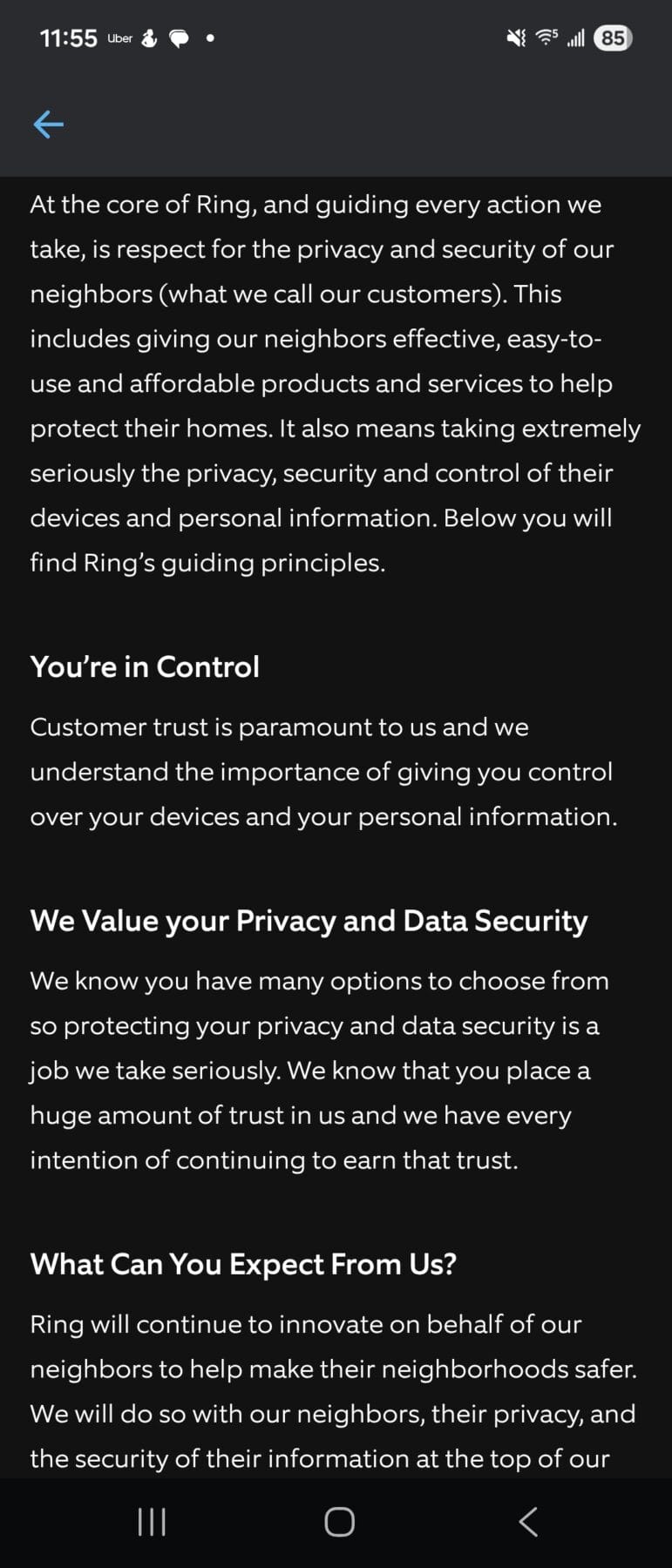
But it does say that I am in complete control so maybe there is a data sharing option somewhere else.  Further down we finally get to the "data management" option.  It says "Request a copy of your data, manage third-part access, or delete your data."  There we go!  Here is the screen you get:
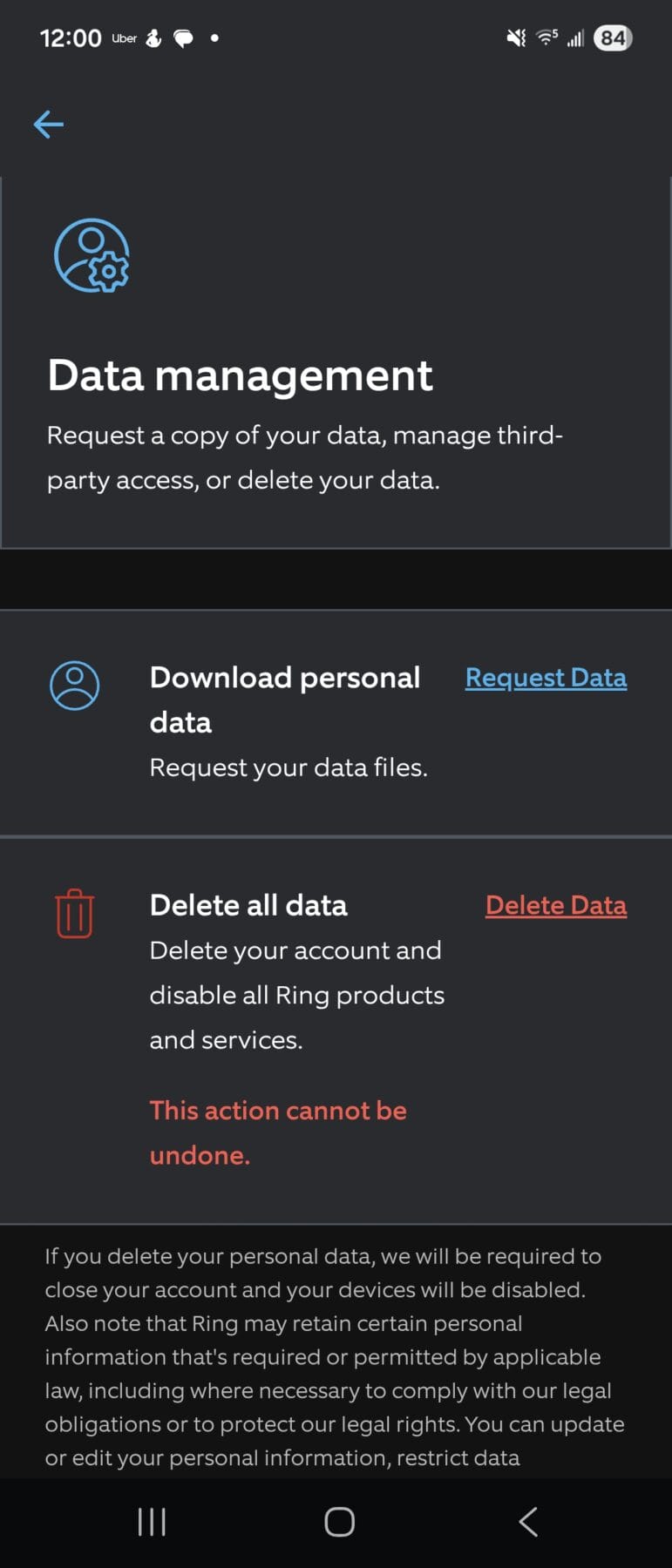
This is the whole screen. Notice anything?  As promised, you can download your personal data, I guess just to see what the CIA is looking at.  You can delete your data, at the cost of bricking your products.  But there is no actual option to manage 3rd party data access.  It is promised in the privacy statement, it is promised in the menu header, but it does not exist.  After an hour on their site and in the app, I still don't know who has access to my doorbell camera image.


**footnote: The other day in Orange County CA I was doing my 4 mile walk through some neighborhoods and I passed 4 young (at least relative to me) women pushing strollers.  When I looked, all 4 strollers had dogs in them, not children.  Some time ago someone said (sorry I can't give credit, can't remember) "dogs are the new children, plants are the new dogs."  I didn't really understand that until recently but I believe it.  I can't remember an airline flight I have been on that had more babies in the cabin than dogs.

It's Not Just About Money, It's About Class

I still think my first reaction to the Left's pushback on DOGE's probe of the spending of USAID and later other government departments was on target:

Which led to this meme (it's an old standby but under @boriquagato
influence I am dipping my toe into meme creation:

As an aside, I am fully supportive of addressing real privacy abuses found in the DOGE process, though having these concerns come from the party and the media complex that spent the last four years trying to leak Donald Trump's and other rich people's tax returns and whose first response to these privacy concerns was to dox members of Musk's analytical crew makes me skeptical this is the real concern. For government workers, "privacy" means keeping secret bad or stupid decisions. Remember this one (which was again about covering up spending)?

Some of the questionable redactions, by contrast, are charming efforts at bureaucratic butt-covering. Lisa Page, for example, was discussing with Peter Strzok the challenge of having an intimate meeting in Andrew McCabe’s conference room, given the size of his grand new conference table. “No way to change the room,” Page texts in the version provided by Justice. “The table alone was [REDACTED]. (You can’t repeat that!)” Hmmm, what classified, top-secret, national-security information could possibly have been redacted? The blacked out bit, it seems, was a simple “70k.” The DoJ—and can you blame them, really?—didn’t want Congress to know they were in the habit of spending $70,000 on a conference table.

Update 2-17: DOGE is seeking access to IRS systems with taxpayer data. As loath as I am to slow this effort down, I think we need to hear about some strong controls before this proceeds.

But having thought about this longer, I think this is about more than just money. It is also about class. Just listen to how the cool kids in the media talk about Musk's group of young weirdly-nicknamed geeks. This is fairly typical:

He was speaking specifically about a Trump executive order that decrees that the Department for Government Efficiency can force federal agencies into firing four people for every new hire. “Who the hell voted for Mr. Musk?” Begala raged. “Who the hell voted for—excuse the phrase—a guy who calls himself Big Balls? A 19-year-old kid going in there and trying to fire cancer researchers and scientists and teachers and agricultural specialists. It’s, it’s appalling.”

This is moderately hilarious from a) a party who still has not told us which unelected people really were making decisions behind the curtain for a senile Joe Biden; and b) an individual (Begala) who wielded immense power and influence across all departments of the Clinton Administration. The department staffs in DC are 99.99% people who are both unelected and unconfirmed by Congress. The issue is not that they are unelected, the issue is that they are "the wrong sort." I am reminded of the British aristocracy in the 19th century that would tolerate almost any sort of governmental incompetence or malfeasance as long as the people were "the right sort" -- meaning of their class.

The mention of Victorian England reminds me of another way that class is likely involved here. In the English aristocracy the oldest son inherited the title and often all the land and income (which was entailed to the title). This left little for any additional sons, so an income had to be found somewhere for them in a profession that did not require them to sully themselves with "trade" (daughters were handled a different way, through the marriage market). Reading for the law was an acceptable profession for a son with brains, and the army or navy were outlets for many. But most families needed a way for their sons without too much brains or ability and not militarily inclined to make a living. A position in the Church was often the solution.

Modern American blue-blood parents are no different -- they need a way to secure a living for their kids who won't or can't land a job in the modern elite career choices (law, consulting, investment banking, or a sexy startup). Unlike in Victorian times, the military or the Church are no longer preferred elite options? So what to do with your 22-year-old gender studies major? The parents need her to get an income and they need her to do it in a context that they can proudly report to their friends -- Paul Begala does not want to tell his friends that his son's job is maintaining distributor pricing lists ** (anyone who does not believe the latter criteria should have been at my Princeton or Harvard Business School 25th reunions).

The solution? Get them a job at a non-profit, the modern American version of going to the Church. As Arnold Kling noted once, non-profits tend to have much higher status than do for-profits. And without competition they don't have to carry the same performance standards as for-profits. And they are incredibly susceptible to trading a position for your kid in exchange for a nice donation.

The employment rosters of non-profits and NGO's are stuffed with the children of privilege. So much so that there are many non-profits that seem to do nothing EXCEPT employ and pay the travel expenses of 20-something kids from rich and/or influential families. I have been writing about the non-profit scam for years. As I wrote then:

From my direct experience, I would go further.  There is a tranche (I don't know how large) of non-profits that are close to outright scams, providing most of their benefits to their managers and employees rather to anyone outside the organization.  These benefits include 1) a salary with few performance expectations; 2) expense-paid parties and travel; 3) myriad virtue-signalling opportunities; 4) opportunities to build personal networks.  This isn't just criticizing theoretical institutions -- people I know are in such jobs in these organizations.

The spending that DOGE is going after at USAID and other departments likely threatens the income of a number of under-qualified elite kids. So I will update my meme:

**Footnote: I will proudly tell the world that my son's first job out of college was indeed maintaining distributor pricing lists for Ballast Point beer. Trying to optimize profits across the matrix 100+ sku's and scores of distributors is a great real world skill building entry-level job that so many of the change-the-world-before-I-am-25 college kids currently eschew.

Postscript: If you want the blank template for the Astronaut meme updated for DOGE, I share it here.