Missed Opportunity

I don't want to be too much of a Monday morning QB, but this sure is a missed opportunity:

Buses

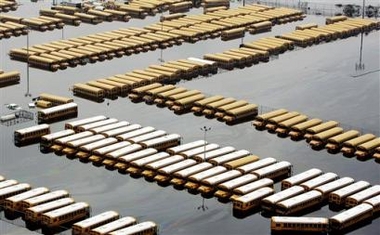
The city declared a mandatory evacuation.  Why then did it stick tens of thousands in the Superdome, right in the middle of town, rather than evacuate them with the assets they already owned in quantity?

Some critics are calling it a racist plot.  If we rely on Coyote's Law, the most likely answer is incompetence and stupidity.

Update:  Junk Yard Blog has extensive reports on unused busses, including more sattelite imagery, local evac plans, reports from locals, etc.  Just keep scrolling down the page

Red Cross Donation Link (Sticky)

Donate to the Red Cross

Thanks to Big Cat Chronicles for the banner images.

Roundup of FEMA-Related Articles

Marginal Revolution has an incredible roundup of FEMA and disaster-preparedness articles, many from a libertarian point of view.

Top Down vs. Bottom Up

Government bureaucrats tend to resist bottom-up solutions to problems -- after all,their jobs depend on the primacy of central planning and solving problems top-down.  It is interesting to read this email posted at Vodka Pundit in this light:

Fed is dropping the ball on basic necessities such as water, portolets, you
name it. Woefully unprepared and nobody seems to be in charge or have the
gumption to get it done.

Louisiana politicians should be absolutely raising hell right now. Lots of
people including yours truly have volunteered to bring (including food,
generators, food, etc., to be self sufficient for a week or so) the most
important thing which is a boat but have been told NO under no uncertain terms.
"My" town is under water, people are in critical condition, and I have skill
sets and assets - including a boat which will come out of the hole in 14 incles
of water - and we are being denied the opportunity to help. And quite frankly,
that REALLY PISSES ME OFF.

Military is stepping up and bringing considerable skills and assets to the
table. Had they been listened to earlier, lots of logistical issues would have
been resolved. IOW's, the bureaucrats are getting moved to the sidelines but
"turf issues" are not going quietly into the night.

You can see the bureaucratic mindset at work hear:  An emphasis on being in control vs. solving the damn problem.  Don't want a lot of citizens running around on their own bringing in supplies of helping people, do we?

If we are going to insist on a 100% top-down approach, then its good the military is coming in to take over.   Only the military has the large-scale logistical experience and resources to take-on something of this scope top-down  (and even they have struggled with what may be a smaller rebuilding task in Iraq).  The US military did more good than any single organization during the Asian Tsunami, so I hope for the same here.  I would hope there are a few aircraft carriers heading to the area.

Postscript:  I know everyone is having fun blaming the feds, but what about the locals here?  If my town was below sea level with only a single dike between me and being 30 feet under a lake, I might insist that my local politicians have a contingency plan for breaches.  I have wondered why a few ships couldn't have been scuttled in the breach early in the crisis.

Update:  Much more on top-down vs. bottom-up response to Katrina here.

Technorati Tags: 

Scrappleface: Lack of Bush Eloquence Imperils Hurricane Victims

Very funny from Scrappleface.  Here is an excerpt:

Fears increased today among hundreds of thousands of refugees from the
hurricane-ravaged gulf coast as they faced a Labor Day weekend with little hope
of an eloquent speech from President George Bush....

One New Orleans man, currently living in the 'Plaza End Zone' section of the
Superdome as he awaits news of his missing family members, said, "I can survive
for some time with little water, no food and highly unsanitary conditions...but
if I don't hear some poetic words of comfort and stirring verbal imagery from
the president pretty soon, I'm a goner."

Read it all.

Technorati Tags:  ,

Katrina Satellite Photos Before and After

When you first see the comparison of Katrina before and after photos, you will think the "after" photos seem underexposed.  Examining the larger images, you will find that they are not underexposed, just everything is now covered in dark green water.  What a mess.  Here are downloadable versions of many of the same photos.

Update:  These photos of the Mississippi Gulf Coast don't have the flooding, but very dramatically show the type of damage sustained.  The USGS has a gallery of before and after Katrina photos here. This site shows the levee breaks in New Orleans from space.

Other Katrina-Related Topics:
Technocrats and the Katrina Response  **Popular**
Bottom-up vs. Top-down Solutions
Hurricanes and Big Government
In Defense of Price Gouging
Fallout of Federal Control and (here too)

Technorati Tags: 

Can't Anyone Reality Check Numbers?

I am constantly frustrated with the media's inability to reality check the numbers they publish.  In many cases, just a few seconds thought would tell them that the numbers make no sense.

Today's example actually comes from a "meth-is-death" web site which is run by the Tennessee state attorneys-general association and is linked prominently from the Federal Government's anti-drug web site  (Hat tip to Reason).  Here are their numbers, copied right from the site:

  • 1 in 7 high school students will try meth.
  • 99 percent of first-time meth users are hooked after just the first try.
  • Only 5 percent of meth addicts are able to kick it and stay away.
  • From the first hit to the last breath, the life expectancy of a habitual
    meth user is only 5 years.

So 14.3% (1 in 7) try meth, 99% of those who try are hooked, and 95% of those hooked stay hooked, and all of those hooked die in five years.  So .143 x .99 x .95  or 13.45% of all kids are dying on average by the age of 23.  Wow.  There must be a really huge conspiracy out there to cover up all these deaths. Given that there are about 17,000,000 high school age kids, that means that in the next 5 years or so nearly 2.3 million of them are going to die.   And adults who run anti-drug programs wonder why kids don't take their warnings seriously. 

Gas Scarce in Phoenix?

This morning, as I drove to work and stopped to get gas, I noticed that they were sold out of two of their three grades (only premium was left).  The manager told me that several folks had come in today saying that this was the fourth or fifth place they looked for gas, though I will say the next two stations down the street seemed to have gas and I did not see lines anywhere.

Phoenix is one of those funny gas markets, where due to government regulations, we have a unique gas blend that can only be made in one place by left handed Eskimos, or whatever.  Several companies have tried for years to get a refinery permitted to serve this market, but the Arizona state government has consistently blocked it.  As a result, we get some strange ups and downs here, including gas lines last year when the only pipeline into town from the only refinery that makes gas that can be sold here broke.

Its a bit too early for Katrina to be actually affecting wholesale gasoline supplies (update:  or maybe not), but it is not too early for Katrina-led expectations to be draining gasoline inventories.  I explained previously about how an expectation among consumers that gas will be short can become a self-fulfilling prophecy:

Take
the example of 1972, and we will use typical numbers of that era.  Lets
say there were 100 million cars each with an average 20 gallon tank.
Lets say normally, people refill their tank when it is ¼ full, so on
average their tank is 5/8 full.  Doing the math, there are 5/8 times 20
times 100 million gallons actually in cars or about 1,250 million
gallons.  That's right - one of the largest single inventories of gas
in this country is in people's tanks.

Now,
lets say due to supply panic, everyone suddenly refills at ¾ full. No
one wants to be caught short (I remember in the 1970's, people would
wait in line to put a gallon or two in their tanks -- it was nuts).  In
this case, on average they are 7/8 full or there are a total of 1750
Million gallons in cars' tanks.  So, in the space of what might be two
or three days, people suddenly demand 500 million gallons above and
beyond their normal usage to increase their tank's inventory.  Boom,
stations are out of gas, which causes people to feel even less secure
without a full tank, so they inventory more (many in spare gas cans)
and the problem gets worse.

Here is my previous post on why I am hoping for gas price gouging.

Racial Profiling in the Media

A pretty cynical bit of racial profiling going on here.  White people are borrowing needed food, black people are looting (though there is an interesting contrast here in how each person goes about their carbohydrate intake, lol)

Please, Let There Be Gas Price Gouging

Katrina comes at a very bad time for US gasoline markets.  Supplies are already tight, and now a substantial amount of US oil production and refining capacity are shut in, for an unknown period of time.  Long ago, I worked as an engineer in a refinery and it can take days to get everything restarted from a cold start.  The result will almost certainly be near-term gas shortages.

There are two ways this can play out:  1)  a short term spike in prices, as much as a dollar or more a gallon or 2) long and irritating gas lines.  Lets hope that prices are allowed to reach their level and gas lines can be avoided, but who knows what political stupidities (ala Hawaii) will be proposed. 

I really, really hate gas lines.  I hate the uncertainty of whether or not I can find a station open.  I hate refilling my tank every day to make sure I am not caught short.  And for those of you who say I am arrogant since I can afford higher prices but the poor cannot, I assure you that folks who are paid by the hour are hurt much worse waiting around for hours in gas lines than the mere irritation I encounter.  More on gas line expectations as a semi-self-fulfilling prophecy here.

PS-  Expect to see news of a refinery fire or explosion over the next week.  The risk of accidents is very high when these complex plants have to start up -- they weren't really meant to be turned on and off.

Update:  First signs of a gas shortage?
Update #2:  The Mises Blog has a roundup of economics posts supporting price spikes during spot shortages (popularly known as gouging).
Update #3:  Jane Galt has more in praise of price gouging

What I Love about the South

Having grown up in Texas, I love this:  Their city underwater and possibly joining Atlantis for eternity, the Superdome looking like the Kingdome, the newspapers flooded out of their offices, with no power and no printing presses, probably operating out of a Motel 6 somewhere, the New Orleans Times-Picayune still has time to address life's essentials -- How ARE the Saints going to stop the run this year? (posted at 8:50 PM Tuesday)

One of the major on-field concerns for the Saints is to figure out how
to stop the run. Off the field reports of major flooding back home
occupied the thoughts of many of the Saints players Tuesday in the
second day of practice at San Jose State.

Going into Thursday's preseason finale against the Oakland Raiders, the
Saints have allowed a whopping 535 yards on the ground in the first
three exhibitions with a staggering 6.7 yards per carry for opponents.

You may have to scroll down a few posts, I am not sure their permalinks are working right.

Severe Hurricane Frequency in New Orleans

OK, I warned you, editorials are already blaming the damage in New Orleans on Global Warming in general and George Bush in specific.  Here is what you need to know about this meme:

  • Katrina is the 5th category four or five hurricane to hit within 100 miles of New Orleans since 1899.  This includes the hurricanes in 1948, 1965, and Camille in 1969.  Camille was the real whopper up to this point, one of only 3 class 5 hurricanes to ever hit the US before Katrina.  Note however, after three major (class 4 or 5) hurricanes in 21 years in the area from 1948-1969, there has not been another one to hit this area for 36 years.   It is difficult to figure out how you get an increasing frequency argument from this data.

A more detailed study of hurricane frequency is here and nice graphs here.  It turns out that increasing $ damages from hurricanes have more to do with expensive houses near the coast than increasing hurricane severity.  More on cycles of hurricane activity here

If there is a government failing here, it has more to do with local infrastructure than CO2This blog blames the lack of infrastructure on Bush (of course).  I have no particular problem bash Bush for anything, but my question is,if the locals knew this, as the blog implies, why didn't the locals spend their own damn money on their own infrastructure to protect their own selves.  If New Orleans chooses to build their city below sea level, why should the rest of us bear the cost of their higher-than-average infrastructure costs?

A Voice For Businesses in California

California is one of the toughest states in the country to do business in.  Bill Leonard, a member of the California BOE*, takes a refreshingly free market approach for a left-coast politician.  From looking at his site, he and I may not see eye-to-eye on immigration, but he has been a lone voice of sanity on tax and regulatory policy in California for several years.  If you are interested, his email newsletter is generally filled with news and commentary on how California tax and regulatory law is changing and how these changes may affect local businesses.  You can sign up for his newsletter here.

*  You know your state is in trouble when the department of taxation and revenue calls itself the "Board of Equalization", though I am told this originally referred to equalization of tax policy across counties rather than having the redistributive overtones it has today.

Update on Iraq

Here is my update on Iraq:  We are still there, and will be there for a while.  And we are still spending nearly every available financial and human resource, not to mention all of our national attention and available goodwill, on the effort to make Iraq a prosperous and successful free and independent nation, to the exclusion of being able to bring much change about anywhere else in the world.

I can't tell you whether the effort in Iraq is going well or poorly.  Certainly if I pay attention to the major media alone I would assume it's a disaster, but we all know the media has a bias toward negativity that trumps any political biases it might have (after all, your local news station learned long ago that "your kids are happy and healthy, story at 11" is not a very good way to tease the evening news).  Being familiar with alternate sources on the Internet, I know that there are successes as well as failures on the ground.  In fact, you can even sort of deduce the successes from the major media coverage.  When the NY Times stops writing about blackouts in Iraq, you know that the electrical system is fixed.  When the WaPo stops writing stories about shortfalls in re-enlistment rates, you can infer that the rates are back up.

But to me, all this back and forth over success and failure in Iraq is only peripheral to my main problem with the war.  Let's for the sake of argument posit that things are going swimmingly, and we are able to start removing assets and support from Iraq next year.  That will mean that for four or five years, the entire attention and resources of the only country in the world that is able to substantially influence the behavior of other countries will be focused on just one country. 

During the Iraq war and occupation, we have not had the "bandwidth", either in attention or moral authority or resources, to help stave off Sudanese genocide, to steer Zimbabwe off its destructive path, to influence the course of events in Iran or North Korea, to change the behavior of terrorist sponsors like Saudi Arabia, or even to head off Russia's apparent slide back toward totalitarianism. 

Now, one could easily argue that its not our job to fix these things.  And I go through phases of agreeing with this.  However, our invasion of Iraq is predicated on the assumption that it should be our foreign policy to try to fix the worst of these problems.  And if it is, does it really make sense to invest everything we have and more on one country for four or five years (or more?)  From the first days of the war, I have called this my "cleaning of the Augean stables argument".  There are just too many messes in the world to head them all off by military invasion.  Afghanistan probably justified such a military effort, given its direct connections to 9/11, but I am still confused as to why Iraq justified this attention more than 20 or so other nations I could name.  Afghanistan  convinced the world that the US was ready to use the military if it had to, and helped to reverse the perception of weakness left by Carter's response to the Iranian hostage takers, Reagan's bailing out of Lebanon, and Clinton's running form Somalia and refusing to respond to the Cole attacks.  9/11, for all its horors, gave us a certain moral authority in the world to try to clean things up.  This credibility and authority could have given new life to non-military efforts, but we chose not to use them.

Now that we are there in Iraq, I tend to be in the stay the course camp.  There are too many recent examples, such as those cited above, where bailing out has created a perception of weakness that have encouraged our enemies to more boldness.  The situation we are in with the Iraqi people is much like the obligation the police have to a mafia informant that the police have convinced to turn state's evidence with the promise of protection against retribution.  If you suddenly throw the guy back out on the street to be killed publicly, its going to be really hard to get anyone else to trust you in the future.

I will confess that there are two things that from time to time cause me to have some doubts about my  stance.

The first was the seeming cascade of good news from surrounding countries in the middle east last January, as a successful Iraqi election emboldened opposition forces in a number of countries, including Lebanon, Egypt, and Iran.  If the neocons are right, and successful democracy in Iraq leads to a cascade effect in the surrounding nations, then my argument about spending too much time and effort on one country loses some of its power.

The second and perhaps more powerful input that sometimes causes me to rethink my opposition to the Iraq war is the insanity that tends to emerge from others who are anti-war, and with whom I do not want to be associated.  Take Cindy Sheehan and her beliefs, since she seems to have been adopted as a spokesperson and mascot by much of the vocal anti-war left. (I promised myself I would never mention Cindy Sheehan in this blog, but if she can meet with the president once and later claim that the president won't meet with her, then I guess I can write about her once and then claim I won't ever mention her).

Ms Sheehan has stated, as have many others in the anti-war movement including Michael Moore, at least five reasons for their being anti-war that drive me nuts:

Insurgents are Freedom Fighters:  Sorry, but no.  Most of the insurgents are ex-Baathists or Muslim extremists who want to reinstate a fascist state in the mold either of Saddam's more secular version or Iran's more fundamentalist version.  The insurgency is the equivalent of what Germany would have been like had the SS followed through on its promise to continue fighting a guerrilla war from the Bavarian Alps.  The world is a better place without the Baathists in power, and the insurgents do not have good aims for the Iraqi people.  Period.

Its all a Jewish plot:  Everything old is new again, and this particular brand of anti-Semitism, seeing Jewish cabals everywhere pulling strings of the government, seems to be back in vogue.  However, is there any particular reason Israel would want to shake the tree in Iraq?  After all, the last and only time they were attacked by Iraq directly was the last time the US went to war with Saddam.  Israel is still surrounded by enemies, with or without Saddam in power in Iraq.  In fact, one could argue that what Israel should really want is for Iraq and Iran go back to beating the crap out of each other in war after war.

It was all for oil:  How?  People always say this, but they can never explain to me the mechanism.  If it was to put US companies into ownership positions over Iraqi oil, we did a damn bad job since the Iraqi's seem to still own all their own oil (though we did head off the French from grabbing the oil).

War is never justified:  I don't think war was justified in this case, but never?  If you make this statement, then it means you have to be willing to live with anything, from genocide to totalitarianism, up to and including in your home country.  As long as there are people who only know how to live by force and wish to rule me, war always has to be an option.

Iraqis were better off under fascism when they had security:  I am not an Iraqi, so I won't try to make this trade-off for them.  However, I would like to point out a huge irony about the folks, mainly on the left, who make this argument.  The very same folks who make this argument for the Iraqis have been faced with the same choice themselves over the last few years:  Would you rather an increased risk of domestic terrorist attack, or greater security at the cost of reduced freedoms via the Patriot Act, more random searches, profiling, surveillance, etc. etc.  Most on the anti-war left have shouted that they will take the extra risk of violent attack in order to retain their individual liberties.  I agree with them.  The difference is that I don't project exactly the opposite choice onto the Iraqi people.

Update:  Professor Bainbridge seems to be in roughly the same boat.
Do People Want Regulation?

Advocates of the statist web of regulation in California argue that this mass of government control makes California a more desirable place to live.  Andy Roth asks, does it?

Some high income earners are
leaving
California because of its punitive tax rates. Could low- and
middle-income workers be leaving as well? One crude measure is to examine the
one-way rental rates for U-Haul vans. Using U-Haul's website, I queried a one-way rental for a 10-foot van
for October 1st, 2005.


One-Way Trip Price
Los Angeles to Las Vegas $454.00
Las Vegas to Los Angeles $119.00

Pre-Columbian Genetic Engineering

This is pretty cool, from Charles C. Mann's new book, and quoted by Marginal Revolution:

...the modern species [of maize] had to have been consciously developed by a
small group of breeders who hunted through teosinte strands for plants with
desired traits.  Geneticists from Rutgers University...estimated in 1998 that
determined, aggressive, plan breeders -- which Indians certainly were -- might
have been able to breed maize in as little as a decade...modern maize was the
outcome of a bold act of conscious biological manipulation -- "arguably man's
first, and perhaps his greatest, feat of genetic engineering," [Nina
Federoff]..."To get corn out of teosinte is so -- you couldn't get a grant to do
that now, because it would sound so crazy...Somebody who did that today would
get a Nobel Prize!  If their lab didn't get shut down by Greenpeace, I mean."

Followup on Vioxx

I wrote about the Vioxx decision here as another defeat for personal choice. Marginal Revolution has a good post on gaps in the anti-Vioxx science.  Here is a taste:

...[E]ven if there actually is an elevated risk of the magnitude the studies
suggest but can't prove, the question is whether I might want to accept a 1 in 4,000 risk of dying
from a heart attack in order to get the only medication timt
makes my pain bearable and a mobile life livable
.  And if I say no to the
Vioxx, I may end up taking something that is less effective for my pain but has
risks of its own.

.... How did we arrive at a system in which 12 random Texans are assigned
responsibility for evaluating the scientific merits of statistical evidence of
this type, weighing the costs and benefits, and potentially
sending
a productive blue-chip American company into bankruptcy protection?

Why Libertarians are Paranoid, Example #12,403

Those on the left and the right often try to laugh off libertarians, ascribing to "paranoia" our fear of the power of government. 

Well, I could argue that if this is paranoia, I share a similar phobia with men like Thomas Jefferson and James Madison, whose fear of government power permeate all their writings, as well as the Constitution they helped to produce.  They believed that even good men could be corrupted by the government, and they were proven correct in an incredibly short time by John Adams.  Adams is by all accounts a good man, dedicated to freedom and democracy, and one of the chief intellectual architects both of the Revolution and the Constitution.  But it was Adams that signed into law the Alien and Sedition Act, perhaps the worst piece of illiberal and unconstitutional legislation in the history of this country.

Or, if I didn't want to make the founding father's / original intent argument, I could just point to this (hat tip Marginal Revolution):

A federal judge in Texas, calling the Federal Deposit Insurance Corp. a "corrupt
agency with corrupt influences on it," awarded a Houston financier $72 million
to cover his legal fees in a decade-long suit involving a failed savings and
loan and the government's efforts to take control of a stand of endangered
California redwood trees in the 1990s.

The FDIC, a regulatory agency that insures deposits at banks and
savings and loans, filed suit against Charles E. Hurwitz in 1995, seeking to
collect more than $800 million because Hurwitz indirectly controlled a Texas
S&L that failed in 1988. The FDIC, after a series of legal setbacks, dropped
its suit against Hurwitz in 2002....

On Tuesday evening, Hughes issued a scathing, 131-page ruling. In it, he cited
evidence that the FDIC brought the case largely because of pressure from
environmental groups, members of Congress and the Clinton administration. The
reason: Hurwitz's Pacific Lumber Co. owned 3,500 acres of endangered redwoods in
Northern California. Hughes found that the FDIC, in close concert with
environmental groups, sued Hurwitz to pressure him into a "debt-for-nature"
swap, in effect giving the government his trees in exchange for his supposed
liability in the failure of the United Savings Association of Texas....

Hughes said FDIC officials and lawyers, in depositions, "ranged from
manipulative evasiveness to plain perjury." He cited records of two years of
communications, including extensive discussions of legal strategy and political
matters, between the FDIC and environmentalists over the proposal to use a
banking-practices lawsuit as pressure on Hurwitz to give up the
redwoods.

Hughes said FDIC officials "discarded the mantle of the American
Republic for the cloak of a secret society of extortionists. If the vice
president called, they responded. If a congressman called, they responded. If a
lobbyist called, they responded. They heeded every call but that of duty and
honor."

Wow.  I know many people are paranoid about the lack of accountability of major corporations, and felt vindicated by the Enron case, over which the press spilled acres of ink.  However, Enron is nothing compared to this.  While fraud is bad, Enron at least was never able to use the coercive regulatory and police power that the government has to seek its ends.

Be Prepared

Now that Hurricane Katrina has moved inland, it's time for the next stage of preparation - preparing for the onslaught of global warming activists ready to use New Orleans' devastation to justify government intervention in the economy.  Heck, some global warming activists tried to blame the earthquake induced SE Asian Tsunami on global warming.

For the last couple of years, the meme has circulated that hurricanes are getting worse, and that this is a predictable result of global warming.  More destructive hurricanes may or may not be a result of global warming -- I don't know, and I challenge any climatologist who thinks they can make a definitive prediction on hurricane forces based on a half degree change in global temperatures. 

What is fairly clear is that hurricanes are not actually getting worse.  Damage from them is getting worse, but that is more of a function of building a lot of expensive structures close to the water over the last 30 years.  And it is particularly true in New Orleans, which relies on massive pumps operating 24 hours a day to keep the city above water on a good day.  Patrick Michaels has more on the hurricane meme here, including a disturbing tale of the religion of global warming trumping good science.  Where I am on global warming here.  More on global warming activism overcoming the scientific method here.  I will never forget this quote from Steve Schneider of the NOAA:

We have to offer up scary scenarios, make simplified, dramatic
statements, and make little mention of any doubts we have. Each of us
has to decide what the right balance is between being effective and
being honest.

How to Get an SBA Loan

Note that this article is one in a series of articles on small business how-to's.  Past series have covered how to buy a business, labor audits, sales taxes, and workers comp.

I recently went through the process of obtaining an SBA (Small Business Administration) loan.  These are loans that are what I call "cash flow" loans, secured more by the companies earnings rather than collateral (though collateral may be required, see below).  SBA loans are written by private banks to standards set by the government.  If these standards are met, then bank loans under this program get a partial guarantee from the US government.

Before I go on to describe the process, I feel compelled to note that as a libertarian who does not believe the SBA should even exist and who believes that such loan guarantees are a subsidy program that should be eliminated, I was obviously conflicted by whether to seek out such a loan.  What finally made the decision for me is that this government program has crowded out all other private options.  Banks get about the same rate for an SBA loan as they would for a commercial loan without the guarantee.  Since the guarantee is out there and doesn't cost the bank anything, the bank has no reason not to insist on it?  Therefore, as a small company in the SBA size range, there just are not any banks willing to lend without the SBA guarantee.  This does not mean that in a free market without the SBA there would be no loans - it just means that when such a free subsidy program exists, banks are going to take it.

Types of Loans

The following is a gross simplification, but for a small company, there are basically two types of loans: secured loans and cash flow loans.  Secured loans are by far the most common for small businesses.  I, like nearly every entrepreneur I know, have had to pledge my house at various times as collateral for loans.  While it is fairly easy in today's market for a small company to get an equipment loan (typically lease-finance of a purchase) secured by hard assets, few lenders will provide loans for general business and working capital needs unless they are secured by something tangible -- homes, vehicles, receivables, etc. 

However, most businesses need capital for more things than just to buy hard goods.  Seasonal businesses may need loans to pay the rent in off-seasons, retail businesses need money to grow inventory and pre-pay for new leases, while opening new divisions may require paying salaries well in advance of first revenues.  Unfortunately, most businesses that claim to be business banks have no desire or talent to understand a business well enough to make a cash flow loan.  I am not talking about just Ethyl's Bank, but large banks like Bank of America and Wells Fargo who were stumped when I wanted to discuss some unique financing needs in my business.  I know people with a half million dollars a year in free cash flow out of their business who have trouble getting bankers to make unsecured cash flow loans.  And, as mentioned above, those who do make cash flow loans typically insist on having the SBA guarantee.

How an SBA Loan Works

I will not pretend to be an expert on all the intricacies and rules.  The SBA has a number of programs, offering loans of different lengths of time and for different purposes.  The SBA has programs for both revolving lines of credit as well as standard 10-15 year loans.  Each of these programs has different under-writing criteria, fees, and limitations, which your banker will have to explain to you.  Most SBA loans, including mine, fall under the section 7(a) program.  The SBA site tries to explain some of this.

As stated in the intro, an SBA 7(a) loan actually is issued by a bank, but to SBA underwriting criteria and with an SBA guarantee.  The SBA only guarantees a portion of the loan, something like 50-75% depending on the exact loan type, with the bank taking the rest of the risk.  These loans are issued at a floating rate of prime plus a percentage, and the SBA has rules that caps the rates as well as fees the bank can charge.  The SBA charges a substantial fee, in the 2-3% of total loan value, up front to the borrower for the guarantee.

Banks participate in the program in one of two ways.  Most any bank can originate an SBA loan, collecting all the (very substantial) paperwork needed by the SBA and forwarding it to the SBA for approval.  In addition to the underwriting time at the bank, the SBA can take many weeks to complete this analysis.   A smaller subset of banks have been pre-approved by the SBA to act as their underwriting agent - called a preferred lender or PLP.  This means that they can do the SBA's analysis for them.  This often greatly accelerates the process.  My total time form the bank's first data request to the final loan closing was less than a month, which is very fast.

Choosing the Bank is Critical

From the section above, it should be obvious that you should strongly consider working through a bank that has the preferred lender status with the SBA.  Note that having  or not having this status does not necessarily correlate with bank size.  The "expert" I was hooked up with at Bank of America (my main bank) was useless, and told me in so many words that it would be impossible for me to ever get an SBA loan.  I ended up working with Silver State Bank, a relatively new business bank out of Nevada.  They had the whole process automated, and when combined with a very knowledgeable banker on the front end named Jerry Woods here in Phoenix, the process was as smooth as silk and very, very fast.  In fact, I got the whole loan done in less time than it took BofA two years ago to do my line of credit.

Costs and Other Considerations

SBA loans are not cheap, and I would strongly urge you to pursue secured asset-backed loans as far as you can.  My total fees, including the cost of the guarantee, ran to about 3% of the total loan value.  In addition, I STILL had to put up collateral to back the non-guaranteed portion of the loan.  In retrospect, I think I did a bad job of negotiating with my banker on this.  No matter how good they are, bankers are still bankers and are going to attach every asset that can sit still for collateral whether they really need it or not.  I should have pushed back harder on this issue.  Overall, though, I am excited that I now have the capital to continue to grow my business.

PS-  If you want to enjoy some of this capital at work, come to Lake Havasu and rent a jet ski for a day!  All those other entrepreneurs out there are investing money in dead-end stuff like microchips and improved manufacturing --  Ha!  There is nothing like being able to tear around a big lake on 110HP to really make America competitive!

More Map Fun

Lately I have been playing with Google Earth - I love flying from outer-space right down to my house.  However, this caught my eye yesterday.  As the risk of being the last person who has seen it, A9 (owned by Amazon) has a mapping program that shows pictures of the ground level view wherever you put the cursor.  Not all roads, by any means, are covered, so turn on the "mark streets containing images" box to see with blue lines where they have pictures.  I found the user interface for scrolling the maps around and zooming pretty counter-intuitive, so its kind of immature, but it is an interesting idea to be able to know what your destination looks like and maybe look at landmarks for key intersections.  A9's original product was a yellow pages that showed what your search results looked like and plotted them on a map.

Channeling my Grandparents

You know how when you grew up, your parents and grand-parents always said stuff like "I remember when I was a kid, we didn't even have X", where X was airplanes, or TV's or ice or whatever.  I actually found myself having one of those moments in the OfficeMax store today.  I remember when I got my first hard drive for my IBM PC in the very early 80's.  It was 10MB, cost about $500, and my one thought at the time was "I'll never be able to fill up this thing".

Today at the office supply store at the register I made an impulse purchase for a new USB memory key.  My son stole mine to use to take stuff back and forth to school, and I wanted a larger capacity drive anyway.  So here I was buying a 1GB key, with 100x the storage of that first hard drive in a package about 1/100 of the size of that hard drive, and I was buying it at the cash register from a rack next to the gum.  Pretty cool.

However, I am not going to let scientists totally off the hook.  I am still waiting for my hover car, my jet pack, and my vacation on the moon, which I expected to have long before now.

Cool Web Neighborhood Tool

I played with this tool this weekend, and it makes some pretty cool web relationship maps.  I am not sure it is authoritative, but it is fun.  It maps relationships between sites and pages based on Google forward and back link data.

The Ever-Widening Search For Deep Pockets

I could fill this blog with litigation horror stories, but there is no need when Walter Olson does such a good job.  If you read his blog much, one of the themes than runs through the cases he highlights is the ever widening search in every case to find the deep pockets.  Unfortunately for trial lawyers, the person who is truly at fault, ie the drunk driver that runs down a pedestrian, seldom has deep enough pockets to produce a really satisfying fee.  So you gotta be creative.  This is to be expected.  What is not to be expected is the lengths to which the judicial system goes to validate this search (via Overlawyered):

The state Supreme Court has ruled that store owners can be sued for causing
injuries in a drunken driving accident if they sold gas to an intoxicated
driver.

The court ruled in a lawsuit filed by two men who were severely
injured in 2000 when they were struck head-on by Brian Lee Tarver, who later
pleaded guilty to vehicular assault and driving under the influence.
Before the accident, Tarver bought gas at an Exxon owned by East
Tennessee Pioneer Oil Company.

Fortunately, I guess, Exxon is used to getting sued for damages by drunk drivers

This case I wrote about previously is one of the best examples I have seen of how liability goes to the deep pockets, not the guilty:

Car veers into
truck's lane...and so a jury has ordered the trucking company, Auction
Transport Inc., to pay $22.5 million over the resulting injuries to a
young passenger in the accident, which occurred at rush hour on Kansas
City's I-435. Mary Coleman's car, allegedly sideswiped by a third
vehicle, had careened in front of the truck, but attorneys argued that
the truck driver had been "driving too fast in congested traffic and
not watching the road." The jury found the trucking company responsible
for just less than half the fault of the accident -- a greater share of
fault than the allegedly sideswiping driver -- and Coleman for hardly
any of it.

So, surprisingly enough, three
vehicles involved, two with limited resources and one with deep
pockets.  Guess who is liable - the deep pockets of course, despite the
fact that he was the only driver among the three who stayed in his lane!

Now, here is the thought experiment.  Move the truck with
deep pockets into any of the other two roles.  Imagine first that it
was the car that nudged the plaintiff into the other lane.  Imagine
next that the truck was the one nudged into oncoming traffic and hit
the plaintiff.  In these two cases, if they had gone to trial, who
would have gotten the blame?  I would bet you that in either case, the
truck with the deep pockets would have been given most of the blame in
either of these cases.

So where is the fairness?  Why should blame be based on
bank account size, and not actual actions?  Is there anything more than
coercive wealth transfer going on here?  Does this constitute justice?

More on Gasoline Prices

Lynne Kiesling is on fire, with a series of posts on gasoline pricing over at the Knowledge Problem.  She has posts here and here showing how gasoline purchases have fallen steadily as a percentage of household income, and she also has a nice summary post about the recent runup in prices here.

She is now headed up to the Boundary Waters - hopefully she is camping the Boundary Waters here.