Greatest Corporate Value Proposition Ever
Flying Robots Deliver Tacos To Your Location
If this is an April Fools joke, I am going to cry.
Dispatches from District 48
Flying Robots Deliver Tacos To Your Location
If this is an April Fools joke, I am going to cry.
Congrats to New Mexico for this picture on their Department of Revenue site. This is EXACTLY how I feel when I am trying to track down some bizarre new tax I have just found out that we may owe.

I missed this from Volokh a while back, but since our Con-law-professor-in-chief has done so poorly defending the Constitutionality of the PPACA, someone gave Congress a crack at the job:
Most of us know that when then-Speaker Pelosi was asked where the Constitution gives Congress the power to enact an “individual mandate,” she replied with a mocking “are you serious? Are you serious?”
Here are a few more pearls of constitutional wisdom from our elected representatives.
Rep. Conyers cited the “Good and Welfare Clause” as the source of Congress’s authority [there is no such clause].
Rep. Stark responded, “the federal government can do most anything in this country.”
Rep. Clyburn replied, “There’s nothing in the Constitution that says the federal government has anything to do with most of the stuff we do. How about [you] show me where in the Constitution it prohibits the federal government from doing this?”
Rep. Hare said “I don’t worry about the Constitution on this, to be honest [...] It doesn’t matter to me.” When asked, “Where in the Constitution does it give you the authority …?” He replied, “I don’t know.”
Sen. Akaka said he “not aware” of which Constitutional provision authorizes the healthcare bill.
Sen. Leahy added, “We have plenty of authority. Are you saying there’s no authority?”
Sen. Landrieu told a questioner, “I’ll leave that up to the constitutional lawyers on our staff.”
Ken over at Popehat had a great article about a proposed cyber-bullying law in Connecticut. While he later reports the bill may have died in committee, it is still instructive to look at it, as its twin may well get passed in AZ and many other states are proposing such laws faster than the little animals pop up in a whack-a-mole game.
I am becoming increasingly convinced that these are all stealth attempts to protect politicians and public officials from criticism. Look at the proposed law in CT:
(a) A person commits electronic harassment when such person, with intent to harass, annoy or alarm another person, transmits, posts, displays or disseminates, by or through an electronic communication device, radio, computer, Internet web site or similar means, to any person, a communication, image or information, which is based on the actual or perceived traits or characteristics of that person, which:
(1) Places that person in reasonable fear of harm to his or her person or property;
(2) Has a substantial and detrimental effect on that person's physical or mental health;
(3) Has the effect of substantially interfering with that person's academic performance, employment or other community activities or
responsibilities;
(4) Has the effect of substantially interfering with that person's ability to participate in or benefit from any academic, professional or community-based services, activities or privileges; or
(5) Has the effect of causing substantial embarrassment or humiliation to that person within an academic or professional community.
One of the tricks of these laws is to mix and thereby conflate outrageous behavior most all of us are willing to restrict (e.g. make a credible threat to someone's life) with everyday behaviors such as annoying people.
Let's say I were to write in my blog that, say, Joe Arpaio is an jerk and should not get re-elected. Let's analyze the statement
By this law, therefore, even this relatively mild criticism is illegal. In fact, since all criticisms of politicians can be said to negatively affect their re-election chances, by part 3 any political criticism online would be illegal.
I honestly don't think this is a bug, it is a feature. Already police departments and other public officials are using cyber-bullying laws to stomp on those who criticize them.
After some noodling with 30 year term policies for 50-year olds fitting my wife and my descriptions, the Coyote think tank has unearthed this devastating chart:

This is based on quotes for $1,000,000 in term insurance on a 30-year policy as quoted at Quickquote.com for a fifty-year-old man and woman (male: $2990, female $2020 or 48% more expensive for men).
What is your reaction to this? If it is something like, "no sh*t, women live longer so their insurance is going to be cheaper," then you are a normal rational human being that understands that more expensive risks require higher premiums.
But the Obama administration does not see things this way at all. More expensive premiums for more expensive risks are used by the administration to demagogue to favored constituency groups that they are somehow being hosed and only Obama can protect them. I mean, why else would the Administration release this chart:

Just a few weeks ago a grad student from Georgetown became famous for talking about all the expensive and special needs that women have that need to be covered in health insurance. So of course their insurance is more expensive.
Here is a perfectly accurate way to re-label this chart

So here is the Obama algorithm. If men are more expensive to insure, men should pay the difference. If women are more expensive to insure, men should pay the difference.
I am seldom surprised at NBC's behavior -- after all, this is the network that ran the exploding pickup truck story, only to admit later that it put model rocket engines in the fuel tanks to ignite the cars during simulated crashes because the they weren't catching fire on their own.
But NBC's editing of the Zimmerman 911 tapes to make them more inflammatory really sets a new low. The country was practically on the verge of race riots, with groups actually posting dead-or-alive bounties for Zimmerman, and NBC purposefully edited the tape from neutral to incendiary?
Professor Rizzo was keen that I check out the $12,000 solar picnic table at University of Rochester

Most kids use this to hook up their laptops. Here are a few assumptions
This means the table would produce 31,200 W-hr per year or 31.2 KW-hr per year. This yields an annual electricity savings of $3.12, giving the table a payback time on its investment of 3,846 years. If one assumes a cost of capital anywhere north of 0.026% per year, then the sun will go dark before this table pays itself off.
I want to thank Professor Mike Rizzo and members of the University of Rochester Alexander Hamilton [sic] Society for having me up to speak last week. I had an awesome time touring campus, some quality pub time with some of the students, some really good donuts, and then a speaking engagement followed by literally hours of questions and discussions. Here are some of us out the next day hiking the waterfront (Professor Rizzo is fourth from the right). This is at a "lighthouse" which I had expected to be some sexy Maine-type thing but turned out to be a 3-foot wide steel column with a blinking red light on top. We are on one of the breakwaters at the mouth of the Genessee River as it pours into Lake Ontario.

Professor Rizzo teaches four economics courses, including a couple of the introductory survey courses, and many students go out of their way to take all four, even if they are not even in the department. The group had an incredible vibe, the kind of student-professor learning group we all thought would be typical of college but most of us seldom actually encountered. It reminded me of Dead Poet's Society, except with economics rather than poetry and without the suicides.
In addition to being a popular professor, Rizzo also is a vastly outnumbered campus defender of individual liberty and economic sanity. I can't tell me how many kids told me they had been converted to the cause of free market economics by Professor Rizzo.
Professor Rizzo is also a constant campus gadfly on cost-benefit sensibility. Featured in an upcoming post will be a U of R solar charging station that was one of Rizzo's favorite targets. Which brings us to the issue of the group's name and why I keep writing [sic]. Apparently creating a new campus organization and 501c3 was way too costly, so they just piggy-backed on an existing group, despite the incongruity of the "Alexander Hamilton" name on a group generally dedicated to exploring small government.
I seem to be having some odd problem subscribing to his feed in Google Reader (all I get is Viagra Spam) but his blog is here: The Unbroken Window. Update: I could never get his feed to work for me so I burned a new one on my feedburner account. http://feeds.feedburner.com/UnbrokenWindow
This is a pretty well-known non-secret among about anyone who does academic research, but Arnold Kling provides some confirmation that there seems to be a tremendous bias towards positive results. In short, most of these can't be replicated.
A former researcher at Amgen Inc has found that many basic studies on cancer -- a high proportion of them from university labs -- are unreliable, with grim consequences for producing new medicines in the future.
During a decade as head of global cancer research at Amgen, C. Glenn Begley identified 53 "landmark" publications -- papers in top journals, from reputable labs -- for his team to reproduce. Begley sought to double-check the findings before trying to build on them for drug development.
Result: 47 of the 53 could not be replicated. He described his findings in a commentary piece published on Wednesday in the journal Nature.
"It was shocking," said Begley, now senior vice president of privately held biotechnology company TetraLogic, which develops cancer drugs. "These are the studies the pharmaceutical industry relies on to identify new targets for drug development. But if you're going to place a $1 million or $2 million or $5 million bet on an observation, you need to be sure it's true. As we tried to reproduce these papers we became convinced you can't take anything at face value."...
Part way through his project to reproduce promising studies, Begley met for breakfast at a cancer conference with the lead scientist of one of the problematic studies.
"We went through the paper line by line, figure by figure," said Begley. "I explained that we re-did their experiment 50 times and never got their result. He said they'd done it six times and got this result once, but put it in the paper because it made the best story. It's very disillusioning."
This is not really wildly surprising. Consider 20 causal relationships that don't exist. Now consider 20 experiments to test for this relationship. Likely 1 in 20 will show a false positive at the 95% certainty level -- that's what 95% certainty means. All those 1 in 20 false positives get published, and the other studies get forgotten.
To some extent, this should be fixable now that we are not tied to page-limited journals. Simply require as a grant condition that all findings be published online, positive or negative, would be a good start.
My flu from last week seems to have migrated to my chest. Lots of coughing, fever, and right now I can hardly talk. Yuk.
Another solar company which received $2.1 billion in loan guarantees from the Obama Administration has gone bankrupt. The good news is that it has not spent much of that taxpayer money, and its bankruptcy is probably due more to the bankruptcy of its German parent, which in turn is likely related to the huge cuts Germany has made in its feed-in tariff subsidies.
The big asset possessed by Solar Trust is the Blythe solar project, a planned 1000MW facility that apparently has all of its permitting in place. The Blythe facility was originally going to be a solar-thermal facility, with adjustable mirrors focusing the sun on a central boiler that would in turn power turbines. This plan was scrapped last year in favor of a more traditional PV technology, and I know local company First Solar has been hoping to save itself by getting the panel deal (First Solar also has been hammered by the loss of German subsidies).
If we take the cost of this planned 1000MW facility as the stated $2.8 billion (of which 2.1 billion would be guaranteed by US taxpayers), we see the basic problem with solar. A new 1000MW natural gas powered electric plant costs no more than about $1 billion. It produces electricity 24 hours a day. This solar plant, to be the largest in the world, would produce 1000 MW for only a few hours of the day. That area of desert gets about 7 peak sun hours per day (the best in the country) so that on a 24 hour basis it only produces 292 MW average. This gives it a total capital cost per 1000 MW of $9.6 billion, making it approximately 10 times costlier than the natural gas plant to build. Of course, the solar plant has no fuel costs over time, but solar is never able to close the gap over time, particularly with current very low natural gas prices.
Update: Apparently the $2.8 billion was just for the initial 484 MW so you can double all the solar costs in the analysis above, making the plant about 20x costlier than a natural gas plant.
This is an interesting perspective on why Blackberry / RIM may not be dead yet. After a weekend trying to futz with iPhone access to Gmail and a failed iPhone OS upgrade, I am sympathetic to the enterprise argument that modern iOS and Android smart phones may be lacking in the security and stability that corporations want. There is still an enterprise market out there -- after all, IBM completely left most of the sexy and high-profile consumer markets but still does about hundred billion in sales each year at a respectable 15% profit margin.
Arizona House Bill 2549, which just passed its committee 30-0:
It is unlawful for any person, with intent to terrify, intimidate, threaten, harass, annoy or offend, to use ANY ELECTRONIC OR
DIGITAL DEVICE and use any obscene, lewd or profane language or suggest any lewd or lascivious act, or threaten to inflict physical harm to the person or property of any person.
I'm no lawyer, but it sure looks like, under this proposed law, my blogging that Sheriff Joe is an asshole will be illegal (if he is annoyed, and believe me he is annoyed by any criticism).
Note also that by the wording of the law, said communications are illegal in Arizona if it was originated here or received here. That means if you folks in Colorado or California put something profane in an Internet comment, and it annoys some idiot in Arizona, you are technically in violation of the law.
Sometimes I have this fantasy that we have a Goldwater-libertarian streak among Arizona Republicans. Obviously, this is just that, fantasy.
Sea Dragons! (larger versions at the link below the video)
Sea Dragons! from Warren Meyer on Vimeo.
If you need any extra encouragement to go to the Monterrey Aquarium some time, try these two jellyfish exhibits
Jellyfish from Warren Meyer on Vimeo.
Jellyfish 2 from Warren Meyer on Vimeo.
Lots more updates but I have to get home from Buffalo first. Here is a funny quote
When the Earth Hour ambassadors include a child, a magician, a couple of actors, a singer, a model, a chef, a radio presenter, a celebrity gardener, a priest, a hotelier, a former rock star, a green politician, an SBS landscape architect and not a single economist or scientist, I think we’ve long stopped listening to “the science” and are checking out the designer label.
I have written before that I have a large movie collection ripped to a 16TB raid. In the past I have used SageTV to stream, but Sage was bought out by Google almost a year ago and has gone totally dark since then. So I switched to XBMC, which given I am not messing around with PC-based DVR, actually turns out to be a better solution from a software standpoint. I will post on my progress next week. The problem is getting a low cost streaming box to run it, like Sage had with the HD200 and HD300.
Here is the hottest product in the geeky build-your-own end of home theater, the Raspberry Pi. A tiny computer board that apparently will run XBMC (I presume the Linux version) and stream at a full 1080P and costs about $35. Right now, XBMC users are using either dedicated PC's or hacked AppleTV boxes. I have one of each on the work bench -- the dedicated PC is expensive and the AppleTV box based on the old ATV2 won't run 1080p. The new ATV3 will run 1080p but no one has apparently rooted that yet, and besides it is still a lot more than $35. So I am on the waiting list for my Pi.
I don't often defend Conservatives but I will say that there is nothing much more useless to the public discourse that bullsh*t sociology studies trying to show that Conservatives are dumber or whatever (and remember, those same studies show libertarians the smartest, so ha ha).
In this general category of schadenfreude masquerading as academics is the recent "finding" that conservatives are increasingly anti-science or have lost trust in science. But here is the actual interview question:
166. I am going to name some institutions in this country. Some people have complete confidence in the people running these institutions. Suppose these people are at one end of the scale at point number 1. Other people have no confidence at all in teh people running these institutions. Suppose these people are at the other end, at point 7. Where would you place yourself on this scale for: k. Scientific community?
A loss of trust in the scientific community is way, way different than a loss of trust in science. Confusing these two is roughly like equating a loss in trust of Con Edison to not believing in electricity. Here is an example from Kevin Drum describing this study's results
In other words, this decline in trust in science has been led by the most educated, most engaged segment of conservatism. Conservative elites have led the anti-science charge and the rank-and-file has followed.
There are a lot of very good reasons to have lost some trust in our scientific institutions, in part due to non-science that gets labeled as real science today. I don't think that makes me anti-science. This sloppy mis-labeling of conclusions in ways that don't match the data, which Drum is ironically engaging in, is one reason may very scientific-minded people like myself are turned off by much of the public discourse on science. The irony here is that while deriding skepticism in the scientific community, Drum provides a perfect case example of why this skepticism has grown.
The game the Left is playing with the Supreme Court is interesting. Their argument going into last week's Supreme Court frackas boiled down either to, "this is really needed so it must be Constitutional" or something like "we thought the Federal government could do anything." By the way, while I find the latter depressing and it should be wrong, I can understand after decisions like Raich why one might come to that conclusion.
After getting pummeled in court this week, the Left has a couple of new takes. The first is that while their side's lawyers did not offer any good arguments, particularly vis a vis limiting principles, it's the Court's obligation to do it for them. The second is an interesting sort of brinksmanship. It says that this is so big, so massive, so important a legislation, that the Supreme Court basically does not have the cojones to overturn it on a 5-4. The extreme example of this argument, which I am seeing more and more, is that its so big a piece of legislation that it is wrong for the Supreme Court to overturn it whatever the vote, the implication being that Constitutional muster can be passed merely by making legislation comprehensive enough.
Kevin Drum has been taking both these tacks, and included this gem in one post:
So what will the court do? If they don't want a rerun of the 1930s, which did a lot of damage to the court's prestige, but they do want to put firmer limits on Congress's interstate commerce power, the answer is: find a limiting principle of their own. But find one that puts Obamacare just barely on the constitutional side of their new principle. This would avoid a firestorm of criticism about the court's legitimacy — that they're acting as legislators instead of judges — but it would satisfy their urge to hand down a landmark decision that puts firm limits on further expansion of congressional power. Liberals would be so relieved that Obamacare survived that they'd probably accept the new rules without too much fuss, and conservatives, though disappointed, would be thrilled at the idea that the court had finally set down clear limits on Congress's interstate commerce power.
You can see both arguments here - the proposition that the Court owes it to the defense attorney to make up a better argument for him, as well as the notion that the stakes are too high to overturn the legislation.
By the way, maybe I just went to some right-wing fascist school, but I sure don't remember any discussion of a loss of prestige by the Court as they overruled large swaths of the New Deal, particularly since their decisions were pretty consistent with past precedent. I always considered it was FDR who lost prestige with this authoritarian impulse to pack the Court to get the Constitutional answer he wanted. And taking the 1930's as an example, it sure seems both Left and Right are wildly hypocritical and inconsistent on when they are in favor and against Court activism.
I found this to be one of the most immoral statements I have read in a long time (bold added)
Saez and Diamond argue that the right marginal tax rate for North Atlantic societies to impose on their richest citizens is 70%.
It is an arresting assertion, given the tax-cut mania that has prevailed in these societies for the past 30 years, but Diamond and Saez’s logic is clear. The superrich command and control so many resources that they are effectively satiated: increasing or decreasing how much wealth they have has no effect on their happiness. So, no matter how large a weight we place on their happiness relative to the happiness of others – whether we regard them as praiseworthy captains of industry who merit their high positions, or as parasitic thieves – we simply cannot do anything to affect it by raising or lowering their tax rates.
The unavoidable implication of this argument is that when we calculate what the tax rate for the superrich will be, we should not consider the effect of changing their tax rate on their happiness, for we know that it is zero. Rather, the key question must be the effect of changing their tax rate on the well-being of the rest of us.
From this simple chain of logic follows the conclusion that we have a moral obligation to tax our superrich at the peak of the Laffer Curve: to tax them so heavily that we raise the most possible money from them – to the point beyond which their diversion of energy and enterprise into tax avoidance and sheltering would mean that any extra taxes would not raise but reduce revenue.
Another way to state the passage in bold is, "if one can convince himself he will be happier with another person's money than that other person would be, it is not only morally justified, but a moral imperative to take it."
This is the moral bankruptcy of the modern welfare state laid bare for all to see. Not sure if this even deserves further comment. Either you see the immorality or you bring a lot of very different assumptions about morality to the table than I. For those of you who accept the quoted statement, how are you confident you will always be the taker, the beneficiary? You might be if the box is drawn just around the US, but from a worldwide perspective all you folks in the American 99% may find yourselves in the world's 1%.
And from a purely practical standpoint, while I suppose one might argue that the total happiness in this particular instant could be maximized by taking most all the rich's marginal income, what happens tomorrow? It's like eating your seed corn. Taking capital out of the hands of the folks who have been the most productive at employing capital and helicopter dropping it on the 99% feels good right up until you need some job creation or economic growth or productivity improvement.
To this day, over 30 years after I had it explained in economics class, I am still floored by the line I read in the introductory macro textbook describing the Keynesian manipulation of Y=C+I+G+(X-M) to demonstrate a "multiplier" effect. The part that I never could get over was at the very beginning when they said "I, or Investment, is considered exogenous" - in other words, the other variables could be freely manipulated, the government could grow and deficit spend as much as it liked, and investment would be unaffected. Huh?
My memory was that Keynesians considered "I" a loser. They felt anything that was not G or C actually acted as a drag, at least in the near term (in the long run we will all be dead). This despite the fact that "I" is the only thing that grows the pie over time.
Went away for a few days with my wife and came down with some kind of flu thing everyone we know in Phoenix seems to have. Temperature, sore throat, coughing, achy joints, headache but fortunately no barfing. Without the vomiting, I can power through what I have to get done, its just not fun.
I am wondering if the CDC uses social media data to track disease outbreaks. I have seem Twitter data showing dynamically when such and such event happened by geotagged Twitter traffic. Be interesting to do that with all tweets with the word "sick".
A few years ago I was asked to give a presentation in front of a group of Phoenix business leaders on climate and alternative energy. I can't remember what particular group it was, but it was some public-private group that was heavily invested in advocating for local subsidies to promote strategic businesses - the sort of local MITI that most large cities have, that has this delusion that they can ramp up the city's growth by focusing public and private investment into a few selected industries (that they select, of course).
I told them that I thought their focus on solar manufacturing was dumb. First, the whole idea that because Arizona is a good solar market meant that it should have some advantage in solar manufacturing made absolutely no sense. This only makes sense for products with high transportation costs or a particular input cost that can be gotten more cheaply in one particular area (the location of aluminum manufacturing near cheap electricity in the Northwest comes to mind). By the same logic all car manufacturers would be located in LA.
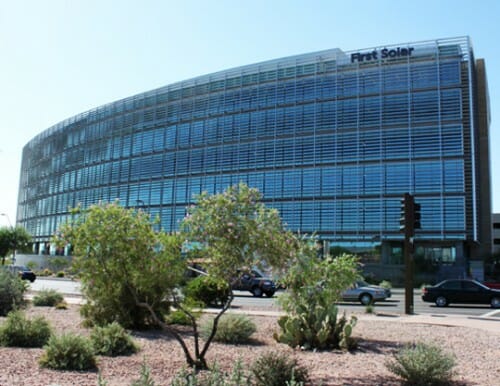
Second, I said that the whole solar business was completely driven by subsidies. If the subsidies were to go away, the heart of the business would go away faster than pets.com. I specifically mentioned First Solar in a positive context here, saying that though they where wholly dependent on subsidies for their revenues, they at least acknowledged as a corporate strategy they needed to get costs low enough to compete without subsidies. (Someday, solar will get to that point, I hope, but I am skeptical that current approaches will yield the breakthrough, but that is another discussion).
If you want to understand the financial problems First Solar is having, let me show you four items.
First, from their 2010 annual report:
Geographic Risk. Our solar modules are presently predominantly sold to our customers for use in solar power systems concentrated in a single geographic region, Germany. This concentration of our sales in one geographic region exposes us to local economic risks and local public policy and regulatory risk in German.
This is way back in the notes on page 133. By the way, I took a whole course in business school on reading financial reports. Here is the key lesson for those not in the financial industry: read them from the back. Skip all the glossy crap at the front, go straight to the notes.
OK, here is the second bit of information. Here is a world map of solar insolation, which is essentially the total solar energy available to produce power in a location when adjusted for atmosphere, weather, latitude, etc.

See Germany? I won't insult your geographic knowledge by pointing at it, but much of Germany is in that yellow-green color which, for solar potential, means (in scientific terms) "it sucks." Let's zoom in, and compare it to the US to get a feel for it (combined from two charts here)

Apparently the better sites in Germany have the same solar potential as ... Seattle! The sliver of absolute best sites in Germany have approximately the same solar potential as Buffalo, NY.
So we have a company whose fortunes are dedicated almost entirely to selling solar panels into one of the most unpromising solar sites in the world. Why is Germany buying so much solar?
OK, here is the third bit of information. For years Germany had enormous feed-in tariffs (mandated above-market minimum prices) for solar electricity:
The German feed-in tariff scheme has been in operation since 1991 and is regarded as one of the most successful in the world. In Germany, feed-in tariff rates are differentiated according to the source of the renewable energy. Separate tariffs are determined for biogas, biomass, hydroelectric, geothermal, solar and wind energy sources. The tariff paid for solar generators varies between EUR 45.7c/kWh and EUR 57.4c/kWh, depending on the capacity of the system and other design features. The tariff is greater for generators that are attached to the roof of a building or structure and greater again for generators that are attached to another part of a building. In Germany, the feed-in tariff is paid for a period of 20 years
Note the language from several years ago where "most successful" is determined without references to costs.
0.574 Euros per kWh is equal to about $0.75 today and even more several years ago when exchange rates were higher. Remember this is a wholesale price, and should be compared to a $0.04 to $0.06 wholesale electricity price in the US (I use US numbers to as its not clear to me Europe has a particularly competitive wholesale market. The French have some sort of fixed price system set around $0.06).
However one wants to look at it, these are enormous subsidies. People putting up solar panels in Germany were getting paid 10-15x what a market price for the same electricity might have been.
Finally, here is the fourth piece of evidence leading to First Solar's woes. In 2010 and 2011 Germany, whose consumers began to balk at paying the highest electricity rates in the world in order to subsidize the method of electrical generation least suitable to Germany, began substantially cutting these tariffs. In 2012 they will cut them even further:
German Environment Minister Norbert Roettgen and Economy Minister Philipp Roesler are set to hold a press conference on Thursday to outline the government's new approach on subsidies. However, the indications are that the cuts will be heavier than the market has been expecting:
- a 30% cut in the feed-in-tariff (FIT) to 13.5 cents per kilowatt hour for new large solar installations
- and a 20% cut in the FIT to 19.5 cents for new small plants
The market has of course been expecting cuts in the German FIT system. However, this news is decidedly worse than expected and likely to continue to pressure solar stocks - particularly those such as Yingli (YGE) with a significant exposure to German solar demand.
From a peak of $0.75 per kWh, Germany will now pay $0.255 per kWh for smaller installations, still four times the market price for wholesale electricity but only a third of what they paid during First Solar's boom years. As I wrote yesterday, Germany was essentially paying $2 for milk from brown cows and $25 for milk from black cows. This can't be sustained.
If one assumes a wholesale electricity price of 6 cents, First Solar's German customers were getting a 92% subsidy. Sure, First Solar now faces other problems like Chinese competition and they have shot themselves in the foot on quality, but at the end of the day the only way they can survive is to convince some other government to turn on the taxpayer money spigot to keep them in business. I am hoping we in Arizona and the US will not be the suckers, but I fear that we will. One can argue the projects I discussed the other day, including the one where we taxpayers loaned First Solar the money to sell its solar panels to its own subsidiary, are evidence of this. My guess is that First Solar will be throwing a lot of money and time towards Obama, praying for his re-election.
My readers recently taught me this trick for trying to identify an image. Go to this link:
Click on the little camera in the right-hand side of the search box. This brings up a sort of reverse image search, where you can upload an image or put in an image URL and it will give you a guess as to what it is.
Update: I found a bit more time to give some more background on First Solar and German feed in tariffs here.
If I had the time, I would love to try to research and list every subsidy recieved by a company like First Solar. Here are just a few:
First Solar is an Arizona-based manufacturer of solar panels. In 2010, the Obama administration awarded the company $16.3 million to expand its factory in Ohio -- a subsidy Democratic Gov. Ted Strickland touted in his failed re-election bid that year.
Five weeks before the 2010 election, Strickland announced more than a million dollars in job training grants to First Solar. The Ohio Department of Development also lent First Solar $5 million, and the state's Air Quality Development Authority gave the company an additional $10 million loan.
After First Solar pocketed this $17.3 million in government grants and $15 million in government loans, Ex-Im entered the scene.
In September 2011, Ex-Im approved $455.7 million in loan guarantees to subsidize the sale of solar panels to two solar farms in Canada. That means if the solar farm ever defaults, the taxpayers pick up the tab, ensuring First Solar gets paid.
But the buyer, in this case, was First Solar.
A small corporation called St. Clair Solar owned the solar farm and was the Canadian company buying First Solar's panels. But St. Clair Solar was a wholly owned subsidiary of First Solar. So, basically, First Solar was shipping its own solar panels from Ohio to a solar farm it owned in Canada, and the U.S. taxpayers were subsidizing this "export."
But this is just a few of them, even on this deal. For example, the Canadian solar farm very likely picked up federal and provincial subsidies from Canada, and even more likely gets some kind of subsidized feed-in tariff (meaning that an above-market wholesale rate is paid for its electricity). This sort of feed-in tariff, which is paid by electricity consumers, is wholly un-transparent and likely makes up the large bulk of solar subsidies. I know the state of Arizona threw a lot of money at First Solar as well (which is headquartered in the Phoenix area.)
During First Solar's boom years, the company was mainly supported by sales to Germany, probably one of the worst solar sites in the world after perhaps Seattle. But the German government mandated feed-in tariffs for solar that were five times (or more) the market price for electricity. It was like saying that, while milk generally goes for $2 a gallon, the government mandated that milk from brown cows could be sold for $10 a gallon, and what's more, consumers had to buy it.
The House Your Tax Money Built
I found this picture, c. 1961, in some old photos my parents took. From the photos around it, it looks to have been taken on a driving tour of ante-bellum mansions in Louisiana and Mississippi.

Update: Readers identified it as Longwood, an old mansion in Mississippi, which appears to have been fixed up since this was take.n

