Archive for the ‘Politics’ Category.

Our Great Political Sport: Scoring Points Off Tragedy

If one needs any skill as a politician, it is the ability -- with a straight face -- to, with no evidence whatsoever or even against countervailing evidence, blame any tragedy that occurs on your own personal bete noir.  Thus the Gabriel Giffords shooting was due to un-civil discourse by Conservatives, Benghazi was due to a YouTube video, the Boston Bombings were a results of too lenient immigration policy, the Newtown killings were due to the excess influence of the NRA, and the Gosnell murders were due to the legality of abortion.

In this same vein I received this email from California State Senator Fran Pavley

The recent Ventura County wildfires were just the latest example of the huge costs of climate change to California, serving as a reminder of the need for continued action, Sen. Fran Pavley (D-Agoura Hills) said Thursday. Presiding over a hearing of the Select Committee on Climate Change and AB 32 Implementation, Sen. Pavley noted that the unseasonably early wildfire in Ventura County two weeks ago generated $10 million in firefighting costs. The dangers of climate change are no longer an abstraction, Sen. Pavley said.

“We can’t afford extreme climate, and so California doing its fair share to reduce greenhouse gas emissions is incredibly important,” Sen. Pavley said.

Wildfires are one of many costs of climate change, environmental officials and experts said at the hearing. California also faces flooding, heat waves and threats to its drinking water system.

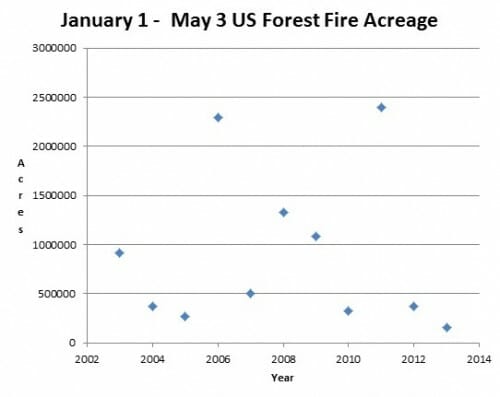
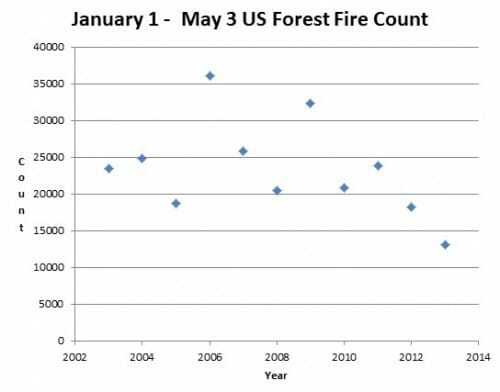
Even before atmospheric levels of CO2 rose, the US had thousands, even tens of thousands of wildfires a year.  So against a backdrop which would expect many fires in California even absent climate change (natural or man-made), it would be heroic to attribute one single fire to the effect of mankind's  CO2 production.  But it is even more astounding given that wildfires in the US are actually down so far this year -- way down.  Here is the data source, and here are two charts the Real Science blog prepared from this data.
screenhunter_275-may-05-05-06 screenhunter_276-may-05-05-07

Undermining Your Own Argument

Apparently Leftist blogger Meg Lanker faked a rape threat against herself in an attempt to Conservatives look bad.  OK, this is sad and pathetic, even more so because it is almost guaranteed that her political allies will first forgive her, and then defend her actions as some sort of brave and necessary action to fight patriarchal... uh, whatever.    It is also an incredibly dangerous action at a university, given that the Obama Administration has demanded that schools eliminate due process from on-campus sexual assault allegations and tilt their judicial process, such that it is, against accused male students.  Had she done this at, say, Yale and actually framed a particular guy, that guy would probably be kicked out of school already.

I won't add any more critique of Ms. Lanker.  Just assume that I am appalled by her actions.  But let me raise an issue with the Conservative critique of Ms. Lanker:  No one seems to be able to resist the temptation to comment on her looks and her weight, two things that (to my knowledge) are absolutely irrelevant to the discussion.  They are just completely ad hominem.  Stacy McCain engages in it, for example.   The posts on this Facebook page (which perhaps is a hoax itself, given the ungrammatical and frankly absurd wording of the header phrase) are even more abusive in this same vein.  Seriously folks, it is rather undermining to your argument that Lanker was exaggerating the boorishness of men with her fake threat when you jump on her Facebook page and engage in boorish ad hominem attacks.

Update:  Holy moly did I get the wrong link for the Stacy MCain post.  I will leave the link above as-is because it is kind of funny.  I had this link on my clipboard because I wanted to suggest them to my teenage daughter as a way to deflect unwanted (by dad) male attention.  The Stacy McCain link is here.


A Guide for the Left: Using Abortion to Understand the Passion of 2nd Amendment Advocates

My new Forbes column is up, and discusses the incredible similarity, in my experience, between gun and abortion advocates.  I find this particularly interesting because, in many cases, the occupants of each camp hate each other.

The most important common trait they share is that they both tend to feel (and act) like they are standing on shifting sands.  They both feel that their Constitutional rights (for guns as written in the 2nd Amendment, and for abortion as clarified in Roe v. Wade) are under constant attack by a powerful and vocal minority.  They share almost the exact same sense of paranoia (I don’t mean any negative connotation to that word — as a libertarian, I am paranoid about a lot of things).  As a result, they feel the need to hold the line against every regulation or incursion, no matter how seemingly reasonable, fearing the narrow edge of the wedge that will eventually threaten their core rights.  They know in their hearts that the true intent of regulators is to work towards outright bans, so even seemingly “reasonable” and narrow limits are treated as a Trojan Horse and opposed with an energy and vehemence that seems over-the-top to people outside of the debate or on the opposing side.

Lurching From One Emotionally-Driven Piece of Legislation to the Next

The Left is worried that Conservatives will jump on the fact that the Boston killers were immigrants to slow down immigration reform:

the anti-immigration right has jumped on this morning's news to argue that this is not the time to loosen our immigration laws. After all, the two guys who set off bombs at the Boston Marathon have turned out to be a pair of immigrants. As radio host Bryan Fischer says, "Time to tighten, not loosen, immigration policy." Greg Sargent comments:

It’s unclear thus far how widespread the effort among conservatives will be to connect the Boston bombing suspects to the immigration reform debate. But it’s certainly something that bears watching. If this argument picks up steam, it will be

another indication of how ferocious the resistance on the right to immigration reform is going to get.

I think it's safe to say that this argument will pick up steam. Why wouldn't it, after all? It's a gut punch to the idea that immigrants are no more dangerous than natives, and it doesn't matter which side logic is on. It's a strong appeal to emotions, and it's probably an effective one.

Wow, it would not have occurred to me to justify immigration restrictions (in a nation where we are basically all immigrants) based on the bad actions of a couple of individuals.  But since the Left recently tried to do exactly this with gun control, to justify restrictions on millions of law-abiding people based on the actions of one person, I guess they know what they are talking about.  The whole demagogic tendency is sickening.  While I would love to see radical immigration reform, including the right of most anyone to be legally present and working in this country (though not necessarily in line for citizenship or safety net benefits), I have pretty low expectations.

Drum gives a good answer, but the question he is asked reflects this pathetic kind of political opportunism

A few days ago, someone asked: Who are you secretly hoping the bombers turn out to be? My answer was, whatever kind of person is least likely to have any effect whatsoever on public policy.

Arguing Against Personal Interest

The best time to argue for general principles is when they work against one's own interest, to firmly establish that they are indeed principles rather than political opportunism.  Two examples:

First, from a topic rife with political opportunism, the Supreme Court a three-judge panel recently ruled Obama's NLRB not-really-recess appointments were unconstitutional.  I think that was the right decision,  but a President has got to be able to get an up or down vote in a timely manner on appointments.  As much as I would love to see all of Obama's appointments languish for, oh, four years or so, and as much as I really don't like his activist NLRB, having to resort to procedural hacks of this sort just to fill administrative positions is not good government.  The Senate rules (or traditions as the case may be) that even one Senator may put a hold on confirmations is simply insane.  While I am a supporter of the filibuster, I think the filibuster should not apply to certain Constitutionally mandated activities.  Specifically:  passing a budget and appointment confirmations.

Second, readers of this blog know how much I dislike our sheriff Joe Arpaio.  He was unfortunately re-elected a couple of months ago, though the vote was closer than usual.  This week, an Arizona group who also does not like Joe has announced it is going to seek a recall election against him.  Again, as much as I would like to see Arpaio ride off into the sunset, this practice of gearing up for recall elections just days after the election is over is just insane.  It is a total waste of money and resources.  While I don't like to do anything that helps incumbents, there has to be some sort of waiting period (perhaps 1/4 of the office term) before we start this silliness.

Thoughts On Election Spending

It is pretty standard to read lamentations about how high spending was in the most recent election.  However, it strikes me that election spending was irrationally low.  With stakes literally in the trillions (differences in tax policy, crony protection of certain industries and groups, etc.), it is a wonder to me that more money is not spent.

Political spending is rising because we have given the government insane powers over, well, everything.

The Wasted Vote Fallacy

Republicans before the election worked to convince Libertarians that a vote for Gary Johnson (or any other third party) was a wasted vote -- that Libertarians needed to be voting against Obama and therefore for Republicans.  Some libertarians have argued that the only way to change the Republican Party is from within.  Libertarians need to join the party and then work to make the party less statist.

I thought this was a crock at the time and think so even more now.  Here is the key thought:  Republicans are not going to change their platform and their candidates and their positions to woo voters they are already getting.  After the election, no one in the Republican leadership was talking about what a mistake it was to run a big government Republican like Romney -- the ex-governor of Massachusetts for God sakes -- who authored the predecessor to Obamacare.  No one was wondering about Gary Johnson as a 2016 candidate.

What the GOP did do is panic at the shellacking they got among Hispanic voters.  The ink was not even dry on the ballots before Republican leadership was considering abandoning their anti-immigrant stance in order to win more Hispanic voters.  I am not sure that will get them Hispanic voters, but whether they are right or not, that is the conversation they were having.  They were asking, "How do we attract voters WE DID NOT GET" -- not, "how do we attract voters we are already getting".

The turn of the century Progressive Party (William Jennings Bryant, free silver, etc) never won a Presidential election but both the Republicans and Democrats co-opted many of their platform positions because they sought to attract voters they were losing to the Progressives.

I don't see how Libertarians can look at a party that has fielded John McCain (author of speech restrictions) and Mitt Romeny (author of the proto-Obamacare) as any sort of long-term home.  Heck, the Republicans more seriously considered Rick Santorum and Donald Trump than Gary Johnson or Ron Paul.  I respect what Mr. Paul has done in bringing libertarian issues to the debate, but as long as he keeps reliably delivering his voters to whatever lame statist candidate the party fields, the GOP is never going to seriously address libertarian concerns.

I Don't Get It

I refuse to follow the ins and outs of polls and the horserace aspects of elections.  But I couldn't miss all the blog activity that somehow Nate Silver is purposefully corrupting his election predictions for some partisan reason.

A physics professor once used to tell us that if we don't even know the sign of the answer, then we should assume we have no understanding of what is going on.  Well, I don't even know the sign of the answer here.  Would a partisan inflate Obama's predicted chances of winning, thus giving him some sort of momentum?  Are there voters who just want to be on the winning side and vote on election day for whomever they think is going to win?  Or would a partisan make his man look worse in order to panic the base and make sure they get out and vote?

So I Made The Mistake of Watching Part of the Third Debate...

It was an amazing spectacle.  Two men fighting for 90 minutes to stand on the same patch of ground.  None of the issues I care about -- escalating drone strikes, rendition, indefinite detainment, Presidential kill lists, warrant-less wire-tapping -- were discussed because both men supported all of the above.  Somehow in just 11 years since 9/11, all of these issues seem to be beyond debate.  Amazing.   I have the third party debate Tivo'd, and I hear these issues got more play.  By the way, here I am in my debate gear

PS-  I am increasingly coming to the counter-intuitive conclusion that if one cares about ending these abuses of Executive power associated with the never-to-end-because-it-is-so-useful-to-politicians war on terror, then one should be rooting for Romney to win.  Not because he will end these practices -- no, I would expect him to enthusiastically embrace them.  But because the natural opponents of these practices on the Left will finally start to speak up and oppose them once they are not being practiced by their guy.  Right now, these practices are being expanded in a vacuum with almost no push-back.

On Private Job Creation, Obama and Reagan are Tied

Obama claims to have created more jobs than Reagan.  Republicans fire back with charts that say otherwise.

Here are the true numbers for private jobs created by these Presidents in office:

  • Reagan:    zero
  • Obama:     zero

Just once I would like to see a Presidential candidate answer:

"Why, I didn't create a single private job in office.  Anyone I hire is by definition a public employee.  The best I can do is to keep government out of the way, as much as possible, of the private individuals who do create new businesses and new products and new technologies that tend to lead to more private employment.  The worst thing I can do is to try to be investment-banker-in-chief.  Every dollar I hand to some company I like is money taken out of the hands of 300 million private individuals, who collectively know a hell of a lot more than I as to what makes for a better business investment  (and by the way they have far better incentives that I as well, since they are investing their own hard-earned money, and should I develop the hubris to play the stimulus game, I would be investing your hard-earned money."


A Good Reason to Vote For A Write In Candidate...

... because it really annoys public officials when you don't vote for the candidates they have approved.

Every write-in entry must be verified with the list of legitimate write-in candidates for that election, by a three-member review team. In the August primary election, Maricopa County elections officials saw the biggest ratio of fake-to-legitimate write-in candidates in recent memory: Among 90,433 entries in write-in slots, 1,738 were votes for legitimate write-in candidates.

Each fake entry cost Arizona counties money and manpower and slowed down the tabulation process, said Maricopa County Recorder Helen Purcell, who oversees elections.

“They think they’re making some kind of a statement or being cute,” Purcell said.

The rise of write-in candidates - over 90,000 in one small-turnout primary election, strikes me as a very interesting untold story about the election and a metric of voter frustration with the whole process.

So don't be afraid to go off the board -- it is your right, no matter how much it irritates petty bureaucrats.  Mal Reynolds for President!

Is This Really Political Discourse? My First and Last Experience with the Debates

I wasn't planning on watching the debates, but my wife made me watch the first 20 minutes.  Is this really what passes for political discourse in this country?  I was particularly struck by the appeals to unnamed authorities -- both candidates said something like "I saw a study the other day [unnamed] that said my plan was great" or "your plan was bad."  Seriously pathetic.

And, after the corporatism and cronyism of the last 8+ years, the fact that Romney could not explain why it made sense to cut tax rates but eliminate deductions just convinced me he deserves to lose.  He was losing to class warfare rhetoric on tax cuts, when he should have been taking the high ground, even with the occupy wall street folks, saying that it was time to stop tilting the tax code towards special interests and populist fads at least one of which -- the tilting of the tax code to home ownership -- helped drive the recent economic downturn.

I blog and don't tend to debate in real time, because I always think of great quips hours later, but even I had the perfect rejoinder for Obama in real time when he said, "I think we should return to Clinton era tax rates, when the economy was great and growing."  Romney should have said, "If I am President, I will happily work with Democrats to do just that, as long as they agree to return to Clinton era spending levels.   After all, if government policy during that era was really so perfect for the economy, then spending levels must have been appropriate as well."

I don't plan to watch any more of this garbage until and unless they include someone other than the Coke and Pepsi candidates.   I'd like to see Gary Johnson but heck, even adding a Marxist would probably help.

Quote of the Day

Reacting to the unbelievable economic ignorance he has seen in recent campaign ads, Don Boudreaux writes

If astronomy operated similarly to politics, the world’s top astronomers would compete furiously amongst themselves to see who could most effectively assure the general public that the sun orbits around a stationary flat earth – a flat earth that was created just 4,000 years ago and which sits atop a tower of turtles.

A Good Reason To Get Obama Out of Office

OK, there are lots of reasons to get Obama out of office.  The problem is, that for most of them, I have no reasonable hope that Romney will be any better.  Corporatism?  CEO as Venture-Capitalist-in-Chief?  Indefinite detentions?  Lack of Transparency?  The Drug War?   Obamacare, which was modeled on Romneycare?  What are the odds that any of these improve under Romney, and at least under Obama they are not being done by someone who wraps himself in the mantle of small government and free markets, helping to corrupt the public understanding of those terms.

But here is one issue Obama is almost certainly going to be worse:  Bail outs of states.  States will start seeking Federal bailouts, probably initially in the form of Federal guarantees of their pension obligations, in the next 4 years.  I had thought that Obama would be particularly susceptible if California is the first to come begging.  But imagine how fast he will whip out our money if it is Illinois at the trough first?

Now that Chicago's children have returned to not learning in school, we can all move on to the next crisis in Illinois public finance: unfunded public pensions. Readers who live in the other 49 states will be pleased to learn that Governor Pat Quinn's 2012 budget proposal already floated the idea of a federal guarantee of its pension debt. Think Germany and eurobonds for Greece, Italy and Spain.

Thank you for sharing, Governor.

Sooner or later, we knew it would come to this since the Democrats who are running Illinois into the ground can't bring themselves to oppose union demands. Illinois now has some $8 billion in current debts outstanding and taxpayers are on the hook for more than $200 billion in unfunded retirement costs for government workers. By some estimates, the system could be the first in the nation to go broke, as early as 2018....

For years, states have engaged in elaborate accounting tricks to improve appearances, including using an unrealistically high 8% "discount" rate to account for future liabilities. To make that fairy tale come true, state pension funds would have to average returns of 8% a year, which even the toothless Government Accounting Standards Board and Moody's have said are unrealistic....

Look no further than the recent Chicago teachers strike. The city is already facing upwards of a $1 billion deficit next year with hundreds of millions of dollars in annual pension costs for retired teachers coming due. But despite the fiscal imperatives, the negotiation didn't even discuss pensions. The final deal gave unions a more than 17% raise over four years, while they keep benefits and pensions that workers in the wealth-creating private economy can only imagine.

As a political matter, public unions are pursuing a version of the GM strategy: Never make a concession at the state level, figuring that if things get really bad the federal government will have no political choice but to bail out the pensions if not the entire state. Mr. Quinn made that official by pointing out in his budget proposal that "significant long-term improvements" in the state pension debt will come from "seeking a federal guarantee of the debt."

I had not paid much attention to the Chicago teacher's strike, except to note that the City basically caved to the unions.  The average teacher salary in Chicago, even without benefits, will soon rise to nearly $100,000 a year for just 9 months work.  But I am amazed at the statement that no one even bothered to challenge the union on pensions despite the fact that the system is essentially bankrupt.  Illinois really seems to be banking on their favorite son bailing them out with our money.

Priceless

I usually don't take notice of this type of story, even when it involves a lot of schadenfreude in seeing problems at Harvard.  But how can you not enjoy a story about over a hundred Harvard students cheating on an open-book take-home test in ... get ready for it ...  Goverment 1310 – “Introduction to Congress.”  Given the subject of the course, I wonder if the ones who did not cheat could be failed for not really understanding the subject matter?

Things You Didn't Know About the European Debt Crisis

Apparently the most important issue is not the unsustainability of deficit spending, lack of fiscal responsibility, or the tough problems of balancing expensive bailouts with expensive defaults.  It is making sure the timing of a Greek default does not negatively affect Obama's re-election.  From the Independent (UK) entitled, "Obama asks eurozone to keep Greece in until after election day"

American officials are understood to be worried that if they decide Greece has not done enough to meet its deficit targets and withhold the money, it would automatically trigger Greece's exit from the eurozone weeks before the Presidential election on 6 November.

They are urging eurozone Governments to hold off from taking any drastic action before then – fearing that the resulting market destabilisation could damage President Obama's re-election prospects. European leaders are thought to be sympathetic to the lobbying fearing that, under pressure from his party lin Congress, Mitt Romney would be a more isolationist president than Mr Obama.


Proof We Live In a World With Statist Assumptions

Only a mostly-statist world would consider Paul Ryan a libertarian.

Also, here is my growing Romney fear -- that this guy shares many of the same assumptions as President Obama about the government's role in top-down management of the economy.  So far, his rhetoric has the feel not of seeking freedom from state authority but instead that, in the context of top-down state authority, he will be the better, smarter manager.  In other words, we are doomed.  Which is about the way I sum up every Presidential election.

Total Symmetry

I read a few political blogs from the Left and Right - not many, because I cannot stand the whole team-politics thing, but I feel like I need to hear what they are saying.  Apparently, Conservatives (after the Supreme Court Obamacare decision) are saying that their side is too soft, too amenable to being intimidated by the Left.

Here is my observation from reading a fairly equal helping of political blogs from both sides:  These sort of things are cherished beliefs of both sides.  I don't have the post-holiday energy to hunt up the links, but I can say with confidence that both Left and Right seem to believe, or at least to write that:

  • Their own side compromises more than the other side does
  • The other side is much more bare knuckles, doing what it takes to win.  Their own side has ethics that always causes them to stop short
  • The other side is better at keeping its members from breaking ranks
  • The other side is raising more money than their side
  • The other side is a vast coordinated conspiracy using a top-down imposed message while their own side is mainly individuals acting independently

Now That Mandates Are Effectively Legal, Here is The Next One

You have to watch politicians' commercials

The Dish Network, in its continuing effort to attract new viewers, introduced a new DVR called the Hopper earlier this year. The Hopper's main appeal is that it allows you to skip past commercials entirely, and unsurprisingly, TV networks aren't very happy about this. But guess who else is unhappy?

At a Wednesday hearing on video distribution held by the Communications and Technology Subcommittee of the Energy and Commerce Committee, [Rep. John Dingell, D–Clueless] complained that the service will allow potential voters to skip past important commercial messages.

"I've got an election coming up, like all my colleagues," Dingell said, during his questioning of Dish Network Chairman Charlie Ergen. "We all put political ads on the local stations to reach our constituents. The Hopper potentially limits the ability of every member of this subcommittee to reach constituents to help them make up their minds on Election Day.

"Do you understand and appreciate the concerns that the politicians up here on the dais and other politicians everywhere will feel about that, yes or no?" Dingell asked.

Quick Observations about the NFIB

The Wall Street Journal editorial page had a piece on the "smearing" of small business.  Apparently, in the political battle over Obamacare, the NFIB has become the new target of the left.

I have not seen these attacks on the NFIB, but after the bizarre joint attacks on ALEC, I certainly believe they exist.  The WSJ summarizes these attacks this way:

According to the smear campaign against the National Federation of Independent Business, or NFIB, small businesses are thrilled with the Affordable Care Act and the trade group betrayed the 300,000 companies it represents. Among the dozens of media outlets publishing anti-NFIB op-eds disguised as reporting, Reuters recently asked in a headline, "Who truly speaks for small businesses?" The question mark was superfluous.

The chairmen of the House Progressive Caucus, Democrats Raul Grijalva and Keith Ellison, chimed in with a letter accusing the NFIB of acting against "the best interest of small business owners" and "the popular opinion of the American small business community." They suggest Karl Rove is behind the suit, as he is everything else.

As a member of the NFIB  (I joined several years ago specifically due to their work on health care) I believe the NFIB addresses issues that really concern our company better than any other group I have found.  Certainly they are far better than the Chamber of Commerce, which tends to be a group of large companies more interested in crony handouts than free competition.  Members get polled constantly to see what issues we care about and to see what positions we would like the NFIB to take.

This latter process makes the NFIB among the most virtuous of the organizations to which I have belonged.  Certainly the Sierra Club, way back when I was a member, never polled me on whether I preferred them to focus their efforts, say, on political activism or true conservation efforts.

I am exhausted by journalists and politicians on the Left who have barely even worked in a profit-making venture, much less run one, who speak with great authority on what small business owners should or should not want.  Our company is in the business of making long-term operations bids.  For the last three years, we have had to bid two numbers for our expenses, one with Obamacare and (a much lower one) without.  Never in 25 years of our history has any external factor, government-drive or not, made this much contingent difference to our bids.  So it is simply insulting to be told that it should not make any difference to me, or that its effects will be universally cost-reducing.

Further, it is really, really hard for a small business to parse the impact of Obamacare because it is #$&*#$ hard to figure out just what its provisions are.  McDonalds can afford to hire a team of experts to figure it out, and to start gaming it by using its political clout to seek special exemptions and treatment from the Obama Administration.  We cannot.  The NFIB is the only organization, public or private, in the country that has actually helped us understand the law's requirements.  For several years running, they have sent an expert, at their expense, to our industry gatherings to help educate companies on the law.

Only One Reason To Do This

There is only one reason to be concerned that fundraiser attendees might record the session -- because one knows the candidate is giving tailored and mutually contradictory messages to different groups.   Obama has a different speech, I suppose, for the 1% than he does for the 99%.   Which is no big surprise, since it is a practice as old as modern campaigning* and one I am sure both parties engage in.  But it is probably a larger issue for Obama -- when so much of a politician's campaign style rests on demonizing certain groups, groups that are also large campaign contributors, it must be a tricky business tailoring his message.


* footnote:  I leave this in a footnote because I don't want to be seen as breaking Godwin's law by bringing up the Nazis, but its almost impossible to talk about modern campaigning techniques in the age of mass media without mentioning them.  They pioneered many of the techniques used by about everyone nowadays.  One thing they did was to create focused messages for different groups -- tailors or farmers or city people or industrial workers or Catholics or whoever.  They were incredibly cynical in how they did this, even by modern standards, and didn't really care what the message was, and so ended up with wildly contradictory promises, e.g. promising farmers higher prices for their produce and promising urban laborers lower food prices.

First Rule of Budget Politics

Proponents of higher taxes and larger government often criticize small government folks in Congress for being "obstructionist" and "not willing to compromise."

But here is the problem:  Coyote's first rule of budget politics is to never trade current tax increases or "temporary" spending increases for future spending cuts, because the future spending cuts never happen.  Ever.  Not once.  In fact, I would not agree to trading current tax increases for current spending cuts, because taxes will stay forever but spending cuts will just be over-ridden in a few months.

Here is a recent example:

Last summer, Republicans in Congress agreed to increase the federal debt limit in exchange for the Democrats’ pledge to cap future spending at agreed-upon levels. The compromise was embodied in the Budget Control Act; discretionary spending was to increase by no more than $7 billion in the current fiscal year. I wrote yesterday about the fact that the Democrats intended to violate the Budget Control Act by increasing deficit spending on the Post Office by $34 billion. The measure probably would have glided through the Senate without notice had Jeff Sessions not challenged it. Sessions insisted on a point of order, based on the fact that the spending bill violated the Budget Control Act. It required 60 votes to waive Sessions’ point of order and toss the BCA on the trash heap.

Today the Senate voted 62-37 to do exactly that. This means that the consideration that Republicans obtained in exchange for increasing the debt limit is gone. Moreover, some Republicans–I haven’t yet seen the list–voted with the Democrats today.

One principal lesson can be drawn from this experience. It happens all the time that Congressional leaders will trumpet a budget agreement that allegedly saves the taxpayers trillions of dollars–not now, of course, but in the “out years.” But the out years never come. Tax increases are rarely deferred to the out years; they take place now, when it counts. But spending cuts? Never today, always tomorrow.

Purported agreements about what federal spending will be years from now are utterly meaningless. Congressmen will make a deal, brag about the ostensible savings in the press, and then walk away from it the moment our backs are turned, as the Democrats (and a handful of Republicans) did today.

When folks say, "we just want a compromise" on budget issues, what they are really saying is "we want to roll you.  We are hoping you are stupid enough to trade for future cost reductions that will never happen.  We can get away with this because we have an ally in the press, who always treats promises of future cost reductions as entirely credible and believable and thus paint those who are skeptical of them as radical obstructionists."

Whatever the Motives, the Results Look Eerily Like Racism

I have been reading of late some histories of Germany in the 1930's, with a particular emphasis on racial laws and policy.   Over time the expanding bans on Jewish participation in the economy and society as well as preferences given to non-Jews for government jobs led to some practical problems, including:

  • What percentage of Jewish blood made one Jewish?  The Nazis messed around with this problem a long time, in part because of Hitler's absolute reluctance to get involved in such details.  Was it one grandparent?  Three grandparents?
  • How does one test for such things?  In the thirties, there was an boom in geneology research in Germany, as everyone raced around trying to figure out what evidence was sufficient to establish someone's race

It would be nice to think we put this kind of thing to bed, but here we are in the 21st century running around trying to answer the exact same questions

This story reminded me of the 1980s case of the twin red-haired Boston firefighters who claimed to be black, based on a photo of a great-grandmother and alleged oral history. While I remembered that they had gotten fired for their alleged fraud, I didn’t remember this detail:

Under current rules, said [general counsel to the state personnel office] Ms. Dale, candidates who say they are members of minority groups are judged by appearance, documented personal history and identification with a minority community. Disputes over claims of minority status are resolved by the Department of Personnel Administration.

 And indeed, there eventually was a two-day administrative hearing, in which the hearing officer determined that the twins failed all three criteria, and thus were not black. A judge upheld the ruling, finding that the twins had claimed minority status in bad faith.I have to admit being under the impression until now that as a legal matter, minority status was an in issue of self-reporting. But at least in the Massachusetts Civil Service system, one can get fired for “racial fraud.”

  • Every year, in the name of some sort of racial harmony, I have to sit down and report to the government on the race of each of my employees.  For 364 days a year I can ignore the race of my employees, but one day a year the government makes me wallow in it.  Here are part of the instructions:

Self-identification is the preferred method of identifying the race and ethnic information necessary for the EEO-1 report. Employers are required to attempt to allow employees to use self-identification to complete the EEO-1 report. If an employee declines to self-identify, employment records or observer identification may be used.

Where records are maintained, it is recommended that they be kept separately from the employees basic personnel file or other records available to those responsible for personnel decisions.

Race and ethnic designations as used by the Equal Employment Opportunity Commission do not denote scientific definitions of anthropological origins.

I am told we are trying to create a society free of racism, but the results sure look a lot like racism to me.

The Perfect Example of Politics over Policy

I don't think you could find any better example of paying off one's political constituents at the cost of out groups than this:

Congressional Democrats and the White House have agreed to pay for a bill to freeze student loan interest rates for a year by raising taxes on so-called S Corporations, according to a top Senate Democrat and senior House and Senate aides, but Republicans said the tax increase may ensure the bill’s defeat in the Senate.

Apparently, the taxpayer-subsidized rate of 3.4% on student loans is set to go up to a less-subsidized 6.8% in a couple of months.    So to keep this subsidy rolling, Congress is proposing to tax S-Corporations, mainly used by entrepreneurs and small businesses  (disclosure:  including mine) to avoid double taxation of business income.

I don't think its possible to come up with a real policy reason that money should be taken away from entrepreneurs and given to 18-year-olds so they can overpay for college, especially since most of the subsidy for student loans is captured by universities that have simply raised tuition to soak up each successive college subsidy program.  Note that Congress is instituting a permanent tax hike on entrepreneurs in order to give just a 1-year break (ie through the next election) to students.

But this is the perfect political bill.  It takes money from a group likely to be lost to the Administration in the next election anyway (e.g. entrepreneurs and small business people) and transfers it to a group that is very likely to vote for Obama if it votes at all, but needs to be energized to get to the polls.  The Obama Administration was obviously watching the Occupy movement carefully, and noted that much of the angst seemed to be aimed at student loans.

Expect similar payoffs to other constituencies over the next few months.  Oops, here is one already.

A Terrible Idea

I am sure that prosecuting Jon Edwards is a heck of a lot of fun for Republicans, but it is an enormous mistake.  Yes, the guy is a poster child for the hypocritical self-serving jackass that defines exactly whey we hate politicians.  But setting a legal precedent for defining campaign spending subject to crazy election laws more broadly is a terrible idea.  Already, there are prosecutors who, mostly for political reasons, have tried to nail certain politicians for election law violations by labeling certain activities as in-kind political giving.  Down this path lies a world where every institution that offered a candidate's family member or friend a job, or a spot in college, or a book deal, or a consulting contract is subject to ex post facto scrutiny and potential prosecution.