Carnival of the Capitalists
The new Carnival of the Capitalists is up at the Red Prawn.
The host next week is....me! Submissions should be sent via the Gongol submission page here.
Dispatches from District 48
The new Carnival of the Capitalists is up at the Red Prawn.
The host next week is....me! Submissions should be sent via the Gongol submission page here.
Mobile PC has a great top 100 list of great gadgets of all time, from the swiss army knife to the pocket fisherman to the iPod. Really cool idea for a list, and the authors range pretty far and wide for their selections.


After seeing a piece of my son's history curriculum at school, I realized for about the hundredth time just how poor an understanding most people have about the great industrialists of the 19th century, so unfairly painted as "robber barons". While it is said that "history is written by the victors", I would observe that despite the fact that socialism and communism have been given a pretty good drubbing over the last 20 years, these statists still seem to be writing history. How else to explain the fact that men who made fortunes through free, voluntary exchange of products can be called "robber barons"; while politicians who expropriate billions by force without permission from the most productive in society are called "progressive".
To be sure, capitalists of the 19th century sometimes played by rules very different from ours today, but in most cases those were the rules of the day and most of what they did was entirely legal. Also to be sure, there were a number of men who were fat ticks on society, making money through fraud and manipulation rather than real wealth creation (Daniel Drew comes to mind). However, most of the great industrialists of the 19th century made money by providing customers with a better, cheaper product. In the rest of this post, I will look at two examples.
The first is Cornelius "Commodore" Vanderbilt, the person to whom the term robber baron was originally applied (by the New York Times, interestingly enough - some things never change). While Vanderbilt is perhaps best known for his New York Central railroad, the term was actually applied to him earlier in life in his shipping days, where he made a fortune running steamships in and out of New York City. Vanderbilt stood accused of overly predatory tactics in moving into rivals territories. However, in 1859 Harpers Weekly observed (via An Empire of Wealth by John Steele Gordon):
...the results in every case of the establishment of opposition lines by Vanderbilt has been the permanent reduction of fares. Wherever he 'laid on' an opposition line, the fares were instantly reduced, and however the contest terminated, whether he bought out his opponents, as he often did, or they bought him out, the fares were never again raise to the old standard. This great boon -- cheap travel-- this community owes mainly to Cornelius Vanderbilt". (sorry, no link available -- I guess they weren't putting their articles online in 1859)
In many ways, Vanderbilt was the Southwest Airlines of his day, and, just like with Southwest today, towns begged for him to serve them because they knew he would bring down rates. In fact, there is actually another parallel with Southwest Airlines. In the early days of Southwest, most of the airline industry was regulated such that new entrants competing at lower prices were pretty much excluded by government rules. Southwest got around these rules by flying only in Texas, where interstate rules did not apply. Their success in Texas was a large reason for the eventual demise of government regulation that effectively protected fat and inefficient incumbent airlines, with drastically lower fairs the result.
When Vanderbilt first entered the steamship business, most routes were given as exclusive charters to protected monopoly companies, most run by men with friends in the state government. Vanderbilt took on the constitutionality of these government enforced monopolies and, with the help of Daniel Webster, won their case in the Supreme Court. Within a decade, the horrible experiment with government monopoly charters was mostly over, much to the benefit of everyone. While private monopolies have always proved themselves to be unstable and last only as long as the company provides top value to customers, publicly enforced monopolies can survive for years, despite any amount of corruption and incompetence. Vanderbilt, by helping to kill these publicly enforced monopolies, did more than perhaps any other man in US history to help defeat entrenched monopolies, yet today most would call him a monopolist.
By the way, there are two charges against Vanderbilt that partially stick. Those are that he bribed legislators and that he sought out price fixing agreements with his competitors. Both are true, but both need context.
To understand the bribery, one has to recognize that NY state passed a law that you could not be convicted of bribery solely on the evidence of the other party involved in the bribe. In other words, they effectively made bribery legal as long as you were smart enough to do it without witnesses. The real corruption was in the NY legislature at the time. While Vanderbilt's motives were likely not always pure, no one who understands the state of NY at the time would deny that Vanderbilt would have been gutted had he not pro-actively played the bribery game himself in Albany in self-defense.
The price-fixing charge is even easier to deal with in context - basically price fixing agreements were entirely legal at the time. In fact, price-fixing has been thought necessary, particularly in transportation, by politicians of all stripes for centuries - remember as late as the 1970's we had government enforced price-fixing in railroads and airlines. In the 1930's, FDR via the NRA briefly instituted a government price-collusion scheme on the entire economy.
My other featured industrialist here on hug-a-robber-baron day here at Coyote Blog is John D. Rockefeller. At one point of time, Rockefeller controlled 90% of the refining capacity in the country via his Standard Oil trust. He was and is often excoriated for his accumulation of wealth and market share in the oil business, but critics are hard-pressed to point to specifics of where his consumers were hurt. Here are the facts, via Reason
Standard Oil began in 1870, when kerosene cost 30 cents a gallon. By 1897, Rockefeller's scientists and managers had driven the price to under 6 cents per gallon, and many of his less-efficient competitors were out of business--including companies whose inferior grades of kerosene were prone to explosion and whose dangerous wares had depressed the demand for the product. Standard Oil did the same for petroleum: In a single decade, from 1880 to 1890, Rockefeller's consolidations helped drive petroleum prices down 61 percent while increasing output 393 percent.
By the way, Greenpeace should have a picture of John D. Rockefeller on the wall of every office. Rockefeller, by driving down the cost of Kerosene as an illuminant, did more than any other person in the history to save the whales. By making Kerosene cheap, people were willing to give up whale oil, dealing a mortal blow to the whaling industry (perhaps just in time for the Sperm Whale).
So Rockefeller grew because he had the lowest cost position in the industry, and was able to offer the lowest prices, and the country was hurt, how? Sure, he drove competitors out of business at times through harsh tactics, but most of these folks were big boys who knew the rules and engaged in most of the same practices. In fact, Rockefeller seldom ran competitors entirely out of business but rather put pressured on them until they sold out, usually on very fair terms.
From "Money, Greed, and Risk," author Charles Morris
An extraordinary combination of piratical entrepreneur and steady-handed corporate administrator, he achieved dominance primarily by being more farsighted, more technologically advanced, more ruthlessly focused on costs and efficiency than anyone else. When Rockefeller was consolidating the refining industry in the 1870s, for example, he simply invited competitors to his office and showed them his books. One refiner - who quickly sold out on favorable terms - was 'astounded' that Rockefeller could profitably sell kerosene at a price far below his own cost of production.
More here. In fact, many, many of these defeated competitors became millionaires in their own right with the appreciation of the Standard Oil stock they got in the merger.
Eventually the Standard Oil monopoly weakened as most private monopolies do. Monopolies seldom if ever engage in the price-increase games everyone expects them to, but they do get risk averse and lose vitality over time without serious competition. This indeed did happen to Standard Oil, and it missed a number of key market turns, such as the Texas oil boom. By the time is was broken up under the Sherman anti-trust act, Standard's market share had already fallen to 60%. As would be the case many times in history, the government acted on the economic "threat" of Standard Oil at the very time the market was already doing the job.
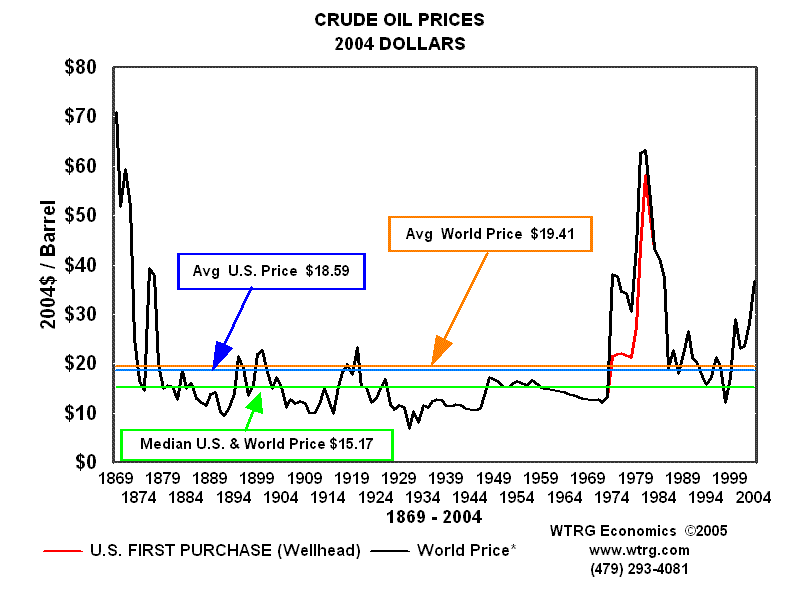
Ever since, people have expended a lot of unnecessary energy getting worried about bigness and monopolies in industry. I always laugh when "progressives" decry the monopoly power of the oil industry to manage prices. I worked for the oil industry in the 80s, and if they had the power to manage prices they sure were doing a crappy job of it. If someone thinks that oil companies have been manipulating prices, they have to explain this chart to me. If prices are manipulated at all, they look like they are being kept low and stable.
Another great example of monopoly paranoia is the near continuous Microsoft-bashing in the courts. The most famous anti-trust case was the successful case by Netscape and numerous other Microsoft competitors attempting to kneecap Microsoft, nominally for monopolizing the browser market. Now lets leave aside the obvious issue of just how consumers are getting hurt by being given a free browser by Microsoft. The plaintiffs apparently successful argument (incredibly) was that through a series of technology and marketing moves, Microsoft prevented competition. If that is so, if competing with Microsoft is so hard, then why are 30% of my visitors using Firefox when none used it a year ago. I use Firefox, and you know what, it took me about 5 minutes to download, install it and start running it. Boom, monopoly gone. Lots more on anti-trust here.
UPDATE: Welcome to the Greenwich Public Schools. Thanks for linking me from your web site. Despite my Arizona home today, I actually lived in Greenwich for a while growing up. You can find other essays on capitalism and individual freedoms here and here, or you can check out Dave Berry, who is much funnier than I am. If you are looking for a stronger defense of free markets than you can find in most public schools, a good place to start is at the Cato Institute.
The government has found over time that it is able to sell higher taxes to the voters on certain items if they can portray those items as representing some socially unwanted behavior. These are often called "sin" taxes. The justification for the tax in its beginning is as much about behavior control as revenue generation. Taxes on cigarettes, alcoholic beverages and even gasoline and plastic grocery bags have all been justified in part by the logic that higher taxes will reduce consumption.
However, a funny thing happens on the way to the treasury. Over time, government becomes dependent on the revenue from these taxes. The government begins to suffer when the taxes have their original effect -- ie reducing consumption -- because then tax revenues drop. The government ultimately finds itself in the odd position of resisting consumption drops or restructuring the tax so it no longer incentivizes reduced consumption so that it can protect its tax revenue collections.
Cigarettes are a great example. In this article, via overlawyered, from Forbes (simple registration required):
Big tobacco was supposed to come under harsh punishment for decades of deception when it acceded to a tort settlement seven years ago. Philip Morris, R.J.Reynolds, Lorillard and Brown & Williamson agreed to pay 46 states $206 billion over 25 years. This was their punishment for burying evidence of cigarettes' health risks.
But the much-maligned tobacco giants have subtly and shrewdly turned their penance into a windfall. Using that tort settlement, the big brands have hampered tiny cut-rate rivals and raised prices with near impunity. Since the case was settled, the big four have nearly doubled wholesale cigarette prices from a national average of $1.25 a pack (not counting excise taxes) in 1998 to $2.10 now. And they have a potent partner in this scheme: state governments, which have become addicted to tort-settlement payments, now running at $6 billion a year. A key feature of the Big Tobacco-and-state-government cartel: rules that levy tort-settlement costs on upstart cigarette companies, companies that were not even in existence when the tort was being committed.
So, a tax that was originally meant to punish supposed past wrong doing by cigarette makers is causing problems because it was... actually doing what it was supposed to by hurting those companies. Lots of good stuff, I encourage you to read it all - basically state governments have gone from opponents of the cigarette companies to their partners. Antarctic Liberation Front opponent Eliot Spitzer comes in for particular attention.
A second example I discussed comes from San Francisco, where a tax aimed at discouraging use of plastic garbage bags was modified so that it collected more money, but no longer discouraged use of plastic.
A third example comes to us via Vodka Pundit, which points out that California now is considering supplementing their gas tax with a per-vehicle-mile tax. The gas tax was always effectively a per-vehicle-mile tax, since the amount of gas you used was proportional to the number of miles you drove. And, of course, the gas tax is far easier to manage than a per-vehicle-mile tax (yes, coming soon, its the odometer auditors!)
So why a need for the new tax? Well, it turns out that Californians are buying a lot of very fuel-efficient cars, including new hybrids, which reduces gas consumption and thus taxes. Of course, this is EXACTLY what most people hope the gas tax is doing - helping to conserve gasoline and reduce emissions and incentivizing people to purchase efficient vehicles. Now California is considering substituting a new tax that collects more money but provides no conservation incentives.
UPDATE: Welcome Carnival of the Vanities! If you're looking to kill more time at work today, check out my rant on the recent New London eminent domain case in front of the Supreme Court titled "all your base are belong to us".
As I wrote here, I think of environmental issues in two categories:
These land-use laws constitute by far the most distressing area to me in environmental law. In the worst cases, these laws can result in what are effectively 100% takings of a person's land without any compensation. (Example: you buy a lot on the ocean for $500,000 to build a beach house. Before you can build it, new regulations are passed making it illegal for you to build a house on that land. Yes, you still own the land, but it is now worthless to you since you cannot use or develop it). Good article on this here (pdf) and a listing of Cato Institute articles on this topic here.
The government is of necessity involved in #1, though we can argue that some regulatory structures are more efficient than others (e.g. trading vs. command and control). Government involvement in #2 is often a mess, and is one reason why private conservation groups and land trusts have made so much headway.
Reason has recently released a fairly comprehensive roundup of private conservation efforts that goes into much more detail on this topic.
Hey, this may be a first -- audit blogging. I have an auditor from the Washington Department of Revenue in my office right now auditing my last two years sales tax returns. She's a nice lady and so far the interaction has been pleasant.
Here is the funny thing - she has spent about 3 hours now trying to figure out what tax rates should apply at my various locations, and she is still at it. I have written several times about the complexity of WA state sales tax variations for lodging, and how they vary by geography (here and here). OK, if your experienced auditor has to spend hours in frustration trying to figure out what tax applies, the system is too complicated.
Update: At halftime I am ahead, with WA owing me $800. Stay tuned.
UPDATE #2: Small potential setback in the 3rd quarter. Several years ago I shifted assets (vehicles) I had bought in Arizona and used for years in Arizona to Washington for operations there. The auditor suggested I may owe use tax on the vehicles in WA. Huh? Use tax drives me up a tree in general, but this seems really crazy. WA is hyper sensitive to this issue because they have high sales taxes and very high vehicle registration fees and neighboring Oregon has not sales tax and lower registration fees.
Today (OK, its the 16th now, so yesterday) is apparently the start date for the Kyoto Treaty. You can find examples of my skepticism about the costs and benefits of the Kyoto treaty here. I won't go back over all that stuff here.
The Washington Post article linked above includes the usual misstatements about global warming, and is fisked here. I particularly liked this line (emphasis mine):
...by uniting the vast majority of the world's nations, Kyoto could equally be the harbinger of an international model that rewards pollution-cutting innovation and pushes countries and companies to pursue cleaner forms of growth
The implication being that the US is the odd man out of a global consensus. But then read further:
The pact, ratified by 141 nations, limits emissions from 35 industrialized countries
See the consensus problem? Yes 141 nations ratified it, but only because 106 of them didn't have to do anything and were exempt. In fact, they were exempted because the framers of the treaty knew that these countries would not ratify the treaty unless they were exempt.
I also enjoyed the implication in the article that America's withdrawal from the treaty is solely based on the stand of President Bush. You very seldom see any mention that the Senate voted 95-0 NOT to sign Kyoto until it was substantially amended, changes that have never been made to the treaty and never will be. This occurred years before GWB became president.
There were two interesting court decisions today that each can be summarized as "the press does not have rights or legal privileges beyond those granted to any ordinary citizens"
The first case is the DC Circuit's decision to allow subpoena's of reporters about their sources in the Valerie Plame affair.
Appellants counter that Justice Powell could not have meant what the United States argues, as this would have given reporters no more protection than other citizens. However, they never make it clear why they are convinced that Justice Powell must have intended to give reporters more protection than other citizens. The Constitution protects all citizens, and there is no reason to believe that Justice Powell intended to elevate the journalistic class above the rest.
Much more here at Beldar. I can't resist one quote from him:
And on its own, the DC Circuit's lengthy decision
today is absolutely fascinating for hard-core law wonks, especially
ex-judicial clerks. Indeed, I feel the urge to write several thousand
words about it "” dry quotes from the written opinions, connected by an
over-extended football metaphor, leavened with dollops of snark.
LOL.
The second case is in Maryland, where the state court determined that two Baltimore Sun reporters do not have the guaranteed right to a level of access to government officials and information beyond that given to a private decision. As a citizen of that state, I might want to punish my elected representative at the polls if I thought they were trying to stifle criticism by managing the press poll too much; however, I agree with the court that the paper is not owed any legal redress.
I am sure we will hear cries tomorrow from editors about growing threats to the first amendment. Don't be confused: These decisions are about press privilege, not press freedom. Neither you nor I can ignore a federal subpoena, and neither should a reporter.
If you want to worry about the first amendment, read this:
The survey of 112,003 students finds that 36% believe newspapers should get "government approval" of stories before publishing.
Eeek.
Note: the following post grew out of an update to this post -- I have not pulled it out into its own post.
I resisted the call by a number of web sites at the beginning of the year to make predictions for 2005. However, now I will make one: We will soon see calls to bring a tighter licensing or credentialing system for journalists, similar to what we see for lawyers, doctors, teachers, and, god help us, for beauticians. The proposals will be nominally justified by improving ethics or similar laudable things, but, like most credentialing systems, will be aimed not at those on the inside but those on the outside. At one time or another, teachers, massage therapists, and hairdressers have all used licensing or credentialing as a way to fight competition from upstart competitors, often ones with new business models who don't have the same trade-specific educational degrees the insiders have. As Milton Friedman said:
The justification offered [for licensing] is always the same: to protect the consumer. However, the reason is demonstrated by observing who lobbies at the state legislature for the imposition or strengthening of licensure. The lobbyists are invariably representatives of the occupation in question rather than of the customers. True enough, plumbers presumably know better than anyone else what their customers need to be protected against. However, it is hard to regard altruistic concern for their customers as the primary motive behind their determined efforts to get legal power to decide who may be a plumber.
Such credentialing can provide a powerful comeback for industry insiders under attack. Teachers, for example, use it every chance they get to attack home schooling and private schools, despite the fact that uncertified teachers in both these latter environments do better than the average certified teacher (for example, kids home schooled by moms who dropped out of high school performed at the 83rd percentile). So, next time the MSM is under attack from the blogosphere, rather than address the issues, they can say that that guy in Tennessee is just a college professor and isn't even a licensed journalist.
Fortunately, this effort will fail, in part because it is fighting the tide of history and in part because constitutional speech protections would probably invalidate any strong form of licensing (I wish there were similarly strong commerce protections in the Constitution). Be careful, though, not to argue that this proposal will fail because the idea is stupid, because it can't be any more stupid than this form of licensing (or this one; or this one). Here are the various trade-specific licenses you need here in Scottsdale - I would hate to see the list for some place like Santa Monica. My favorite is the one that says "An additional license is required for those firms which are going out of business."
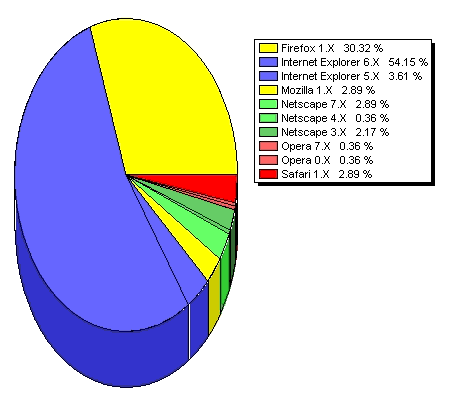
In this post, I was surprised at the high share that Firefox has with Coyote Blog readers. Looking into this further, I have found the high (30+%) Firefox share to be pretty stable over time. However, I have a second Sitemeter account that tracks the cumulative stats for all my camping and recreation related sites of my business. These visitors are much less likely to be computer-savvy, and the browser shares demonstrate this:
Coyote Blog Readers:
Recreation Site Visitors:
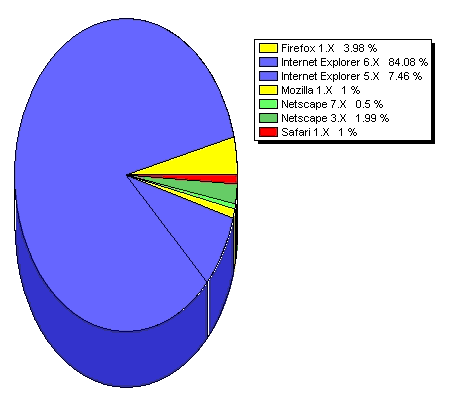
Not sure I really had a point here, but it is an interesting difference.
I haven't blogged at all about the whole Eason Jordan thing, partially because blogging on it would be like adding one extra reporter to the Superbowl, and partially because his comments, while way out of line for head of a journalism organization, didn't seem to be much worse than all the other things he has said over time.
Anyway, I mention it here because whether his comments were "off the record" seems to be an important part of the controversy. I can't think of any ethical justification for this distinction. I can understand when comments are "private" (say with my family around my house) or "confidential" (say with my managers about what we are paying someone) or even "anonymous" (such as when a source might be blowing the whistle on their boss). What, though, does it mean if public comments in a public forum are "off the record"?
The only practical, rather than ethical, justification I can come up with is that someone wants their remarks to be "off the record" when they are telling one audience something different than another audience. Such as when a politician speaks radically to his/her hard left or right base, but doesn't want moderate voters to hear the extreme positions they are advocating. Or such as when a US news director makes anti-American comments to an anti-American audience and doesn't want his US viewers to hear. There is nothing very pretty about either of these situations - why does the media continue to enable this behavior?
The only other argument I can come up with is that the media tends to be so incompetent that they can seldom summarize a speaker's remarks correctly or quote them in context, and speakers know this, so they use "off the record" to protect themselves from the media's incompetence. But if this is the true justification for "off the record", it is ironic and funny to see the head of CNN news using it. He is basically saying that "I know in advance that my own organization will get my remarks wrong so I won't allow them to quote me".
UPDATE and PREDICTION: I resisted the call by a number of web sites at the beginning of the year to make predictions for 2005. However, now I will make one: We will soon see calls, from media insiders, to bring a tighter licensing or credentialing system for journalists, similar to what we see for lawyers, doctors, teachers, and, god help us, for beauticians. The proposals will be nominally justified by improving ethics or similar laudable things, but, like most credentialing systems, will be aimed not at those on the inside but those on the outside. At one time or another, teachers, massage therapists, and hairdressers have all used licensing or credentialing as a way to fight competition from upstart competitors, often ones with new business models who don't have the same trade-specific educational degrees the insiders have. As Milton Friedman said:
The justification offered [for licensing] is always the same: to protect the consumer. However, the reason is demonstrated by observing who lobbies at the state legislature for the imposition or strengthening of licensure. The lobbyists are invariably representatives of the occupation in question rather than of the customers. True enough, plumbers presumably know better than anyone else what their customers need to be protected against. However, it is hard to regard altruistic concern for their customers as the primary motive behind their determined efforts to get legal power to decide who may be a plumber.
Such credentialing can provide a powerful comeback for industry insiders under attack. Teachers, for example, use it every chance they get to attack home schooling and private schools, despite the fact that uncertified teachers in both these latter environments do better than the average certified teacher (for example, kids home schooled by moms who dropped out of high school performed at the 83rd percentile). So, next time the MSM is under attack from the blogosphere, rather than address the issues, they can say that that guy in Tennessee is just a college professor and isn't even a licensed journalist.
Fortunately, this effort will fail, in part because it is fighting the tide of history and in part because constitutional speech protections would probably invalidate any strong form of licensing (I wish there were similarly strong commerce protections in the Constitution). Be careful, though, not to argue that this proposal will fail because the idea is stupid, because it can't be any more stupid than this form of licensing (or this one; or this one). Here are the various trade-specific licenses you need here in Scottsdale - I would hate to see the list for some place like Santa Monica. My favorite is the one that says "An additional license is required for those firms which are going out of business."
I am not a Scrooge on most holidays - heck, we even decorate our house for July 4, not to mention Halloween and Christmas. However, I feel about the same guilt in not celebrating Valentines Day as I do not having kitchen floors as minty-fresh as the ones in the Pine-Sol commercial.
When I was single, I used to love Valentines Day. Often it was a great excuse to get my girlfriend all romantic and full of wine, and, well, you know. One year when I was in business school and was sans g/f, I secretly left a red rose on the desk of every female in my section.
Since I have been married, though, Valentines has been one of those sort of grim opportunities to screw-up, like anniversaries. For the married person, Valentines is all down-side. Yes, I know a few couples who have developed some Valentines rituals with which they seem to have a lot of fun (power to them), but my wife and I never have particularly bonded with the day. This year, my wife and I swore off the flowers (its much more money to apply the money to roses some day she is not expecting them) and had a nice lunch al fresco on a beautiful Phoenix day. So I guess it wasn't so bad after all.
Popular Mechanics has a very readable debunking of many of the most prevalent 9/11 conspiracies. I am sure conspiracy theorists will generally respond to most of the scientists quoted with the all-encompassing "they're in on it!" Once you get so many people giving evidence that the conspiracies are incorrect, you drive the conspiracy into the realm of Meyer's Law:
When the same set of facts can be explained equally well by
- A massive conspiracy coordinated without a single leak between hundreds or even thousands of people -OR -
- Sustained stupidity, ignorance and/or incompetence
Assume stupidity.
In this case, the word stupidity is unfair. The 9/11 attacks fall into the category of the "unimagined". Frank Borman (as portrayed in the awesome mini-series "From the Earth to the Moon", I have not been able to find out if they used his actual words) is speaking to a committee hearing on the Apollo 1 fire that killed three astronauts. Under intense scrutiny for a set of conditions that in retrospect seemed ridiculously unsafe, Borman described the problem as "a failure of imagination".
In this case, for example, conspiracy theorists ask why no military plane intercepted the aircraft. First, I would argue that without any prior precedent, no military commander or politician would have the cajones to shoot down a planeload of innocents on a commercial airliner (now THAT would be conspiracy fodder, had it happened). Second, though, the article quotes a number of military commanders to say that the US didn't really have the radar coverage or aircraft patrols in place to intercept an airplane attacking from within the country - everyone previously imagined the threat to come from outside our borders, and that is how our defenses were arrayed.
Anyway, read the who article - it is an entertaining roundup of conspiracy theories (people do have good imaginations) and a well-argued debunking of them. (via Instapundit)
When I first installed Google desktop search, I thought it was awesome. It did an amazing job indexing everything from my Outlook email to the files on my hard drive to my Internet history files.
A couple of months later, though, I am not so thrilled. In particular, Google desktop search seems to be missing all kinds of hits in my email. I will get no email returns from Google but then use the "find" function in Outlook and get 20 hits for the same search term.
This is very disappointing, because I was so fired up about the product initially. It seems like Google software may be subject to the same senescence issues that seem to be a fact of life in Windows. Since it is both free and a beta, I am perfectly willing to cut them slack, but I do hope they get the kinks worked out.
The Carnival of the Capitalists is up this week at Weekend Pundit. The Carnival is coming here to Coyote Blog in 2 weeks.
The Carnival of the Capitalists is up this week at Weekend Pundit. The Carnival is coming here to Coyote Blog in 2 weeks.
Appliance repair men take notice:
By a vote of 60 to 34, the Virginia House of Delegates has approved a bill that would fine people $50 for wearing low-riding pants that show off their underwear in a "lewd or indecent manner."
I presume fines are doubled if an actual butt-crack is revealed.
UPDATE: Looks like the (especially the bottom photo).
Steven Malanga has a fascinating analysis of electoral politics in big cities (via reason):
The electoral activism of this New New Left coalition--public-employee unions, hospitals and health-care worker unions, and social-services agencies--has reshaped the politics of many cities. As the country's national political scene has edged rightward, thwarting their ambitions in Washington, these groups have turned their attention to urban America, where they still have the power to influence public policy.
In New York, this public employee coalition makes up a third of the work force and an even larger portion of the voters in the last election.
An exit poll conducted by City Journal of the 2001 New York mayoral election found that private-sector workers heavily backed Michael Bloomberg, the businessman candidate who had been endorsed by Rudy Giuliani and had run on a pledge of no new taxes (which he broke after his first year in office), while those who worked in the public/health-care/social-services sectors favored his Democratic opponent, who ran on a promise of raising taxes to fund further services. In the race, Bloomberg won among private-sector voters by 17 percentage points, while the Democrat won by 15 points among those who worked in the public/nonprofit sectors
Read it all.
Several months ago in this post, I pointed out that the income tax system has become so "progressive" that:
Half of the people in this country pay more than 100% of the personal income taxes. The other half get, as a group, a free ride (though there are individuals in this group that pay paxes, net, as a group, they do not). We are basically at the point in this country where 51% of voters could vote themselves all kinds of new programs and benefits knowing that the other 49% have to pay for them.
Malanga's article points out the other side of the coin. We are also increasingly approaching the point where, at last in certain urban centers, half the workers can vote themselves government jobs (and pay raises, pensions, etc) at the expense of the other part of the population.
I just finished reading these three books, one after the other:
In basic outline, each book has exactly the same plot, about a man joining the army in some future war. Each have many of the classic war-story elements, including the tough over-the-top drill Sargent in basic training.
At the same time, all three are totally different, in different universes with different physics and different politics and enemies. And, perhaps most importantly, each with a different outlook on war and its necessity. Each one is awesome individually but created an amazing accidental trilogy when read together.
Had a record day today hosting the Carnival of the Vanities. Guess what time in the traffic chart below that Glenn Reynolds linked to me?

Consensus on global warming (and on many other academic issues on campus) is apparently achieved the same way Augusta Country Club remains all male: just don't invite anyone who doesn't fit in (via the Commons):
LONDON, February 2 (RIA Novosti's Alexander Smotrov) - Presidential economic aide Andrei Illarionov criticizes the policy of censorship practiced at the British Climate Change Conference.
The scientific conference of G8 experts is held in Exeter in the south of Britain on February 1 through 3.
"Its organizers have not accepted reports from many participants whose views are different from that of the organizers,'" Mr. Illarionov told RIA Novosti in the interview.
Asked by the RIA Novosti correspondent why his name is not in the list of speakers, Mr. Illarionov said: "Making a report here is impossible because organizers practice a policy of censorship against people having different points of view."
Mr. Illarionov is against the Kyoto Protocol, which intends the cutting of greenhouse gas emissions.
Arizona has a history of producing some fairly libertarian politicians, and our Congressman Jeff Flake fits that mold. Via the Club for Growth, Flake points out some more egregious pork:
Washington, D.C. - Arizona Congressman Jeff Flake, who represents the state's Sixth District, today highlighted another pork project contained in the massive omnibus spending bill that Congress passed late last year. This week's egregious earmark: $1.5 million for a demonstration project to transport naturally chilled water from Lake Ontario to Lake Onondaga.
Jane Gault at Asymmetrical Information is on a roll with a series of posts about the problems with the Medicare system. Check out her posts on the , the media bias when programs are cut, and the rising cost of Medicaid.
The problem in the world of health care costs is actually very simple: patients have the incentive to over-consume services and providers have the incentive to over-provide services. Patients consume as many services as possible because some other entity is generally footing the bills, such that the marginal cost to the patient of extra services is generally nil (if you don't believe this, imagine a world where a 3rd party paid for your car - would you choose the same care you drive today?) Providers tend to over-provide in part for the same reason, and in part as a defensive response to the threat of torts. As a result, costs go through the roof, and those who pay (government, insurance companies, employers) respond by rationing, which pisses everyone off.
This disconnect between the entity paying the bills and the entity selecting the care cannot endure. The fix in the future is guaranteed to be one where the decision maker on the selection of care is the same person who is paying for the care. The only choice we have in designing the system is whether that entity making the decisions is the government (as preferred by statists of all stripes) or the patient.
We need a system where people pay their own everyday medical bills, with insurance in place for catastrophic needs (which is basically how we take care of our cars). You could probably incentivize this tomorrow by making personal medical expenses tax deductible while at the same time making employer-provided medical insurance taxable just like every other kind of compensation. Not only would this fix the incentives problem in the system, but would also eliminate the portability issue associated with employer-provided coverage.
Unfortunately, people have a huge mental block where paying for their own medical care is concerned. My wife is a great example. When I became self-employed, she was shocked that I did not get dental insurance. I tried to explain that we would just use the insurance to pay for checkups and a filling here-or-there, and it would probably cost more than just paying the expenses ourselves. But for her, medical bills are paid by insurance, not by individuals, and it actually felt wrong for her to pay her own doctor's bill (we have a big annual deductible on our medical insurance too so it acts mainly as catastrophic coverage). This is not an isolated attitude - it is why many people equate "not insured" today with "not getting medical care".
Postscript: There is nothing magical about the system of employer-paid medical insurance we have today. Many large employers implemented paid health benefits as a way to evade government wage freezes during the NRA of the 30's and later in World War II. In the tight labor market of WWII, government mandated maximum wages could not lure enough workers, so free health benefits were thrown into the compensation mix since only cash wages were frozen. The system is perpetuated today by a tax code that does not tax health insurance as it does all other parts of the compensation package.
UPDATE: Or, we could just try this
UPDATE#2: A small example of the mindset: Carly Fiorino get $42 million as a parting gift from HP, but still insists that HP privide her medical insurance. With $42 million, she couldn't pay for it herself? (via gongol)
Perhaps, as reported here at Arizona Watch. Symington would certainly make politics more interesting around here for a while.
Welcome to the 125th edition of the Carnival of the Vanities. Many thanks to Silflay Hraka for starting the Carnival to showcase smaller blogs to a wider readership. Look for future Carnivals at these sites:
February 16th - Soccer Dad
February 23rd - Pundit Guy
March 2nd - Belief Seeking Understanding
March 9th - Solomonia
March 16th - Bird's Eye View
March 23rd - CodeBlueBlog
March 30th - Eric Berlin
April 6th - Incite
April 13th - Yea, Whatever
Future dates are open to anyone interested in hosting. While you're here, feel free to look around -- this post will tell you more about what I do here.
OK, enough of the introduction, on with the show. As is traditional, we have taken all comers regardless of their point of view. I have exercised my editorial license only in selecting the first post: