Posts tagged ‘media’

How the Media Supports Big Government

I have always thought that the media tends to support big government.  I have never understood if that is because the media is dominated by big-government liberals, as conservatives claim, or if there is some shared self interest between media and a large government, since so much of what is newsworthy flows from the government.  After all, look how dull the news gets in August when Congress lets out.  Anyway, I have always been frustrated by the unhelpful media coverage of budget debates.  In particular, the media seems to systematically want to call a slowing of spending growth a "cut".  Patterico's Pontifications has an example.

Scrappleface: White House to Boost Empathy Statements

via Scrappleface:

As one unnamed reporter put it, "In the hours immediately following the disaster, millions of people in Thailand, India, Indonesia, Somalia and elsewhere turned their eyes toward America to discover whether the president would rush back to Washington D.C. and empathize with their plight. But Bush stayed in Crawford and made just one official statement, as U.S. military planes surveyed the damaged area and Air Force C-130 cargo planes with humanitarian goods headed for the region. It's as if Bush thinks that action is a substitute for news conferences."

LOL.  I have always hated the empathy dance after disasters, particularly the now required visit by the President to the disaster site.  What is he going to do?  The visit to the WTC site soon after the attack on 9/11 had value because it made a statement about security that gave confidence to people that they could return to Manhattan.  Why is it necessary, though, to tour hurricane damage by helicopter?  Isn't that the experts job? 

We had a number of our operations in Florida shut down for weeks after the recent hurricanes there.  Several of my friends asked me if I was going to go visit the damage.  "What for" I asked?  The damage had been described to me, and the folks in charge there who knew the area had a good plan in place for fixing things.  If I showed up, work would have to stop for a day while everyone showed me around.  The time to go back is after it is cleaned up, when you can thank everyone for their hard work.  But of course, I didn't have to deal with the media editorializing on my heartlessness because I didn't run to Florida and sight-see the damage.

6-year-old Protesters

Here is a scoop for a few folks out there:  6-year-olds do not have the reasoning ability or a sophisticated enough view of the world to be polical activits.  However, they are, given their lack of sophistication, perfect subjects for political indoctrination and great pawns for media-savvy advocacy groups looking for a little airtime.

I saw this story on Fox News today about a group of 2nd graders manipulated by their activist public school teacher and the Rainforest Action Network to protext at Chase Manhattan in New York against logging and oil drilling.  Apparently unable to get anyone with a high school education or a adult reasoning level to support their cause, the RAN turned to first and second graders:

"I celebrate the world, I celebrate the rainforest, and I care [about] the reality of what is happening with my students, which is only fair, and I let them make their own choices," said teacher Paula Healey.

Right.  Six-year-olds are in the perfect position to formulate their own opinion on sophisticated issues.  Even if the kids did have adult decision-making faculties, I would bet a gazillion dollars that Ms. Healey never brought any contrary opinions into the classroom, exposure to which is necesary for most of us to "make their own choices".

This is entirely inappropriate at this age in the Public Schools.  In my mind, this is just another reason for school choice - if there are parents who disagree with me and consider it a good use of a first grader's time to carry a picket sign about issues s/he can't possibly comprehend at a NY bank, then they should be able to send their kids to a school that so specializes, but the rest of our kids can be left alone to learn trivial stuff like math and reading.

Does the Web Demand New PR Technologies?

Two different inputs recently have gotten me thinking about public relations and the web, and just how far behind the technology curve many PR departments may be.

The first input was a comment I got on one of my posts that I wrote while on vacation last month.  In this post I mentioned that I would be heading for Disney World for our traditional family reunion, but that growing crowds on Thanksgiving week would probably force us to try a different week next time.  I got a comment from someone who sounded like a Disney employee, recommending a better week.  Now, it turns out that it was not a Disney employee, just a helpful reader (one of my loyal 34 or so).  But it got me to thinking.  Are corporate PR departments keeping up with the web?  If Disney was not doing stuff like this, why aren't they?

The second input was this post in Reason's Hit and Run blog.  They point out TIVO efforts to manage the use of the TIVO copyright to ensure that they do not lose the rights to the name.  (Though the article mentions Xerox and Kleenex, my understanding is that Formica actually came the closest to losing its copyright on that name due to overuse as a generic term for, uh, whatever Formica is).  How can companies possibly keep up with their trademark usage on the web?

Back when I worked for a large corporation, we had PR people, either in or out of house, who would provide us with weekly news summaries of where the corporation was in the press.  This was particularly helpful to those of us in marketing, who wanted to make sure we saw all the reviews of our product (so we could use the good ones and refute the bad ones).

In the world of the Internet, this approach seems hopelessly dated.  In the "old days" I used to walk to school 20 miles each day in the snow, up hill both ways  (sorry, always feel like I am channeling my dad when I say "in the old days") the media might have 10  or 15 mentions of our product every two weeks.  Now, on the web, there might be 10 or 15 an hour. Every day employees may be talking about the company in a chat room, customers may be commenting on the company in some place like epinions.com or in Amazon reviews, blogs may be posting on the company, and authorized or unauthorized vendors may have set up shop to sell the company's products online.

How does  a company keep up with all this?  If I was a large company, I would be actively searching the web for key words associated with my company and competitors, looking for new posts or entries or reviews or even whole websites.   Employees spilling secrets in a chat room?  Need to tell legal.  New web site selling our product? Send it to marketing to make sure they are authorized and are using our trademarks and product descriptions correctly.  Blogs posting on us?  We might want to add our own comment to the post.

What we need is the modern technology version of the clipping service.  The technology would probably be pretty straight forward - a company wouldn't even have to build it's own search engine - it could just take a full snapshot of the Google results one day and compare those results to a search the next week, and look for changes.

Or, better yet, why doesn't Google provide this service to corporate accounts itself?  After all, they do need something to justify their sky-high PE ratio, maybe this would help.  Wouldn't Exxon pay $50,000 a year for this service?  Heck I pay D&B several hundred dollars a year for a credit watch service on my company's credit rating, I would certainly pay some hundreds a year for a PR watch of my small business and my competitors.

UPDATE:

One company that seems to be doing something ike this is BuzzMetrics.  Link courtesy of RatherBiased.com

Demographics of Terrorism

I thought this demographic and psychological study by the Foreign Policy Research Institute (caution:  I have not idea who these guys are) and linked via Little Green Footballs is pretty interesting.

Most people think that terrorism comes from poverty, broken families, ignorance, immaturity, lack of family or occupational responsibilities, weak minds susceptible to brainwashing - the sociopath, the criminals, the religious fanatic, or, in this country, some believe they're just plain evil.

Taking these perceived root causes in turn, three quarters of my sample came from the upper or middle class. The vast majority"”90 percent"”came from caring, intact families. Sixty-three percent had gone to college, as compared with the 5-6 percent that's usual for the third world. These are the best and brightest of their societies in many ways.

Al Qaeda's members are not the Palestinian fourteen-year- olds we see on the news, but join the jihad at the average age of 26. Three-quarters were professionals or semi- professionals. They are engineers, architects, and civil engineers, mostly scientists. Very few humanities are represented, and quite surprisingly very few had any background in religion. The natural sciences predominate. Bin Laden himself is a civil engineer, Zawahiri is a physician, Mohammed Atta was, of course, an architect; and a few members are military, such as Mohammed Ibrahim Makawi, who is supposedly the head of the military committee.

This is not particularly surprising to me.  The "terrorism comes from poverty" mantra has more to do with trying to make a political point (generally to excuse terrorism and totalitarianism and often to blame the US) rather than any particular facts on the subject.  In fact, the description above matches surprisingly well with US domestic terrorists and mass murderers.  Though there is a lot of argument nowadays about this stereotype, Phillip Simpson describes the FBI's serial killer profile (emphasis mine):

He is usually a white male between twenty-five and thirty-five years old, though of course there are teen-aged and elderly serial killers as well. Generally, the male serial killer is at the height of his physical powers, a fact which not only serves him in the practical matter of overpowering victims but also empowers him in the public arena: his strength and apparent potency (and of course, choice of innocent victims) render him an effective media monster. He is also likely to be an eldest son or an only child and of average or above-average intelligence. His childhood may have been marked by incidents of sexual or physical abuse, and his parents may be divorced or flagrantly unfaithful to one another. He usually possesses a strong belief that he is more intelligent and privileged than ordinary people (a belief that only grows stronger when confronted by evidence to the contrary) and thus exempted from the social restrictions that govern the masses. No safe predictions can be made about his economic origins, but as Leyton notes, serial murder in our era is more a crime of the middle classes than of the lower or upper ranges of the socioeconomic hierarchy.

The sexual material may or may not be parallel, though it is interesting to think about in terms of the anti-women male dominance of radical Islam.

Europe and Free Speech

Europe has never had the strong tradition of or protection of free speech and press that we enjoy in the US.  For years, I have criticized the use of libel laws in Europe to stifle speech -- similar things are attempted in the US, but seldom get very far in the courts.

Now comes this proposal (courtesy of Captains Quarters):

The Council of Europe has called on its 46 member-states to introduce legislation on the right of reply to correct false information on online media.

It said the Committee of (Foreign) Ministers, executive of the European human rights watchdog body, had adopted a recommendation on the right to reply for online Internet media.

This recommended that members consider introducing legislation on the "right of reply or any other equivalent remedy, which allows a rapid correction of incorrect information in online or off-line media......"

Fortunately, our government does not have any legal or constitutional right of reply in any media, though the implications for the Internet are interesting since about 20% of my readers are in Europe, if you can trust my referral logs.  So lets give it a test:  the EU is a bureaucratic, statist nightmare.  There, lets see if that gets a response.

Review - Michael Crichton's "State of Fear"

My post here and here remind me that I should review the book I just finished --Michael Crichton's State of Fear.  In this book, a group of environmental activists are trying to help mother nature along by creating some natural disasters to draw media attention for the global warming crusade.

I really wanted to like this book.  For once, the villain was not some greedy dastardly businessman trying to increase profits of his corporation at the expense of people's lives.  I have always felt that novels with a political ax to grind were tedious, particularly when they got to the preachy parts.  Clive Cussler, for example, has gotten bad about this in his later books like Shock Wave.  In this book, like in most, the crime is usually so over the top that it is just illogical that anyone would go about business that way - the same time and money spent on less villainous activities would yield far more profit.  It's like those James Bond movie villains who create a $100 million laser satellite and underground control facility only to extort $10 million.

I had thought that the reason I did not like these books was that I disagreed with most of political polemic in them.   However, "State of Fear" has taught be a valuable lesson - I hated the polemic in this novel too, even when I agreed with it.  Crichton makes the same mistake I have railed on Cussler and others for - the cost and elaborate planning that go into most of the planned terrorist attacks make no sense in proportion to benefits.  While I might agree that too many people are mindlessly marching to the global warming drummer without any real thought or consideration of the facts, I thinking blowing some of these folks up into out of control monsters does not help make that point - it just makes you look like you have an ax to grind.  Its also unfair to give the global warming point of view such a poor advocate, the sum total of whose analytical arsenal consists of saying "well, everyone believes it".

<rant>  By the way, a quick word to all you statists, socialists, liberals, and environmental freaks who seem so worked up all over the web about the above admittedly poor literary techniques:  Get over it!  First, global warming is seldom represented by its advocates as the messy, unclear, chaotic, hard to predict thing it really is.  You advocates of global warming have constantly exagerated your case, so get over it when someone does it in the other direction.  Second, I have probably read over a hundred novels where the advocates of capitalism, markets, business, and individual responsibility are just as incompetant as the advocates for global warming are in this book.  Let me see you complain about a book with polemic that you agree with, as I have done, and then I will listen to you. </rant>

So I rank the book as OK, with some pretty good scenes and plot marred by some tedious expositions and diatribes (and remember, this is coming from someone who agrees with the diatribes!)  Tom Clancy does a much better job of evenhandedly dealing with eco-terrorists in Rainbow Six, probably his last good novel. 

By the way, if I wanted to novelize a rant against global warming's bad science, I would choose about anyone except for Crichton, whose middle name is "bad science".  I enjoy his novels, but did you ever ask yourself why all the doctors had to go through all that decontamination in Andromeda Strain, when they were never going to come in contact with the objects under study anyway?  Or, in Timeline, if they are really traveling to parallel but out of sync alternate universes, then how do changes they make in the other universes (such as the dropped glasses) propagate to our universe?  And don't get me started on the science of Prey or the use of chaos theory in Jurrasic Park.

UPDATE

Well, the emails are already coming in.  Since this is getting a lot of hits already off search engines by people who do not normally read this site, and to save writing a number of individual responses, I will give the elevator version of where I am on global warming:

  • The world has probably warmed over the last several decades due to man-made CO2 production, but less than is generally reported because
    • Global warming advocates, out of several available data sets, always pick the one that shows the most warming, while other data sets show less.  The data set they choose (ground temperatures) is not without issues.
    • Advocates tend to ignore other influences that might be raising temperatures in addition to man-made CO2, including natural climatic cycles, increased solar activity, and urban heat island effects.  These effects were apparently substantial in the first half of the century.  To argue that they are not part of the story in the second half of the century, you have to argue that they stopped at the same time that CO2 began having an effect.
  • The world will warm further due to man-made CO2, but the models for future warming are almost certainly overstated, for at least two reasons:
    • While I can't judge the science, I sure as heck can evaluate an economic model and the models for the amount of CO2 produced in the next century are basically economic models.  And they are hugely flawed.  The models have made assumptions that grossly overstate CO2 production in the future.  As just one example, the models assume that many of the least energy efficient nations have huge growth booms over the next 50 years, so that their economies grow larger than that of the US (for example, South Africa is shown to have a larger economy in the future than the US).  These models also assume that these countries do not get much more efficient, so you end up with models showing enormous, absurdly energy efficient economies in the future -- which of course grossly overstates CO2 production
    • As I said, I don't have the science to dispute the models in depth, but one has to be concerned when the models do not match history, and in fact predict historically a much higher temperature rise than we have seen to date.  Advocates will argue that this is fixed, but it was fixed with fudge factors, not science.  People have tried doing this with financial models as well, fudging theoretical models that aren't working to match history, and have gone broke doing so.
  • When and where warming occurs does matter.  Crichton was dead wrong about this - things do not warm evenly.  Models show most warming is in the coldest areas in winter at night.  Since having warming night-time winter temperatures in Siberia does not really panic anyone, this does not get much coverage.
  • The Kyoto treaty is hugely flawed, leaves out the countries causing the most CO2 production increases, is ridiculously anti-American, will cost economies a ton, and will have little affect on future warming, even by advocate's models.
  • I worry that the science being done on global warming is not as good as it could be, as the field has become so politicized.  Any scientist who dares to even introduce data that might soften the global warming catastrophe message is marginalized.
  • Those who report on global warming, including the media and the administration of large projects like the UN climate change project distort scientific findings, substituting complexity and questions with certainty

This is just a summary, without dueling citations.  I covered the same points, but marshaling evidence and citations here.

MORE REVIEWS

More blog reviews, both positive and nevative, linked here.  Other folks who are skeptical about global warming seem to have liked the book a lot.  I still think that this is more of a reaction to finally having a novel that is skeptical of progressive causes rather than a reaction to a quality adventure book.  I continue to maintain that it is better for action books to just stick to the action.  I will be very upset if this starts an arms race among writers to get more and more heavy handed with their politics in their novels.

Junk Science's "10 Most Embarrassing Moments of 2004"

If you have never checked out JunkScience.com, you should.  They do a nice job of providing balance and fact-based analysis for many science "stories" in the media, particularly those where the science is driven by political correctness or a litigation and/or political agenda.  The spend a lot of time on global warming, mainly because there is just so much bad science there to criticize, but they range all over, from the latest food Nazi threats to the latest chemical contamination panic.

Last week, they release their 10 most embarrassing moments of 2004.  One example:

10. University of Arkansas researchers attacked the Atkins Diet in January with a report linking a high-carbohydrate diet with weight loss, saying it was possible to lose weight without cutting calories and without exercising. What they didn't reveal, however, was that the study subjects who lost weight actually ate 400-600 calories per day less than those who didn't lose weight.

Never, ever, ever trust a science story in the press.  The press has no idea how to use or manipulate data (if they had been able to do math, they would not have been journalism majors in the first place).  The press generally publishes science stories by cribbing 95% of the story from activists press releases.  Even when there is data in the story, rather than just bald unsupported declarations, it is either seriously flawed, or more humorously, contradicts the text of the story.

I can't resist supporting this statement with a couple of examples from JunkScience.com.

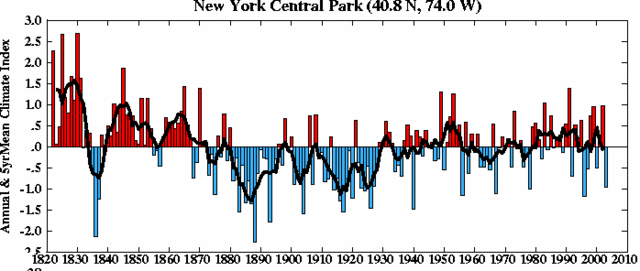
This is a temperature chart for Central Park, NY.  It gets a lot of play in the press as a "common sense" proof of global warming, and comes right off the NASA climate site:

Cenpark_com

Now, lets ignore the fact that urbanization could be causing a local temperature increase that does not reflect a general climate trend.  Lets, however, select our time frame a little differently.  Lets take the whole data set, which goes back further, rather than this set chosen by activists to make their point.  The same data over a longer trend looks like this:

Cent_park_3_1

OOPS!  Gee, I am not sure Central Park looks much warmer.  In fact, you could argue it is cooler.  Hmmmm.  Ask yourself if you really think it was an accident that the year with the single lowest temperature in the middle of the second graph was used as the starting point for the first.

OK, one other, because I can't resist.  There is some debate (though perhaps not enough) about what temperature data set to use - ground level readings, satellite data, balloons, etc.  It might not stun you to learn that out of 3-5 alternative temperature data sets, global warming activists choose not the middle or the average but the single set (ground temperatures) that show by far the most warming to date.  By coincidence, this data set is perhaps the least reliable, since it never has had anything like 100% area coverage, it is subject to the most human error, and it is influenced by urban warming effects. 

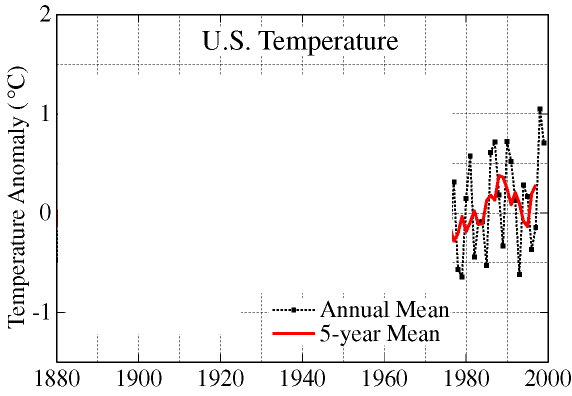
However, if you want to use ground data, certainly the most reliable is data for the United States, where data has been taken over a larger coverage area for more time with more consistent standards than any other location.  Global Warming activists will love to show this chart of US temperatures since about 1978:

Ustemp2

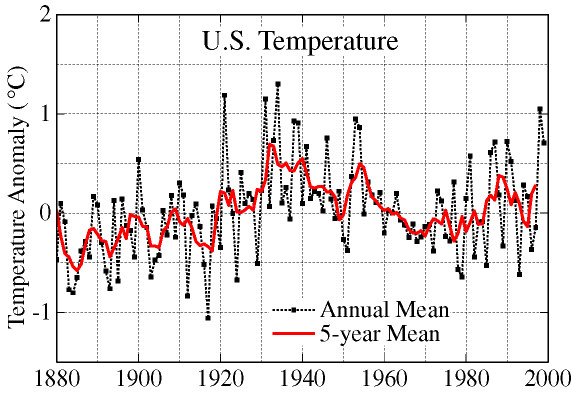
Wow, that looks bad - looks like a nearly one degree Celsius rise in less than 25 years.  This is the "hockey stick" climatologists refer to.  Let's leave aside that this same rise is not visible in satellite data or other measurement approaches.  Like the NYC data, lets take a longer time span.  Can you guess why this chart begins in 1978? 

Ustemp

So we are not even at the high's for the last 100 years - those occured in the 1930's  (you remember - drought, dust bowl, etc?)

OK, that's just a taste - check out their web site for more.  In addition, you can read my post on the Kyoto treaty to find other skeptics of global warming, as well as some specific information about how Kyoto is more an anti-American treaty than an environmental treaty.

UPDATE

Based on some responses I have gotten, its probably best that I point out that the reason for posting the charts above was not to "disprove" global warming.  It was to just make the point that you need to be careful with any science you see in the media.  If you look here or here, you will see where I am on global warming, which basically that manmade warming probably exists but is being overstated for a variety of reasons.  In fact, my whole point here is really that you CAN'T prove or disprove something as complex, chaotic, and poorly understood as climate change with 2 or 3 charts.

Its Time to End Licensing of Broadcast Media

Television and Radio have always had a very different regulatory regime than any other type of media.  Unlike, say, newspapers or cable TV companies or satellite providers, television and radio companies have to get and continue to renew licenses and are expected operate in the public interest, whatever the heck that is.  TV and radio stations get access to what has become very valuable bandwidth for free, the only cost being that they have to give regulators what amounts to a veto over their content.  Because of this regulatory structure, you get goofy stuff like this:

The Federal Communications Commission's enforcement bureau has asked NBC for tapes of the opening ceremony of the Summer Olympics, apparently in response to one or more indecency complaints.

Its fun to laugh at this stuff, and it drives me crazy, but at the end of the day the problem is not the FCC or Bush or red states or fundamentalists.  The problem is the first-amendment defying concept that the Feds should have any say in media content.  Period.  The FCC is actually in a difficult spot - by law, they have to enforce decency standards, but when they do so, they look like moralistic thugs.

I do not know the history here, but for some reason the US government, perhaps because it was in the throws of the socialist/fascist New Deal era, abandoned all of its traditional and successful models for allocating a newly discovered or accessible resource (in this case, parts of the spectrum) in favor of this public service liscencing approach.  I can think of at least three different models that the US government has used in similar circumstances and that have all worked much better:

  • The Homestead Act:  This established the principal of being the first to stake out and improve a resource (in this case parcels of land) in allocating government lands in the west.  Perhaps the best piece of legislation in the history of the country.    Could have easily followed this principle in the broadcast spectrum - an individual or company would have to broadcast continuously on a certain frequency for 2 years to gain permanent ownership
  • Mining Law: In some ways similar to the Homestead act, again it grants ownership of a resource to people who add value to it (in the case of mining, to the people who prospected for it and discovered it).
  • Outright Sales:  The government does this all the time, including land sales, mineral lease sales (e.g. offshore oil) and more recently cell phone spectrum sales.

Lets end this regulatory structure now:

  1. Grant all current licensees ownership of the spectrum they are currently using.  Drop all content-related regulation. 
  2. There are many non-licensed outlaw low-power stations operating.  Create a set of homestead requirements that they can get access to their bandwidth if they meet certain requirements within a certain time frame
  3. Acknowledge that technology today allows more of the spectrum to be used than channel spacing of the 1950's allowed.  Open up more of the holes in the spectrum for use.
  4. Sell the newly available spectrum

More Niche Blogs

Like much of the media, the proliferation of blogs are leading new bloggers to seek out new niches.  Here are two pretty narrow, though as a guy, fairly compelling ones I found today:

The first is the NFL Cheerleader Blog.  Hmm, if I could find a way to get paid to write that blog, my life would be complete.

The other is RemoteBlog, a blog dedicated entirely to universal remote controls.  If that is too niche for you, you might like Gizmodo or Home Theater Blog.

By the way, if anyone is itching to send Coyote a Christmas gift, I will gratefully accept one of these bad boys.

The Sanctity of Grand Jury Testimony

I know this will come as a shock to many people, but grand jury testimony is supposed to be secret and stay that way.  I mention this, because lately, "sealed" and secret court records seem to inevitably end up in the media.  The most prominent example is yesterday's leak of Balco grand jury testimony, though the Clinton-related grand juries seemed to be sieves as well.

There are real reasons for secrecy in grand jury proceedings.  The most obvious is that grand juries have often been used to build cases against organized crime figures, and those testifying may be risking their life to do so.  More recently, with the enormous power of the press to convict people even before they go to trial, sealed testimony can help protect reputations as well as the presumption of innocence.

Now, I am not a lawyer, and I would love to hear what Volokh has to say.  I suspect there are those who would argue, as they did in the (admittedly different) case of the release of Jack Ryan's divorce records, that transparency in the legal system is more important than individual privacy.  This may or may not be true legally, but I think it would hurt the grand jury process, and anyway, I don't think this is what happened here - the Balco testimony looks to have been leaked illegally.  By the way, I am tired of the notion that journalistic privilege stemming from the first amendment trumps legal compliance with any other laws.  I know the press loves having this, sortof like the double-O license to kill, but I don't buy it.

UPDATE#1

Hey, maybe I can be a lawyer.  Here is Eugene Volokh talking about journalistic privilege today!

UPDATE#2

I forgot to mention that there is an exception to secrecy - the witness may publicly discuss their own testimony.  Again, however, I do not think this is the case here.  I don't think Giambi released these details about his own testimony, and the format of the article - with both sides of the Q&A, is pretty clearly from the transcript of the hearings.  Besides, if Giambi were going to voluntarily go public with this admission, he is much more likely to get paid $10 million to tell it to Barbara Walters than he is to anonymously leak it to the SF Chronicle.

Criminalizing the Fast Forward Button

Wow, the concept of fair use is sure taking a beating.  Politicians are sure carrying a lot of water lately for media companies.  Check out this article at Incite.  This is not that far-fetched.  A couple of years ago, ReplayTV added a jump ahead 30 seconds button on their machine that would instantly skip a standard commercial.  TIVO, the industry leader, has held off matching this function due to industry pressure.

By the way, I don't know if it works but this is posted as a hack to get a 30 second skip on TIVO machines. (more here and lots more sites via google search)

Two Faces of Islam

For years, a number of more conservative groups have been warning that the messages given by Islamic leaders and holy men in English for world consumption were far different than the messages given to their own people in Arabic.  And indeed, their translations of Arabic speech aimed at Muslims can be pretty scary.  Few Westerners believed or wanted to believe these warnings, preferring to hope that most arabs were like themselves, basically peaceful and supportive of democracy and plurality. 

For years, I was skeptical of these claims.  I felt like it would require extraordinary laziness and incompetance on the part of the media to just digest the English statements of Islamic leaders without ever checking out what they were saying in Arabic.  However, over the past couple of years, I have lost all faith in the work ethic, intelligence, and dilligence of the western media, and have come to believe that it would be enitrely possible for Arab leaders to manipulate Western media in this way.

For this reason, a part of this article (hat tip LGF) about German reactions to Musilm violence in the Netherlands is interesting to me.  It seems that, after the recent violence, the media finally had the idea to actually listen in on what some Islamic religeous leaders are saying in Arabic:

"These Germans, these atheists, these Europeans don't shave under their arms and their sweat collects under their hair with a revolting smell and they stink," said the preacher at the Mevlana Mosque in Berlin's Kreuzberg district, in the film made by Germany's ZDF public TV, adding: "Hell lives for the infidels! Down with all democracies and all democrats!"

Beyond the bizarre body hair reference, this is NOT what the media has been saying that Islam is teaching here in the west (I don't imply this represents the majority, but the media has essentially claimed it does not exist at all).

By the way, the proposed "solotions" strike me as nuts, and should also be enlightening to anyone in the US who looks up to Continental Europe as a counter-weight to percieved creeping fascism with the Bush Administration.  I may not be a fan of the Patriot Act, but nobody in the Bush administration, with far more provocation, has suggested anything as loony as making all religeous ceremonies English-only.

Alternate Obituaries for Arafat

Some of the "official" biographies of Arafat in the media are starting to make me sick.  Arafat was not a slightly flawed statesman and freedom-fighter.  Arafat was a leading terrorist who has squandered the Palestinians chances to get a real homeland for themselves.  When given the chance at statehood, he was unwilling and unable to create any sort of rule of law, and quickly demonstrated that he was really seeking violence and chaos, not stability and happiness, for his people.  You can find "alternate" obituaries here and here.

Global Warming, a Messy Picture

A while back, I wrote here with a wrap-up of what I believed about Global Warming and the Kyoto Treaty.  My point of view is that the earth is probably warming, but not nearly as fast as doomsayers predict; that the certainty the major media puts forth on global warming bears no resemblance to the messy, chaotic nature of climate and climate research; and that Kyoto is a bad treaty aimed at screwing the US, and that the costs don't outweigh the (marginal) benefits of its adoption.

Reason has a nice roundup of some new evidence pertaining to climate, that helps confirm at least the first 2 of my 3 hypotheses above.  About half the evidence points to warming and about half refutes rapid warming.  It would be interesting to do a media search to see which of these made the papers, but I think you can probably guess.

Libertarianism, the Environment, and Kyoto: Part 2

This is the second part of a two part post. Part 1, with more general background on my libertarian point of view on the environment, is here.

Because hell is freezing over today, and because the Russions just ratified the Kyoto Treaty, apparently putting it over the top for it to get started, I wanted to talk more specifically about the Global Warming and the Kyoto Treaty.

First, recognize that, whatever one's views are of Global Warming, Kyoto is a flawed treating from the United State's perspective. Leaving out the validity of global warming or the cost-benefit issues (which we will discuss below) the Kyoto treaty is a thoroughly anti-American document, crafted by other countries to put the vast vast majority of the cost on the US.

Why? Well, first, and most obviously, the entire developing world, including China, SE Asia, and India, are exempt. These countries account for 80% of the world's population and the great majority of growth in CO2 emissions over the next few decades, and they are not even included. If you doubt this at all, just look at what the economic recovery in China over the past months has done to oil prices. China's growth in hydrocarbon consumption will skyrocket over the coming years.

The second major flaw is that European nations cleverly crafted the treaty so that among developed nations, it disproportionately affects the US. Rather than freezing emissions at current levels or limiting growth rates, it calls for emissions to be rolled back to 6-8% below 1990 levels. Why 1990? Well, a couple of important things have happened since 1990, including:

a. European (and Japanese) economic growth has stagnated since 1990, while the US economy has grown like crazy. By setting the target date back to 1990, rather than just starting from today, the treaty is effectively trying to roll back the economic growth in the US that other major world economies did not enjoy. This difference in economic growth is a real sore spot for continental Europeans.
b. In 1990, Germany was reunified, and Germany inherited a whole country full of polluting inefficient factories from the old Soviet days. Most of the factories have been closed in the last decade, giving Germany an instant one-time leg up in meeting the treaty targets, but only if the date was set back to 1990, rather than starting today.
c. Since 1990, the British have had a similar effect from the closing of a number of old dirty Midlands coal mines and switching fuels from very dirty coal burned inefficiently to more modern gas and oil furnaces.
d. Since 1990, the Russians have an even greater such effect, given low economic growth and the closure of thousands of atrociously inefficient communist-era industries.

A third flaw is that Kyoto refused to accept increases in CO2 absorption as an offset to CO2 emissions. For example, increasing the amount of forest cover in a country can have the same effect as reducing emissions, since the forests lock up atmospheric carbon. The only logical reason for disallowing this in Kyoto is that it is an area where North America has a real advantage. Contrary to what most people might guess given all the doom and gloom environmental talk about sprawl and deforestation, the acres of forested land in the US has been steadily increasing since the 1920s.

It is flabbergasting that US negotiators could allow us to get so thoroughly hosed in these negotiations. Does anyone really want to roll back the economic gains of the nineties, while giving the rest of the world a free pass? Anyway, as a result of these flaws, and again having little to do with the global warming argument itself, the Senate voted 95-0 in 1997 not to sign or ratify the treaty unless these flaws (which still exist in the treaty) were fixed Note that this vote included now-candidate John Kerry and previous enviro-candidate Al Gore.

These gross and obvious flaws in Kyoto could let us off the hook from arguing the main point, which is, does global warming justify some sort of international action like Kyoto. So lets assume that Kyoto was all nice and fair and some reasonable basis was arrived at for letting countries share the pain. Should we be doing something?

To see if a treaty like a modified-to-be-fair-Kyoto makes sense to sign and adhere to, one must evaluate at least five questions:

1. Has the world been warming, and is this due to man's activities and specifically CO2(rather than natural cycles)
2. Do increasing CO2 levels lead to global warming in the future
3. Are man-made actions substantially increasing CO2 levels, and what kind of temperature increase might this translate into
4. How harmful will the projected temperature increases be
5. How much harm will CO2 limitations create and how do these stack up against the harms of global warming.

Continue reading ‘Libertarianism, the Environment, and Kyoto: Part 2’ »

On Class Warfare and Income Taxes, Part 1

This has actually become part 1 of a two-part post. In part one, we will look at the unbelievable proportion of income taxes paid by a small percentage of people in this country, and reflect on how crazy it is to talk about the rich getting a free ride. In post 2, we will look at a couple of truly regressive taxes where the rich really do get a free ride, and wonder why these issues get mostly ignored.

Something interesting has happened in this country over the last decade, and it is shown below in one of my favorite statistics. There is much talk in the media about this or that group paying their "fair share" of taxes, but as is usually true in the media, there are depressingly few facts in these articles. This is strange, since there are several government reports that pretty clearly outline the share of taxes paid by various income brackets. The numbers below are from a Congresional Budget Office Report, but the same numbers are buried in the IRS web site as well.

For 2003, the estimated share of total individual income taxes paid by:

Wealthiest 1%: 33.6%
Wealthiest 5%: 55.1%
Wealthiest 10%: 67.9%
Wealthiest 20%: 83.0%
Wealthiest 40%: 97.8%
Wealthiest 60%: 103.0%

The way to read this is that the wealthiest 10% of taxpayers pay 67.9% of the country's individual income taxes. And yes, that 103% is not a typo - the bottom 40% in income as a group pay negative personal income taxes (because of the EITC).

This leads to the following fascinating conclusion: Half of the people in this country pay more than 100% of the personal income taxes. The other half get, as a group, a free ride (though there are individuals in this group that pay paxes, net, as a group, they do not). We are basically at the point in this country where 51% of voters could vote themselves all kinds of new programs and benefits knowing that the other 49% have to pay for them.

Extra Credit Exercise: Given the numbers above, and all the talk about "tax cuts for the rich", craft an income tax cut that does not disproportionately benefit the top half of the income spectrum.

Hard, huh? The same CBO report had an interesting comparison. They estimated what these same numbers would have been without the recent tax cuts. Without the "George Bush tax cuts that unjustly benefit the rich" these same numbers in 2003 would have been:

Wealthiest 1%: 31.9%
Wealthiest 5%: 51.8%
Wealthiest 10%: 63.9%

OOPS - Coyote, that can't be right? That means that the wealthiest people pay a higher share of income taxes after the Bush tax cuts. That must mean that the tax cuts disproportionately helped the lower income brackets? Can that be right?

Yes, thats right. Without the Bush tax cut, the top 60% would have paid 99.9% of all individual income taxes. Now, after the tax cut, they pay 103%, meaning the bottom 40% have gone from paying about 0% to actually getting a bunch of money in net EITC.

Which just goes to prove a related point I make a lot - agree with him or disagree with him, G.W. Bush has got to be one of the worst presidential communicators in recent memory. For further proof, see debate #1.

Interestingly, John Kerry used this same report to say that these tax cuts shifted the burden of taxation to the middle class. And, in one way, he is right, though not in the way that his statement is generally interpreted. For more, see part 2, coming soon. (hint - think total taxes, not just income taxes)

UPDATE

Reason, my favorite libertarian rag, has a related analysis from Nick Gillespie and Mike Snell here. I don't think I trust either Bush or Kerry on fiscal discipline. Neither, apparently, do Gillespie and Snell:

But the fact remains that Bush's cuts have reduced the amount of income tax we all pay. Though Kerry will certainly suggest otherwise in Friday's debate, the trouble with Bush's budget policy isn't that he cut income taxes. It's that he hasn't cut spending. Indeed, perhaps the strongest case for electing Kerry may be that he will usher in an age of divided government that will restrain federal spending and the various problems that accompany it.

UPDATE #2

Fixed an unbelievably bad triple negative - Even I could not figure out what I was trying to say.