Archive for the ‘Regulation’ Category.

Thank You, Richard Branson

I have never been a Richard Branson groupie, but I must say for once I am appreciative of his efforts.  Branson has helped to make crystal clear the process by which governments take control of the economy.  The story comes to us via the Mises Economics blog, and starts this way:  According to Branson:

"The big oil companies are making extortionate profits out of the current oil
price," he announced, in his most calculating, populist style.

How anyone who runs the Virgin Megastores can complain about someone else's high pricing is beyond me, but lets let him run a little further:

"The biggest problem with the oil price is the lack of refinery capacity. There
is enough oil for everyone in the world, but the refineries are just not there."

And they are not there because...governments do not allow oil companies to build new refineries.  The government having created the problem, the solution would seem to be for the government to repeal the offending restrictions that caused the problem.  But here is where we get to the great tool of statism:  The problem created by the government is blamed on private enterprise and "market failure" and portrayed as necessitating... more government intervention:

"There has been talk of a windfall tax on big oil companies. Perhaps the
Government should use that money to invest in refinery infrastructure."

Of course, the big oil companies would invest those windfall profits in refining capacity on their own had they been allowed by government, but lets ignore that messy detail.  Ahh, but here is the best part.  Not only does the government now get to invest in refineries, but it gets to do it by channeling the money to the political supporters (i.e. Branson) of those in power, thus cementing their power and control.

According to the paper, Britain's favourite "entrepreneur" aims to put $100
million behind his latest scheme to build an oil refinery for airline fuel. Yes,
the Bearded Wonder is said to be about to launch a new company called - you
guessed it! - "Virgin Oil" within four or five months and is "seeking to attract
funding from other airlines and the Government...."

But, not content with this, our man from the tropical paradise has scented an
easier mark, for Sir Richard has seemingly exploited the crass celebrity-worship
of our New Labour masters, while also playing up to our ineffable Chancellor's
ever present desire to meddle in the markets.

For those of you who have held up Branson as some archetype of entrepreneurship: Stop it.  Here you see a man who is attempting to finance his entry into an industry by getting the government to take money by force from the current competitors in that industry and to give it to him to finance his startup.  I have always suspected Branson of being from the Orrin Boyle school of business and this just proves it.

Technorati Tags: 

Double-Speak is Alive and Well

This was funny, from labor boss John Sweeney (via Cafe Hayek):

Let's require big, profitable companies such as Wal-Mart to provide health care
to their employees instead of passing the cost along to everybody else, and
let's begin to develop a national health care plan that provides affordable
coverage to all Americans.

This is really, really funny.  Notice that in the first half of the sentence, he decries passing health care costs "along to everybody else" and then in the second half advocates a national health insurance plan that would pass individual health care costs onto... everybody else.  Also note that since Wal-mart, despite Mr. Sweeney's description as being big and profitable, has one of the lowest profit margins in the Fortune 100, it would likely have to raise prices in order to... pass these costs along to everybody else.

What Mr. Sweeney is actually frustrated about is that there are a large number of individuals in the labor force that he does not make decisions for and who do not in turn contribute to his personal power.

Cafe Hayek has more.

Do People Want Regulation?

Advocates of the statist web of regulation in California argue that this mass of government control makes California a more desirable place to live.  Andy Roth asks, does it?

Some high income earners are
leaving
California because of its punitive tax rates. Could low- and
middle-income workers be leaving as well? One crude measure is to examine the
one-way rental rates for U-Haul vans. Using U-Haul's website, I queried a one-way rental for a 10-foot van
for October 1st, 2005.


One-Way Trip Price
Los Angeles to Las Vegas $454.00
Las Vegas to Los Angeles $119.00

Peoples Republic of Hawaii

Well, our most socialist state is attempting to repeal the laws of supply and demand:

Hawaii issued a list of wholesale price caps for gasoline, the
state Public Utilities Commission said, amid this month's
record-breaking run up in retail gas that saw island residents paying
some of the highest prices in the nation.

This marks the first state cap on gasoline prices since the 1970s
energy crisis, when the average inflation-adjusted price of a gallon of
regular unleaded hit $3.

Hawaii's recently enacted gas cap law goes into effect on September 1, with the pre-tax wholesale cap in Honolulu set at $2.1578

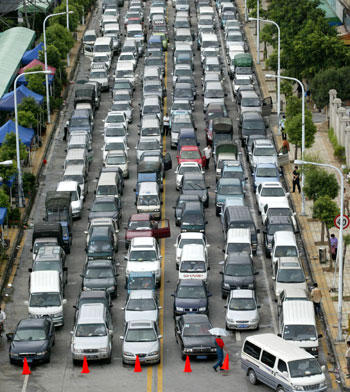
Gee, I bet this will work out really well.  Either the price cap will be set high, such that it is meaningless, or it will be set low, such that Hawaii will likely get this:

China_gas2
update:  given the structure of the price caps, the result could actually be higher rather than lower prices at the pump -- see update #2 below.

It's good to know that Hawaii is looking to China for economics ideas.

The Chinese government and its state-owned oil companies are locked
in battle over artificially low gasoline prices at the pump that has
caused a massive shortage in the southern manufacturing province of
Guangdong....

The crisis
highlights the persistent problems Beijing faces as the economy is
transformed to a more market-based system but that is often retarded by
authorities who fear loosing political control in the face of
full-fledged capitalist rules.

Beyond the obvious run-up in world-wide oil prices and Hawaii's logistical isolation that raises all of the prices on the island, the article on CNN identified one other possible culprit for high prices: the state government

Higher-than-average taxes on gasoline in Hawaii contribute to those
high prices. The state levies a 16 cent per gallon tax, and various
local authorities add on other taxes.

In Honolulu, for example, total state, federal and local gas taxes
amount to about 53 cents per gallon, one of the highest rates in the
United States. The national average, according to the American
Petroleum Institute, is about 42 cents per gallon

It seems like only a few days ago I was pointing how governments have a hard time resisting meddling in oil markets, and that this meddling never works out well.

Even in the US, which is typically more comfortable with the operation
of the laws of supply and demand than other nations, the government has
been loathe to actually allow these laws to operate on oil.  During the
70's, the government maintained price controls that limited demand side
incentives to conserve, thus creating gas lines like the ones we are
seeing in China today for the same reason.  When these controls were
finally removed, a "windfall profits tax" was put in place to make sure
that producers would get none of the benefit of the price increases,
and therefore would have no financial incentive to seek out new oil
supplies or substitutes.  Within a few years of the repeal of these
dumb laws, oil prices fell back to historical levels and stayed there
for 20 years.

Like the gas rationing and price controls in the 1970's, this occurs in a Republican administration (Hawaiian Governor Lingle).  It continue to be difficult to take the Republican Party's professed support for free markets seriously.

Hawaii's Star Bulletin reported that Governor Linda
Lingle (R) is an opponent of the caps. The newspaper said Lingle
believes it would be better to force oil companies to open their books
and show consumers how much money they make at each stage of business.

If she is so opposed to it, why didn't she veto the bill?  And is having government officials marching into private offices to confiscate accounting data really her preferred "free market" alternative?

Update:  Apparently the cap in Hawaii was passed pre-Lingle, and she fought to reverse it, so I will cut her some slack. Lynne Kiesling has more details on the plan, which includes how the cap will be calculated week to week.  Politicians there are calling it a "market-based price cap".  LOL.  Next we will see freedom-based speech limitations and privacy-based telephone taps.  Note that how the cap is calculated does not change the statement I made before:  Either the price cap will be set high, such that it is meaningless, or
it will be set low, such that Hawaii gets gas lines.

PS- Lynn is the economic goddess of energy markets, so if energy and power markets and regulation interest you, I recommend her blog.

Update #2:  Jane Galt makes the good point that the Hawaiian price caps are on wholesale gasoline prices, so while there may be gas shortages at the wholesale level, retail prices may be able to float higher to close the supply gap.  This would ironically lead to higher, not lower prices at the pump, and large profits for gasoline retailers.  Since wholesale sources of gas tend to be out-of-state corporations, and gasoline retailers tend to be smaller, locally owned businesses, I wonder if this is a case of rent-seeking by gas station owners.

Another Limitation on Individual Choice

I won't go too much into the details of the recent Vioxx jury verdict.  Professor Bainbridge has a complete roundup which is worth reading, and Reason had an analysis of the merits of the case a while back.  Though its not really the point of this post, I can't resist a few snippets:

Jurors who voted against Merck said much of the science sailed right over their
heads. "Whenever Merck was up there, it was like wah, wah, wah," said juror John
Ostrom, imitating the sounds Charlie Brown's teacher makes in the television
cartoon. "We didn't know what the heck they were talking about."

One juror considered the fact that the CEO, whose company faces thousands of law suits, didn't show up as an admission of guilt:

... [juror] Ostrom, 49, who has a business remodeling homes, was also disturbed
that former Merck Chief Executive Raymond Gilmartin and another top Merck
official gave videotaped testimony but weren't in the courtroom. "The big guys
didn't show up," said Mr. Ostrom. "That didn't sit well with me. Most definitely
an admission of guilt."

And of course there is this now famous gem:

One juror, Ms. Blas, had written in her questionnaire that she
loves the Oprah Winfrey show and tapes it. "This jury believes they're going to
get on Oprah," Ms. Blue told Mr. Lanier. "They only get on Oprah if they vote
for the plaintiff."

Read the Bainbridge post, it has much more.

Anyway, the point of this post is that this verdict represents a very dangerous assault on individual choice.  Recognize that there are many, many activities in life where individuals are presented with the following choice:

If I choose to do X, my life will be improved in some way but I may statiscally increase my chance of an early death.

You may react at first to say that "I would never risk death to improve my life", but likely you make this choice every day.  For example, if you drive a car, you are certainly increasing your chance of early death via a auto accident, but you accept this risk because driving allows you to get so much more done in your life (vs. walking).  If you ride a bike, swim, snow ski, roller blade, etc. you are making this choice.  Heck, everyone on the California coast is playing Russian Roulette with an earthquake in exchange for a great climate, beautiful scenery, and plentiful jobs.

The vast majority of drugs and medical therapies carry this same value proposition:  A drug will likely improve or extend your life in some way but carries a statistical chance of inducing a side effect that is worse than the original problem, up to and including death.  The problem is that we have structured a liability system in this country such that the few people who evince the side effects can claim more money in damages than the drug was worth to all the people it helped.  For example, if a drug helps 999 people, but kills the thousandth, and that thousandth person's family is awarded $253 million in damages (as in this case), the drug is never going to be put on the market again.  Even if the next 1000 people sign a paper saying we are willing to take the one-in-a-thousand risk to relieve the pain that is ruining our lives, they still are not going to get the drug because the drug companies know that some Oprah-loving jury will buy the argument that they did not understand the risk they were taking and award the next death another quarter of a billion dollars.

This exact same effect nearly killed the vaccination industry.  In the end, Congress had to pass legislation  immunizing (ha ha) vaccine makers from lawsuits when known 1-in-10,000 side effects occur.  While I am not a big fan of the FDA, if it is going to exist and put drugs through 20 years of tests and a forest full of paperwork to get approved, I think that approval process should confer some sort of litigation immunity. 

By the way, have you noticed the odd irony here?  Robert Ernst (the gentleman who died in the Vioxx case) is assumed, both by the FDA and the litigation system, to be unable to make informed decisions about risk and his own health.  But a jury of 12 random people who never experienced his pain can make such decisions for him?  And us?

Richard Epstein said it better than me, in the WSJ but I will like to Reason which is free:

I would like to send my message to [plaintiff's lawyer Mark] Lanier and
those indignant jurors. It's not from an irate tort professor, but from
a scared citizen who is steamed that those "good people" have imperiled
his own health and that of his family and friends. None of you have
ever done a single blessed thing to help relieve anybody's pain and
suffering. Just do the math to grasp the harm that you've done.

Right now there are over 4,000 law suits against Merck for Vioxx.
If each clocks in at $25 million, then your verdict is that the social
harm from Vioxx exceeds $100 billion, before thousands more join in the
treasure hunt. Pfizer's Celebrex and Bextra could easily be next.
Understand that no future drug will be free of adverse side effects,
nor reach market, without the tough calls that Merck had to make with
Vioxx. Your implicit verdict is to shut down the entire quest for new
medical therapies. Your verdict says you think that the American public
is really better off with just hot-water bottles and leftover aspirin
tablets.

Ah, you will say, but we're only after Vioxx, and not those good
drugs. Sorry, the investment community won't take you at your word. It
realizes that any new drug which treats common chronic conditions can
generate the same ruinous financial losses as Vioxx, because the flimsy
evidence on causation and malice you cobbled together in the Ernst case
can be ginned up in any other. Clever lawyers like Mr. Lanier will be
able to ambush enough large corporations in small, dusty towns where
they will stand the same chance of survival that Custer had at Little
Big Horn. Investors can multiply: They won't bet hundreds of millions
of dollars in new therapies on the off-chance of being proved wrong.
They know they'll go broke if they win 90% of the time.

Your appalling carnage cries out for prompt action. Much as I
disapprove of how the FDA does business, we must enact this hard-edged
no-nonsense legal rule: no drug that makes it through the FDA gauntlet
can be attacked for bad warnings or deficient design.

The Health Care Trojan Horse

I get email and comments from time to time that my language deriding government's intervention into every aspect of our lives is overblown and exaggerated.  My answer:  Oh yeah, well how about this:

Mike Huckabee, the Governor of Arkansas, now
requires annual fat reports. These are sent to the parents of every
single child aged between 5 and 17; a response, he says, to "an
absolutely epidemic issue that we could not ignore" in the 1,139
schools for which he is responsible.

I just cannot craft any reasonable theory of government where this is the state's job.   The "obesity" crisis in this country just amazes me.  "Experts" every few years broaden the definition of who is overweight or obese, and suddenly (surprise!) there are more people defined as overweight.  Even presuming it is the state's job to optimize our body weights, is it really the right approach to tell everyone they are too fat?  Having known several people who were anorexic, including at least one young woman who died of its complications, is it really a net benefit to get young people more obsessed with looks and body style?  And what about the kids that are genetically programmed to be overweight?  Does this mean that years of taunting and bullying by their peers is not enough, that the state's governor wants to pile on now?

It is interesting to note that governor Huckabee apparently started this initiative after his own personal battle with weight loss:

[Huckabee] lost 110lb after being warned that his
weight, more than 280lb after a life of southern fried food, was a
death sentence. A chair even collapsed under him as he was about to
preside over a meeting of state officials in Little Rock.

We all have friends who have lost weight or gotten into homeopathy or became a vegan and simply cannot stop trying to convert their friends now that they see the light.  Now we have the spectacle of elected officials doing the same thing, but on a broader scale and with the force of law, rather than  just mere irritation, on their side.  One can only imagine what report cards kids would be carrying home if Huckabee had instead had a successful experience with penis enlargement.  What's next, negative reports for kids with bad acne?  For women whose breasts are too small?  For kids who are unattractive?

As I have argued many times in the past, a large part of the blame for these initiatives is public funding of health care.  Beyond the efficiency and choice arguments, I have tried to point out that publicly funded health care is a Trojan horse for a number of truly intrusive nanny-state government controls of our lives.

It isn't such a stretch to imagine the effect
when people realise "” as residents of Arizona have been told already "”
that about 40 per cent of their healthcare charges are spent treating
the consequences of avoidable obesity.

When health care is paid for by public funds, politicians only need to argue that some behavior affects health, and therefore increases the state's health care costs, to justify regulating the crap out of that behavior.  Already, states have essentially nationalized the cigarette industry based on this argument.

By the way, I am willing to make a bet with anyone that no where near 40% of our healthcare charges in Arizona are due to obesity.  I am positive some advocate made up this number, or created it using some ridiculously broad assumptions, and it has now been swallowed by the credulous and scientifically-illiterate press.

Update: Wow, the solution to obesity!  Government funded shrubbery:

City dwellers living in areas with little greenery and high levels of
graffiti and litter are more likely to be obese than those living in
pleasant areas with lots of greenery, say researchers in a study
published on bmj.com today.

Reason number 6,345 not to ever take "facts" from a "study" reported in the media at face value.

Update #2: More about the health care as a trojan horse for statism  (emphasis added)

BangkokThe World Health
Organization (WHO) has always had a rather expansive notion of what it
means to be healthy. If one looks at the official definition it defines
health as a "state of complete physical, mental and social well-being
and not merely the absence of disease or infirmity." According to that
understanding there isn't much that is not in some way connected with
health.  And for the health promoters at WHO's recently completed Bangkok conference that means that health is the supremely important value that trumps everything else.

After
all, the health promoters argue, it is surely obvious that health is a
necessary condition for any sort of life, so it must follow that for
any truly rational person health must outweigh any other value that
might conflict with it.
But the "obvious" -- especially the obvious of
the health promoter -- is often likely to be untrue. While it may be
true that being alive is in some not very interesting sense necessary
for having a life, it is not at all true that being "healthy,"
especially as defined by WHO, is a necessary condition for having a
good life.


All
of us make trade-offs between optimal health and other values all of
the time. We travel by car for instance, for reasons of economy or
convenience, even though we might recognize that statistically planes
are safer. We smile at Alan Dershowitz's cardiac calculus where a
patient chooses between ten years of inactive life and the risk of
sudden death:


"My
doctor has made a prognosis/That intercourse fosters thrombosis/But I'd
rather expire/Fulfilling desire/Then abstain, and develop neurosis."


My Follow-up to Andy Warhol

As most of you know, Andy Warhol once predicted that "In the future, everyone will be world-famous for 15 minutes."  The statement seems eerily correct given the explosion of talk shows and reality TV, which mainly happened after his statement.

I would like to follow-up on Mr. Warhol's bold prediction with one of my own:

In the future, everyone will be on the TSA's no-fly list

The TSA has the ridiculous policy of stopping everyone with a similar name as a single terrorist subject.  So, once a John Smith comes under scrutiny as a possible terrorist, every John Smith gets turned away at the gate

Sarah Zapolsky's 1-year-old son had better get used to being looked at as a
possible terrorist every time his family gets on a plane.

That's because experts and officials say there's no way the toddler's name
will be taken off the federal no-fly list - even after he and another tot made
headlines for being stopped as potential terror threats.

"His name is the same or similar to someone on the no-fly list," said Ann
Davis, a spokeswoman for the Transportation Security Administration, explaining
that even though a baby is not a threat, someone out there with the same name
is, and the name must be kept on the list.

Hat tip to Hit and Run.

Proved Right at Internet Speed

Here was my prediction, in an article on "community" investment in services like broadband:

Bureaucracies never, ever let themselves die, and there is no way a
municipal broadband business will ever let itself be killed by a
competitor - that competitor will be blocked, even if that likely means
that local broadband consumers have to stick with higher costs and
outdated technologies.

Now there is nothing abnormal about this -- every business tries to protect itself from competitors.  But only the government has the unique and dangerous power to block competition by law, which makes it a particularly dangerous owner of business assets (either on their own or via the dreaded "public-private" partnership).

I must admit, I expected it to take some time to be proven right.  I expected that things would go OK for the local governments in broadband until an (inevitable) technology shift found them defending their outdated infrastructure against new entrants.  However, proof comes much faster, via Reason's Hit and Run:

Boston's Logan International Airport is attempting to pull the plug on
Continental Airlines' free Wi-Fi node, which competes with the airport's
$7.95-a-day pay service.

In an escalating series of threatening letters sent over the last few weeks,
airport officials have pledged to "take all necessary steps to have the (Wi-Fi)
antenna removed" from Continental's frequent flyer lounge....

At stake is a sizable chunk of revenue that Massport receives from its
pay-per-use Wi-Fi service, which is operated by a commercial provider
called Advanced Wireless Group.

Q.E.D.

Update:  By the way, the mother of all government backed cartels using state regulatory power to squash competition that might reduce government rents is in tobacco.  Good article here at Reason.  They summarize:

In short, a cartel of states has colluded with a cartel of tobacco companies to create a public-private
supercartel: a market-fixing scheme that is locked in by law, yet is accountable to no particular
government authority; that is immensely profitable to the parties at the expense of millions of hapless
consumers; and that is enforced with penalties that clobber any would-be defectors. The deal also creates
what amounts to a new national taxing authority that arises from state collusion and that bypasses Congress.
The companies provided the deep pockets, the states provided the muscle, private law firms provided the
legal talent, and public-interest groups provided legitimacy.

Hey Southerners, Join Arizona on the "Dark" Side

Congress is probably going to extend Daylight Savings Time, despite complaints from airlines that their rescheduling and reprogramming costs will be exorbitant. Virginia Postrel points out that while a boon for the Northeast, southerners are not amused:

The source of this bright idea is, not surprisingly, the ever-meddlesome Ed Markey, who calls the bill
"a huge victory for sunshine lovers." As a certified sunshine lover, I'd say it
looks more like Massachusetts's revenge on Texas (and the rest of the Sunbelt)
for George Bush's victory over John Kerry. There are some places--and Dallas is
definitely one of them--that need just the opposite: shorter sunny evening
hours. Once the sun goes down and the temperature falls to the high 80s, you can
actually enjoy sitting outside.

The ostensible goal of the bill is energy saving, but the evidence
is weak
.... 

Oddly missed even in fairly
thorough
 accounts is
any consideration of the extension's most obvious cost: More demand for
energy-eating air conditioning in the fast-growing, very hot Sunbelt. A lot more
people live down here than did back during the Nixon administration.

Southerners, come join Arizona on the "dark" side of this issue.  Arizona decided long ago that it had plenty of daylight, did not need to save it, and therefore was not going to play with the other kids.  We sometimes catch some grief for being out of step, but you don't see any of us scrambling around the house twice a year looking for our VCR manual to figure out how to change the clock.


A Distasteful Task

Today, I am filling out my EEO-1 form, which I always find a mildly distasteful task.  For those who don't know, the EEO-1 is an annual report the government requires of all but very small corporations.  It requires me to list numbers on how many of my workers are black females or Native American males or Asian or whatever.  I have to ask all my managers to stare at the skin color of their employees and tell me what flavor everyone is so I can report it.  The government is careful to tell us that it is bad form to actually ask people what race or ethnicity they are, so it is up to us to apply whatever racial stereotypes we carry to the task of identification.  So much for a color-blind society.

I'm Confused About this Interstate Commerce Thing

In Raich, the Supreme Court determined that marijuana grown, harvested, and consumed at the same house in California constituted interstate commerce and therefore was subject to federal rather than state regulation (via the Consitution's commerce clause).

However, apparently cigarettes purchased over the Internet from an Indian Nation within the boundaries of NY state and consumed in Washington state are not interstate commerce and are therefore subject to Washington State sales tax:

On Thursday, a federal judge ordered tribal Internet
cigarette vendor Scott Maybee to turn over his list of Washington
customers who purchased cigarettes through his Web site,
SmartSmoker.com between November 7, 2004 and April 1, 2005, writes the Buffalo News.
The Washington Department of Revenue is sending letters to those
appearing on Maybee's list asking for full payment of uncollected taxes
from their purchases.

Actually, it is probably not sales tax involved but "use tax", the cutesy way most states get around limitations on taxing interstate commerce.  Basically, they invented a thing called use tax that applies only on goods that you use in state and on which no sale tax was paid to any state.  While the use tax legal evasion is common to most states,  I have written before about other such cute evasions Washington State uses to collect taxes where they are not supposed to.

Bureaucracies Never Die

A while back, I lamented all the work it takes in some states to get a liquor license.  Most liquor license laws stem back to the emergence from prohibition, when states wanted to purge organized crime from the liquor business.  What the heck, then, are they trying to do today, other than limit competition for incumbents, which is the typical role of licensing?  Before I go on, I can't help quoting Milton Friedman again about liscencing of all sorts:

The justification offered is always the same: to protect the consumer. However, the reason
is demonstrated by observing who lobbies at the state legislature for
the imposition or strengthening of licensure. The lobbyists are
invariably representatives of the occupation in question rather than of
the customers. True enough, plumbers presumably know better than anyone
else what their customers need to be protected against. However, it is
hard to regard altruistic concern for their customers as the primary
motive behind their determined efforts to get legal power to decide who
may be a plumber.

Anyway, here in Arizona, it takes a load of paperwork even to change the manager of a licensed facility (even regulation-happy California does not require this).  For each manager, a multi-page application, personal history, proof of training, and fingerprint cards (yes, really) have to be submitted, and an FBI background check has to be completed (to make sure they never worked for Al Capone, I guess).

Today, I got my new managers application back from the license bureaucracy a second time for corrections.  This time, here are the two errors they found:

  • For the year when the manager was full time RVing (that means living the nomadic life with no permanent home, roaming the country in his RV) he didn't show a permanent address.  Yes, we explained his lifestyle then, but the form requires a permanent address for the last five years and can't be processed without it
  • For a period of time when the manager was unemployed, he did not fill in his own home address where it asked for his employer's address

That's it - after sitting in their hands for weeks. After already returning the application to me before with another flaw, and never mentioning these flaws.  No phone call to get the information, just rejected out of hand, requiring the whole process start over again. 

After dealing with these folks for years, it is absolutely clear to me that they have totally lost sight of what the original mission of their organization might have been, and have substituted the mission "uncompromisingly ensure the rigorous compliance with all forms and processes adopted by this organization in the past".

Remind Me, Why is Dick Grasso on Trial?

Aspiring Governor, self-proclaimed substitute for the SEC, and enemy of Antarctica Eliot Spitzer is about to start a criminal trial against Dick Grasso, former head of the NY Stock Exchange (NYSE). 

And I have no idea why. 

Certainly it has something to do with Mr. Grasso's pay, which Mr. Spitzer thinks was too high.  The NYSE, for those who may be confused, is a private institution owned by some of the richest and supposedly financially savviest people in the country.  The owners or seat-holders select a board of directors, who in turn approved Mr. Grasso's pay package.  I imagine that there are folks who think that the stock exchange is a public institution or uses public money, but it is not and does not, though it does have some quasi-regulatory responsibilities.

The best I can figure it, Mr. Spitzer is arguing that Mr. Grasso somehow tricked these babes-in-the-woods on the board, which include naive and inexperienced people such as CEO's of Fortune 50 companies, heads of investment banks and brokerage firms, and a former US Secretary of State.  Now, I can imagine that the government might have an interest if Mr. Grasso somehow cooked the books to inflate his pay fraudulently.  In fact, the director of HR has admitted he did not give the board all the relevant information, but board members have already said that they did not rely on this person for their information.  Remember that most of the folks on the board themselves get paid in a similar league as Mr. Grasso's pay, so most saw it as a competitive offer, at least until negative publicity caused all the cockroaches to run for cover.

So Mr. Spitzer is starting criminal proceedings against people who he thinks negotiate too well for themselves or are paid more than they are worth.  I am sure glad he wasn't doing this 15 years ago.  I remember getting hired as a new Business school grad at McKinsey & Co. as a consultant for some ridiculous amount of money, and thinking "I can't be worth that!  I don't know anything!  Are they really paying me to tell experienced CEO's what to do?"  Boy, what panic I would have had if I had known there was an AG out there looking to send overpaid people to jail!

The WSJ has a really fascinating editorial that I will link to, though a paid subscription is required (update:  Try this link instead, it may get you there free or maybe here).  The overall picture is one of, if there was a crime at all, the wrong people are on trial.  Here is a taste:

In early June of 2003, when the
membership of the [NYSE] compensation committee changed, the Webb interviews
begin to tell a story of wider board dysfunction. And if there was a
screw loose in this new operation it appears to be not Mr. Langone --
who by all the interview accounts ran a tight ship -- but his
successor, [former New York State Comptroller Carl] McCall. This is a vital point, given that Mr. Spitzer, a
fellow Democrat, did not name Mr. McCall in his lawsuit. What toppled
Mr. Grasso was not the $139 million payment the board approved in
August of 2003 but the later news that Mr. Grasso was owed $48 million
more. Many board members said they didn't know about this payment and
for that many blame Mr. McCall.

The interview notes are rife with comments that Mr.
McCall had little inclination or ability to understand the contract he
took over negotiating. An outside consultant, William Mischell, said
that when he and Mr. Ashen explained the contract to Mr. McCall, "the
meeting . . . lasted somewhere between 15 to 30 minutes, with McCall
making or taking phone calls throughout and not really focusing on the
details." Mr. McCall himself told investigators that "the subject of
executive compensation was entirely foreign to him" -- yet he refused
offers of help to explain the contract to others. When asked why Mr.
McCall was chosen to chair the committee rather than someone more
knowledgeable, Mr. Karmazin told the Webb team that it was an "image
thing" (the NYSE had just instituted new governance standards).

Mr. McCall's excuse for not giving directors
"additional details" about the $48 million or other aspects of the
contract -- which were clearly stated in the text -- is that "he was
not aware of any." That's because, as he admitted, he didn't read the
full document, even before he signed it. Moreover, at least one
director, Van der Moolen's Mr. Fagenson "asked McCall twice to make
certain that all pension plans and other plans were going to terminate
on this date, but stated he never received any updates from McCall on
these issues."

As Mr. McCall went to brief the full board on Aug. 7,
2003, he was given talking points that referenced the extra $48 million
but didn't read these or tell the board. J.P. Morgan Chase CEO William
Harrison noted that Mr. McCall "did not appear to understand the
proposed payout very well. . ." Avon CEO Andrea Jung noted that "McCall
struggled" and that "others were more able to answer questions." Mr.
Karmazin described Mr. McCall as "flustered," and said he did a
"horrible job" of explaining the numbers. Leon Panetta, former Clinton
White House chief of staff, speaking of a later McCall performance, was
blunt: "Carl knew nothing."

The article sums up the Board this way:

The board, which was often
dysfunctional, was stocked with celebrities from diverse
constituencies, many of whom didn't understand the NYSE or take their
responsibilities seriously. Former New York State Comptroller Carl
McCall, who brought Mr. Grasso's contract to fruition, was viewed by
his colleagues as incompetent and, in the words of Goldman Sachs CEO
Henry Paulson, not "financially sophisticated." Former Secretary of
State Madeleine Albright felt she shouldn't "question" the pay; Bear
Stearns CEO James Cayne admitted he "tuned out" of the pay proceedings;
and Van der Moolen Vice Chairman Robert Fagenson suggested the only
real concern was "how this was going to reflect on the Board."

But the interviews also make clear that more astute
board members, such as Mr. Langone, former Viacom President Mel
Karmazin, and former Merrill Lynch Chairman David Komansky, took it
upon themselves to understand Mr. Grasso's contract, and offered strong
arguments for why they'd paid him as they had. "We knew what we were
doing when we paid him. We did it purposely, and we believed it was the
right compensation," Mr. Komansky said in his interview

In this environment, Grasso is culpable, how?

More on Federalism and this Supreme Court

Yesterday I wrote that this Supreme Court confused me - I couldn't find a consistent thread in their federalism-related rulings.  Orin Kerr at Volokh has an explanation that makes more sense to me than any other.  He explains where each justice is coming from, and concludes:

The mathematics of federalism on today's Supreme Court, then, is that the four
Justices who do not favor judicial enforcement of federalism constraints only
need one additional vote to form a majority. Conversely, for the Court to rule
in favor of a federalism limitation, common ground must exist that ties together
the differing viewpoints of all five of the right-of-center Justices. The odds
are that the former will happen more often than the latter, which is why
victories for federalism principles have tended to be rare and on relatively
narrow (that is, symbolic)
issues

The Mises Blog informs me that this notion of "affecting" interstate commerce being sufficient to justify federal intervention originated in 1942 with Wickard v. Filburn.  Apparently the majority was accepting Wickard, though Thomas's dissent that I quoted in my earlier post sure points out how Wickard pretty much demolishes the commerce clause.

So Much for Federalism and the Commerce Clause

I tend to be a pragmatic, rather than a dogmatic, federalist.  What I mean by that is that I support federalism for the pragmatic reason that it tends to slow statism, rather than a dogmatic belief that federalism is somehow morally superior.  Generally, federalism has been good for this country, as it has provided a check to states that go nuts on taxation and over-regulation.  The exodus of businesses from the Northeast in the 60's and 70's and from California more recently are examples of this effect at work, as citizens vote with their feet for the regulatory regime they prefer.

The recent decision on medial marijuana, where the Supreme Court ruled 6-3 that federal marijuana laws trump state medical-marijuana statutes seems to be another nail in the federalism coffin.  One can tell immediately that the ruling is all about federalism (rather than drugs) when you have the spectacle of the three most conservative judges supporting state legalization laws and the most liberal judges ruling for continued marijuana illegality under federal law.  Again reading my handy pocket Constitution (courtesy of Cato), it is hard for me to find where the feds have purview over regulating California home-grown pot smoked in California.  By accepting the argument below, the Supreme Court has basically ruled that the feds can pretty much regulate intra-state commerce, since you can probably make a similar argument in any case:

lawyers for the U.S. Justice Department argued to the Supreme Court
that homegrown marijuana represented interstate commerce, because the
garden patch weed would affect "overall production" of the weed, much
of it imported across American borders by well-financed, often violent
drug gangs

By the way, think about that for a minute.  They are arguing that home-grown weed would "affect" the inter-state commerce of "violent drug gangs".  How would it affect it?  It would reduce their commerce!  So the feds are claiming purview over home-grown pot because it would, what?  Unfairly reduce the inter-state trade of violent drug gangs?

Clarence Thomas makes the point succinctly that accepting this argument is the end of the distinction between inter- and intra-state commerce:

Respondents Diane Monson and Angel Raich use marijuana that has never
been bought or sold, that has never crossed state lines, and that has
had no demonstrable effect on the national market for marijuana. If
Congress can regulate this under the Commerce Clause, then it can
regulate virtually anything and the Federal Government is no longer
one of limited and enumerated powers.

Is it just me, or does this Supreme Court seem all over the place in its rulings?  Maybe you constitutional scholars out there can figure it out.

Update:  More from Reason

More thoughts:  The left complains that the right is trying to create a theocracy via the Supreme Court.  The right argues that it just wants to protect constitutional limits on government, which the left wants to exceed.  I have been and still am suspicious of some conservative judges on the court, but I must say that the way the votes fell in this case certainly hurts the "theocracy" argument.  I would start to believe if it wasn't for the fact that in the next case, if recent history is any guide, everyone will likely reverse their positions again.

Government Is the Leader in "Unfair" Business Practices

I am always amazed at our government, which piously goes after business after business for "unfair" business practices, but never seems to apply the same rules to itself.  My latest example:

Today, I was (finally) granted a liquor license for our store and PWC rental business at Lake Havasu, AZ.  Since the approval process takes so long, I am ready at this point to be happy almost no matter what terms I get the license on.  Unfortunately, the state has rigid dates for licenses - they all expire June 30 of each year.  Since it is June 6 (hey, happy D-Day!) I get a license that runs from Jan 1 to June 30, and so have to renew almost immediately.  But here is the really good part:  They will not pro rate the license cost to June 6.  In other words, I have to pay the full $1000+ for the whole 6 month period, even though I am using only a few weeks.  Sleazy.  I wrote more about the whole liquor license process here

PS-  many will suggest that I just wait and go pay on July 1 for my license.  Well, they thought of that too.  There are rules on the application process such that it has to be completed in a fixed number of days.  If I don't buy the license by June 18, the whole 120-day application process starts over again.

Creating Two Classes of Citizens

Over the past couple of days, the comment period and the resulting debate about FEC rule-making for blogs and campaign finance reform really has me simmering.  As a review, McCain-Feingold for the second* time in modern US history created a dual class of citizenship when it comes to First Amendment speech rights:  The "media" (however defined) was given full speech rights without limitations during an election, while all other citizens had their first amendment rights limited. 

These past few weeks, we have been debating whether this media exemption from speech restrictions should be extended to bloggers.  At first, I was in favorThen I was torn.  Now, I am pissed.  The more I think of it, it is insane that we are creating a 2-tiered system of first amendment rights at all, and I really don't care any more who is in which tier.  Given the wording of the Constitution, how do I decide who gets speech and who doesn't - it sounds like everyone is supposed to:

Congress shall make no law respecting an establishment of religion, or
prohibiting the free exercise thereof; or abridging the freedom of
speech, or of the press; or the right of the people peaceably to
assemble, and to petition the government for a redress of grievances.

I have come to the conclusion that arguing over who gets the media exemption is like arguing about whether a Native American in 1960's Alabama should use the white or the colored-only bathroom:  It is an obscene discussion and is missing the whole point, that the facilities shouldn't be segregated in the first place.

I have read my handy pocket Constitution (courtesy of the Cato Institute) through a number of times, and I have yet to find any mention of special constitutional privileges or rights for employees of major media firms.  Unfortunately, we seem to act like its in there somewhere, as I wrote here as well, though in a different context.

*  Footnote:  This is not the first time we have created two classes of citizen when it comes to speech.  Over the last 30-40 years, we have differentiated "political" speech from "commercial" speech.  Until McCain-Feingold, political speech was pretty zealously protected by the courts, while we have gotten to the point that the government can pass nearly any law it wants restricting commercial speech.  Here is a simplistic example.  Unless I am over some spending limit, I can buy an ad in the NY Times and print in 70 point type "Bush Sucks" and no court would bat an eye.  If I am a pissed off Ford customer, I can print an ad in the Times saying "Ford Sucks" and probably be fine as well.  However, if I am a Honda dealer, and place an ad in the NY Times saying "Ford Sucks", I will likely get fined and slapped with an injunction.

When the Constitution says that "Congress shall make no law ... abridging the freedom of speech" it sure seems like there aren't any qualifying words like "political" or "commercial"

More on Statism and the Housing Bubble

In a followup post to the impact of "smart growth" policies on housing prices and availability, Tim Cavanaugh has this in Reason:

What's weird is how rarely, in San Francisco media, you'll hear the above
argument made at all. The "crisis" in housing prices is almost invariably
described as an inexplicable force of nature (in the local TV news) or as a
conspiracy by developers (in the alt.weeklies). You'd think, in a city full of
progressives who can talk all day about how they wish they could afford a home,
somebody might have started to wonder whether there's a connection between
political decisions and the fact that the city is remarkably segregated and
prohibitively expensive.

He has more, as does Thomas Sowell:

That fact has much to do with skyrocketing home prices. The people who vote on
the laws that severely restrict building, create costly bureaucratic delays, and
impose arbitrary planning commission notions need not pay a dime toward the huge
costs imposed on anyone trying to build anything in the San Francisco Bay area.
Newcomers get stuck with those costs...

People who wring their hands about a need for "affordable housing" seldom
consider that the way to have affordable housing is to stop making it
unaffordable. Foster City housing was affordable before the restrictive land use
laws made all housing astronomically expensive. Contrary to the vision of the
left, the free market produced affordable housing -- before government
intervention made housing unaffordable.

You Mean Congress Has Trouble Writing Clearly?

I thought this was kind of funny, from the to throw out the Arthur Anderson Obstruction of Justice conviction (related to Enron). Note the last line, emphasis added:

"[The U.S. Code] punishes not just 'corruptly
persuading' another, but 'knowingly ... corruptly persuading' another.
The Government suggests that 'knowingly' does not modify 'corruptly
persuades,' but that is not how the statute most naturally reads. "¦ The
Government suggests that it is 'questionable whether Congress would
employ such an inelegant formulation as "knowingly ... corruptly
persuades." ' "¦ Long experience has not taught us to share the
Government's doubts on this score, and we must simply interpret the
statute as written."

So the government's argument was based in part on the assumption that Congress would never write poorly or inelegantly, and the Supreme Court responded by saying - "Hah!"

Protecting the Consumers from Low Gas Prices

Decades ago, anti-trust regulation abandoned any pretense that its goal was protecting consumers.  The vast majority of anti-trust laws and cases today are more about protection of businesses from competition.  A good historic example is the Microsoft case, where consumers were bravely protected by the government from getting various utilities included free with their operating system.  You only had to look at the major defenders of the anti-Microsoft anti-trust suit (e.g. Sun, Oracle, etc) to know that the suit was about protecting other businesses rather than protecting consumers.

It would be difficult to find a better example of this today than for gasoline in Maryland:

A gasoline price war erupted in St. Mary's County last week after one station
slashed its price for regular to $1.999 a gallon and spurred three others to
follow suit, giving drivers some hope of relief at the pump.

But the price dip proved fleeting.

Maryland regulators quickly stepped in and told the stations that their prices
were too low. They needed to go up by 5 cents...

The sudden fluctuation in the Lexington Park area was the result of a
little-noticed Maryland law that took effect in 2001. The General Assembly
mandated that stations cannot charge less than what they pay for gas -- unless
they're lowering prices to compete with a nearby station.

The rationale for the law is ostensibly this:

Independent service station owners pressed lawmakers for the measure as a way to
protect themselves from big retailers selling gas below cost to drive them out
of business and limit competition. Maryland is one of at least 13 states to
adopt similar laws, which are not in effect in the District or Virginia.

First, its not the government's job to protect individual businesses.  Businesses should be treated like adults who knew the risks they were getting into in a business.

Second, this argument is specious anyway.  The logic is that ostensibly these dealers will be driven out of business, and then the big guys, without competition, will jack up their prices.  This is absurd.  It is important to note that it never happens this way, not for any sustained period of time in any market in the hundred years of gasoline retailing.  Gasoline retail margins are low, have been low, and will always be low.  If they ever creep up locally, someone has the incentive to undercut prices because volume is so important to profitability.  In fact, people have accused Wal-mart of this for years - ie they cut
prices and drive out the independents.  But so what, particularly if
prices never go back up?  This is even more true in gasoline retailing because gasoline station capacity never really leaves the market.  Because of the unique nature of the infrastructure, and the environmental rules vis a vis underground tanks, the best use for a gasoline station sold in bankruptcy is another gasoline station.  Even if an independent goes bankrupt, the site will likely stay a gas station, under different ownership.

Finally, in the current gasoline market, there are very good reasons not related to driving competitors out for one to sell gas under cost.  Many modern gas stations make as much or more profit on their convenience stores, car washes, and other services than they do on gas.  I know my company does in the few places where we sell gasoline.  Using gasoline as a loss leader to bring in convenience store traffic is perfectly valid.  Grocery stores have been doing this with eggs and milk for years.

This type law is a lazy protection device for a few companies that happen to have political clout in the government.  Maybe the IJ will get on the case.  Overlawyered.com has commentary and examples from other states.

Update:  One should also note that it various circumstances, the oil industry has, in addition to this case where a company was hit by the government for selling at a lower price than competitors, been accused of gauging (selling above cost and other competitors) and collusion (selling at the same price as competitors).  The Mises Blog has a nice link to R.W. Grants the Incredible Bread Machine, a poem that includes this stanza:

"These very simple guidelines,
You can rely upon:
You're gouging on your
prices if
You charge more than the rest.
But it's unfair competition if

You think you can charge less!
"A second point that we would make
To
help avoid confusion...
Don't try to charge the same amount,
That would
be Collusion!
You must compete. But not too much,
For if you do you see,

Then the market would be yours -
And that's Monopoly!


Flagstaff Not Yet Ready To Abandon Property Rights

Yesterday, Flagstaff, AZ became the latest community to vote on limits to "big box" stores.  When Wal-mart wanted to create a larger store that offered groceries, a group of local citizens didn't like the idea.  Not satisfied with exercising their individual right not to shop there, they got their city government to craft an ordinance to stop Wal-mart from expanding.  Wal-mart supporters gathered signatures and forced the ordinance to clear the voters as Proposition 100.   Via Arizona Watch, the ordinance would:

  1. Prevent retail establishments larger than 125,000 square feet
  2. Require retail establishments larger than 75,000 square feet to restrict the
    sale of non-taxable grocery items to less than 8% of their floor space
  3. Require retail establishments larger than 75,000 square feet to be subject
    to economic impact studies
  4. Require a conditional use permit (and the associated community input and
    hearings) for establishments larger than 75,000 square feet

Like all zoning, the ordinance was an attempt of citizens to control the use of someone else's property without having to actually buy the property.  Fortunately, the measure failed, though narrowly.  I will say that to some extent, I have trouble defending Wal-mart.  Wal-mart often takes advantage of statist actions to grow, including accepting loads of local government incentives and even eminent domain to grow.   To some extent, getting nailed by a local government is just getting hoist on its own petard, but I will defend them anyway because I could be next.

Supporters of the ban rallied under the "new urbanism" concept:

Meanwhile, the New
Urbanism concept -- a community design that mixes residential and
businesses districts to decrease the need to drive to outlying areas --
may face some challenges.

"What this
means is we're going to have to make some alternatives to the New
Urbanism vision," said Councilmember Kara Kelty. "We understand that we
have to maximize land usage. We need to continue that effort, but we
can't do that without the public."

Basically New Urbanism supporters would rather have a bunch of expensive and limited choice (but cute!) boutiques for you to shop at rather than whatever store you would prefer to shop at.  Rather than leaving this decision up to consumers, we-know-better-than-you planners in government take this upon themselves.  Reason had a nice article on New UrbanismCato critiqued the smart growth folks here.

But, don't be fooled that this is just about land use.  This reaction article from the Arizona Daily Sun has some priceless quotes (note that these are from people the reporter found shopping in Wal-mart!):

"I voted 'Yes.' I'm really
disappointed because this town has enough Wal-Marts, and I don't know
where they're going to find land space for huge stores, with that kind
of square feet. We're running out of room for people to live here. I
wonder how happy they'll be if the Super Wal-Mart was built on McMillan
Mesa, that's private land. I don't know where they're going to put one."

First, if they can't find the land, then there won't be a problem, will there?  And god forbid someone builds a Wal-mart on private land. Should we use eminent domain instead?  I must admit that to some extent I sympathize with the residents of Flagstaff.  Like Boulder or Vail, it is a small town in a beautiful mountain setting.  And, like Boulder and Vail, the wealthy of nearby large cities (Phoenix) have descended on it, buying second homes like crazy.  The result has been increased traffic and prices, offset by a white-hot economy, increases in wealth for long-time residents via existing home prices, and huge boost to the tax base that is much larger than the cost of serving the new part-year residents.  The locals are trying to figure out how to keep the capital gains in their homes, keep the extra jobs, and keep the extra taxes without actually having any new people in town, and its not really working for them.

"My first reaction was
'Boo' when they announced it. They announced it over the loudspeaker. I
heard some cheers, and I heard some claps. The one thing I hate is the
thought of creating minimum-wage, part-time jobs that do not pay their
employees' benefits. They're just going to exploit more college
students, like they do here. I do shop here for lack of a better place
to shop."

Whoa, this doesn't sound much like land use, but it sure is heard as a rationale a lot for anti-Walmart zoning.  Look, if Wal-mart is paying too little, then no one will take the jobs.  Since these are net new jobs, they likely will go to people not now currently working.  How does that hurt anyone?  By the way, you gotta love the "exploit more college students" swipe.  Since when are college students owed more than minimum wage?  I worked for minimum wage in college, and I seem to be OK.  Also, how can many college students want anything other than part-time work?  And, most hilariously, I don't know any [mostly young, healthy] college student that gives a rip about benefits (by which I presume they mean medical).  Very few college students have or need health coverage separate from their parents or school programs anyway. I wrote a lot more about Wal-mart and wages here.

By the way, this man's commitment to principals is hilarious.  When quoted, he was shopping at Wal-mart.  This person can't even be bothered with the one strong individual free-will non-coercion option open to him:  Don't shop there.  When quoted, he was at that very moment benefiting in the form of lower prices for whatever was in his cart from these supposedly horrible labor practices.  Jeez, talk about knee-jerk statism.  If half of the shoppers in that store voted for this limit Wal-mart ordinance, then get them together and boycott the damn place and you'll probably shut it down, and you could leave the government and property rights violations out of it.

Now, let us all get out our violins for this guy who voted for the limits:

"I feel like a hypocrite
because I do shop at Wal-Mart. If we let them build a Super Wal-Mart,
what happens to this current store? Are we going to have a big empty
space there? If they move it to the other side of town, I won't go over
there. This is convenient for me.

OK, so this man voted to use government force and coercion to wipe out the property rights of other private individuals because... he was afraid new stores might be less convenient?  Look folks, this is why we have a Constitution and Bill of Rights, and why the founders did not create an unlimited democracy.  51% of the people are not supposed to vote away the rights of the other 49%.  We protect rights like speech against such tyranny of the majority.  At some point, unfortunately, we stopped protecting property rights.  This is the result - your property rights effectively subsumed to people who are worried about driving too far to the store.

I will end on this one:

"I think it stinks. I
voted 'Yes' for the proposition. I definitely didn't like the tactics
(Wal-Mart) used. I wish people didn't go and shop there. I really
thought it was going to get beat. We voted down fluoride, so why not
vote down Super Wal-Mart? 
That's the kind of town we are. This town has
that kind of progressive attitude. I'm just disgusted with the whole
corporation -- Wal-Mart. I think it's wrong."

I have written a number of times:  Do not be fooled by the term "progressive".  Progressives, despite the name, hate bottom-up, non-controlled-from-the-top change.  More than that, they hate the decisions you make with your own property.  They believe that they can make much better decisions for your property than you can.  The next time you support the "progressives" in stripping some third party of their property rights, remember that you might be next.  Remember the progressive slogan:  "All Your Base Are Belong to Us".
Those Sophisticated Europeans

I honestly thought this was a gag at first.  Those sophisticated Europeans, who are supposedly so much more protective of civil rights and privacy and the like than we neanderthals in the US, are requiring that Spanish executives register details of their sex life with the government:

SPANISH business leaders are being told they have to declare any illicit love affairs - to the stock market.

In an attempt to crack down on insider trading, the directors of
companies quoted on Spain's stock exchange will have to come clean, on
a twice-yearly basis, about anyone with whom they are having an
"affectionate relationship"...

Company directors must also provide information about their wives or
husbands and family, but it is the idea of a "lovers' register" - in
which bosses could have to admit to having affairs or out themselves as
gay - which has sparked reactions ranging from disbelief to fury among
businessmen.

Ricard Fornesa, the president of the huge La Caixa savings bank, described the legislation as "laughable".

A spokesman for another leading Spanish financial house - who would
not be named - was outraged, saying: "If I had a lover, which I don't,
would they expect me to admit it? What next? I get a call from someone
who has found out saying "Ëśpay me money or I tell your wife'. It's
stupid and it's ludicrous."

I don't think this even requires comment.  Some of course will have nothing to do with it or will remain silent.  Knowing a few Spanish gentlemen, though, I wonder if there will be some who will have the tendency to exaggerate and tack on names.  I would be tempted to submit a list of all the wives of male Congressmen.  I guess I should start working on my submission in case this approach is adopted by the SEC.  Lets see now ... Paris Hilton, the Olsen twins, Laura Bush, Maria Shriver, Martha Stewart, Lassie, the Little Mermaid, ...

Hat tip to Overlawyered.

A Blow for Competition

Just yesterday, I wrote in this post how depression-era alcoholic beverage laws meant to curb organized crime were being used by governments to protect local businesses from competition.  Today, the Supreme Court took aim at one such practice:

A Supreme Court decision Monday means that Missouri and Illinois
consumers soon will have access to a wider selection of wines and that
wineries in both states will be able to expand their consumer base.

In a 5-4 ruling, the court declared unconstitutional state laws that
prohibited out-of-state wineries from directly shipping wine to
consumers, yet allowed in-state wineries to do direct shipments. The
court said the laws unfairly discriminated against out-of-state
wineries.

Congratulations to the Institute for Justice, one of the few groups out there protecting property rights and individual freedoms in the commercial arena.  Now, if only the Supreme Court would take on laws protecting car dealers from competition.

Postscript:   While major industries change from region to region, nearly every town or city of any size has influential local business owners in three areas who tend to have an unduly large influence on local politics:

  • Media owners (newspaper, radio, TV station owners)
  • Car Dealers
  • Beverage wholesalers (Coke, Pepsi, Miller, A-B, etc.)

While at the national level, government may be more focused on shoving subsidies at dairy farmers and Archer-Daniels-Midland, local and state governments love to protect incumbants in these three industries from competition (particularly in small to medium sized cities), who in turn donate tons of money (or in the case of media, in-kind exposure) to the politicos.

Revisiting Nuclear Power

The NY Times has an article on a growing but still small minority of environmentalists who are ready to revisit nuclear power:

Several of the nation's most prominent environmentalists have gone
public with the message that nuclear power, long taboo among
environmental advocates, should be reconsidered as a remedy for global
warming.         

Their numbers are still small, but they
represent growing cracks in what had been a virtually solid wall of
opposition to nuclear power among most mainstream environmental groups.
In the past few months, articles in publications like Technology
Review, published by the Massachusetts Institute of Technology, and
Wired magazine have openly espoused nuclear power, angering other
environmental advocates...

In his article, Mr. Brand argued, "Everything must be done to increase
energy efficiency and decarbonize energy production." He ran down a
list of alternative technologies, like solar and wind energy, that emit
no heat-trapping gases. "But add them all up," he wrote, "and it's just
a fraction of enough." His conclusion: "The only technology ready to
fill the gap and stop the carbon-dioxide loading is nuclear power."

While I am more of a warming-skeptic than most (see here, among others), I made this same plea for reconsidering nuclear power a while back.  However, a different regulatory approach (not laxer, just different) will be required:

If aircraft construction was regulated like nuclear power plants,
there would be no aviation industry.  In the aircraft industry,
aircraft makers go through an extensive approval and testing process to
get a basic design (e.g. the 737-300) approved by the government as
safe.  Then, as long as they keep producing to this design, they can
keep making copies with minimal additional design scrutiny.  Instead,
the manufacturing process is carefully checked to make sure that it is
reliably producing aircraft to the design already deemed safe.  If
aircraft makers want to make a change to the aircraft, that change must
be approved with a fairly in-depth process.

Beyond the reduction in design cost for the 2nd airplane of a series
(and 3rd, etc.), this approach also yields strong regulatory benefits.
For example, if the
in a particular aircraft, then the government can issue a bulletin to
require a new approved design be retrofitted in all other aircraft of
this series.  This happens all the time in commercial aviation.

One can see how this might make nuclear power plant construction
viable again.  Urging major construction companies to come up with a
design that could be reused would greatly reduce the cost of design and
construction of plants.  There might still be several designs, since
competing companies would likely have  their own designs, but this same is true in aerospace with Boeing, Airbus and smaller jet manufacturers Embraer and Bombardier.

Classic Moral Hazard

According to the WSJ($), you and I are going to take on the pension obligations of UAL:

A bankruptcy judge approved a
proposal from United Airlines parent UAL Corp. to transfer four
underfunded employee pension plans to the federal government, paving
the way for the largest pension default in U.S. corporate history.

The plans, which have a shortfall of $9.8 billion,
cover more than 120,000 United workers and retirees. United, the
nation's second-largest carrier in terms of traffic, wants to transfer
them to the federal Pension Benefit Guaranty Corp., or PBGC, which
would add to the already heavy strain on the agency from a spate of
pension defaults in recent years. Since accounting for United's
obligations last year, in anticipation it would assume them, the agency
has taken on obligations exceeding its assets by $23.3 billion  [ed note- the agency takes in only about $1 billion a year in premiums, so $23.3 billion in the hole is a very big number]....

The court's decision could have wide
repercussions in the airline industry, which is struggling with high
fuel costs, intense fare competition and overcapacity. Sidestepping its
pension liabilities will help UAL attract additional funding, while
giving it a huge cost advantage over many of its rivals, which are
saddled with underfunded defined-benefit retirement plans of their own.
That will put further pressure on those airlines to slash their costs
or in some cases seek bankruptcy protection in hopes of terminating
their own pension plans.

It is difficult for me to even start on how much this pisses me off.  These pensions are real obligations that UAL took on, and represent value provided in exchange for work that has already been done.  As outlined below, I am not big on the defined benefit pension model, but that does not change the fact that these companies are defaulting on a solemn obligation.  The temptation I guess is always great when finances get tight to defer obligations that are the farthest in the future, and so pension underfunding is one of the first things to occur.  There is no way management should get a pass for this, and I am flabbergasted that equity holders expect to retain anything out of the bankruptcy when employees have not been fully paid.

This being said, there is plenty of blame to go around, including for the union and the government.  The UAL unions should have been dropping the hammer on the company in the form of strikes or whatever at the first sign of under-funding.  Instead, they were more concerned about jacking up their salaries to the highest levels in the industry, ignoring the reality that airline finances by the late 90's were basically a balloon that if you pushed on it in one place, it popped out in another.  Unions allowed the underfunding to continue in large part lulled by the promise of the PBGC and taxpayers to make the pension funds whole if they continued to be underfunded.  This is the moral hazard that occurs in any kind of financial insurance like this, and the unions apparently were both right and wrong - we taxpayers will take on the obligations but their benefits will also get a haircut.

One of the lessons I thought was learned from the S&L bailouts of the 90's was that you can't provide such financial insurance without a parallel regulatory structure to make sure some kind of minimum fiduciary responsibility exists.  But, not learning a thing, the government has this pension guarantee program in place and exercises virtually no oversight over the funding or management of the insured pensions.

It is astounding to me that a large number of people still support defined benefit plans over defined contribution plans. What I don't honestly understand is why the rank and file still buy into this.  Defined contribution plans are much easier to monitor and audit and keep companies honest.  Once the money is in a vehicle such as a 401K, the money can't be taken away by the company or lost in a bankruptcy (unless the 401K is invested in the company's stock, which any adviser will tell you to never, ever do (see "Enron").  Now, I understand that there can be some tricky migration issues from one system to another, and companies use the transition as an excuse to cut back on their net contributions, but these are workable and negotiable issues .  My guess is that the support for defined benefit plans comes mainly from union leadership, since these plans give
them control of huge amounts of funds and thereby gives them extra
power (see Teamsters for the classic example, or more recently, the situation at Calpers).  I wrote more on this topic here.

The issues here are surprisingly similar to the Social Security debate, as discussed here.  Would you rather have the money in your own account, despite the fact you will then have to bear market risks, or would you rather the money remain in the hands of your company or your Congress.  In entirely parallel situations, money entrusted to UAL management and to Social Security has all been spent, with nothing now left to pay retirees. 

Update:  It just occured to me to ask - why don't frequent flyer mile holders ever have to take a haircut in an airline bankruptcy?  We frequent flyers are creditors too, holding a claim on the company in the form of our miles.  In fact, I would think my claim as a holder of miles is much much worse than other creditors.  For example, why should employees have their pensions cut before I get my miles account cut?  Heck, employees seem to have a much better claim than I do, especially since many of my miles were earned, like everyone else's, as marginally ethical kickbacks directly to me for influencing my employer's spending on air travel.  Despite this, it appears that pensions will be cut, and salaries will be cut, and bondholders will lose value, and stockholders will be diluted, but my miles will all still be good.

Update #2: Assymetrical information has a nice post along the same lines, pointing out an issue with corporate defined benefit pensions that I forgot to mention:  If you are 20 years old with a company, are you really willing to make a bet that your company will even exist in 60 years to pay off your pension?  Not to mention the portability issues, since few people remain with the same company to retirement.  I think I actually have a couple of defined benefit pension plans I am vested in from early in my career - one from Exxon, when I was about to quit to go back to school and was offered, due to poorly structured plan rules, the chance at early retirement instead.  I think I qualify for like $1.23 a month for life from that plan.

More also from Will Collier:

I don't mean to tread on Martini Boy's turf here, but the pensions
crisis among all of these old-line companies illustrates a great no-no
of long-term investing: lack of diversification. In the end, even
though they presumably didn't have much choice in the matter, all those
UAL employees who've been promised a defined-benefit pension are in the
same boat as the Enron and WorldCom employees who voluntarily put all
of their 401(k) money in their own company's stock. They bet the house
on one horse, and by they time old age caught up with the grizzled nag,
there was barely enough left of it to cart off to the glue factory

Kevin Drum also points out that these defined-benefit funds are easy to manipulate, since managers can play with the "expected returns" variable to change the necesary annual contribution.