Archive for the ‘Regulation’ Category.

The Oil Reality

Yesterday we saw the people who have done the most to keep oil prices high (e.g. Congress) trying to blame shift their policy failures onto oil company executives.  Hilariously, Maxine Waters thinks she would do a better job for consumers if she were in charge of the US oil companies. 

Beyond the realities of supply and demand, which I guess we all despair of teaching Congress, there were these remarks by Shell's John Hofmeister (via Powerline):

While all oil-importing nations buy oil at global prices, some, notably
India and China, subsidize the cost of oil products to their nation's
consumers, feeding the demand for more oil despite record prices. They
do this to speed economic growth and to ensure a competitive advantage
relative to other nations.

Meanwhile, in the United States, access to our own oil and gas
resources has been limited for the last 30 years, prohibiting companies
such as Shell from exploring and developing resources for the benefit
of the American people.

Senator Sessions, I agree, it is not a free market.

According to the Department of the Interior, 62 percent of all
on-shore federal lands are off limits to oil and gas developments, with
restrictions applying to 92 percent of all federal lands. We have an
outer continental shelf moratorium on the Atlantic Ocean, an outer
continental shelf moratorium on the Pacific Ocean, an outer continental
shelf moratorium on the eastern Gulf of Mexico, congressional bans on
on-shore oil and gas activities in specific areas of the Rockies and
Alaska, and even a congressional ban on doing an analysis of the
resource potential for oil and gas in the Atlantic, Pacific and eastern
Gulf of Mexico.

The Argonne National Laboratory did a report in 2004 that identified
40 specific federal policy areas that halt, limit, delay or restrict
natural gas projects. I urge you to review it. It is a long list. If I
may, I offer it today if you would like to include it in the record.

When many of these policies were implemented, oil was selling in the
single digits, not the triple digits we see now. The cumulative effect
of these policies has been to discourage U.S. investment and send U.S.
companies outside the United States to produce new supplies.

As a result, U.S. production has declined so much that nearly 60 percent of daily consumption comes from foreign sources.

The problem of access can be solved in this country by the same
government that has prohibited it. Congress could have chosen to lift
some or all of the current restrictions on exportation and production
of oil and gas. Congress could provide national policy to reverse the
persistent decline of domestically secure natural resource development.

This is a point I have made for a while:

Exxon Mobil is the largest U.S. oil and gas company, but we account for
only 2 percent of global energy production, only 3 percent of global
oil production, only 6 percent of global refining capacity, and only 1
percent of global petroleum reserves. With respect to petroleum
reserves, we rank 14th.
Government-owned national oil companies dominate the top spots. For an
American company to succeed in this competitive landscape and go head
to head with huge government-backed national oil companies, it needs
financial strength and scale to execute massive complex energy projects
requiring enormous long-term investments.

Lots more good stuff, check it out.
Zoning and the Housing Bubble

The Anti-Planner links an article by a Federal Reserve Bank economist on the housing market in Houston and how it is affected by zoning:

"Given that Houstonians had access to the same new types of
mortgages as the rest of the country and that Houston has had greater
population growth than other large metros, we might expect price
appreciation to be stronger in Houston than elsewhere," says the
article. "However, the opposite has been true."

The reason? Houston's lack of zoning and its large supply of land
available for development allowed builders to respond to easy credit by
increasing the pace of construction. Slow and unpredictable permitting
processes prevented builders in many other regions, including Florida
and the Pacific Coast states, from similarly stepping up production.

While some cities and regions have further delayed construction by imposing adequate public facilities or concurrency ordinances, Houston allows developers to create their own municipal utility districts.
Through these districts, the developers install the sewer, water, and
other facilities needed by their developments and charge the property
owners over time.

The result is that housing prices did not bubble, and they are not
significantly declining today. As of the fourth quarter of 2007, in
fact, they were still increasing. Anecdotal evidence from local
realtors and developers indicates that the tightening credit market has
soften the demand for homes under $200,000, but homes above that price
are still selling well.

Whatever correction Houston faces, says the article, "takes place in
the context of prices that are squarely in line with local construction
costs and without the painful supply-induced downturn under way in many
other markets." This leaves Houston relatively immune to the ups and
downs of housing prices experienced in regions with planning-induced
housing shortages.

I need to think a bit about how that relates to this.

Incumbent Protection

So much of government regulation boils down to the protection of politically connected incumbent competitors against new competition.  This is an astonishing example, sent in by a reader:

BEMIDJI, Minn. - Assistant House Majority Leader Frank Moe says people
who rent out their lakefront homes may be hurting the state's resort
industry.

The Bemidji DFLer has authored a bill ordering the
state's tourism agency to study whether the increased competition is
hurting resorts. It's now awaiting Governor Tim Pawlenty's signature.

If you are willing to make up your own bed, there are a lot of reasons why private home rentals are a more attractive vacation option than resorts, particularly when you consider the high price of those ancillary resort services.  Why the government needs to be involved in what is, to my eyes, just a normal consumer preference is beyond me.  This last line caught my eye:

The state's resort industry is struggling as lakefront property values
soar but the market restricts what they can charge for cabin rentals.

Uh, OK.  I have the same problem -- land for cabins and campgrounds in areas people want to spend the weekend is really expensive, labor costs are up, but rental rates remain low.  So what?  Through their preferences and how they translate to prices, consumers are saying that there is better uses for prime land than lakefront rental cabins.  I can accept that.

On the Front Lines of Building the Nanny State

Paula Brown is on the front lines of building the nanny state.  Her son and his friend built a bicycle ramp out of rocks and old boards in the street in front of Ms. Brown's house.  The youthful construction couldn't stand the stresses involved, and the boy's friend suffered a nasty crash, sending him to the hospital with multiple broken bones.  Ms. Brown, who was present in the house as the boys built their jury-rigged Evil Knievel ramp, believes that the government needs to be doing more:

"We've got good drinking and driving laws here, but why no helmet laws?" asked Paula Brown, Cam's mother.

The Browns moved to Scottsdale in August from Vancouver, where helmets are required for bikes, skateboards and scooters.

"We make our kids wear helmets for anything on wheels," Brown said.

Tammy Blackwell, Tristan's mother, also would support a helmet law
for kids. "My husband and I went out and bought helmets for ourselves
because of this."...

She complains that, since Scottsdale doesn't have a rule, peer-group pressure is more compelling to kids than common sense.

Evidently the city's modest signs recommending helmet use and the
more existential, "Skate at Your Own Risk" aren't making a dent.

The real logic gap in this story is that the kid who was hurt was wearing a bike helmet at the time.  So the severe injuries involved had nothing to do with helmet wearing, and everything to do with the lack of adult supervision by Ms. Brown.

California Energy Leadership: Leading the Race to the Bottom

California is apparently trumpeting its "leadership in energy."  The centerpiece of its claims is its low per capita electricity use.  Arnold is making the claim now, but Kevin Drum was pushing this a while back when he said:

Anyway, it's a good article, and goes to show the kinds of things we
could be doing nationwide if conservative politicians could put their
Chicken Little campaign contributors on hold for a few minutes and take
a look at how it's possible to cut energy use dramatically "” and reduce
our dependence on foreign suppliers "” without ruining the economy. The
energy industry might not like the idea, but the rest of us would.

Max Schulz of the Manhattan Institute is not impressed:

California's proud claim to have kept per-capita energy consumption
flat while growing its economy is less impressive than it seems. The
state has some of the highest energy prices in the country "“ nearly
twice the national average "“ largely because of regulations and
government mandates to use expensive renewable sources of power. As a
result, heavy manufacturing and other energy-intensive industries have
been fleeing the Golden State in droves.

Neither am I.  I addressed this issue a while back in response to Drum's post, but since the meme is going around again, I will excerpt from that old post.

The consumption data is from here.
You can see that there are three components that matter - residential,
commercial, and industrial.  Residential and commercial electricity
consumption may or may not be fairly apples to apples comparable
between states (more in a minute).  Industrial consumption, however, will not be comparable, since the mix of industries will change radically state by state.....

Take two of the higher states on the list.  Wyoming, at the top of
the per capita consumption list, has industrial electricity consumption
as a whopping 58% of total state consumption.  KY, also near the top,
has industrial consumption at 50% of total demand.  The US average is
industrial consumption at 29% of total demand.  CA, NY, and NJ, all
near the bottom of the list in terms of per capital demand, have
industrial use as 20.6%, 15.1%, and 16% respectively.  So rather than
try to correlate electricity consumption to local energy regulations,
it is clear that the per capita consumption numbers by state are a much
better indicator of the presence of heavy industry. In other
words, the graph Drum shows is actually a better illustration of the
success of CA not in necessarily becoming more efficient, but in
exporting its pollution to other states.
  No one in their
right mind would even attempt to build a heavy industrial plant in CA
in the last 30 years.  The graph is driven much more by the growth of
industrial electricity use outside CA relative to CA.

Now take the residential numbers.  Lets look again at the states at
the top of the per capita list:  Alabama, South Carolina, Louisiana,
Tennessee, Arkansas, Mississippi, Texas.  Can anyone tell me what these
states have in common?  They are hot and humid.  Yes, California has
its hot spots, but it has its mild spots too  (also, California hot
spots are dry, so they can use more energy efficient evaporative
cooling, something that does not work in the deep south).  These
southern states are hot all over in the summer.  So its
reasonable to assume that maybe, just maybe, some of these hot states
have higher residential per capita consumption because of air
conditioning load?
  In fact, if one recast this list as
residential use per capita, you would see a direct correlation to
summer air conditioning loads.   This table of cooling degree days weighted for population location is a really good proxy for how much air conditioning is needed by state.  (Explanation of cooling degree days).
You can see that states like Alabama and Texas have two to four times
the number of cooling degree days than California, which should
directly correlate to about that much more per capita air conditioning
(and thus electricity) use....

OK, now I have saved the most obvious fisking for last.  Because
even when you correct for these numbers, California is pretty efficient
vs. the average on electricity consumption.  Drum attributes this,
without evidence, to government action.  The NY Times basically does
the same, positing in effect that CA has more energy laws than any
other state and it has the lowest consumption so therefore they must be
correlated.  But of course, correlation is not equal to causation.
Could there be another effect out there?

Well, here are the eight states in the data set above that the
California CEC shows as having the lowest per capita electricity use:
CA, RI, NY, HI, NH, AK, VT, MA.  All right, now here are the eight
states from the same data set that have the highest electricity prices:  CA, RI, NY, HI, NH, AK, VT, MA.  Woah!  It's the exact same eight states!  The 8 states with the highest prices are the eight states with the lowest per capita consumption.
Unbelievable.  No way that could have an effect, huh?  It must be all
those green building codes in CA.  I suspect Drum is sort of right,
just not in the way he means.  Stupid regulation in each state drives
up prices, which in turn provides incentives for lower demand.  It
achieves the goal, I guess, but very inefficiently.  A straight tax
would be much more efficient.

Cognitive Dissonance

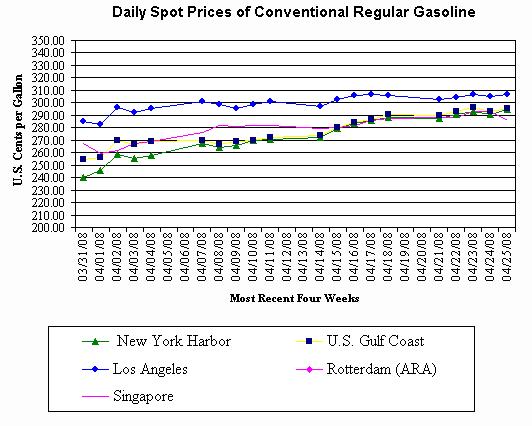
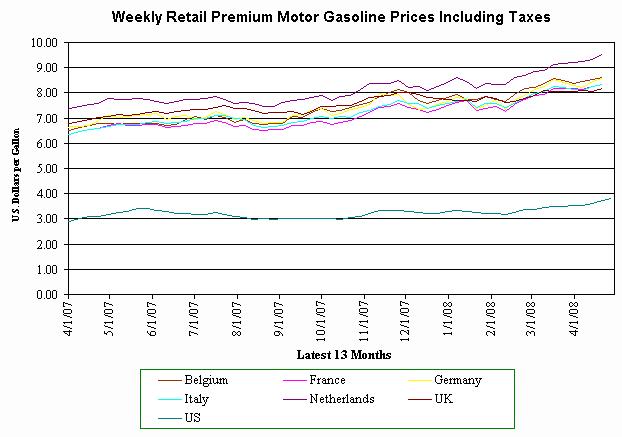
As a follow-up to this post on gas-price demagoguery, I would like to observe that the very same people who are most likely to demagogue about high gas prices in this country are the very same ones who advocate that the US adopt European-style taxation levels, regulatory policy, and CO2 targets, the results of which can be seen here:

Gas1

If you can't read the colors on the scale well, I think you can guess which is the US price line and which are the European gas prices.  Source here.  Just to be clear, this has nothing to do with wholesale gasoline prices, which are substantially similar between the US and Europe:

Gas2

Since the difference in price does not go to the producer, I will leave it as an exercise to guess where the extra $5 per gallon is going (hint:  Uncle Francois)  The cognitive dissonance required to call for 80% CO2 reductions while simultaneously decrying $3.50 gas prices is just stunning to me.

Update:  From the same source, here are the gas prices in dollars per US gallon EXCLUDING taxes:


Date Belgium France Germany Italy Nthrlnds UK US
4/14/2008 3.32 3.28 3.18 3.61 3.85 3.09 3.21

Update #2:  More here on Hillary's sleight of hand.  And this from Robert Samuelson, at how this cognitive dissonance extends to exploration limits:

We could be producing more, but Congress has put large areas of
potential supply off-limits. These include the Atlantic and Pacific
coasts and parts of Alaska and the Gulf of Mexico.
By government estimates, these areas may contain 25 billion to 30
billion barrels of oil (against about 30 billion barrels of proven U.S.
reserves today) and 80 trillion cubic feet or more of natural gas
(compared with about 200 tcf of proven reserves).

What keeps these areas closed are exaggerated environmental fears,
strong prejudice against oil companies and sheer stupidity. Americans
favor both "energy independence" and cheap fuel. They deplore imports
-- who wants to pay foreigners? -- but oppose more production in the
United States. Got it? The result is a "no-pain energy agenda that
sounds appealing but has no basis in reality," writes Robert Bryce in
"Gusher of Lies: The Dangerous Delusions of 'Energy Independence.' "

Something Else I didn't Know

Something I didn't know:  Arizona has a State Board of Homeopathic Examiners.   Seriously?  Do we also have a state board for horoscope writers?  For witch doctors?  For water diviners?  Doesn't the Flat Earth society need some supervision?

How do you have a board of scientific examiners for a discipline that has no science behind it.  A key part of homeopathy is the repetitive dilution of active ingredients to make "medicines."  In fact, homeopathy advocates claim that more diluted mixtures are more potent.  Here is an example, via Wikipedia:

Hahnemann advocated 30C dilutions for most purposes (that is, dilution by a factor of 1060).[73] A popular homeopathic treatment for the flu is a 200C [1 in 10400] dilution of duck liver, marketed under the name Oscillococcinum. Comparing these levels of dilution to Avogadro's number, one liter of a 12C homeopathic remedy created from diluting 1 liter of 1 molar solution
contains on average only about 0.602 molecules of the original
substance per liter of the 12C remedy. Similarly, the chance of a
single molecule of the original substance remaining in a liter of 15C
remedy dose is about one in 1.7 million, and about one in 1.7 trillion
trillion trillion (1036) for a 30C solution.

So what does the Homeopathic board do, look at the products sold for $100 by homeopaths and say, yep, that's pure water, it must be a valid homeopathic brew?

According to our governor here in Arizona, the Homepathic examiners are not doing their job.  What does that mean?  Did some homeopath actually sell a product that had a measurable amount of the active ingredient?  Anyway, the two comments so far on the Republic article sort of sum the whole debate up:

Commenter 1:  The number of people injured by homeopathic treatments is a tiny
fraction of the number of people killed and injured by regular
allopathic physicians and prescription drugs. The allopathic community
doesn't like the competition, though, so they create a crisis.

Commenter 2:The number of people helped by homeopathic treatments remains zero, so
the cost/benefit ration is infinitely higher than that of allopathy.  It's true that the allopathic medicine industry doesn't like
competition, but that doesn't change the fact that homeopathy is
nothing more than faith healing.

A couple of notes, just so I am not misunderstood:

  1. I am sympathetic with the desire not to load oneself up with drugs as much as many doctors seem to prescribe.  I have been prescribed antibiotics about 10 times in the last 20 years and have actually taken them once.  That being said, all those drugs and medical procedures have a real utility in aggregate.  To some extent homeopaths are, like vaccination avoiders, free riders on the medical care provided everyone else.  Go try your diluted duck liver in a plague-ravaged Middle Age city and see how far it gets you.  Go back 100 years and see how many of your children you can save from early death with homeopathy.
  2. I am very sympathetic to those who are frustrated that the current medical profession provides only one type of care without competition.  I have argued this same thing many times.  Its absurd, for example, that we have to go to a person with 8 years of medical education to get a few stitches put in.  Why can't someone with far less expensive education set up an emergency practice without an MD to dress and sew up simple wounds?  Think how much this would clear out the typical ER.  But we can't, because the government colludes with doctors to protect their medical monopoly and their single preferred (read intensive and expensive) style of care.

Wherein A Libertarian Argues For Regulation Enforcement

I got to thinking today about regulation and its enforcement in this imperfectly government-dominated world after reading this Jon Stewart quote as relayed by Kevin Drum:

With this administration, if a passenger blows up a plane, it's a
failure in the war on terror. But if the plane just blows up on its own
"” eh, it's the market self-regulating.

What struck me that I had not thought of before is the question of whether non-enforcement of a published regulatory regime was the same as letting a market self-regulate.  And my answer was:  No, at least not in the short to medium term.

The reason is that the government regulatory regime crowds out private mechanisms that might attempt to achieve the same goals.  What do I mean by crowding out?  For example, if the government published car reliability metrics and regulation for all cars, no matter how imperfect, would JD Power and Consumer Reports bother with the investment to do the same?  For decades, insurance companies wrote de facto building codes and performed fire inspections of their insured structures.  They no longer do so, because the government has taken on that role (arguably less well than the insurance companies, who had the reputation of being tigers on such inspections).  Would Moody's exist to rank bond risks if the government had regulations in place that theoretically forced all securities to (I don't know how) have the same risk?  My marina liability insurer conducts occasional inspections of my marinas.

As a result, insurers don't inspect airlines, nor do manufacturers enforce inspection and replacement regimes (as automobile companies do, to some extent, to protect their warranty).  Third parties rate airlines for customer service but not for safety.  The whole private evaluation regime for airlines exists on the assumption that the government has regulatory program X and Y in place that is enforced.  In the long term, if the government were to abandon enforcement, and this lasted long enough for that expectation to exist in the market, new private regulatory methods would arise [arguments would most certainly exist between libertarians and others whether these new regimes were as effective as the old regime, but almost undoubtedly something would emerge].  But in the near term, we don't have a self-regulating market or even the expectation of one. 

As a result, I come to the conclusion that while deregulation may be needed, the absolute wrong way to do it is via non-enforcement of existing regulations.  So there you have it, a libertarian calls for better enforcement.  Comments?  I am just starting to think about this and would appreciate feedback.

Fighting the Competition, One Legislature at a Time

Thanks to an email from a reader, comes this bizarre but all-too-common tale of an industry group supporting licensing to protect itself from competition:

Imagine you were a state legislator and some folks
asked you to pass a law making it a crime to give advice about paint
colors and throw pillows without a license. And imagine they told you
that the only people qualified to place large pieces of furniture in a
room are those who have gotten a college degree in interior design,
completed a two-year apprenticeship, and passed a national licensing
exam. And by the way, it is criminally misleading for people who
practice interior design to use that term without government permission.

You might stare at them incredulously for a moment,
then look down at your calendar and say, "Oh, I get it -- April Fool!"
Right? Wrong.

These folks represent the American Society of Interior
Designers (ASID), an industry group whose members have waged a 30-year,
multimillion-dollar lobbying campaign to legislate their competitors
out of business. And those absurd restrictions on advice about paint
selection, throw pillows and furniture placement represent the actual
fruits of lobbying in places like Alabama, Nevada and Illinois, where
ASID and its local affiliates have peddled their snake-oil mantra that
"Every decision an interior designer makes affects life safety and
quality of life."

Legislative analysis by a half-dozen states that
rebuffed ASID's attempts to cartelize interior design -- including
Colorado, Washington and South Carolina -- has failed to support ASID's
claim that the location of your couch or the color of your bedroom
walls is literally a matter of life and death. As the Colorado
Department of Regulatory Agencies put it, there is "no evidence of
physical or financial harm being caused to . . . consumers by the
unregulated practice of interior designers."

I am not sure this even needs comment.  I traditionally end my posts on licensing with this Milton Friedman quote:

The justification offered is always the same: to protect the consumer. However, the reason
is demonstrated by observing who lobbies at the state legislature for
the imposition or strengthening of licensure. The lobbyists are
invariably representatives of the occupation in question rather than of
the customers. True enough, plumbers presumably know better than anyone
else what their customers need to be protected against. However, it is
hard to regard altruistic concern for their customers as the primary
motive behind their determined efforts to get legal power to decide who
may be a plumber.

Many other posts in the same vein here

Unfortunately, the EU Is What Many US Politicians Long to Emulate

From the Times, via Daniel Mitchell at Cato:

An award-winning winemaker whose wares are sold at the royal palaces is
facing a £30,000 bill after European bureaucrats ruled that he was
using the wrong-shaped bottles. Jerry Schooler, who sells 400,000
bottles of fruit wines and mead a year, has been threatened with
prosecution over his determination to use traditional measurements. The
proprietor of the Lurgashall Winery in West Sussex, has been told to
halt the sale of beverages such as mead, silver birch wine and bramble
liqueur in 75cl and 37.5cl bottles. If he continues to sell them, he
could be taken to court under a new EU directive that permits the sale
of such products in 70cl, 50cl or 35cl measures only. "¦Mr Schooler now
faces costs of about £30,000 to change his production line. "We are
going to have to change all our bottling, the labels, machinery, boxes
and maybe the corks as well and it is going to cost me thousands to do
it," he said. "¦West Sussex County Council's trading standards
department said that the winery was bound by EU Directive 2007/45/EC,
which was drawn up in September to "lay down rules on nominal
quantities for prepacked products". It said the directive meant that
the use of 37.5cl bottles for liqueurs was illegal.

Don't miss his other story of passengers having to hop off buses every 30 miles to satisfy EU regulations.  The latter regulation is actually one that is remarkably similar to railroad regulation in the US, where a crew day was defined as something like 100 miles.  Modern freight railroads were having to change crews every two hours - I don't know if that one is still on the books.

Damned if You Do, Damned if You Don't... Hell, Damned if You Try To Run Any Kind of Business at All

Arizona state law now requires that employers use the federal e-verify system to screen employees for legal immigrant status.  As I mentioned earlier, state law requires that I use this system in ways that are illegal under federal rules, at the risk of losing my business license.

Right now, I am going through a 6000 screen required tutorial that I have to endure before I can use a system that requires me to fill in about 3 blanks and hit enter.  (Of course, since this is a government system, the tutorial has already crashed twice three five times and I have had to restart it each time).  Somewhere in the midst of the training, I reach this admonition:

You may not discriminate against applicants and employees based upon
their citizenship or immigration status with respect to hiring, firing,
or recruitment or referral for a fee. This includes treating citizens
and non-citizens differently during the hiring process, such as
screening out non-citizens or not hiring lawful immigrants based upon
their immigration status.

WHAT?  Personally, I am all for living by this, but isn't this EXACTLY what the law is requiring me to do?  To discriminate against people, and ban my hiring of them, based on their immigration status?  How can I possibly keep my actions legal if I am required to discriminate based on citizenship status but I am also banned from discriminating in hiring based on citizenship status.  How Orwellian can we get?

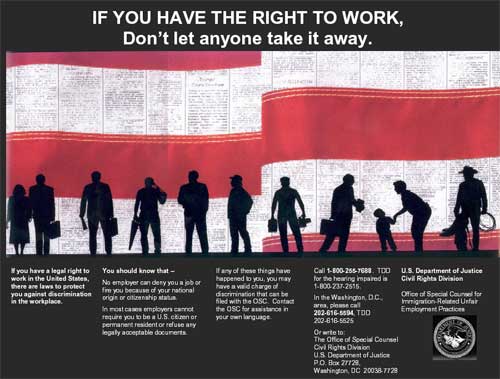
To continue the Orwellian theme, as part of this law by the state of Arizona whose sole purpose is to restrict the classes of people I can and can't hire, I must display this poster:

Ocw_poster

Gee, I would have thought everyone in the world had the right to seek work and to contract with anyone they please for their labor, but in fact the only body taking away the right is the group that made this poster -- ie the government -- which requires that everyone have a special government license called citizenship or a green card before they can sell their labor to willing parties in this country.

Well I wondered, of course, why there were 176 (I counted) training screens just to enter name-social-DOB and hit return.  It turns out that by "agreeing" to join the e-Verify program, which I am forced to do by Arizona law, I have agreed to become a US immigration officer and to do their job for them (without compensation, of course).  Here is an example screen:

There are five options for resolving a case:

  • Resolved Authorized. Select this option when employment is authorized.
  • Resolved Unauthorized/Terminated. Select this option when
    employment is not authorized (SSA Final Nonconfirmation, DHS Employment
    Unauthorized, or DHS No Show), or when a Tentative Nonconfirmation
    response is uncontested AND employment is terminated.
  • Self Terminated. Select this option if an employee quits or
    is terminated for reasons unrelated to employment eligibility status
    while the verification query is in process.
  • Invalid Query. Select this option if a duplicate query was discovered after the query was sent or if a query was sent with incorrect data.
  • Employee Not Terminated. Select this option to notify DHS
    that you are not terminating an employee who received an SSA Final
    Nonconfirmation, DHS Employment Unauthorized, or DHS No Show response
    or who is not contesting a Tentative Nonconfirmation response.

Got that?

Every campaign year we get these debates with all of these stupid questions, including things like "do you know how much a gallon of milk costs" or "Who is the head of state of Mayanmar?"  I would just love to see someone ask Obama or Clinton "In the largest city of your state, can you name all of the city, county, state, and federal licenses, registrations, tax numbers, certifications and registrations you need to be able to legally run a business with 10 employees?"

Update: OMG I have to pass a 33-page test before it will let me use the system.  LOL.  We can't test government-employed teachers for subject competency but we can test employers on government bureaucratic procedures before we allow them to hire anyone.

Update #2:  Well, there is an hour and a half of my life I will never get back.  It would have gone much quicker if they had a server that wasn't powered by a hamster on a treadmill.  Every several pages the server would take a minute or more to respond with the next page, and every twenty pages it would crash my browser completely.  Incredibly, to continue the Orwell theme, there were several questions where a correct answer required one to confirm government propaganda about the program.  Stuff like "The e-Verify helps every employer by...."

I am now fully empowered to, as required by US and Arizona law, discriminate in hiring based on immigration status just so long as I am careful not to discriminate in hiring based on immigration status.

Down With DST

I think that Arizona's decision not to go on DST is a great one.  Being outside in the summer sunshine in Phoenix can be miserable, but the desert cools very quickly once the sun goes down.  The earlier the sun goes down in the summer, the better as far as I am concerned.  Within an hour or two after sunset, it is pleasant to sit and eat and play outside.

A new study seems to show that DST increases electricity use, rather than reducing it.  DST was, if my memory serves, a WWII innovation to save electricity.  It does so quite well if electricity demand is driven mainly by lighting.  It lets one read and function by sunlight in the evening hours.   However, as air conditioning has become a larger element of electricity demand, that equation is changing.  DST can lead to higher air conditioning loads in the evenings.

Our main finding is that"”contrary to the policy's intent"”DST increases
residential electricity demand. Estimates of the overall increase range
from 1 to 4 percent, but we find that the effect is not constant
throughout the DST period. There is some evidence of electricity
savings during the spring, but the effect lessens, changes sign, and
appears to cause the greatest increase in consumption near the end of
the DST period in the fall. These findings are consistent with
simulation results that point to a tradeoff between reducing demand for
lighting and increasing demand for heating and cooling. Based on the
dates of DST practice before the 2007 extensions, we estimate a cost of
increased electricity bills to Indiana households of $8.6 million per
year. We also estimate social costs of increased pollution emissions
that range from $1.6 to $5.3 million per year.

First Question: Ask About the Energy Balance

Over the coming months and years, you are going to see a ton of stories like this for somehow storing or reprocessing CO2:


If two scientists at Los Alamos National Laboratory are correct,
people will still be driving gasoline-powered cars 50 years from now,
churning out heat-trapping carbon dioxide into the atmosphere "” and yet
that carbon dioxide will not contribute to global warming.

The scientists, F. Jeffrey Martin and William L. Kubic Jr., are
proposing a concept, which they have patriotically named Green Freedom,
for removing carbon dioxide from the air and turning it back into
gasoline.

The idea is simple. Air would be blown over a liquid solution of
potassium carbonate, which would absorb the carbon dioxide. The carbon
dioxide would then be extracted and subjected to chemical reactions
that would turn it into fuel: methanol, gasoline or jet fuel.

This process could transform carbon dioxide from an unwanted,
climate-changing pollutant into a vast resource for renewable fuels.
The closed cycle "” equal amounts of carbon dioxide emitted and removed
"” would mean that cars, trucks and airplanes using the synthetic fuels
would no longer be contributing to global warming.

Although they have not yet built a synthetic fuel factory, or even a
small prototype, the scientists say it is all based on existing
technology.

You are going to see a ton of stories like this from academia because academics respond to incentives like everyone else -- faced with billions of dollars available for funding research into carbon-neutral technologies, they are going to publicly promote their ideas in an attempt to garner this funding.

The first question you should always ask is about the energy balance.  I am sure that this is technically possible.  Today we can create hydrogen fuel from sea water, but it is atrociously expensive from an energy standpoint.  The problem, then, is whether it makes any sense from a cost and energy balance point of view.  This is a good hint that it does not:

Even with those improvements, providing the energy to produce gasoline
on a commercial scale "” say, 750,000 gallons a day "” would require a
dedicated power plant, preferably a nuclear one, the scientists say.

We have to be suspicious that the carbon benefits come from the nuclear plant they require, not the process itself.  In fact, one is left to wonder why we would go through so much effort at all rather than just charge electric cars directly from the nuclear plant.  My sense is we are much closer on battery technology than on this stuff.


All Businesses Allowed, Except Those That Are Proven Successes With Customers

Via Hit and Run:

The Palm Beach Town Council on Monday voted unanimously to block "formula restaurants" from opening in the island town.

The ban, which was first proposed in 2006, applies to restaurants with
three or more units and similar trade names, standardized and limited
menus, uniforms, architecture, and decor. The measure will go before
voters this spring.

In other words, if your business has proven itself to be successful with customers and attempts to bring this proven success formula to our town - forget it.

The post digs in further, and finds the real problem to be that the Palm Beach Town Council is afraid of the "riff raff" that might come with certain plebeian chains.  Which reminds me of Lexington's opposition to the Boston Red Line being extended into their town.  Ostensibly, they were opposed to it on fiscal grounds, but that is a joke in a town that has never opposed a government program ever on fiscal grounds.  In fact, they were afraid of the "riff raff" the metro might bring to town, but the more-liberal-than-thou residents could never admit that in public.

It Turns Out That I Am Not A Patriot

It turns out, according to Barack Obama, (who hales from the party that doesn't believe in questioning anyone's patriotism) that I am not a "Patriot Employer."  This is from the text of Senate Bill S. 1945 of which he is a co-sponsor  (My snark is interspersed in italics):  Patriot Employers are to be given tax breaks over unpatriotic employers (I presume this means that their tax rates will be raised less in an Obama presidency than those of other folks) with "patriot employers" defined as such:

(b) Patriot Employer- For purposes of subsection (a), the term
`Patriot employer' means, with respect to any taxable year, any
taxpayer which--

        `(1) maintains its headquarters in the United States if the taxpayer has ever been headquartered in the United States,

      OK, I guess I can comply with this.  Though I am not sure the best way to begin an Obama "kindler gentler foreign policy" is to tell the nations of the world that we will be taxing their company's income in the US at a higher rate than our own companies.

        `(2) pays at least 60 percent of each employee's health care premiums,

      So the #1 determinant of patriotism is not commitment to individual rights but paying 60% of employee health care costs.  I guess I am so unpatriotic

      And, just from a practical standpoint, 90% of my employees are seasonal, hired for about 4 months of the year.  To be patriotic, I have to pay their health care costs all year long?  Also, since most of my employees are retired, they are on Medicare or an employee retirement medical plan.  If they pay $0 in premiums and I pay $0 of that, do I get credit for 60%?  Maybe the government can mandate a solution for zero divided by zero, like they did for the value of pi years ago

        `(3) has in effect, and operates in accordance with, a policy requiring neutrality in employee organizing drives,

      I presume neutrality means that in a hypothetical union drive, I do not express my opinion (and likely opposition) to said unionization drive?   I am told that this also entails allowing card checks rather than hidden ballot voting.  In other words, patriotism is being defined here as 1) giving up your free speech rights and 2) opposing hidden ballot voting.  Uh, right.  Besides, if a union organized our company, as unlikely as that would be, I would probably have to do a Francisco d'Anconia on the place.

        `(4) if such taxpayer employs at least 50 employees on average during the taxable year--

        `(A) maintains or increases the number of full-time
        workers in the United States relative to the number of full-time
        workers outside of the United States,

        In other words, we don't want American companies growing overseas.  This could also be called the "give up international market share act."  This implies that it is unpatriotic for US-based Exxon to explore for oil in Asia and that it is more patriotic to let the Chinese national oil company do it.  This implies that it is more patriotic for Coke to lose market share in Germany than to gain it.  This means that it is more patriotic for Mattel to buy its toys in China from Chinese companies rather than run the factories themselves (and thereby be accountable themselves for product quality and working conditions).

        This is beyond stupid.  We LIKE to see US companies doing well overseas.  If we have to import our raw materials, we feel more comfortable if it is US companies doing the extraction.  Don't we?  In the name of patriotism, do we really want to root for our domestic companies to fail in international markets?

        `(B) compensates each employee of the taxpayer at
        an hourly rate (or equivalent thereof) not less than an amount equal to
        the Federal poverty level for a family of three for the calendar year
        in which the taxable year begins divided by 2,080,

        90% of my workers are retired.  They work for me to supplement their income, to live our in nature, and to stay busy.  They need me to pay them based on the poverty line for a family of three, why?  I will tell you right now that if I had to raise wages this much, most of my employees would quit.  Many of them force me to give them fewer hours so they can stay under the social security limits for income.  I discussed what rising minimum wages often force me to do here, but just as an illustration, a $1 an hour across the board wage increase would easily wipe out all the money I make in a year and put me into a loss position.  In which case the lowered tax rate would not do me much good anyway.

          `(C) provides either--

            `(i) a defined contribution plan which for any plan year--

            `(I) requires the employer to make
            nonelective contributions of at least 5 percent of compensation for
            each employee who is not a highly compensated employee, or

            `(II) requires the employer to make
            matching contributions of 100 percent of the elective contributions of
            each employee who is not a highly compensated employee to the extent
            such contributions do not exceed the percentage specified by the plan
            (not less than 5 percent) of the employee's compensation, or

          `(ii) a defined benefit plan which for any plan
          year requires the employer to make contributions on behalf of each
          employee who is not a highly compensated employee in an amount which
          will provide an accrued benefit under the plan for the plan year which
          is not less than 5 percent of the employee's compensation, and

          Uh, I am not sure why it is unpatriotic for an employee to save for themselves, but I think 401k plans are a nice benefit.  I would certainly offer one except for one tiny fact - ALL MY EMPLOYEES ARE ALREADY RETIRED!!  They are over 65.  They are drawing down on their retirement, not contributing to it.

          This is at the heart of the problem with all US labor law.  Folks up in Illinois write laws with a picture of a steel mill in mind, and forget that employment and employees have infinite variations in circumstances and goals. 

          So I am unpatriotic, huh.  But if forcing companies to contribute to emplee retirement plans is patriotic, why is hiring folks once they are retired to give them extra income in retirement unpatriotic?  In fact, maybe I could argue that 100% of the wages I pay go to retirement spending

        `(D) provides full differential salary and
        insurance benefits for all National Guard and Reserve employees who are
        called for active duty, and

          In other words, we of the government are not going to pay our employees (ie reservists on active duty) what they are worth and are not going to give them benefits, so to be patriotic you need to do it for us.  We in Congress are not really very patriotic and don't support the troops, so you need to do it for us.

          All kidding aside, I would do this in my company if it was applicable, but I really resent being piously told to do so by several Senators who don't really model this behavior themselves.

        `(5) if such taxpayer employs less than 50 employees on average during the taxable year, either--...

blah, blah.  Basically the same stuff repeated, though slightly less onerous.

Since when did patriotism equate to "rolling over to the latest AFL-CIO wish list?"

Cap and Rent-Seek

Just the other day, I made the point that just because regulated corporations support a regulation does not mean that said regulation is sensible or good for the economy.  Often, incumbents are beneficiaries of industry regulation, which tends to give them certain advantages over new entrants.  I showed an example with General Electric and the new energy bill regulating light bulbs:

we see that GE has a product sitting on the shelf ready for release
that fits perfectly with the new mandate.  Assuming competitors don't
have such a technology yet, the energy bill is then NOT a regulation of
GE's product that they reluctantly bow to, but a mandate that allows GE
to keep doing business but trashes their competition.  It is a market
share acquisition law for GE.

Marlo Lewis makes a similar point, this time in relation to cap and trade systems:

I can't count how many times I've heard that line of
chatter"”and from people who usually assume anything corporations are
for must be bad!
 
There are many reasons some corporations
support cap-and-trade, or at least say nice things about it in public.
Some companies seek the PR value from looking green....
 
But in the case of energy companies, many who support
cap-and-trade do so in the expectation that they'll get a boatload of
carbon permits from the government"”for free!
 
Permits represent an artificial, government-created
scarcity in the right to produce energy. The right to produce energy is
very valuable, especially where government restricts it. The tighter
the cap, the more valuable each permit traded under the cap.
And this is a major problem with cap and trade that no one talks about:  It is a huge government subsidy and protection of existing competitors against new entrants.  Because in most systems, current competitors receive a starting allotment of credits for free, but new entrants who want to start up and compete against existing companies must purchase their credits.  This is tolerated in Europe, because that is how the European quasi-corporate-state works, with politicians and large corporations in bed together to protect each others' incumbency.  But it creates a stagnating economic mess, ironically locking in place the very companies and business models environmentalists would like to see overtaken by new ideas and entrants.

Frequent readers know that I am not convinced the costs of man-made global warming exceed the costs of abating such warming.  However, if we are going to do so, a carbon tax makes so much more sense, in that it avoids the implicit subsidies of incumbents and reduces the opportunities for rent-seeking and political shenanigans.  Politicians, however, live for these rent-seeking opportunities, because they generate so many campaign contributions.  They also favor hidden taxes, as cap-and-trade would be, over direct taxes, such as the carbon tax, because they are, well, gutless.

More here on cap-and-trade vs. carbon tax.

HT:  Tom Nelson

Businesses and Regulation

I sometimes here supporters of a certain regulation say "even big company X supports this regulation, so it must be a good idea."  But this is based on a faulty assumption, similar to that made by people who equate being pro-business in politics with being pro-free markets.  They are not the same thing.  As was said at the Cato blog:

Representatives of the business community frequently are the worst
enemies of freedom. They often seek special subsidies and handouts, and
commonly conspire with politicians to thwart competition (conveniently,
they want competition among their suppliers, just not for their own
products). Fortunately, most business organizations still tend to be -
on balance - supporters of limited government. But as the Wall Street Journal notes, some state and local chambers of commerce have become relentless enemies of good policy.

Incumbents of major industries very often shape regulation to their advantage, and to the disadvantage of consumers and smaller or new competitors.  For example, as one of the larger companies in my business, many of the regulations and restrictions I rail against in this blog actually help my business.  Licensing requirements, bonding requirements, insurance requirements, regulatory and reporting requirements, etc.  all tend to make it nearly impossible for new companies to enter the business to compete against me, and give a distinct advantage to the larger incumbent players.   I still vehemently oppose all that garbage, but I do so as a defender of capitalism and against what are probably the best interests of my company.

So when large companies like GE say that they are now on the global warming bandwagon and support government intervention in CO2 emissions and such, it is not an indicator that CO2 science is any good; it just means GE has decided that likely CO2 legislation will help its bottom line.  While GE is portrayed as someone who will get hurt by CO2 regulation but is reluctantly coming around to the science anyway, what it in fact really means is that GE has decided that global warming regulation can be shaped to its advantage, particularly if it can use its size and political muscle molding the details of that regulation.  Here is a great example, via Tom Nelson (the Instapundit of global warming skepticism)

But there is sure to be strong opposition to the bill, including from General Electric Co.

The
light bulb maker is developing a new generation of efficient
incandescent bulbs, said Kim Freeman, a GE spokeswoman in Louisville,
Ky.

By 2012, she said, GE will have an incandescent bulb that uses as little energy as the compact fluorescent bulbs sold today.

"We
would oppose any legislation that would ban a particular technology,"
she said. "Giving consumers more choices is the appropriate approach."

The
company supports the standards passed by Congress in December,
according to Freeman. That law requires bulbs to be 25 percent to 30
percent more efficient starting in 2012.

Read between the lines, and you see GE attempting to steer global warming legislation to its advantage.   The last paragraph goes a long way to explaining GE's support of the last energy bill (with substantial light bulb legislation), which GE might have been expected to oppose.  Because now we see that GE has a product sitting on the shelf ready for release that fits perfectly with the new mandate.  Assuming competitors don't have such a technology yet, the energy bill is then NOT a regulation of GE's product that they reluctantly bow to, but a mandate that allows GE to keep doing business but trashes their competition.  It is a market share acquisition law for GE.  On the other hand, GE says a total ban would be bad, because it would force CF bulbs to the forefront, where GE trails its competitors.  This is the cynical calculus of rent-seeking through regulation.  And it is all worthless, because high efficiency bulbs are one of the things that so clearly pay for themselves that consumers will make the switch for themselves without government mandates.

The Fascists Have Jumped the Shark

Via the Junkfood Science blog,

It has actually happened. Lawmakers have proposed
legislation that forbids restaurants and food establishments from
serving food to anyone who is obese (as defined by the State). Under
this bill, food establishments are to be monitored for compliance under
the State Department of Health and violators will have their business
permits revoked.

Unbelievable.  And not that this would make it right, but the ban is not even on serving certain types of fattening foods, but on serving any food.  Here is the key part of the law:

Any food establishment to which this section
applies shall not be allowed to serve food to any person who is obese,
based on criteria prescribed by the State Department of Health after
consultation with the Mississippi Council on Obesity Prevention and
Management established under Section 41-101-1 or its successor. The
State Department of Health shall prepare written materials that
describe and explain the criteria for determining whether a person is
obese, and shall provide those materials to all food establishments to
which this section applies. A food establishment shall be entitled to
rely on the criteria for obesity in those written materials when
determining whether or not it is allowed to serve food to any person.

The Consumers are Saved!

I could probably start a blog just featuring ridiculous government licensing practices.  As I have written before, licensing generally has little to do with the consumer, and more to do with protecting current incumbents from competition.  Via Radley Balko, this is one of the uglier examples I have seen of late:

Mary Jo Pletz was really, really good at eBay. But now the former
stay-at-home mother and gonzo Internet retailer fears a maximum $10
million fine for selling 10,000 toys, antiques, videos, sports
memorabilia, books, tools and infant clothes on eBay without an
auctioneer's license.

An official from the Department of State knocked on Pletz's
white-brick ranch here north of Allentown in late December 2006 and
said her Internet business, D&J Virtual Consignment, was being
investigated for violating state laws....

The 33-year-old opened her Internet business in 2004 so she could
stay home with her 6-month-old daughter, Julia, who was diagnosed with
a hypothalamic hamartoma brain tumor.

She cooperated when told it was illegal and works at dental offices
in Allentown, Bethlehem and Lehighton as a hygienist to help pay the
bills at home. Julia, whose health stabilized on medication, is
enrolled in day care. Pletz also has a son, Douglas, 7.

But the state has not dropped prosecution. It sent Pletz a complaint in
April and an amended complaint in December. The complaint says she
could be fined $1,000 for each violation of the state law. The April
complaint noted 10,000 sales. Pletz and her attorney, Joseph V. Sebelin
Jr. of Palmerton, did the math - $10 million in possible fines. The
second complaint does not list a number....

Because of the complaint, Pletz worries the state also could revoke
her dental hygienist's license, which she earned by attending community
college for seven years at night.

"I really wish that they will walk away from that one and prosecute
somebody else," said State Rep. Michael Sturla (D., Lancaster), who is
chairman of the House Professional Licensure Committee. "There is every
reason in the world that if she is found guilty, she should be
exonerated," he said.

This latter is the most outrageous of all, and it is a line taken by a number of public officials -- that the concept of prosecuting people who are selling things on eBay is just fine, but they should not have started with someone who has less sympathetic.  Maybe Exxon has an eBay arm.

Sturla has proposed the bill to create the electronic auctioneer's
license. The license would require the Internet seller to buy a $5,000
bond for about $40 a year. This would protect consumers, he said.

Bull.  This would protect competitors.  eBay has numerous controls in place to identify problem sellers.

D&J Virtual Consignment had 11,000 feedback comments on eBay
and 14 were negative, Pletz said, giving her a 99.9 percent
satisfaction rating.

I can say from experience that for some reason they must teach this in
government school -- when in doubt, make service businesses get a
bond.

This is not unique - Ohio tried to do the same thing.  But why is a person who sells on eBay an auctioneer at all?  Isn't eBay the auctioneer?  If I turn my stuff over to Christies to auction off, setting a reserve price in advance and having them take a sales commission, how is that any different than putting the same stuff on eBay.  In Ms. Pletz case, eBay is earning the auction commission.  She is just taking a retail margin.

Licensing Everything

In case you thought the government was sane.  By a strict reading of the law, a license would be required to put a smoke detector in your own house.

No Dancing Allowed

Drew Carey's new Reason video focuses on San Tan Flats, a restaurant in the Phoenix area where local officials are trying to ban dancing.

I was on this case a year ago.

The Joys of Government Mandates

Today, I had to buy gas in Oregon.   Usually, I try to gas up just before I enter Oregon, in protest of their anachronistic laws making self-service gasoline illegal.  Unfortunately, I had not choice but to stop in a station in Portland.  Because of this government mandate, I had to sit in my car for 5 minutes waiting futilely for service.  Getting none, I finally got out and gassed up myself.  The state-mandated car-fueling employee, who couldn't manage to get to me to fill up my car, was at my car in 5 seconds once he saw that I was impinging on his territory by gassing up my own vehicle.  I told him full service was not service at all if I had to wait five minutes, and he could have me arrested if he wanted.  For the rest of the time I gassed my car, I was subjected to an ignorant left-coast lecture on how the mandate created jobs.  All this lecture took place, of course, while other customers waited for service.  I wonder what it would feel like to know with absolute certainty that your job was completely useless and existed only because of a trick of legislation.  People who owe their jobs to the government are always a lot more vigilent about protecting their turf than they are about providing service.

Cool, There's a Word For This

I have been calling it "the health care Trojan horse for fascism."  It is the phenomenon where government funding of health care is used as an excuse to micro-regulate individual behaviors.  Apparently, the economic term is "government financing externalities."

These kinds of "government financing exernalities" are commonly used
to justify government regulations that restrict individual freedom.
Liberals use these arguments to justify such regulations as mandatory
seat belt laws, smoking bans (because government may end up subsidizing
smokers' medical treatment if they get lung cancer), and most recently
restrictions on morgage terms (because the government may bail out
people who end up defaulting). Conservatives have their own favorite
government financing externality arguments. For example, many argue
that we should restrict immigration because otherwise the immigrants
might collect welfare benefits that are paid for by taxpayers.
Obviously, the greater the role of government in financing a wide range
of activities, the greater the number of potential government financing
externalities. The expansion of government spending facilitates the
expansion of government regulation intended to curb the negative
effects of the spending.

Government financing externality arguments generate their appeal
from the fact that they seem not to be paternalistic. We are willing to
let you hurt yourself, advocates implicitly suggest, but we can't let
your bad behavior hurt the taxpayers.

The libertarian solution to this problem is to eliminate the
government financing that created the "externality" in the first place.
I

It is Time To Reform the US Patent Office

The evidence is fairly clear that it is past time to reform the US Patent Office, particularly in its handling of software and Internet-related patents.  One of my ex-employers, Mercata, managed to obtain several patents (including a few that were awarded postmortem) that in effect patented volume discounting (though the method was sortof kindof clever).  Amazon famously managed to patent 1-click ordering, and numerous companies from Red Hat to Blackberry have been subject to expensive suits from various patent trolls, many of whom never took a single step to monetizing or developing their patents besides hiring lawyers. 

Stephan Kinsella at Mises has another good example:  Apple is attempting to patent the ordering of take-out food by cell phone.

Genius! Apple's done it! They've solved the problem of waiting in line for food or beverages. You place your order before you get it--but not the normal way--see, here's the pure genius of it--you place your order, get this, you won't believe it, wirelessly.
Yep! Who would have thunk it? I mean, I know it's well known to call in
a food order and drive there in time to get it, so you don't have to
wait in line (and this might be done on a (wireless) cordless home
phone, or a (wireless) cell phone, but I digress); or to place your
order and receive one of those little blinky-buzzy things that tells
you when your order is ready, so you don't have to wait in line (hey,
aren't those little blinky wireless buzzers, er, wireless? but again, I
digress); and it's known to communicate wirelessly; and in other
countries, it's well-known to use cell phones to make purchases. And in
McDonald's, you can place your order at a little automated computer
kiosk (but maybe it uses wires! Whew--HUGE difference, lemme tellya).

But, my God, Apple! Oh, it's amazing--the innovative brilliance to think of using a cell phone--a cell phone,
do you hear me!?--to place an order for a cuppajoe... so you don't have
to stand in line... it's so beautiful, I'm about to shed tears...
Sniff... Thank God for the US patent system giving them a king's
monopoly on this unique idea. Otherwise, no one would have come up with
this!. And let's only hope Apple gets a patent on this and is able to
sue or threaten other companies to pay them royalties for all their
remotely similar "wireless communications systems". After all, it's a small price to pay to have the American innovation we do.

There was a time when I was naive enough to think that the US Patent Office would step back and say -- "oops, we screwed up.  We really didn't know what we were doing when we were flooded with all of these business-model-masquerading-as-software patents.  Now we realize we need to get our act together."  Congress is going to have to step in and reduce or eliminate the patentability of software and business models (all other software other than computer code is subject copyright law, not patents).

But of course, Congress will never make these reforms, because forcing business competition into the courts under arbitrary and changing law rather than settling business model superiority in the marketplace generates far more political activism and campaign donations.  So why am I even bothering writing this.  Never mind.

Postscript: By the way, if I were running a software or Internet company, I would be filing every dumb patent application I could think of, because if I don't, someone else will and will and then I am stuck with a suit and trying to prove priority.  Which causes me to think of one way we might force reform -- a sort of reverse strike.  Every software company in 2008 should strive to file as many patent applications for every BS thing they can think of.   Maybe a deluged PTO might at that point force some kind of reform.

Nanny's of the Year