So Waxman-Markey is Still Alive

Via the AZ Republic:

House Democrats narrowly won a key test vote Friday on sweeping legislation designed to combat global warming and usher in a new era of cleaner energy. Republicans said the bill included the largest tax increase in American history.

The vote was 217-205 to advance the White House-backed legislation to the floor, and 30 Democrats defected, a reflection of the controversy the bill sparked.

Interestingly, Democrats are selling the bill by saying it won't work.  Since a cap-and-trade scheme can only succeed if it changes consumer consumption patters, it must impose costs on consumers to work.  But...

"The bill contains provisions to protect consumers, keep costs low, help sensitive industries transition to a clean energy economy and promote domestic emission reduction efforts," the White House in a statement of support for the legislation.

Next stop, Senate, where the bill has even more of an uphill climb.

Update: Final tally on the main vote was 219-212.  Of course absolutely no one who voted "yea" has any idea what they voted for, since no one can even produce a copy of the bill, much less attest that he or she read it.

Wal-Mart Credit Compaint

I don't know if this is a result of the credit tightening or just mindlessly poor service by Wal-Mart credit as provided by GE Capital

Continue reading ‘Wal-Mart Credit Compaint’ »

Screaming Pre-Order Deal On Windows 7

I have been a frequent detractor of Windows Vista.  However, after playing around with the Windows 7 beta for a while, I am very encouraged about this new OS.    For a limited time, Microsoft is offering pre-order sales of Windows 7 home and pro upgrade packages (these require you to already have Windows on your computer).  Prices are $49.99 and $99.99 respectively, which represent a 50% discount to the planned prices of these products at roll-out.  I already bought 3 copies from Amazon  (that is the limit, apparently, that Amazon is setting).  Delivery is not until some time in October.

Amazon links:  Windows 7 Home Premium Upgrade and Windows 7 Professional Upgrade.

Climate Bill Payoffs

I am again hearing rumblings that the climate bill may pass the House.  If so, it will be interesting to see what last minute bribes were added to make this happen.  The most recent bribe we know about is the commitment to pay farmers not to grow crops with the weak window dressing that this is somehow a carbon offset.

The logic behind this farm offset provision is actually hilarious, as it undermines years of BS arguments by corn ethanol supporters.  These ethanol supporters have argued, against the results of every study ever conducted outside of a state school in the corn belt, that the CO2 used in growing corn and processing it into ethanol is less than the CO2 absorbed by corn while growing.

But the argument of farmers in the recent climate bill is that farmers should be paid to do nothing (ie leave fields fallow) because this will reduce CO2 produced in growing the crops.  But this is only the case if such CO2 in the production phase is larger than the CO2 absorbed from the crop's growth.  So if Waxman-Markey passes, we will have expensive energy provisions based  on the assumption that Co2 used in crop production simultaneously both is and isn't greater than CO2 absorbed in growth.  Outstanding.

By the way, for those who still haven't figured out the power of the farm lobby, note that while farmers are paid not to do their business, no other class of individual or industry will recieve similar payments.

Today's Quiz

In our new corporate state, does anyone think this decision was made purely on the business merits?  Note that the only people mentioned or commenting in the article (other than a GM and UAW PR flack) are politicians of the various states.

WAAAAAAAAAAAAAA

Having lobbied hard for the stimulus bill with the expectation they could get some extra local spending without the political cost of having to tax the locals more to pay for it, Americas mayors find they in turn got played:

President Barack Obama is facing complaints from big-city mayors and county politicians that parts of the economic stimulus package are shortchanging their constituents.

Vice President Joe Biden has been holding private conference calls on the stimulus with elected officials from around the country, some of whom have been telling him that metropolitan regions are losing out to rural areas in the competition for stimulus money.

That argument tracks a report released by the U.S. Conference of Mayors that concluded that cities have gotten a disproportionately small share of stimulus money set aside for road and other transportation improvements.

I thought the following was particularly hilarious.  It appears that the mayors have abandoned progressive tax policy in favor of a more classical notion of fairness:

The mayors commissioned a report looking at a pot of $18 billion set aside for transportation. When the report was released this month, the 85 most populous metropolitan areas had received $8.8 billion - or 48 percent of the total. Yet those same areas account for 63 percent of the U.S. population and 73 percent of the gross domestic product, the report said.

Chicago would need to get another $250 million in stimulus transportation funds to reach a level that reflects its contribution to the Illinois economy, the report calculated. In Ohio, Cleveland and Cincinnati account for 40 percent of the total economy yet received less than 5 percent of the transportation stimulus funds earmarked for the state.

I am sure the richest 10% who pay the vast majority of the taxes will be happy to know that the mayors are now advocating that stimulus money be spent in proportion to how people contribute to the economy.  Yeah, you can hold your breath for that.  It turns out that progressive redistribution is only a good thing if you are on the recieving end.

A Consistent Government Mindset

The Antiplanner observes, in the context of the Washington metro crash, that governments are happy to appropriate funds for expensive new facilities, but almost never want to appropriate funds for capital replacement and refurbishment of such facilities 20-30 years later.  Such refurbishment is nearly always necessary.  Private businesses plan for it -- for example, oil companies plan and budget on the assumption that all of their gas stations will need to be torn down and rebuilt every 20-25 years.

I work with public recreation a lot and can say that the exact same problem exists -- politicians love funding a new park or visitor center or museum expansion, particularly if they can get their name on it, but consistently refuse to fund capital replacements decades later when these are needed.  I guess they are unsexy.

Creating Another "Market" Failure

This is OK, because when it inevitably creates problems, those problems can again be blamed on a failure of free-market capitalism.

Two U.S. Democratic lawmakers want Fannie Mae and Freddie Mac to relax recently tightened standards for mortgages on new condominiums, saying they could threaten the viability of some developments and slow the housing-market recovery....

In March, Fannie Mae said it would no longer guarantee mortgages on condos in buildings where fewer than 70 percent of the units have been sold, up from 51 percent, the paper said. Freddie Mac is due to implement similar policies next month....

In a letter to the CEO's of both companies, Representatives Barney Frank, the chairman of the House Financial Services Committee, and Anthony Weiner warned that a 70 percent sales threshold "may be too onerous" and could lead condo buyers to shun new developments....

In addition to the 70 percent sales threshold, Fannie Mae will also not purchase mortgages in buildings where 15 percent of owners are delinquent on condo association dues or where one owner has more than 10 percent of units, as the firm sees these as signals that a building could run into financial trouble, the paper added.

Hey, it worked before.

We Make Money the Old Fashioned Way -- Through Massive Public Subsidies

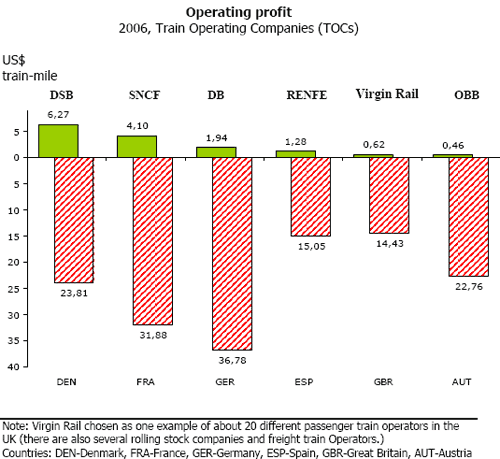
During and after the Obama proposal for lots more government spending on long-distance rail lines no one will ride, there was a lot of discussion about how European railroads make money with high speed lines.  This sounded like BS to me, from my experience.  Years ago I consulted briefly with the SNCF, the state railroad of France.  Just as one example, we found they had something like 100,000 freight cars and 125,000 freight car mechanics.  I tongue-in-cheek suggested they could assign each guy his own car to ride with full time and fix if necessary and still cut staff by 20%.

Anyway, it turns out the profitability claim is BS.  The Antiplanner links to this study by the Amtrak inspector general.   Here is the key chart, with the green the "reported" profits.  But it turns out they book subsidies as revenue.  The subsidies (including indirect subsidies like taking railroad pensions into the national system and off the railroad's books) are in red.

railroad-lossesPostscript: I have always been amazed that greens get all misty-eyed at European rail.  Sure, its cool to ride a fast train, but the cost of having an extensive passenger rail system is that most of Europe's freight pounds along highways, rather than via rail.  In the US, the mix is opposite, with few passengers on trains but much more of our freight moving by rail.  I would have thought that preferentially moving freight over rail rather than passengers was a much greener approach.

We Can Only Afford This With Other People's Money

It turns out, the first $100 million a mile extension of Phoenix light rail is having to be postponed.  The reason?  Its just too much money for the local pols.  So why is this one piece being postponed when any number of other extensions, such as the $230 million a mile airport extension, still going forward?  Well, it turns out that all those other lines (as well as the original) use large dollops of federal money, while the delayed extension was planned to use only local money.

It turns out that we are not willing to pay the full freight of building light rail for ourselves, and only want to do it if we are able to grab at least half the cost from people outside of Arizona.  AZ Republic story

Double Dip

A while back I worried that frequent, random, and unprecedentedly extensive Obama interventions in the economy and private commerce could well cause any economic recovery to stagnate as businesses sat on their wallets waiting for more clarity.   Though the ins and outs of the Great Depression are endlessly debated, there is good evidence that the Depression was extended by just this effect, in particular by the effects of the National Industrial Recovery Act, America's flirtation with Mussolini-style fascism.

Economist MaxedOutMama (who, to her credit, was sounding alarms last year long before most everyone else including me were) says that there is still a lot to be worried about and that businesses are indeed sitting on their wallets:

The rolling four-quarter change for GDP is now -2.5%. Far more frightening is the same figure for gross private domestic investment, which in Q1 was -23.6%, and has now been falling since fourth quarter 2006! Gross private domestic investment is the fundamental driver of this economy and just about every other economy, and at no time can one ever rack up a such a string of GPDI decreases in an economy without generating a pretty intense recession.

That is the first thing on which every realistic economist must stay concentrated. Talk about a credit crisis does not address the fundamental economic operator, and dumping a lot of stimulus money into the economy will not overcome a recession produced by collapsing GPDI unless it boosts domestic investment - which our stimulus package does not.

In fact, I would argue that government actions over the last 6 months, from executive compensation controls to Waxman-Markey to health care "reform" all do just the opposite -- suppress investment by increasing uncertainty.

By the way, the inflation I have been promising for a while has obviously not occured yet.    The Fed says they have it under control.

The Federal Reserve signaled Wednesday that the weak economy likely will keep prices in check despite growing concerns that the trillions it's pumping into the financial system will ignite inflation.

Fed Chairman Ben Bernanke and his colleagues held a key bank lending rate at a record low of between zero and 0.25 percent. And they pledged again to keep it there for "an extended period" to help brace the economy.

Inflation is this massive rock that takes a while to start moving.  The Fed has pushed the rock right to the top of the mountain but says not to worry, if it starts accelerating down the hill they will be able to stop it.   Don't believe it.

Seen and Unseen

After business school, I spent years in corporate marketing and planning roles.  A big part of those jobs were prioritizing investment projects against limited available funds.  Perhaps it is due to this experience, but to me it seems dead obvious that shifting capital and other resources to projects businesses would not have done on their own is clearly going to result in losses to the overall economy.  It can be argued that such investments pay off in other ways, and certainly I so argued when we were discussing cleaner water and air, but the whole notion that green spending and requirements will create jobs is just a myth.

I covered this before, but here is a Spanish study on the Spanish wind programs Obama said he wished to emulate (via Carpe Diem):

1. As President Obama correctly remarked, Spain provides a reference for the establishment of government aid to renewable energy. No other country has given such broad support to the construction and production of electricity through renewable sources. The arguments for Spain's and Europe's "green jobs" schemes are the same arguments now made in the U.S., principally that massive public support would produce large numbers of green jobs. The question that this paper answers is "at what price?"

2. We find that for every renewable energy job that the State manages to finance, Spain's experience cited by President Obama as a model reveals with high confidence, by two different methods, that the U.S. should expect a loss of at least 2.2 jobs on average, or about 9 jobs lost for every 4 created, to which we have to add those jobs that non-subsidized investments with the same resources would have created.

3. The study calculates that since 2000 Spain spent €571,138 ($800,000) to create each "green job", including subsidies of more than €1 million ($1.4 million) per wind industry job. The study calculates that the programs creating those jobs also resulted in the destruction of nearly 110,500 jobs elsewhere in the economy, or 2.2 jobs destroyed for every "green job" created.

Bad Timing Awards

Today in my inbox I got a letter from "Governor Mark Sanford" with a pitch to join the Goldwater Institute (a conservative / free market think tank here in Arizona).  Oops.

Nostalgianomics

I am a little late on this, but here is the latest from Brink Lindsey, another member of the Princeton Tower Club libertarian blogger set:

Yet the return to peacetime and prosperity did not result in a shift back toward the status quo ante. The more egalitarian income structure persisted for decades. For an explanation, Krugman leans heavily on a 2007 paper by the Massachusetts Institute of Technology economists Frank Levy and Peter Temin, who argue that postwar American history has been a tale of two widely divergent systems of political economy. First came the "Treaty of Detroit," characterized by heavy unionization of industry, steeply progressive taxation, and a high minimum wage. Under that system, median wages kept pace with the economy's overall productivity growth, and incomes at the lower end of the scale grew faster than those at the top. Beginning around 1980, though, the Treaty of Detroit gave way to the free market "Washington Consensus." Tax rates on high earners fell sharply, the real value of the minimum wage declined, and private-sector unionism collapsed. As a result, most workers' incomes failed to share in overall productivity gains while the highest earners had a field day...

Krugman sees the rise of inequality as a consequence of economic regress"”in particular, the abandonment of well-designed economic institutions and healthy social norms that promoted widely shared prosperity. Such an assessment leads to the conclusion that we ought to revive the institutions and norms of Paul Krugman's boyhood, in broad spirit if not in every detail.

There is good evidence that changes in economic policies and social norms have indeed contributed to a widening of the income distribution since the 1970s. But Krugman and other practitioners of nostalgianomics are presenting a highly selective account of what the relevant policies and norms were and how they changed.

The Treaty of Detroit was built on extensive cartelization of markets, limiting competition to favor producers over consumers. The restrictions on competition were buttressed by racial prejudice, sexual discrimination, and postwar conformism, which combined to limit the choices available to workers and potential workers alike. Those illiberal social norms were finally swept aside in the cultural tumults of the 1960s and '70s. And then, in the 1970s and '80s, restraints on competition were substantially reduced as well, to the applause of economists across the ideological spectrum. At least until now.

The "treaty of Detroit" model, if it ever even existed in the first place, is merely NRA-lite, an echo of the Mussolini-style corporate state FDR tried to create before the war.  Read the whole thing - Brink is, as usual, hard to excerpt.

One thing that is seldom mentioned in discussions of income inequality is the absolute wealth of the lower income brackets.  The evidence is pretty strong that the lowest income brackets in the US do at least as well as comparable brackets in Europe (especially after you correct for immigration), which have pursued the corporate state model Krugman longs for.  Our rich are richer, but our poor are about the same, and unemployment is systematically lower here.  So the problem is, what?  Just envy?

More on income distribution and mobility here.

This Sounds Like A Really Good Plan

The largest government medical insurance program, Medicare, is threatening to nearly bankrupt the federal government with its rising costs that no one in 30 years has figured out how to manage, short of attempts at price controls (controls which are driving doctors out of the business).  Treat with extreme skepticism mystery double-secret methodologies that the Obama administration promises will cut costs 30% when no such savings have ever been achieved in Medicare.

The largest government run medical care organization, the VA, apparently provides awful service and is rife with fraud and errors due to poor accountability.

So, despite 89% of Americans reporting themselves satisfied with their medical care (one of the highest approval ratings for ... anything I have seen out of a poll) we are going to replace our current system with one run by the government.

Outstanding.

Postscript: You will often get quoted enormous numbers (often as high as 47 million) for the uninsured.  This seems to be the driving force behind the felt need for health care change.  But when someone quotes this number to you, ask for the number excluding a) college students; b) people who make over $50,000 a year who could presumably pay for their own coverage; c) illegal immigrants;  d) people transitioning between jobs and e) people already eligible for Medicare/Medicaid but don't bother to sign up until they are actually sick.  You will get a number a LOT lower, closer to 10-15 million.

If we need to do something more to help 10 million or so poor people, then lets help 10 million or so poor people.  Let's not screw up what exists for the other 290 million or so people in this country.  As I wrote before

But health care is different.  The author above is probably correct that some crappy level of terribly run state health care will probably be an improvement for some of the poor.  But what is different about many of the health care proposals on the table is that everyone, not just the poor will get this same crappy level of treatment.  It would be like a public housing program where everyone's house is torn down and every single person must move into public housing. That is universal state-run health care. Ten percent of America gets pulled up, 90% of America gets pulled down, possibly way down.

Health care reform by hatchet, axe, and saw*.

Update: From Doug Ross

The Kaiser Family Foundation, a liberal non-profit frequently quoted by the media, puts the number of uninsured Americans who do not qualify for current government programs and make less than $50,000 a year between 13.9 million and 8.2 million. That is a much smaller figure than the media report and is also subject to "the 45% rule", wherein that percentage will transition to new jobs within a four-month time-frame.

A Challenge to Defenders of the Regulatory State

To all those who think that corporations are whiny b*tches when complaining about the burden of regulations, I have a challenge -- Go out and obtain an on-sale alcohol license from the state of California.  I dare you.  And no using retired ABC employees as paid consultants, that is cheating.  You have to do it yourself.

You Better Shop Around

This is from Tori Barnett on John Stossel's blog (Stossel being yet another member of the powerful Princeton Tower Club libertarian blogging set):

As we approach ABC's Wednesday White House Health Care town meeting, I'm thinking more about how health insurance"”private or government run"”destroys the individual's incentive to shop around. People spending their own money and dealing directly with doctors is the only thing that honors individuals' different preferences and controls costs.  How can we hold costs down at all if the market isn't allowed to work?

But few people are talking about that.

The pundits write about the popularity of Medicare.  Of course it's popular.  People love getting free stuff.  But Medicare is on an unsustainable path. It is more than 30 trillion dollars in the red!

As I wrote previously:

Take purchasing a car.  When I need a new car, who determines what car I end up with?   Why, I do.  And who pays for the car and shops around for a price that makes sense in the context of the perceived value of the car?  Why, I do again.  The person who uses the car, the person who chooses the type and quality of the car, and the person who pays for the car are all the same person.

This clever procurement model of integrating the payer, the shopper, and the user all into a single individual is one we use for, well, just about every product and service we buy.  Milk, Internet service, DVD's, house painting, airline tickets "” all the same model.

OK, lets consider a model that does not work this way.  Let's say someone just rear-ended your car and, miracle of miracles, they actually have a good, solid insurance policy that owes you for your car repairs.  In this case, you will be consuming the repair services, and have the incentive to find the absolute best, cost-no-object body shop you can find to do the best, most fabulous job fixing your car, because someone else (ie the insurance company) is paying.  The insurance company has a different incentive.  They want to get off with as small a loss as possible, to protect their profitability as well as keeping prices low for future policy-holders.  They are going to want you car fixed cheap, particularly since you are probably not even their customer.  They are going to try to deliver the minimum.

No surprisingly, people tend to get ticked off in these situations, as they grind against the opposing incentives of the insurance company.  It's one reason that the insurance field is highly regulated (because nowadays people complain to their Congressman whenever they get irritated).  It's also a measure of how ineffective regulation is in really managing this friction, since despite zillions of government rules people still get pissed off.  The reason is that there is simply no good solution.   Both parties want a solution at the extreme end of a cost-value scale, neither have much of an incentive to compromise, and neither will be happy with a solution in the middle of these extreme incentives, and no amount of government fiddling with the tradeoff point is going to change this.

OK, but in this example, at the end of the day, it is just a car, and probably this is a once-in-a-lifetime event.  What if we replace "car" with "baby daughter" or "grandmother" or "your life?"  Now, as Bill Murray says, the kidding around is pretty much over.  It is a recipe for an incendiary disaster.  Which is exactly what we have in health care.

If we take these three roles - user, service quality specifyer, and payer/price shopper - there are very few places in medicine today where these three roles are united.  Further, despite the fact that the vast majority of the problems in US health care are demonstrably from this role separation, none of the plans currently being considered by Obama or Congress unify these three parties.

With my high deductible medical policy, I am actually one of the few middle/upper class folks who actually shops for health care.  And I can tell I am in the minority by the reaction I get from doctors and medical services companies, that look at me like I am from Mars when I ask for detailed pricing, or when I order less than the full and complete battery of potential tests and services based on my own judgment and price/value trade offs.  Folks in the medical profession are used to people saying "whatever, the insurance company is paying for it."

The post went on to show data for medical care expenses NOT generally covered by insurance, so that they are paid out of pocket.  Not surprisingly, these expenses are the only part of health care seeing actual real price drops:

medical-2

The Odd Bipolar World of Statism

Certainly one driver of statism is arrogance -- the technocratic belief that one's intellectual capacity and decision-making ability is superior to that of the masses, and therefore should be substituted (via authoritarian control) for that of the masses.  This was clearly the driver of statism in the early to mid-century.  Its what caused FDR to be so enamored of Mussolini-stype fascism.  A few smart people making the trains run on time.

But I am starting to wonder if there isn't a second driver of statism that comes from the opposite direction -- projecting one's own weaknesses on the rest of humanity and, assuming they share these weaknesses, using this assumption as a reason for mommy-state controls.  This latter reasoning came through in this article summary in my feed reader from the Arizona Republic:

Lamenting his first teenage cigarette, President Barack Obama ruefully admitted on Monday that he's spent his adult life fighting the habit. Then he signed the nation's toughest anti-smoking law, aiming to keep thousands of other teens from getting hooked.

If Causality is Complicated Enough, You Can Take Credit For Anything

Apparently California has passed a new law that requires land use planning to be tied to the CARB CO2 emissions limits.  Well, all of us who make our money in neighboring states will certainly be happy to have yet more Californians driven into our arms.

This effort is based in part on the claim, which I see all the time, from here, based on a Brookings Report here:

Residents of Portland emit 35 percent less carbon per capita than those of other US cities

Portland is the #1 poster child for "smart growth" style urban planning,  and so smart growth advocates have decided that Portland's low carbon footprint is due to smart growth.

Interestingly, though Brookings certainly supports smart planning, their study has moments of honesty that everyone tries to ignore.  For example, it makes points I have made over and over about the cities at the top of the electrical efficiency and low emissions lists:

The fuel mix used to generate electricity matters in residential footprints. A high-carbon fuels mix significantly penalizes the Ohio Valley and Appalachian regions, which rely heavily on coal power. Alternatively, hydro-reliant metro areas such as Seattle have substantially smaller residential footprints.

Pricing influences the electricity component of the residential footprints. Each of the 10 metro areas with the lowest per capita electricity footprints in 2005 hailed from states with higher-than-average electricity prices, including California, New York, and Hawaii. Many Southeastern metro areas, on the other hand, with high electricity consumption per capita have had historically low electricity rates.

Weather unmistakably plays a role in residential footprints. High-emitting metro areas often concentrate in climates that demand both significant cooling and heating, such as in the eastern mid-latitude states. In contrast, the 10 metro areas with the smallest per capita residential footprints are all located along the West Coast, with its milder climate.

So, let's take Portland.  It has a mild climate, it has higher than average utility prices, and its electricity is supplied in large part by zero-emission hydro plants.  Small wonder it does well on the footprint analysis.  But given all these advantages, supp0rters want to claim Portland is near the top not due to any of this stuff but due to land planning and mass transit?  In fact, transit's share of commutes in Portland has been steadily falling for years, despite the urban legends to the contrary.

But here is another reality check on the list -- Portland is #3.  #1 on the list is Honolulu, a very mild climate and certainly no poster child for anti-sprawl.  Even more telling is #2 - Los Angeles.  LA has an even lower carbon footprint than Portland.  So much for smart growth and transit ridership as the main explanation!   Even Phoenix, the most spread out non-transit-using city in the country is above average at #21 out of 100, despite having what is most certainly NOT a mild climate.   My guess is that it has something to do with that clean, carbon friendly nuclear power plant just outside of town, the largest in the US.

Postscript: This report claims that smart planning is better than a carbon tax because people don't respond to changes in gas and electricity prices.  But the fact that the lowest carbon footprints and lowest per capita electrical use areas correspond with those with the highest prices gives the lie to that proposition.

Anatomy of a Deceptive Analysis

I am just looking over a report on "Smart Growth" as the be-all end-all to carbon emissions reductions  (and everything good up to and including world peace).  I haven't read it in depth, but just skimmed it and had a few thoughts.

First and most interestingly, the entire study is about the effects of "smart growth" but I can find no definition of the term.  I have a general idea of what it means -- zoning and land use policies that prevent the physical expansion of cities and strive for increased urban population densities combined with transportion policies that defund roads and highways in favor of mass transit, biking, and walking.    But it is odd that a real scientific study of the effects of X can be conducted without making sure everyone is talking about the same X.

Second, as with most such studies, the issue of individual liberties is carefully avoided.  Smart Growth is about living in the way planners prefer, not the way you individually might prefer.  Discussing the benefits of Smart Growth without once considering the impacts of individual liberty is a bit like blithely proving that killing everyone at the age of 70 will reduce health care costs without once discussing nagging ethical issues with such a plan.

I may do a more in depth debunking of this report (and I can bet Randal O'Tool will do one) but I want to show you one example of the difference between a scientific study and advocacy marketing materials like this one.  Here is a chart from page 10 of the report.  It is trying to show that higher urban densities will help all of our personal budgets.
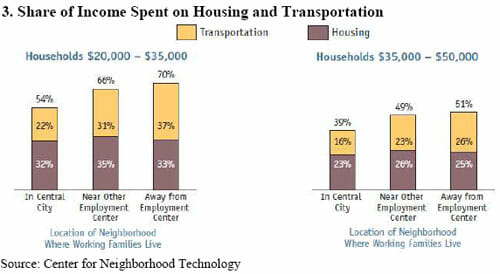
smart_growth

First, we can probably assume the numbers here are complete BS.  Does anyone really believe that the average family outside the central city making $50,000 or less is spending more on transportation than they are on housing?

But that is almost tangential.  The real purpose of this chart is to deal with the number 1 criticism of smart growth -- that by limiting land use and restricting growth and forcing everyone to live in the city center, then housing prices skyrocket (and, by the way, help contribute to bubbles - it is no accident that many of the counties hit hardest by the recent housing bubble collapse are in growth managed counties).

This chart is meant to refute this by saying - see, housing in the center city is not more expensive -- the average person spends just as much on housing in the city as in the suburbs.  But hopefully you see the flaw -- what do they get for that money?  It may well be that for people $35,000 a year and under, the amount they can spend on housing is capped by other expenses they have, such that 1/3 of the total is about what they have to spend.  But this does not mean that people in the center city are just as well off as people outside of it.  It is very likely the suburban folks are getting far more for their money.  After all, people are rational, and if they really are spending so much more money for transportation to live in the suburbs, there probably is a good reason.

Postscript: It would also be interesting to know what the rest of the spending pie does from urban to suburban.  My guess is that folks living in city centers making less than $35,000 are not saving a ton - so where is all that "found" money going they are supposedly not spending on transit.  Could something else be more expensive in the city than in the suburbs?  Does anyone really believe it is cheaper to live in the city center than out in the suburbs for equivilent quality of life.  Sure, there are reasons to live in the city, and for some people's preferences it represents a better quality of life.  But not a cheaper one.

Postscript #2: In fact, the best single critique of all the smart growth analysis that purports to show that people will be better off when the planners intervene is "If so, then why are they not pursuing their own rational self-interest today?"  Smart Growth folks will say it is due to lack of choice, but that is silly -- if people want it, someone is going to make money giving it to them.  The only exception might be publicly supplied goods, particularly transportation.  I am sure there is a huge demand for having an expensive rail line run from one's house to one's business with low fares subsidized by other people, but I am not sure this is a realistic good to promise.
I Warned You

In any number of posts, I warned that, based on past precedent, Presidents almost never roll back executive power, even if they promised to do so in the election campaign.  For example, I wrote on innauguration day this year:

...thoughtful people already on day 1 should have evidence that things are the same as they ever were, just with better PR.   For God sakes, as his first expenditure of political capital, Obama is pushing for a trillion dollar government spending bill that is basically one big pork-fest that might make even Ted Stevens blush, a hodge-podge of every wish-list of leftish lobbyists that has been building up for eight years.  I will be suitably thrilled if the Obama administration renounces some of the creeping executive power grabs of the last 16 years, but he has been oddly silent about this.  It seems that creeping executive power is a lot more worrisome when someone else is in power.

Radley Balko writes:

My own hunch is that presidents try to keep campaign promises that expand the government and their own power, and either back down from or are unwilling to expend much capital on promises that make government smaller and more accountable, thus limiting their own power.

Looking over PolitiFact's report card on Obama's campaign promises, that seems to be about right thus far. By my count (and some of this is certainly subjective) of the of the 31 promises the site says Obama has kept thus far, 20 in some way grow or expand the federal government. Just six make the government smaller, more transparent, or more accountable. The remaining five have no effect, or amount to a wash.

Of the six campaign promises PolitiFact says Obama has unquestionably broken, five would have limited his own power, provided tax breaks, or provided more accountability and transparency to the federal government. One was mostly symbolic (recognizing the Armenian genocide). So far, he hasn't broken a single promise that would grow or expand the government, though he has compromised on a few, and many have been stalled.

This Was My Suggestion As Well

I have proposed a similar protest effort for the next census as this:

The Washington Times reports that:

Outspoken Republican Rep. Michele Bachmann says she's so worried that information from next year's national census will be abused that she will refuse to fill out anything more than the number of people in her household.

We should all follow her lead on this. The government has no legitimate business asking about plumbing, race, and financial affairs in the census. Last census I did the same thing as Ms. Bachmann and refused to answer any but the constitutionally required information, which I took to be number of people, sex and age, since all (except now sex) apply to voting. Note that race does not, and certainly not bathroom fixtures.

The Constitution requires number of people and location to set Congressionaly districts.  Any other information is pure intrusion that the state uses generally to justify and/or manage a huge variety of coercive programs.

I am enormously inexperienced in organizing grass roots efforts and my not have the time or where-with-all to to so in the case, but this is the closest I have ever been to doing so.  My original post (linked above) garnered a lot of interest.

Waxman-Markey

Though I disagree with McArdle on the magnitude of potential warming, I think her assessment of Waxman-Markey is dead on:

But the real question, I think, is whether the low cost is a feature or a bug.  The only way a bill is going to have an impact is if it causes real financial pain to American households--enough to get them to change their behavior.  Waxman-Markey obviously is not going to do that.  And indeed, the projections of its effect on global warming are entirely negligible.

So the reason to get this mad about Waxman-Markey is either that you think it provides a framework for future action, or that you think it will persuade China and India to get on board.  The latter is, I think, entirely wishful thinking on the part of American environmentalists.  China is not going to let its citizens languish in subsistence farming because 30 years from now, some computer models say there will be some not-well-specified bad effects from high temperatures. Nor is India.  Global warming isn't even high on the list of environmental concerns they'll want to attack as they get rich; local air pollution is far more pressing.  Thinking that we're somehow going to lead them by example is like thinking that poor rural teens are going to buy electric cars because Ed Begley jr. has one.

No, I think the argument has to rest on the notion that Waxman-Markey gives us a framework to advance.  And it might.  But then again, Europe's much-vaunted system has had multiple spectacular failures, and the only reductions it has actually achieved seem to come largely from controversial offsets with large auditing problems.

Everybody Back Off. I Have A Child and I'm Not Afraid to Use It

An Australian MP brings a screaming toddler onto the floor of Parliament during a debate and is shocked when she is asked to take her kid out.  She demands a more family-friendly workplace  (there is some suggestion it was all a manufactured stunt).   The story is guaranteed to further piss off single people who already feel that they have to work extra to cover for their co-workers with kids.  I have two kids but have never expected the world to defer to me.  When I had my first kid, I had a job at McKinsey & Company that really wasn't compatible with how I wanted to raise my new child.  Rather than storm around about family friendly work places, I quit and found a job that did fit.   After all, having the kid was my choice, not theirs.

Libertarians Are Used to Bad Choices, but...

... a debate between Sheriff Joe Arpaio and Al Sharpton certainly leaves me without a side to cheer for.