We Know What You Are -- Now We Are Haggling Over the Price

I predicted the climate bill would likely pass the House as Obama and Co.  would happily pull out the checkbook to spend taxpayer money to bribe Representatives to pass his legislative agenda.   I wrote:

I am again hearing rumblings that the climate bill may pass the House.  If so, it will be interesting to see what last minute bribes were added to make this happen.  The most recent bribe we know about is the commitment to pay farmers not to grow crops with the weak window dressing that this is somehow a carbon offset.

The Washington Times reports on one such payoff:

When House Democratic leaders were rounding up votes Friday for the massive climate-change bill, they paid special attention to their colleagues from Ohio who remained stubbornly undecided.

They finally secured the vote of one Ohioan, veteran Democratic Rep. Marcy Kaptur of Toledo, the old-fashioned way. They gave her what she wanted "“ a new federal power authority, similar to Washington state's Bonneville Power Administration, stocked with up to $3.5 billion in taxpayer money available for lending to renewable energy and economic development projects in Ohio and other Midwestern states.

This is part of that mysterious 310-page ammendment that was revealed just hours before the vote.

Awesome Idea

Libertarians can be reasonable.  We can support some regulation, when it is absolutely necesary.  Like this idea, via Sallie James at Cato:

James Gibney, a reporter from the Atlantic, called me last week to ask some questions about dairy supports. He was preparing a blog post to propose a new labelling idea that might help break the frustrating stranglehold that the farm lobby has over U.S. agricultural policy. Here's James' idea:

To wit, every product whose ingredients benefit from a subsidy should include the following language on the label:

"This product has been subsidized by the U.S. government at taxpayer expense. For more information, please visit usda.gov."

And every product that benefits from tariff protection should have the following language on the label:

"This product is protected from foreign competition by U.S. import tariffs. Its price is higher as a result. For more information, please visit usitc.gov."

My Mom Would Be Going Blind in England

Several new drugs have reversed my mom's macular degeneration, and are such a wonder that she is even willing to tolerate frequent injections into her eyeball, a concept that gives the rest of our family the willies.  Forget about it in England, though, where National Institute for Health and Clinical Excellence (NICE), which Obama wants to emulate in the US, does not allow these drugs:

3. In 2007, NICE restricted access to two drugs for macular degeneration, a cause of blindness. The drug Macugen was blocked outright. The other, Lucentis, was limited to a particular category of individuals with the disease, restricting it to about one in five sufferers. Even then, the drug was only approved for use in one eye, meaning those lucky enough to get it would still go blind in the other.

And by the way, is NICE an Orwellian name or what?

Postscript: Fortunately, we are unlikely to have a system that bans Americans from spending their own money on things the plan will not buy  (a bit of socialist egalitarianism that is practiced in a number of European countries).  Not for lack of trying by many Democrats, however.

Sorry

Sorry to feed readers for all the spam test posts yesterday.  I thought I was catching them before they hit the RSS feed, but I was obviously wrong.  I did finally figure out how to make email and email picture posts work.

Over-Stating Our Ability to Adopt Renewables

All those confident in our ability to ramp up things like wind and solar quickly should take a long look at T. Boone Pickens decision to virtually abandon billions of investment in wind.

One of the ways I think our potential to increase renewables is over-stated is that the government has begun lumping hydro power into wind, as in these charts.  They show "renewables" as about 9% of electricity production.   Increasing this to, say, 20% seems daunting but doable - after all, we are just doubling it.

But in fact, almost all of the 9% is hydro power, and that is not going to increase (in fact environmental presure is actually to destroy several hyrdo facilities to allow the rivers to run free).  This means that to get total renewables to 20%, other renewables like wind and solar will have to increase from about 1% to 12%, or a twelve fold increase.  This is much more daunting, especially since a raft of subsidies and incentives and programs have gotten us to just 1%.

Postscript: Owning a home in Phoenix with a big flat roof, there is no one in the world rooting for solar to be economic more than I am.  I have run the numbers recently, and taking advantage of all government subsidies, the investment has about an 8-10 year payback.  It's just not there yet.  Further, I worry that the current silicon/germanium IC technologies are dated and dead end.  I fear that buying solar now is like buying the last IBM mainframe before PCs came out.  I have a ton of confidence in the innovativeness of man, and believe that a real solar breakthrough will occur in the next 10 years.  Wind, on the other hand, is never going to work.  It is the ethanol of electricity production.

So When Did Democrats Adopt the No-Fly List?

So, how are all you libertarians feeling who supported Obama hoping he could not make too much of a hash of the economy, but were willing to take the risk in exchange for an expansion of civil rights, a demobilizing of the post-9/11 security state, and curbs on executive power?

This from Rahm Emanuel is just nuts.  I remember just 6 months ago Democrats were rightly critical of the no-fly list, arguing (as I do) that there cannot reasonably be a million terrorists running around America and that the list unreasonably curbs civil liberties of everyone put on it without due process, and without any hope of removal in case of mistakes.

I had to listen to the youtube video (in the linked article) to confirm for myself he really said this and in context, but this is exactly what he means, garnering applause from the Brady Center:

"if you're on that no-fly list, your access to the right to bear arms is cancelled, because you're not part of the American family; you don't deserve that right. There is no right for you if you're on that terrorist list."

Wow, a lot of due process here.  What's next,  sending every girl who has her name on a men's room wall (you know, the ubiquitous "for a good time call..." graffiti) to prison as sex workers?

If your second ammendment rights are cancelled (it can't be an accident that he is using nearly the exact text from the Constitution) then doesn't that imply that other Constitutional rights can be cancelled as well?  After all, its dangerous to let terrorists assemble, is it not?  And speak.  And practicing their religion can be a problem.  Etc...

Please, let's not go here.

Testing post by email

I really wanted to post by email in England but could not make it work. Trying again.

Update: So close, yet so far away. LOL. I will keep working on it.

Nerd Heaven

I just got an invited to join Google Voice.  This is a really awesome looking service.  In about 5 minutes I had a phone number in my area code picked out that would be my one number.  I then added phones I had that I wanted this number to ring.  The account gives me web access to voice mail (both a sound file and a written transcript) and text messages.  It also gives me free long distance calling any where in the US, all for $0 a month.  Lots of other features like customized greetings and call forwarding that depends on the caller which I have not played with yet.  Pretty cool.  If you get an invite, I would grab your number.

Wherein Kevin Drum Discovers Different Individuals Have Different Preferences

From Kevin Drum today on health care:

But here's the tidbit that caught my eye:

A fascinating series of pilot programs, including for prostate cancer, has shown that when patients have clinical information about treatments, they often choose a less invasive one. Some come to see that the risks and side effects of more invasive care are not worth the small "” or nonexistent "” benefits. "We want the thing that makes us better," says Dr. Peter B. Bach, a pulmonary specialist at Memorial Sloan-Kettering Cancer Center, "not the thing that is niftier."

When I read about healthcare, pretty much the only thing I hear is that everyone wants infinite amounts of it.  And they always want the latest and greatest stuff.

Not me.  My motto is, "That healthcare is best that cares the least."  Or something like that.  Basically, I prefer to get the minimum reasonable amount of healthcare possible, and I have a strong preference for the simplest, oldest, best-known treatments.  I'm not exactly a fanatic about this, but generally speaking I think that most new treatments turn out not to be nearly as effective as we think, and the more time you spend around hospitals the better your chances of catastrophe.

Wow, that's amazing!  Its almost as if we shouldn't have one bureaucracy in Washington making health care decisions for everyone!  In fact, there are several things in here that tend to challenge leftish assumptions:

  1. Contrary to leftish assumptions, individuals do seem to be grown up enough to make health care tradeoffs for themselves
  2. Individuals seem to want to make different cost-benefit-treatment trade offs from each other, belying the notion there is some universal optimum that bureaucrats in Washington are capable of achieving
  3. Allowing individuals to actually shop and make price-benefit decisions in health care might actually reduce costs and improve satisfaction (though absolutely no one in DC seems to be proposing a plan along these lines)

Unfortunately, Drum seems to take none of these lessons from his own post.  Here is the conclusion he draws:

But maybe the difference is just information: I read an awful lot about this stuff, and it's convinced me that there dangers to overtreatment just as there are dangers to undertreatment.  Leonhardt's "fascinating series of pilot programs" suggests that with better information, more people might agree.

Creepily, he seems to conclude from all this that if we can just "educate" the public more, they will be more likely to accept the one-size-fits-all treatment constraints to be implemented by Washington.

PS: I am generally with Drum on doing the absolute minimum for run of the mill health problems I encounter.  If I have a cold, for example, I don't start dosing myself with every over the counter drug I can find.  And our family tries very hard not to use antibiotics unless the condition is really serious.

But my sense is that my attitude will change a lot if the "C" word ever comes into play.  Cancers are much more solveable early than late, and my tendency would be to hit the crap out of it early with  as much of the arsenal as I could.  I don't know what Drum's personal medical history is, but my sense is that it is unwise to extrapolate linearly one's treatment preferences from colds to cancer.

SNAFU!

The hamster who powers my server apparently fell off his treadmill and the server went down for a while today.  Those most affected were probably folks who were trying to comment, as most of the time the blog could read from the server but not write.  Hopefull things are fixed now.

We Really Live In A Weird World

House Majority Leader laughs at the idea legislators would actually read the bills they vote on:

House Majority Leader Steny Hoyer (D-Md.) said Tuesday that the health-care reform bill now pending in Congress would garner very few votes if lawmakers actually had to read the entire bill before voting on it.

"If every member pledged to not vote for it if they hadn't read it in its entirety, I think we would have very few votes," Hoyer told CNSNews.com at his regular weekly news conference.

Hoyer was responding to a question from CNSNews.com on whether he supported a pledge that asks members of the Congress to read the entire bill before voting on it and also make the full text of the bill available to the public for 72 hours before a vote.

In fact, Hoyer found the idea of the pledge humorous, laughing as he responded to the question. "I'm laughing because a) I don't know how long this bill is going to be, but it's going to be a very long bill," he said.

Get Ready for the Carbon Offset Accounting Follies

I have already written before about carbon offset companies apparently double or even triple counting carbon credits or offsets.  Here is another example, sent by a reader:

Reilly and Herrgesell, the company's president and project manager, respectively, have been trying to develop a way to "incentivize the consumer" for nearly two years. What they came up with was a model for selling personal carbon credits.

"(It's) a new idea," said Herrgesell, "but a very powerful idea."

To get started, you create a personal profile with usage data from your utility bills over the last year at My Emissions Exchange. Then, you reduce your energy consumption. My Emissions Exchange certifies your personal carbon credits, and sells them for you in the global voluntary carbon market.

The carbon credits are equal to a one-ton reduction in carbon emission, and are currently trading between $10 and $25, according to the site.

"This is the only effort out there that can align green activity with financial benefit," said Reilly.

First, I have looked at the site in question, and find no differentiation for how one's power is generated.  My power in Phoenix comes from a big honking non-CO2-emitting nuclear plant, so my actual carbon credits for reduction in electricity use are theoretically more complex.  Is the clean nuclear power I didn't used sold so it substitutes for fossil fuel power?  Did I cut my power peak or off-peak?  And does it substitute for gas (not much CO2) or coal ( a lot of CO2)?  Its amazing that there are real markets that will accept such soft savings as real credits to be paid for.

Second, in the proposed Waxman-Markey bill, utilities get counted directly on their CO2 output, so either this program will have to go away or else it will represent a double counting of the same benefit (as at the utility level your reduction in electricity use will also "count").

Third, the economic knowledge of the author quoted above is just staggeringly low.  I mean, all this time I thought electricity prices were how consumers were "incentivized" [sic] to use less power.  The implication is that somehow incentives are out of alignment and this is the "only effort" aimed at aligning them.  But consumers already save money by reducing their utility use (does anyone have a utility contract that reads the opposite?)  One might argue that these guys can provide an additional financial incentive that will create incentives for more conservation at the margin, but that's about it.

Honduras & The Rule of Law

In my July 4 post, I wrote that many Americans make what I think of as a mistake in elevating voting and democracy as the primary wonders of the United States.  In that post, I argued that  -- 1.  The Rule of Law  2.  Protection of Individual Rights and 3.  The Subordination of the Government to the Citizenry -- were all more important than voting.

It seems this was a timely post, as Obama appears hell-bent on making the same mistake in Honduras:

Again and again Obama stresses the fact that Mel Zelaya was "democratically-elected". But the same could be said about many of today's dictators. Elections are only one part of the democratic process. The other, and the one that sustains the electoral process, is the rule of law. Focusing only on the fact that Zelaya was "democratically-elected" but ignoring the fact that he has attempted to subvert Honduran constitutional principles that ensure such democratic elections is bad enough.

However, continuing that line of criticism after being apprised of the constitutional arguments and the process which led to Zeyala's ouster is completely unacceptable. Yes, we back the right of people to democratically elect their leaders. But we must also back their decision, driven by the rule of law, to remove a leader when he refuses to follow the law he is sworn to uphold. Why is it that Obama, the "Constitutional law professor, doesn't appear to "get" that?

In Honduras, Obama is siding against the rule of law, against the legislative branch, and against the Supreme Court, but for Executive power and for an enemy of liberty.  Hmm, maybe he is consistent after all.

Awsome Senate Testimony on Transit

From Randal O'Toole (of course). I usually try not to over-excerpt other folks work but I just can't resist in this case.  I like Mr. O'Toole's work on transit because he does not just focus on the cost-benefit issues, but the personal liberty aspects as well:

My testimony focused on two points. First, despite increasing transit subsidies by 1250 percent (adjusted for inflation) since 1970, transit travel has declined from 49 to 45 trips per urban resident and transit's share of urban travel has declined from 4.0% to 1.6%. Second, even if we could get more people to ride transit, transit uses as much energy, and emits nearly as much greenhouse gases, as cars; and the trends suggest that cars will be more environmentally friendly than any transit system in the country by 2025.

There were two interesting responses to my testimony. First, another witness said (and I'm quoting from memory), "All he did was divide total greenhouse gas emissions by passenger miles." A reporter told me later that it sounded like he was questioning my methods, but his real argument was that more money spent on transit in combination with smart-growth land-use planning would lead to reduced auto driving.

I don't believe that is true (and said so), but even if it were true: can you imaging AT&T (back when all phones were land lines) telling Congress, "We want you to restrict property rights, drive up housing prices, and prevent people from living in their preferred lifestyles so that we don't have to extend our lines so far?" Or FedEx or UPS saying the same thing today? Why is transit so special that everyone else in the country has to completely rearrange their lives just for it?

You can say the answer is "climate change," but transit agencies and smart-growth planners wanted to do all these things before climate was an issue. The truth is that transit is a declining but politically powerful industry, and part of its power comes from the fact that it is publicly owned and so elected officials have a vested interest in keeping it going.

In a very real sense, transit is just like the British coal, rail, and other nationalized industries in the 1960s: its main purpose is no longer transportation but to meet other political goals such as keeping transit workers employed and construction contracts going to transit builders. If transit were private, no one would argue that we have to make the world less convenient and more expensive for the 95 percent of people who travel by car so that it will be more convenient for the 1 or 2 percent who travel by transit.

Another Fear-Mongering Claim Proved to be Total BS

The scare story, from November 2008:

Advocates for the nation's automakers are warning that the collapse of the Big Three - or even just General Motors - could set off a catastrophic chain reaction in the economy, eliminating up to 3 million jobs and depriving governments of more than $150 billion in tax revenue.

Industry supporters are offering such grim predictions as Congress weighs whether to bail out the nation's largest automakers, which are struggling to survive the steepest economic slide in decades.

Even if just GM collapsed, the failure could bring down the other two companies - and even the U.S. operations of foreign automakers - as parts suppliers run out of money and shut down"¦.

Automakers say bankruptcy protection is not an option because people would be reluctant to make long-term car and truck purchases from companies that might not last the life of their vehicles.

I called BS on this at the time.  Turns out it was yet another made-up scare story to justify government coercion and more unthinking expenditure of taxpayer dollars:

One of the biggest fears of a GM bankruptcy filing -- a collapse of revenue -- appears to not be as prominent an issue as originally thought.

Car buyers appear undaunted by GM's bankruptcy, assuaging one of the auto maker's biggest fears heading into Chapter 11. Early signs point to stable demand for GM cars and trucks since the company filed for Chapter 11.

Mr. Henderson said June retail sales are tracking higher than May. "June sales are moving along just fine," Mr. Henderson told reporters at a summit in Detroit. Sales to rental and other fleets are down from last month, he said. "We're very gratified for the support of dealers and customers that we've received through this."

WTF?

Thank god we have a "liberal" president, or else we might all have to worry about our civil rights and abuse of power:

Defense Department General Counsel Jeh Johnson moved the Obama administration into new territory from a civil liberties perspective. Asked by Sen. Mel Martinez (R-Fla.) the politically difficult but entirely fair question about whether terrorism detainees acquitted in courts could be released in the United States, Johnson said that "as a matter of legal authority," the administration's powers to detain someone under the law of war don't expire for a detainee after he's acquitted in court. "If you have authority under the law of war to detain someone" under the Supreme Court's Hamdi ruling, "that is true irrespective of what happens on the prosecution side."

Will There Be Medical Innovation After The US Socializes Medicine?

Most all the world pays a marginal cost for drugs, medical devices, and procedures that does not come close to repaying the development effort that went into those products.  Further, most of the world has regimented medical systems that have very strong immune systems against any sort of innovation.

As a result, almost all medical innovation occurs and is paid for in the United States, with the rest of the world acting as a free rider.  Sure, some Swiss or Japanese firms still develop a few drugs, but most of those efforts are still justified by profits in the US market.

To this end, Megan McArdle had my favorite quote of the day:

we're still driving quite a bit of product innovation.  Our messy, organic, wasteful, unfair, irrational system allows experimentation, and they [Europeans] cherry pick the best results.  If we stopped doing this, their system would stop looking so good.

This is not to mention that the US tends to act as the capacity of last resort for desperate people in other countries who either can no longer tolerate the wait for a procedure or are not allowed by their country to have a certain procedure or drug.

Coolest Thing I Have Seen From Our Government This Year

The new bypass bridge at Hoover Dam.  Photo courtesy of the Mail Online.

57676302

Something that Flabbergasts Me

Since 1972, oil company executives have, like clockwork, been dragged up to Washington every five years to defend themselves against charges that they have cartelized the oil industry with the express purpose of limiting supply and driving up prices to consumers.  Over the last 10 years, and particularly post-Katrina, scrutiny has fallen heavily on US refiners to justify refined product supply shortfalls and resulting price spikes.

So, after years of demagoguing oil companies for purposefully limiting refining capacity and output to drive up gasoline prices, Democrats in Congress are on the verge of passing Waxman-Markey, which will have the very focused and predictable result of... limiting US refining output and driving up gas prices.  In fact, the only possible way it will achieve its goals of limiting CO2 output is if it is wildly successful in reducing gasoline supply and driving up gas prices.  Amazing.

Yet more proor that what is never OK for the [private] goose is always OK for the [public] gander.

Why Goldman Sachs, GE, etc. are Behind Cap and Trade

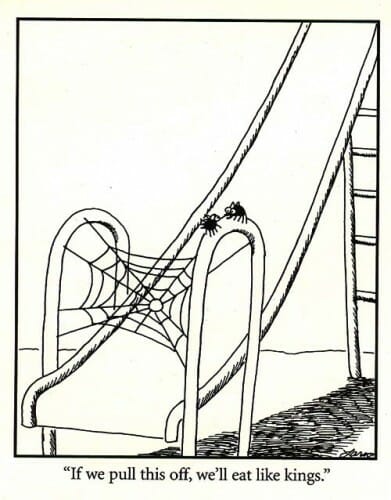
Chris Horner of NRO used this Far Side cartoon as a good way to illustrate why many large corporations have jumped on the Waxman-Markey bandwagon:

eat-like-kings

Waxman-Markey is not climate or energy policy, its a pillar in Obama's attempt to build a European-style corporate state, where a clique of large unions, large corporations, and selected politicians run the state to their own mutual benefit.

PS-  I'm not buying the Goldman Sachs as trilateral commission conspiracy in Horners article.  But the direct line from Enron to the current cap-and-trade bill is an important one that is under-reported.  Enron was on the cap-and-trade lobbying bandwagon very early on.

Spelling Errors and Evolution

I thought this Kenneth Chang column in the NY Times was pretty interesting.  Much like we can sometimes spot plagiarism by spotting where spelling errors have been reproduced, apparently errors in our DNA give clear pointers to our evolution from other species.

All my complaints about the NY Times not-withstanding, I think if the Times were to disappear, I would miss their science reporting the most.

A Brief Cricket Guide For American Baseball Fans

I am back in the USA, but I am missing my daily dose of cricket each evening.  I found watching cricket incredibly relaxing in the evening.  Despite common perception, it is not a difficult sport to understand -- it just has a vocabulary all its own.

This is actually a pretty big week in British cricket, as the biennial Ashes matches between Australia and England begin on Wednesday.  Apparently, Australia has pretty much owned England over the years, with the exception of an exciting victory by England four years ago.   The only way I have found to watch it in the US is via a pay internet site associated with Sky TV.  Anyone have any better ways?

Cricket for American Baseball Fans

As a public service, here is my quick description of cricket in terms American baseball fans will understand.  This will leave out some details and arcana (just as one can easily describe the basics of baseball without mentioning catcher interference or running on a dropped third strike).  Commenters are free to get all over me with exaggerated anger for any small mistakes I make.  Note that I purposefully am using some American baseball terms for things in order to make the translation easier.

The cricket field is a large oval (of varying sizes) with two wickets or stumps about 66 feet apart in the middle of the field (about 6 feet longer than the distance from an American pitching mound to home plate) (picture).  Think of the two stumps as two home plates separated by a single base path.   This is a useful way to think of it because herein we get to the part that is most confusing to Americans:  At any one time, there are two batsmen, one at each end.  And, there are two bowlers (the equivalent of pitchers), again one on each end.  If you think of it as two home plates, each with its own batter and pitcher alternating play, you get the idea.

Play progresses in a series of overs, which is 6 balls or pitches in a row.  A single bowler will bowl 6 balls, or one over, from his end, and then play reverses and the other bowler at the other end will bowl six balls.  This continues until all the batters on the team are out (more in a minute).  As in baseball, bowlers get tired and get replaced over time.  Much like high school or little league baseball, bowlers are not specialists but are fielders who are rotated in and out of the bowling position from the field.  Again, just like American baseball, bowlers can be straight ahead speed specialists or they can be spinners (ie throw a variety of curving balls).  Bowlers generally bounce the ball into the batsman (though they don't have to), as they can then take advantage of funny hops off the uneven playing surface and because the bounce can accentuate the effects of spin.  Unlike American pitchers who are fixed to a spot on the mound, cricket bowlers can make long running starts to their bowling.

Since there are two batsmen, whoever is facing the current bowler is the active batter. In addition to the bowlers and the keeper (like an American catcher) there are 9 fielders dispersed 360 degrees around the batter.  Only the catcher wears something like an American-style leather glove -- all the other fielders are bare-handed.

OK, here is the second thing that befuddles American baseball fans:  Batsmen continue to bat and score runs until they are out - even if this takes hours and scores of pitches.   There are no ball and strike counts that limit the time batting.  If the batter hits a short ground ball to a fielder, a sure out in American baseball, he does not have to run in cricket and therefore cannot get out.  And once he hits and gets some runs, he still keeps batting.  These are all differences from American baseball.

When the batsman gets a hit, he has a choice to run.   If he chooses to run, both he and his partner (remember there are two batsman at a time) run to the opposite stump.  Making it safely is one run.    If the ball is hit well enough, he may run back and forth for more than one run.  If the ball rolls all the way to the "outfield" wall, it is automatically scored as four runs.  If the ball clears the "outfield" fence on the fly (the equivalent of an American home run) it is automatically 6 runs.

Note that if the batter runs an even number of bases, he ends up back at the stump where he started and he will be the one to face the bowler on the next pitch.  If he scores an odd number of runs, the other batsman will now face the bowler.  There is some strategy involved in this, as it gives the batting team some leeway to determine which of its two batters will face the current bowler.

There are a number of arcane ways to get a batter out, but the most common are the following:

  • Bowled:  The ball hits and breaks the wicket.  First and foremost, then, a batter is defensive.  He needs to make contact with any ball that is headed for the wicket.  If any part of the batsman hits the wicket (eg he hits it with his bat or with his leg while running) this is also an out.
  • Leg before wicket (LBW):  If the ball hits the batters leg, and the referee rules the ball would have hit the stump, the batter is out
  • Run out:  When the batter chooses to run (and this is a choice) he can be "thrown out" in baseball parlance if a fielder throws the ball back and hits the stump  (or someone tags the stump with the ball) before the runner gets back to the wicket (the equivalent to a force-out in baseball).  I have not watched a lot of cricket, but I have never seen anyone run out.  Batsmen tend to be pretty conservative in going for runs this way, as a single out is far more devastating than in American baseball so they take fewer chances.  Its better to live and bat some more than try to stretch out a single extra run.  Particularly since a good batter can score 50 or even 100 runs in a single at-bat (or inning) before getting out.
  • Caught:  If the batter hits the ball in the air and it is caught, the batter is out.  There are several fielders typically concentrated just behind the batter as catching the equivalent of an American foul tip backwards (there is no foul territory in cricket)  seems a particularly rich source of caught balls.

Batters therefor face a tension.  They must guard the wicket at all costs, and the safest way to do so is to hit a lot of ground balls to avoid being caught out.  But the batter also needs to score, and so must sometimes take some chances in order to score runs by putting the ball in the air.  The best batters seem to be the ones who can hit the ball hard on the ground and consciously seek out gaps in the fielders.  The best equivalent in baseball I can think of is batters who are good at hitting the infield gaps on hit and run plays.

An inning is the process of having an entire team bat and be put out once.  In a test match, typically over four days, each team might have two innings.  There are a number of rules variations that might end innings sooner on time or number of overs.

A note on scoring:  When watching TV, they still flash a lot of stats I do not frankly understand.  But the most common will be a score after a test match might say England was 292 and 165.  This means they had 292 runs in their first innings and 165 in their second.  For an inning in progress, the score will look something like this:  164-4.  This means that the team batting has so far scored 164 runs and has had four batsmen put out.

There are many other unique terms (I personally like "maiden" as a particularly apt term for a no-run over) but I think this is a good start.   There is a lot of arcana in test cricket I don't yet understand, but none of it stops me from enjoying the games.   Enjoy.  That is, if one could ever get any cricket on American TV.

Government Apples and Private Oranges

Bruce McQuain has a really good post debunking the meme that Medicare overhead costs are lower than those of private insurers.  You should read the whole post, but the short answer is:

  • Medicare participants are older and less healthy than those insured privately, so the denominator for their overhead ratio is much higher
  • Comparing overhead costs per plan participant, Medicare costs are higher than private
  • The comparison is apples and oranges, because private firms pay account differently than does the government
  • Lower Medicare overhead has tradeoffs, as it lets fraud through which is not counted as a cost

I can't add to Bruce's post, except to say that as someone in the business of trying to privatize government functions, we see the apples and oranges problem all the time.  I am constantly having cost discussions with government bodies, and they frequently leave out most of the following when they compute their costs:

  • Insurance  (e.g. liability, property).  They say the government is self-insured, but the government does not charge its divisions any cost for this implicit guarantee.  I have to pay real money for it.
  • State / local taxes.  Private companies have to collect and pay many state and local sales, excise, and property taxes that the feds do not pay.
  • Pensions / retirement benefits.  The government grants fat pensions and retirement medical benefits to its employees but does not accrue or put any funds away in the present to pay for these.  Private companies do  (and in fact would go to jail for not doing so).
  • Capital spending and rent.  This varies by entity, but most government bodies do not see full depreciation of the capital assets they are using in their budgets.  Ditto for the value of the space they are occupying - they often get valuable space rent and/or depreciation free.
  • Services from other government divisions.  Sometimes transfer prices are charged, and sometimes they are even close to market rates, but most times they are not

The Emergency Room

We often hear that one of the reasons health care "reform" is necesary in the US is because the uninsured overwhelm emergency rooms.  We hear horror stories of overcrowded emergency rooms with long wait times, which would only be better if we had a national health care system like Canada.

A couple of interesting facts:

Average US emergency room wait time:  4.05 hours

Average Canada emergency room wait time:  8.9 to 23 hours

I confess the numbers are not apples-apples, but they are certainly in the ballpark and highly illustrative.   Have any commenters seen a direct comparison?

Update: OK, the numbers are more apples-apples than I thought.  The US 4 hour number is total time from coming in the door to leaving or getting a bed, the same as the Canadian numbers.  The CNN report linked above got their data from here.

Regulation Aids the Large & Established

I have written many times about how regulation tends to help the large and well established competitors against smaller companies and potential future market entrants.  Larger companies have the size to pay compliance costs and the political muscle to sway regulation in their direction and co-opt regulatory bodies.  The tobacco settlement, ostensibly aimed at "big tobacco" has done nothing but cement the market leadership of the top brands.  This is why you see some large companies jumping on board cap and trade or health care reform -- for example, Waxman-Markey contains rules that give a particular advantage to certain GE lighting technologies on which it holds patents.

The CPSIA is another such law, and Overlawyered has been all over the story.  Here is what a craft fabricator of handmade dolls (even say your grandma selling at a craft fair) will have to comply with:

"¦Each batch needs a unique identifying number.

However, if in the course of making the products, you have to break into a separate box of buttons that has a separate batch or lot number itself, even if the product is otherwise identical, this is a separate batch and you need a separate new label for it with its own batch number that you assign. "¦ It is conceivable [if you incorporate variations into the product] every item you produce is its own batch and each needs its own number and label. "¦

You will need to do "batch control". You need to create a separate BOM [Bill of Materials] for each batch. You can keep this electronically in a database or spreadsheet. It is my understanding you need to keep these records for three years.

Though it was originally Mattel's problem with lead from China in toys that caused the CPSIA to get passed (Congress always has to "do something" when a story makes the news) do you think it is Mattel or grandma who will be driven out of the business?  In the future, when leftish hippies wail that there are no small manufacturer crafts or locally grown food at their weekend fair, you will know why.

Much more coverage on CPSIA here.