The Corporate State

Life is too short to spend much time on the Democratic Underground, but this article by Ernest Partridge popped up in one of my Google watch lists.  I highlight only because it contains this straw man:

The dogmatism of free market absolutism resides in the belief that the unregulated market never fails to be beneficial to all; the belief, in other words, that there are no malevolent effects of unconstrained market activity, no "back of the invisible hand." From this belief follows the insistence that the free market is self-correcting, and that there is thus no need for regulation � that, in Ronald Reagan�s enduring words, "government is not the solution to our problems, government is the problem."

I can't think of any thoughtful defender of capitalism and free markets that ever would have said that the market "never fails" or that it is "beneficial to all" or that there are never bad outcomes or that the market is perfectly self-correcting.

Bad, stupid shit happens all the time in free markets.  For example, BP idiotically dumps a few zillion barrels of oil into the Gulf of Mexico.  In a free society, BP will be out billions of dollars in cleanup costs and damage settlements -- it might even bankrupt itself if governments allow that to happen, and thus will never again be able to do something so careless.  Markets can't prevent a first dumb action, like huge leveraged bets on ever-increasing housing prices, but markets can make sure the folks involved don't have the resources to do it again -- that is, except if governments bail them out from their mistakes.

The point is not that markets are perfect -- the point is that they are superior in both function and the retention of personal liberty to the alternative of giving governments coercive power to use force against individuals to change market outcomes.  The point is not that individuals don't do destructive things within the context of free markets.  The point is that they have a lot less power to do harmful things over long periods of time than if one gave that person coercive power in a government job backed by police forces and armies.   There is only a limited amount of damage anyone can do when they depend on the uncoerced cooperation and agreement of their counter-party.   A tobacco company CEO doesn't have a hundredth the power to ruin peoples lives as does one member of Congress. Fifty years of slimy cigarette advertising doesn't have the power of one Congressional mandate.  Go to Chicago, Detroit, Baltimore -- which has been worse for these cities -- the private campaign to sell cigarettes or the government led war on drugs?

Its clear from later in the article that the author is yet another person with a list of pet peeves who wants to use force on the American citizenry to get his way.  The author doesn't like cigarettes, so intervention with tobacco companies is a valid role for government.  OK, well I can't stand reality TV shows, so much so that I would rather be in a room of smokers than a room with "the biggest loser" on TV, but you don't see me wanting to give government power to do something about it.

But what is amazing to me is how much his examples actually make the libertarian point for limitation of government.  Try his first one:

Private Prisons. Good for the corporations: more prisoners, "three strikes" laws, mandatory sentencing. The cost to society: less rehabilitation and early release, increased government expenditures and taxes. It is noteworthy that the United States has the largest prisoner to population ratio in the industrialized world.

You have to really re-read history to come to the conclusion that American incarceration rates are mainly driven by privatization of prisons.   My sense is the causality is the other direction - we have passed crazy drug laws and mandatory sentencing for sometimes petty crimes and have had to turn to private actors with private capital to keep up with the demand to construct new prisons.

Like the author, I hate this incarceration trend, but its really a stretch to blame this on privatization.  And, I am the first to deride the symbiotic relationship between powerful corporations and the government.  I have written on any number of occasions that both political parties in this country seem to be trying to build a European-style corporate state.  So, even if I don't think he has history quite right here, I am willing to concede the point.  Because, in fact, this seems to me an indictment of exactly what he is trying to defend -- the government interventionist state.

The only reason corporations lobby the government is that the government has the unique power to coercively intervene in markets.  Corporations try to engage this power for their own benefit and to step on competitors, both current and future.  The root cause failure here is not the fact that private companies try to engage this power, but that this power exists at all.

Amazingly, he makes the same argument about war:

War, Inc. Good for the corporations (i.e., the military-industrial complex and "private contractors" such as Halliburton and Blackwater): more wars, expenditure of rockets, bombs and ammunition (requiring restocking of inventories). Cost to society: avoidance of diplomatic solutions, increased military budget and battlefield casualties, disobedience to international law (e.g., the Geneva and Nuremberg protocols).

I am staggered to see that someone who is defending giving more power to the government is simultaneously highlighting examples where this power is misused so horribly  (and what could be a more despicable crime by legislators than incarcerating more people or starting wars just to help a favored corporate interests).  I don't think wars are started primarily to help armaments manufacturers, but if they are, then this kind of failure by politicians is FAR worse than any he could point out in unregulated markets, only making my point for me.  Markets are not perfect, but the cure of government use of force is worse than the disease.

Since the author dwells on cigarettes, just look at the so-called tobacco settlement.  Supposedly, this was the great government hammer wielded against cigarette companies to punish them for years of selling a dangerous product.  But in fact, all the settlement did was cement the market position of largest tobacco companies.  The settlement effectively made government a financial partner with tobacco companies, and since it was implemented, the government has wielded its power to protect the companies who were involved in the settlement against competition (particularly from low-price upstarts) so as to protect its own cash flow.  The position of the major tobacco companies has never been as secure and profitable.

I think the author's response would be that if we ban corporate election spending, then all would be well.  This does not pass any kind of smell test.  First, corporate giving has been effectively banned (or at least severely limited) for 20 years, and we see the staggering influence corporations have none-the-less.  We only have to look at Europe, where the troika of politicians, large corporations, and large unions run those states to their own benefit, to the detriment of all others (e.g. smaller businesses, business without political contacts, workers outside of favored fields like autos, young workers, etc.)  This symbiotic relationship occurs without campaign cash being a major element.

If you want to understand how this works, just look at recent legislation like cap-and-trad and health care.  Legislators propose some populist interventions in a market to help themselves get re-elected.  Corporations who might naturally oppose such interventions agree to support legislation in exchange for a number of subsidies and special protections. Trades occur that have little to do with campaign contributions.  Just look at the influence GE wields in getting special deals for itself.

The GM bankruptcy was a classic example.   GM is given a big taxpayer bailout and some cuts in labor costs.  In exchange for labor cost cuts, unions get the government to squash secured creditors of GM in their favor in dividing up ownership and also get some special considerations in pending health care legislation.  Secured creditors allow this to occur because they got TARP funds from the government.   Politicians get active support from GM and the UAW in getting out the vote, positive PR, etc.  The only people who lose are taxpayers, all the other automobile competitors, and workers in every other industry who must pay taxes to support auto workers special deal.

By the way, don't tell me that this is not what you want, that if only we have the right people (e.g. yourself) in power this will never happen.  Wrong.  It always happens.  Every dang time.  The incentives are overwhelming.  Given politicians the power to do that one good intervention you want, and you have also given them the power to do a thousand that you don't want.

Postscript: By the way, please do not ever take a "progressive" seriously when they say they care about the poor.  Take this for example:

Outsourcing of jobs. Good for the corporation: increased profits and return on investment of stockholders. Cost to society: poverty, loss of educational opportunities, redistribution of wealth "upward," shrinkage of customer base, economic depression.

Another way of stating outsourcing is say that it is "transferring a job from a rich American to a poor person in a developing nation."  As a country becomes richer and more educated, low-skilled jobs are not going to continue to get done by college grads.  PhD's, in general, are not going to stitch underwear.  Low skilled jobs in a wealthy society do get outsourced, and these new low-skilled jobs in developing nations become the seed or the catalyst for future wealth-creation and development.

This is one ironic problem that progressives in this country have -- even the poorest Americans would be middle class in many of the countries of the world.  If progressives really want to transfer wealth from the rich to the poor, everyone in the US would pay and no one would receive a dime, it would all flow to other countries.

Job Claims "Unexepectedly" Rise

That's the headline from the Arizona Republic today.  Do editors realize this is becoming a national running joke?

The number of people filing new claims for unemployment benefits unexpectedly rose last week by the largest amount in three months. The surge is evidence of how volatile the job market remains, even as the economy grows.

Overzealous Prosecution

It sure looks like the Feds are bending over backwards to make sure R. Allen Stanford, accused of massive investment fraud, is not allowed to defend himself.  The Feds are running the whole playbook at him, from onerous pre-trial detention requirements to asset forfeiture (the latter to the point that the Feds are working to make sure the insurance policy he had to pay for his defense in such actions is not allowed to pay him.)  I understand that a guy who has substantial interest in offshore banking centers might be a flight risk, but this is absurd:

Mr. Stanford has been incarcerated since June 18, 2009 and was moved to the [Federal Detention Center] on September 29, 2009. Immediately upon his arrival at the FDC, he underwent general anesthesia surgery due to injuries that were inflicted upon him at the Joe Corley Detention Facility. He was then immediately taken from surgery and placed in the Maximum Security Section "” known as the "Special Housing Unit" (SHU) "” in a 7' x 6 1/2' solitary cell. He was kept there, 24 hours a day, unless visited by his lawyers. No other visitors were permitted, nor was he permitted to make or receive telephone calls. He had virtually no contact with other human beings, except for guards or his lawyers.

When he was taken from his cell, even for legal visits, he was forced to put his hands behind his back and place them through a small opening in the door. He then was handcuffed, with his arms behind his back, and removed from his cell. After being searched, he was escorted to the attorney visiting room down the hall from his cell; he was placed in the room and then the guards locked the heavy steel door. He was required, again, to back up to the door and place his shackled hands through the opening, so that the handcuffs could be removed. At the conclusion of his legal visits, he was handcuffed through the steel door, again, and then taken to a different cell where he was once again required to back up to the cell door to have his handcuffs removed and then forced to remove all of his clothing. Once he was nude, the guards then conducted a complete, external and internal search of his body, including his anus and genitalia. He was then shackled and returned to his cell. In his cell there was neither a television nor a radio and only minimal reading material  was made available to him. He remained there in complete solitude and isolation until the next time his lawyers returned for a visit.

In short, Mr. Stanford was confined under the same maximum security conditions as a convicted death row prisoner, even though the allegations against him are for white collar, non-violent offenses. He is certainly not viewed as someone who poses a threat to other persons or the community, nevertheless, he has been deprived of human contact, communication with family and friends, and was incarcerated under conditions reserved for the most violent of convicted criminals. Officials at the FDC informed counsel that this was for Mr. Stanford's "own protection" and to minimize their liability.  .  .  .

Remember, he has not been convicted -- this is pre-trial detention.  The sole goal, legally, is supposed to be to keep him from fleeing before his trial.

I am sensitive to this from my climate work.  My gut feel is that people who are truly confident in their case do not work overtime to make sure their opposition is not allowed to make their case.

Someone in Massachussetts Has Been Reading Atlas Shrugged

How else could they have gotten the idea for the hospital unification plan, except by modeling it after the steel and railroad plans in Ayn Rands novel.

The Massachussetts plan:

In hopes of bringing down the state's skyrocketing health care costs"”which are currently growing about 8 percent faster than the state's GDP"”the Massachusetts Senate is reportedly considering a bill that, among other things, would "require hospitals in better financial shape to put money back into the health care system to lower premiums." At first glance, this might sound like an easy way to bring down prices: Cut into provider profits to bring down insurance premiums. And the AP article doesn't provide much in the way of detail about how the provision would work, so it could be basically harmless. But it looks to me like the Senate is pushing for a system in which hospitals that set prices and contain costs successfully enough to find solid financial footing subsidize those that don't. Does this strike anyone else as an odd way to attempt to curb costs?

From the Atlas Society, describing a scene from Atlas Shrugged:

In one scene government dictators explain to steel magnate Hank Rearden how they intend to save his industry as a whole"”read his incompetent competitor"”through a Steel Unification Plan. All income from steel producers will be placed into a common pool and distributed to manufacturers based on how many furnaces each company owns. Follow the math here for a moment as an incredulous Rearden explains their own plan to them:

"Orren Boyle's Associated Steel owns 60 open-hearth furnaces, one-third of them standing idle and the rest producing an average of 300 tons of steel per furnace per day. I own 20 open-hearth furnaces, working at capacity, producing 750 tons of Rearden Metal per furnace per day. So we own 80 "˜pooled' furnaces with a "˜pooled' output of 27,000 tons, which makes an average of 337.5 tons per furnace. Each day of the year, I producing 15,000 tons, will be paid for 6,750 tons. Boyle, producing 12,000 tons, will be paid for 20,250 tons"¦ Now how long do you expect me to last under your plan?"

Rearden can't believe that these bureaucrats actually believe such nonsense. And their only answers are "In times of national peril, it's your duty to serve" and "You must make certain sacrifices to the public welfare" and "You'll manage."

Civil Forfeiture

This is an issue that has been around for a while, and one of the illiberal legacies of the war on drugs.  Police have broad powers to seize your property with very little due process, and the incentive to do so as they are generally allowed to keep the proceeds of these seizures in their budgets.  John Stossel writes about the problem in his column today.  Unfortunately, I see little bleed-through of this issue our of libertarian blogs into the partisan ones, though I do remember Kevin Drum doing something on it a while back.  Knowing politicians, I hold out little hope that in a time when government budgets are under assault, politicians will voluntarily give up the power to grab operating funds off the street.

Most of the stories in the article were familiar to me, though this expansion of the concept was new:

[Radley] Balko has reported on a case in which police confiscated cash from a man when they found it in his car. "The state's argument was that maybe he didn't get it from selling drugs, but he might use that money to buy drugs at some point in the future. Therefore, we're still allowed to take it from him," Balko said.

Sounds like that Tom Cruise movie "Minority Report," where the police predict future crimes and arrest the "perpetrator."

Just Go Watch The Wire

For "the Wire" fans, here is a real life episode of a recurring theme on that show -- arrest quotas and metrics creating incentives for bad behavior by the police.

The new recordings obtained by the Village Voice reinforce both sets of allegations made last March. The implications are pretty startling: As a matter of policy, NYPD seems to be encouraging its officers to harass innocent people, even to the point of arresting and detaining them for non-crimes (the city had a record 570,000 stop-and-frisk searches last year). At the same time, the department may be pressuring some officers and citizens to downgrade actual crimes"“even serious ones"“or to not report them at all.

In short, officers are rewarded for petty harassment, but punished for documenting felonies. Here is one irritating practice among many:

About those numbers: While only about one tenth of 1 percent of the stops yielded a gun (at present it's nearly impossible to legally carry a gun in New York), the practice has helped drive up the city's marijuana arrests from 4,000 in 1997 to 40,000 in 2007. Marijuana for personal use was actually decriminalized in New York during that period. But you still can't display your pot in public. So the police simply stop people, trick them into emptying their pockets, and then arrest them for displaying marijuana in public.

Read the whole thing in Reason.

How About a Little Skepticism Here?

I was emailed this photo as a "shocker" and "outrage" as it somehow is the smoking gun to show what immigrants are after.

Really?  You don't think there is any chance this is a plant or satire?  I understand that the folks protesting are far more radicalized, and have different goals, than the average immigrant, but it really takes a lot of credulousness to take this picture as representative of the goals of Mexican immigrants.

Krugman on Libertarianism

I was going to write a long post on Krugman's article, but Michael Cannon takes care of it with one sentance:

Paul Krugman says libertarianism is not a serious political philosophy because politicians are corruptible, do stupid things, et cetera.  My colleagues Aaron Powell and David Boaz demonstrate why that's a bigger problem for Krugman than for libertarians: Krugman's statism wouldn't make politicians any less ignorant or corruptible, it would just give those ignorant and corruptible politicians more power.

By the way, I thought this earlier article by Brett Barkley was pretty interesting.  He investigated which economists changed their views the most based on who occupied the White House.  Want to lay any bets on who won the title of most politicized economist?

When the White House changes party, do economists change their tune on budget deficits? Brett Barkley does a systematic investigation. Six economists are found to change their tune "“ Paul Krugman in a significant way, Alan Blinder in a moderate way, and Martin Feldstein, Murray Weidenbaum, Paul Samuelson, and Robert Solow in a minor way "“ while eleven are found to be fairly consistent.

Shoe on the Other Foot

From TJIC:

I can't condemn illegal aliens in the US, because, if the zappos were on el otro pie, I'd break the law in the second.

Eventually, we achnowleged that the "need to drink booze" was too powerful to prohibit.  My hope is that we will come to the same conclusion for the "desire to seek a better life."

Eskimos Running Out of Ice

At least, that is, when the government is managing the ice supply:

Venezuela's economy is in trouble despite the country's huge oil reserves. Blackouts plague major cities. Its inflation rate is among the world's highest. Private enterprise has been so hammered, the World Bank says, that Venezuela is forced to import almost everything it needs.....

This is not the way it was supposed to be. Venezuela is one of the world's great energy powers. Its oil reserves are among the world's largest and its hydroelectric plants are among the most potent.

Glass Houses

I was forwarded an email today, and I can't honestly figure out the source since it is one of those that has been forwarded a zillion times, but at some point it passed through the Arizona 2010 Project.  It consisted mainly of pictures of desert areas along major immigration routes that had been trashed by illegal immigrants.  This picture is pretty typical.

Certainly an ugly site, particularly for someone who lives and works in the outdoors as I do.

Here is a quote, I think from the original email but it may have been from one of the forwarders (emphasis added):

This layup is on an 'illegal super - highway' from Mexico to the USA (Tucson) used by human smugglers.

This layup area is located in a wash area approximately .5 of a mile long just south of Tucson.

We estimate there are over 3000 discarded back packs in this layup area. Countless water containers, food wrappers, clothing, and soiled baby diapers. And as you can see in this picture, fresh footprints leading right into it. We weren't too far behind them.

As I kept walking down the wash, I was sure it was going to end just ahead, but I kept walking and walking, and around every corner was more and more trash!

And of course the trail leading out of the layup area heading NORTH to Tucson, then on to your town tomorrow.

They've already come through here. Is this America the Beautiful?  Or another landfill?

The trash left behind by the illegals is another of the Environmental Disasters to hit the USA. Had this been done in one of our great Northwest Forests or Seashore National Parks areas there would be an uprising of the American people........but this is remote Arizona-Mexican border.

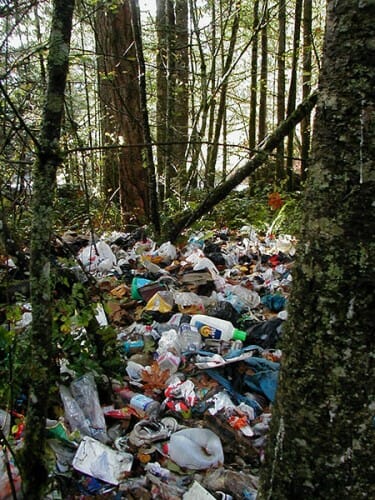
Well, it so happens my life is spent cleaning up public parks.  My company's mission is to privately operate public parks.  A lot of that job is picking up and hauling away the trash.  And I can tell you something with absolute certainty:  This is exactly what a highly trafficked area in our great Northwest Forests or Seashore National Parks would look like if someone wasn't there to pick up.  Here is one example from a northwest forest, in Oregon:

We run busy campgrounds and day use areas all over the country, and you would not believe the trash on the ground on a Monday morning.  And this is after the place was cleaned on Sunday morning and with trash cans available every 10 feet to throw things away correctly.  I have seen a few areas in the National Forest that were busy ad hoc camping areas -- meaning they had no facilities, no staff, and no trash cans -- and they were absolutely trashed by good old red-blooded American citizens.  Parts looked no different than this picture.  Most of these areas have since been closed, because of this ecological damage.

In fact, in my presentation I make to public agencies about our services, I say that we are actually in the environmental preservation business.  By attracting recreators to defined areas of the wilderness where we have staff to clean up after the visitors and limit their impact on nature, we are helping to preserve the other 99% of the land.

So, yes this is ugly, but it frustrates me that this is used to play into the Joe Arpaio type stereotypes of Mexicans

All these people that come over, they could come with disease. There's no control, no health checks or anything. They check fruits and vegetables, how come they don't check people? No one talks about that! They're all dirty. I sent out 200 inmates into the desert, they picked up 18 tons of garbage that they bring in"”the baby diapers and all that. Where's everybody who wants to preserve the desert?"

To my mind, this is an argument against Mexican immigration in the same way that violence against women is used as an argument against legalizing prostitution.  Prostitutes suffer abuse in large part because their profession is illegal which limits their access to the legal system when victimized, not because violence is inherent to their profession.  Trash in a wash in the desert is a result of the illegality of immigration that forces people into stream beds rather than city check points when they enter the country.

Postscript #1: Please, if you are a good, clean, thoughtful user of public parks, do not write me thinking I have dissed you.  I have not.  Most of our visitors are great and thoughtful, and we really appreciate that.  But it takes only a few to make an unbelievable mess.

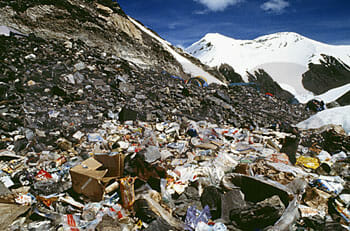
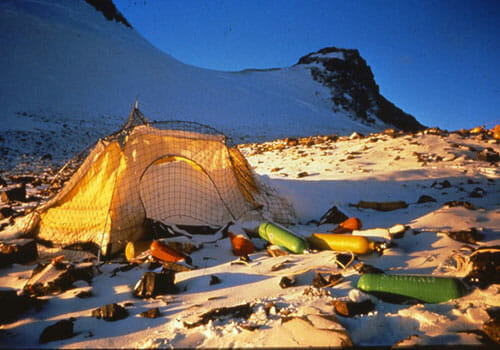
Postscript #2: I am willing to believe that poorly educated immigrants have fewer litter taboos than we have been acculturated with.   But I have seen enough to say that no ethnic group out there should be too smug.  For God sakes, there had to be a large effort near the top of Mt. Everest to clean up a huge dump that had accumulated of oxygen bottles and other trash near the summit.   Here are pictures of what rich Americans and Europeans do on Mt Everest when they are hiking and there is no trash can nearby:

When Allies Are Worse Than Your Enemies

Back in college, I burned a lot hotter on a variety of political issues.  I would argue with about anyone, and often did.  The dinner table was almost always the venue for some political fight.  During those arguments, I quickly discovered something -- people nominally on my side of the argument were sometimes my biggest problem.  I remember any number of times telling some person to shut up and let me argue the point.  People email me all the time asking me to ban some idiot commenter trolling in opposition to all my posts.  I tell them I am much more likely to ban an idiot commenter nominally supporting my point than the other way around.

Which brings me to Eric Holder:

"I've just expressed concerns on the basis of what I've heard about the law. But I'm not in a position to say at this point, not having read the law, not having had the chance to interact with people are doing the review, exactly what my position is," Mr. Holder told the House Judiciary Committee.

This weekend Mr. Holder told NBC's "Meet the Press" program that the Arizona law "has the possibility of leading to racial profiling." He had earlier called the law's passage "unfortunate," and questioned whether the law was unconstitutional because it tried to assume powers that may be reserved for the federal government.

Rep. Ted Poe, who had questioned Mr. Holder about the law, wondered how he could have those opinions if he hadn't yet read the legislation.

"It's hard for me to understand how you would have concerns about something being unconstitutional if you haven't even read the law," the Texas Republican told the attorney general.

I have never been totally comfortable with the Democratic support of immigration anyway.  The party, particularly under this administration, seems to take the position that the government can be as authoritarian as it likes, as long as it does not discriminate racially in doing so.  This post hypothesizes that the Democrats' support for immigration is political rather than principled, a desire to create the next new underclass that can be exploited for political points, and I can't really disagree based on past history.

Readers know I support open immigration.  I see immigration restrictions as government licensing of who can and can't work (and who can and can't be hired) -- an intrusion Conservatives would likely reject in any other context.  Since I am opposed to immigration limits, I am opposed to giving government extra powers in the name of enforcement, in the same way I oppose, say, asset seizure laws originally aimed at enforcement of drug prohibition.

I acknowledged that the law is less onerous in its amended form (because, you see, I actually read the whole thing, here and here for example), but what the law's supporters fail to deal with in claiming the letter of the law will not be enforced in a racist manner is how even existing law is being enforced here in Phoenix by Joe Arpaio in a racist manner.  When Joe goes into a business, and handcuffs all the people with brown skin, releasing them only when a relative or friend races to the police station with a birth certificate, it is an ugly, un-American scene (here or here or here).  I would take supporters of the bill more at their word as to how the law will actually be used in practice if they were not the same people actively cheer-leading Joe Arpaio at every turn.

Great Moments in Government Investment

Remember how the US gasoline-powered automobile market would never have developed without the massive government grants to Standard Oil to build out a gas station network?  Yeah, neither do I.

But I Was Not One of Them

I liked this bit from Megan McArdle on Elena Kagan because it fit so well with a category of people I saw all the time at Princeton (Kagan and I overlapped somewhat though I did not know her).

But I do think that David Brooks is onto something when he notes that her relentless careerism, her pitch-perfect blandness, are a little creepy. Not in themselves, but because they're a symptom of a culture that increasingly values what Brooks calls Organization Kids: the driven, hyperachieving spawn of the Ivy League meritocracy who began practicing Supreme Court nomination acceptances and CEO profile photo poses long before they took notice of the opposite sex.

The discussion of late is whether these Ivy Leaguers really are representative of the broader country, but I would add that these folks really were not liked even within Princeton.  A great example is Eliot Spitzer.  His treatment of Princeton and its student government as a sort of minor league tryout for future political ambitions drove everyone nuts, to the point that he even triggered an outlandish opposition party, the Antarctic Liberation Front.

Back when I was an undergrad at Princeton, one of my fondest memories was of a bizarre Student Body Governing Council (USG) election.  The previous USG administration, headed by none other than fellow Princetonian Eliot Spitzer, had so irritated the student body that, for the first time in memory, the usually apathetic voting population who generally couldn't care less who their class president was actually produced an energetic opposition party.  Even in his formative years, Spitzer was expert in using his office to generate publicity, in this case frequent mentions in the student newspaper that finally drove several students over the edge.The result was the incredibly funny and entertaining Antarctic Liberation Front.  I wish I had saved their brochures, but their proposals included things like imposing a dawn to dusk curfew on the school and funding school parties by annexing the mineral rights between the double yellow lines of the US highways.  All of this was under the banner of starting jihad to free Antarctica.  The ALF swept the USG election.  This immensely annoyed Spitzer and other USG stalwarts, who decried the trivialization of such an august body.  The pained and pompous wailing from the traditional student council weenies (sounding actually a lot like liberals after the last presidential election) only amused the general student population even further.  After a few student-council-meetings-as-performance-art, the ALF resigned en mass and life went back to being just a little bit more boring.

(Don't miss Virginia Postrel's take on the whole episode, occasioned by Spitzer whining about the episode 20 years later in the New Yorker.)

One other data point:  Two years later, after drinking a few adult beverages, it came into my head that it would be a really good idea to moon the USG meeting being held nearby.  I asked for volunteers, expecting a handful, and got over 40.  The episode saddens me only because I did not think of it soon enough to have mooned Spitzer.

Update: Hilarious

Anti-Immigration Playbook

There is an anti-immigrant playbook in this country that goes back at least to the 1840's and the first wave of Irish immigrants.  Typical arguments applied to nearly every wave of immigrants to this country have been 1.  They are lazy; 2. They are going to take our jobs (funny in conjunction with #1); 3.  They increase crime and 4. They bring disease.

To date in Arizona, we have seen all three of the first arguments in spades, but until recently I had not seen #4.  But trust Sheriff Joe to be out front on this, issuing a press release stating:

Sheriff Joe Arpaio says that he has long argued the point that illegal immigration is not just a law enforcement problem but is a potential health hazard as well.

"This is a risk to our community and to my deputies," Arpaio says. "Deputies never know what they may face in the course of enforcing human smuggling laws."

Arpaio says that in the last two months, four inmates, all illegal aliens from the country of Mexico, were confirmed with having chicken pox, placing 160 inmates into immediate medical quarantine.

Earlier Apraio had this to say to GQ magazine (but he's not a racist!)

All these people that come over, they could come with disease. There's no control, no health checks or anything. They check fruits and vegetables, how come they don't check people? No one talks about that! They're all dirty.

Of course, like many of Arpaio's fulminations, this release fell somewhere between a grand exaggeration and an outright lie.

Maricopa County health officials denied reports by the Sheriff's Office that 160 jail inmates had been quarantined two months ago because of four illegal immigrants with chicken pox.

Officials also downplayed a news release issued by Sheriff Joe Arpaio's office last night about chicken pox found in immigrants busted yesterday, noting that such minor outbreaks don't normally make the news.

After our inquiries, MCSO Lieutenant Brian Lee said that Arpaio had, in fact, misspoken when he stated for the news release that a large-scale "quarantine" had taken place.

The Power of Regulation

John Stossel has this chart to clearly define the power that is OSHA regulation:

Wow, that sure makes a big difference.  Which confirms my experience as a business owner.  Financial incentives like workers comp rates are a FAR more powerful force, at least in my business, to root our safety issues than the arcane and bureaucratic mandates that flow out of OSHA.

Risk and CDO's

This is one of the better simple explanations of both the appeal and hidden risk of CDO's. The example, which is short and is worth working through, ends this way:

Suppose that we misspecified the underlying probability of mortgage default and we later discover the true probability is not .05 but .06.  In terms of our original mortgages the true default rate is 20 percent higher than we thought--not good but not deadly either.  However, with this small error, the probability of default in the 10 tranche jumps from p=.0282 to p=.0775, a 175% increase.  Moreover, the probability of default of the CDO jumps from p=.0005 to p=.247, a 45,000% increase!

The dark magic of structured finance conjured many low-risk securities out of many risky securities.  Like all dark magic, however, the conjuring came at a price because if you didn't get the spell exactly correct it was easy to create something much more risky and dangerous than you were likely to have ever imagined.

As an ex-engineer who used to do a lot of operations analysis as well as post-disaster failure analysis, this shares a central theme that I have found in many such failures -- people tend to overestimate their own knowledge.

Coming in to a class at HBS, the professor had us all do a 20 question survey.  It asked us questions like "what is the population of Argentina" and then asked us to give the lowest and highest number we thought it would be such that the answer had a 95% chance of being in that range.  Based on this, only one of our 20 answers should have been out of my limits.  About eight of the answers were out of my ranges.  It was a really good lesson in overestimating one's knowledge.

Which leaves me with a thought -- if we define a large part of the problem as overestimating our understanding of a certain phenomenon, from your observation of the Obama administration and its personalities, what gives you any confidence that a new lager of government regulators will solve this problem?

The Most Outlandish Historical Revisionism I Have Ever Seen

First, the background.  Veronique de Rugy writes something that is undeniably true, though the Left has played semantic games with words like "trust fund" and "lockbox" for years to try to "shelter" the public from this reality:

In practice, [] the trust fund and interest payments it receives are simply accounting fiction. For years, the federal government has been borrowing the Social Security Trust Fund assets for its daily spending. The fund has nothing left in it except IOUs from the federal government. In fact, even the interest is paid in IOUs.

Hence, the only way Social Security will not go into the red this year and in future years is if the federal government pays back Social Security. But since the money has long ago been consumed, it must borrow money from the public or raise taxes to pay its Social Security debts.

In response, Kevin Drum whips out this absolutely stunning statement:

Back in 1983, we made a deal. The deal was this: for 30 years poor people would overpay their taxes, building up the trust fund and helping lower the taxes of the rich. For the next 30 years, rich people would overpay their taxes, drawing down the trust fund and helping lower the taxes of the poor.1

Well, the first 30 years are about up. And now the rich are complaining about the deal that Alan Greenspan cut back in 1983. As it happens, I agree that it was a bad deal. If it were up to me, I'd fund Social Security out of current taxes and leave it at that. But it doesn't matter. Once the deal is made, you can't stop halfway through and toss it out. The rich got their subsidy for 30 years, and soon it's going to be time to raise their taxes and use it to subsidize the poor. Any other option would be an unconscionable fraud.

I really had a WTF moment when reading this.  Its hard to know where to start, so here are some reactions in semi-random order:

  • For those of you over 40, do you remember such a deal?  No, you don't, because there never was one.  What happened was that Congress decided to sweep the Social Security surplus into the deficit calculation in order to disguise the magnitude of unsustainable spending, to help prevent the kind of electoral backlash we may well see later this year.  This is Soviet-style history making.
  • Here is a thought problem: Picture Tip O'Neil, Speaker of the Democrat dominated House of Representatives at the time, publicly signing on to a deal that the poor would pay higher taxes for 30 years to give the rich a tax break.  It is a total joke to even consider.   The absurdity of such a notion is mind-boggling.
  • It took me a while to parse this and figure out what he was even talking about.   For example, there was never a tax increase to the poor during the 1980's, so what does he mean that the poor would pay more for 30 years?  The only way this can even be the correct view of the world is if one makes two assumptions:
      1. Everything Congress chooses to spend money on is perfectly, morally justifiable and therefore spending levels are a fact of nature beyond our ability to challenge or question
      2. Rich people have the moral obligation to pay for all incremental government programs, and all budget gaps will be closed by new taxes on rich people.  Taxes on rich people, as a corollary, are never too high.

      Given these assumptions, then the "Deal" sort of kind of makes sense.  By the progressive "logic" of these two assumptions, social security taxes in an alternate world would have been reduced during the surplus and the general budget deficit would have been filled not with social security surpluses but higher taxes on the rich.

      • The previous logic depends on treating social security taxes as unfairly regressive taxes as part of an income transfer / welfare program.  If you treat them as premiums in an insurance program, the retroactive logic trying to cast this as a "deal" in 1983 doesn't work.  Interestingly, many on the left in other forums have argued against calling social security taxes anything but insurance premiums, including....Kevin Drum

      The men in my family of my father's generation returned home after serving their country and got jobs in the local steel mills, as had their fathers and their grandfathers. In exchange for their brawn, sweat, and expertise, the steel mills promised these men certain benefits. In exchange for Social Security taxes withheld from their already modest paychecks, the government promised these men certain benefits as well.

      "¦.These were church-attending, flag-waving, football-loving, honest family men. They are rightfully proud of providing homes and educations for their children and instilling the sorts of values and manners that serve them well as adults. And if I have to move heaven and earth, now that they've retired, the Republican party is NOT going to redefine them as welfare recipients.

      • Note by the way, that if this really is an insurance program, any private insurer or private pension fund managers in America would be in jail had they done what our trustworthy federal government did.  In effect, they spent other people's pension money on current operations.

      If we want to describe the last 30 year history of Social Security surpluses as a deal, here is what the actual deal was without ex post facto varnish:  Congress in the eighties said that they were going to spend that surplus money now to get themselves re-elected, and some other Congress 30 years hence would have to figure out how to deal with the bare cupboard.   That was the deal.  It was a simple screw you to future generations.

      Drum, given his progressive assumptions, fantasizes a deal based on his assumption that the only way to fill in the hole is with higher taxes on the rich, because his mind is incapable of wrapping itself around any other alternatives (see the two assumptions above).

      But it is worth noting that the surplus was in the main handed away by the Democrats to the poor and middle class through new entitlement spending.  Its hard to figure how a series of actions that took seniors pensions and frittered it away in a variety of programs that at best helped the poor and in reality probably helped no one but government bureaucrats somehow obligates the rich to pay 30 years of new taxes to clean the whole mess up.

      It's Harder Than it Looks in Movies

      You know how in movies, when a car goes over a cliff, it always blows up spectacularly when it hits the bottom?  Well, it turns out that this is harder than it looks to duplicate in real life.

      Katie Bar the Door

      I have a new theory -- that the most dangerous circumstances for individual liberty in this country are when Conservatives and Liberals agree.  When there is some issue where the authoritarianism of the right coincides with the authoritarianism of the left, then watch out.  The example I offer today is child molestation prosecutions, where the law and order Right meets the smug for-the-children moralizing of the Left.  Where Janet Reno meets Joe Arpaio.

      Congrats to Tonya Craft for her acquittal, and here's hoping (though there is not much chance) that the prosecutors and particularly that jackass of a judge suffer some sort of negative consequences from their outlandish abuse of due process.  My jury experience on a similar case here.

      UpdateAnd speaking of Sheriff Joe...

      False Dichotomy

      False dichotomy, via Mother Jones:

      Faced with a world that can support either a lot of us consuming a lot less or far fewer of us consuming more, we're deadlocked: individuals, governments, the media, scientists, environmentalists, economists, human rights workers, liberals, conservatives, business and religious leaders. On the supremely divisive question of the ideal size of the human family, we're amazingly united in a pact of silence.

      My guess is that the authoritarians at Mother Jones don't particularly care which is the outcome, so long as they get to wield the coercive power to make the choice for us.  Thank God these guys didn't run things in 1900.  Or 1800.  Or 1700.  Or 1600.  Or 1500.  Given their belief in zero sum choices and their complete lack of confidence in the power of the human mind to innovate, who knows what kind of sub-optimal world we would have been locked into?

      Headline of the Day

      From Valley Fever

      Escort Beats Valet Bloody With High-Heeled Shoe at Valley Ho in Scottsdale, Cops Say

      By the way, "Valley Ho" is actually the real name of the hotel, which is a contemporary, moderately upscale renovation of a old Scottsdale hotel.

      Hotel Selection Fail

      I had an early morning flight out of Louisville today, and so stayed in a hotel near the airport to maximize my sleep time.  Usually this is fine, as most airports are dormant from 10pm to 6am.  Unfortunately, I failed to remember that Louisville is the main air-hub for UPS (like Memphis is for FedEx) so a big bank of planes was landing around midnight, and more noisily, taking off between four and five AM.

      Where's the Love For Princeton Law School?

      From David Bernstein

      The president went to Harvard, and barely defeated a primary opponent who went to Yale. His predecessor went to Yale and Harvard, and defeated opponents who went to Yale and Harvard, and Harvard, respectively. The previous two presidents also went to Yale, with Bush I defeating another Harvard grad for the presidency. And once Elena Kagan gets confirmed, every Supreme Court Justice will have attended Harvard or Yale law schools.

      I know that Harvard and Yale attract a disproportionate percentage of America's talented youth, but still, isn't this a bit much? Are there no similarly talented individuals who attended other Ivy League schools, other private universities or (gasp!) even state law schools?

      For what its worth, I have a Princeton undergrad degree and an MBA from Harvard and the number of Harvard-Yale-Princeton employees working for me in our 420-employee firm is ... zero.

      Friday Funny, Two Days Late

      I make fun of homeopathy from time to time here, so I thought this was hilarious, via Megan McArdle.

      Homeopathic bombs are comprised of 99.9% water but contain the merest trace element of explosive. The solution is then repeatedly diluted so as to leave only the memory of the explosive in the water molecules. According to the laws of homeopathy, the more that the water is diluted, the more powerful the bomb becomes.

      'It was only a matter of time before these people got hold of the material that they needed to make these bombs,' said former UN weapons inspector, Hans Blix, 'The world is a much more dangerous place with the advent of these Weapons of Mass Dilution.'

      'A homeopathic attack could bring entire cities to a standstill,' said BBC Security Correspondent, Frank Gardner, 'Large numbers of people could easily become convinced that they have been killed and hospitals would be unable to cope with the massive influx of the 'walking suggestible'.'

      The severity of the situation has already resulted in the New Age terror threat level being raised from 'lilac' to the more worrisome 'purple' aura. Meanwhile, new security measures at airports require that all water bottles be scanned to ensure that they are not being used to smuggle the memory of an explosion on board a plane.

      Speaking of making fun of homeopathy, I saw Penn and Teller in Phoenix on Friday.  Very enjoyable show.   I have a sense their Vegas show is more "adult," but their road show was appropriate for the whole family (unless you are really uptight and/or politically correct).