2460 Days or So Early

A few days ago I wrote:

I would be willing to bet him that within the decade, it will become a mainstream idea in the progressive community to fund shortfalls in Social Security and Medicare with a full or partial seizure of 401K's.

This is not quite there, but it sure shows that they are thinking in this direction

The senior administration official said that wealthy taxpayers can currently “accumulate many millions of dollars in these accounts, substantially more than is needed to fund reasonable levels of retirement saving.”

Under the plan, a taxpayer’s tax-preferred retirement account, like an IRA, could not finance more than $205,000 per year of retirement – or right around $3 million this year.

Wealth taxes on large pools of savings are not far behind

Alabama Defines Favored Industries in the Corporate State

If you want to get special privileges and crony handouts in Alabama, you need to have a company in one of these industries:

automotive, automotive-industry related, aviation, aviation-industry related, medical, pharmaceutical, semiconductor, computer, electronics, energy conservation, cyber technology, and biomedical industry

For example, if you are in one of these businesses, you don't need to bother to accumulate a block of land for your plant the old-fashioned way, by buying it from the current owners.  Companies in these industries can now get the government to seize the land by eminent domain and hand it to them.

I am not sure why these are the favored few industries, but this list matches similar lists in other states of industries that get special tax breaks, relocation incentives, subsidies, protection from new competitors, etc.  The rest of us who run unfavored businesses have to pay towards the profitability of these industries, because for some reason they are particularly good at re-electing politicians.

PS-  I would add liquor wholesalers, professional sports teams, car dealers, and media companies to the list of locally favored industries.

I Have A Better Idea: Let's Just Kill It

Kevin Drum thinks the mortgage interest deduction is unfair because people with bigger mortgages get bigger deductions.  In particular, he is concerned that people with smaller deductions get no incremental benefit because these deductions are seldom larger than their default personal exemption.

But tax deductions are always going to be like this in a progressive system -- the rates are progressive and the fixed personal exemption is extremely progressive, so the combination of the two mean that tax deductions are going to preferentially help the rich more.  This reminds me of the arguments in Colorado when tax law required a tax reduction and Democrats in the state legislature complained that people who don't pay taxes would be getting no benefits from this.

He tries to posit some silly alternative tax credit system, but why bother?  Haven't we had enough of distortive tax breaks that favor a single industry and/or shift investment alarmingly into a particular pool of assets (thus increasing the risk of bubbles).  Isn't the whole notion of tax-subsidizing home ownership but not rentals inherently regressive, no matter how the deduction or credit is calculated?  Doesn't the labor market rigidity of home ownership most penalize lower income workers who get trapped in a certain geography by their home and cannot migrate for better wages, as blue collar workers have done in past recessions and recoveries?

Why wouldn't a good progressive like Drum be advocating for an elimination of the deduction altogether?  Is this one of those coke-pepsi party things, where the Republicans have taken over the issue of limiting deductions so Democrats have to reflexively defend them, even if ideologically it would make more sense for them to promote their elimination?

How To Win An Argument With Those Who Already Agree, and Lose With Everyone Else

I think that I am just going to post this line from Kevin Drum largely without comment:

In particular—and please excuse the wild guess here—I imagine that most people who have a serious jones for cutting federal spending are really only interested in cutting spending on poor people. Cutting other services just isn't what they signed up for. It's the Obamaphones and the food stamps that are wasteful, not the Yellowstone snowplows and small town air traffic controllers.

One of the things I tell folks in the climate debate -- don't try to learn about the other side of the argument from yours by listening to your own folks' characterization of it, go actually listen to the other side.  This is what comes of  trying to understand people only by listening to their intellectual enemies.  It is also why I read a lot of blogs (like Drum's) with which I disagree.

Has Drum seriously not ever heard the concentrated benefits, dispersed cost argument?

This Would Never Happen Today

I love this little story of one of the richest men in the world being unable to complete a real estate parcel he wanted.  Why?  Because this would never happen today.  The owners and tenants of the small properties Rockefeller wanted to acquire actually had strong property rights in the 1930's.  Today, a rich real estate developer would just go to the city and have their property declared blighted, seized by eminent domain, and handed to them on a platter.

More Arizona DMV Madness

My daughter is ready for her final (in-car) driving test to try to get her driver's license.  But it turns out that the AZ DMV only gives driving tests before 3PM each day.

This is yet another policy designed for the pleasure of government workers (who want to get home nice and early) and not customer-citizens.  Ask yourself:  Who are 99% of the people who take the in-car driving test.  Answer:  16-year-olds, also known as high school sophomores.  And what are they doing up until 3PM weekdays?  Why, they are going to school!

So I have to pull my daughter out of school to take the driving test.  But it is worse than that, because we can't just show up at 2:30, missing perhaps her last class.  The AZ DMV has this insane process that is essentially a series of chained queues.  One waits in line for the receptionist, who gives the "customer" a number based on what task they want to complete (license, tags, etc).  One then waits endlessly for this first number to come up, only to find that the person who calls you up can only complete half the task (at best), so you then have to wait in line for the next person to complete the next task, etc.

Well, reports from all the other parents tell us that if you show up two hours early (e.g. at 1PM), there is a very good chance you will not get the driving test.  If all the prior queues one must work through cause one to show up at the driving test queue even at 3:01 -- Sorry!  You have to come back another day and start all over.

This is obviously insane.  The chained queue process is nuts.  The fact that the one portion school age kids must complete ends before school is out is nuts.  The fact that the person who performs the last step in the chained process goes home first is nuts.

Until last year, and with my previous kid, we did not have to do this.  AZ had a very sensible law that allowed private licensed driving schools to give the driving test.  You could still go through the DMV, but for a $100 or so one could get this done via a high service, no-queue, work-on-the-weekend private company.  But of course our legislature ended this sensible service last year, ostensibly over concerns about quality, but likely because the DMV folks didn't like competition from outsiders who actually gave a sh*t about customer service.

Facebook Tries to Recreate AOL

This sounds a lot like what AOL tried to do, back before anyone knew what the web was or how to navigate it.  Interesting how these things come back around

Facebook's long-term ambition has been twofold. First, to become the de facto front end for the web— to become a portal not just to the lives of your buddies, but to everything else that is on the web in the first place. (There is remarkably little discussion about Facebook eclipsing Google as a search engine, maybe because nobody thinks the subject is worth taking seriously; they need to reconsider.) The second step is to replace the web entirely— to take every piece of functionality that we've normally associated with the rest of the web, from picture storage to news aggregation to messaging— and reincarnate it inside Facebook's ad-driven walled garden.

Facebook Home is yet another way to do that. By giving people a low-entry-level device that's essentially a front end for Facebook— or a convenient all-in-one fullscreen app— they make it easier for people to dispense with dealing with any other part of the web that's not Facebook. They don't have to block anything explicitly; they just have to make the Home experience so immersive, and offer so much through it, that after a while you don't feel the need to touch anything else. And given that I have friends who barely know a web that exists outside of Facebook, that's really unnerving.

The Missing Warning Label

Zero Hedge pointed out this ad for California state bonds:

20130404_cali


In light of the recent Stockton bankruptcy, this should carry a warning label:  "California reserves the right to repudiate up to 100% of these bonds whenever payment of the interest or principle interferes with paying state employees the maximum possible pension benefits.  These bonds are subordinated to any promises made at any time by any politician to state employees unions, past, present, or future."

Best Buy: We Focus on Items People Don't Buy from Walmart or Amazon

Well, that is not exactly what they said, but this confirms some earlier casual observations of their stores I have written lately:

Shoppers typically associate Best Buy with TVs and computers, but the retailer plans to dedicate more floor space to appliances in the coming months as the housing market continues to improve.

Here is my translation:  Half of our floor space has gone digital (DVD, CD, games) and the other half has items where Amazon and Walmart are killing us.  But we are locked into long-term leases we can't break for a bunch of freaking large stores so we need to put something out there.  So we will try appliances.  Next up, mattresses?

Government Prioritization Fail: Adding Staff When It Is Least Essential

Matt Welch has a good article here about a self-refuting NPR piece, which was obviously supposed to be a scare story about the loss of Sequestration money but turned out to be an illustration of just how stupid the sequestration panic was.  It's funny listening to the podcast of this episode as the NPR hosts desperately try to support the Administration position.

But one thing I thought was funny was this bit illustrating pre-sequester government staffing prioritization:

NPR's David Greene brings on Yvette Aehle, director of the Southwest Georgia Regional Airport in Albany, Georgia, to talk about the terrible danger that passengers will face now that Aehle's airport stands to lose its air traffic controllers:

AEHLE: Well, I don't really want to say anything is less safe. It's just a better opportunity for people to listen and to be heard and to understand where they are. And also, I'd like to point out that we don't have 24-hour tower coverage here currently. Those air traffic controllers are only directing traffic between 8 am to 8 pm seven days a week. And most of our heavy traffic is outside of those hours.

So the government chooses to staff the control tower only half the day.  But they choose to staff the tower during the 12 hours of lightest traffic, presumably because the employees wanted day jobs rather than night jobs.

As an aside, I will confess that my business of running public parks benefits from this.  The biggest management load on parks is obviously on weekends and in the evenings (in campgrounds).  Most employees of public agencies only work weekday days.  Its incredibly typical that public parks employees will take their vacations in July and August, by far the busiest months.  One advantage  (other than the obvious cost advantage) we have over public operations is that public agencies can't or won't ask their employees to work weekends and defer their vacations out of the summer time.  We are perfectly happy to hire people with very clear expectations that the job involves work on weekend and holidays.

I will give you my reminder of how to understand most government agencies:  Ignore the agency's stated purpose, and assume that it is being operated primarily for the benefit of its employees.  One will very often find that this simple heuristic is far better at explaining agency decisions than relying on the agency's mission statement  (this does not mean that there are not dedicated individuals in the agency truly, even selflessly, dedicated to the stated mission -- these two notions are not at all mutually exclusive.  Government agencies do not act badly because they are full of bad people, they act badly because their incentives cause good people to do stupid things).

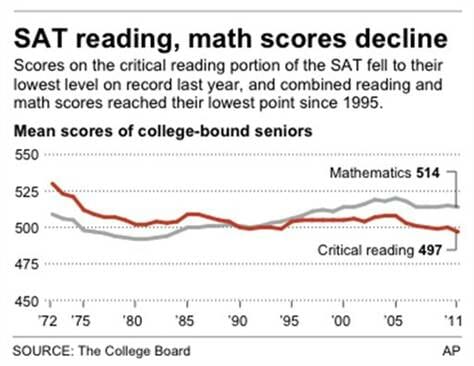
SAT Scores Are Bad Education Evaluation Data

I am happy to see the public school system coming in for much-deserved criticism.  I don't have anything to add to this article that I have not already said about schools many times.  But I want to make one complaint about a chart used in the blog post:

sat-scores


SAT scores are a terrible metric for measuring academic performance over time.

First, I am not at all convinced that the test scoring does not shift over time (no WAY my son had a higher score than me, LOL).

But perhaps the most important problem is that all students don't take the SAT -- it is a choice.  Shifts in the mix of kids taking the test -- for example, if over time more kids get interested in college so that more marginal academic kids take the test -- then the scores are going to move solely based on mix shifts.  Making this more complicated, there is at least one competitive test (the ACT) which enjoys more popularity in some states than others, so the SAT will represent an incomplete and shifting geographic mix of the US.  Finally, as students have gotten smarter about this whole process**, they gravitate to the ACT or the SAT based on differing capabilities, since they test in different ways.

To me, all this makes SAT scores barely more scientific than an Internet poll.

** If you have not had a college-bound student recently, you will have to trust me on this, but parents can spend an astounding amount of time trying to out-think this stuff.  And that is here in flyover country.  Apparently private school parents on the East Coast can be absurd (up to and including hiring consultants for 6 figures).  A few years ago it was in vogue to try to find your kid a unique avocation.  Violin was passe -- I knew kids playing xylophone and the bagpipes.  A friend of mine at a high profile DC private school used to have fun with other parents telling them his son was a national champion at falconry, the craziest thing he could make up on the spur of the moment at a cocktail party.  Other parents would sigh enviously, wishing they had thought of that one for their kid.

Matt Ridley's 10 Questions For Climate Alarmists

As I have read Mr. Ridley over the years, I have found him to have staked out a position on anthropogenic climate change very similar to mine  (we are both called "lukewarmers" because we accept that man's addition of greenhouse gasses to the atmosphere warms the world incrementally but do not accept catastrophic positive-feedback driven catastrophic warming forecasts).

I generally find room to nitpick even those whom I largely agree with, but from my perspective, this piece by Ridley is dead on.   (thanks to a reader for the link)

The Low Information Voters Will Inherit the Earth

Via Eugene Volokh

Gator Country 101.9 morning deejays Val St. John and Scott Fish are back on the air today after a one-day suspension for an April Fool’s Day joke involving Lee County’s water supply.

The hosts of the “Val and Scott In The Morning Show” on the Bonita Springs-based country music station were suspended Monday after perpetrating the joke that involved telling listeners there was dihydrogen monoxide in the county’s water. Dihydrogen monoxide is another way to describe water.

Some listeners didn’t get the joke, however, and began calling the Lee County Utility asking about the issue....

Tony Renda, 101.9 general manager, said in a message to The News-Press today that suspension of the two deejays remained in effect until the following was accomplished:

“Although the VAST MAJORITY of our listeners got the joke, some didn’t. We needed to ensure that ALL of our listeners understood that there was no problem with the water,” Renda said in the message, adding that the station had to ensure that both the Lee County Utility and Lee County Health Department were both satisfied with the efforts.

After seeing the very funny Penn and Teller episode (where they have environmental activists signing a petition to ban dihydrogen monoxide), I am not surprised that people did not get the joke.  The amazing thing is the fact that the radio station, and society in general, felt the need to pander to this ignorance by actually suspending the radio show hosts.  In effect, they were forced to apologize for the public's appalling ignorance.

This is the society that progressives have been fighting for -- one in which the listener defines acceptable vs. unacceptable speech based on his or her own hurt feelings and ignorance.

Illustrating Pollution Articles with Water Vapor

I have written here before about how frequently steam plumes are used by the media to stand in as a proxy for pollution.  Here is another example, with extra points for artful photography and use of lighting conditions to make the white steam look dark and scary.

Bitcoin, Short Sales, and Volatility

I am fascinated by Bitcoin and would love to see it be a success.  But Tyler Cowen has a quote that reflects some of my concerns about it:

…bitcoins are an uncomfortable combination of commodity and currency. The commodity value of bitcoins is rooted in their currency value, but the more of a commodity they become, the less useful they are as a currency.

Bitcoin is in the midst of an enormous price bubble, with increases in value of as much as 50% over just a few days.  This is astounding volatility for even a commodity, much less a currency.

Cowen said something at the end of the post, almost as a throw-away, that got my attention:  "There is, by the way, no current way to short Bitcoin."  The reason this caught my eye is that I have argued a long time that short selling is an important mechanism to reduce market volatility.

Every time we get to a market bubble or problem, insiders always start arguing against short selling saying it makes volatility worse and undermines markets.  But what they are really saying is that they like volatility so long as it is up. They had no problem with the bubble that propelled their securities up, they just don't want them to come back down to Earth.

In certain bubbles, when interest in a certain asset class gets really frothy, anyone who is skeptical of the asset and its new high values will sell and get out.  This means that as the bubble grows, all the skeptics are long gone from the market.  No longer owning the asset, these skeptics have no further "vote" or influence on the price.  Short selling is a way for skeptics to continue to influence the price and asset values.  To this extent, I think it tends to limit the peak of bubbles, just as bottom-fishers limit the debt of troughs.

Bitcoin would likely benefit from skeptics having some sort of influence on bitcoin values.  But without a way to short, Bitcoin values are driven solely by wacky anarcho-capitalists (e.g. people like me) and people fearful of Cyprus style depositor losses.  Essentially all the true believers are bidding against themselves.

Damn April Fools! I Wanted This to be Real

+1 For Twilight Struggle

I have written before about how much I enjoy the physical board game Twilight Struggle.  This is not really going out on a limb, since it has occupied the #1 spot at BoardGameGeek for a while.  But over the last 3 months my son and I became totally addicted.  He is at college, but we played online via the terrific Twilight Struggle add-on in the VASSAL gaming engine  (all free).  Very highly recommended.

Some Gaming Reviews: SimCity, Bioshock Infinite

First, an update on SimCity.  I am a huge SimCity series fan from way back.  I was excited by the new release, which turned out to be a total disaster.  I wrote several weeks ago about the horrendous decision to make SimCity an always-online game, which led on day 1 to the game being unplayable for most because of server problems and overloads at EA.

Since that time, they have (mostly) fixed the server overload issues and I have been able to play.  Sort of.  The game is beautiful and the interface is pretty nice.  And the game tantalizing retains many of the elements that made the previous games so compelling to some of us.  But in the end, the game is a fail.

First, it is full of bugs.  One horrible bug ensures that over time, almost every city you build will crash on the online server.  The only solution is to accept a rollback to an earlier state, though every once in a while this leads to a total city loss.

Beyond that, almost every element of the game is broken.  Sims will suddenly stop going to school, and complain about there being no education when an empty school is right across the street.  City water tables can be drained in a matter of months, making a city unplayable -- one can avoid this only by putting their sewer plant right by their water supply.  Certain city specializations added to the game, like gambling, don't work right.   Meteor showers cities every few months and can't be turned off.  etc. etc.

It may be that this game will be playable in 6 months or so, but even then I fear that the EA team has simplified the game so much and removed so many options to appeal to the mass market XBOX set that the wonky complexity many of us enjoyed in early games will never be there.  In particular, city size is limited such that in about 20 minutes of play I can completely fill the city space.  All that one can even do with the game after that is just sit and watch density increase and expand a fire station or two as the population grows.  In fact, a lot of the game for me runs unattended, since EA had to turn off the fast speed mode.  The city now needs to just run for hours for anything to happen, so I resorted to leaving it on in the other room and checking back on it every hour or two.

Oh, and by the way.  The highly touted multiplayer features are a bad joke.  Someone in the business department told developers that the game had to be online for piracy protection, and told them to go develop some game features that justified this decision so they could tell users that the online requirement was really for their benefit and not for copy protection.  Well, they failed.

Bioshock Infinite.   I don't play a lot of first person-shooter style role-playing games, but my son talked me into playing the new Bioshock.  He has played a lot of this genre (e.g. the Mass Effect series) and said that this was the best he had ever played.  This evaluation may be in part due to his fascination with strange dystopic visions of society, because we certainly get one in this game (as in each of the Bioshock series).

I am not every far into it but I will say that is a fun experience.  So far I would say it was less of a game and more of an immersive novel -- WTF is this place I am in and what is going on.   The environment is really fascinating to explore.  I am still trying to figure out the back story, but piecing it together is a fun process.  Already I have been to several memorable locations.

My Retirement Rant

First, I will say that I am perfectly happy for folks who are either good earners or good savers or both and who choose to use their accumulated wealth to stop working at some age.

However, I am completely lost as to how we have somehow decided that multi-decade end-of-life paid vacations, starting as early as age 50, is somehow an inalienable right that must be guaranteed by government.  I suppose I can see a safety net for folks who, though age and disability, simply get too old to be productive (but remember that I have nearly 500 people mostly over 65 who work for me, mostly doing manual trades, so don't tell me older people can't be productive).  And that was what Social Security initially was -- the age 65 was chosen as a retirement age not because it guaranteed 10-15 years of senior leisure but because it matched the life expectancy at the time.  The equivalent age would be well into the 70's today.

Of course, others think differently.  A group is now proposing an expanded Social Security program that would guarantee nearly 100% of earnings to low-income retirees (there are smaller increases for higher income workers but most all the change is for low-income folks).

While they are proposing higher taxes to support this, my guess is that it will not be long before a wealth tax is suggested.  After all, they are hoping to replace 401K's as a savings vehicle.  If so, why not seize those funds to help pay for the plan.  The other day, Kevin Drum mocked those who fear a government seizure of 401K's as the tinfoil hat brigade.  I would be willing to bet him that within the decade, it will become a mainstream idea in the progressive community to fund shortfalls in Social Security and Medicare with a full or partial seizure of 401K's.

Re-Inflating the Bubble

We all know from progressive and Democratic writers the the Community Reinvestment Act and other efforts to offer cheap home loans to people without good credit had nothing to do with the mortgage industry offering too many loans to people without good credit.

So we should not be in the least bit worried that the Obama Administration is calling for more mortgages to be given to people with weaker credit, while sub-prime auto loans are simply booming.  Because we have learned from Iceland and Greece and Cyprus that the best way to deal with a debt crisis is by encouraging consumers to take on more debt, and the best way to respond to an asset bubble is to try to re inflate the bubble.

All of this, of course, is simply crazy talk.  The people who are involved HAVE to know this won't end well, because the most recent example of this leading to disaster is only 4 years old.  Hell, the people doing this were in office when this same approach fell apart last time.  But politicians refuse to face some pain now to avoid huge pain in the future - for politicians, the discount rate on pain is infinite.

Ugh, Another Crony Enterprise Born

When I read this in our local paper, alarm bells immediately went off:

A friendship cemented while working together on the state’s economic development efforts has led to a new partnership linking Roy Vallee, the former Avnet Inc. chairman and chief executive officer, with private developer Don Cardon.

Great, two folks who have focused on bringing crony corporatist benefits to selected local businesses and business relocations are going into business together.  I don't know these guys, I am sure they are fine folks, but my first thought was a business that leveraged their connections with government to create private profits.

Reading further, this seems like a good guess:

The two metro Phoenix business leaders say they will collaborate on large commercial developments, including those with a special public-interest focus and those with special complexities....

Cardon spent three years at the Arizona Commerce Authority, a public-private partnership, and the predecessor Arizona Commerce Department. Aside from that, he perhaps is best-known as a driving force behind CityScape, the three-block, $1.2 billion mixed-use development in downtown Phoenix. He cites as a strength his ability to bring private and public interests together on a project.

Yep, I definitely think I am on to something:

The firm will strive to encourage a “collective vision” and “make sure projects are worthy of investment and will be successful,” Cardon said. “Everything we do will involve public value, enriching the quality of life.”

You know the type of project -- the ones where the city / state / Feds justify investing millions of taxpayer money into private projects because "they create jobs" (like those at Solyndra).  In fact, the two partners are already polishing up this mantra, which I am sure we will hear over and over:

Deals typically will exceed $100 million and will create hundreds of jobs, both in the development stage and when complete, he said. The company , however, will maintain a fairly lean staff.

“We’re not a big employer, but we’ll be a job creator,” he said.

I want to make a couple of quick points:

  • Investments whose primary return is "jobs" are not investments, because jobs are a cost, not an income stream.  Investing public money to create jobs means that one is investing money now so that it incurs costs later. 
  • All successful capitalist enterprises that make  a profit by definition create "public value" and "enrich the quality of life."  Otherwise no one would buy their product or service and they would fail.  In fact, only publicly-funded projects can evade this sort of accountability.  When it is said that these projects deliver "public value," what is meant is that they deliver benefits that a few self-selected people have defined as somehow interesting to the public, but which it turns out the public (when given a choice) is unwilling to pay for.  Which is how we get the local town of Glendale continuing to subsidize an ice hockey team for $25 million or so a year.

I Am Going To Frame This And Put It On the Wall for the Times My Wife Is Ready to Kill Me

"I wish I had ended up with a Princeton man"

source

RSS Problems Apparently Due to Google Getting Blacklisted as Spammer

I found out more about why the WordPress Bad Behavior plugin was blocking updating of my Feedburner RSS feed -- apprently, Google got a bunch of its IP addresses blacklisted in project Honeypot, which Bad Behavior uses as one source of spam data.  Here is more:

This is caused by an architectural problem at Google, and will require Google to resolve the issue for the problem to go away permanently. The issue is that, in the case of FeedBurner, Google uses IP addresses which are shared by third parties using Google App Engine, some of which are spammers. The spammers quickly get Google’s IP address blacklisted all over the Internet, and suddenly FeedBurner stops working.

If you are impacted by this issue, you can whitelist the affected IP addresses or the FeedBurner user agent string, or disable Project Honey Pot. Be aware that doing any of these will increase the amount of spam you receive. You should also complain to Google, since this isn’t the first time this has happened, and they seem to have done absolutely nothing about it.

Fisker Flashback: Ray Lane Touts Obama As Greatest Venture Capitalist-In-Chief Using Solyndra as Evidence

You can't make this up.  Ray Lane, the very nicely politically-connected investor whose connections to Obama are often credited with Fisker scoring millions of taxpayer money, made a video several years ago praising Obama as a great new model of venture-capitalist-in-chief.

I can't believe any intelligent human being would think that the right role for the President is to be a venture capitalist with taxpayer money, or that even if this were so that Obama would be the right person with the right skills to do it well, but I suppose trying to score hundreds of millions in taxpayer money changes your perspective.

But the funny part is the example he uses - he thinks the best evidence of Obama being a swell investor is ... Solyndra.  Obviously filmed before Solyndra failed  (and the US government allowed all the remaining assets to go to another set of Obama cronies), this video is hilarious.

Fisker Flashback: Karma Gets Worse Mileage Than An SUV

Even in all-electric mode, the Fisker Karma gets worse mileage than an SUV  (only a deeply flawed EPA MPGe rating, purposely designed to over-state electric car efficiency, hides this fact).