Sorry for the Popup
Yesterday I seem to have embedded a quote that included code of an irritating popup that wouldn't go away. Sorry. Thanks for the emails form folks who alerted me to the problem.
Dispatches from District 48
Yesterday I seem to have embedded a quote that included code of an irritating popup that wouldn't go away. Sorry. Thanks for the emails form folks who alerted me to the problem.
I just don't understand the enthusiastic support for Mitt Romney and his description as an heir to the Reagan legacy. In particular, he claims to single-handedly have implemented HillaryCare in Massachusetts, the program that was arguably responsible for sweeping the Republicans into Congress in 1994. My sense is that Hillary in the intervening years has moved on to an even more socialist plan, but everything I see in the Romney plan looks very much like Hillary's original proposal.
The plan is command and control at every turn -- for example, I am a huge believer in high deductible health insurance. My family has saved a ton with it, and it shifts health insurance to be more like, you know, insurance -- meaning it covers catstrophic, bankrupting problems but not day to day expenses. Well, this sort of very reasonable plan, which has the added benefit of bringing some price competition to medicine because people like me now care about prices, was made illegal in Massachusetts by Romney and Company. Romney strikes me as just another 1970's-style big government Nixonian Republican, like nearly every other Republican in the race this time around.
Prime Minister Wen Jiabao
responded Wednesday to growing public anxiety about inflation by
announcing that China would freeze energy prices in the near term, even
as international crude oil futures have continued to surge....Last November, China raised gasoline and diesel prices by almost 10
percent, partly to appease officials at state-owned refineries.
Refiners had complained that price controls were forcing them to
swallow the difference between higher prices for crude oil on the world
market and regulated consumer prices at home for refined products. So
refineries cut back production of gasoline and particularly diesel,
causing long lines at fuel stations around the country.
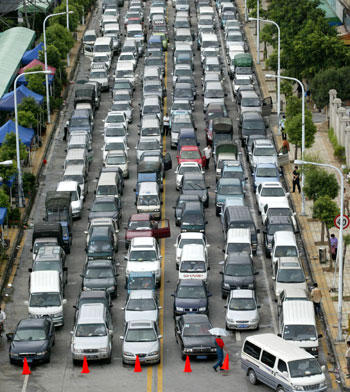
More on past Chinese problems from gas price caps. Here is a picture of one such past gas line in China.
I got my driver's license in 1978, just in time to spend the first few months of my driving life sitting in gas lines with the family car, a result of a series of market distorting actions by the US government.
Meanwhile, I presume the French and Germans will see no problem with this approach:
The Economist says,
of the state of economics education in France and Germany, "I
desperately hope it's not really this bad." Unfortunately, I think it's
really that bad. When the 35 hour work week was proposed, I was talking
to someone in the French consulate who did economics and trade. "Aren't
you worried that this will raise employer's costs and lead to business
failures or higher unemployment?" I asked."That's just Anglo-saxon economics" was his rather stunning reply. Apparently, in France, demand curves do not slope downwards.
The NFL playoffs are absolutely my favorites sporting event of the year. So of course I have to get on an airplane Sunday afternoon to get to a Monday morning meeting. To get in the spirit, here is one of my favorite NFL spoofs, Peyton Mannings United Way commercial on SNL:
How in the world do you make a 1,145 calories, 71 g fat turkey burger??
From the PC Magazine Blog:
The venerable BlackBerry manufacturer launches a native Facebook client
that makes staying in touch with your Facebook friends a cinch.
Venerable? BlackBerry? ROFLMAO, as they say.
Frequent readers will know that I don't think much of our County Sheriff Joe Arpaio. Sheriff Joe gains a ton of PR for himself as the "toughest sheriff in America" and relishes in making jail conditions as miserable as possible. Recognize that this is the jail that holds many people after arrest but before conviction.
Now on to the figure mentioned in the Dickerson piece of 2,150
"prison condition" lawsuits since 2004. Anyone with two licks of sense
can go online at pacer.psc.uscourts.gov, or dockets.justia.com,
enter "Arpaio" into the federal court docket, then count the lawsuits
that name "prison conditions" as the cause. Count back to 2004, and as
of mid-December, that number was more than 2,150.The same search for
the top jail custodians in L.A., New York, Chicago, and Houston nets a
total of only 43 "prison condition" lawsuits.Remember, those 2,150
lawsuits against Arpaio are only in federal court. There are hundreds
more listed online with the Maricopa County Superior Court, at superiorcourt.maricopa.gov/docket/civilcourtcases/.....
"For the period January 1, 1993, to [November 29, 2007], the county
has paid $30,039,928.75 on Sheriff Department General Liability
claims," state the docs. "This figure includes all payments, attorney
fees, other litigation expenses, settlements, payments on verdicts,
etc."Additionally, New Times
asked Crowley how much the lawsuit insurance policy that also covers
the sheriff has cost taxpayers. Crowley croaked, "The county has paid
for General Liability coverage for the period 3-1-95 to 3-1-08 total
premiums of $11,345,609.50."Keep in mind that this
liability coverage figure is high, in part, because of all those
lawsuit payoffs to relatives of dead inmates.From 1995 to 1998, the county paid $328,894 a year for an insurance policy with a $1 million deductible.
Today,
Maricopa County pays a yearly premium of $1.2 million for outside
insurance with a $5 million deductible. For any lawsuit that costs $5
million or less, the county foots the entire bill. It's the best policy
the county can buy because of Arpaio's terrible track record.
Russell Pearce is the Arizona legislator who authored the AZ employer sanctions law. Remember, that's the law that requires, among other things, employers to check the immigration status of current employees using an INS system that has federal rules in place that make it illegal to use this system to... check the immigration status of current employees. His plan is to reduce a major source of labor in the Arizona economy which, by the way, has a 3.5%-4.1% unemployment rate over the last year, the lowest level in 30 years.
Anyway, now Mr. Pearce has decided to target babies:
The newest front in the battle over illegal immigration is dragging health-care workers into the fray.
The Arizona Hospital and Healthcare Association is trying to kill a
proposal by Rep. Russell Pearce, R-Mesa, that would require its members
to check the citizenship of patients who deliver babies at Arizona
facilities.If neither of the parents can prove citizenship, the hospital would be barred from issuing a regular birth certificate.
Babies of parents who are here legally but not citizens also would be denied regular birth certificates.
Beyond the obvious concerns about driving moms away from medical care for their deliveries, Mr. Pearce has a teeny-tiny Constitutional issue he must deal with in the 14th Amendment:
All persons born or naturalized in the United States, and subject to
the jurisdiction thereof, are citizens of the United States and of the
State wherein they reside.
Mr. Pearce is hoping that "subject to the jurisdiction thereof" can be stretched to say that such persons do not include immigrants. In fact, the Supreme Court does not seem to have ruled on this specific issue (corrections welcome in comments) but historically they have been extremely loath to place limits on this. And no one except Mr. Pearce and perhaps a few of his immediate family members believes that barring citizenship to children of legal immigrants will pass Constitutional muster. And I am pretty sure that no matter how these questions come out, disallowing birth certificates would never survive a court challenge. I don't think the immigrants' home country would issue a birth certificate in such a case so we would be creating people without a country.
The author says this is an old joke, but it was new to me. It traces the evolution of math quizzes in our public schools:
1960s
A logger cuts and sells a truckload of lumber for $100. His cost of
production is four-fifths of that amount. What is his profit?1970s New-math
A logger exchanges a set (L) of lumber for a set (M) of money. The
cardinality of Set M is 100. The set C of production costs contains 20
fewer points. What is the cardinality of Set P of profits?1980s
A logger cuts and sells a truckload of lumber for $100. Her cost is $80, her profit is $20. Find and circle the number 20.
1990s
An unenlightened logger cuts down a beautiful stand of 100 trees in
order to make a $20 profit. Write an essay explaining how you feel
about this as a way to make money. Topic for discussion: How did the
forest birds and squirrels feel?
He goes on to show how reality may have overtaken the joke.
Working for someone else: Days are way too long.
Working for myself: Days are way too short.
Take the 10-second test at Climate Skeptic.
Les Miles will remain as coach of the LSU football team (at least for a while) despite being wooed by Michigan. (LSU must wonder what's wrong with their coaching job - they have won two national championships this decade but can't get a coach to stay).
In order to keep Les Miles, LSU inserted this clause in his contract:
Should Miles win the BCS championship [ed: which he now has accomplished] his contract states he has to be
among the top three paid college coaches in the nation, which would
bump him to the $3.5 million range.
This is not uncommon language now in sports contracts. For example, players with a franchise tag in the NFL must get a salary equal to or greater than the average of the top five players at that position.
So here is my question. What happens if three other college coaches, say Pete Carrol, Jim Tressel, and Urban Meyer (who have all won national championships in the last 10 years) were to demand that they too should be guaranteed a salary that puts them in the top three coaches? Don't things start getting real recursive at this point?
Postscript: Yeah, I know, the language generally says they get bumped to a top X position on the day of a certain event, like winning the BCS or having the franchise tag applied, which circumvents the circularity problem, mostly, by not being an open-ended reset. It is still funny to think about. There is nothing to stop 4 coaches from negotiating a clause with an open-ended reset such that their salaries would spiral to infinity. Even Solomon might struggle with that one when it went to court, though the Gordian Knot solution would be to just run one of the four through with a sword.
I wonder if this has ever happened, say with two CEO's that had contracts that guaranteed that each would, at any given time, be the highest paid CEO in the Fortune 500.
Kevin Drum thinks he has a killer analysis supporting government health care. In a post he titles sarcastically "Best Healthcare In the World, Baby," Drum shares this chart:
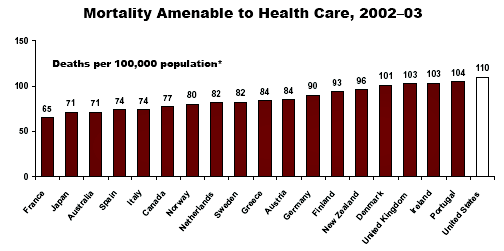
The implication is that the US has the worst healthcare system, because, according to this study, the US has the highest rates of "amenable mortality," defined as deaths that are "potentially preventable with timely and effective health care."
I get caught from time to time linking to studies that turn out to have crappy methodology. However, I do try to do a little due diligence each time to at least look at their approach, particularly when the authors are claiming to measure something so non-objective as mortality that was "potentially preventable."
So, when in doubt, let's look at what the author's have to say about their methodology. The press release is here, which gets us nowhere. From there, though, one can link to here and then download the article from Health Affairs via pdf (the site is gated but I found that if you go through the press release site you can get in for free).
The wording of the study and the chart as quoted by Mr. Drum seem to imply that someone has gone through a sampling of medical histories to look at deaths to decide if they were preventable deaths. Some studies like this have been conducted. This is not one of them. The authors do not look at any patient data.
Here is what they actually did: They arbitrarily defined a handful of conditions as "amenable" to care. These are:
Ischemic Heart Disease (IHD)
Other circulatory diseases
Neoplasms (some cancers)
Diabetes
Respiratory diseases
Surgical conditions and medical errors
Infectious Diseases.
Perinatal, congenital, and maternal conditions
Other (very small)
All the study does is show how many people died in each country from this set of diseases and conditions. Period. It doesn't determine if they got care or if they in particular could have been saved, but just that they died of one of the above list of conditions. This study was not an effort to identify people who died when their particular condition should have been preventable or amenable to care; all it measures is the number of people in each country who died from list of conditions. If Joe is talking to me and in the next second flops over instantly dead of a massive heart attack, the author's consider him to have died of a disease amenable to care.
We can learn something by looking at the breakdown of the data. If you can't read the table below, click on it for a larger version

Let's take the data for men. The study makes a big point of saying that France is much better than the US, so we will use those two countries. In 2003, France has an "amenable disease" death rate 56 points lower than the US. But we can see that almost this whole gap, or 42 points of it, comes from heart and circulatory diseases. The incidence of these diseases are highly related to diet and lifestyle. In fact, it is well established that the US has a comparatively high incidence rate of these diseases, much higher than France. This makes it entirely possible that this mortality difference is entirely due to lifestyle differences and disease incidence rates rather than the relative merits of health care systems. In fact, this study is close to meaningless. If they really wanted to make a point about the quality of health care systems, they would compare them on relative mortality with a denominator of the disease incidence rate, not a denominator of total population.
But in their discussion, the study's authors reveal themselves to be, if I am reading them right, complete idiots in terms of statistical methods. The authors acknowledge that lifestyle differences may be a problem in their data. This is how they say they solved this problem:
It is important to recognize that the development of any list of indicators of amenable mortality involves a degree of judgment, as a death from any cause is typically the final event in a complex chain of processes that include issues related to underlying social and economic factors, lifestyles, and preventive and curative health care. As a consequence, interpretation of findings requires an understanding of the natural history and scope for prevention and treatment of the condition in question. Thus, in the case of IHD, we find accumulating evidence that suggests that advances in health care have contributed to declining mortality from this condition in many countries, yet it is equally clear that large international differences in mortality predated the advent of effective health care, reflecting factors such as diet and rates of smoking and physical activity.16 To account for this variation, we included only half of the mortality from IHD, although, based on the available evidence, figures between, say, 25 percent and 70 percent would be equally justifiable.
I have a very smart reader group, so my sense is that many of you already see the gaffe here. The author's posit that 50% of heart disease may be due to lifestyle, though the number might be higher or lower. So to correct for this, they reduce every country's heart disease number (IHD) by a fixed amount of 50%. WTF?? This corrects for NOTHING. All this does is reduce the weighting of IHD in the total measure.
Look, if the problem is that lifestyle contribution to heart disease varies by country, then the percentage of IHD deaths that need to be removed because the deaths are lifestyle related will vary by country. If the US has the "worst" lifestyle, and the number for lifestyle deaths is about 50% there, it is going to be less than 50% in every country. The correction, if an accurate one could be created, needs to be applied to the variance between nations, not to the base numbers. Careful multiple regressions might or might not have sorted the two sets of causes apart, but dividing by 50% doesn't do anything. This mistake is not just wrong, it is LAUGHABLE, and calls into question the author's qualification to say anything on this topic. They may be fine doctors, but they don't know squat about data analysis.
There may be nuggets of concern for the US lurking in this data. I don't know how they measure deaths from surgical conditions and medical errors, but its not good to be higher on this. Though again, you have to be careful. The US has far more surgeries than most other countries per capita, so we have more surgical deaths. Also, medical error data is notoriously difficult to compare country to country because reporting standards and processes are so different. In the US, when the government measures medical errors, it is a neutral third party to the error. In Europe, the government, as healthcare provider, is often the source of the error, calling into question how aggressive these countries may be in defining "an error." Infant mortality data is a good example of such a trap. The US often looks worse than European nations on infant mortality because it is defined as infant deaths as a percentage of live births. But the US has the most advanced neo-natal capabilities in the world. Many pregnancies that would result in a "born dead" in other countries result in a live birth in the US. Since these rescued births are much more problematic, their death rate is much higher.
There is good news for the US in the study. The item on this list most amenable to intensive medical intervention is cancer (neoplasms in the study above). In that category, despite a higher incidence rate than many of these countries, the US has one of the lowest mortality rates as a percentage of the total population, which implies that our cancer mortality in the US as a percentage of cancer incidence is much better than these countries. This shows our much higher 5-year cancer survival rates.
Update: I thought this was pretty clear, but some of the commenters are confused. The halving of IHD numbers was applied to all countries, not just the US. So the actual male US IHD number is about 100 before halving and the actual French number is about 40. Again, this halving only reduces the weighting of IHD in the total index; it in no way corrects for differences in incidence rate.
Frequent readers will know that unlike most other libertarian blogs, I have not plastered the site with hopeful articles and endorsements for Ron Paul. I have always been 99% supportive of his work in Congress and was happy to have him there. But I resisted even registering in the Arizona primary to vote for him. Arizona requires that to vote in a primary, I have to register as belonging to that party, and I am just not going to do that.
Part of my reluctance to jump on the bandwagon has been my general disaffection with politics and some ambivalence as to whether my elected overlord is from Coke or Pepsi. The rest, I think, was a subliminal fear of supporting any Libertarian candidate because they always seem to turn out to be wing-nuts. QED.
Update: The excuse that he didn't know what was in a series of ghost-written newsletters is just ridiculous. I will accept that excuse for one issue, a mistake in selecting partners (I am sure there are bloggers out there who regret guest-blogger selections) but a long series of newsletters implies tacit approval or at least acceptance.
For years, protectionists in this country have tried to argue that "oh, I am really for free trade, but to be fair we must impose environmental and labor standards on our trading partners." Well, now Europe is proposing doing exactly the same to us:
The European Commission is considering proposing a
carbon dioxide tariff on imports from states failing to tackle
greenhouse gas emissions, while also considering a toughening-up of the
EU's own emission trading system....
The plan reflects pressure by French president Nicolas Sarkozy who
argued in October that Europe should "examine the option of taxing
products imported from countries that do not respect the Kyoto
Protocol," referring to the 1997 international agreement on fighting
climate change.Mr Sarkozy urged Brussels to discuss the implications of "unfair
competition" by firms outside the EU, which do not have to abide by
strict European standards on CO2 emissions.
This letter from Don Boudreaux seems relevant:
Hillary Clinton needs a
language lesson. She favors only trade that is found by government to
"benefit[] our workers and our economy" and that promotes "rising
standards of living across the world" ("" December 3; my emphasis). She then asserts that "There is nothing
protectionist about this."Oh please.
Protectionism
exists whenever, wherever, and whyever government artificially raises
its citizens' costs of buying imports. Protectionism has forever
rested on the false notion that government officials know best how
consumers should spend their money. And it attempts today to hide its
ugly face behind the smiling mask of allegedly noble intentions, such
as those mouthed by Sen. Clinton.
The title of his post is "The Moment Somone Must Explain that He or She Isn't a Protectionist, You Can Bank on that Person Being a Protectionist."
Not much comment necessary for the following, except to say that I don't think one should be able to call this an unintended consequence of US biofuel and corn subsidies when 1) the results are utterly predictable and 2) folks like myself publicly predicted it.
The US is the world's leading producer of soy, but many American soy
farmers are shifting to corn to qualify for the government subsidies.
Since 2006, US corn production rose 19% while soy farming fell by 15%.The
drop-off in US soy has helped to drive a major increase in global soy
prices, which have nearly doubled in the last 14 months. In Brazil, the
world's second-largest soy producer, high soy prices are having a
serious impact on the Amazon rainforest and tropical savannas."Amazon
fires and forest destruction have spiked over the last several months,
especially in the main soy-producing states in Brazil," said Laurance.
"Just about everyone there attributes this to rising soy and beef
prices."High soy prices affect the Amazon in several ways. Some
forests are cleared for soy farms. Farmers also buy and convert many
cattle ranches into soy farms, effectively pushing the ranchers further
into the Amazonian frontier. Finally, wealthy soy farmers are lobbying
for major new Amazon highways to transport their soybeans to market,
and this is increasing access to forests for loggers and land
speculators.
Sorry, this is work-related, but we are considering bidding on the management of campgrounds on Lake Merwin, Yale Lake, and Swift Reservoir near Mt. St. Helens in WA. Since these facilities are under a lot of snow, I won't be able to get a good feel for them. Anyone out there familiar with these facilities? If so, I would love an email or comment post about them, good or bad.
Kevin Drum observes that yet another study has put to rest the theory that Thimerosal, a preservative that used to be put in some childhood vaccines, causes autism:
However, despite the equivocal (at best) scientific evidence linking
thimerosal to autism, conspiracy theories abounded and the issue deeply
split the autism community. Firm evidence in one direction or the
other, though, had to wait until now. Thimerosal was ordered removed
from most childhood vaccines in 1999, and by the early 2000s children
had stopped receiving virtually all thimerosal-based vaccines. If
autism rates then decreased, it would be good evidence that thimerosal
really had been to blame.But that didn't happen. Interim studies have shown no decrease in
autism rates, and a study released today puts the nail in the coffin of
the thimerosal story. It tracks children born in California and
includes enough years of data to show pretty definitively that autism
diagnoses continued to rise even after thimerosal was removed
I thought it was time to move on from this theory years ago, but Drum says that it continues to be carried forward by parents desperate to find an explanation for their child's autism. I guess I am a bit more cynical, for I would argue that this bad science of Thimerosal has been carried forward, just like the bad science of breast implant caused immune deficiencies, by trial lawyers desperate for another easy extortion target. And, just as medical studies did not stop lawyers from pressing forward implant lawsuits, I am sure the Thimerosal lawsuits are not going to go away either.
When the government does not allow prices to float in real time in response to changes in supply and demand, then gluts and shortages are inevitable. When shortages occur, due to prices that are capped or not allowed to move upwards sufficiently quickly, queues and/or spot shortages occur. When the government decides it does not like this, the jack-booted thugs step in and we have government-enforced rationing. California, famous for its stupidity in letting wholesale electricity prices float while capping retail prices and thus creating an economic disaster several years ago, is at it again in the electricity market:
What should be controversial in the proposed revisions to Title 24 is
the requirement for what is called a "programmable communicating
thermostat" or PCT. Every new home and every change to existing homes'
central heating and air conditioning systems will required to be fitted
with a PCT beginning next year following the issuance of the revision.
Each PCT will be fitted with a "non-removable " FM receiver that will
allow the power authorities to increase your air conditioning
temperature setpoint or decrease your heater temperature setpoint to
any value they chose. During "price events" those changes are limited
to /- four degrees F and you would be able to manually override the
changes. During "emergency events" the new setpoints can be whatever
the power authority desires and you would not be able to alter them.In
other words, the temperature of your home will no longer be yours to
control. Your desires and needs can and will be overridden by the state
of California through its public and private utility organizations. All
this is for the common good, of course.
I can't think of anything that better illustrates the tie between free exchange and freedom. And by the way, how long before the greenies in the legislature suggest using this mechanism even when there are not shortages to turn down everyone's air conditioner, just because they can.
Update: Exercise for the reader -- Figure out how, once this policy goes bad, the state of California will again blame Enron for their failure.
Over at Climate Skeptic, I administer a 20-second Rorchach test on a sea ice chart.
After several years and jillions of emails telling me I have a problem, I finally have https://coyoteblog.com (without the www) pointing to this site rather than an under construction page.
This is a story that most people who care for humanity would consider good news:
After years of secret preparation, the world's cheapest car will be unveiled in Delhi this week...At 100,000 rupees (£1,290), the People's Car, designed and
manufactured by Tata, is being marketed as a safer way of travelling
for those who until now have had to transport their families balanced
on the back of their motorbikes.Ratan Tata, 70, chairman of the
family-run business, who has spearheaded the race for a cut-price car,
wrote on the company website: 'That's what drove me - a man on a
two-wheeler with a child standing in front, his wife sitting behind,
add to that the wet roads - a family in potential danger.'But Tata hopes also to create a 'new market for cars which does not
exist', making them accessible to India's booming middle classes made
recently rich by an economy growing at around 9 per cent a year. ...Last
year just over one million cars and seven million motorbikes were sold
in India. Tata wants to transform some of those motorbike buyers into
car owners and believes that the company can eventually sell up to a
million People's Cars a year. Analysts say the project could
revolutionise car prices, not just in India, but globally. Several
other manufacturers have similar products in the pipeline.
Awesome. This is a story about three quarters of a billion people who have lived in poverty, well, forever, starting to join the middle class.
But many environmentalists, about 100% of whom I would venture to say own a car themselves, oppose this transition to prosperity:
'There is this mad rush towards lowering the prices to achieve mass
affordability,' said Anumita Roychoudhury, of the Centre for Science
and Environment in Delhi. 'If vehicle ownership increases very rapidly,
we'll have a time bomb ticking away. When you lower the price that
drastically, how will you be able to meet the safety and emissions
standards? There are no clear answers yet.'
I would challenge this person to design a car that doesn't crash test better than a motorbike. This is just incredible arrogance, attempting to deny millions of people the prosperity which western environmentalists already share. (via Maggies Farm)
Postscript: The fact is that environmental quality in every developing nation tends to follow a J-curve. Early stage development tends to muck things up a bit (think air quality in 1018th century Pittsburg or in China today) but things improve as people get wealthier. Places like China and India are in some of the lowest reaches of that J-curve. Attempting to freeze their development in place not only arrogantly denies these folks prosperity, but also cuts off future environmental gains that come with wealth.
Outside of trade policy and climate treaties, I very seldom discuss foreign policy. First, because it is not my first interest. Second, because I am not an expert and do not spend the time to keep myself sufficiently informed on the issues to have useful insights. Third, because of exactly this problem stated so well my Megan McArdle:
I periodically flirt with isolationism, or if you prefer,
"non-intervention". Like most libertarians, I'm attracted to "high
concept" political philosophy: simple rules that can be stated in a
sentence or less. No arguments about causus belli, blowback, or
ultimately unknowable political ramifications; just a simple "yes or
no" test. Did a foreign army invade the United States? For "Yes", press
one; for "No", press two, and go back to arguing about what should
replace child welfare laws in the coming anarcho-capitalist society.Besides, all the foreigners hate having us there. Why not leave, and
see if absence makes the heart grow fonder? (I suspect that many
nations which have come, over long decades, to regard regional peace as
some sort of natural law, will get a rather nasty surprise. This might
make our influence look, in retrospect, rather appealing.)But anyone who thinks at all seriously about libertarianism will,
fairly early on, be faced with a very high hurdle. There are a handful
of wars in which American intervention unambiguously halted gross
abuses of human liberty. World War II is one, though many end up going
around, rather than over . . . arguing that the Nazis were the direct
result of American intervention in World War I; or that it was
justified because Japan attacked us1; or that Russia and Britain would have defeated Hitler anyway2. The American Civil War, however, is by far the highest leap; and the hardest to dodge.In theory, every state has the right to secede, and the stated
Federal rationale for the Civil War--preserving the union--was the
vilest tyranny. In practice, chattel slavery was a barbarism even
viler.And so we killed 20-30% of the Confederate Army, not a few of our
own, and uncounted numbers of civilians. That's not counting the
wounded, who probably outnumbered the dead. All we managed to achieve,
at this horrendous cost, was a corrupt and brutal occupation, followed
by the "freedom" of Jim Crow, sharecropping, and "separate but equal". And it was worth it.
The good guys won. We didn't do everything we wanted to, or even
everything we could have, or should have. Jim Crow was putrid. But it
was nonetheless so much better than slavery that it was worth the
horrendous cost--in my opinion, and that of almost everyone in the
world.
For me, a big part of the problem is one of information -- generally, most of the information one might find useful in deciding if X is a good war to pursue is from the government, an institution that demonstrably cannot be trusted based on past history when it makes this case. Non-interventionism seems the right way to go, except for the
(relatively few) times it is not. The problems is, to paraphrase the
famous dictum about advertising money, "half (or more) of our wars are
a waste -- we just don't know in advance which half." Megan uses the
example of the Civil War, saying that that war was worth it because we
got rid of slavery. But the war by no means began that way. It wasn't
really until well into the war that both sides were pretty much in
agreement that the war was about ending or retaining slavery. I would argue that in advance, that war looked like an awful, terrible, horrible proposition. The initial value proposition was "let's go to war so the Feds can have a bigger empire to run." Only later did it become, "let's go to war to free a large part of our population." There was a female professor, I forget her name, who made the point that the Emancipation Proclamation changed the war from a bloody waste of time to a moral positive. But that came years into the fight.
The other problem I have is that the war is fought by, well, the government, the institution for which I have no trust. One way of thinking about it is that every time we go to war, we put our lives and treasure and very future as a country in the hands of the Post Office. Eeek.
Movie producers sell DVDs cheaper in, say, Taiwan than they do in the US. This is not an unheard of economic phenomenon -- it happens in every commodity and product. The reason we don't notice these price differences too much is that traders and arbitragers and shipping companies will target the largest price differentials and take advantage of them by buying and shifting products around until the price differential is less than the transportation and transaction costs. Basic economics.
However, despite a number of structural advantages that already serve to reduce this cross-flow (e.g. different languages), the media companies are trying to stretch copyright law far beyond what CopyOwner says is legally defensible:
Copyright owners (including the owners of the "works" embodied in
the copyrighted labels on common non-copyrighted goods) like to
discriminate in pricing by creating artificial markets so that
discounts in one market won't be resold at a lower price in over-priced
markets. The thinking goes, "Why let U.S. consumers get the benefit of
prices that are affordable to people in developing countries when we
know we can get more out of the U.S. consumer's pocket?"The
"first sale doctrine," now codified as Section 109 of the Copyright
Act, makes clear that the copyright owner's right of distribution is
subject to the copy owner's right to sell it to anyone, anywhere, at
any price. And that's great policy. Entrepreneurs who see too big a gap
between the prices charged U.S. consumers and the prices charged
consumers elsewhere for identical copies can buy the cheaper product
and sell it at a profit, while still giving the U.S. consumer a better
bargain.But that's not why I nearly fell out of my chair. I
was used to these anti-competitive price discriminators ranting about
perfectly lawful gray market goods. What this story does is label these
perfectly legal importers as pirates. That's right. Despite quoting the
Supreme Court in Quality King Distributors v. L'anza Research International,
that "once the copyright owner places a copyrighted item in the stream
of commerce by selling it, he has exhausted his exclusive statutory
right to control its distribution," a ruling that suggests that the
evildoers are those who try to circumvent the law by preventing gray
market imports, they go on to call the importers "pirates"
It is always amazing how big round numbers hold the media in thrall. Last week we saw the inevitable spate of articles about oil crossing the $100 mark, if only for a few minutes of trading (actually, the more interesting milestone was somewhere back in the low $90 range when we exceeded the highest past price for oil in inflation-adjusted dollars).
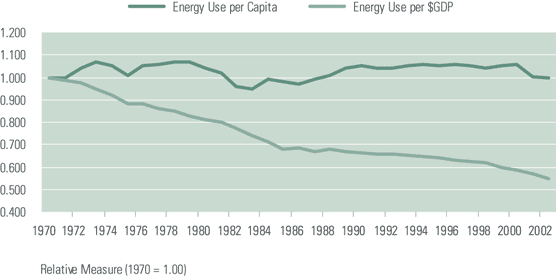
I don't get hugely worked up about gradual commodity price changes. Oil price increases are signals, signaling marginal consumers to use less and suppliers with historically marginal sources and substitutes to consider their development. Also, our economic dependence on oil per dollar of GDP has declined, meaning that $100 oil has less impact on the economy than, say, it would have 20 years ago:
I would certainly prefer lower oil prices, and my business suffers to some extent when gas prices rise, but it is not a disaster (it is interesting that higher oil prices are considered bad in the media, while lower home prices are considered bad in the media). I know from past experience in the oil patch that oil price bubbles are often followed by oil price drops. The high oil prices of the seventies were followed by rock-bottom oil prices in the eighties, and subsequent recession in the oil patch (causing the housing bust I discussed here).
Also, given how we got to these higher oil prices, I tend to take them as good news. Oil prices are not rising due to some drop off in supply. Instead, they are rising because of a strong global economy, in particular with millions of people entering the middle class in Asia. This is GOOD news.
I have written on peak oil a bunch, so I won't get into it again. Oil production at worst is going to flatten out for a long time, meaning we will have a steady rise in oil prices over time as the economy grows. If you want a third party evaluation of peak oil theory, go ask climate catastrophists who believe that CO2 production is an impending disaster for the economy. These guys know that there are lots of unproduced hydrocarbons out there, and it terrifies them. Al Gore and James Hansen were running around last week trying to close off Canadian tar sands from development.
Finally, after this series of random thoughts, one more interesting take on this via Megan McArdle: $100 oil was a stunt
Some observers questioned the validity of the price mark when it
emerged that the peak was the result of a trader "“ one of the "locals"
who trade on their own money "“ buying from a colleague just 1,000
barrels of crude, the minimum allowed, industry insiders said. The deal
on the floor of the New York Mercantile Exchange was at a hefty premium
to prevailing prices.Insiders named the trader as Richard Arens, who runs a brokerage
called ABS. He was not available for comment. Analysts said he may have
been testing the ceiling of the crude price, but the premium he paid
surprised the market.Before the $100-a-barrel trade, oil prices on Globex were at $99.53
a barrel. Immediately after the trade, prices went down to about
$99.40, suggesting a trading loss of $600 for Mr Arens.Stephen Schork, a former Nymex floor trader and editor of the
oil-market Schork Report, commented: "A local trader just spent about
$600 in a trading loss to buy the right to tell his grandchildren he
was the one who did it. Probably he is framing right now the print
reflecting the trade."