Comments

Several people have said they have had difficulties with comments.  I don't know if it is a real problem, or if it is just that I was gone on Sunday and a bunch of stuff piled up in the moderation queue  (any comment with multiple links goes to a moderation hold for me manually to check for spam).  I will look in to things.

Update: Several comments on the post about police and photography creepily were sent straight past moderation into spam.  I have recovered them.

Who Could Have Predicted This?

Kevin Drum quotes the Financial Times:

US banks that have received government aid, including Citigroup, Goldman Sachs, Morgan Stanley and JPMorgan Chase, are considering buying toxic assets to be sold by rivals under the Treasury's $1,000bn (£680bn) plan to revive the financial system.

....Wall Street executives argue that banks' asset purchases would help achieve the second main goal of the plan: to establish prices and kick-start the market for illiquid assets.  But public opinion may not tolerate the idea of banks selling each other their bad assets. Critics say that would leave the same amount of toxic assets in the system as before, but with the government now liable for most of the losses through its provision of non-recourse loans.

Wow, no one could have predicted this.  Except for anyone who spent 5 minutes with the numbers:

There is an interesting incentive to collude [in the Geithner plan] between banks and investors.  The best outcome for both is for investors to pay a high price to banks and then have the bank kick back some portion to the investor.

I will confess that I did not take the next logical step and consider that the ultimate collusion would be for banks themselves to be the investors, but the incentives for doing so were dead clear (part 1, part 2).

I will stick by my original conclusion -- Taxpayers are hosed at any price.

By the way, can anyone tell me what the evidence has been for the contention Barack Obama is "really smart," because I sure don't see it.  Yeah, he went to an Ivy League School, but so did I and there were plenty of people there I wouldn't trust to run a lemonade stand.  Sure, he gives a nice prepared speech and seems to have invested in that vocabulary building course Rush Limbaugh used to peddle on his show, but what else?  All I see is a typical Ivy League denizen of some NGO who thinks he/she can change the world if only someone will listen to them, who just comes off as puerile if you really spend any time with them.  I will go back to what I wrote on inauguration day:

Folks are excited about Obama because, in essence, they don't know what he stands for, and thus can read into him anything they want.  Not since the breathless coverage of Geraldo Rivera opening Al Capone's vault has there been so much attention to something where we had no idea of what was inside.  My bet is that the result with Obama will be the same as with the vault.

I Called The Ward Churchill Verdict

On several occasions, I have (unpopularly) argued that Ward Churchill's firing from his tenured faculty position at the University of Colorado was unjustified, as the termination seemed to pretty clearly be due to his remarks about 9/11 rather than any academic mis-conduct.

While Colorado has tried to argue that they fired him because his academic work was weak, I have argued that it is no weaker than much of the work done by any number of high-profile racial and gender studies departments  (Duke University being just one recent example).  Racial and gender studies professors are generally evaluated based on their political activism, not their scholarship, so firing Churchill was both wrong on a first amendment basis and wrong because his statements on 9/11 were merely conforming to the standards of his chosen academic discipline.

A jury seems to agree:

A jury found on Thursday that the University of Colorado had wrongfully dismissed a professor who drew national attention for an essay in which he called some victims of the Sept. 11 attacks "little Eichmanns."...

The jurors found that Mr. Churchill's political views had been a "substantial or motivating" factor in his dismissal, and that the university had not shown that he would have been dismissed anyway.

If you don't believe me about activism trumping scholarship as a criteria for hiring racial and gender studies professors, just listen to Churchill's lawyer:

Mr. Lane, Mr. Churchill's lawyer, said his client had been a spokesman throughout his academic career for disempowered people and causes "” a trait, Mr. Lane said, that never made Mr. Churchill popular with people in power. "For 30 years, he's been telling the other side of the story," Mr. Lane said.

Missing are terms like study, research, investigation, etc -- this is activism, pure and simple.  And Colorado knew it and wanted it when they hired him, so it was wrong for them to fire him for it.

Hosed At Any Price -- An Update on Geithner Plan Analysis

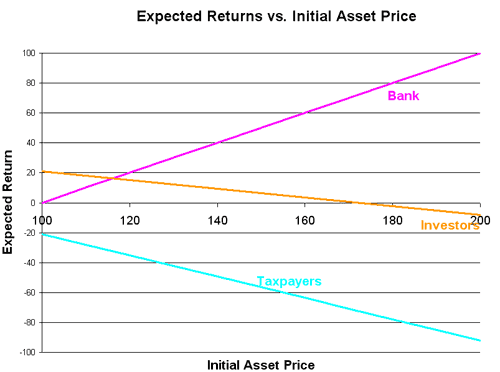
I had someone ask me whether the results in this post on the economics of Geithner's latest brainstorm were an artifact of the selected purchase price for the distressed asset of 150.  The answer is no.  Investors are willing to buy this asset on these terms at any price under 175, and banks are willing to sell for any price over 100.  Here is the graph of expected values as a function of the purchase price

geithner-plan

Note the taxpayer gets hosed at any price  (kind of the Obama-Geithner update on "unsafe at any speed")  Two things I had not realized before:

  • Without competition among investors to drive up the price, a very large percentage of the taxpayer subsidy goes to the investors rather than the banks.
  • There is an interesting incentive to collude here between banks and investors.  The best outcome for both is for investors to pay a high price to banks and then have the bank kick back some portion to the investor.

Poof

Thanks to a reader who pointed out to me that this post on Obama's economic policy and Mussolini-style fascism went poof.  I have no idea why, but if anyone else notices similar behavior, please drop me an email.  I have never deleted an old post, even when I have been later embarrassed by what I wrote, so posts should not disappear.

The post is back up, thanks to the Google cache, but some comments may have been  lost.  Sorry.

Computer Tampering with the Intent to Harass

What does the title of the post mean? Well, if you are the Phoenix police (and at least one sorry-ass local judge) it is the name of the new "crime" invented to describe blogging that is critical of public officials.

In what should send a frightening chill down the spine of every blogger, writer, journalist and First Amendment advocate in the United States, Phoenix police raided the home of a blogger who has been highly critical of the department.

Jeff Pataky, who runs Bad Phoenix Cops, said the officers confiscated three computers, routers, modems, hard drives, memory cards and everything necessary to continue blogging.

The 41-year-old software engineer said they also confiscated numerous personal files and documents relating to a pending lawsuit he has against the department alleging harassment - which he says makes it obvious the raid was an act of retaliation.

Maricopa County Judge Gary Donahoe signed the search warrant that allowed at least ten cops to raid his home in North Phoenix on March 12 while handcuffing his female roommate for three hours as they tore the place apart....

The search warrant lists "petty theft" and "computer tampering with the intent to harass" as probable causes. He has yet to see an actual affidavit that lists in detail the probable cause and is skeptical that one even exists.

Hat tip to Radley Balko.   The police are apparently considering throwing in identity theft to the charges. The Bad Phoenix Cops web site is raw and over the top traffics in salacious gossip about senior police officers, but I can't see how that is illegal.  Well, its been a good week here in the Phoenix area -- Sheriff's deputies arrest four people for applauding a speech critical of the Sheriff, and now police arrest a blogger who has been critical of them and confiscate his computer.

Postscript: The author of the blog where I excerpted the article above is a Miami photographer who has been on the front lines of one of an emerging civil liberties issue.  Police have somehow developped a theory, based on no law and in total contradiction to the first Ammendment, that it is somehow illegal to photograph or film police doing their jobs in public places.  They particularly hate such filming and photography when it shows them doing something absurd.  The photographer's ongoing fight with the legal system, all begun when he had the temerity to take pictures of police officers in a public place, is here.  The blog is very well written and thoughtful and seems to try hard to be fair -- in fact, this is one of the I have ever seen someone make of his opposition.

Privitizing Gains, Socializing Losses

Nobel Laureate Joseph Stiglitz has a great deconstruction of the Geithner toxic asset plan in the NY Times.  If you want to see how the new corporate state works, where the government works with a small group of powerful insiders to the benefit of those insiders and the detriment of everyone else, this is a great example.

Stiglitz walks through how the Geithner plan will operate, and I want to do so as well.  I have added a few tables to help illustrate his example a bit better.

Let's begin with a financial asset that was originally worth $200.    To make things simpler, we'll assume that with the current economy there are now two outcomes for this asset -- a 50% chance it recovers and eventually pays off its full value of $200, and a 50% chance it becomes effectively worthless  (more realistically, there is a range of outcomes, but this does not really effect the following analysis).

The average "value" of the asset is $100. Ignoring interest, this is what the asset would sell for in a competitive market. It is what the asset is "worth."

This is a classic expected value analysis.  At business school, you spend a lot of your time doing these (trust me).  Expected value is just the percentage chance of each outcome times the value of the outcome, on in this case 50% x $0 + 50% x $200 = $100.

So Stiglitz hypothesizes a situation under the new Geithner plan where a private entity might be willing to pay $150 for this $100 asset.  That's certainly a windfall for the financial institution that owns the asset currently, since the asset is only worth $100 on the open market.  But why would someone pay $150?  Well, it starts with this:

Under the plan by Treasury Secretary Timothy Geithner, the government would provide about 92 percent of the money to buy the asset but would stand to receive only 50 percent of any gains, and would absorb almost all of the losses

The actual percentages are 8% from the private purchasers, 8% "equity" from the government, and 84% in a government-guaranteed loan  (Equity is in scare quotes because most investors learned long ago that if you provide 80%+ of the capital in a risky venture, you can call the investment "debt" all day long but what you have really done is made an equity investment).

So let's look at how the purchase cost is divvied up based based on a $150 purchase cost:

Taxpayer $138
Investor $12
Total $150

But we have already posited how this will come out:  a 50/50 chance of $0 and $200 for the final asset value.  So we can compute the outcomes.

50% Chance Investment = $0 50% Chance Investment = $200 Expected Value
Taxpayer -138 +25 -56.5
Investor -12 +25 +6.5
Bank +150 -50 +50

So there is a huge built-in subsidy here.   Now, I don't personally think the government needs to be injecting equity in banks.  But  I understand there are a lot of people who support it.  So perhaps the $50 subsidy of the banks in the above example is warranted.  But why the $6.5 subsidy of Geithner's old pals in the investment world?  This is a pure windfall for them, like finding money laying on the street.   Even Vegas does not tip the odds so far in favor of the house.

I agree with Stiglitz's analysis:

What the Obama administration is doing is far worse than nationalization: it is ersatz capitalism, the privatizing of gains and the socializing of losses. It is a "partnership" in which one partner robs the other. And such partnerships "” with the private sector in control "” have perverse incentives, worse even than the ones that got us into the mess.

So what is the appeal of a proposal like this? Perhaps it's the kind of Rube Goldberg device that Wall Street loves "” clever, complex and nontransparent, allowing huge transfers of wealth to the financial markets. It has allowed the administration to avoid going back to Congress to ask for the money needed to fix our banks, and it provided a way to avoid nationalization.

Update: I posted an update on the plan and these numbers here.

More on Inflation

If I have not been convincing enough, Q&O has more on why you really, really should be planning for inflation.

Earth Hour Embarassment

Have you been reading all the follow-up stories documenting the huge cuts in electricity use during Earth hour?  Yeah, neither have I.  That is because there weren't any, at least in the US.  Apparently our local Arizona utilities couldn't really find any statistically significant drop in usage.

But here is the embarrassing fact for the City of Phoenix, though the fact appears to be one year old:

The drop-off in participation might be tied to Phoenix not being a key participant like it was in 2008.

The city spent $3,000 in overtime for employees to run around and shut off lights last year, said the mayor's spokesman Scott Phelps.

We seriously paid for that last year?  Unbelievable.

Somehow the lack of participation was spun in the article as "It was a global vote for action on climate change."  Probably why I could never be a media flack - no way I could say that with a straight face.

By the way, the Coyote family celebrated Earth hour by consuming big slabs of methane-producing cow at Ruth's Chris.

Update: The feed header for the AZ Republic article linked above reads "Arizona shrugged off Earth Hour while much of the rest of the globe turned off lights Saturday night."  Really?  Much of the rest of the globe turned off lights?  I must have missed the evidence, or even mention of this, in the article.

Why Electric Cars Are Not Really The Answer

Look, I would love to have a good all-electric vehicle with a 100-mile range.  I love the torque of electric motors, and have had a blast every time I have driven a Prius.  But to get over-focused on all this mess is to miss the real problem American auto manufacturers have failed to deal with (via Carpe Diem)

cars1

If went back in time and showed US auto makers this chart in 1995, they would have said "holy cr*p!  We're screwed!"  And they were.  American auto makers still made cars like they were in the 1950's auto industry.  Asian manufacturers made cars like they were in the modern PC industry.

Only 3-1/2 More Years Until We Go To The Polls To Select A New GM CEO

Russel Roberts deconstructs Obama's auto speech.  Well worth the read.

I have worked with folks in the government for years.  One of the common syndromes I see in government officials of all levels is something I call "arrogant ignorance."  I see a lot of it in this administration.

Why These Guys Are Not Working In A Real Business

You start to get a sense of why green reporters might not make it in the actual value-creation world when you read stuff like this.  Is it really possible that someone is so pareto challenged that in a bid to make the world a cleaner place, they focus on ... excercise balls?  It is utterly unsurprising after reading this that when Bjorn Lomberg approaches environmental improvement from a prioritization perspective (ie where can we get the biggest improvement bang for the least bucks), greenies look at him like he is from Mars (or worse, Hades).

A New Low, Even for Sheriff Joe

Our local county Sheriff's deputies arrested four people in a County Board of Supervisor's meeting whose only "crime" was applauding for a speaker who criticized Sheriff Joe Arpaio.

Friction between Maricopa County government officials and a vocal coalition of activists who oppose Sheriff Joe Arpaio reached a new level when authorities arrested four people during a County Board of Supervisors meeting Wednesday.

Sheriff's deputies and county Protective Service officers arrested two men and two women in the middle of the meeting when they stood and applauded a speaker who criticized Arpaio.

Joel Nelson, Jason Odhner, Monica Sanschafer and Kristy Theilen all were charged with suspicion of disorderly conduct and trespassing, said sheriff's office spokesman Lt. Brian Lee....

The crackdown brought the anti-Arpaio activist arrest tally to nine in the past four months.

The article includes video, so you can judge for yourself just how disorderly these people were.  Readers of this site continue to heap on me examples of Arpaio's positive public press (via PR staff paid with my tax dollars) as evidence I am too hard on Joe.  Look, I don't care how inspired his program is for caring for lost dogs with prisoners, at his core he has no respect for basic civil rights.  He is a government thug who distracts potential critics, like a magician, with pink underwear and bologna sandwiches.

Special big props to County Supervisor Max Wilson, who effectively eschewed any civilian control of the police, confirming to Arpaio that he is a law unto himself and accountable to no one:

Supervisor Max Wilson. R-District 4, declined comment on whether he was comfortable with the arrests. "I don't tell the police how to do their job. I don't instruct them to do it or when to do it. They're professionals at it and that's the way they handle it," he said.

J Edgar Hoover would have been quite comfortable with this model.

Mussolini-Style Fascism

Megan McArdle did not like this from David Henderson:

President Obama has done something far more serious. He has already, in less than 100 days, moved the U.S. economy further towards fascism. Sean Hannity and other critics keep criticizing Obama for his socialist leanings. But the more accurate term for many of his measures, especially in the financial markets and the auto market, is fascism.

Here's what Sheldon Richman writes about "Fascism" in The Concise Encyclopedia of Economics:

Where socialism sought totalitarian control of a society's economic processes through direct state operation of the means of production, fascism sought that control indirectly, through domination of nominally private owners. Where socialism nationalized property explicitly, fascism did so implicitly, by requiring owners to use their property in the "national interest""“that is, as the autocratic authority conceived it. (Nevertheless, a few industries were operated by the state.) Where socialism abolished all market relations outright, fascism left the appearance of market relations while planning all economic activities. Where socialism abolished money and prices, fascism controlled the monetary system and set all prices and wages politically. In doing all this, fascism denatured the marketplace. Entrepreneurship was abolished. State ministries, rather than consumers, determined what was produced and under what conditions.

She replied

How is this helpful?  Has clarifying the distinction between fascism and socialism really added to most peoples' understanding of what the Obama administration is doing?  All this does is drag the specter of Hitler into the conversation.  And the problem with Hitler was not his industrial policy"“I mean, okay, fine, Hitler's industrial policy bad, right, but I could forgive him for that, you know?  The thing that really bothers me about Hitler was the genocide.  And I'm about as sure as I can be that Obama has no plans to round up millions of people, put them in camps, and find various creative ways to torture them to death.

I'm confused.  It appears to me that McArdle, and not Henderson, was the one who introduced rounding up people in camps into the discussion.  In fact, the prototype example of fascism, in Italy, never went in the genocide direction.   Genocide per se was not a defining feature of fascism, any more than it was in communism.  In both cases genocide was the result of handing immense unchecked power to a small group of people.  And I am not clear why, after Stalin and the Kmer Rouge, McArdle thinks that fascism is any more loaded with genocide associations than socialism.

To avoid this whole confusion, I usually use the term "Mussolini-style fascism" since we do seem blinded and incapable of looking past Hitler whenever that word fascism is mentioned.  But I think the discussion of Mussolini-style fascism is as least as relevant as the frequent discussions on McArdle's other sites of the causes of the Great Depression.  While Italy adopted the model before the Depression, many nations considered emulating it as a response to the Depression.  I think the evidence is fairly clear that FDR was an admirer of certain aspects of this model, and his National Industrial Recovery Act emulated many mechanisms at the core of Mussolini's model.

I actually think the Henderson is correct - Mussolini style fascism, and the modern European corporate state, are may be better analogs to describe where this Administration is heading than socialism.

An Enormous Blunder

It is becoming increasingly clear that Obama has made an enormous blunder, driven in part by his best-and-the-brightest-style hubris, in taking personal ownership of GM.  Not because it will be an enormous waste of taxpayer money, because I don't think he cares about a few tens of billions of our money.  It is a blunder because GM may not be fixable, and if it is salvageable in some smaller format, it will require painful compromises by politically powerful groups Obama really does not want to square off with.

Obama's stepping forward and claiming ownership for GM's success strikes me as roughly equivalent to someone stepping forward in March of 1945 to take ownership of the German war effort.   The decision is all the dumber because there was a perfectly good alternative -- ie the bankrupcy courts -- with far more experience (not to mention authority and legislative mandate) to handle these type of situations.

Megan McArdle has a good roundup of what challenges face GM and the Obamacrats.

Update: Obama seems to be hinting that a bankruptcy may still be in the cards.  The key challenge for him will be to deal with the obvious accusation of why he didn't allow this before spending $20 billion or so of taxpayer money.  Expect the administration to be focus-grouping and trial-ballooning various euphamisms for chapter 11 to disguise this problem.

And This Is Better, How?

Critics of high executive pay on the soft-core / moderate left (as opposed to the hard-core socialist left) often argue that they are not against large incomes per se.  However, they argue that high executive pay is often the result of a failure in the structure of corporate governance, where a group of cozy insiders on the board and management hand each other compensation packages to which the rank and file of shareholders would be opposed  (a subset of the agency cost problem).

I am somewhat sympathetic to this argument, as I have personally observed instances where I thought boards and management were too cozy by far.  However, no one has really succeeded at proving this hypothesis on executive pay, and in fact shareholders when they have had a chance to vote on such packages have never really made a meaningful dent in them, and one can find a number of private companies where such governance issues presumably don't exist but high executive compensation packages can exist.

Just as an aside, a classic example of this can be found in the fabulous book "Barbarians at the Gate" about the RJR Nabisco takeover fight.  The book does a great job of portraying a company with horrible corporate governance issues that seemed to be used to enrich managers with both salaries and perks, but then observed that the new private owners of the company gave their new CEO a compensation package that might have made the previous executives blush.

Anyway, I am yet again off the point.  My point was to observe that the mainstream left seems to believe that there are corporate governance issues at large corporations that disenfranchise the majority of shareholders vis a vis key decisions involving the company executives.  So I have to ask myself, if this is a real fear, then how does one justify having the President of the United States effectively fire the GM CEO, without any vote or substantial input from shareholders?

Postscript: It is all well and good to be cognizant of agency costs.  Everyone should understand when an employee (or contractor or whatever) has different incentives than they themselves possess.  For example, on my recent backyard renovation, I always kept in mind that my architect wanted to create a showplace that would advance his business and possible get into a magazine.  In general, this alligns our interests, but there were times he pressed for things I did not value and I had to be insistent we were not going to do those things.

However, many folks seem to want to run off to government to do something about agency costs whenever or wherever they are found.  This is hugely dangerous, as Congress tends to have the highest agency costs one will ever be likely to find.

A Trillion Dollars? No Problem

The answer to all of Obama's spending in trillion dollar chunks is obvious.  All we have to do is make our currency work just like that of Zimbabwe, and we will be fine.  We could pay off a trillion dollars with 10 bank notes (I bought just one the other day on eBay for $30 or so).

zimbabwe-trillion

The problem, of course, is that this is what the Obama administration actually appears to be doing.

My First Ever Investment Advice

I don't generally give investment advice, because I am not really qualified to do so and I make enough mistakes with my own investments that it seems silly to give other people advice.

But these are extraordinary times, and I do want to pass on one general piece of advice: Be ready for inflation.  If you are under forty, you probably don't even remember any real inflation, so you may need to seek advice as to how to handle it.

I just do not see how there is going to be any way to avoid a substantial uptick in inflation over the next couple of years. Crazy-large deficit spending, huge inflation of the money supply, absurdly low interest rates, massive government money-printing efforts, and government-mandated tilts in the balance of power between labor and management towards the unions can only add up to inflation,

Now, if we were really in the next Great Depression, as the Obama administration tried to tell us in its early weeks (mainly in order to pass pet legislation in a mood of total panic), then we might not see much immediate inflationary pressure. But I think most of us are realizing that the whole depression thing was over-sold. We are likely already on the first steps towards a recovery (if the Administration does not keep doing stupid stuff to kill it) and this recovery will become obvious by the third quarter (for their budget, the Obama administration is forecasting this now to be a milder-than-average recession). When the recovery starts, inflation is going to slam home hard and fast.

The smart money already knows this. That is why the government (as is the UK government) is having a hard time finding takers for long-term government bonds fixed at 4 or 5 percent. Such low rates could easily be under water after inflation.

So, find ways to hedge inflation.  Here are some general ideas:

  • If you need to borrow money, now is a great time if you can borrow long and fixed (as with 30-year mortgages).  With high inflation, the amount you owe effectively goes down every year.  Borrowers love inflation!
  • Avoid buying long-term bonds at fixed rates like the plague.  Again, you want to be issuing such bonds, not buying them.
  • Consider various US government inflation-adjusted bonds, or shorter maturities on traditional bonds
  • Equities tend to be a good inflation hedge.  Revenues and earnings go up with inflation, so equity prices and dividends tend to as well.  There will be, though, certain industries and companies that will not manage well in this environment.
  • Gold is OK, but I have always thought of gold as dead value.  Sure, it can hedge inflation, but it gives no real return.  Commodity producer stocks (e.g. oil companies) may be a better bet.
  • International stocks are really dicey in this kind of environment.  Added to the underlying risk of investing in less developed markets is the currency question, which basically boils down to -- we know the US is screwing up its currency, but will other countries screw theirs up worse?  If you think there is a country out there who is less likely to inflate their currency, by all means consider equities and bonds denominated in that currency.  You get the underlying return plus an exchange rate boost   (all things being equal, if the US has a lot of inflation and others don't, the value of the dollar will fall.  Thus investment returns in, say, Euros will return more dollars in the future.)

These are just some ideas, and I am not positive they are all good ones.  Talk to someone more knowledgeable than me, but whatever you do, I think you need to be planning for inflation.

Falling Short of Standards in a Profession with No Standards

Ward Churchill's civil suit to be reinstated to his teaching post is apparently in court.  Churchill is arguing that the nominal reasons for his termination (mostly shoddy academic work) were not alone enough to have normally justified his termination, and that he was in fact fired for his remarks about 9/11.  This is an important distinction, because tenured professors can generally not be fired for exercise of first amendment rights, no matter how wacky their statements.

In a post that spawned a number of angry emails, I actually said I thought Churchill was fired improperly.  There is plenty of evidence that the Native American studies department at Colorado, and gender/racial studies departments in general, have never enforced any sort of academic rigor, and it is hypocritical to suddenly discover such rigor for this case.  Churchill has been rewarded and promoted historically for much of the same work he is nominally getting fired for now.  Further, examples are legion of heads of various elite university racial and gender studies departments who exercise the same or less academic rigor as Churchill but whom no one is criticizing.   As I mention in my earlier post, Cal State Long Beach hired a paranoid schizophrenic who had served prison time for beating and torturing two women as the head of their Black Studies department.

Frankly, Colorado is getting exactly what they hired.  They weren't looking for a research mastermind.  They were looking for a politically correct hire to fill a void and create a department that made them look nice and progressive on paper.  And that is exactly what they got.

Update: Here is a good example of the academic standards in many racial and gender studies departments, where political activism substitutes for scholarship.  Churchill, by being slack on his research work and publishing but making high-profile and incendiary statements in public, was merely following the template of many such department heads.

What About the Rest of Us?

Via Hit and Run:

The Obama administration recently filed a somewhat encouraging amicus curiae brief in the Supreme Court case involving Savana Redding, the girl who was strip-searched when she was in eighth grade by Arizona public school officials looking for contraband ibuprofen. The brief (PDF) argues that the U.S. Court of Appeals for the 9th Circuit was right to conclude that the search violated Redding's Fourth Amendment rights but wrong to allow a lawsuit that seeks to hold the school officials personally liable. "The school officials are entitled to qualified immunity because the law was unclear at the time they acted," says the brief, which was signed by Acting Solicitor General Edwin Kneedler, joined by lawyers for the Education Department, the Defense Department, and the Office of National Drug Control Policy.

I won't comment on the case per se, except to say that we have to be insane to be placing adults in positions of responsibility who think it makes sense to strip search young girls looking for Advil.

But I will observe that the Obama administration's position in the last sentence is NOT the one it takes with my business any time or any place.  Qualified immunity because the law was unclear?  Hell, most of the regulations we deal with are wildly unclear -- everything from anti-trust law, which is anything a jury says it is, to how many sinks I need in my store.  No one has ever suggested that I have qualified immunity because the law is unclear.  In fact, the government makes very clear that I am absolutely liable for whatever they think the law says, even if this opinion changes from day to day.

Not the Onion

A reader sent me this, and I was just floored.  The California Air Resources Board (CARB) is asking for legislation to ban black cars in California

The California legislature is considering regulating the color of cars and reflectivity of paint to reduce the energy requirements to cool them. A presentation on the proposed legislation by the California Air Resources Board is below.

The problem isn't the color per se, but the reflectivity of the paint overall. And dark colors just don't reflect well, so they are likely out. "Jet black remains an issue," says the report.

Anyone who's ever entered a very hot car knows that it can be cooled down immediately by driving a few feet with the windows open, effectively neutralizing any color-caused heat issues before engaging the air conditioner. But whatever, black is evil.

Un-freaking-believable.  This is what happens when you satisfy an emissions reduction goal (in this case CO2) via complex command-and-control legislation rather than simpler price mechanisms.   Earlier, I told the story of how California adopted an increasingly sprawling CARB micro-management of their economy to reduce CO2 rather than implementing earlier proposals for a simple carbon tax.

Dude, The Market Figured That Out 6 Months Ago Before You Started Shoveling My Money At Them

After giving tens of billions of dollars of our money to the auto makers, Obama has now figured out what I and many others knew years ago:

Obama, responding to a question during an online town hall meeting, said the current business model for U.S. carmakers was unsustainable and the Big Three would need to change their ways.

From the article, however, it is still clear that Obama has no intention of allowing GM to go into chapter 11, as they should have 6 months ago.   There is a good political reason for this -- remember what I explained before.   Obama is working to equate chapter 11 with the disappearance of the American auto industry, clearly an untrue and facile proposition.  Many large companies, from airlines to energy companies to equipment manufacturers, have gone bankrupt over the last several decades and continued operations or at least had their productive assets taken over by other companies.  GM's assets are not just going to go poof.

However, there is a clear set of winners and losers in a bankruptcy -- and there is enough case law on it that all the players at GM know it and they know into which category they fall.  Those who are lower down the food chain are hoping that putting the restructuring in Obama's hands rather than those of the bankruptcy process will improve their outcomes.  And, to get those higher on the food chain (ie senior debt holders) to accept this they need the government to bring taxpayer money to the table.  The whole point of an Obama-led restructuring, then, is not to somehow preserve the US auto industry but to improve the financial position of certain GM stakeholders at the expense of US taxpayers  (and probably consumers, and some sort of protectionism is likely to be part of this deal).

But here is the most interesting point that was really hammered into me in reading this article.  If you were to rank Obama as to where he stood vis a vis all American adults in terms of his knowledge of business and what it takes for a company to be successful, where would you rank him?  I don't think very many would put him in the top half.  In fact, given that he has never, to my knowledge, had any real job in business of any sort (not even a high school job at McDonald's or something similar), I am not sure I would put him above the 10th percentile.  Anyway, put your own number to this question, and then read these quotes from the linked article

The president said he planned to announce decisions on the future of the industry in the coming days.

"But my job is to measure the costs of allowing these auto companies just to collapse versus us figuring out - can they come up with a viable plan?" he said.

White House spokesman Robert Gibbs said Obama will announce his strategy for the auto industry before he leaves for Europe on Tuesday.

Seriously, would you hand over your business or your stock portfolio for Obama to manage?  I didn't think so.  It takes years of experience to be able to read a business plan skeptically.  And even people who are experienced at it fail a lot.

By the way, for those who suspect that decisions will not be based on actual market realities but satisfaction of pet political goals, you are probably correct:

The president said even as the economy bounces back, Detroit can't focus on "trying to build more and more SUVs and counting on gas prices being low."...

Gibbs said Obama still thinks U.S. automakers build cars that Americans want to buy. Both he and the president own Ford Escape hybrids. "It's a nice car," Gibbs said. "It really is."

So, for example, one can assume its likely the Obama strategy for GM success will include lots of hybrids.  Of course, the market reality is this:

the slowdown has been particularly brutal for hybrids, which use electricity and gasoline as power sources. They were the industry's darling just last summer,  but sales have collapsed as consumers refuse to pay a premium for a fuel-efficient vehicle now that the average price of a gallon of gasoline nationally has slipped below $2.

"When gas prices came down, the priority of buying a hybrid fell off quite quickly," said Wes Brown, a partner at Los Angeles-based market research firm Iceology.

I personally believe that a meer restructuring of GM is unlikely to create a turnaround, as I discussed here.

Postscript- It is a bit apples and oranges for me to say that Obama is evaluating business plans here.  In fact, he is not.  Though he calls them that, if the Chrysler retructuring plan they put on the web is any guide, these are political plans, not business plans.  No real business plan, for example, seeking to attract private capital would prioritize the goals "Commitment to Energy Security and Environmental Sustainability", "Compliance with Fuel Economy Regulations," and "Compliance with Emissions Regulations" ahead of "Achieving a Competitive Product Mix and Cost Structure."  In fact, the section about costs and competitive products comes dead last in the Chrysler plan, almost as an afterthought.

Update: This sad story about athletes and their difficulty in managing their money seems relevent.  These guys, who have spent their whole life getting really good at one thing, don't even have the basic financial vocabulary to understand money management, and absolutely no ability to parse a business plan:

It began in the winter of 1991 when he sank $300,000 into the Rock N' Roll Café, a theme restaurant in New England designed to ride the wave of the Hard Rock Cafe and Planet Hollywood franchises. One of his advisers pitched the idea as "fail-proof, with no downsides," Ismail recalls. He never recouped his money and has no idea what became of the restaurant.

Lesson learned? If only. After that Ismail squandered a fortune funding not only that inspirational movie but also the music label COZ Records ("The guy was a real good talker," says Rocket); a cosmetics procedure whereby oxygen was absorbed into the skin ("We were not prepared for the sharks in the beauty industry"); a plan to create nationwide phone-card dispensers ("When I was in college, phone cards were a big deal"); and, recently, three shops dubbed It's in the Name, where tourists could buy framed calligraphy of names or proverbs of their choice ("The main store opened up in New Orleans, but doggone Hurricane Katrina came two months later"). The shops no longer exist.

You might say Ismail had a run of terrible luck, but the odds were never close to being in his favor. Industry experts estimate that only one in 30 of the highest-caliber private investment deals works out as advertised. "Chronic overallocation into real estate and bad private equity is the Number 1 problem [for athletes] in terms of a financial meltdown," Butowsky says. "And I've never seen more people come to me about raising money for those kinds of deals than athletes."

Doesn't this sound like the current administration in microcosm?  Does Obama have any better chance with his GM investment?
Norman Borlaug on Organic Farming

Reason asked Norman Borlaug about the claim that organic farming is better for the environment and human health and well-being.  His answer:

That's ridiculous. This shouldn't even be a debate. Even if you could use all the organic material that you have--the animal manures, the human waste, the plant residues--and get them back on the soil, you couldn't feed more than 4 billion people. In addition, if all agriculture were organic, you would have to increase cropland area dramatically, spreading out into marginal areas and cutting down millions of acres of forests.

At the present time, approximately 80 million tons of nitrogen nutrients are utilized each year. If you tried to produce this nitrogen organically, you would require an additional 5 or 6 billion head of cattle to supply the manure. How much wild land would you have to sacrifice just to produce the forage for these cows? There's a lot of nonsense going on here.

If people want to believe that the organic food has better nutritive value, it's up to them to make that foolish decision. But there's absolutely no research that shows that organic foods provide better nutrition. As far as plants are concerned, they can't tell whether that nitrate ion comes from artificial chemicals or from decomposed organic matter. If some consumers believe that it's better from the point of view of their health to have organic food, God bless them. Let them buy it. Let them pay a bit more. It's a free society. But don't tell the world that we can feed the present population without chemical fertilizer. That's when this misinformation becomes destructive...

I want to add a big "ditto" to this answer in reference to the whole food miles and locally grown food movement.  There is a lot of evidence that trying to get all of our food locally will actually increase energy use.  It will certainly harm the environment by increasing land use.

Why?  Because currently, economic incentives push farming of a particular food item towards the land that is best-suited and most productive for that item  (government subsidies, both direct, e.g. farm programs, and indirect, e.g. subsidized water for agriculture in arid areas like Arizona and SoCal, interfere with this, but that is a different subject).  The locally grown food movement seeks to shift crops from large productive farms located in the best soils and climates for that crop to smaller farms located in sub-optimal growing areas.  This HAS to increase agricultural land use, prices, and in many case, energy use.  More here.

Prices Matter

On September 12 last year, I linked an article in the Arizona Republic that I declared to be ridiculous wishful thinking on the part of the author, completely disconnected from how people have responded to price changes in the past:

The worst oil shock since the 1970s has put a permanent mark on the American way of life that even a drop in oil's price below $100 a barrel won't erase.

Public transportation is in. Hummers are out. Frugality is in. Wastefulness is out....

As prices come falling back to earth, Americans aren't expected to drop their newfound frugality. The jarring reality of $4-a-gallon gasoline stirred up an unprecedented level of consumer angst that experts say will keep people from reverting to extravagant energy use for years to come - if ever again....

"I see a permanent shift," said Kit Yarrow, a consumer psychologist at San Francisco's Golden Gate University who has studied how high oil prices have affected Americans' buying behavior. "Historically, when gas prices come down, people use more. But we've learned a lot of new things during this period and it will be hard to go back to our gas-guzzling ways."

Thank God for consumer psychologists.  From the LA Times last week:

Americans have cut back on buying vehicles of all types as the economy continues its slide. But the slowdown has been particularly brutal for hybrids, which use electricity and gasoline as power sources. They were the industry's darling just last summer,  but sales have collapsed as consumers refuse to pay a premium for a fuel-efficient vehicle now that the average price of a gallon of gasoline nationally has slipped below $2.

"When gas prices came down, the priority of buying a hybrid fell off quite quickly," said Wes Brown, a partner at Los Angeles-based market research firm Iceology.

45613269

Prices matter.  Nearly every other form of communication, from advertising to public education to presidential fireside chats to go-green guilt promotion campaigns pale in comparison to the power of prices to affect behavior.

Postscript: I studied a lot of marketing in business school and was a marketing guy for years in corporate America.  I wonder how a marketing guy and a "consumer psychologist" differ?  The only differences I can think of are 1) a marketing guy's pay will suffer over time when he is this wrong and 2) I found in marketing that bringing facts to the table often yielded better forecasts than simply applying my personal biases and wishful thinking.  About 10 seconds of looking at how consumer focus reverted away from conservation after the oil price collapse in the 1980's might have given these guys a hint.   Particularly since the price shock of 2008 was far shorter and less severe than the shocks of the 1970's.  Here is my measure of gas price pain (I have not updated it for the recent price collapse):

gas_prices_2

Don't Say I Didn't Warn You

MaxedOutMama echoes many of my thoughts on recent economic activity and the shameless way our President has been manipulating these issues:

In January, I was writing that fundamentals had taken an upswing, and that the US economy was going to try to resurge in the third quarter.

The numbers that came in for January and February did show what P-Nat projected, which was a gradual bottoming pattern overall and the beginning of some upticks. Bloomberg today:

Orders for U.S. durable goods unexpectedly rose in February on a rebound in demand for machinery, computers and defense equipment.
...
Combined with reports showing improvements in retail sales, residential construction and home resales, the figures indicate the economy is stabilizing after shrinking last quarter at the fastest pace in a quarter century. Stepped-up efforts by the Obama administration and Federal Reserve to ease the credit crunch may help revive growth later this year.

Last night Obama took credit for these events, but the stimulus package had nothing to do with it - the effects of that haven't even hit the economy yet. Very little of that package will be felt in the first half of 2009, in fact, and less than 25% of the effect will be felt in 2009. I would also like to point out that at the time the stimulus bill was being debated, the administration was claiming that the economic emergency was so dire that the representatives and senators shouldn't even be allowed to read the thing before they voted on it. Instead, this was what was really going on in the economy.

She also shares my concerns that the recovery may in fact be undone by recent government actions, not the least of which is the Weimar Republic-like printing of money to buy back government bonds and help fund a mushrooming deficit.  In fact, she and I must be fairly attuned, as she wrote:

Last week I was so sick at heart that I didn't think I could continue writing this blog.

I too felt almost exactly the same last week.  Never have I been so depressed about the direction of domestic policy (I might have felt about the same around 1978, but I was only 16 and had other things on my mind).  Every day last week there seemed to be a new policy directive crazier than the last.  I had a real feeling like I was living through the last half of Atlas Shrugged, where an increasingly desperate government initiates a series of policies with disastrous long-term effects crafted just to survive a little longer in office.  The only difference was several years in the book seemed to have been compressed into about a week of real time.

Fortunately, I am basically a happy soul and I seldom stay depressed long.  I just did what I always do when I despair for the world - spent some time with my family and concentrated on what I could fix, namely the health of my own business.