Author Archive

I Stand By My Prediction -- Republicans Have Shackled Themselves to a Suicide Bomber

Granted this was not that brave of a call, but nevertheless from July 20:

Back in the depths of WWI, the Germans woke up one day and found that their erstwhile ally Austria-Hungary, to whom they had given that famous blank check in the madness that led up to the war, was completely incompetent. Worse than incompetent, in fact, because Germany had to keep sending troops to bail them out of various military fixes, an oddly similar situation to what Hitler found himself doing with Italy in the next war.  ... Anyway, Germans soon began to wonder if they were "shackled to a dead man."

I am reminded of that phrase as I see that the Republicans have officially nominated Donald Trump for the presidency, perhaps the worst choice the party has made in its history, Nixon included. I don't think "shackled to a dead man" is quite right. I think that "shackled to a suicide bomber" is more apt. Trump is not only going to lose big in this election to an incredibly weak Democratic candidate, but he is also going to kill the Republicans in the House and Senate and any number of down-ballot elections.

19h Century Climate Pseudoscience: Rain Follows the Plow

After the Civil War, as settlers began to settle the drier lands of the western plains, they noticed that the low rainfall had started to increase.    In what must be some impulse programmed into human behavior, folks at the time attributed this cyclical natural variation in climate to man's actions.  The theory went that actually settling the land and overturning the sod brought more rain, encapsulated by the phrase "rain follows the plow".

The theory arose in the late 1860s and 1870s during the westward expansion of European-American settlement west of the Missouri River and across the 100th meridian west. The definition can be found in the Kansas Journey Textbook as well. This was the traditional boundary line between the humid and semi-arid portions of central North America. Specifically, in the early part of the decade, white settlement had spread into central and western Nebraska along the Platte River. Emigrants on the Oregon Trail began reporting that the land in western Nebraska, previously known for its yellowed, dry vegetation during the summer, had seemingly become green.

Out of this evidence, some scientists concluded that the apparent increase in rain was due to the settlement and the effects of cultivation. One of the most prominent exponents of the theory in the United States was Cyrus Thomas, a noted climatologist. After studying the recent history of Colorado, he concluded that the increase in moisture was permanent, and that it coincided exactly with the first settlers' cultivating of the land. Other prominent advocates of the theory were Ferdinand Vandeveer Hayden, the notedgeographer who had explored and surveyed parts of the Rocky Mountains of Colorado; Samuel Aughey, a professor at the University of Nebraska; and Charles Dana Wilber, an amateur scientist and author.

Thomas and other climatologists offered a variety of explanations for the theory. A common idea was that the plowing of the soil for cultivation exposed the soil's moisture to the sky. In addition, newly planted trees and shrubs increased rainfall as well, as did smokefrom trains, or even the metal in the rails or the telegraph wires. Another hypothesis stated that the increased vibrations in the atmosphere due to human activity created additional clouds, from which rain fell. This idea led to the widespread dynamiting of the air across the Great Plains in the 1870s.[3]

The theory was widely embraced in its day, not only by scientists, but land speculators and emigrants. Some historians have argued that the theory was embraced readily as an outgrowth of Manifest Destiny, the idea that the United States had a mission to expand, spreading its form of democracy and freedom. The theory is regarded as partially responsible for the rapid settlement of the Great Plains in the later 19th century. In 'The Great Valleys and Prairies of Nebraska and the Northwest', published in 1881, Charles Dana Wilber wrote:

In this miracle of progress, the plow was the unerring prophet, the procuring cause, not by any magic or enchantment, not by incantations or offerings, but instead by the sweat of his face toiling with his hands, man can persuade the heavens to yield their treasures of dew and rain upon the land he has chosen for his dwelling... ...The raindrop never fails to fall and answer to the imploring power or prayer of labor.[4]

William Gilpin, the first territorial governor of Colorado and an aide to President Abraham Lincoln, was a proponent of this theory. Gilpin was a strong believer in the idea of Manifest Destiny. One of his books was called The Mission of the North American People. He strongly promoted western settlement and invoked this theory as one of his reasons for people to migrate west.[5]

Climatologists now understand that increased vegetation and urbanization can result in increased precipitation. The effect, however, is local in scope, with increased rainfall typically coming at the expense of rainfall in nearby areas. It cannot result in a climatological change for an entire region. They also understand that the Great Plains had had a wetter than usual few seasons while this theory was developed and increasing settlement were both taking place. When normal arid conditions returned, homesteaders suffered


If You Want to Worry About Something Other Than This Election....

From the WSJ:

A Midwestern metropolis is under attack from an unseen enemy, with victims pouring into doctors’ offices and pharmacies with telltale wounds.

“Right now I don’t even want to go outside to get the paper,” said 82-year-old Chuck Heinz, a retired manufacturing manager whose upper torso is peppered with dozens of welts.

Megan Kinser, who has been attacked at least two dozen times, goes out only when she has to. “It makes me nervous,” said the 32-year-old pharmacy assistant.

The culprit: Pyemotes herfsi, otherwise known as the oak leaf itch mite.

The eight-legged pest causes intense itching in humans. Native to Central Europe, researchers believe it made its U.S. debut in the 1990s in Kansas City and has since spread to many parts of the Midwest, with outbreaks happening every three to eight years. Nearly invisible to the eye at 1/100th of an inch, the mites are back in full force.

“You can’t see them, they’re microscopic and before you know it they’re under your skin,” said Jared Mayberry, marketing director of Ryan Lawn & Tree in Overland Park, Kan.

People are being told to wear hats and cover most of their skin when they go out and to jump in the shower as soon as they go inside. And to avoid walking under red oaks, particularly pin oaks.

But with at least 3.5 million pin and other red oak trees in the Greater Kansas City area, according to a 2010 estimate by the Agriculture Department, that may be easier said than done.

The arachnid becomes of most concern to humans in the fall, after it spends all summer feasting on the larvae of a gall midge, a fly that nests in oak leaves.

The itch mites eventually tumble to Earth this time of year—as many as 300,000 a day per tree.

Working With the Government

In my email today:

CDFW LICENSE PAPER STOCK NOTIFICATION

This email is to inform you that the California Department of Fish and Wildlife (CDFW) is discontinuing the BLUE license paper.  Effective November 1, all licenses must be printed on GREEN license paper.

Please check your license paper stock, if you do not have GREEN license paper, place an order through the CDFW terminal by following the directions below. Once you confirm and/or receive the GREEN license paper, please recycle the BLUE license paper.


The Madness of Shareholder Lawsuits

At least one investor (and likely soon many more) in Theranos is suing the company:

When Theranos founder Elizabeth Holmes announced that the company was shifting its focus, she said her team is lucky to have investors who believe in its mission. But there's at least one major investor who doesn't, and it has already sued the controversial blood-testing provider. According to The Wall Street Journal, Partner Fund Management (PFM) LP is accusing the startup of convincing it to pour $100 million into the startup by feeding it a "series of lies." The San Francisco-based hedge fund firm filed the lawsuit in Delaware today and sent out a letter to its own investors.

In the letter, the firm said:

"Through a series of lies, material misstatements, and omissions, the defendants (Theranos), engaged in securities fraud and other violations by fraudulently inducing PFM to invest and maintain its investment in the company."

At some level, shareholder lawsuits are utter madness.  Consider the case where all owners of a company are suing the company.  If they win, the amount they win from the company is offset by a drop in value of their ownership in the company.  At best this is a break-even proposition but when lawyers fees are included, this is a recipe for immense value destruction.

I am not really an insider on these things, but my guess is that the explanation for the madness comes by relaxing my assumption above that "all owners" are suing.   If only one owner is suing, then this becomes a potential mechanism for transferring value from other owners or investors.  There are of course real situations where a certain minority class of shareholders is screwed by the majority, but I don't think that is the case here.  In the case of Theranos, I assume the whole company is headed into a messy bankruptcy, and PFM is racing to the courthouse to be first in what is sure to become a messy litigation-fest.  They likely have one or both of these goals

  • Since they likely cannot sell their equity and cash out normally, given the uncertainty about the company's future,  they may be able to effectively cash out by getting other owners to pay them off in a settlement of this suit.
  • Since their equity may be worth zero soon, if they can win a lawsuit the payout becomes a much more senior form of indebtedness and might move them up towards the front of the line for any value that still exists in the company

Update:  From one of my readers at a CPA firm:  A key reason for shareholder suits is to trigger insurance coverage payouts for management and/or Board errors and omissions.  This in theory both increases the company’s assets and creates a senior claim by the plaintiffs to those particular assets.

You're Wasting Your Vote -- Not

People ask me who I am voting for in the Presidential election this year about five times a day.  I wish they wouldn't.  Asking me about the upcoming election is a bit like having people constantly asking me if I am looking forward to my root canal next week.  I find the whole subject of elections depressing -- these are people competing to exercise power over me that they should not have -- and this feeling only is worse with the horrendous choices we are being offered this year by the major parties.

But I play along, and tell them I am voting for Gary Johnson.  And then I get, about 100% of the time, this retort -- You're wasting your vote!

What the hell does this mean?  Since we keep voting and nothing really changes in the corrupt actions of a power-hungry government, I suppose one could call that a wasted vote, in the same spirit of "doing the same thing over again and expecting different results."  Many libertarians refuse to vote, both for this reason and to avoid giving their sanction to those who seek to exercise power.  But that is now what most people mean when they say I am wasting my vote.

What they mean is that any vote that is not for one of the two main Coke or Pepsi parties is wasted because the system has been structured by these two parties to make third party runs effectively hopeless (in much the same way that Coke and Pepsi coordinate their actions in the retail channel to exclude rivals from shelf space).

This is clearly brilliant marketing by the two major parties to get this phrase so embedded in everyone's head, but it is stupid.  For example, by this same logic, any vote for a losing candidate is wasted, so 47 or 48 percent of people are always wasting their vote.

The two major parties are going to continue producing the same crap candidates by the same process and espousing the same stale statism until people start voting for someone else.

I know a lot of folks fear a Trump presidency so much they are willing to hold their nose and vote for Clinton just to make sure that is avoided.  I can't necessarily argue with that logic.  Clinton is a conventional candidate and at least will suck in conventional and predictable ways.  But I am more confident in the robustness of the American system to withstand bad Presidents, even perhaps as bad as Trump.  I will say I would have been more confident in this statement 16 years ago before the last two Presidents worked so hard to erode Constitutional safeguards and checks on the power of the President.  On this dimension (and really only on this dimension) a Trump presidency might at least have one silver lining, in that it would sure as hell cure the Left of their love for the imperial presidency.

I Have A Million Problems With Hillary Clinton, But This is Not One of Them

Apparently, Republicans are trying to make an issue of Hillary Clinton, 40 years ago, successfully defending an accused rapist as his court-appointed attorney.  I feel bad for any victim denied justice, but everyone deserves representation in the legal system.  Republicans talk about her defending a guilty man, but everyone is innocent before the law until convicted, so she was defending an innocent man.  Heck, she should be praised for actually doing a good job in a position a lot of attorneys would just mail it in -- get a quick plea bargain and get back to real paying clients.  Do I blame OJ's attorneys for his not guilty verdict?  Not in the least (I blame the prosecutor and a judge who could not control his courtroom).

Hey, Someone's Listening!

New Pacific Legal Foundation attorney Jeremy Talcott generously gives me some credit for his interest in defending liberty.   At about the 5:50 mark.  While blogging, one is so disconnected from the readers it sometimes feels like lecturing in a pitch black auditorium and wondering if anyone is in the audience.  PLF is one of the half dozen top organizations in the country using litigation to protect liberty (along with others like the IJ, Goldwater, Mackinac, etc.)

Why Germany Struggles With Integrating New Immigrants -- And Why Their Experience Isn't Comparable to the US

For years I have argued that immigration controls in this country are effectively a form of occupational licensing.  While US immigration controls are a terrible policy IMO, Germany's approach seems even worse.  They welcome people into their country but don't let them work, and then wonder why newly immigrated refugees can't find jobs.

In 2015, Germany waited the longest of any country in Europe to restrict the flow of asylum seekers from the Middle East. Yet once they arrived, the asylees who immediately sought work in Europe’s largest economy were greeted by bureaucracy. The law initially forbade asylees from seeking work for 9 months after their arrival, but was reduced to 3 months in November 2014. Then, inexplicably, at the height of the inflows, the German governmentbanned working if the asylee was forced to stay a reception center, which could be up to 6 months.

After the initial waiting period, asylees did not receive unrestricted employment authorization. Instead, they would have to find a “concrete” job offer—i.e. a firm must promise to hire them if the permit is granted—then apply for authorization. Even then, companies can only hire them during the first 15 months if the jobs are offered first to EU residents, and the federal labor department agrees that no one was willing to take. They also set asylee wages, which can price out low-skilled workers.

The hoops don’t end there. Asylees still have to get the approval of the immigration office at the municipal level. Under the law, it would take four years before they could compete equally with EU citizens.

On top of all these refugee-specific regulations, skilled workers are then tasked with proving that they can work in certain occupations. In order to obtain an occupational license, documentary proof of training—proof that’s often buried under bombed-out homes in Syria—is required. Some states in Germany allow asylees to demonstrate their skills in order to receive licensing, but others do not. “I am a dentist and could work, but what am I supposed to do? I am not allowed to work here!” one asylee told DW News.

Low-skilled immigrants haven’t avoided being targeted either. Germany introduced its first ever minimum wage in 2015—which disproportionately hits lower skilled migrants—and a study by the German government in August 2016 found that it had already cost 60,000 jobs.


It Turns Out That Firing Nobody and Giving the Agency More Money is a Really Poor Way to Fix Things

Working in the world of privatization, one objection I get all the time to privately operating in a here-to-for public space is that government officials are somehow more "accountable" to the public than are private companies.

This strikes me as an utter disconnect with reality.  If I screw up, I make less money or even go out of business.  When government agencies or officials screw up, they generally remain unchanged and unpunished forever.  There are no market competitive forces just waiting to shove a government agency aside -- they have a monopoly enforced at the point of government guns.  As I wrote a week ago about a conversation between myself and a government official about my operating public parks:

I understand that my margins are so narrow, if even 5% of those visitors don't come back next year -- because they had a bad time or they saw a bad review online -- I will make no money.  Those 2 million people vote with their feet every year on whether they think I am adequately serving the public, and their votes directly affect how much money I make.

Government agencies have nothing like this sort of accountability for public service.

One reason government agencies seldom change is that the typical response to even overt malfeasance is 1) to give the agency more money, as the agency will blame all incompetence on lack of budget (just think "public schools" and teachers unions) and 2) the agency will fire nobody.

Take the Phoenix VA.  Congress eventually rewarded the VA with more money, almost no one was fired, and the one of the worst managers in the VA system, a serial failure in multiple VA offices who would have been fired from any private company I can think of, was put in charge of the struggling Phoenix VA.

Well, it turns out that firing nobody and giving the agency more money is really a poor way to fix things.

Patients in the Phoenix VA Health Care System are still unable to get timely specialist appointments after massive reform efforts, and delayed care may be to blame for at least one more veteran's death, according to a new Office of the Inspector General probe.

The VA watchdog's latest report, issued Tuesday, says more than two years after Phoenix became the hub of a nationwide VA scandal, inspectors identified 215 deceased patients who were awaiting specialist consultations on the date of death. That included one veteran who "never received an appointment for a cardiology exam that could have prompted further definitive testing and interventions that could have forestalled his death."

The report portrays Phoenix VA clerks, clinicians and administrators as confused and in conflict about scheduling policies despite more than two years of reform and retraining.

"Unexpectedly" as a famous blogger would say.


Yes, Let's Make Entrepreneurship and Business Formation Even Harder

I am on the road this week in Alabama and Tennessee, but I felt the need to comment on one issue of the day.  These thoughts will be a bit rushed:

Well, it looks like the awesome team of Trump and Clinton may manage to take yet another shot at reducing entrepreneurship.  It's all a result of the report that the Donald had a nearly billion dollar tax loss decades ago, and that - gasp - this tax loss might have shielded his income from taxes for years.  Hillary's supporters are already demanding changes to the tax code and Trump, as usual, cannot muster an intelligent defense on even a moderately technical topic.

As someone who built a business over 10 years, I can't think of anything that would do more to screw up the already languishing rate of new business formation than to somehow limit the deductability of business losses on future years' taxes.

I lost money for years in my business -- trying to get it going, trying to grow it, engaging in more than a few failed experiments of new services.   I would have been much less likely to do so had I known that I couldn't offset future profits on my taxes with current losses.

I will add that making changes to the deductability of losses will only lead to some screwed up accounting behavior.  For example, had I known that the losses would not have been deductible, I probably would have found excuses to capitalize a lot of my expenses, reducing paper losses early and getting tax deductions later in the form of depreciation.  I probably could have saved some of the deductions but only with a lot of extra bookkeeping and accounting effort.  Is this really the way we want to revive the economy, by shifting sucking up more of entrepreneurs' time on useless paperwork games with the IRS/

Failing Government Managers Are Never Fired, They Are Just Moved (Or Even Promoted)

After the scandalous management practices in the Phoenix VA which were proved to sacrifice patient well-being, and even patient lives, in favor of artificially pumping up managers' metrics and bonuses, someone with experience in the private sector might have expected the agency to clean house.  Hah!

First, Congress rewarded the failing VA with more budget and headcount, the very things that motivate most government managers.

Now, the VA has assigned what appears to be their worst manager from a tiny, overseas branch of the agency to run the sensitive Phoenix office.

The Department of Veterans Affairs has named a new director to its beleaguered Phoenix VA Medical Center, and the decision instantly came under fire because the appointee left a previous hospital leadership post after it got the lowest satisfaction rating of any facility in the VA system.

RimaAnn Nelson, who most recently headed a tiny VA clinic in the Philippines, is expected to take charge of a Phoenix VA Health Care System that was the epicenter of a national crisis over its treatment of veterans. She is the seventh director during the past three years to enter a revolving leadership door at Carl T. Hayden VA Medical Center....

Nelson, who began her career as a nurse, was sent to the Philippines in 2013 after a series of incidents under her leadership at the VA St. Louis Health Care System. The Daily Caller, a non-profit, investigative news organization, said the incidents included two closures of the hospital due to medical safety issues, and potential exposure of HIV to hundreds of veterans.

How is this person even still employed, much less being rewarded with a larger, more responsible post?

EEK! Those Power Plants Are Spewing Water Into the Atmosphere!

Yet another media article on CO2 illustrated with steam plumes

Postscript:  This is even funnier, potentially, since given the size and design of those cooling towers, this is very likely a nuclear plant, which of course has no CO2 emissions at all.

Postscript #2:  I tried a reverse image search to try to confirm my guess this is a nuclear plant.  This is what Google returned:

co2_fail

That will give you some idea how often the media has used this stock image of water vapor to illustrate CO2 articles.

Get Kindle Versions of My Books Free For A Limited Time

Starting today, through about October 2, the Kindle electronic version will be free for both my books.   This includes my novel BMOC and my short story String Theory.

Reasons to Hate Politics

Bryan Caplan gives a number of apolitical reasons to hate politics.  I agree with them all, but want to add one more.  Here are his:

I hate the hyperbole of politics.  People should speak literal, measured truth or be silent.

I hate the Social Desirability Bias of politics.  People should describe reality as it is, not pander to wishful thinking.

I hate the innumeracy of politics.  People should focus on what's quantitatively important, not what thrills the masses.

I hate the overconfidence of politics.  People shouldn't make claims they won't bet on, and shouldn't assert certainty unless they're willing to bet everything they own against a penny.

I hate the myside bias of politics.  People should strive to be fair to out-groups, and scrupulously monitor in-groups, to counteract our natural human inclination to do the opposite.

I hate the "winning proves I'm right" mentality of politics.  Winning only proves your views are popular, and popular views are often wrong.

Last but not least:

I hate the excuses people make for each of the preceding evils.

To these I would add:  I hate how people treat politicians as personal saviors.  I can't even understand how people can permanently glue a politician's name to the bumper of their car.

Free Books, Starting Tomorrow

Starting tomorrow, and for a limited time, the Kindle electronic version will be free for both my books.   This includes my novel BMOC and my short story String Theory.

Guide for Politicians: How to Lie in the 21st Century

Lying is an old, old skill among politicians.  What is new in the 21st century is that with the advent of the Internet and alternative media, it is much more likely for a politician to get caught publicly in a lie.  Based on my observations over the last year of the political-media process, here is my brief guide for politicians on how to lie, or more accurately, how to manage affairs when caught lying.

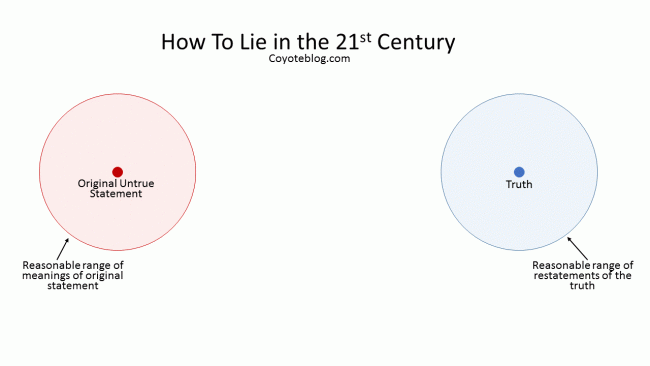
First, there must be a lie, as represented by this chart:
21st century lying

There is some underlying truth out there (shown with the blue dot), and given the squishiness of the English language at times, there are a variety of ways that truth could reasonably be restated, shown by the blue circle around it.  On the left we will assume someone has lied or made an incorrect statement about that truth, and again there is a reasonable range of meanings around that untrue statement, shown by the red circle around it.  Note that the reasonable range of meanings for the original statement do not encompass the truth.

So what happens next?  Well, one possibility is that no one calls you on the untruth.  Congratulations, you are done!  The other possibility, though, is that some crazy dude on the Internet found a cell phone video embedded in a World of Warcraft chat room that reveals you did not tell the truth.  So what now?

The thing to remember at this point is that you have two assets.  First, you presumably have supporters.  Your supporters want to believe you.  They are looking for some explanation or statement from you that is even minimally convincing, and they are ready to trumpet that explanation like it is the Word of God to the rest of the world.

Your second asset is the media.  Your original lie was maybe a week ago.  That is the Jurassic Period for the media.  They don't have the staff to track down what is happening today, much less go back over something from a week ago.

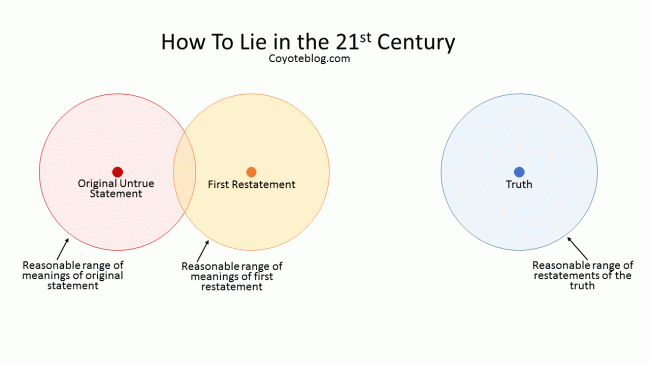
Taking these two assets in mind, you are going to restate your original untrue statement, as so in orange:
slide2

The key for this to work is to make sure the range of meanings from your original statement and the range of possible meanings from your new statement overlap.  By doing so, you haven't admitted to lying or changed your position -- you have clarified.  Cognitive dissonance in your supporters will cause their brains to immediately substitute all instances of your first statement in their memories with your new restatement.

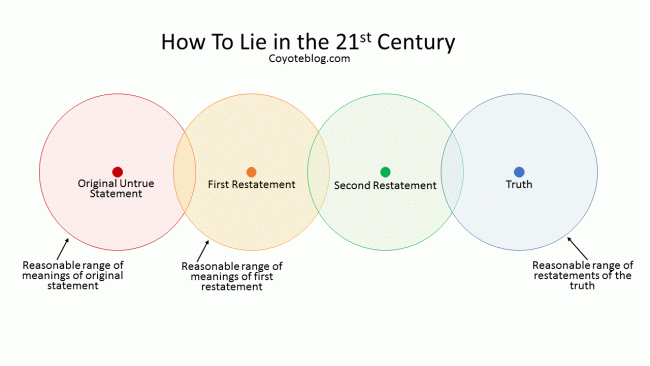
OK, but what happens when that dude in his pajamas does it again, and claims you are still lying with your new restatement.  What do you do?  Same thing as last time: another restatement.  If necessary, you will keep restating until the range of meanings of your restatement overlaps with the truth:
slide3

Yay!  You are done.  If you really want to win the news cycle, take your final restatement to Politifact and get them to rate it as mostly true.   Sure, some crazies on the other side of the aisle are going to be screaming that the ultimate truth does not at all resemble your original statement, but just claim that they are dredging up old news and that it has already been settled.  For extra points, if you are a female and/or the member of an ethnic minority, claim discrimination, saying that the opposition is driven by racism, misogyny, etc.

I think this is all clearer with an example.  So let's take the case of Philander J. Donkeyphant, who is running for reelection.  Phil decides to lie about the vehicle he was driving yesterday.  Why does he lie?  Who knows, but Phil is a successful politician and senior government official and therefore one of our betters and let's not question his tactics.   So let's see how his lie plays out:

Lie:  I drove a red car yesterday

Soon, Philander has a problem.  Some crazy lady finds a traffic camera video and proves no red car drove by that could have been Philander's.  So Phil is forced into his first restatement:

First Restatement:  I was driving a deep-red pickup truck

A bit of a stretch but we can't really call it changing his story, since many folks might refer to the family car and actually be talking about a pickup truck.  And the "deep red" comment seems downright helpful, trying to provide more detail.  But wouldn't you know it, that lady can't find any deep red pickup trucks on camera.  So Phil moves to his second restatement:

Second Restatement:  I was driving a violet truck.

Again, a bit of a stretch, but violet is not far from deep-red.  He has dropped the detail of it being a pickup truck, now it is just a truck, but still arguably consistent with his immediately previous statement.

Finally, our annoying blogger-lady finds Philander and his vehicle on a video.  It turns out:

Truth:  He was driving a purple 18-wheeler.

When shown the video, old Phil says, "Sure, that's what I said.  A violet truck.  Obviously my opposition has nothing better to do than make stupid issues like this out of nothing.  Politifact confirms that "violet truck" is a truthful way to describe a "purple 18-wheeler" so the issue is closed.

I Nominate This For Worst Idea Ever for a Movie Based on a Game

Why Scams Work

The WSJ has an interesting article about why get rich quick schemes that should be so easy to demolish, particularly with Google at our fingertips, seem to attract so many people.

The article reminded me of a piece I published years ago over at my climate site.  It was about a company called "Hydroinfra" in Sweden.  I want to reprint the article as I still find the subject to be immensely entertaining.  In particular, I really really encourage you to look at the comments section of this article linked towards the bottom and see the back and forth with reader "michael".  In the face of overwhelming skepticism from pretty much every other reader, Michael desperately wants to believe -- so much so that he and a few others start heaping derision and sinister motives (interspersed with spurious appeals to authority) on those who are trying to patiently explain the science.  One can see this same desperate behavior from those who have bought into every famous pyramid scheme ever.

I got an email today from some random Gmail account asking me to write about HyrdoInfra.  OK.  The email begins: “HydroInfra Technologies (HIT) is a Stockholm based clean tech company that has developed an innovative approach to neutralizing carbon fuel emissions from power plants and other polluting industries that burn fossil fuels.”

Does it eliminate CO2?  NOx?  Particulates?  SOx?  I actually was at the bottom of my inbox for once so I went to the site.  I went to this applications page.  Apparently, it eliminates the “toxic cocktail” of pollutants that include all the ones I mentioned plus mercury and heavy metals.  Wow!  That is some stuff.

Their key product is a process for making something they call “HyrdroAtomic Nano Gas” or HNG.  It sounds like their PR guys got Michael Crichton and JJ Abrams drunk in a brainstorming session for pseudo-scientific names.

But hold on, this is the best part.  :

Splitting water (H20) is a known science. But the energy costs to perform splitting outweigh the energy created from hydrogen when the Hydrogen is split from the water molecule H2O.

This is where mainstream science usually closes the book on the subject.

We took a different approach by postulating that we could split water in an energy efficient way to extract a high yield of Hydrogen at very low cost.

A specific low energy pulse is put into water. The water molecules line up in a certain structure and are split from the Hydrogen molecules.

The result is HNG.

HNG is packed with ‘Exotic Hydrogen’

Exotic Hydrogen is a recent scientific discovery.

HNG carries an abundance of Exotic Hydrogen and Oxygen.

On a Molecular level, HNG is a specific ratio mix of Hydrogen and Oxygen.

The unique qualities of HNG show that the placement of its’ charged electrons turns HNG into an abundant source of exotic Hydrogen.

HNG displays some very different properties from normal hydrogen.

Some basic facts:

  • HNG instantly neutralizes carbon fuel pollution emissions
  • HNG can be pressurized up to 2 bars.
  • HNG combusts at a rate of 9000 meters per second while normal Hydrogen combusts at a rate 600 meters per second.
  • Oxygen values actually increase when HNG is inserted into a diesel flame.
  • HNG acts like a vortex on fossil fuel emissions causing the flame to be pulled into the center thus concentrating the heat and combustion properties.
  • HNG is stored in canisters, arrayed around the emission outlet channels. HNG is injected into the outlets to safely & effectively clean up the burning of fossil fuels.
  • The pollution emissions are neutralized instantly & safely with no residual toxic cocktail or chemicals to manage after the HNG burning process is initiated.

Exotic Hyrdrogen!  I love it.  This is probably a component of the “red matter” in the Abrams Star Trek reboot.  Honestly, someone please tell me this a joke, a honeypot for mindless environmental activist drones.    What are the chemical reactions going on here?  If CO2 is captured, what form does it take?  How does a mixture of Hydrogen and Oxygen molecules in whatever state they are in do anything with heavy metals?  None of this is on the website.   On their “validation” page, they have big labels like “Horiba” that look like organizations thave somehow put their imprimatur on the study.  In fact, they are just names of analytical equipment makers.  It’s like putting “IBM” in big print on your climate study because you ran your model on an IBM computer.

SCAM!  Honestly, when you see an article written to attract investment that sounds sort of impressive to laymen but makes absolutely no sense to anyone who knows the smallest about of Chemistry or Physics, it is an investment scam.

But they seem to get a lot of positive press.  In my search of Google, everything in the first ten pages or so are just uncritical republication of their press releases in environmental and business blogs.   You actually have to go into the comments sections of these articles to find anyone willing to observe this is all total BS.   If you want to totally understand why the global warming debate gets nowhere, watch commenter Michael at this link desperately try to hold onto his faith in HydroInfra while people who actually know things try to explain why this makes no sense.

Years later, doing a Google search, I still seem to be the only person in the first 10 pages of Google results that wrote a skeptical article.  Seriously, I figured out this was all bullsh*t from about 60 seconds of studying their web site -- is this really what happens in tech journalism?  I got the same press release in my box that they did.  I (and many of the tech site commenters) figured this out quickly, why didn't any actual journalists?


In Defense of Profits -- Why They Are At Least As Moral as Wages

Quick background:  my company privately operates public parks, making our money solely from the entry fees voluntarily paid by visitors and campers.  We don't get paid a single dollar of tax money.

A major partner of ours is the US Forest Service (USFS), which actually operates more recreation sites than any other agency in the world (the National Park Service has a higher profile and the Corps of Engineers has more visitors, but the USFS is the most ubiquitous).  Despite the USFS being an early pioneer of using private companies to reduce the operating costs of parks and campgrounds, the USFS still has a large number of employees opposed to what we do.  The most typical statement I hear from USFS employees that summarizes this opposition -- and it is quite common to hear it -- is that "It is wrong to make a profit on public lands."

It would be hard to understate the passion with which certain USFS employees hold to this belief.   I discovered, entirely accidentally through a FOIA request my trade group had submitted to the USFS, that a Forest Supervisor in California (a fairly senior person in the USFS management structure) whom I have never met or even had a conversation with circulated emails through the agency about how evil he thought I was.

This general distaste for profit, which is seen as "dirty" in contrast to wages which are relatively "clean" (at least up to some number beyond which they are dirty again), is not limited to the USFS or even to government agencies in general, but permeates much of the public.  As a result, I thought I would describe a conversation I had with a USFS manager (actually this is the merger of two conversations).  The conversation below had been going on for a while discussing technical topics, and we will pick it up when the District Ranger makes the statement highlighted above (a District Ranger is the lowest level line officer in the USFS, responsible in some cases for the land management functions of an area the size of a county.  I have cleaned up the text (I am sure the sentences would not be as well-formed if I had a transcript) but I think this captures the gist of it:

Ranger:  I think it's wrong that you make a profit on public lands

Me:  So you work for free?

Ranger:  Huh?

Me:  If you think it's wrong to make money on public lands, I assume you must volunteer, else you too would be making money on public lands

Ranger:  No, of course I get paid.

Me:  Well, I know what I make for profit in your District, and I have a good guess what your salary probably is, and I can assure you that you make at least twice as much as me on these public lands.

Ranger:  But that is totally different.

Me:  How?

At this point I need to help the Ranger out.  He struggled to put his thoughts on this into words.  I will summarize it in the nicest possible way by saying he thought that while his wage was honorable, my profit was dishonorable, or perhaps more accurately, that his wage paid by the government was consistent with the spirit of the public lands whereas my profit was not consistent

Me:  I'm not sure why.  My profit is similar to your wage in that it is the way I get paid for my effort on this land -- efforts that are generally entirely in harmony with yours as we are both trying to serve visitors and protect the natural resources here.    But unlike your wage, my profit is also a return on the investment I have made.  Every truck, uniform, and tool we use comes out of my profit, whereas you get all the tools you need paid for by your employer above and beyond your salary.  Further, your salary is virtually guaranteed to you, short of some staggering malfeasance.  Even if you do a bad job you likely would just get shunted to a less interesting staff position at the same salary, rather than fired.   On the other hand if I do a bad job, or if one of my employees slips up, or even if some absolutely random occurrence entirely outside my control occurs (like, say, a flood that closes our operations) my profit can completely evaporate, or even turn into a loss.  So like you, I get paid for my efforts here on public lands, but I have to take risk and make investments that aren't required of you.  So what about that makes my profit less honorable than your wage?

Ranger:  Working on public lands should be a public service, not for profit

Me:  Well, I think you are starting to make the argument again that you should be volunteering and not taking a salary.  But leaving that aside, why is profit inconsistent with service to the public?  My company serves over 2 million visitors a year, and 99.9% give us the highest marks for our service.  And for the few that don't, and complain about a bad experience, every one of those complaints comes to my desk and I personally investigate them.  Do you do the same?

Why do I make such an effort?  Part of it is pride, but part is because I understand that my margins are so narrow, if even 5% of those visitors don't come back next year -- because they had a bad time or they saw a bad review online -- I will make no money.  Those 2 million people vote with their feet every year on whether they think I am adequately serving the public, and their votes directly affect how much money I make.  Do you have that sort of accountability for your public service?

Postscript:  Interestingly, though perhaps not surprisingly, the government ranger did not bring up what I would consider the most hard-hitting challenge:  How do we know your profits are not just the rents from a corrupt, cronyist government contracting process.  Two things let me sleep well at night on this question.  The first is that I know what lobbying I do and political connections I have (zero on both) so I am fully confident I can't be benefiting from cronyism in the competitive bid process for these concession contracts.  Of course, you don't know that and if our positions were reversed, I am pretty sure I would be skeptical of you.

So the other fact I have in my favor, which is provable to all, is that the recreation areas we operate are run with far lower costs and a demonstrably higher level of service than the vast majority of recreation areas run by the government itself.  So while I can't prove I didn't pull some insider connections to get the work, I can prove the public is far better off with the operation of these parks in private hands.

The Problem With Parsing Feedback From Customers

We have a number of ways to collect customer feedback and I ensure that any negative score or comment we get from any source comes right to my email box so I can investigate personally.  We don't get that many negative comments, perhaps a couple a month (which is pretty good with over 2 million visitors last year).  The most common negative comment is something like "your employee was very rude to me."

This comment is a good illustration of how it can be hard to parse customer comments.  Because from my experience, the comment "your employee was rude to me" tends to mean one of two very different things:

  1. My employees were actually rude to the customer, requiring an immediate intervention on my part
  2. My employees were as patient and polite as can be expected, but were giving the customer an answer the customer did not want to hear (e.g. "you can't park on the grass, I need you to move your car.")

This year, I would say explanation #2 is in the lead by about 70%-30% over explanation 1.  As an operator of a public campground, we must enforce the rules set by the public agency.  We frequently encounter customers who simply do not like the rules and therefore consider the existence of the rules to be a violent aggression against them.  A great example is food storage.  In areas of high bear activity, it is important that customer properly store their food so as not to attract bears to the campground -- campers in these areas are given literature about food storage and our hosts come by to explain the rules and answer questions.  But there are folks who simply won't comply, and these folks frequently complain to me that my people are being rude.

Postscript: As an added bonus, I will give you one example of why businesses often tear their hair out over online reviews.  A year or so ago we got a Yelp review at a lakefront campground saying that the customer had been "lied to" because she was not allowed to use her jetskis in the lake.  I was surprised at this, since the no jetski rule is set in stone by our government partner and I thought we had made it pretty clear on the web site.  So I contacted the customer asking what we had done to mislead her.  She said that her dad promised her that she could jetski and we wouldn't let her so that is why she said we lied.   There are times in life when you just have to move on, and this seemed like one of them, so once I assured myself there was nothing we could do to correct errors in our web sites, I said "thanks for the feedback" and hung up.

Your Good Intentions Mean Virtually Nothing

I am exhausted with folks, particularly on the Progressive Left, judging themselves and each other based on their intentions.  Your intentions mean virtually nothing.  I suppose it is better to have good intentions than bad, but beyond that results, particularly in the public policy arena, are what should matter.  And the results of most Progressive well-intentioned legislation are generally terrible.  For example, as I wrote earlier today, poverty in this country is mainly caused by lack of work rather than low wage hours, but Progressives preen over their good intentions in introducing higher and higher minimum wages that will only serve to reduce the work hours of low-skilled poor people.

Via Mark Perry comes this great article on Progressive good intentions in Seattle collapsing into rubble.  It does not except well, so I recommend you check it out, but I will summarize it.

Begin with a libertarian goal that should be agreeable to most Progressives -- people should be able to live the way they wish.  Add a classic Progressive goal -- we need more low income housing.  Throw in a favored Progressive lifestyle -- we want to live in high density urban settings without owning a car.

From this is born the great idea of micro-housing, or one room apartments averaging less than 150 square feet.  For young folks, they are nicer versions of the dorms they just left at college, with their own bathroom and kitchenette.

Ahh, but then throw in a number of other concerns of the Progressive Left, as administered by a city government in Seattle dominated by the Progressive Left.  We don't want these poor people exploited!  So we need to set minimum standards for the size and amenities of apartments.  We need to make sure they are safe!  So they must go through extensive design reviews.  We need to respect the community!  So existing residents are given the ability to comment or even veto projects.  We can't trust these evil corporations building these things on their own!  So all new construction is subject to planning and zoning.  But we still need to keep rents low!  So maximum rents are set at a number below what can be obtained, particularly given all these other new rules.

As a result, new micro-housing development has come to a halt.  A Progressive lifestyle achieving Progressive goals is killed by Progressive regulatory concerns and fears of exploitation.  How about those good intentions, where did they get you?

The moral of this story comes back to the very first item I listed, that people should be able to live the way they wish.  Progressives feel like they believe this, but in practice they don't.  They don't trust individuals to make decisions for themselves, because their core philosophy is dominated by the concept of exploitation of the powerless by the powerful, which in a free society means that they view individuals as idiotic, weak-willed suckers who are easily led to their own doom by the first clever corporation that comes along.

Postscript:  Here is a general lesson for on housing affordability:  If you give existing homeowners and residents the right (through the political process, through zoning, through community standards) to control how other people use their property, they are always, always, always going to oppose those other people doing anything new with that property.  If you destroy property rights in favor of some sort of quasi-communal ownership, as is in the case in San Francisco, you don't get some beautiful utopia -- you get stasis.  You don't get progressive experimentation, you get absolute conservatism (little c).  You get the world frozen in stone, except for prices that continue to rise as no new housing is built.  Which interestingly, is a theme of one of my first posts over a decade ago when I wrote that Progressives Don't Like Capitalism Because They Are Too Conservative.

Postscript #2:  So, following the logic above, one can think of building restrictions and zoning as a form of cronyism.  Classic cronyism is providing subsidies to politically favored companies and restricting the ability of new competitors to arise to compete with them, granting them an effective monopoly and the ability to jack up their prices.  So what do we do with housing?  We give massive subsidies to home-owners and restrict competition from new housing that might reduce their home value, thus granting current homeowners an effective monopoly and the ability to jack up their prices.  I challenge anyone to tell me that rising home prices in Palo Alto are not driven by the exact same government actions for favored constituents as are rising prices for Epipens.

Postscript #3:  I will ask a question using Progressive terminology -- you were worried about these young renters and their power imbalance vs. development companies and landlords.  So how much more powerful are they now with a thousand fewer rental units on the market?  Consumers have power when supply is plentiful.  Anything done to reduce supply is going to reduce consumer power.

Interesting Timing

This last Sunday, September 11, on the same day Hillary Clinton's staff were struggling to erase concerns that Hilary was in poor health after her collapse in New York, PBS Masterpiece aired a nice little movie called "Churchill's Secret".  I recorded it but did not watch it last night, so only yesterday saw the connection:  the movie was about a major stroke Churchill suffered circa 1953, in the midst of his second stint as Prime Minister of the UK.   One subplot, and the reason for the title, was of Churchill's political staff working like crazy to (successfully) hide Churchill's stroke and incapacity from everyone -- media, the public, his own party.  I wonder if PBS, likely Clinton supporters to a person, regrets the timing?

Why the Minimum Wage is A Bad Anti-Poverty Policy in One Chart

This is a regular chart used by Mark Perry, updated for the most recent data.  It is one of my favorites.

click to enlarge

Mark has a lot of great analysis of this data, too long to excerpt, so I refer you back to the link to see his comments.  But I want to add one of my own.

Let me restate the numbers in this chart one other way to give a pretty stark view of utility of raising the minimum wage as a poverty program. Let's look at the first lowest vs. the second lowest quintile.

Raising current workers in the poorest quintile to second quintile earnings ($28,970 to $35,858) would increase the first quintile's average income by $2,962. On the other hand, keeping first income wages flat but raising first quintile household's average earners to second quintile number of earners (0.43 to 0.91) increases the first quintile's average income by $13,905.

By this analysis, increasing first quintile hours worked (and % employment) has 4.7 times more leverage than fiddling with wage rates.

So now consider raising the minimum wage, which will raise some wages but reduce unskilled employment -- it is exactly the wrong thing to do, even before we consider that the majority of minimum wage earners who benefit from such an increase and keep their jobs are not in the lowest quintile but are 2nd and third earners in rich and middle class households.

Remember When I Said It Was All About the Mix?