Things That Are Below Average
Having the A/C fail when it is 115F outside.
The good news is that it is only 92 in my bedroom. Oh, and its a dry heat.
Update: The candy bars in my pantry are all melted.
Dispatches from District 48
Having the A/C fail when it is 115F outside.
The good news is that it is only 92 in my bedroom. Oh, and its a dry heat.
Update: The candy bars in my pantry are all melted.
Sometimes one molecule of active ingredient diluted into the entire volume of the world's oceans still isn't enough of a pick-me-up on a Friday afternoon. So I leave you with this, via John Stoessel:
Anyone want to bet that things like homeopathy will get included in the government's "must cover" rules under the new health proposal?
Previously, I used 1970s gas price lines as an example of a situation where the government, as Uwe Reinhardt puts it, "reduce[d] rationing on the basis of price and ability to pay."
Here is another example: The Pruitt Igoe housing project in St. Louis, which was abused so badly by its occupants it had to be torn down less than 20 years after it was built.
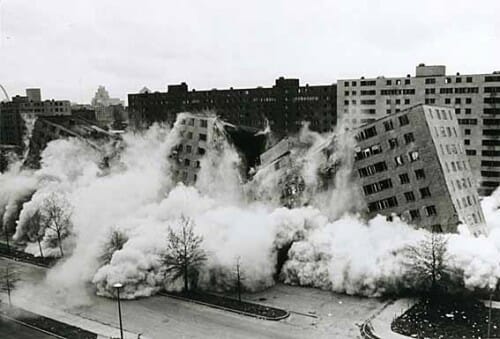
I will remind you of my earlier comparison of universal health care to public housing:
Lyndon Johnson wants to embark on a futile attempt to try to provide public housing to the poor? Our taxes go up, a lot of really bad housing is built, but at least my housing did not get any worse. Ditto food programs "” the poor might get some moldy cheese from a warehouse, but my food did not get worse. Ditto welfare. Ditto social security, unemployment insurance,and work programs.
But health care is different. The author above is probably correct that some crappy level of terribly run state health care will probably be an improvement for some of the poor. But what is different about many of the health care proposals on the table is that everyone, not just the poor, will get this same crappy level of treatment. It would be like a public housing program where everyone's house is torn down and every single person must move into public housing. That is universal state-run health care. Ten percent of America gets pulled up, 90% of America gets pulled down, possibly way down.
It is not at all surprising that an Ivy League University professor does not recognize a difference between rationing by individual choice based on price signals and rationing based on government mandate. What is surprising to me is that I remember this particular professor, Uwe Reinhardt, as the only person who would ever take the free market side of campus debates. Kind of depressing. I guess he must have seemed free market just by contrast, or else he has evolved a bit. Is it ironic to anyone else that radicalism of the 1960s, which purported to be based on individualism and freedom, has led to campuses where it is normal not to even consider individual liberty as part of a public policy equation? It just reinforced my sense that no one really wants to get rid of "the man," they just want to be "the man" themselves.
In particular he writes:
As I read it, the main thrust of the health care reforms espoused by President Obama and his allies in Congress is first of all to reduce rationing on the basis of price and ability to pay in our health system
We actually have plenty of examples of the government ending rationing by price and ability to pay. Gas price controls in the 1970s are one very good example. Anyone remember the result?

Or more recently in China, where gas prices were controlled well below world market levels:

We substituted gas rationing by willingness to pay the posted price with gas price rationing by ability to waste four hours of one's day sitting in lines. (I had never thought of this before, but there must be some interesting economic implications of preferentially routing fuel to those least likely to have a full-time job).
Perhaps worse, Reinhardt equates criticism of the current health care system ( and particularly its productivity) with support for socialization of the system. Really? There are perfectly valid free market reasons to criticize health care, where any number of government policy decisions over the years have disrupted the efficacy of price signals and created terrible incentives.
More here from Doug Bandow of Cato
Postscript: Farther left? Further left? Sorry, I try, but your scribe is an engineer at heart and sometimes struggles with the native tongue. When I was in fourth grade, I remember doing a battery of achievement tests, and getting 99+ percentile scores on every test but spelling, where I got something like a 25th percentile. I think this score put me down mostly with kids for whom English is a second language (or maybe even worse, with Russian kids for whom ours is a second alphabet). Only technology in the form of spell-checkers has bailed me out of my personal handicap.
From Walter Olson, on the House health care bill:
Contacts on Capitol Hill inform me that Republicans yesterday managed to block a remarkable provision that had been slipped into the House leadership's 794-page health care bill just before it went to a House Ways & Means markup session. If their description of the provision is accurate "†and my initial reading of the language gives me no reason to think it isn't "†it sounds as if they managed to (for the moment) hold off one of the more audacious and far-reaching trial lawyer power grabs seen on Capitol Hill in a while.
For some time now the federal government has been intensifying its pursuit of what are sometimes known as "Medicare liens" against third party defendants (more)....
The newly added language in the Thursday morning version of the health bill (for those following along, it's Section 1620 on pp. 713-721) would greatly expand the scope of these suits against third parties, while doing something entirely new: allow freelance lawyers to file them on behalf of the government "†without asking permission "†and collect rich bounties if they manage thereby to extract money from the defendants. Lawyers will recognize this as a qui tam procedure, of the sort that has led to a growing body of litigation filed by freelance bounty-hunters against universities, defense contractors and others alleged to have overcharged the government.
It gets worse. Language on p. 714 of the bill would permit the lawyers to file at least some sorts of Medicare recovery actions based on "any relevant evidence, including but not limited to relevant statistical or epidemiological evidence, or by other similarly reliable means". This reads very much as if an attempt is being made to lay the groundwork for claims against new classes of defendants who might not be proved liable in an individual case but are responsible in a "statistical" sense. The best known such controversies are over whether suppliers of products such as alcohol, calorie-laden foods, or guns should be compelled to pay compensation for society-wide patterns of illness or injury.
He has a lot more detail. Ask anyone in a public contact business in California how similar laws for ADA violations have worked out. Just one more horrible, failed law from California that has driven the state into the ground now being emulated at the national level.
From the House health care bill:
"There shall be no administrative or judicial review of a payment rate or methodology established under this section or any other section."
Julius Shulman, creator of perhaps my single favorite urban photo, has died at the age of 98. I like the black and white version linked above better than the color, which I confess I had never seen before.
Female migrants should on average be prettier, ceteris paribus, than those who stay in the old country.
A new stadium for a professional sports team is going to be built without public money. At least, that is, without any money from governments of the United States. It will be built and owned by the Pima-Maricopa Indian Community, agruably a nation unto itself.
Normally, if I were to contemplate resorting to bribery to change someone's decision, I would have to face two hurdles. First, of course, I would face legal consequences because in many contexts., bribery is illegal. Second, I would have to consider the cost -- is the price being demanded worth it. After all, it makes little sense to spend a million dollars to bribe someone to make a decision worth a hundred thousand dollars to me.
But, unfortunately, neither of these problems exist when Congressional leadership seeks to bribe recalcitrant lawmakers to vote their way. Bribery in this context is not illegal, its just "horsetrading." And the cost is meaningless, because folks like Nancy Pelosi do not bear the cost of the bribe, taxpayers do.
It is totally clear to me that Obama and Pelosi will spend any amount of money to pass their key legislative initiatives. In the case of Waxman-Markey, the marginal price per vote turned out to be about $3.5 billion. But they didn't even blink at paying this. That is why I fear that some horrible form of health care "reform" may actually pass. If it does, the marginal cost per vote may be higher, but I don't think our leaders care.
Waaaay back, before the stimulus was even passed, I did an analysis of the proposed spending in 2009-2010 and said that very little of it was for the infrastructure type projects that were being promised. I concluded:
The reason so much of this infrastructure bill can be spent in the next two years is that there is no infrastructure in it, at least in the first two years! 42% of the deficit impact in 2009/2010 is tax cuts, another 44% is in transfer payments to individuals and state governments. 1% is defense. At least 5% seems to be just pumping up a number of budgets with no infrastructure impact (such as at Homeland Security). And at most 6% is infrastructure and green energy. I say at most because it is unclear if this stuff is really incremental, and much of this budget may be for planners and government departments rather than actual facilities on the ground.
So don't call this an infrastructure bill. This is a tax cut and welfare bill, at least in 2010 and 2011.
Via the Atlantic (hat tip to TJIC) we get a GAO report that comes to the same conclusions (they leave out the tax cut part and look at only the spending side):
But most federal stimulus funds aren't necessarily being spent to create $250K jobs out of thin air -- they're being spent to plug in the ongoing decay in state budgets. That was the conclusion of the GAO report early this month. Here's a graph they provided breaking down stimulus spending by program:
Of the $29 billion spent this year, 90 percent has gone to assist Medicaid and to stabilize tottering state budgets, according to the report. That's not just job creation -- that's emergency rescue, a fiscal crutch propping up our humpback deficit-ridden states. So what exactly is the logic in kicking the crutch away? If you see an old man with a cane who's barely managing to place one foot in front of the other, the logical commentary seems to me to be "Thank God for that crutch," not "Well obviously that crutch isn't doing much for him, he probably won't mind if I borrow it for a while."
But we're talking about job creation, so let's take a look at shovel-ready, highway spending, which the GAO puts at 6 percent of the spent stimulus. I suppose this would be a good place to knock the administration for not spending fast enough to create construction jobs, but Conor Clarke notes here (with a chart, of course), highway spending is actually ahead of schedule is all 16 states the GAO studied for the report.
Only $29 billion spent so far? Can we please just stop it now before the other $700 billion or so get spent? Why are we planning spending in 2015 to prop up the 2009 economy?
I generally don't do horserace style political blogging on strategy between the Coke and Pepsi parties, and I am not going to start now. However, I did find it funny that it was Mike Huckabee threatening Sarah Palin that she should not leave the GOP. It's funny to me because of all the things the GOP could do to potentially attract me to the party, having Mike Huckabee leave the party would be close to first on the list.
Apparently in the future I will have two health plan choices -- my current plan or the government plan. And the only reason I will be able to keep my current plan is that is will be grandfathered in. A few years ago I switched plans, to get one with a better price and mix of benefits for my family. I will never be allowed to do this again under the new health care bill:
It didn't take long to run into an "uh-oh" moment when reading the House's "health care for all Americans" bill. Right there on Page 16 is a provision making individual private medical insurance illegal.
When we first saw the paragraph Tuesday, just after the 1,018-page document was released, we thought we surely must be misreading it. So we sought help from the House Ways and Means Committee.
It turns out we were right: The provision would indeed outlaw individual private coverage. Under the Orwellian header of "Protecting The Choice To Keep Current Coverage," the "Limitation On New Enrollment" section of the bill clearly states:
"Except as provided in this paragraph, the individual health insurance issuer offering such coverage does not enroll any individual in such coverage if the first effective date of coverage is on or after the first day" of the year the legislation becomes law.
So we can all keep our coverage, just as promised "” with, of course, exceptions: Those who currently have private individual coverage won't be able to change it. Nor will those who leave a company to work for themselves be free to buy individual plans from private carriers....
Wow, even for this cynical libertarian, this is a new low of technically complying with a promise while in substance completely violating the spirit of that promise.
By the way, how long will my current insurer even be able to offer me my plan given that it cannot generate any new business (I use Assurant, who specializes in individual policies for self-employed people like myself).
This is a great example of what I have been saying all along - regulation always helps large companies more than small. Everything in this legislation is tailor-made to help large companies who already have health plans and pound small companies and the self-employed. This is in part because the large companies have the lobbying muscle to get themselves a seat at the table as the bill is crafted. But it is more than just neglect, it is an outright attack. Large companies most fear competition from smaller, lower cost competitors. Anything to make the life of small business more expensive and difficult helps cement the big guys market position.
Update: Here is a scary thought -- what will it do to entrepeneurship in this country when a decision to leave a large company and go into business for oneself bascially means giving up private health insurance and going on Medicare?
Update #2: For readers, as well as a place for me to find it in the future, here is a link to all 1000+ pages of the bill. Enjoy.
Let's put another tax on employment, making it more costly for companies to hire people. That's the ticket out of the recession!
Employers who do not provide health insurance to workers would generally have to pay a fee or penalty to the government. The fee would be equal to 8 percent of wages for an employer with an annual payroll of more than $400,000.
Disclosure: This has a personal impact on me and my business. Wages in our company are 50% of revenues, we earn a 6-8% profit as a percentage of sales, and this will increase our wages by 8%. You do the math. The good news, I guess, is that this will gaurantee that I will not be subject to the new surcharge on high incomes.
Jonathon Adler argues that Senator Feinstein grossly exaggerated the number of cases where the Supreme Court said the Congress had exceeded the bounds of the commerce clause. Feinstein said it was dozens of times in the last 10 years, Adler counts about two. I don't have my own count, but smaller numbers seem right to me -- just look at the extent of activities Congress currently pursues under the banner of the Commerce Clause. For god sakes, several years ago the Supreme Court ruled that federal marijuana laws trumped state laws based on the commerce clause -- even when the drugs are grown for personal use and don't cross state lines. As Clarence Thomas wrote in that case in dissent:
Respondents Diane Monson and Angel Raich use marijuana that has never been bought or sold, that has never crossed state lines, and that has had no demonstrable effect on the national market for marijuana. If Congress can regulate this under the Commerce Clause, then it can regulate virtually anything and the Federal Government is no longer one of limited and enumerated powers.
But what I found really depressing in Adler's post was this:
Adding up all of the cases in which the Court found statutes exceeded all of the federal government's enumerated powers, including the sovereign immunity cases, the commandeering cases, and the 14th Amendment cases, in the last twenty years still doesn't get us to the three-dozen-plus cases Feinstein claimed. Add in the federalism-related constitutional avoidance cases, and we're still a ways off.
Given all the expansions of federal and Executive power over the last 10 years, and the hundreds of cases in front of the Supreme Court, the Court has not been able to rouse itself more than a handful of times to declare that the feds have exceeded their powers under the Constitution? Bummer.
Believe it or not, I am actually in Washington DC. I am on the executive committee of our little industry's trade group, and as such it is expected that once a year we venture to DC to talk to Senate and House staffers about what legislation is pending that may affect our business. I won't call this "lobbying" as that word implies we have any influence over outcomes. It is more of a grim due dilligence to see what we are going to have to try to deal with next.
As this activity has roughly the same appeal for me as being dragged naked by a truck down the Interstate, I have avoided this task for years. I finally relented to my duty, and here I am.
For those too young to remember, during the 1980's we endured a hysteria about child molestations, with a number of pretty obviously innocent men dragged to jail on the back of testimony coerced from kids by over-zealous prosecutors. Janet Reno became particularly famous for the "Miami method" of hounding kids until they started pointing fingers at whomever the prosecutors had their eye on, and rode such fame to the US AG office (see here and here for the disturbing details).
As the kids grow up, a number of these prosecutions are finally falling apart, as in this story. Of course, as i9s typical in such cases, despite all the witnesses coming forward and admitting they were coerced into making false accusations, the prosecutors are not giving up easily. via Overlawyered
The Waxman-Markey Bill is pretty bad, but it could have been a lot worse:
The citizen suit provision was set forth in Section 336 of the discussion draft version of ACES [Waxman-Markey], and it would have given environmental groups and other activists standing under the Clean Air Act to "commence an action" when someone has "suffered, or reasonably expects to suffer, a harm attributable, in whole or in part, to a violation or failure to act referred to in subsection (a)." Harm under this section was defined as: "For purposes of this section, the term "˜harm' includes any effect of air pollution (including climate change), currently occurring or at risk of occurring, and the incremental exacerbation of any such effect or risk that is associated with a small incremental emission of any air pollutant (including any greenhouse gas defined in Title VII), whether or not the risk is widely shared."
Wow, would this create an absolute litigation circus or what? By current anthropogenic greenhouse gas theory and under the actual text above, one could get sued for breathing. (via Overlawyered)
People often think of the minimum wage as a restriction on employers "” that they cannot pay less than a certain number for a job. But it is also equally a restriction on job seekers "” my son cannot legally offer to take a job for less than $7.25, even though he would probably gladly do so. For teenagers, just gaining the experience of working and building basic skills (like showing up on time, following procedures, interacting with customers and fellow employees) has enormous value, such that even a nominal payment of a few dollars an hour would more than compensate him for his labor.
Ann Althouse has found the Fair Labor Standards Act (FLSA), which contains the minimum wage, also can lead to restrictions on employee behavior:
Everyone at The University of Wisconsin will have their pay cut by about 3% and will be "furloughed""”told they do not have to work"”for a corresponding period of time. But it turns out that we not only don't have to work, we are being told we cannot work. The guidelines ban any kind of work during furloughs, anywhere. This means that even if you are at home you are not supposed to read professional material, get and send emails, make calls, use a smart phone, etc. Employees who violate the work ban can be disciplined.
She goes on to describe her voyage of discovery as to why so irrational-sounding a policy might exist, but I alredy knew. To furlough exempt (meaning exempt from hourly bookkeeping) workers, they must become non-exempt. And non-exempt workers have to be paid for time worked, even if the time worked was not ordered by the employer and even if the time worked was against the wishes of the employer.
We face this situation all the time. We have hourly workers in campgrounds. Unlike in a factory (for which the FLSA was written and where there are fairly strict controls on how people work), my campground workers have a lot of leeway to set their own schedule and determine their work patterns. But I have to set very clear guidelines - "at the end of the day you have to get x and y and z done and you are not authorized to work more than t hours doing it."
But we nearly always have folks who want to go do whatever they want to do. I had an employee who loved to arrange river rocks around camp sites as borders after he had finished his other work. His work looked really nice. But I could not afford to pay him to arrange river rocks around camp sites. His manager told him to stop. He kept doing it. You know what? I still had to pay him for his time to arrange river rocks, despite the fact the company had specifically told him not to and despite the fact that this time exceeded the guidelines I gave him (once his work exceeds X hours, he has to get management permission to work more in a certain time period). In fact, the only way I eventually was able to stop paying him to arrange river rocks at work was to fire him.
The other day, there was an intriguing story in the USA Today that a disproportionate share of stimulus money is flowing to counties that voted for Obama. In fact, counties that voted Obama are getting twice as much per capita so far as counties that did not. Matt Yglesias writes:
The insinuation of the piece is that the stimulus bill's funding streams are being artfully manipulated or something to disproportionately direct resources toward Obama-loving constituencies....[But] the secret to the riddle seems to be that areas that benefit from federal spending formulae tend to support the Democrats. Not as a result of short-term fluctuations in voting patterns or federal spending levels, but as a structural element of American politics.
Kevin Drum misses Matt's point, I think, when he responds:
Actually, that's not quite right. It's weirder than that. I just got around to reading the piece, and aside from the factual statement in the lead, it doesn't insinuate that the money is being unfairly distributed. In fact, every single paragraph after the lead quotes people saying that there's nothing dubious going on and the money is just being distributed by formula. The piece doesn't quote a single person, not even Sarah Palin, suggesting that there's any monkey business going on here.
But this does not refute Matt's point as I understand it, that "tinkering" is not necessary because the formulas themselves have been worked over time to preferentially send money certain places. I would use the analogy that there are well worn channels where the money preferentially flows.
I must disagree that a story that money tends to flow preferentially (on a ratio as high as 2:1) to Democratic districts should be spiked, as Kevin Drum advocates. I think there is a story in this, though certainly I agree with Kevin it is not the story the author set out to write (one of micro-manipulation by Administration employees).
My sense is that the causality involved would be impossible to discover. Does money flow preferentially to these districts because Democrats are better or more focused on bringing home the taxpayer largess to their districts? Or does our money preferentially flow to these districts based on, say, economic or demographic factors that line up well with Democratic constituencies. Or is it, more likely in my mind, a virtuous circle with both factors involved.
Either way, this is an interesting story and some interesting new data in our endless red state-blue state analyses.
My son is at the age in high school that he needs to find a job, either during the summer or after school or both. But this is not an easy chore. The economy certainly has a lot to do with this, but Congress has been doing its share to keep teenagers unemployed as well:
Thanks to an ill-advised law enacted with bipartisan support in 2007, the cost of providing an entry-level job to individuals with few skills or minimal experience will be going up by more than 10 percent. Those who cannot find a job paying at least $7.25 an hour will not be permitted to work. Welcome to the latest chapter of America's minimum-wage folly.
Those who press for a higher minimum wage often claim that making entry-level jobs more expensive won't reduce the number of entry-level jobs. Were the government to compel a 41 percent increase (see graph above showing the 41% increase in the minimum wage from $5.15 in 2006 to $7.25 this year) in the price of gasoline or movie tickets or steel, every rational observer would expect a drop in the demand for gasoline, movie tickets, or steel. Yet when it comes to the minimum wage, politicians and journalists somehow persuade themselves that making workers more expensive won't reduce the demand for workers.
But that's exactly what it does. Artificial price floors - mandatory minimum prices set higher than what the market will bear - generate surpluses. Minimum-wage laws are no exception. The price floor imposed by the government on the supply of low-skilled labor results in a labor surplus, which is just another way of saying higher unemployment.
The laws of supply and demand are not optional. They weren't enacted by Congress and Congress can't override them. Minimum-wage laws don't make low- and unskilled Americans more productive, more experienced, or more desirable. They merely make them more expensive - and more likely, therefore, to be unemployed.
People often think of the minimum wage as a restriction on employers -- that they cannot pay less than a certain number for a job. But it is also equally a restriction on job seekers -- my son cannot legally offer to take a job for less than $7.25, even though he would probably gladly do so. For teenagers, just gaining the experience of working and building basic skills (like showing up on time, following procedures, interacting with customers and fellow employees) has enormous value, such that even a nominal payment of a few dollars an hour would more than compensate him for his labor.
But I think there is another factor that increasingly limits teenage jobs that is not often discussed - liability. I never really thought about this until I was running a business and found that my company and I may be personally liable for bone-headed decisions made by far off employees I have never met. In our super-ligious society, does a company really want 15-year-old boys interacting with the public, no matter how much or little they are paid, when even one teenage-boy-style flip comment or sexual joke might result in a lawsuit?
Previously, I have written a number of articles on the minimum wage focused on the other end of the age scale. My company hires folks in the seventies and eighties, a practice that is increasingly difficult to maintain with the minimum wage increasing.
GM is apparently emerging from bankruptcy. It will have the same (though fewer) managers, employees, and assembly plants. It will have the same product designers, marketers, strategists, and planners. It will have roughly the same organization systems, the same culture, and the same history. Though it was able to shed some plants and employees, it will have most of the same stifling work rules on the shop floor. It did, however, manage to shed a lot of interest payments to creditors who entrusted their money to GM in return for claims on GM assets, only to be given the shaft by the Obama administration,
The main difference in the new GM is that it will have an ownership group whose primary concerns are NOT the financial success of the company. The UAW will be primarily concerned with keeping union members employed and happy and not shifting any manufacturing to lower-cost venues. The US Government will be primarily concerned with making sure the UAW is happy and promoting a number of its own goals, like "sustainable" plants and smaller cars, irrespective of whether these goals make business sense. It will be a company more concerned with whether plants have recycling programs and workers with American passports rather than cost or quality. Both the UAW and the US government can pursue such non-business goals secure in the knowledge that financial success is virtually irrelevant, as the US taxpayer can be counted on to make up any shortfalls.
I predicted the climate bill would likely pass the House as Obama and Co. would happily pull out the checkbook to spend taxpayer money to bribe Representatives to pass his legislative agenda. I wrote:
I am again hearing rumblings that the climate bill may pass the House. If so, it will be interesting to see what last minute bribes were added to make this happen. The most recent bribe we know about is the commitment to pay farmers not to grow crops with the weak window dressing that this is somehow a carbon offset.
The Washington Times reports on one such payoff:
When House Democratic leaders were rounding up votes Friday for the massive climate-change bill, they paid special attention to their colleagues from Ohio who remained stubbornly undecided.
They finally secured the vote of one Ohioan, veteran Democratic Rep. Marcy Kaptur of Toledo, the old-fashioned way. They gave her what she wanted "“ a new federal power authority, similar to Washington state's Bonneville Power Administration, stocked with up to $3.5 billion in taxpayer money available for lending to renewable energy and economic development projects in Ohio and other Midwestern states.
This is part of that mysterious 310-page ammendment that was revealed just hours before the vote.
Libertarians can be reasonable. We can support some regulation, when it is absolutely necesary. Like this idea, via Sallie James at Cato:
James Gibney, a reporter from the Atlantic, called me last week to ask some questions about dairy supports. He was preparing a blog post to propose a new labelling idea that might help break the frustrating stranglehold that the farm lobby has over U.S. agricultural policy. Here's James' idea:
To wit, every product whose ingredients benefit from a subsidy should include the following language on the label:
"This product has been subsidized by the U.S. government at taxpayer expense. For more information, please visit usda.gov."
And every product that benefits from tariff protection should have the following language on the label:
"This product is protected from foreign competition by U.S. import tariffs. Its price is higher as a result. For more information, please visit usitc.gov."
Several new drugs have reversed my mom's macular degeneration, and are such a wonder that she is even willing to tolerate frequent injections into her eyeball, a concept that gives the rest of our family the willies. Forget about it in England, though, where National Institute for Health and Clinical Excellence (NICE), which Obama wants to emulate in the US, does not allow these drugs:
3. In 2007, NICE restricted access to two drugs for macular degeneration, a cause of blindness. The drug Macugen was blocked outright. The other, Lucentis, was limited to a particular category of individuals with the disease, restricting it to about one in five sufferers. Even then, the drug was only approved for use in one eye, meaning those lucky enough to get it would still go blind in the other.
And by the way, is NICE an Orwellian name or what?
Postscript: Fortunately, we are unlikely to have a system that bans Americans from spending their own money on things the plan will not buy (a bit of socialist egalitarianism that is practiced in a number of European countries). Not for lack of trying by many Democrats, however.