Posts tagged ‘Higher Education’

The Middle Class is Shrinking -- And That's a Good Thing

An important goal of Marxist thought is the proletarianization of the middle class -- to convince great numbers of people in the office worker and shopkeeper classes that they are not beneficiaries of a rising tide of success but are no better than coal shovelers in a boiler room, victims of capitalist oppression that need to join the revolution. It is impossible to view the recent mayoral election in NYC as anything but a sign of their success.  People in NYC wail about how dehumanizing it is to sit in an office for 8 hours a day.

Socialists have been brilliantly successful at creating bad outcomes via institutions they control or policies they promote, and then blaming those bad outcomes on capitalism.  Probably the most brilliant success has been the shittification of higher education.  Socialist-controlled universities create sky-high expectations for their degrees, and reinforce these expectations with rampant grade inflation that makes every student feel like a success -- even when they do almost no work.  Academics on the Left route students into degrees and classes with absolutely no economic value (e.g. Paraguayan Feminist Poetry) and then dump them into the world -- after loading them down with $250,000 or more of debt -- with no possible path to reaching the promised expectations or even paying off the debt.  And when all this inevitably fails, the academic apparatchiks who live high on tuition money are quick to blame the failure on "capitalism."  And since these schools no longer teach students much about reasoned engagement with difficult and complex ideas -- and in fact encourage emotional reasoning, virtue-signaling, and just wailing in anger on TikTok over logical argument -- voters respond that "yeah, it must be capitalism's fault."

Anyway, in the context of all the turgid articles about the shrinking of the middle class and the failures of capitalism for the middle class, consider this which is all in 2024 $ (source):
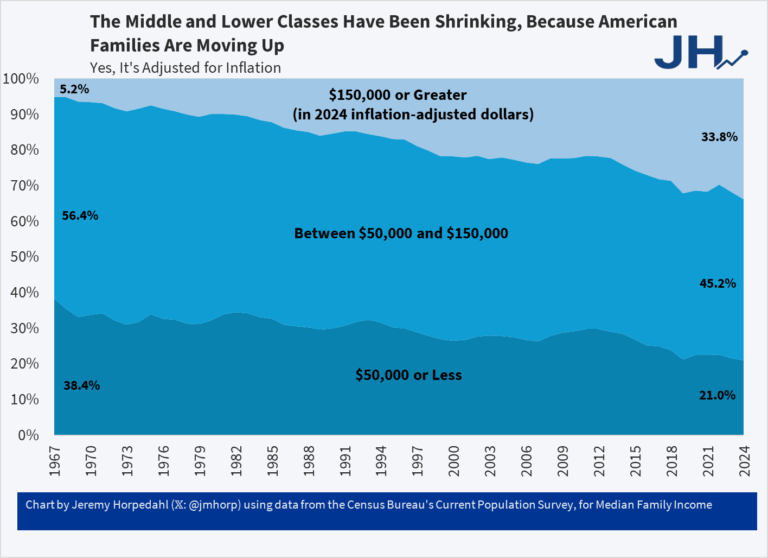
Yes the middle class is shrinking -- because people in it are becoming richer.  They are not (on average, certainly there are individuals who go up and down) getting poorer because the poorest band on this chart is shrinking even faster than the middle class.  This is an enormous freaking victory for most everyone, but yet we are electing radical communists to tear down capitalism.  Incredible.

Postscript:  About a dozen years ago when my son was looking at colleges, like many parents I sat in a number of college admissions department presentations about the school.  All these presentations were remarkably similar -- my kids and I started calling them the "how we are unique in the exact same ways every other school is unique" speeches.

But another thing I noticed quickly was all the encouragement of students that if they go to their school, they will all go out and change the world the moment they graduate.  I guess it is good to be encouraging but this is a ridiculous expectation.  Except for perhaps a half dozen kids a year across the whole country, no one changes the world at 22 with an expensive degree and little life experience.  I have great respect for my son but at 22 he was happy to get a job with a beer company managing complex pricing lists and evaluating channel profitability.  It was work that was of value to the company but it was certainly not changing the world.  But he gained some great experience with data analysis, how to work in an organization, how to manage his time, etc. that were building blocks for better jobs or perhaps a future entrepreneurial excursion.  He learned what he was interested in doing, which focused his future learning plan.

For myself, I eventually helped shape a new industry but I didn't even get started on that path until my forties.  I had the opportunity to get fairly useful degrees at two renowned schools (Princeton engineer, Harvard MBA), but what I learned there was like 5%, at most, of the knowledge I used to eventually be successful.

Perhaps I am just old now and every older generation thinks this same thing, but haven't you noticed that many 22-year-olds that enter an organization today in an entry-level position seem to think they are in charge?  I have been asked to speak to young people about school and careers and one of the things I tell them is that at 22 they are not going to be advising presidents, they are going to be updating pricing lists.  And that is OK.  Deliver value to the company and learn from it what you can.  I think a lot of young people would be happier and in a better position to manage their learning and career if someone had just told them "your entry-level job is probably going to suck -- do a good job and work for something better."

My Annual Letter to Princeton Giving -- Exhausted with the New Scholasticism

In what has become something of an annual tradition, here is this year's response to Princeton's annual giving request

My short answer is that I am not interested in donating to the University. 

What follows is the longer answer.  I probably should have found a previous year’s version of this letter that was better organized and sent that again, but lacking access to my files here are a few thoughts.

When I was at Princeton, the University used to reject the idea that it was a “trade school” whose sole mission was to teach future professionals the details of their craft.  Instead, the University insisted its mission was to create better citizens – and I bought into that when I was there in the 80’s.  But I no longer believe this is true.   I don’t see many graduates of any Ivy League school participating in our polity in a reasoned and mature manner or bringing to bear a sophisticated understanding of history, economics, and political theory to public discourse.  Heck, in many cases I don’t even see them acting like adults.

I suppose it will be easy to write this off to being more of the same from supporters of the current US President, except that I am not a supporter of the current Administration and have been sending these same concerns in letters to both the current and former Princeton presidents.

A partial list of these concerns include:

  • Reduction of standards in admissions, grading, and even the seriousness and rigor of the academic material itself. To some extent the meta problem is the complete collapse of K-12 education (and more narrowly K-5 education) but rather than highlight and push back against falling levels of preparation, Princeton has joined the parade to mediocrity and lowered its own standards to paper over the problem.
  • Hostility to certain races and ethnic groups that became so bad it caused me to quit participating in Princeton recruiting in 2017 because I could no longer look qualified Asian candidates in the eye and tell them honestly they had a chance
  • Lack of intellectual diversity in the faculty and administration. I find it astonishing that a university – which is primarily an institution of ideas – would focus primarily on diversity of skin pigment and reproductive plumbing rather than diversity of ideas. Universities like Princeton refuse to admit that a diversity of ideas and political outlooks/assumptions might even be important.  Such a monoculture is never healthy.
  • Rewarding virtue signaling over rational debate combined with a rejection of reason in favor of some sort of emotional calculus. Not only has the university developed a monoculture, but it is one based on a post-modern, anti-enlightenment, anti-rational philosophy that ironically rejects almost every principle on which modern universities were founded.  It is almost like a return to medieval scholasticism, where students are taught to torture facts into defined narratives and dogmas.
  • Emphasis on promoting activism over other paths to living a productive life, an emphasis that starts in the admissions process
  • Releasing graduates with no comprehensive understanding of history or economics but with fabulous AI- and consultant-polished application essays and theses based on personal lived experience. Why are schools training students to wallow in their own experience when their mission is supposed to be (or used to be) about broadening knowledge and awareness – exactly the opposite?   Is this education or mental health therapy? The one thing I did NOT need Princeton for was to contextualize how much it sucked to be a 16-year-old academically focused student at my high school.
  • Making all the personal political, with 100% litmus test scores necessary to avoid exclusion. I remember at Princeton we had a table of 8-12 shifting members (“creatively called ‘the table’”) who ate together every day for two years.  The group had everything from Christian Conservatives to Marxists and we argued about everything, but we have all been friends for life. 
  • Lack of any sane control on administrative spending, which has caused costs to skyrocket. I know that due to the generosity of Princeton alumni, these costs are manageable, but just because the school can afford this administrative bloat does not mean that it should.  I would never donate to a charity where more than half the money goes to administrative overhead.

All this ignores more recent issues with which I am less familiar, such as the horrifying return of overt antisemitism and student use of AI to thwart both learning objectives and the honor code.  Princeton’s response to both of these seem puzzlingly slow, but I have lost some of my connections on campus and don’t want to speak from ignorance.

When I graduated from Princeton in the 1980s, I would have gladly hired any 10 random people in my class for a corporate startup (if I had such a thing at the time).  After 2003, when I did own my own large company of about 1600 employees, I would never have hired an Ivy League grad.  Many of my managers had no degree at all (up to my COO and director of HR) and if we needed a college grad we would look for a scrappy young community college student long before someone from the Ivy League, even without considering the difference in price.  As a minimum, the local kid was less likely to hold a sit-in in my office.

I would love someday to support higher education again and would happily fund any institution that was demonstrably taking a shot at even some of these issues.