The State of Tort Law

I haven't written that much lately about tort law, but it certainly has not gotten better.  Here is an example set of facts:

19-year-old Sidney Odom happily went along when 20-year-old Travis Kirby and 18-year-old Riley Strickland asked "Who wants to go to the Beacon?""”a bar in Terry, Mississippi. A long night of drinking and driving came to an end at about 3 am when Kirby's Camaro hit a tree at about 90 mph. As none of the three were wearing seatbelts, all were ejected from the vehicle. Kirby, whose blood-alcohol level was three times the legal limit at 0.25%, died at the scene; the other two were injured.

Think for a moment about who you reasonably believe to be at fault for the accident.  Now, here is who actually was forced to accept liability:

  • The dealer who sold them the car
  • The shop that installed their tires
  • Goodyear tire company

All you can say is, huh?  When looking at modern tort outcomes, a much better predictor of legally assigned liability than trying to decide who was trully at fault is to look at the net worth of everyone who had any relation to the victims, and assuming those with the highest net worth will end up being heald "liable."

The Health Care Trojan Horse May Now Have Its Achilles

Via Jacob Sullum:

Today President Obama appointed Thomas Frieden, New York City's crusading health commissioner, as head of the Centers for Disease Control and Prevention. Frieden, an infectious disease specialist who is known mainly as an enthusiastic advocate of New York's strict smoking ban, heavy cigarette taxes, trans fat ban, and mandatory calorie counts on restaurant menu boards, embodies the CDC's shift from illnesses caused by microbes to illnesses caused by lifestyle choices.

Explanation of the health care Trojan Horse here.  More articles here.

Why Chrysler is Closing Dealers

I had a question the other day:  Why is closing dealerships a cost savings for Chrysler?  My understanding is that dealers were independently-owned businesses that bought inventory from the manufacturer, and then sold and serviced the cars.

I came up with only two answers:

  1. Auto makers finance dealer inventory in some way (either as financing or putting the inventory on consignment) such that cutting back on dealers cuts back on financing needs.  Yes, with fewer dealers, the others are likely to need more inventory, but basic inventory theory says the total in the system will still be less with fewer outlets.  Also, they might preferentially cut weaker dealers more likely to need financing in favor of larger dealers who can self-finance
  2. Having too many dealers competing against each other with the same product undermines pricing in the market.  Dealers cut pricing to the bone in order to get the servicing income stream after the sale.  While this should not directly affect the pricing to the manufacturer, it might be argued that retail discounting is a negative for the brand over time  (electronics manufacturers have debated this point for years, and there is certainly no consensus on this).

Megan McArdle provides her own answers to this question, some similar and some different:

A number of readers have asked a simple, obvious question:  why do the dealers cost Chrysler so much money that they want to shut them down?  I don't have a complete answer to it, but here's what I understand:

  • Inventory:  Chrysler often has to take back unsold inventory.  A lot of dealers selling a little inventory is costly, because you have to ship a minimum number of cars to each dealer
  • Financing:  Chrysler helps many dealers float their purchases (though to be fair, those dealers also tap their own credit for things like advertising, expanding the company's effective spending)
  • Brand costs:  Shabby, run-down dealerships don't improve the image of the firm, and if they are the only game in town, drive users to other cars.

She follows with a good analysis of why independent dealers exist in the first place.

It will be interesting to see how this goes down.  Frequent readers will know that I often have said that the power base of many small-medium size towns is made up of 1) the auto dealers, 2) the beverage wholesalers and 3) the owners of the local TV stations and newspapers.  Auto dealers wield a lot of local political power - they are often the largest single financial supporter of local politicians and even some Congressional reps.  They also wield power as typically the largest single advertiser in local media, so they get sympathetic coverage.  Over the years, they have translated this into a lot of legislative help (such as limitations on Internet competition).

No Shame

I can't even believe he can say this with a straight face:

President Barack Obama, calling current deficit spending "unsustainable," warned of skyrocketing interest rates for consumers if the U.S. continues to finance government by borrowing from other countries.

"We can't keep on just borrowing from China," Obama said at a town-hall meeting in Rio Rancho, New Mexico, outside Albuquerque. "We have to pay interest on that debt, and that means we are mortgaging our children's future with more and more debt."

Holders of U.S. debt will eventually "get tired" of buying it, causing interest rates on everything from auto loans to home mortgages to increase, Obama said. "It will have a dampening effect on our economy."

No duh.   And whose name is scribbled on the bottom of the stimulus bill?  Isn't this the type of concern one expresses before spending a couple of trillion dollars?  Obama reminds me exactly of the young students he lectured at ASU the other day about not getting into too much debt.  He already sounds like kids calling their dad -- it wasn't my fault!  I didn't know!  The only difference is there is no one left out there to bail out the US - no dad, no friendly government, nobody.

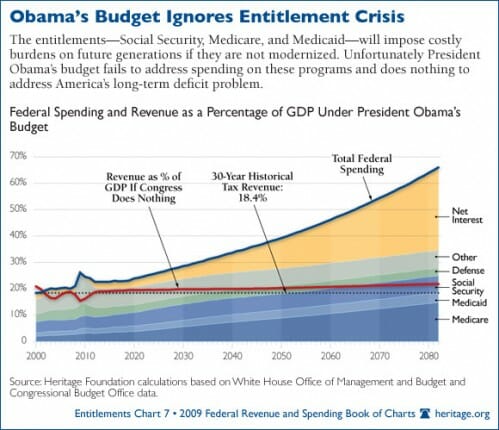
By the way, if you are worried about current deficits, read this post Q&O calls "fun" with charts -- there is absolutely nothing fun about it.  A sample:

entitlements_07-580

More Expensive Than Welfare

Obama and Congressional Democrats seem to have hit upon a way of helping the unemployed that is even more expensive than Welfare.  Many of the stimulus-related jobs programs turn out to spend millions of dollars to preserve just a few jobs.  Their only net benefit is to politicians -- by making certain preferred corporations the intermediary for these funds, these corporations will in turn line politicians' campaign coffers with money, something welfare recipients were never very good at.

A good example is the ongoing fight by Congressman Maurice Hinchey to force the Obama Administration to accept a new helicopter as part of an $835 million dollar program that supports 800 jobs in Mr. Hinchey's district.  TJIC has a very apt counter-proposal:

Instead of spending $835 million, why not just cancel the program and hand each of the workers a $500,000 check with the memo line "welfare - because you produce something no one wants" ?

That'll put food on the table of these 800 workers (for a decade), save us $435,000,000 and maybe teach 800 workers and 1 Democratic politician something about economics.

Yes, but Travis, in your model, who is going to write checks back to Mr. Hinchey?

Sennheiser PX 100

Glen Reynolds repeats a past recommendation for the Sennheiser PX-100 headphones, and I want to give that recommendation a big ditto.  I have three pair at home and love them.  They are inexpensive, rugged, sound great, and fold up cleverly (though there is a learning curve to getting them back in the case).

Jeff Flake is Freaking Brilliant

The Republicans have lost the knack for being a minority party in opposition.  Nowadays, they waste tremendous time and effort playing he-said-she-said with Nancy Pelosi or Jon Edwards, while blithely voting for more pork and trillions in new spending.  Obama, after all, wouldn't have his favorite and best tool (TARP) for building a Mussolini-style corporate state without Republican votes.

While it strikes me that a capable opposition would certainly know how to turn a knife in a political scandal, it also should be ready to introduce principled alternatives to key legislation.   The best such proposals are ones that attempt to achieve the stated goals of the majority party better and faster than the majority's own legislative efforts.

Which brings us to Jeff Flake, who is becoming a master of this.   When Nancy Pelosi and Barack Obama spouted platitudes about openness in government (without really taking any steps to achieve it) Flake came along and introduced bill after bill challenging the Democrats put their money where their mouth is on earmarks and transparency.  I have always been a big fan of Congressman Jeff Flake, who represents a district not far away from my home.  Though we don't agree on every issue, there are few, if any, politicians whose judgment I trust more.

Flake's most recent initiative is one close to my heart.  As readers know, I have good scientific reasons for believing the threat of CO2 emissions has been grossly overstated.  However, if we are going to commit to reducing CO2, we might as well do it intelligently, and Flake's proposal is very close to one I have been pushing for some time:

Conservative House members Jeff Flake (R-AZ) and Bob Inglis (R-SC), along with Rep. Dan Lipinski (D-IL), have introduced an alternative to the cap-and-trade proposal developed by House Democrats: HR 2380, the "Raise Wages, Cut Carbon" Act of 2009. Their proposal is for a carbon tax that will gradually increase over time, offset by a reduction in payroll taxes.

Of course I think this is brilliant, because it is my idea as well.  But it is also a brilliant opposition strategy.  Flake's approach is far better than the cap-and-trade mess the Democrats have gotten themselves in  -- not just because it would work better, but because it actually hits key supposedly liberal objectives better than does the Democrat's bill.  Specifically:

  • Fairness. Sure, everyone is correct that a carbon tax can be politicized, but I do not think it can be gamed nearly as much as cap-and-trade.  For evidence, I turn to California.  California has both a cap-and-trade legislation, rule-making for which has been thrown to the California Air Resources Board (CARB); and it has carbon-tax-like excise taxes, which we generally call sales taxes.  Sure, there are some special case sales tax categories aimed a politically connected groups, but in general the sales tax system in California is simple and mostly fair.  More importantly, it is a layup to administer.  Contrast that to CARB, which has been slogging away in cap-and-trade related rule-making for years, and has everybody both pissed off and panicked.  Should cow flatulence be counted?  Should National Forests be able to sell offsets?  How do you create any kind of fair offset accounting given the shenanigans in Europe?  Should we allow Californians to have black cars? (seriously)  This is a perfect A-B test, as the legislators are the same in both cases -- sales taxes are simple and fair, cap-and-trade is a mess.
  • Openness and transparency. It is clear that Obama's stated commitment to openness and transparency was all so much BS.  But why not nail him to that cross anyway?  Few if any of the general public understand cap-and-trade.  It is a tax, but it is inherently hidden from view, and passed through to consumers buried in rates in a way that offers politicians maximum deniability.  Everyone understands a sales tax, or the gas tax.  The system and its costs will be right out front (which is exactly what Democrats secretly DON'T want, which is what makes this a clever opposition tactic).
  • Progressiveness. For all their talks about the common man and being progressives, the advocates of cap-and-trade are pushing what is possibly the most regressive tax increase of all time.  Again, there is a kind of political money laundering that hides the tax, but it is a tax none-the-less, and will hit the poor the hardest when electricity and fuel prices inevitably increase.  Flake's proposal to take the proceeds of the tax and use them to reduce the payroll tax is a great one -- offset one regressive tax with another, while at the same time putting in place incentives for job creation.

Postscript: My 2007 energy plan was as follows (assuming the need to do something about CO2)

  1. large federal carbon tax, offset by reduction in income and/or payroll taxes
  2. streamlined program for licensing new nuclear reactors
  3. get out of the way

Health Care Trojan Horse

I have warned for years about government health care being a Trojan horse for government micro-management of personal behaviors.  If government is paying the health care bills, then anything individual action or choice that can conceivably be linked to health are open to regulation.  The latest episode:

Note in particular their emphasis on "health-related excise taxes." Those discussions are happening in Congress and the administration, too. It's really looking like tobacco, alcohol, and sugared sodas are likely to get a bit more expensive after health reform. Polling around these policies is proving them more popular than most wonks expected, and they have the secondary benefit of being dual-purpose: They raise money and make Americans healthier.

The fascism of good intentions is on its way.

What the Hell Where They Thinking?

I couldn't believe this when I read it:

General Motors is open to considering moving its headquarters from Detroit, selling off U.S. plants and even renegotiating parts of its restructuring plan with its major union, the new chief executive said Monday....

A move by GM to leave Detroit would represent another blow for the economy of a region already reeling from the bankruptcy of Chrysler and the sharp downturn in auto manufacturing.

GM purchased its glass-towered headquarter building known as Detroit's Renaissance Center last year for $625 million.

The article moves on to other topics, but I was struck by this:  A year ago, when bankruptcy was only months away (delayed only by injections of taxpayer money), with the real estate market teetering at its peak and just starting to fall off, with GM hemorraging cash, GM decides to ... spend $625 million on Detroit commercial real estate.

This is outrageous.  All the more so because GM's fortunes and the value of downtown Detroit real estate have a beta coefficient that is probably well above 1.  In other words, if GM decides it wants to sell the building, Detroit commercial real estate is going to tank on the news that GM is leaving Detroit, making the real estate virtually worthless.  It is very dangerous to buy an asset for which you are the only possible buyer if there is any possibility you might want to sell it some day.

I understand that companies that have losing business models often find it more profitable to invest outside of their business**, but GM seems to have found the only investment on the planet worse than their own stock.

** Postscript: I am not a huge Roger Smith fan, but this was essentially his strategy -- GM sucks as an investment, so I am going to invest outside of the auto industry.  Though he caught a lot of grief for it, most of his investments outside of GM turned out to have a substantially higher return for shareholders than his (or his successors') investments inside of GM.   Wikipedia writes:

Smith's purchases of EDS and Hughes were criticized as unwise diversions of resources at a time when GM could have invested more in its core automotive divisions.

But what if investments in your core business are even more unwise?

Symbiosis

Via Overlawyered:

How "safety" news gets shaped: a litigation consultant "at the request of trial lawyers "¦ combed through hundreds of coroner's reports and media accounts" and before long ABC had an alarming story to run.

There is a symbiosis between tort lawyers (who want to inflame a jury into giving large awards, or better yet create a mass tort), the media (who want scare stories to boost circulation) and government (populated with legislators just itching to ban or regulate something to show they "care").  Someone should write a book about that.

An Interesting Tale of Regulation

Bottom line:  Never assume the states reasons of "safety" or "consumer protection" are the actual reasons for a regulation.  Regulation is much more likely to be protection of powerful political interests:

Flashback to 1959. The airline industry is on the cusp of its fifth decade, but there is a problem facing younger pilots who want to enter it. The old-timers just won't retire, and this frustrates potential entrants with much flying experience and training, thanks to military service in World War II, Korea, and elsewhere. The result is a sort of malinvestment in human capital, with many men trained to be pilots without private-sector jobs to justify the training.

What is a young, aspiring pilot to do? Well, he and his peers could make their presence and skills known to the airlines, signaling that the labor market had changed and that it would be possible to hire new pilots at lower wages. Not only would some airlines opt for the lower-priced laborers, thus lowering the airlines' reservation price required to provide flights to consumers, some owners of capital might invest in new airlines, thus increasing consumer choice, industry output, and create a downward pressure on prices.

Such would be the market solution, coordinated by changes in relative prices, and it would be peaceful, characterized by voluntary interaction and compromise by the parties involved. Unfortunately, there was another option, requiring the pilot to join a pilots union to lobby the federal government to enact rules forcing existing pilots to retire at age 60. All the union needed was a lobbying presence and some sympathetic regulators at the FAA.

Guess which option was chosen? It seems that in 1959, the aspiring pilots found a sympathetic ear in C.R. Smith, the then-president of American Airlines who also wanted to ground his older pilots. The industry was switching to jet engines, and Smith wanted to freeload off of the tax-supported training with those engines many of the younger pilots received in the military. So Smith instructed his lobbyists in Washington to rewrite FAA rules to force retirement at 60, and in December of 1959, an FAA administrator named Elwood R. Quesada simply authorized them. In January of 1961, Quesada retired from the FAA and immediately joined the board of directors of American Airlines. The retirement age rule has been in effect for almost 50 years.

What a Horrible Law

Via Reason:

Because, unbelievably, Cartwright had previously been served with an Anti-Social Behaviour Order (ASBO)"”a civil order that is used to control the minutiae of British people's behaviour"”that forbade her from making "excessive noise during sex" anywhere in England.

This case sheds harsh light not only on the Victorian-style petty prudishness of our rulers, who seriously believe they can make sexually expressive women timid again by dragging them to court, but on the tyranny of Anti-Social Behaviour Orders themselves. Introduced by our authoritarian Labour government in 1998, anyone can apply for an ASBO to stop anyone else from doing something that they find irritating, "alarming," or "threatening."

Local magistrates' courts issue the orders, sometimes on the basis of hearsay evidence (which is permissible in "ASBO cases"). In short, the applicant for an ASBO does not have to go through the normal rigors of the criminal justice system in order to get a civil ruling preventing someone he doesn't like from doing something that he finds "alarming" or "dangerous." Once you have been branded with an ASBO, if you break its conditions"”by having noisy sex in your own home, for example"”you are potentially guilty of a crime and can be imprisoned.

The ASBO system has turned much of Britain into a curtain-twitching, neighbor-watching, noise-policing gang of spies. The relative ease with which one can apply to the authorities for an ASBO positively invites people to use the system to punish their foes or the irritants who live in their neighborhoods.

I don't really have much time to comment on this, but is there any need?  And for those smug enough to think this will never happen in the US, just look on college campuses today, where a number of universities are coming awfully close to creating a right not to be offended, and allowing students to define crime as anything that offends them.  And it almost goes without saying that such standards tend to be enforced unevenly, depending on the ideology of those who happen to be in charge.

Yet Another Reason I Have Not Joined The Chamber of Commerce

From the AZ Republic:

A local contestant on "The Biggest Loser," NBC's hit weight-loss show, will be the featured speaker at the Maricopa Chamber of Commerce's Third Annual Keynote Speaker Event on May 27.

Maricopa resident Sione Fa, 28, is expected to share his journey to a healthy, new lifestyle during the fundraising event at Harrah's Ak-Chin Casino Resort.

Really?  You mean Gary Coleman wasn'g available.  Do business owners really have time for this stuff?

Star Trek Review

If you can get over the cognitive dissonance of seeing Spock feel up Uhura, this is a very solid movie.  Much like Casino Royale did for the Bond franchise, it tore the franchise down and rebuilt it very well, creating something that is both familiar and true to the original yet less campy and more up-to-date.  My son, who has never seen any of the original series (yeah, I know, major parenting failure) really enjoyed it as well.   Interestingly, there were almost more references back to The Wrath of Khan as there were to the original series.

Awsome Video

OK, I am an engineer-geek but I think the video below, of a ship leaving the Houston Ship Channel at night, taken with time lapse photography, is really cool.  If your eyes are sharp, you can catch the San Jacinto monument on the right (which Texans went out of their way to make taller than the Washington Monument) and the refinery where I once worked on the left, just before the third bridge (the only suspension bridge).  Via Tom Kirkendall.

I had the sound off when I watched it.  I can do without the techno-jazz soundtrack, but ymmv.  I will confess parts of it look like a scene from Blade Runner.

It's Official, We're Living in France Now

From Cafe Hayek:

President Obama's modest proposal to slice $17 billion from 121 government programs quickly ran into a buzz saw of opposition on Capitol Hill yesterday, as an array of Democratic lawmakers vowed to fight White House efforts to deprive their favorite initiatives of federal funds.

Sen. Dianne Feinstein (D-Calif.) said she is "committed" to keeping a $400 million program that reimburses states for jailing illegal immigrants, a task she called "a total federal responsibility."

Rep. Mike Ross (D-Ark.) said he would oppose "any cuts" in agriculture subsidies because "farmers and farm families depend on this federal assistance."

And Rep. Maurice D. Hinchey (D-N.Y.) vowed to force the White House to accept delivery of a new presidential helicopter Obama says he doesn't need and doesn't want. The helicopter program, which cost $835 million this year, supports 800 jobs in Hinchey's district. "I do think there's a good chance we can save it," he said.

The news releases began flying as Obama unveiled the long-awaited details of his $3.4 trillion spending plan, including a list of programs he wants to trim or eliminate. Though the proposed reductions represent just one-half of 1 percent of next year's budget, the swift protest was a precursor of the battle Obama will face within his own party to control spending and rein in a budget deficit projected to exceed $1.2 trillion next year.

Eugene Lawson for the Supreme Court

From the Liberty Papers:

President Obama says that he wants to nominate a Supreme Court Justice who has "empathy" as opposed to a jurist who makes decisions based on "some abstract legal theory." Not surprisingly, I'm not the only one troubled by his selection criteria. Thomas Sowell has written an excellent 3 part series "Empathy" Versus Law" (Part 1, Part 2, Part 3).

Title reference here and here

"My objective was social progress, human brotherhood and love. Love, Ms. Taggart. That is the key to everything. If men learned to love one another, it would solve all their problems"

Friday Pictures

A couple of cool views of New York from 1931:

ny2

ny1

Full size originals here and here at Shorpy

Update on DC Vouchers

The Thugs Win

Via Zero Hedge:

A group of Chrysler creditors opposing the carmaker's reorganization is likely to disband after two more investment firms withdrew from its membership, a person briefed on the matter told DealBook on Friday.

The withdrawals of OppenheimerFunds and Stairway Capital Management will likely drop the group, calling itself the Committee of Non-TARP Lenders, below 5 percent of Chrysler's $6.9 billion in secured debt, this person said. That would almost certainly eliminate the group's standing in federal bankruptcy court.

Ever since the group made public last week, its membership has shrunken by the day as it faced public criticism from President Obama and others. That continued withdrawal of firms led Oppenheimer and Stairway to conclude that they could not succeed in opposing the Chrysler reorganization plan in court, the two firms said in separate statements.

Just another step closer to a Mussolini-style corporate state.

Update: David Skeel argues the Chrysler bankruptcy settlement is a sham sale of the sort that was outlawed in 1938.  Except, of course, when the President does it, I guess.

Arrogant Ignorance

Over the years, I have developed a term "arrogant ignorance" to describe certain people we deal with from time to time.

We often get young and inexperienced contract managers assigned to one of our relationships.   These folks will struggle, due to lack of experience and fragmentary training, to perform their duties, because they really don't know what to do in many circumstances.  We accept the fact that we often know more about our contract manager's job than she knows herself, and try to help them get up to speed.

However, occasionally these folks, despite very obviously not knowing what they are doing, get hugely arrogant and refuse to admit they don't know what they are doing.  They fire off orders and decisions that not only are wrong, but simply make no sense, and then yell at us within seconds for not complying with their bizarre requirements.   I have always scratched my head over this syndrome, and have assumed that it resulted from a combination of:

  • a young person with absolutely no education and experience in how to work in a high-performing organization.  (think about the organizations a 20-something has seen -- public schools, college faculty, maybe a non-profit over the summer, fake businesses on TV -- nothing that would give them any clue how a high-performing organization works).
  • really bad incentives.  Typically, the worst examples have non-existent formal performance management systems where the informal metrics therefore reign.  These informal metrics often default to things like "always look busy" or "always look like you know what you are doing" or "never do anything that will cause your boss to yell at you" or "never get caught making a bureaucratic process error.

Well, I was thrilled today to find that the syndrome I call "arrogant ignorance" actually has a name.  It was mentioned in this article by Simple Justice and is called the Dunning Kruger effect.   Here is the first line from Wikipedia:

The Dunning"“Kruger effect is an example of cognitive bias in which "people reach erroneous conclusions and make unfortunate choices, but their incompetence robs them of the metacognitive ability to realize it"[1]. They therefore suffer an illusory superiority, rating their own ability as above average.

This also helps to explain another phenomenon we tend to see -- that the absolute worst, most incompetant, most clueless employees tend to be the first (and often only) ones who call me and threaten me with lawsuits over false termination.  The article goes on:

  1. Incompetent individuals tend to overestimate their own level of skill.
  2. Incompetent individuals fail to recognize genuine skill in others.
  3. Incompetent individuals fail to recognize the extremity of their inadequacy.

But at least there is this ray of hope:

4.  If they can be trained to substantially improve their own skill level, these individuals can recognize and acknowledge their own previous lack of skill.

The Demagoguery Moves to GM

From a reader, via Bloomberg

GM's offer is "grossly unfair to the point of abusive," Glenn Reynolds, chief executive officer of CreditSights Inc. in New York, wrote in a report this week. "Politics remains an overriding factor in the equation and has been decidedly unfriendly to the interest of bondholders in a contest with the disproportionately outsized power of organized labor and other Washington-heavy constituencies and interest groups."...

"The attack on institutional investors by the administration in this process is a very strange approach and borders on demagoguery," CreditSights' Reynolds wrote in the report. "The bondholders are being painted into a corner and will have no chance but to stand and fight. You can call them names as long as they get treated fairly. Offer them virtually nothing and then call them names? Now that's just cold."

And here is Cliff Asness, a hedge fund manager not involved with Chrysler:

  • "Let's be clear, it is the job and obligation of all investment managers, including hedge fund managers, to get their clients the most return they can. They are allowed to be charitable with their own money, and many are spectacularly so, but if they give away their clients' money to share in the "sacrifice", they are stealing."
  • "The President screaming that the hedge funds are looking for an unjustified taxpayer-funded bailout is the big lie writ large. Find me a hedge fund that has been bailed out. Find me a hedge fund, even a failed one, that has asked for one. In fact, it was only because hedge funds have not taken government funds that they could stand up to this bullying. The TARP recipients had no choice but to go along."
  • "The President's attempted diktat takes money from bondholders and gives it to a labor union that delivers money and votes for him. Why is he not calling on his party to "sacrifice" some campaign contributions, and votes, for the greater good? Shaking down lenders for the benefit of political donors is recycled corruption and abuse of power."

Cool Photo Concept

The Wages of Sports Stadium Subsidies

Well, you can't say I didn't predict this.  The Phoenix NHL hockey franchise (the Coyotes, a case of obvious before-the-fact trademark infringement on this blog) has declared bankruptcy.  The only current buyer is RIM's Jim Balsillie (a section-mate of mine at HBS) who will only buy the team if he can move it to Canada.  Gee, who would have thought that ice hockey would struggle to be successful in Phoenix?

Several years ago, Phoenix suburb Glendale paid about $180 million to build a hockey stadium for the Coyotes.  The Coyotes had already been in the Valley for several years, losing money all the while, and had shed one ownership team for another fronted by Wayne Gretzky.  It was shear madness to build them a stadium, as their chances of financial success were almost non-existant.  It was already clear at this point that hockey was not going to be a big draw in Arizona.  For this reason, Scottsdale and Phoenix both ended up passing on subsidizing the team before Glendale, out to prove it was a "real" city, stepped up to the plate with a wad of taxpayer money.   The stadium ended up being about as close to the center of mass of the metropolitan area as the Denver airport is in that city.

Do You Owe the State Your Name if You Have Not Committed A Crime?

Carlos Miller has an interesting story from New Hampshire, where a man was arrested for bringing a camera into a courtroom, and then has been detained for weeks in prison because he refuses to tell his captors his name.  By the way, filming and picture taking is explicitly allowed in courts by New Hampshire law and past state supreme court rulings.  The judge who presides over the court in question began banning cameras from court, despite having no legal right to do so, last year after he was personally embarrassed by a YouTube video of his courtroom temper tantrum.  The state has yet to point to the precise statute that requires courtroom visitors to provide their names on demand.  One would think the worst that could happen is to be told that revealing one's name is a security requirement and that those refusing to do so are barred entry.  But 22 days in jail?

Also yet to occur is any arrest or prison sentence for a judge who flaunts the very state law he is sworn to uphold.